Archive for October, 2023

Open Access Week 2023

Posted in Open Access with tags , , on October 23, 2023 by telescoper

I’m reminded by multiple sources that this week is International Open Access Week 2023, with a theme of “Community over Commercialization”.

Of course, round my way, every week is Open Access Week.

The ongoing OA revolution should involve a radical reinvention/disruption of commercialized academic publishing instead of letting exploitative profit-making private publishing firms keep on fleecing the scholarly community. There is much still to do, and we’ll only succeed if more people turn words into actions.

P.S. You could always start by making a donation to arXiv.

New Publication at the Open Journal of Astrophysics

Posted in OJAp Papers, Open Access, The Universe and Stuff with tags , , , , , on October 22, 2023 by telescoper

It’s Sunday but I’ll be a bit busy next week so I’m taking the opportunity today to announce yet another new paper at the Open Journal of Astrophysics. This one was published on Friday 20th October.

The latest paper is the 41st  so far in Volume 6 (2023) and the 106th in all. It is a product of the Dark Energy Survey team and the Kilo-Degree Survey Collaboration, which amounts to about 160 authors altogether. The corresponding author for this article was the Astronomer Royal for Scotland Professor Catherine Heymans, no less.

The primary classification for this paper is Cosmology and NonGalactic Astrophysics and its title is “DES Y3 + KiDS-1000: Consistent cosmology combining cosmic shear surveys”. The article presents a joint analysis of the Dark Energy Survey Year 3 data and the Kilo-Degree Survey data, with a discussion of the implications for cosmological parameters. The key figure – a very important one – is this:

If you want to know more about the result and why it is so important you could read the paper. It is, however, rather long: 40 pages including 21 figures and 15 tables. Do not despair, though, because here is a video explaining the work in the series of Cosmology Talks presented by Shaun Hotchkiss:

Anyway, here is the overlay of the paper containing the abstract:

You can click on the image of the overlay to make it larger should you wish to do so. You can find the officially accepted version of the paper on the arXiv here.

Cursa Bombers!

Posted in Barcelona, Sport with tags , , on October 22, 2023 by telescoper

It’s all go outside my flat! This morning it’s the annual Cursa Bombers (Fireman’s Race), as I found out when I looked it up!

The event begins with teams of four firefighters in full gear running a relay race (4×2.5K) and is then followed by a standard 10K road race. I missed the first bit as I was still in bed.

Spanish Practices

Posted in Barcelona, Education, History, Maynooth with tags , , , , , on October 20, 2023 by telescoper

When I was a lad, during the 1970s, the term Spanish Practices was used pejoratively in a union-bashing sense to describe restrictive practices in the workplace. Until recently I thought it was a modern invention that relied on a stereotypical view of Spanish people as being lazy. In fact it seems the term dates back to Tudor times and is religious in origin, referring to Roman Catholic rites, in contrast to the simpler Protestant forms of worship. Anyway, none of that is what this post is about. I just used the title as clickbait.

I’ve been here in Barcelona, and working in the University of Barcelona, for four weeks now and I thought I’d share a few observations about differences in practice here and in the Ireland (and the UK).

The other night I went out for dinner with colleagues from the Department. The restaurant was much closer to the University than to my flat so instead of going home first I stayed in my office and walked straight there. My route out of the building takes me past a number of teaching rooms. During this warm weather, most of the rooms have the doors open so it’s easy to have a quick look at what’s going on inside. On my way out at about 7.30pm I was surprised to see a number of classes still going on, and they weren’t sparsely attended either.

In Maynooth the latest regular lectures finish at 6pm. Even during the 5pm to 6pm lectures, many students have to leave before the end to catch the one and only bus back to their place of residence. Here the public transport system is so good that isn’t really an issue even for those who don’t live near the campus. As far as I know lectures start at 9am, so students potentially have a very long day. They work hard.

I have to say that I wouldn’t like to have teach late in the evening. I used to do that on Fridays at Queen Mary for the MSc course and didn’t enjoy it. I don’t mind doing 9am lectures, though, but I don’t think students agree – partly because of the difficulty of getting to campus at that time.

In the Faculty of Physics, all the lecture halls, classrooms and laboratories are in one building rather than spread around the campus like they are in Maynooth (and many places in the UK). Fortunately, the building has been designed with students in mind and there is plenty of space for students to use socially or for private study between teaching sessions.

In this picture you can see the inner courtyard of the building occupied by the Faculties of Chemistry and Physics. It’s a big open space, with teaching rooms, etc, on either side. In the far right-hand corner there is a café/bar where one can buy lunch, a coffee, or even a beer, to be consumed either inside or in the seating area in the courtyard. Many students seem to prefer bring their own lunch and eat it in this space., although the food available is pretty good and cheap compared to back home.

As well as being able to eat and drink here, there is plenty of room for students simply to hang out or to study, either alone or in groups. If they don’t feel like that they can use the tram, bus or Metro to go home, and come back later if they have a long gap between classes. None of this is possible at Maynooth.

This particular kind of open space would not work so well in Ireland or the UK because of the weather, though you can probably see in the picture that there had been a bit of rain before I took the photograph, but I hope I’ve made the point that having social spaces makes a huge amount of difference to the student experience, not least because it feels that the University has thought about them. In the neoliberal system that dominates in the UK and Ireland, students are simply a commodity, a source of revenue, to be crammed into every available space and processed as cheaply as possible. In Maynooth students have been, and are being, forced to pay an extra levy for a notional student centre that will probably never be built.

The contrast is very disheartening.

Getting back to educational matters, another thing I’ve noticed walking past classrooms is that it’s not unusual to see a student standing at the blackboard in front of the class going through a problem. I’ve seen that a number of times with quite large classes. Sometimes we ask students to do that sort of thing in tutorials, but I’ve never done so in a full lecture. I think our students would be shocked if we asked, but it’s clearly not unexpected here. That’s a Spanish Practice I’d be quite happy to try.

Two New Publications at the Open Journal of Astrophysics

Posted in OJAp Papers, Open Access, The Universe and Stuff with tags , , , , , , , , on October 20, 2023 by telescoper

It’s Friday so it’s a good time to catch up with the week’s action at the Open Journal of Astrophysics, where there have been two new publications so far this week. These papers take us up to a total of 40  in Volume 6 (2023) and 105 in total since we started publishing.

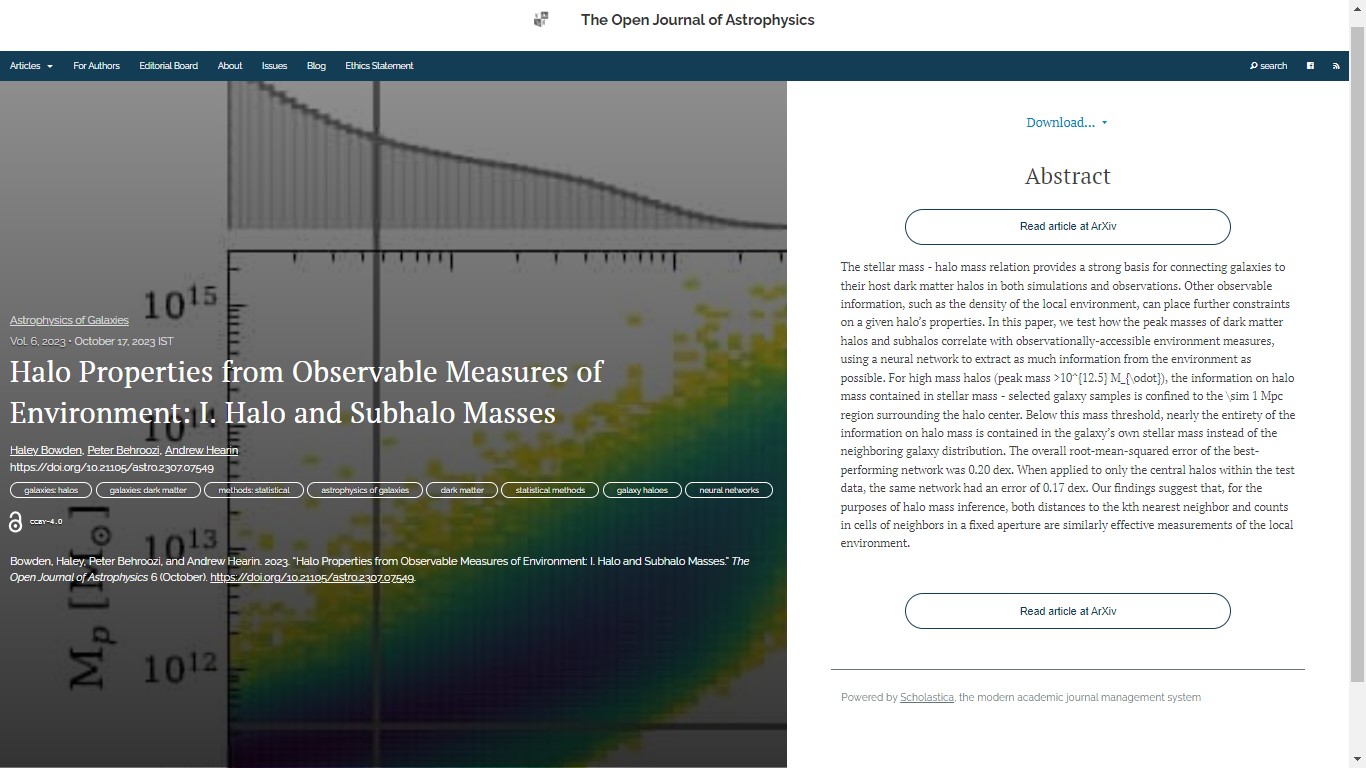
The title of the first paper is “Halo Properties from Observable Measures of Environment: I. Halo and Subhalo Masses” and its primary classification is Astrophysics of Galaxies. it is an exploration using neural networks of how the peak masses of dark matter halos and subhaloes correlate with observationally-accessible measures of their dependence on environment.

The authors based in the United States of America: Haley Bowden and Peter Behroozi of the University of Arizona, and Andrew Hearin of the Argonne National Laboratory

Here is a screen grab of the overlay which includes the abstract:


You can click on the image of the overlay to make it larger should you wish to do so. You can find the officially accepted version of the paper on the arXiv here.

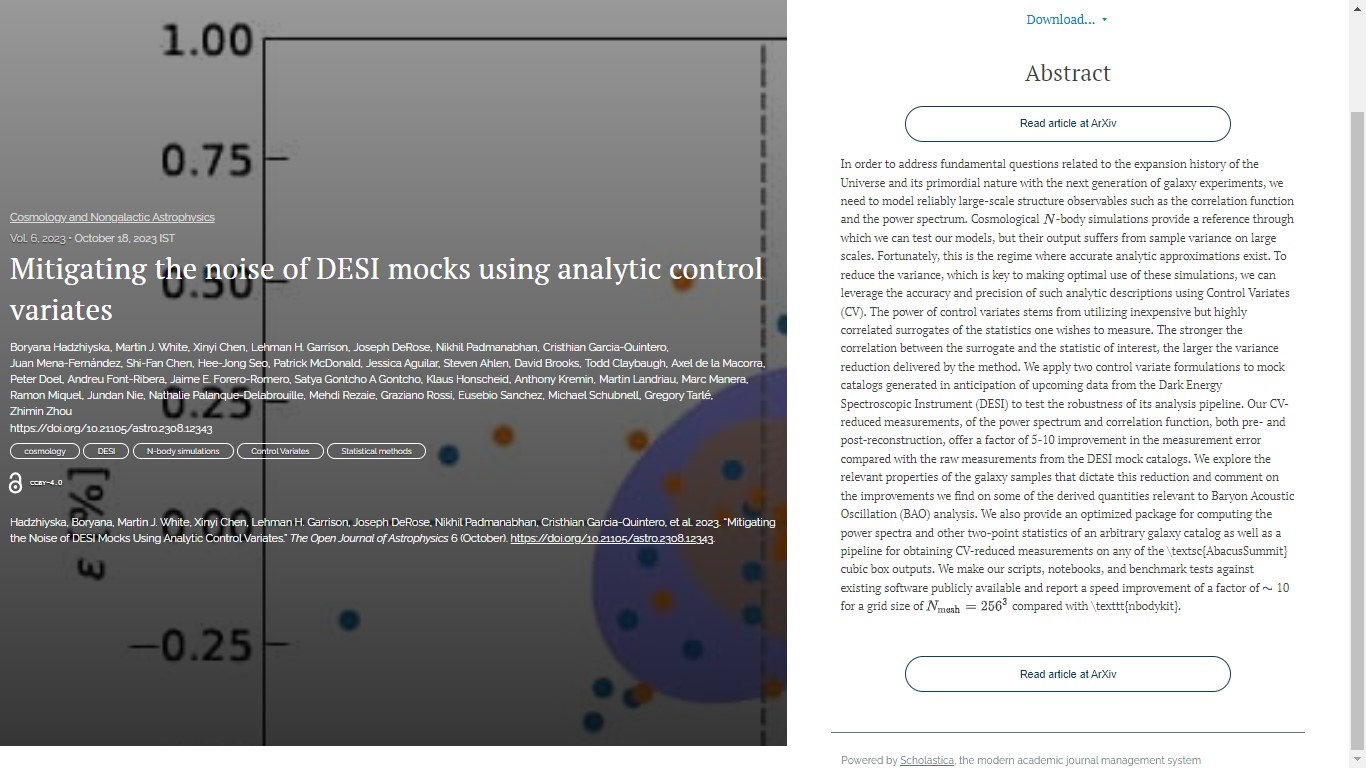
The second paper was published on 18th October 2023.  The primary classification for this one is Cosmology and Nongalactic Astrophysics and is “Mitigating the noise of DESI mocks using analytic control variates”. For those of you not up with the lingo, DESI stands for the Dark Energy Spectroscopic Instrument and you can read more about it here.

The lead author for this one is Boryana Hadzhiyska of the Lawrence Berkeley Laboratory and the University of California, Berkeley (USA) and there are 32 other authors. This paper presents a method for reducing the effects of sample variance on cosmological simulations using analytical approximations and tests it using DESI data.

Here is a screen grab of the overlay which includes the abstract:


You can click on the image of the overlay to make it larger should you wish to do so. You can find the officially accepted version of the paper on the arXiv here.

Gendered Language

Posted in LGBTQ+ with tags , , on October 19, 2023 by telescoper

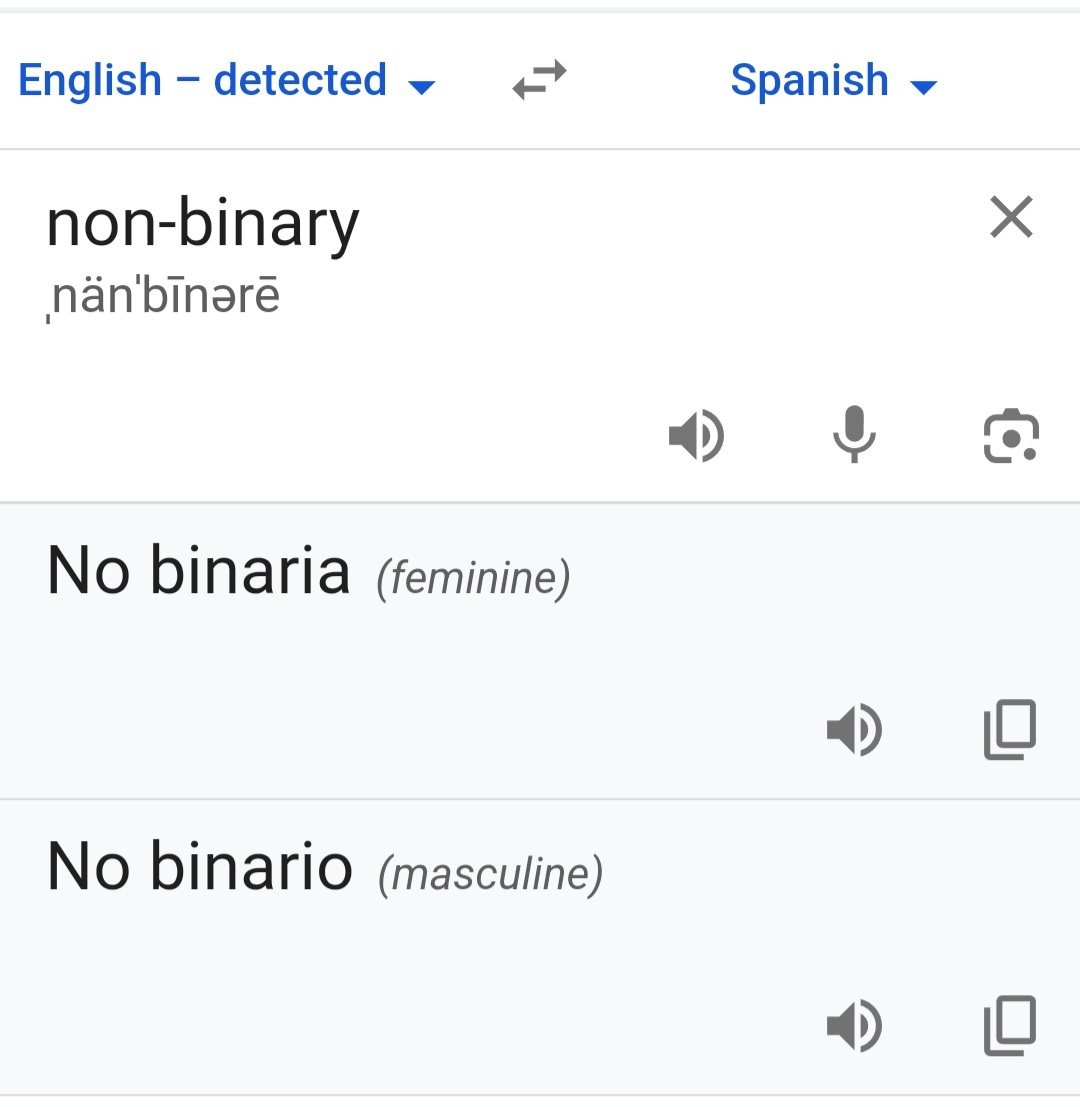
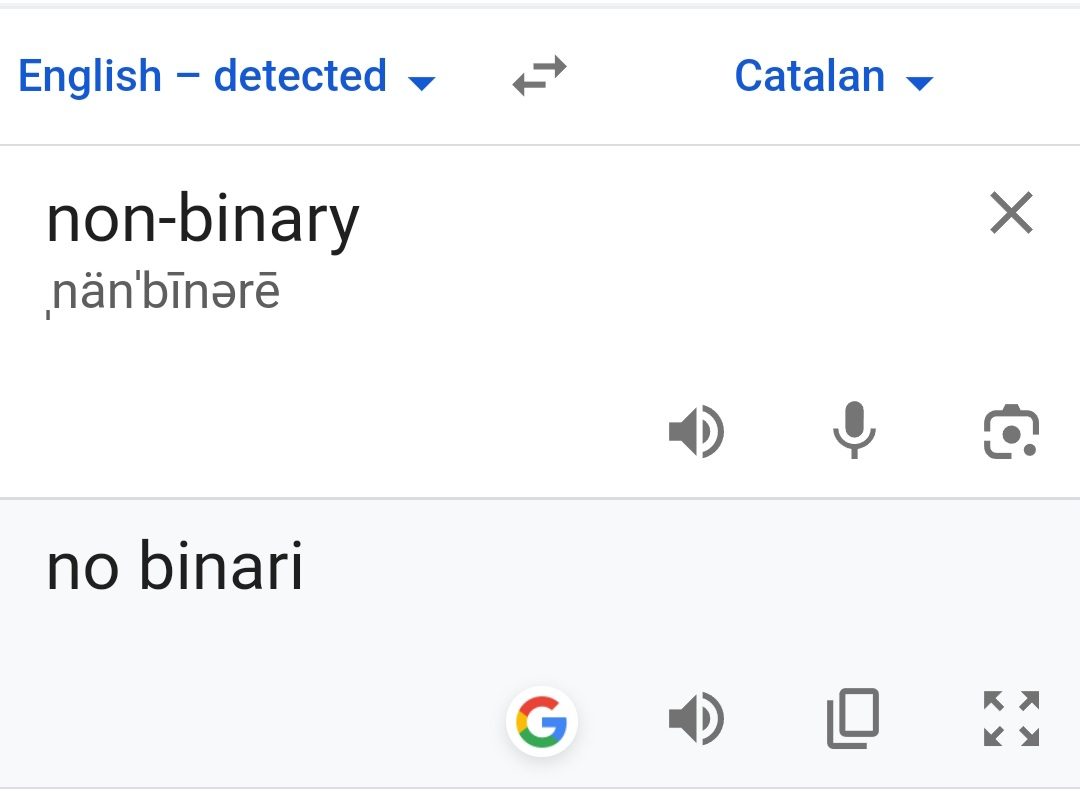
I was bemused to find this when I typed “non-binary” into Google translate for the Spanish version:

Sigh. This rather defeats the whole point of the word. Catalan, on the other hand, makes more sense…

On a more positive note, I have seen examples of the article ‘lxs’ instead of ‘los’ or ‘las’.

R.I.P. Carla Bley (1936-2023)

Posted in Jazz, R.I.P. with tags , , on October 18, 2023 by telescoper

Time for a little tribute to a great figure in the world of jazz, Carla Bley, who passed away yesterday at the age of 87. Carla Bley was a pianist, organist and composer who I first came across through her 1982 album Carla Bley Live! that contains one of my all-time favourite tracks, the gospel-infused The Lord is Listenin’ To Ya, Hallelujah! featuring the superb trombone playing of Gary Valente. I decided not to make that one my tribute piece because it’s really a solo vehicle for the trombonist, but instead another track from another album. This is from the 1989 album Fleur Carnivore, recorded live in Copenhagen in 1988, which I also have back home. Valente features on this one too, with his unmistakable sound like a wounded bison, but it also features some fine examples of Carla Bley’s skill as a composer/arranger as well as other soloists including long-term partner and musical collaborator Steve Swallow. It’s called Healing Power.

R.I.P. Carla Bley (1936-2023)

Open Peer Review Analytics

Posted in OJAp Papers, Open Access with tags , , , , on October 18, 2023 by telescoper
A Peer, Reviewing. Photo from Pexels.com

Quite a few people have contacted me to ask about the Peer Review Process at the Open Journal of Astrophysics so I thought I’d do a quick post here to explain a bit about it here.

When a paper is submitted it is up to the Editor-in-Chief – that’s me! – to assign it to a member of the Editorial Board. Who that is depends on the topic of the paper and on the current availability due to workload. I of course take on some papers myself. I also reject some papers without further Peer Review if they clearer don’t meet  the journal’s criteria of scientific quality, originality, relevance and comprehensibility. I usually run such papers past the Editorial Board before doing such a ‘Desk Reject’.

Once the paper has been assigned, the Editor takes control of the process, inviting referees (usually two) to comment and make recommendations. This is the rate-determining step, as potential referees are often busy. It can take as many as ten declined invitations before we get a referee to agree. Once accepted, a referee is asked to provide a report within three weeks. Sometimes they are quicker than that, sometimes they take longer. It depends on many factors, including the length of the manuscript.

Once all the referee reports are in the Editor can make a decision. Some papers are rejected upon refereeing, and some are accepted with only tiny changes. The most frequent decision is “Revise and Resubmit” – authors are requested to make changes in response to the referee comments. Sometimes these are minor, sometimes they are substantial. We never give a deadline for resubmission.

A resubmitted paper is usually sent to the same referee(s) who reviewed the original. The referees may be satisfied and recommend acceptance, or we go around again.

Once a paper is accepted, the authors are instructed to upload the final, accepted, version to arXiv. It normally takes a day or two to be announced. The article is then passed over from the Peer Review process to the Publication process. As Managing Editor, I make the overlay and prepare the metadata for the final version. This is usually done the same day as the final version appears on arXiv, but sometimes it takes a bit longer to put everything in order. It’s never more than a few days though.

Anyway, here are some “analytics” – it’s weird how anything that includes any quantitative information is called analytics these days to make it sound more sophisticated than it actually is – provided by the Scholastica platform:

These numbers need a little explanation.

The “average days to a decision” figure includes desk rejects as well as all submissions and resubmissions. Suppose a paper is submitted and it then takes 4 weeks to get referee reports and for the Editor to make a “Revise and Resubmit” request. That would count as 28 days. It might take the authors three months to make their revisions and resubmit the paper, but that does not count in the calculation of the “average days to decision” as during that period the manuscript is deemed to be inactive. If the revised version is accepted almost immediately, say after 2 days, then the average days to decision would be (28+2)/2 = 15 days. Also, being an average there are some shorter than 14 days and some much longer.

The acceptance rate is the percentage of papers eventually accepted (even after revision). The figure for ‘total submissions’ includes resubmissions, so the hypothetical paper in the preceding paragraph would add 2 to this total. That accounts for why the total number of papers accepted is not 50% of 388, which is 194; the actual figure is lower, at 105.

Finally, the number of manuscripts “in progress” is currently 23. That includes papers currently going through the peer review process. It does not include papers which are back with the authors for revisions (although it would be reasonable to count those as in progress in some sense).

There we are. I hope this clarifies the situation.

Yellowface, by Rebecca F. Kuang

Posted in Literature with tags , on October 17, 2023 by telescoper

Continuing with my aim of reading more books while on sabbatical, I’ve just finished Yellowface by Rebecca F. Kuang. The story, told in the first person, revolves around June Hayward, an unsuccessful young white author, who is present at the accidental death of Athena Liu, a Chinese-American author, a hit in literary circles, who chokes on a pancake. Athena has just finished a complete draft of a novel about Chinese laborers in World War I and while waiting for emergency services to arrive, June purloins the manuscript and passes it off as her own. She is immediately welcomed by publishers and offered a large advance, but that’s only the start as she has to then contend with accusations of plagiarism and racism as well as being haunted by what appears to be Athena’s ghost. I won’t spoil the read by telling you how it ends, but it did remind me a little bit of Dostoevsky’s Crime and Punishment.

The author describes this as a “horror story about loneliness” in the highly competitive world of publishing, I found much of it resonates with academia too, but it’s really more of a satire about plagiarism and marketing hype than a horror story per se. I found it very readable, and interesting for someone who has recently quit Twitter to see how social media play such an important – and negative – role in the story. I was gripped by the story and read it in just two evenings, which is quick for me. Recommended.

Telescope – Louise Glück

Posted in Poetry, R.I.P. with tags , , , on October 16, 2023 by telescoper

I posted a poem by American poet Louise Glück when she won the 2020 Nobel Prize for Literature (“for her unmistakable poetic voice that with austere beauty makes individual existence universal”). I was sad to read that she passed away just a few days ago at the age of 80. By way of a small tribute here is another poem of hers I like very much. It is called Telescope.

There is a moment after you move your eye away
when you forget where you are
because you’ve been living, it seems,
somewhere else, in the silence of the night sky.

You’ve stopped being here in the world.
You’re in a different place,
a place where human life has no meaning.

You’re not a creature in a body.
You exist as the stars exist,
participating in their stillness, their immensity.

Then you’re in the world again.
At night, on a cold hill,
taking the telescope apart.

You realize afterward
not that the image is false
but the relation is false.

You see again how far away
each thing is from every other thing.

R.I.P. Louise Glück (1943-2023)