Archive for March, 2024

Introducing alphaXiv

Posted in Open Access with tags , on March 9, 2024 by telescoper

I’ve been busy all day so just have time to mention an interesting new development to do with arXiv. There is a new site called alphaXiv, which is a forum for anyone to comment line-by-line on arXiv papers. It also allows you to “get responses directly from authors of the paper or from established research teams from Stanford and Harvard”, which seems to imply that authors can’t be from established research teams unless they are from Stanford or Harvard!

Anyway, you can try alphaXiv here.

I think this is a great idea in principle; it will be fascinating to see how it works out in practice. My main reservation stems from (i) it seems that there is no moderation of comments and (ii) anonymous comments are allowed; there is therefore a significant danger of abusive behaviour as is often the case on, e.g., Reddit.

I’d welcome reactions via the comments box below from anyone who has tried this already or who has thoughts about it generally!

Publishing Revenue and the Learned Societies

Posted in Open Access with tags , , , , , on March 8, 2024 by telescoper

A couple of days ago I posted a reaction to a shockingly dishonest article I saw in Physics World which has led me to resign my Fellowship of the Institute of Physics (IoP). I thought I would spend a bit of time now to raising some wider points (which I’ve raised before) about the extent that such organizations (including, in my field,  the Royal Astronomical Society and the Institute of Physics) rely for their financial security upon the revenues generated by publishing traditional journals and why this is not in the best interests of their disciplines.

Take IOP Publishing. This is a wholly-owned subsidiary of the Institute of Physics that has an annual turnover of around £60M generated from books and journals. This revenue is the largest contribution to the income that the IoP needs to run its numerous activities relating to the promotion of physics.  A similar situation pertains to the Royal Astronomical Society, although on a smaller scale, as it relies for much of its income from Monthly Notices of the Royal Astronomical Society, in which I have published quite a few papers in the past.

Not surprisingly, these and other learned societies are keen to protect their main source of cash and have lobbied very hard for the “Gold” Open Access some authorities are attempting to foist on the research community, rather than the far more sensible and sustainable approaches to Open Access employed, for example, by the Open Journal of Astrophysics.

There are two major reasons why I object to this approach, one practical and one ethical.

First, I consider it to be inevitable that the traditional journal industry will very soon be completely bypassed in favour of  other forms of publishing. The internet has changed the entire landscape of scientific publication. It’s now so cheap and so easy to disseminate knowledge that traditional journals are already virtually redundant, especially in my field of astrophysics where we have been using the arXiv for so long that many of us hardly ever look at journals.

The comfortable income stream that has been used by the IoP to “promote Physics”, as well as to furnish its  building in King’s Cross and office in Dublin, will dry up unless these organizations find a way of defending it. The “Gold” OA favoured by such organizations their attempt to stem the tide. I think this move into Gold `Open Access’, paid for by ruinously expensive Article Processing Charges paid by authors (or their organizations) is unsustainable because the research community will see through it and refuse to pay. I can already see signs of this happening.

The other problematic aspect of the approach of these learned societies is that I think it is fundamentally dishonest. University and other institutional libraries are provided with funds to provide access to published research, not to provide a backdoor subsidy for a range of extraneous activities that have nothing to do with that purpose. The learned societies do many good things – and some are indeed outstandingly good – but that does not give them the right to siphon off funds from their constituents by a sort of stealth levy.  Voluntary institutional affiliation, paid for by a fee, would be a much fairer way of funding these activities.

A couple of days ago I decided to cease paying the annual subscription to, and resign my Fellowship of, the Institute of Physics. I was reasonably comfortable spending some of my own money supporting physics, but don’t agree with  researchers having to fork out huge amounts of money in involuntary payment of APCs to the IOP. I will decide in the next few days whether or not to resign also from the Royal Astronomical Society for the same reason.

Some time ago I had occasion to visit the London offices of a well-known charitable organization which shall remain nameless. The property they occupied was glitzy, palatial, and obviously very expensive. I couldn’t help wondering how they could square the opulence of their headquarters with the quoted desire to spend as much as possible on their good works. Being old and cynical, I came to the conclusion that, although charities might start out with the noblest intentions, there is a grave danger that they simply become self-serving, viewing their own existence in itself as more important than what they do for others.

The commercial academic publishing industry has definitely gone that way. It arose because of the need to review, edit, collate, publish and disseminate the fruits of academic labour. Then the ease with which profits could be made led it astray. It now fulfills little or no useful purpose, but simply consumes financial resources that could be put to much better effect actually doing science. I think the scientific community knows this very well, and hopefully the parasite will die a natural death.

The question for learned societies is whether they can find a sustainable funding model that isn’t reliant upon effectively purloining funds from research budgets. If their revenue from publishing does fall, can they replace it? And, if not, in what form can they survive?

A Man of the World?

Posted in Biographical with tags , , on March 7, 2024 by telescoper

As I sit in an airport waiting for yet another flight I played around with a website that makes a map with countries that you have visited marked on it. Mine looks now like this:

Although I think I’ve travelled quite a lot, I haven’t really seen that much of the world when you look at it. In fact the map drastically overestimates my coverage as I’ve only seen one city in Australia and one in Canada, and have only visited a few states in the USA (not Alaska, for example).

On “Purpose-Led Publishing”

Posted in Open Access with tags , , , , , , , , , , on March 6, 2024 by telescoper

I was flabbergasted by the cheek of an article that recently appeared in Physics World by Michael Brooks announcing that:

I can’t speak about the American Institute of Physics or the American Physical Society but in the context of the Institute of Physics – of which I am a Fellow and in whose house magazine the article appears – I draw your attention to the last sentence of the above excerpt which contains a commitment to “invest funds generated from publishing back into research” (my emphasis).

Really? The IOP invests in research? That’s news to me. How do I apply for a grant? Will they fund my next PhD student?

The IOP invests its funds in many things – many of them worthy – but it does not spend a significant part of the vast income it generates from its publishing house on research. The claim that it does is just dishonest. There’s point in mincing words.

This is an important distinction, particularly so that publishing in most IOP journals now requires the payment of a hefty Article Processing Charge (APC; Artificial Profit Charge would be more apt) which often has to be paid for out of research grants. Previously the revenue of IOP Publishing was appropriated from library budgets through subscriptions, so physicists were less aware of just how much the IOP was raking in. Now that researchers are having to find the funds themselves from research grants it has become more obvious that the IOP is actually a drain on research funds, not a source of them. The APC is a levy on research, designed to generate funds for other things. I think this model is indefensible. What gives the IOP the right to impose charges that far exceed the cost of disseminating scientific results in order to appropriate funds for its other activities?

Moreover, even if the IOP did fund research, what benefit would that be to a researcher in Spain, South Korea or Singapore or indeed anywhere outside the UK and Ireland?

The slogan for the initiative described in the article is “Purpose-led Publishing”. That reminds me of an old saying from systems theory: the Purpose Of a System Is What it Does (POSIWID). What the system does in this case is to raise funds for the IOP. That’s its purpose. Everything else is just marketing spiel.

The claim that IOP Publishing does not make a profit is disingenuous too. It does make a substantial profit. The only difference between it and the likes of Elsevier is where the profits go. A true not-for-profit publisher would charge only at the level to cover the costs of publication. The Purpose that should be leading Publishing in physics is the dissemination of scientific results, not the generation of revenue for sundry other things.

I have avoided publishing in IOP journals for many years because I think the approach of IOP Publishing is unethical. Now I have decided that I no longer wish to be associated with the IOP in any way. I have paid the subscription for 2024 but when that lapses I won’t renew it. Enough is enough.

Sydney looking back

Posted in Biographical with tags , , , , on March 5, 2024 by telescoper

I am a bit jet-lagged, and don’t have the energy for anything too strenuous, so I thought I’d post a couple of reflections of my time in Sydney. Actually I wrote this piece yesterday but was so tired I forgot to post it!

The first thing I should say is that Sydney is a very fine city. I really enjoyed my time there. Although I had four weeks there are still many things I didn’t get to do. Had I been on holiday for a month I might have seen more, but I was actually working a lot of the time. Perhaps I’ll go back when I’ve retired! It was a last-minute decision to go, actually. I only decided in January to make the trip. Had I had more time to plan things I would have been more organized.

One issue with Sydney is that it is very expensive. That goes for food and drink as well as accommodation. I might have found a cheaper place to stay had I looked earlier, of course, but everyone there told me it was always difficult to find rental properties. A while ago I read a story about how and why many young Irish people are moving to Australia. Sydney is even more expensive than Dublin to live in, and there’s just as much difficulty in finding somewhere to rent. On the other hand, in Australia there is a lot more sunshine than in Ireland!

Sydney is also very cosmopolitan and culturally diverse. The most obvious sign of this is the huge range of different cuisines. I rented an apartment with a kitchen rather than a hotel room because I was there for so long that I thought I would do a significant amount of cooking. As it turned out, though, there were many relatively inexpensive eateries nearby, some of them very good indeed, so I didn’t cook all that much.

A Cockatoo or Three

Another thing that struck me at first was the huge difference in flora and fauna, especially the birds. I’ve mentioned some of them before but I should say something about the cockatoos. These are far more numerous than I’d imagined and are rather gregarious, often swooping around in large flocks. They are cute but somewhat deranged creatures, often very noisy and sometimes downright destructive. You don’t want to let one into your house. They are naturally inquisitive and use their strong beaks and dextrous claws to dismantle things. Like all indigenous birds, cockatoos are protected by law. I rather think they are aware of this immunity as they are very cheeky. Strange as they are, I got used to their squawking and screeching. I miss them a bit already.

Anyway, I’m now pretty much recovered from the jet lag – just in time for another flight. It’s going to be a busy ten days or so before I return to Barcelona. A student of mine has their viva examination next week. Although at Maynooth University the supervisor doesn’t attend these examinations, I feel I should be on hand to buy champagne and offer congratulations. And talking of congratulations, I just found out this morning that, after a number of postdoctoral positions, a former PhD student of mine has joined the staff at a UK university. I’m very happy about that – what special delight you feel when you hear one of your former PhD students has got a permanent job!

Homeward Bound

Posted in Biographical with tags , , on March 3, 2024 by telescoper
The Blue Mountains

Here I am in Abu Dhabi airport, about 2/3 of the way home from Sydney, with just enough time for a quick post. We took off about 4pm Sydney time and I had a window seat with a good view of take-off and parts of Australia, including the famous Blue Mountains just to the West of Sydney, but it soon got dark. My flight leaves Abu Dhabi at 2.20am local time and arrives in Dublin at 6.30am local time, so most of this will be in darkness too!

Anyway, farewell Sydney! I’ve enjoyed being in you!

Update: After some minor excitement caused by my having a nosebleed on the plane, I made it back to Dublin in one piece and on time, though there was a long delay on the bus from the Airport owing to an ‘incident’ on the M1 near the airport, so I was about an hour later than expected getting home. I won’t be here for long before I jet off again, but I do need a little time to rest.

New Publication at the Open Journal of Astrophysics

Posted in OJAp Papers, Open Access, The Universe and Stuff with tags , , , , , , , on March 2, 2024 by telescoper

It’s a rainy Saturday afternoon here in Sydney, and here’s the last update from the Open Journal of Astrophysics before I change time zones. In fact there is only one paper to report this week, being  the 16th paper in Volume 7 (2024)  and the 131st altogether. It was published on February 29th 2024.

The title is “Bound circumplanetary orbits under the influence of radiation pressure: Application to dust in directly imaged exoplanet systems” and it  is in the folder marked Earth and Planetary Astrophysics. It presents an investigation into the effect of radiation pressure on bound orbits, with applications to the behaviour of dust in exoplanet systems in general and to the Fomalhaut system in particular. The authors are Bradley Hansen of UCLA and Kevin Hayakawa of California State University (both in the USA).

Here is the overlay of the paper containing the abstract:

You can click on the image of the overlay to make it larger should you wish to do so. You can also find the officially accepted version of the paper on the arXiv here.

There are quite a few papers in the pipeline which I expect to be published during the next week or soon after.

Weather Conditions

Posted in Biographical, LGBTQ+, Maynooth with tags , , , , on March 2, 2024 by telescoper

This is my last full day in Sydney and – by sheer coincidence – it happens to be Sydney Gay & Lesbian Mardi Gras! I will probably go out later to watch some of the fun, although it seems it’s very likely to rain on the Parade; it’s very overcast this morning, although the temperature is still 24°C.

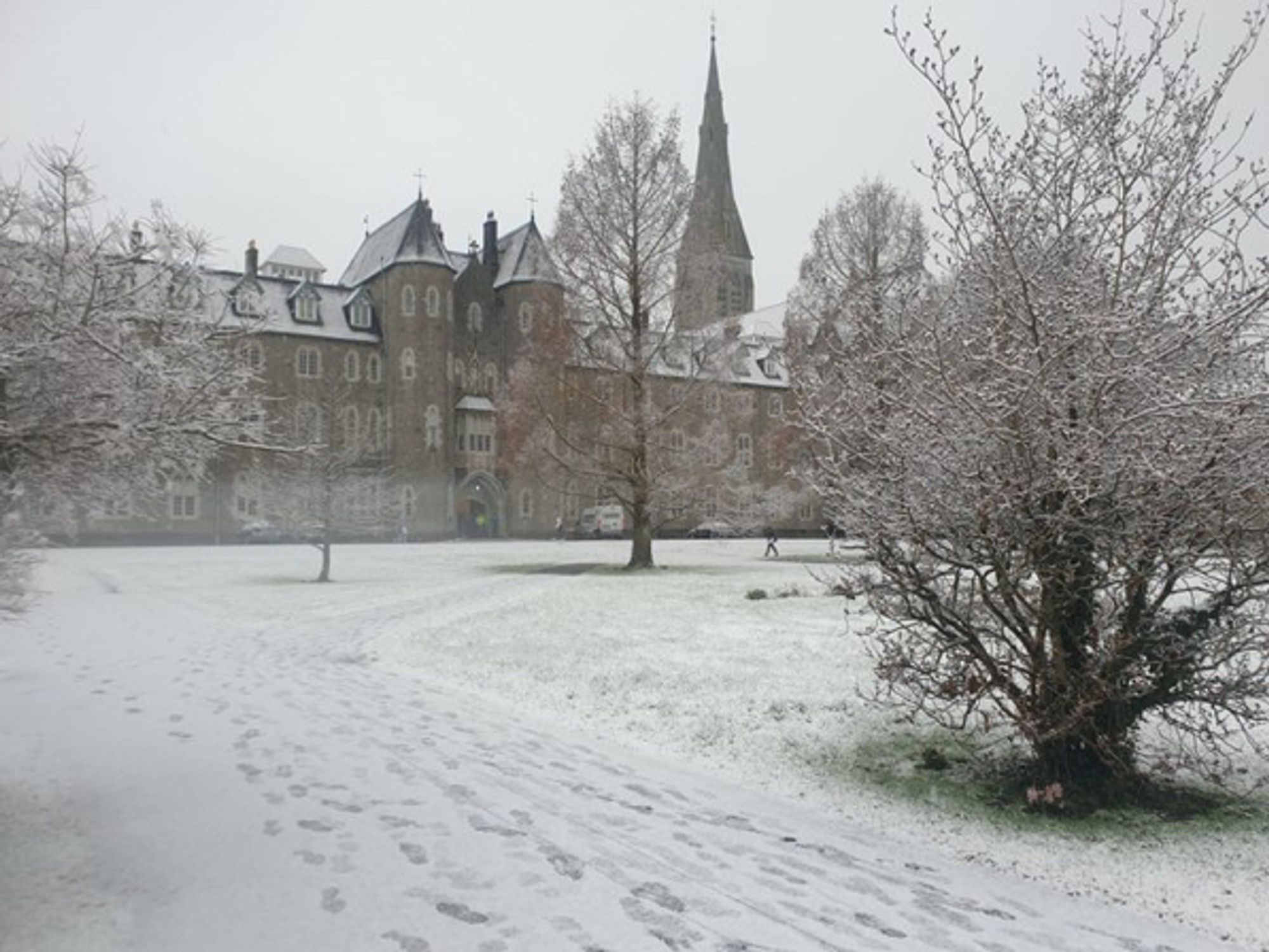
Talking of the weather, I noticed on social media that yesterday it snowed in Maynooth (and elsewhere in Ireland). The contrast with what I’ve been experiencing in Sydney will be rather extreme:

I was a bit concerned that the snow might cause problems with my return flight and/or onward transport, but I’m told that it was soon washed away by rain.

I’ll only be making a brief stop in Maynooth before travelling to (different) warmer climes, of which more in due course.

A Poem for St David’s Day

Posted in Poetry with tags , , , , on March 1, 2024 by telescoper

It’s St David’s Day today, so although I’m still Down Under and far from any daffodils, I wish you all a big

Dydd Gŵyl Dewi Hapus!


Gratuitous Picture of some Daffodils near the Maynooth University Library.

It has become a bit of a St David’s Day tradition on this this blog to post a piece of verse by the great Welsh poet R.S. Thomas. This is The Bright Field.

I have seen the sun break through
to illuminate a small field
for a while, and gone my way
and forgotten it. But that was the pearl
of great price, the one field that had
treasure in it. I realize now
that I must give all that I have
to possess it. Life is not hurrying

on to a receding future, nor hankering after
an imagined past. It is the turning
aside like Moses to the miracle
of the lit bush, to a brightness
that seemed as transitory as your youth
once, but is the eternity that awaits you.