Archive for July, 2024

The All-Ireland Hurling Final

Posted in GAA, Maynooth with tags , , , , , on July 21, 2024 by telescoper

No prizes for guessing what I’ll be watching this afternoon. Today’s the day of the All-Ireland Senior Hurling Championship Final at Croke Park, between Clare and Cork. The weather isn’t too bad; it’s overcast and a bit cool but there’s no rain forecast and it’s not windy. I’m hoping for a good match.

Clare (An Clár) versus Cork (Corcaigh) is not the final I would have predicted before the semi-finals. I thought Limerick and Kilkenny would be the finalists but that just goes to show how little I know. Cork are favourites with the bookies, by the way (4/7 on Cork, 11/8 against Clare) despite the fact that Clare of won the last two encounters between these teams.

If you’ve never been in Ireland for this occasion you won’t realize what a huge event it is. The atmosphere on this very special day is very much like it used to be in England for the FA Cup Final when I was a kid and the build-up just as long, with constant references on both radio and TV. Maynooth is on the railway line going through Croke Park so we see a lot of supporters in their team colours heading to the match. County Clare (which is in the West of Ireland, straddled by Limerick to the South and Galway to the North) is a bit closer to us than County Cork, which perhaps accounts for the preponderance of blue and gold over red and white.

You can watch the whole game live on BBC2 if you’re in the UK. Throw-in is at 3.30pm.

Update: The attendance is 82,300.

Update: HT score Clare 1-12 Cork 1-12. It’s been a much more open game than I expected. Cork started out the stronger team, finding lots of space in the Clare half and shooting very accurately. Robert Downey scored a memorable goal at which point it looked like Cork might overrun Clare, but that didn’t happen and as the half drew to a close Clare became more confident. It’s all square and poised for an exciting second half.

Update: FT score Clare 3-21 Cork 1-27. What an epic game this is! All square on points after Clare conceded a silly free in the dying seconds to allow Cork to equalize. We go to extra time!

Update: Final Score Clare 3-29 Cork 1-34. Drama to the last second, a long free from the Cork goalie lands in the area but Robbie O’Flynn’s shot to tie the game goes agonizingly wide. Clare are the All-Ireland Champions by one-point. What a breathtaking match. Hats off to both teams for serving up a classic! I wouldn’t have complained if it had gone to a replay though…

Here is a clip of Clare’s amazing 3rd goal, scored by Tony Kelly…

Royal Society/SFI University Research Fellowships

Posted in Maynooth, The Universe and Stuff on July 20, 2024 by telescoper

I just realized that I had forgotten to give notice of an important scheme run jointly between the  Royal Society and Science Foundation Ireland that gives early career researchers in Ireland access to University Research Fellowships. In previous years I’ve passed this on ahead of the opening of the scheme, but it is already open. In fact there was a Zoom webinar for Irish applicants on 17th July, which has now passed. The deadline is not until 10th September, however, so there is time to apply.

This scheme provides eight years of research funding and has proved to be a stepping stone to their first permanent academic position for a great many scientists. Here are a couple of items about the eligibility and duration.

Eligibility:  The scheme is open to early career Post Doctoral Researchers with between 3-8 years of actual research experience since their PhD (date on which the degree was approved by board of graduate studies) by the closing date.  You cannot apply if you hold a permanent post in a university.

Funding and Duration:  Once upon a time this scheme provided funding of the research fellow’s salary and research expenses for an initial period of 5 years with the possibility to apply for a further 3 years.  A couple of years ago this changed, however, and applicants are now asked to provide a proposal for a project lasting eight years which is subject to a mid-term review.

Key Dates: Applications need to be in by 3pm 10th September 2024 at 3pm UK time.

For further details and further developments see here.

The scheme covers a wide range of disciplines. including physics and astronomy. Of course if you want to do cosmology, either observational or theoretical, the best place  to do it in Ireland is here in Maynooth but we also do, e.g. condensed matter theory and particle physics.

The deadline is not far off,  so please get cracking. You will need to get a statement of support from the relevant Head of Department at your chosen institution, so you need to make contact with your prospective host as soon as possible.

Four New Publications at the Open Journal of Astrophysics

Posted in OJAp Papers, Open Access, The Universe and Stuff with tags , , , , , , on July 20, 2024 by telescoper

This week we have published four papers at the Open Journal of Astrophysics, which I now present to you here. These four take the count in Volume 7 (2024) up to 60 and the total published altogether by OJAp up to 175. It is gratifying to see the range of high-quality papers published steadily increasing. We are getting several papers submitted every day now.

In chronological order, the four papers published this week, with their overlays, are as follows. You can click on the images of the overlays to make them larger should you wish to do so.

First one up is: “A population of neutron star candidates in wide orbits from Gaia astrometry” by Kareem El-Badry (Caltech, USA) and 12 others based across the world.  The paper presents  a spectroscopic study of neutron star candidates identified using GAIA astrometry to be in wide binary orbits around main sequence stars,  was published on 15th July 2024 and is in the folder marked Solar and Stellar Astrophysics. For more information about this one, see here.

Here is a screen grab of the overlay, which includes the abstract:


You can find the officially accepted version of the paper on the arXiv here.

The second paper to announce is “Systematic Effects in Galaxy-Galaxy Lensing with DESI” and was written by Johannes Ulf Lange (University of Michigan, Ann Arbor, USA) and 58 others, again distributed internationally.  This one reports a study of systematic effects (such as incompleteness and intrinsic alignment) on galaxy-galaxy lensing results from the Dark Energy Spectroscopic Instrument (DESI) survey. This one is in the folder called Cosmology and NonGalactic Astrophysics and was published on 16th July 2024.

You can see the overlay here:


The accepted version of this paper can be found on the arXiv here.

The next paper is also in the folder called Cosmology and NonGalactic Astrophysics.  It is entitled “Unleashing cosmic shear information with the tomographic weak lensing PDF” and is by by Lina Castiblanco (Newcastle Univresity, UK), Cora Uhlemann (Bielefeld University, Germany), Joachim Harnois-Déraps (Newcastle University, UK) and Alexandre Barthelemy (Ludwig-Maximilians-Universität, Germany). This one was published on 17th July 2024.

Here is the overlay:


You can find the full text for this one on the arXiv here.

Last but by no means least, published on 18th July 2024, we have a paper  entitled “When to interfere with dark matter? The impact of wave dynamics on statistics“. The primary classification for this one is again Cosmology and Nongalactic Astrophysics and it discusses the imprint of wave-mechanical behaviour, perhaps associated with ultra-light scalar field dark matter on the statistical properties of large-scale structure. The authors are Alex Gough (Newcastle University, UK) and Cora Uhlemann (Bielefeld University, Germany; who also featured in the author list of the previous paper). This is a paper close to my own interests, but because I know both authors well and was the PhD examiner of the first author I thought it best to recuse myself from an editorial role on this one.


You can click on the image of the overlay to make it larger should you wish to do so. You can find the officially accepted version of the paper on the arXiv here.

It did look likely at one stage that we might publish a paper every day last week, but the final version of one other paper didn’t make it onto arXiv in time to be announced on Friday so I will publish that one on Monday.

Murder before Evensong by The Reverend Richard Coles

Posted in Literature, Television with tags , , , , , , , , on July 19, 2024 by telescoper

The Reverend Richard Coles (no relation), former Communard, ordained priest, broadcaster and TV celebrity recently turned his hand to writing murder mysteries. I bought his first crime novel, Murder Before Evensong, featuring Canon Daniel Clement, a couple of years ago but only got around to reading it recently. It caught my eye for two reasons, one that I am quite partial to whodunnits, and the other that I read and enjoyed the first volume of the author’s autobiography, Fathomless Riches, which showed him to be a very good writer.

As you might have guessed, Murder Before Evensong, is a kind of homage to the old-school Agatha Christie village murder typical of the Miss Marple stories. Murder at the Vicarage came immediately to mind when I first saw the book, but the story is not set so far in the past – more eighties than thirties. Richard Coles is also far wittier than Agatha Christie, with a definite touch of PG Wodehouse in his style. When I got into the book it reminded me very much of the original Midsomer Murders novels written by Caroline Graham, which I think are excellent; with somewhat whimsical plots, and populated with somewhat eccentric characters; the long-running TV series has long since run out of ideas, and is now tired and formulaic, but the books on which it is based are very good indeed. Like the original Inspector Barnaby stories, Murder Before Evensong is very funny in places, but less of a parody and more of an affectionate tribute to the genre. Coles also writes movingly about grief, and its effect on a close-knit rural community, no doubt informed by his own personal life and experiences as a parish priest. Canon Clement obviously has a lot of Richard Coles in him, including a love of dachsunds.

It’s difficult to review a murder mystery without giving a way the plot, so I’ll just say that it is well constructed. I narrowed the list of possibilities down to two very early on, and was proven right, but I didn’t really get the motive right.

Anyway, it’s an enjoyable read and recommended for enthusiasts. I gather that more Canon Clement stories are on the way. That reminds me of a line in an episode of Midsomer Murders, when Barnaby is joined by a new Detective Sergeant, just up from London, who is immediately plunged into the investigation of a killing spree. He turns to his Chief Inspector and says words to the effect of ‘For a small village there are a lot of murders around here’ to which Barnaby raises an eyebrow and says ‘Yes, that has been remarked upon…’

A Lamentation of Swans

Posted in Maynooth with tags , , , , , , , , on July 18, 2024 by telescoper

I was looking forward to making acquaintance with the beautiful swans of Maynooth when my sabbatical is over, but I’ve heard that recent tragic events mean that won’t be happening. The title of this post is not a reference to the collective noun for swans, but literally a lamentation.

A pair of swans had been nesting for several years on the little island in the harbour of the Royal Canal at Maynooth for several years- since before I arrived here. Every spring they have raised a batch of cygnets and these have grown up each summer and departed for a new life elsewhere. I’ve always enjoyed watching the little ones grow and learn how to find food under the very watchful eye of their parents. I had no reason to think things would be any different this year. I was wrong.

The first calamity to occur, earlier this year, was that the island flooded destroying this year’s batch of eggs. The swans tried again, and managed two more cygnets, but neither survived. I’m not sure exactly what happened but it seems, various locks were opened to allow water into the section of the canal England has a much more extensive system of waterways than Ireland and when rivers are close to flooding, water is often diverted into canals to stop them breaking their banks. I guess this is what happened earlier, but I don’t know.

It was bad enough that there are no cygnets this year, but worse was to come. Recently the female swan (pen) was found to be very ill. She was taken away by Kildare Wildlife Rescue (KWR) team and cared for but sadly passed away. All I know is that it seemed to be “an infection” which may or may not be the same cause of death as the cygnets. Avian flu is a possibility, so is some form of poisoning such as botulism. Sadly, people do feed the birds in the harbour with inappropriate things so this might also be a contributing factor.

What about the male swan (cob)? Well, he has gone. I don’t know whether he died too or whether he just left. Swans mate for life and I’ve heard of cases when one of a pair has simply pined away when the other has died.

So there are no swans nesting in Maynooth anymore. It’s really very sad. Swans are beautiful creatures and the pair on the canal was really well known to the community. I hope that another pair will nest on the island before too long. It may even be that a pair of rescue birds will be rehomed there by KWR. Before that happens though, I hope they find out why exactly caused the swans to die. We don’t want more deaths

Academic Publishing is a Lucrative Scam

Posted in OJAp Papers, Open Access with tags , , , , , , , , on July 17, 2024 by telescoper

I saw an article in the Guardian yesterday with the title Academic journals are a lucrative scam – and we’re determined to change that. It’s written by Arash Abizadeh who is Professor of Political Science at McGill University in Canada. I urge you to read the piece if you’re interested in Open Access and the issues surrounding it.

I agree with virtually everything in the article. Indeed I’ve been saying much the same thing for about 15 years! I’m also determined to change things too, which is why we set up the Open Journal of Astrophysics, a “Diamond” Open Access Journal. Talking about the system of Gold Open Access, Prof. Abizadeh writes:

There is an obvious alternative: universities, libraries, and academic funding agencies can cut out the intermediary and directly fund journals themselves, at a far lower cost. This would remove commercial pressures from the editorial process, preserve editorial integrity and make research accessible to all. The term for this is “diamond” open access, which means the publishers charge neither authors, editors, nor readers (this is how our new journal will operate). Librarians have been urging this for years. So why haven’t academics already migrated to diamond journals?

I think the reason more academics haven’t already migrated to Diamond Open Access journals is that there are relatively few such journals. The reason for that is that although there are lots of people talking about Diamond Open Access there are many fewer actually taking steps to implement it. The initiative mentioned in the Guardian article is therefore very welcome. Although I think in the long run this transition is inevitable, it won’t happen by itself. It certainly won’t be helped by the Academic Publishing Industry either. We academics have to provide the push.

Here’s another excerpt:

Career advancement depends heavily on publishing in journals with established name recognition and prestige, and these journals are often owned by commercial publishers. Many academics – particularly early-career researchers trying to secure long-term employment in an extremely difficult job market – cannot afford to take a chance on new, untested journals on their own.

This is true, up to a point.

First of all any institution that has signed up to the San Francisco Declaration On Research Assessment (DORA) should not be relying on (often bogus) indicators of prestige such as the Journal Impact Factor or the journal’s presence in the Scopus index. If Diamond Open Access is to gain further traction it has to be accompanied to a wholesale change towards fairer research assessment practices.

Second, although it is true that it has taken some years to reach the volume it has now, I have been pleasantly surprised how many early career researchers in astrophysics have been keen to try out the Open Journal of Astrophysics. I think that’s because (a) early career researchers have not been indoctrinated into the absurdities of existing publishing practices and (b) they can see that the citation rates on OJAp are no worse than other allegedly more “prestigious” journals.

Sun-like Stars with Hidden Companions

Posted in OJAp Papers, Open Access, The Universe and Stuff with tags , , , , , , on July 16, 2024 by telescoper

I usually only do updates at weekends about papers published in the Open Journal of Astrophysics but I’m making an exception today because a paper we published yesterday is making some waves that I think are worth propagating. The paper is called “A population of neutron star candidates in wide orbits from Gaia astrometry” and the first author is Kareem El-Badry of Caltech (USA); his institution have put out a press release to go with the paper which you an read for more details. They key point is that these are main sequence stars with (probably) neutron star companions and nobody really knows how such systems formed. The paper is also yet another illustration of the amazingly rich source of discovery data that is the European Space Agency’s Gaia mission.

The press release also contains some snazzy graphics, such as this:

The press release explains

The new study, which includes a team of co-authors from around the world, was published in The Open Journal for Astrophysics. Data from several ground-based telescopes, including the W. M. Keck Observatory on Maunakea, Hawai‘i; La Silla Observatory in Chile; and the Whipple Observatory in Arizona, were used to follow up the Gaia observations and learn more about the masses and orbits of the hidden neutron stars.

It is very gratifying to see one of our papers gaining such traction. It also exemplifies something that has struck me recently. Obviously, when we started the Open Journal of Astrophysics I really had no idea how it would go, but one thing that has surprised me (in a pleasant way) is how many articles we are getting from authors based in high-profile US institutions, such as Caltech, Harvard, Princeton and Berkeley (among others). I always assumed that such institutions were rich enough not to be worried by the cost of Article Processing Charges and, being based in America, the authors would in any case be used to paying page charges for the Astrophysical Journal which has been standard practice for ages. Whatever the reason, it sends a great message to the community to see these leading institutions going via the Diamond Open Access route. I hope this provides even more evidence to persuade even more authors that OJAp is a serious journal!

An Leabharlann

Posted in Biographical, History, Irish Language, Literature, Maynooth, Poetry with tags , , , on July 15, 2024 by telescoper

As I’ve mentioned before on this blog, over the past year or so I’ve been trying to catch up on my reading. My stack of books I’ve bought but never read is now down to half-a-dozen or so.

With sabbatical drawing to a close,  the next major life even appearing on the horizon is retirement. Since that will involve a considerable reduction in income, and consequently money to buy books, and my house already has quite a lot of books in it, I thought I’d join the local public library so that when I’ve cleared the backlog of bought books, I’ll read books from the library instead.

With that in mind, I just joined the public library on Main Street, Maynooth, which is only about  15 minutes’ walk from my house. It’s a small branch  library but is part of a larger network across County Kildare, with an extensive online catalogue from which one can acquire books on request. All this is free of charge.

Once I got my card, I had a quick look around the Maynooth branch. It has a good collection of classic literature (including poetry) as well as Irish and world history, which will keep me occupied for quite a while. The normal loan  period is 3 weeks, which provides an incentive to read the book reasonably quickly.

I borrowed books in large quantities from public libraries when I was a child. I’m actually looking forward to getting into the library habit again.

Congratulations to Spain!

Posted in Football, Rugby with tags , , , , , on July 14, 2024 by telescoper

And so it came to pass that Spain beat England 2-1 in the final of the 2024 European Championship. This is a result to add to the memories of Spain I’ve acquired by living there for much of the past year. I haven’t seen every match of the tournament but there’s no doubt in my mind that Spain played consistently the best football, and are worthy Champions. England ran them close in the final, though. Despite Spain having about 66% of the possession it took a very late goal to win it.

So football’s not coming home after all. Evidently it’s still on sabbatical…

I feel a bit sorry for the manager Gareth Southgate. He may not have won a trophy with England (yet) but he’s taken them further in more competitions than most of his predecessors. He attracted a great deal of criticism for his cautious approach in the earlier stages of this competition which he dealt with in a remarkably dignified way. All that eased off a bit when England got to the knockout stage, but I suspect it may come back. Will he put up with it for another two years until the 2026 World Cup?

As for Spain, this is the fourth time they have been European Champions; England have never won this competition. The Spanish squad is very youthful squad too, including the brilliant teenager Lamine Yamal. Nico Williams had a superb tournament too. 

P.S. This evening’s match was broadcast live on RTÉ so I watched it at home. By contrast, yesterday’s rugby between Ireland and the Springboks was not available on a free channel so I was forced against my will to watch it in a pub. I’m glad I did!

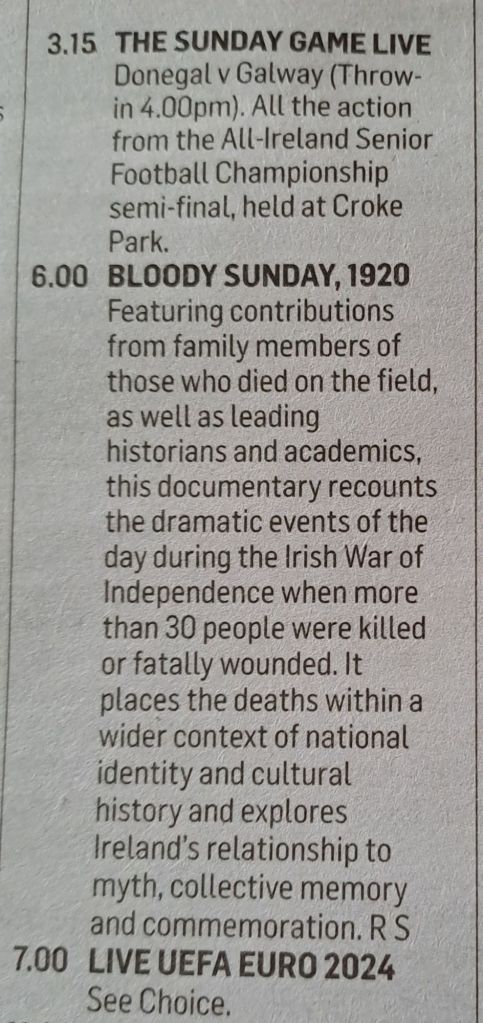
P.P.S the choice of schedule leading up to the Euros final is interesting:

R.I.P. Dr Ruth Westheimer (1928-2024)

Posted in Biographical, LGBTQ+, R.I.P. with tags , , , , , on July 14, 2024 by telescoper

I was very sad to learn yesterday of the death at the age of 96 of celebrity sex therapist Dr Ruth Westheimer, known universally as “Dr Ruth”. I remember her well from TV appearances back in the 1980s during the AIDS crisis when she was a staunch ally of the gay community. Her frank and non-judgmental approach to sex education – especially with regard to safer sex practices – probably saved many lives during that crisis. The fact that she looked like an archetypal little old lady made her use of explicit language rather shocking in a way but also extremely effective. I thought she was wonderful.

I actually had the privilege of meeting Dr Ruth. In fact, I had breakfast with her in a hotel in Reykjavik. We were both participants in a show called the Experiment Marathon which happened in 2008, before I started blogging. I still have the book of the event. Here is the list of participants, along with a picture of Dr Ruth during her contribution:

Anyway, all the participants were staying in the same hotel for this event and on the morning of my talk I came down for breakfast to find the dining room rather crowded. There was a space, however, at Dr Ruth’s table. I recognized her immediately and was a bit nervous but eventually asked if I could join her. She was absolutely charming, very friendly, extremely talkative and delightfully funny. When I was able to get a word in, I told her how much admired her work during the AIDS crisis. She was also extremely tiny, well under five foot tall.

Dr Ruth was born to an Orthodox Jewish family in Germany in 1928. When the Nazis came to power she was moved to Switzerland while her parents remained in Germany. Her father was murdered in Auschwitz; her mother also died during the Holocaust though nobody knows the details. She often said that her attitude during the AIDS crisis was informed by her knowledge that the Nazis murdered gay people too so she felt it was important to her show solidarity.

R.I.P. Ruth Westheimer (1928-2024)