Archive for August, 2024

Hubble Tension Reduced?

Posted in The Universe and Stuff with tags , , , , on August 14, 2024 by telescoper

Back in April I posted about a meeting at the Royal Society in London called Challenging the Standard Cosmological Model, some of which I attended virtually. In that post I mentioned that Wendy Freedman gave a talk related to the ongoing issue of the Hubble Tension, i.e. the discrepancy between different types of measurement of the Hubble Constant, usually characterized as local measurements (using stellar distance indicators) and larger-scale measurements (chiefly Planck). There are quite a few posts about this issue on this blog. Anyway, Wendy Freedman mention in her talk that her latest work on stellar distances suggested a value of 69.1 ± km s-1 Mpc-1, which reduces the tension with Planck significantly. At the time, however, there was no paper explaining how this number was derived.

Yesterday there appeared on arXiv a preprint by Freedman et al. which summarizes the recent results. The abstract is here:

We present the latest results from the Chicago Carnegie Hubble Program ( CCHP) to measure the Hubble constant using data from the James Webb Space Telescope (JWST). This program is based upon three independent methods: (1) Tip of the Red Giant Branch (TRGB) stars, (2) JAGB (J-Region Asymptotic Giant Branch) stars, and (3) Cepheids. Our program includes 10 nearby galaxies, each hosting Type Ia supernovae (SNe Ia), suitable for measuring the Hubble constant (H0). It also includes NGC  4258, which has a geometric distance, setting the zero point for all three methods. The JWST observations have significantly higher signal-to-noise and finer angular resolution than previous observations with the Hubble Space Telescope (HST). We find three independent values of H0 = 69.85 ± 1.75 (stat) ± 1.54 (sys) for the TRGB, H0 = 67.96 ± 1.85 (stat) ± 1.90 (sys)  km s-1 Mpc-1 for the JAGB, and H0 = 72.05 ± 1.86 (stat) ± 3.10 (sys) for Cepheids. Tying into SNe Ia, and combining these methods adopting a flat prior, yields our current estimate of H0 = 69.96 ± 1.05 (stat) ± 1.12 (sys)  km s-1 Mpc-1. The distances measured using the TRGB and the JAGB method agree at the 1% level, but differ from the Cepheid distances at the 2.5-4% level. The value of H0 based on these two methods with JWST data alone is H0 = 69.03 ± 1.75 (total error)  km s-1 Mpc-1. These numbers are consistent with the current standard ΛCDM model, without the need for the inclusion of additional new physics. Future JWST data will be required to increase the precision and accuracy of the local distance scale.

You can read the full paper on arXiv here. A summary of the summary is that of the three methods they use, two give lower values of the Hubble constant and one (Cepheids) gives a higher value but with larger errors. The number quoted in the Royal Society talk was presumably preliminary as it doesn’t match any of the numbers in the abstract, but the point remains.

You can see the reduction in scatter in the new JWST measurements in this Figure (old on the left and new on the right).

On the face of it, these results suggest that the Hubble tension is greatly reduced. I am sure, however, that advocates of a higher value will have been preparing their ripostes and it’s just a matter of time before they arrive on the arXiv too!


Maynooth University Library Cat Update

Posted in Maynooth with tags , on August 13, 2024 by telescoper

I ventured onto Maynooth University Campus today and guess who I found there? He seems fine although he wasn’t exactly a busy bee when I paid him a visit. No doubt he’s taking it easy ahead of the new academic year.

At least he’s keeping himself clean!

In the Dark on Social Media

Posted in Biographical, Politics with tags , , , , , , on August 12, 2024 by telescoper

It’s almost a year since I deactivated my Twitter account. Or should I call it X? Anyway, it doesn’t matter because I don’t use it any more. Over the past few weeks it seems quite a few more – especially in the UK – have had enough of the antics of Elon Musk (aka Space Karen), especially with his attempts to fan the flames of the recent Farage riots by spreading misinformation. The first thing I noticed was that my BlueSky account was suddenly getting quite a lot of new followers. I now have about 850, still a long way short of the over 7000 I used to have on Twitter, but the level of engagement is far higher. That’s because the algorithm Space Karen introduced on X makes it difficult for your own followers. let alone anyone else, to see your tweets. The one disadvantage of BlueSky is that it doesn’t have an API that allows me to post directly from this blog when I publish a post, so I have to copy the URL by hand.

I also have an account on Mastodon where I have over 1200 followers and similarly good engagement. When I first started there a couple of years ago it didn’t have a WordPress API but it does now, so everything I write here gets posted automatically on my feed. Not only that, this blog is now also now fully federated which means that there is an autonomous feed for the blog posts. Not just a link to each post, as the API produces, but the whole post. This is a nice feature because if I change a post on this WordPress platform it automatically gets changed on the Mastodon feed.

I also have a Facebook Page on which these

And now there’s Threads, which is like a version of Twitter bolted onto Instagram. When this first came out last year it wasn’t available in the EU for data protection issues so I didn’t bother with it. I only just found out at the weekend that has been available since December 2023 but I wasn’t paying much attention to social media then so didn’t catch the news. Anyway, since I already have a (very quiet) Instagram account so I set up a Threads account which you can find here if you like that sort of thing. My first impressions of Threads are not very favourable, but let’s see how it goes. At least it’s not as bad as Twitter. I still think it is indefensible that my employer, along with most other universities, has decided to maintain a presence on that site.

The Mechanics of the Pole Vault

Posted in Sport, The Universe and Stuff with tags , , , on August 11, 2024 by telescoper

One of the many highlights of the 2024 Olympics was the amazing achievement of Armand Duplantis in winning the Gold Medal in Pole Vault and in the process breaking his own world record at a height of 6.25m. Here he is

He seemed to clear that height quite comfortably, actually, so I dare say he’ll break quite a few more records in his time. On the other hand, when I first wrote about this back in 2011 the world record for the pole vault was held by the legendary Ukrainian athlete Sergey Bubka at a height of 6.14m which he achieved in 1994. That record stood for almost 20 years but has since been broken several times since. The fact that the world record has only increased by 11 cm in 30 years tells you that the elite pole vaulters are working at the limits of what the human body can achieve. A little bit of first-year mechanics will convince you why, as I have pointed out in previous posts (e.g. here).

What a pole-vaulter does is rather complicated and requires a lot of strength, flexibility and skill, but as in many physics problems one can bypass the complications and just look at the beginning and the end and use an energy conservation argument. Basically, the pole is a device that converts the horizontal kinetic energy of the vaulter \frac{1}{2} m v^2,  as he/she runs in, to the gravitational potential energy m g h acquired at the apex of his/her  vertical motion, i.e. at the top of the vault.

Now assume that the approach is at the speed of a sprinter, i.e. about 10 ms^{-1}, and work out the height h = v^2/2g that the vaulter can gain if the kinetic energy is converted with 100% efficiency. Since g = 9.8 \, ms^{-2} the answer to that little sum turns out to be about 5 metres.

This suggests that  6.25 metres should not just be at, but beyond, the limit of a human vaulter,  unless the pole were super-elastic. However, there are two things that help. The first is that the centre of mass of the combined vaulter-plus-pole does not start at ground level; it is at a height of a bit less than 1m for an an average-sized person.  Note also that the centre of mass of pole (which weighs about 15 kg and is about 5 m long) only ends up about 2.5 m off the ground when it is vertical, so there’s a significant effect there.  Note also that the centre of mass of the vaulter does not actually pass over the bar after letting go of the pole.  That  doesn’t happen in the high jump, either. Owing to the flexibility of the athlete’s back, the arc is such that the centre of mass remains under the bar while the different parts of the athlete’s body go over it.

Moreover, it’s not just the kinetic energy related to the horizontal motion of the vaulter that’s involved. A human can jump vertically from a standing position using elastic energy stored in muscles. In fact the world record for the standing high jump is an astonishing 1.9m. In the context of the pole vault it seems likely to me that this accounts for at least a few tens of centimetres.

Despite these complications, it is clear that pole vaulters are remarkably efficient athletes. And not a little brave either – as someone who is scared of heights I can tell you that I’d be absolutely terrified being shot up to 6.25 metres on the end of  a bendy stick, even with something soft to land on!

Wine in a Can – Marcel Lucont

Posted in Poetry with tags , , on August 10, 2024 by telescoper

And now, some poetry…

Three New Publications at the Open Journal of Astrophysics

Posted in OJAp Papers, Open Access, The Universe and Stuff with tags , , , , , , , , , , , , , , on August 10, 2024 by telescoper

It’s Saturday so it’s time once again for another roundup of business at the  Open Journal of Astrophysics. After last week’s summer lull, this week I have three papers to announce, which brings the total we have published so far this year (Vol. 7) to 67 and the total published by OJAp to 182.

First one up, published on 7th August 2024, is “Brightest Cluster Galaxy Offsets in Cold Dark Matter” by Jonathan Katz of Washington University (St Louis, Missouri, USA),  a simulation-based study of the distribution of the position of brightest cluster galaxies relative to the dark matter distribution and its possible use as a cosmological probe.  The authors are Cian Roche (MIT), Michael McDonald (MIT), Josh Borrow (MIT), Mark Vogelsberger (MIT), Xuejian Shen (MIT), Volker Springel (MPA Garching), Lars Hernquist (Harvard), Ruediger Pakmor (Harvard), Sownak Bose (Durham, UK) and Rahul Kannan (York U., Canada). This paper is in the folder marked Astrophysics of Galaxies.

Here is a screen grab of the overlay, which includes the abstract:


You can read the paper directly on arXiv here.

The second paper to present is “LAMOST J1010+2358 is not a Pair-Instability Supernova Relic” by five authors based in the USA: Pierre Thibodeaux (Chicago), Alexander P. Ji (Chicago), William Cerny (Yale), Evan N. Kirby (Notre Dame) and Joshua D. Simon (Carnegie Observatories) .  As the title makes clear, the paper presents arguments against previous claims that a particular star is not a pair-instability supernova relic. This paper is in the folder marked Solar and Stellar Astrophysics. It was published on Friday August 9th 2024.

The overlay looks like this:


You can read this paper directly on the arXiv here.

Last, but by no means least, comes  “A Pilot Search for Gravitational Self-Lensing Binaries with the Zwicky Transient Facility“, results of a trial search for signals of gravitational lensing of one component in a binary system by a compact companion, with a discussion of future prospects for larger surveys. This one, which was also published on 9th August, is in the folder marked High-Energy Astrophysical Phenomena. The authors are Allison Crossland & Eric C Bellm (U. Washington), Courtney Klein (UC Irvine), James R. A. Davenport (U. Washington), Thomas Kupfer (Hamburg Observatory) and Steven L. Groom, Russ R. Laher & Reed Riddle (Caltech).

Here is a screengrab of the overlay:

To read the accepted version of this on the arXiv please go here.

That’s it for this week. I hope to post another update next weekend.

Have you never contracted Covid-19?

Posted in Biographical, Covid-19 with tags , on August 9, 2024 by telescoper

I’ve taken the liberty of reblogging this post from a blog that I follow, as it is a question that interests me. As far as I know I have never contracted Covid-19, but I think I’m a rare case. I know many people who have had it multiple times. The most I think is five. There was an outbreak at the Euclid Meeting in Rome too, which affected over sixty people. I am hearing through the grapevine that case numbers are rather high at the moment, both in Europe and the USA, but in the absence of any systematic testing it is difficult to know the precise situation.

A couple of months ago I had a nasty cough which I thought might have been Covid-19 but repeated tests came back negative.

In the interest of full disclosure, I am fully vaccinated and boosted. I suppose another booster will be available in the autumn and I’ll take that too.

Anyway, I’d be interested to hear through the comments from anyone who has never had Covid-19 if you feel like divulging such information.

The Woke Olympics

Posted in Film, Sport with tags , , , , on August 9, 2024 by telescoper

I have seen many comments on social media to the effect that the 2024 Paris Olympics have gone “woke”. I agree. Many sports are now mere shadows of what they were a few decades ago let alone the original Greek ideals. Gymnastics for example, the name of which is derived from the Greek gymnós meaning “naked”, nowadays involves competitors with their naughty bits covered up. How woke is that? And the boxers even wear gloves! They’ve all gone soft!

Another example is the fencing. I’m not an expert on this but I did watch quite a lot when I was younger – admittedly not on live TV, but in the form of film recordings. The modern Olympic version of fencing is boring compared with how it used to be. Here are two photographs that illustrate how fencing has gone woke.

For a start, just look at all the protective gear worn by the namby-pamby competitors on the left! And they don’t even use proper swords! It’s health and safety gone mad!

Also, where are the fancy costumes, the stone staircases to run up and down, the chandeliers to swing from, the elaborate hanging tapestries to climb, or the long banqueting tables covered in expensive items there to be trashed? Pathetic!

(P.S. Basil Rathbone (in the still on the right) was actually a seriously good fencer, twice British Army champion in fact, unlike his opponent in the picture Errol Flynn who was so useless that he was a danger to other members of the cast, including Rathbone.)

A Physics Question

Posted in Literature, The Universe and Stuff on August 8, 2024 by telescoper
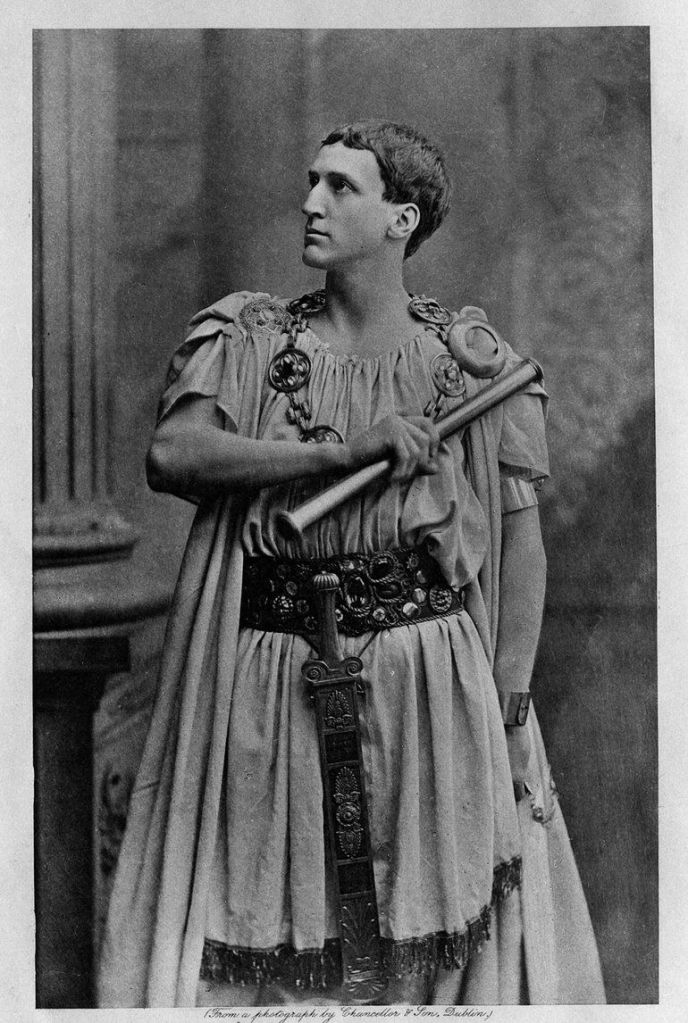
Frank Benson in the role of Coriolanus (1893)

Is Shakespeare’s play Coriolanus different when performed in the Southern Hemisphere?

Open Access Encounters: The Good, The Bad and the Ugly

Posted in Open Access with tags , , , on August 7, 2024 by telescoper

As it was foretold on Saturday, this afternoon I gave a talk at the 32nd General Assembly of the International Astronomical Union currently taking place in Cape Town, or rather at a side event thereof called Open Access Encounters: The Good, The Bad and the Ugly. I actually gave the last talk in the session, which may or may not mean that I was representing The Ugly

About 50 people attended online plus an unknown number in person, so it was quite a decent size of audiance.

I’m not sure if Slideshare is still working on WordPress, but if not here is a PDF of the slides.