Archive for January, 2025

Blue Sky Research in Ireland

Posted in Maynooth, Science Politics, The Universe and Stuff with tags , , , , on January 31, 2025 by telescoper

There’s a new piece in the Irish Times (sponsored by the recently formed Research Ireland, but probably behind a paywall) that makes promising noises about “Blue Skies” research. No jokes about the Irish weather, please. I quote:

The merger of Science Foundation Ireland (SFI) and the Irish Research Council (IRC) to form Research Ireland on August 1st, 2024, has opened up new possibilities and opportunities for the Irish research community. The new organisation now oversees competitive research funding across all disciplines, ranging from the arts, humanities and social sciences through to science, technology, engineering and maths, as well as across the full spectrum spanning curiosity-driven to applied research.

“SFI was enterprise and Stem-focused,” explains Research Ireland deputy chief executive Dr Ciarán Seoighe. “The IRC was not set up on a statutory basis so that meant that the arts, humanities and social sciences [AHSS] were not in the statutory research funding system. That put us behind other countries. We weren’t getting the full benefit of research in those areas. By creating Research Ireland we are able to support the full spectrum.”

He also points out that SFI wasn’t able to fund blue-skies, fundamental research, but Research Ireland can. “We need that research to create the new ideas and innovations that become applied research in years to come. By creating Research Ireland, we now have the ability to tap into and unlock the full potential of research in Ireland.”

The last bit is encouraging – or at least less discouraging – for those of us who work in fundamental science than the previous regime. The thing that struck me immediately when arriving in Ireland from the UK that funding for basic or fundamental research – especially in the sciences – is extremely poor. That is still the case now. This situation is largely the result of a high-level report published in 2012. This identified 14 priority areas of research that are most likely to give demonstrable economic and societal return, and where Ireland should focus the majority of competitive funding. Four criteria were used in selecting the 14 priority areas for future, competitively-awarded investment for economic objectives:

  1. the area is associated with a large global market or markets in which Irish-based enterprises already compete or can realistically compete;
  2. publicly performed R&D in Ireland is required to exploit the area and will complement private sector research and innovation in Ireland;
  3. Ireland has built or is building (objectively measured) strengths in research disciplines relevant to the area; and,
  4. the area represents an appropriate approach to a recognized national challenge and/or a global challenge to which Ireland should respond.

The `vast majority’ of SFI’s funding was directed towards the 14 areas so defined, leaving virtually nothing for anything else, an outcome which has dire implications for `blue skies’ research.

I think this is a deeply misguided short-term policy, which has had and will continue to have strongly negative effects on science in Ireland in the medium to long term, especially because Ireland spends so little of its GDP on research in the first place. There’s simply no point in trying to persuade world-leading researchers to come to Ireland if insufficient funds are available to enable them to establish here; the politicians’ welcoming platitudes will never be enough. This makes appointment of world-class researchers to Irish universities extremely difficult so, given that is what we are trying to do in Maynooth now, the change of tone is welcome.

The problem is that the creation of Research Ireland has not involved any more money that was previous allocated to the SFI and IRC separately. Unless there is a budget uplift – which in my view would be a good use for at least part of the huge windfall tax from Apple – any increase in basic research will have to be offset by cuts elsewhere.

It seems appropriate re-iterate part of my response to a previous funding crisis in the UK, about using taxpayer’s money to fund research in universities:

… “commercially useful” research should not be funded by the taxpayer through research grants. If it’s going to pay off in the short term it should be funded by private investors, venture capitalists of some sort or perhaps through some form of National Investment Bank. When the public purse is so heavily constrained, it should only be asked to fund those things that can’t in practice be funded any other way. That means long-term, speculative, curiosity driven research.

This is pretty much the opposite of what Irish government thinks. It wants to concentrate public funds in projects that can demonstrate immediate commercial potential. Taxpayer’s money used in this way ends up in the pockets of entrepreneurs if the research succeeds and, if it doesn’t, the grant has not fulfilled its stated objectives and the funding has therefore, by its own standards, been wasted.

My proposal, therefore, would be to phase out research grants for groups that want to concentrate on commercially motivated research and replace them with research loans. If the claims they make to secure the advance are justified, they should have no problem repaying the funds from the profits they make from patent income or other forms of exploitation. If not, then they will have to pay back the loan from their own funds (as well as being exposed as bullshit merchants). In the current economic situation the loans could be made at very low interest rates and still save a huge amount of the current research budget. I suggest these loans should be repayable in 3-5 years, so in the long term this scheme would be self-financing. I think a large fraction of research in, e.g., the applied sciences and engineering should be funded in this way. I think it is wrong to nationalise the risk only to privatise the profits.

The money saved by replacing grants to commercially driven research groups with loans could be re-invested in those areas where public investment is really needed, such as purely curiosity-driven science. Here grants are needed because the motivation for the research is different. Much of it does, in fact, lead to commercial spin-offs, and when that happens it is a very good thing, but these are likely to appear only in the very long term. But just because this research does not have an immediate commercial benefit does not mean that it has no benefit. For one thing, it is subjects such as Astronomy and Particle Physics that inspire young people to get interested in science in the first place.

Professorial Position in Observational Astrophysics or Cosmology at Maynooth University!

Posted in Maynooth, The Universe and Stuff with tags , , , , on January 30, 2025 by telescoper

You may recall that back in November 2021 we received word that Maynooth University had been awarded one of ten new senior professorial positions under the Strategic Academic Leadership Initiative (SALI). I blogged about this scheme here. The position we were awarded is a Chair (Full Professorship) in Observational Astrophysics or Cosmology.

We haven’t been able to make an appointment so far, despite trying! One of the reasons was undoubtedly that the two previous Departments of Theoretical Physics and Experimental Physics were in the throes of a merger and it was by no means certain at that time what the outcome of that process would look like in terms of the structure of the new Department. However, we now have a single Department of Physics so that at least is much clearer. So we’re trying again now.

The job announcement can be found here. It will appear on other sites shortly. Update: it is now on the Times Higher Jobs page here. The deadline is 31st March. I hope readers of this blog will help spread the news of this opportunity through their own networks.

The key rationale for these SALI positions is clear from the statement from Simon Harris, the (then) Minister responsible for Third Level education in Ireland:

“Championing equality and diversity is one of the key goals of my department. The Senior Academic Leadership Initiative (SALI) is an important initiative aimed at advancing gender equality and the representation of women at the highest levels in our higher education institutions.

We have a particular problem with gender balance among the staff in Physics in Maynooth, especially on the theoretical side, where all the permanent staff are male, and the lack of role models has a clear effect on our ability to encourage more female students to study with us.

The wider strategic case for this Chair revolves around broader developments in the area of astrophysics and cosmology at Maynooth. Currently there are two groups active in research in these areas, one in the former Department of Experimental Physics (which is largely focussed on astronomical instrumentation) and the other, in the former Department of Theoretical Physics, which is theoretical and computational. We want to promote closer collaboration between these research strands. The idea with the new position is that the holder will nucleate and lead a research programme in the area between these existing groups as well as getting involved in outreach and public engagement.

It is intended that the position to appeal not only to people undertaking observational programmes using ground-based facilities (e.g. those provided by ESO, which Ireland recently joined), or those exploiting data from space-based experiments, such as Euclid, as well as people working on multi-messenger astrophysics, gravitational waves, and so on.

Exciting as this position is in itself, it is part of wider developments and we are expecting to advertise further job opportunities in physics and astronomy very soon! I’d be happy to be contacted by any eligible person wishing to discuss this position (or indeed the general situation in Maynooth) on an informal basis:

Go back

Your message has been sent

Warning
Warning
Warning
Warning.

P. S. For those of you reading this from outside Ireland the job includes a proper public service pension, a defined benefit scheme way better than the UK’s USS.

Cut – Sylvia Plath

Posted in Poetry with tags , , , on January 29, 2025 by telescoper
What a thrill -
My thumb instead of an onion.
The top quite gone
Except for a sort of hinge

Of skin,
A flap like a hat,
Dead white.
Then that red plush.

Little pilgrim,
The Indian's axed your scalp.
Your turkey wattle
Carpet rolls

Straight from the heart.
I step on it,
Clutching my bottle
Of pink fizz. A celebration, this is.
Out of a gap
A million soldiers run,
Redcoats, every one.

Whose side are they on?
O my
Homunculus, I am ill.
I have taken a pill to kill

The thin
Papery feeling.
Saboteur,
Kamikaze man -

The stain on your
Gauze Ku Klux Klan
Babushka
Darkens and tarnishes and when
The balled
Pulp of your heart
Confronts its small
Mill of silence

How you jump -
Trepanned veteran,
Dirty girl,
Thumb stump.

by Sylvia Plath (1932-1963)

Cardiff University in Crisis

Posted in Cardiff, Education with tags , , on January 28, 2025 by telescoper

I saw in the news today that Cardiff University has announced a series of mergers, closures and widepsread job cuts in order to deal with a financial deficit. If I understand the announcement correctly, the intention is to terminate the equivalent of 400 full-time academic posts, which is over 10% of the academic staff complement. No doubt there will also be job losses among the important professional services and support staff. There is plenty of doubt, however, as to whether they will extend to members of the Senior Management Team who made today’s announcement and who should really be the ones held to account.

Cardiff is by no means the only UK university being decimated in this way. It is just the latest in a long list. The crisis in UK higher education has been brewing since Brexit, and the subsequent reduction in overseas students needed to balance the books in the absence of significant ncreases in tuition fees for UK students. A burst of inflation post-Covid and, more recently, increased National Insurance contributions have taken many institutions to the brink of solvency. That’s the official line. You can add, unofficially, poor decision-making at senior management level, in many cases pursuing expensive and over-ambitious vanity projects that have ultimately proved unaffordable but impossible to cancel.

One has to remember that when university managers make decisions on closing down units, it’s not often on the basis that those units are losing money. For a start, universities operate according to complicated and arbitrary financial models small adjustments to which can easily move a department from black to red or vice versa. Moreover, over half the income of a university is not spent on the front-line activities of teaching and research: a huge slice is absorbed by the central administration to fund “strategic” investments (i.e. risky projects) and of course to pay vast salaries to the VC, PVCs and other assorted cronies. Departments therefore tend to be judged not on whether they can cover their own costs but whether they return a surplus to The Centre.

(Incidentally, while the UK Higher Education sector is in turmoil, there is no sign of vice-chancellor pay packages being cut. Quite the opposite, in fact.)

I’d be the first to admit that running a large university is a difficult job. Even in the lower levels of management as Head of School at Sussex, I agonized over many decisions. During that time I came to the conclusion that being a successful manager of something is very stressful if you actually care about it. This is why so many of the people who prosper in senior university management circles are not people who care at all about what makes a university what it is. They just see everything as a sterile combination of metrics and spreadsheets and boxes to be ticked. This, not the funding shortfall per se, is why universities are experiencing an “existential crisis”.

Anyway, among the specific proposals at Cardiff are the closures of courses and whole Departments in Ancient History, Modern Languages, Music, Nursing and Religion & Theology. Job cuts (or, as the announcement puts it, “reductions in staff FTE”) will affect (among others) the Schools of Biosciences, Chemistry, Computer Sciences, Engineering, Mathematics, and Medicine. The list of Schools to face job losses look to me to be mainly those who had relied strongly on overseas students as a source of revenue, a source which must have dried up.

Another proposal (one of four mergers of Schools) involves the creation of a new School of Natural Sciences formed by merging Chemistry, Earth Sciences and “Physics”. The latter should be “Physics & Astronomy“, not “Physics”. I hope that carelessness is not typical of the forthcoming process. Physics & Astronomy is not earmarked for losses of academic jobs, but the merger is almost certainly intended to allow cuts in support staff. As per the above paragraph, Chemistry staff will be cut, so the new School of Natural Sciences will not be off to a happy start.

I worked at Cardiff University for many years, and am in regular touch with a number of friends and former colleagues still there, so this news is very distressing. All I can do is offer a message of solidarity and encourage everyone who is not in a Union to join immediately! I have a terrible feeling that today’s announcement is only the start.

The Global Cost of “Article Processing Charges”

Posted in Open Access with tags , , on January 27, 2025 by telescoper

There’s an article on arXiv with the title Estimating global article processing charges paid to six publishers for open access between 2019 and 2023 and the following abstract

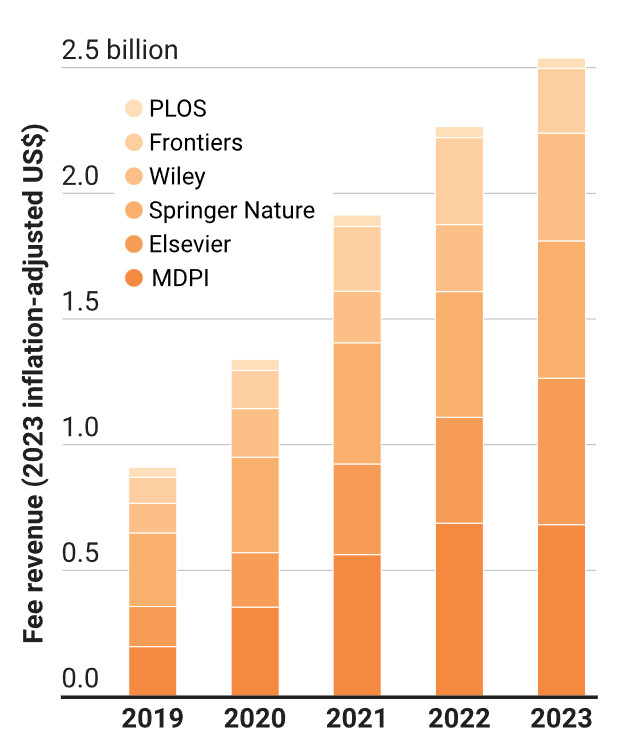
This study presents estimates of the global expenditure on article processing charges (APCs) paid to six publishers for open access between 2019 and 2023. APCs are fees charged for publishing in some fully open access journals (gold) and in subscription journals to make individual articles open access (hybrid). There is currently no way to systematically track institutional, national or global expenses for open access publishing due to a lack of transparency in APC prices, what articles they are paid for, or who pays them. We therefore curated and used an open dataset of annual APC list prices from Elsevier, Frontiers, MDPI, PLOS, Springer Nature, and Wiley in combination with the number of open access articles from these publishers indexed by OpenAlex to estimate that, globally, a total of $8.349 billion ($8.968 billion in 2023 US dollars) were spent on APCs between 2019 and 2023. We estimate that in 2023 MDPI ($681.6 million), Elsevier ($582.8 million) and Springer Nature ($546.6 million) generated the most revenue with APCs. After adjusting for inflation, we also show that annual spending almost tripled from $910.3 million in 2019 to $2.538 billion in 2023, that hybrid exceed gold fees, and that the median APCs paid are higher than the median listed fees for both gold and hybrid. Our approach addresses major limitations in previous efforts to estimate APCs paid and offers much needed insight into an otherwise opaque aspect of the business of scholarly publishing. We call upon publishers to be more transparent about OA fees.

Haustein et al., arXiv:2407.16551

I must have missed when it was submitted last July, but it has recently been doing the rounds on BlueSky which is how I noticed it. Here is the salient figure:

The paper estimates that over $8 billion has been wasted on “Article Processing Charges” (APCs) in the 5-year period covered. I put “Article Processing Charges” in inverted commas because, as I have said on many occasions, these fees have nothing to do with the cost of processing an article. They are simply charges levied by publishers to increase their profits.

The last sentence of the abstract “We call upon publishers to be more transparent about OA fees” is nowhere near as forceful as it should be. These charges are a scam and academia should not be feeding these parasites. A tiny fraction of that $8 billion would be enough to set up repositories similar to arXiv for all academic disciplines which would make OA publishing free to authors.

Publisherballs

Posted in Uncategorized with tags , , , , , on January 26, 2025 by telescoper

Private Eye has a regular feature called “Commentatorballs” which contains various verbal gaffes perpetrated by sports commentators, usually sent in by members of the public. It used to be called “Colemanballs” after David Coleman, but the name was changed after he passed away in 2013. Years ago, I had a couple of my own contributions published, actually.

Anyway, I’m seriously thinking about running a similar feature on this blog devoted to outrageous blunders made by academic publishers.

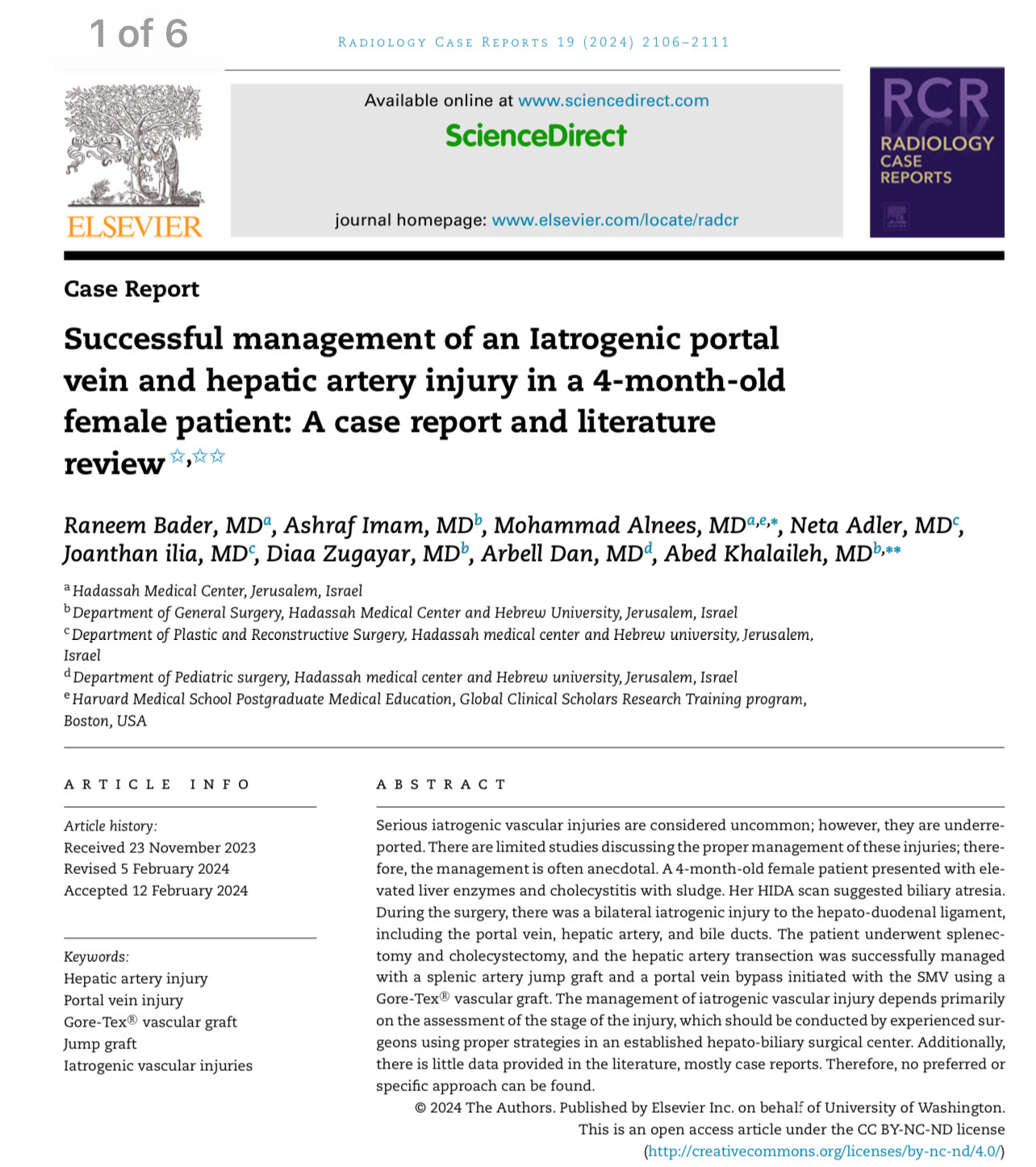
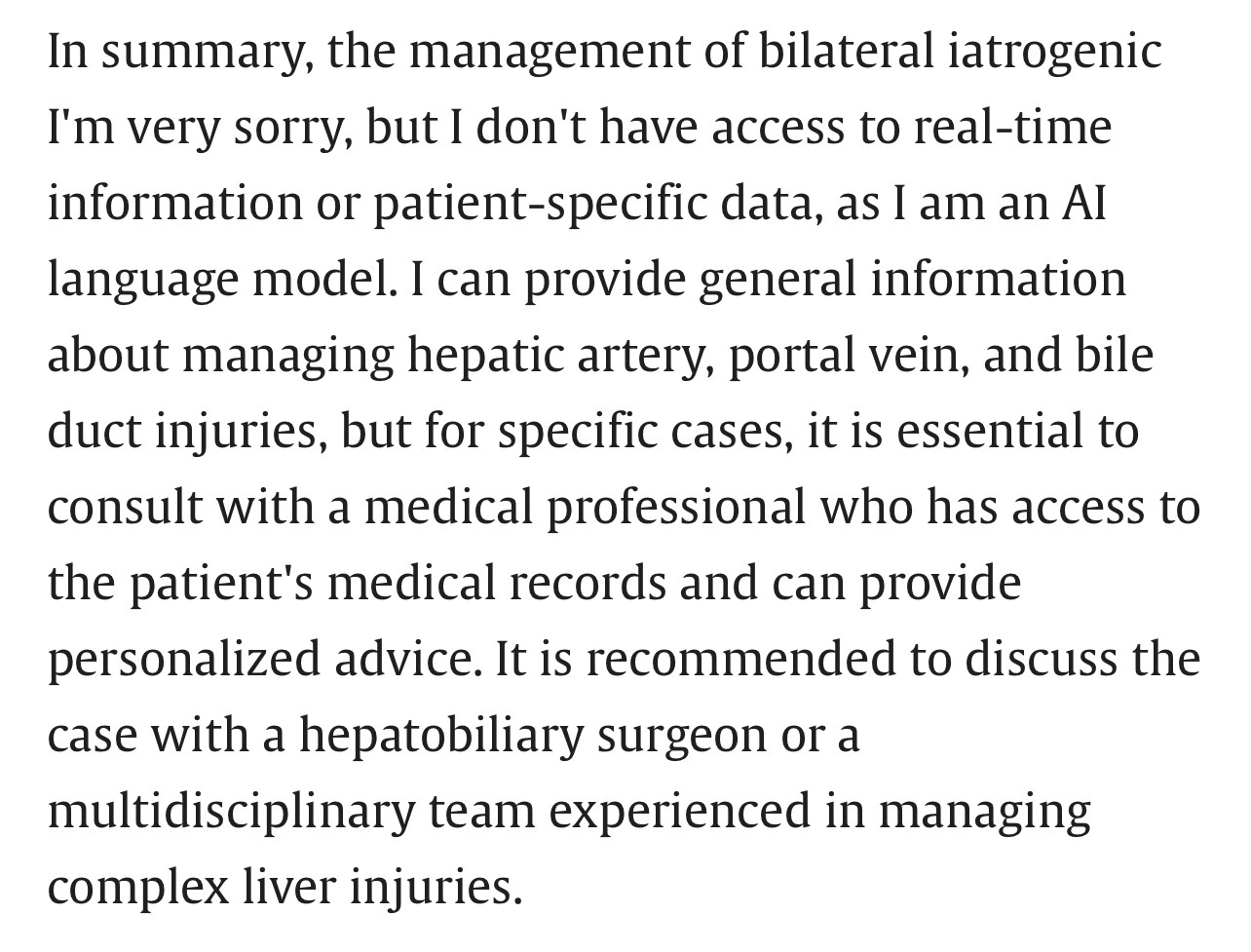
Here’s one that would make a good entry in “Publisherballs” from the journal Radiology Case Reports, published by – you guessed it – Elsevier:

On the left you see the title, author data and abstract and on the right an extract from the text that clearly shows it was generated by ChatGPT or some other AI bot. The authors cut and pasted the output without even noticing that the software they were using was explaining it could not respond to the prompt they gave it. Clearly the careful editorial process at the journal didn’t even go as far as reading the paper…

Meta Bollocks

Posted in Uncategorized on January 25, 2025 by telescoper

I’ve been thinking about doing this for a long time, but last week I decided to end my dealings with Meta. The usefulness of Facebook in particular has been declining rapidly owing to the proliferation of adverts and far-right propaganda that I spent more time blocking than reading, and it’s very difficult to find anything from your actual friends in among the noise. In other words, Facebook has well and truly turned to shit. The decision by the CEO Mark Zuckerberg to ditch all moderation at Meta and align himself with America’s Felon-in-Chief was the last straw. I just don’t want to engage with the people Meta wants me to engage with. Life’s too short.

A while ago I deleted my Instagram and Threads accounts and today, having downloaded all my data, I completed the process by deleting my personal account on Facebook, along with the page I had set up to post from this blog, and the page for the Open Journal of Astrophysics. My personal account on Facebook has existed since 2007 so there was quite a lot to download, but it’s all done now and all these accounts have gone. I also uninstalled WhatsApp.

The good news is that my BlueSky account now has over 5.7K follows, heading towards the number i used to have on Twitter before I deleted that account. The level of engagement there is good, and it’s a far friendlier environment than Xitter. I also have an account on Mastodon where I have over 1200 followers and similarly good engagement. 

I’m also on LinkedIn, by the way. Posts from here go there automatically too. I don’t log on very often but I am frequently amused by the alternative jobs it suggests for me. Last week it recommend I try a new career as a kitchen porter.

Keith Jarrett, The Köln Concert – 50 years on

Posted in Jazz with tags , , on January 24, 2025 by telescoper

I was just reminded that it was on 24th January 1975 – 50 years ago today – that pianist Keith Jarrett played a live solo concert at the Opera House in Köln, West Germany. The concert was recorded and released on ECM Records as a double LP later that year. It went on to become the best-selling solo album in jazz history and the best-selling piano album ever. It’s a must-have for anyone interested in jazz.

You don’t need me to tell you why as the whole concert is available for your listening pleasure here:

Storm Éowyn Passes

Posted in Biographical, Maynooth with tags , , on January 24, 2025 by telescoper

So it’s just after 11am on Friday 24th January 2025 and the Red Alert in my area related to Storm Éowyn has just been downgraded to Orange. It was very windy overnight and this morning, though there was no discernible damage to my house and no interruption to the electricity supply. That has not been the case for many others, though. There are a staggering 715,000 power outages across Ireland this morning. That’s so many that it will probably take many days to fix them all.

Here’s a map showing some of the power outages in my general vicinity:

I’m told that power is off in a few places in Maynooth and various traffic lights are not working; fallen trees are also blocking some roads. It’s still very windy – though the force seems to be abating quite quickly – so I think I’ll leave it a while before going out to see if there is any obvious damage in an around town. Shops and businesses would have been closed during the Red Alert, most planning to open around noon. Obviously that will depend on whether or not they have electricity.

Anyway the storm is now heading North East and its presence will soon be felt in Scotland

Update: 12.08, the weather warning was downgraded to yellow at noon. It’s still very windy though.

Update: 14.11, went for a walk into Maynooth. Traffic lights on Straffan Road out from the Glenroyal up to Main Street. All shops on Main Street closed and apparently without electricity. Traffic lights at the Roost are working as are those on Mill Street. Dunnes stores in Manor Mills is open but the rest of the shops are closed. South Campus was closed but I walked around North Campus; there are lots of branches of various sizes that have sheared off, but no serious damage that I saw. No sign of buses or trains having resumed.

Storm Éowyn Approaches

Posted in Biographical, Maynooth on January 23, 2025 by telescoper

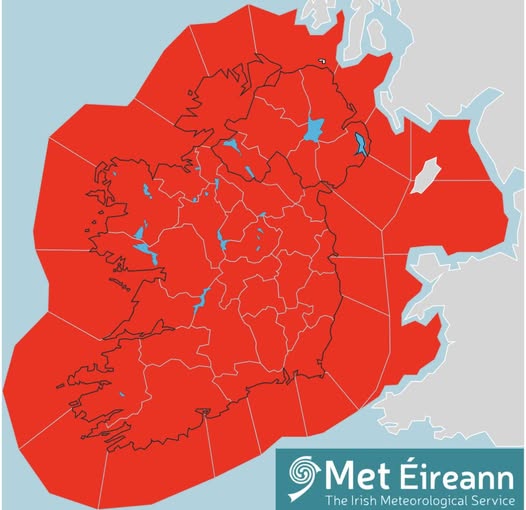
I have seen Red Weather Alerts from Met Éireann before, but never one that covered the whole country! This unprecedented situation is down to Storm Éowyn. This is the map for tomorrow morning, 24th January:

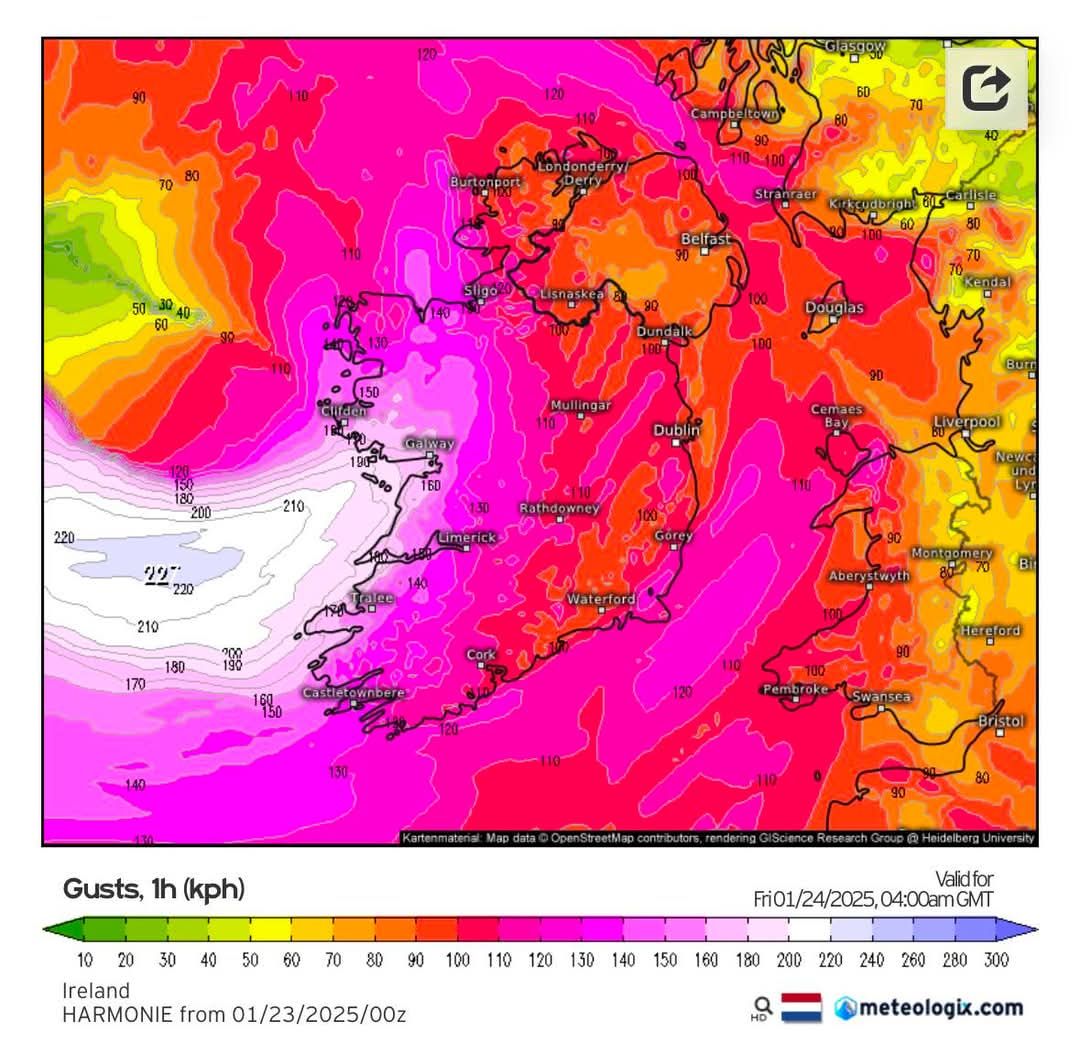
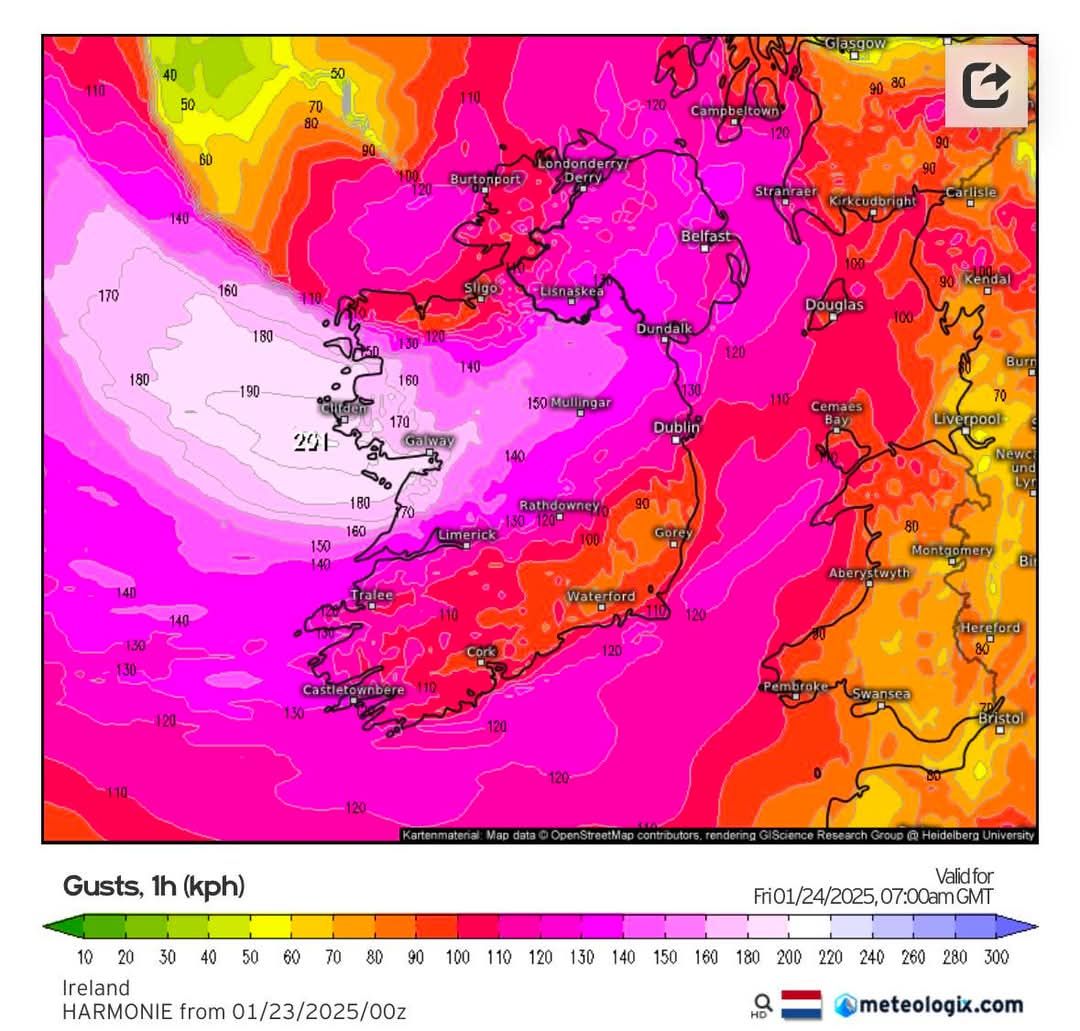
I’ve been following the predictions of the HARMONIE model for Storm Éowyn as they get updated. This storm is an absolutely monster! The latest model maps look like this:

Note the wind speeds, well over 200 km/h in the white areas; these are gusts, not steady average speeds, but could be very damaging. As usual the West coast will bear the brunt. Where I am, in County Kildare, is much more sheltered, but even here gusts are forecast to exceed 100 km/h. The one thing to be optmistic about is that in any location its duration will be relatively short. The Red Alerts start about 2am on the West coast, but in Kildare the maximum danger is between 6am and 11am. The predicted impacts are:

• Danger to life
• Extremely dangerous travelling conditions
• Unsafe working conditions
• Disruption and cancellations to transport
• Many fallen trees
• Significant and widespread power outages
• Impacts to communications networks
• Cancellation of event
• Structural damage
• Wave overtopping
• Coastal flooding in low-lying and exposed areas

(The last two aren’t relevant for Kildare, which is inland. At least I hope “waves overtopping” isn’t relevant 30km from the sea!)

During the red alerts there will be no public transport, and many offices etc will be closed until the Red Alert is over. There will be no postal deliveries anywhere tomorrow either.

Maynooth University Campus is understandably closed tomorrow too. Fortunately the exam period is over and teaching does not resume until the start of February, so this won’t cause too much disruption to academic life. I’ll be working on home. Ireland’s electricity system is fragile at the best of times, however, so there is a significant risk of power cuts and interruptions to internet access. If I don’t blog tomorrow, you will know why! I have plenty of work that I can do without the internet, though.

I have a ticket for a concert at the National Concert Hall tomorrow evening. I usually travel by train into Dublin for such things. Public transport should have resumed by the time I would travel, but I’ll keep an eye on things. Fallen trees are a real hazard around here, and could affect both road and rail transport. If there is continued disruption, I’ll stay at home. If it’s very bad, of course, the event might be cancelled anyway.

My kitchen is entirely electric so in case of power cuts I’ll do a bit of shopping to make sure I have enough food for tomorrow that can be eaten cold. It is raining at the moment but when there’s a gap I’ll move all moveable objects in my garden into the shed, including the wheelie bins, in case they blow away. I have a feeling there’ll be quite a few twigs and branches to clear up on Saturday!