Archive for July, 2025

Masters from Cambridge

Posted in Biographical, Education with tags , , , on July 23, 2025 by telescoper

A few weeks ago, after I posted an item about it being 40 years since I graduated from the University of Cambridge, I was talking to some students. The main subject was that the primary route for becoming a research student is to do an undergraduate degree (Bachelors) followed by a taught postgraduate programme (Masters) before starting a PhD or equivalent. In the course of that discussion I mentioned that I skipped the middle step and went straight from my (three-year) BA at Cambridge to my DPhil at Sussex. Nevertheless, I have got a Masters degree: MA (Cantab), to be precise.

I had to explain that if you graduate from the University of Cambridge then all you have to do is wait a few years and then your B.A. automatically becomes an M.A. In my memory I received news of this just a year or two after graduation but this evening I found the correspondence and it was later than that:

By December 1988 I’d already finished my DPhil thesis, though I wasn’t formally awarded the degree until the following July. I didn’t turn up to the graduation ceremony, of course. I had done at least some work for my B.A. but did nothing at all for my M.A. except survive for three and a half years. Neverthless, I still have the stiff ticket (right) which I show here alongside my B.A. certificate (left) to demonstrate that it looks just like a proper degree certificate even though it is, frankly, a bit of a fraud.

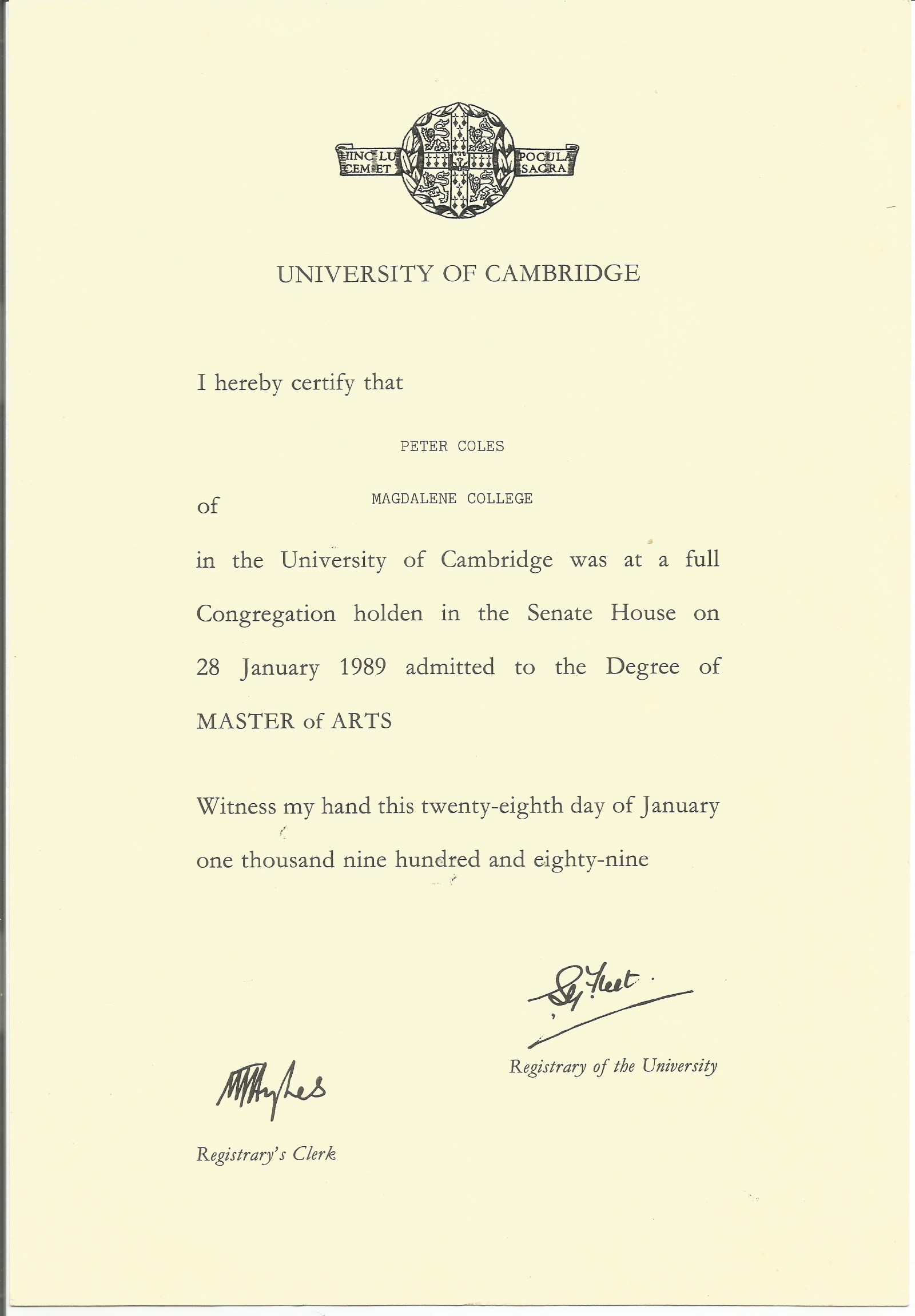
I bet our MSc students currently hard at work on their dissertations wish that theirs were so easy!

By the way, having an MA also gives you (limited) dining rights in College. I’ve never once availed myself of this privilege.
Small Things Like These, by Claire Keegan

Posted in Literature with tags , , on July 23, 2025 by telescoper

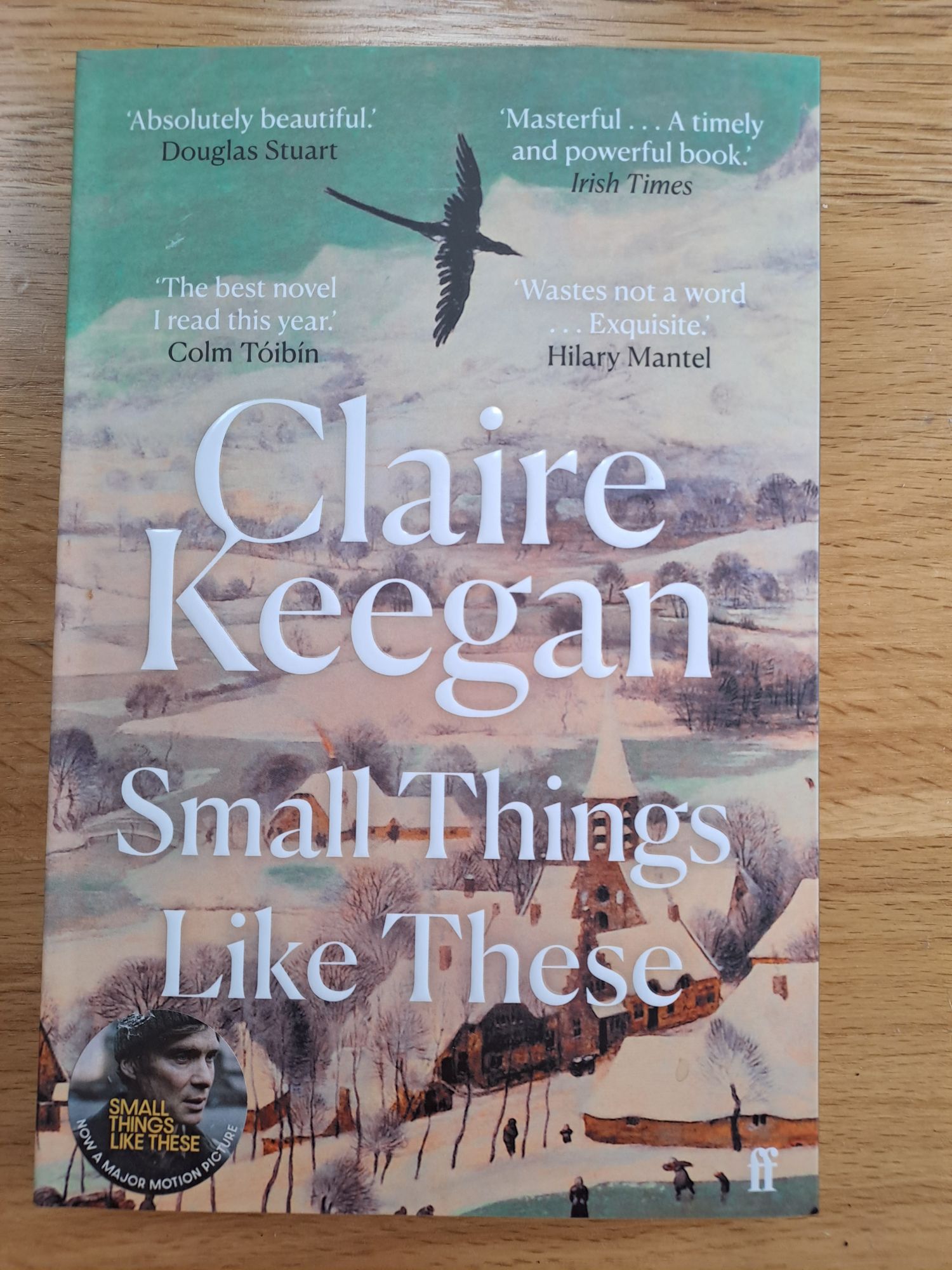
Now on a bit of a roll, I’ve finished reading the third of the  six novels I bought earlier this year. The first of these I read was Foster, by Claire Keegan who also wrote the latest, Small Things Like These. There’s much in common between these two works, not only in the beautifully spare writing style with which the stories are told, but also in the message hope of they find in grim circumstances.

The current book is revolves around a character called Tom Furlong, a hard-working and moderately successful timber and coal merchant who makes deliveries around his neighbourhood. It is set in the 1980s, in a time of economic recession, shortly before Christmas. Tom is happily married with five daughters. Tom doesn’t know who his father was; he was raised by a kindly Protestant lady. One day making his delivery round takes him to the local convent, where he sees the harsh treatment of young unmarried mothers in the Magdalene laundry run by the nuns; later visiting the same place to deliver coal he finds a young girl locked in the coalhouse, in the freezing cold. These and other episodes unsettle Tom, by making him think about how lucky he has been, largely thanks to the kindness of others, and how small things can make a huge difference to how one’s life turns out. What he does at the end of the story is not a small thing at all, and we aren’t told how it works out, but it is an act of kindness and he does it for all the right reasons, so we feel it will somehow all work out for the best.

The last novel I wrote about was a work of historical fiction, and so is this. Although it is set in the 1980s, that was a time in which social attitudes in Ireland were much more dominated by the Roman Catholic Church than they are now, the cruelty of the mother-and-baby homes being just one example. Keegan is at pains to point out that the convent is right next door to the local school, two aspects of the same system of social control.

Small Things Like These was published in 2021 and has already been made into a film featuring Cillian Murphy. I haven’t seen the film, unlike Foster in which case I saw the film based on it, An Cailín Ciúin, before reading the book. I must see the film.

P.S. At the end I found myself thinking of these lines from Wordsworth’s Tintern Abbey

As have no slight or trivial influence
On that best portion of a good man's life,
His little, nameless, unremembered, acts
Of kindness and of love.

BBC Sounds Confusing

Posted in Music, The Universe and Stuff with tags , , , , on July 22, 2025 by telescoper

The BBC Proms having started on Sunday (20th July), I decided to listen to some of the concerts via BBC Sounds. One can’t get BBC Radio 3 on the radio here in the Republic, at least not this far from the border.

I was disappointed, then, to see that BBC Sounds is no longer available to listeners outside the UK. Apparently The BBC is making BBC Sounds exclusively available to UK license fee payers, meaning users outside the UK, including those in Ireland, will no longer be able to access the full service. This change came into effect yesterday (21st July).

So here I am, as I write this, on 22nd July, listening to this evening’s Promenade concert via BBC Sounds. No, I’m not doing anything illegal or unlawful. Neither did I last night, when I listened to Mahler’s Symphony No. 7. It’s just that the change has been implemented in a very peculiar and confusing way.

To start with, this is what I see a see on my screen right now:

I don’t think you get the top message if you listen in the UK, but then you might be listening on the radio anyway.

At the top it says use the BBC.com or the BBC App. For one thing I can’t find any sign of the “BBC App” on PlayStore on anywhere else. For another, BBC.com offers only Radio 4, BBC World Service and a random selection of podcasts. So neither of those options are any good for listening to Radio 3.

If you click to “Find out how to listen to other BBC stations” you get this page which “explains”:

Earlier this year, we launched a new audio service outside the UK on BBC.com and the BBC app. This includes access to BBC Radio 4 and BBC World Service English, thousands of hours of podcasts (including Global News Podcast, World of Secrets and Infinite Monkey Cage) – as well as some of the best of the BBC’s journalism and storytelling including news and history programming.  

As part of the announcement, we said we planned to close BBC Sounds to audiences living outside the UK later this year, making it available exclusively to people in the UK. Anyone who lives in the UK will still be able to use the BBC Sounds app when they go on holiday abroad. We can now confirm that BBC Sounds closed for listeners based outside the UK on 21 July 2025.

Leaving aside the mystery of the “BBC app”, this suggests that BBC Sounds is closed to listeners outside the UK. Except it isn’t.

The article goes on to explain:

Please use the links below for live listening access to the BBC’s other radio stations from across the UK, including BBC Radio 1, Radio 2 and Radio 3, 6Music, 1Xtra and Asian Network, Radio 4Xtra and 5Live, all the BBC’s stations from the UK nations and every local radio station in England.

The link to BBC Radio 3 is this:

https://www.bbc.co.uk/sounds/play/live/bbc_radio_three#noapp

In other words, it takes you back to BBC Sounds, which is where I am listening now! As far as I understand it, one can still listen to the live internet stream of BBC Radio on BBC Sounds, so it’s not closed to listeners outside the UK after all. What is closed (to us foreigners) is the back catalogue of past recordings. I only ever listen to live broadcasts, however, so after all that it’s business as usual for me.

I hope this clarifies the situation.

Happy Retirement, James Hirschfeld!

Posted in mathematics with tags , , on July 22, 2025 by telescoper

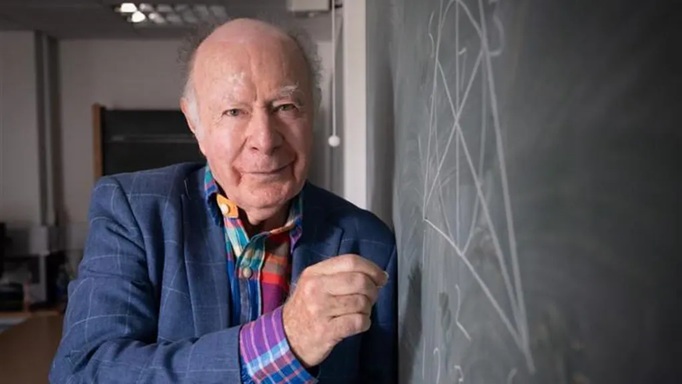
I’m indebted to my erstwhile colleague from Sussex days, Dorothy Lamb, for passing on the news that another former colleague from Sussex days, mathematician Professor James Hirschfeld, has finally retired at the age of 84. He formally retired some years ago, but remained in employment as a Tutorial Fellow. He was very popular with students and staff alike.

Prof. James Hirschfeld, picture credit: University of Sussex

James started as a lecturer at Sussex University in 1966, soon after the opening of the University, and remained working there for almost 60 years. I remember him well from both my stints here: from 1985-990 when I was a research student and then postdoc in the Astronomy Centre, and then from 2013 to 2016 when I was Head of the School of Mathematical and Physical Sciences, of which the Department of Mathematics was a part. He was an excellent colleague who knew the workings of the University inside out and provided valuable advice on many occasions.

James’s retirement was marked by an event at Sussex University. I’m sure I speak for many present and past colleagues and students in wishing him a long and happy retirement.

CP Violation in Baryons

Posted in The Universe and Stuff with tags , , , , , , , on July 21, 2025 by telescoper

I was (pleasantly) surprised to learn a few weeks ago that I shall be teaching particle physics again next academic year. That means that I’ll have to update to the notes to reflect the latest news from CERN. Researchers from the LHCb collaboration have published evidence for CP violation in baryons. The paper is published in Nature here.

For those of you not up with the lingo, CP is an operator that combines C (charge-conjugation, i.e. matter versus anti-matter) and P (parity, i.e. inversion of coordinates). Parity has been known since the 1950s to be violated in weak interactions, so the weak nuclear force distinguishes between states of odd and even parity. CP violation was first demonstrated in the 1960s CP in the decays of neutral kaons resulted in the Nobel Prize  in 1980 for its discoverers Cronin and Fitch. CP violation has subsequeuntly been seen in many other meson decays.

But the mesons (consisting of a quark and an antiquark) are only half of the family of particles made from quarks; the others are the baryons which are made of three quarks (c.f. James Joyce’s “Three quarks for Muster Mark” in Finnegans Wake). Antibaryons consist of three antiquarks, but such are not mentioned in Finnegans Wake.

The baryons concerned in the LHCb experiment contain an up quark, a down quark and a beauty quark and were produced in proton–proton collisions at the Large Hadron Collider in 2011–2018. These baryons and antibaryons can decay via multiple channels. In one, a baryon decays to a proton, a positive K-meson and a pair of pions – or, conversely, an antibaryon decays to an antiproton, a negative K-meson and a pair of pions. CP violation should create an asymmetry between these processes, and the researchers found evidence of this asymmetry in the numbers of particles detected at different energies from all the collisions.

A problem with calculating the magnitude of this effect for baryons is that there is a contribution from the strong force – see the curly line indicating a gluon in the lower panel on the left above – and that is much harder to compute than a pure weak force (represented by the wavy lines indicating W bosons. Yo will see that the tree and loop diagrams involve quark mixing, a process that allows quarks of different generations to couple via weak interactions; there is a buW vertex in the top panel and a tsW vertex in the bottom one. Given the uncertainties, it seems the results are consistent with the level of CP violation predicted in the Standard Model of particle physics.

The big question surrounding this result is whether it can account for the fact that our Universe – or at least our part of it -contains a preponderance of baryons over anti-baryons, so somehow the interactions going on during the Big Bang must have shown a preference for the former over the latter. This problem of baryogenesis is not explained in the Standard Model and, since these results are consistent with the Standard Model, the answer to that question is “no”…

Star of the Sea, by Joseph O’Connor

Posted in History, Literature with tags , on July 20, 2025 by telescoper

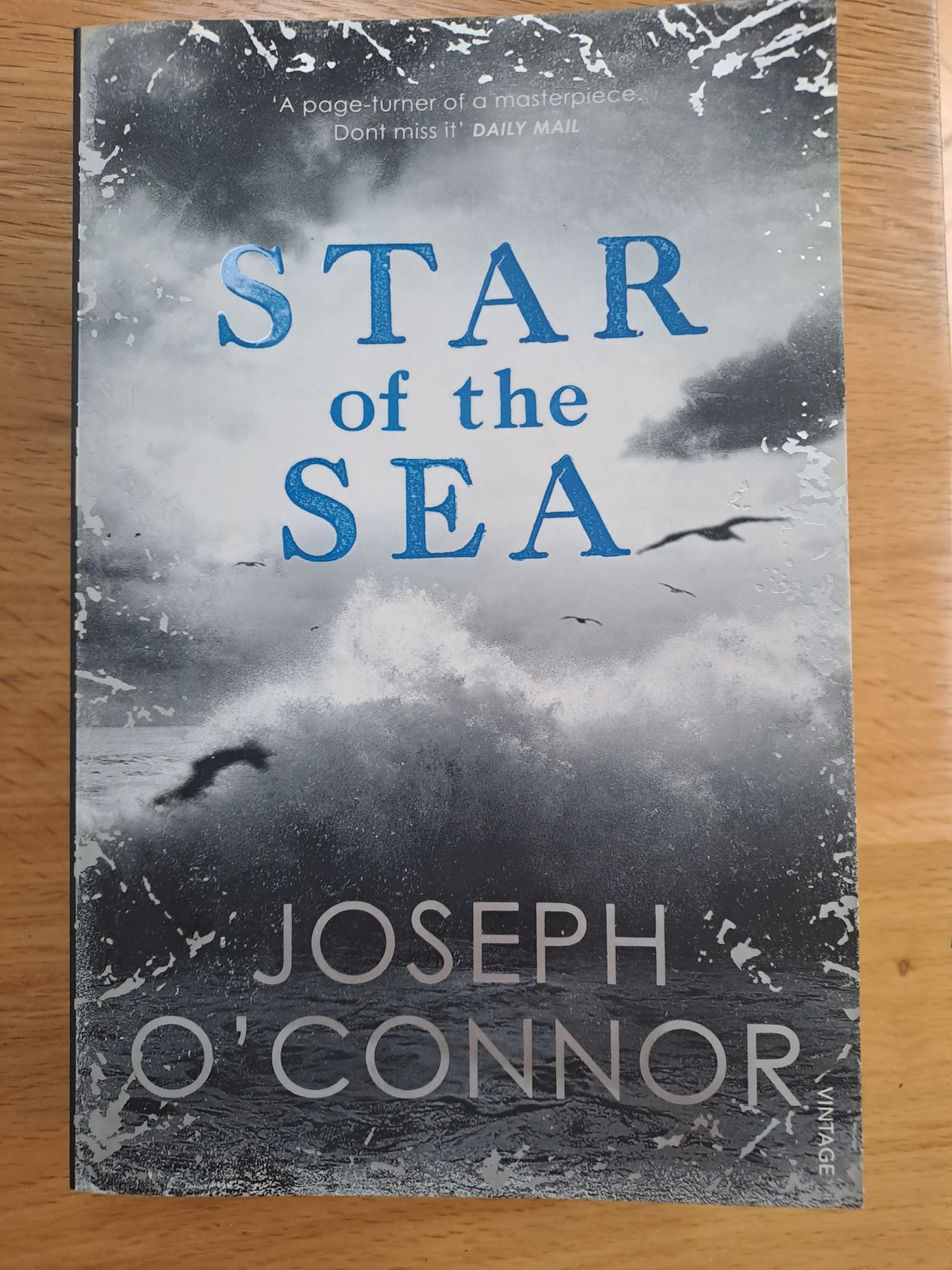
After the excitement of today’s Hurling Final, I finished the second of the six novels I bought earlier this year. Star of the Sea by Joseph O’Connor is set in 1847 and onboard the ship that gives the novel its name, bound for New York from Ireland, carrying desperate passengers fleeing the Great Famine, which provides the overall context for the story.

It’s worth quoting a couple of paragraphs from the author’s introduction to the novel:

We tourists take pleasure in the emptiness of Connemara. There are reasons why such a silence exists. You would not think, as you amble the sleepy lanes, as you are stilled by the twilight descending on the mountain, that you are walking through a space that was once a disaster zone: the Ground Zero, perhaps, of Victorian Europe. These meadows, those pebbled fields, saw astonishing suffering. There was heroism too; there was extraordinary courage and love. But these wine-dark boglands and rutted boreens witnessed tragedy so immense that those that witnessed it, like Grantley Dixon in my novel, would never forget the sight.

All this happened in the 1840s , that decade in which a million of the Irish underclass died as a consequence of famine. residents of the richest kingdom on earth, they lived only a few hundred miles from the empire’s capital, London. But that did not save them; nothing saved them. Abandoned by the dominant of Ireland and Britain, perhaps two million of the desperate became refugees. We might call them `asylum seekers’ or `economic migrants’. They fled their homeland by any means possible, often on ships like the Star of the Sea. Their language, Gaelic, already in decline virtually disappeared overnight. `Mharbh an gorta achanrud‘, one Gaelic speaker remembered. ‘The famine killed everything’.

O’Connor writes unflinchingly about the effects of famine, the poverty, deprivation and starvation, as well as the squalid rqat-infested conditions the `economic migrants’ were forced to endure on their month-long voyage to America. This in itself is interesting, as it has always seemed to me quite surprising that so few Irish authors have written books about An Gorta Mór. But while the Great Hunger is always present, and is what precipitates most of the action, this book is about many other things besides.

The story begins on Star of the Sea with a mysterious character who is taken to walking the decks at night. We learn very early on that his name is Pius Mulvey and his intention is to commit murder. But who is he to kill, and how, and why? The answer to the last of these questions is revealed through a series of flashbacks that reveal connections between him and several passengers in First Class, including a bankrupt Lord Merridith attempting to escape his creditors, Merridith’s wife and family, an aspiring novelist (the Grantley Dixon mentioned above), and a maidservant (Mary Duane) whose connection to them and to Mulvey is deeply tragic. The narrative is interspersed with excerpts from the log of the ship’s Captain, sundry clippings from contemporary newspapers and magazines, including examples of vile anti-Irish racism from the satirical magazine, Punch, and folk songs of the time. It’s all very carefully and cleverly plotted.

It’s partly a mystery novel, partly a suspense thriller, and partly a social commentary worthy of Dickens (who actually appears in the book, in chapters describing Pius Mulvey’s past life in London). It takes a master story-teller to bring all these elements together convincingly, and that is what Joseph O’Connor clearly is. It is not exactly a whodunnit, but I will nevertheless refrain from posting any spoilers as the ending is very clever (as indeed is the whole book). I’ll just say that I found the whole book immensely satisfying and I recommend it highly, as a novel that has real depth as well as being a true page-turner.

Star of the Sea was published in 2002, and was a best-seller then. It’s taken me too long to discover it. I must read more by Joseph O’Connor, but I have four others on my list to finish first!

All-Ireland Senior Hurling Championship Final

Posted in GAA with tags , , on July 20, 2025 by telescoper

As it was foretold, today sees the All-Ireland Senior Hurling Championship Final at Croke Park in Dublin. Unfortunately the weather isn’t great: there’s been quite a lot of rain already today, and the forecast is for more. It’s also extremely humid (93%).

I will however be watching on TV from the comfort of my living room. For those of you in the UK, there is live coverage on BBC2 from 3pm.

This year’s final is between Cork and Tipperary and takes place this afternoon, Sunday 20th July, with the throw-in at 3.30pm. Cork are strong favourites, with bookies quoting odds of 3-1 on (or even shorter). That’s not surprising because they put seven goals past Dublin in their semi-final a couple of weeks ago.

I’ll update this post with the final score (for the files) when it’s all over.

HALF-TIME: Cork 1-16 Tipperary 0-13. A breathless first half with Tipperary playing with just one man up the field and packing the defence to avoid conceding goals, which they did until the very end of the first half when Shane Barrett scored the first. Tipperary actually had the sliotar in the net earlier on, but the goal was disallowed for a square ball: an attacking player cannot be inside the small rectangle (also known as the “6-yard box”) before the ball enters it. Very noticeable that Croke Park is a sea of red – clearly Cork supporters did better at getting tickets!

FULL-TIME: Cork 1-18 Tipperary 3-27. What an amazing turnaround, and a superb second-half performance from Tipperary! Cork completely disintegrated after half-time, scoring only two points in the half to Tipperary’s 23, including three goals (one of them a penalty that also resulted in Cork going down to 14 men). Nothing went right for Cork, who hit the woodwork 4 times even and even missed a penalty, but by then the game was already lost.

Tippperary are the 2025 All-Ireland Senior Hurling Champions!

Weekly Update from the Open Journal of Astrophysics – 19/07/2025

Posted in OJAp Papers, Open Access, The Universe and Stuff with tags , , , , , , , , , , , , , , , , , , , , , , , , , , on July 19, 2025 by telescoper

It’s Saturday morning again, so it’s time again for an update of papers published at the Open Journal of Astrophysics. Since the last update we have published six new papers, which brings the number in Volume 8 (2025) up to 98, and the total so far published by OJAp  up to 333. I expect we’ll pass the century for this year sometime next week.

The papers published this week, with their overlays, are as follows.  You can click on the images of the overlays to make them larger should you wish to do so.

The first paper to report is “Reconstructing Galaxy Cluster Mass Maps using Score-based Generative Modeling” by Alan Hsu (Harvard), Matthew Ho (CMU), Joyce Lin (U. Wisconsin-Madison), Carleen Markey (CMU), Michelle Ntampaka (STScI), Hy Trac (CMU) & Barnabás Póczos (CMU), all based in the USA. This paper was published on 14th July 2025 in the folder Cosmology and NonGalactic Astrophysics. It presents a diffusion-based generativbe AI model for reconstructing density profiles for galaxy clusters from observational data.

The overlay is here:

The officially-accepted version can be found on arXiv here.

The second and third papers are related. They were both published on 14th July in the folder Cosmology and NonGalactic Astrophysics.

The first of the pair is “J-PLUS: Tomographic analysis of galaxy angular density and redshift fluctuations in Data Release 3. Constraints on photo-z errors, linear bias, and peculiar velocities” by Carlos Hernández-Monteagudo (IAC, Tenerife, Spain) and 21 others. This presents an analysis of the Javalambre Photometric Local Universe Survey (J-PLUS) in redshift slices with a discussion of prospects for extracting cosmological information. The overlay is here:


You can find the final version of the manuscript on arXiv here.

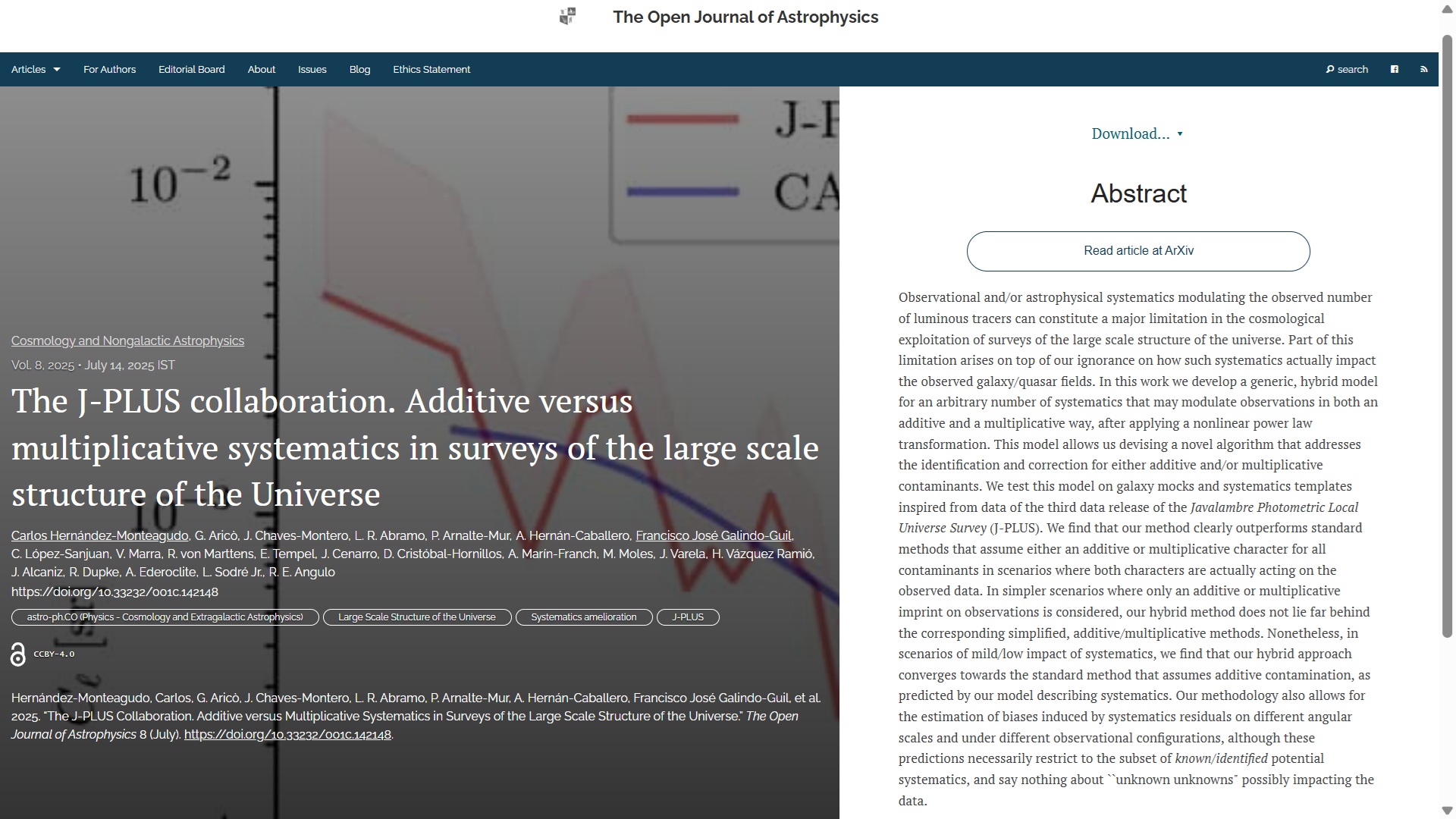
The second of this pair is “The J-PLUS collaboration. Additive versus multiplicative systematics in surveys of the large scale structure of the Universe” by Carlos Hernández-Monteagudo (IAC) and 21 others (the same authors as the previous paper).  This paper presents an analysis of systematic effects in the Javalambre Photometric Local Universe Survey (J-PLUS), and a new model for handling such errors in this and other cosmological surveys. The overlay for this paper is here:

You can find the officially accepted version of this paper on arXiv here.

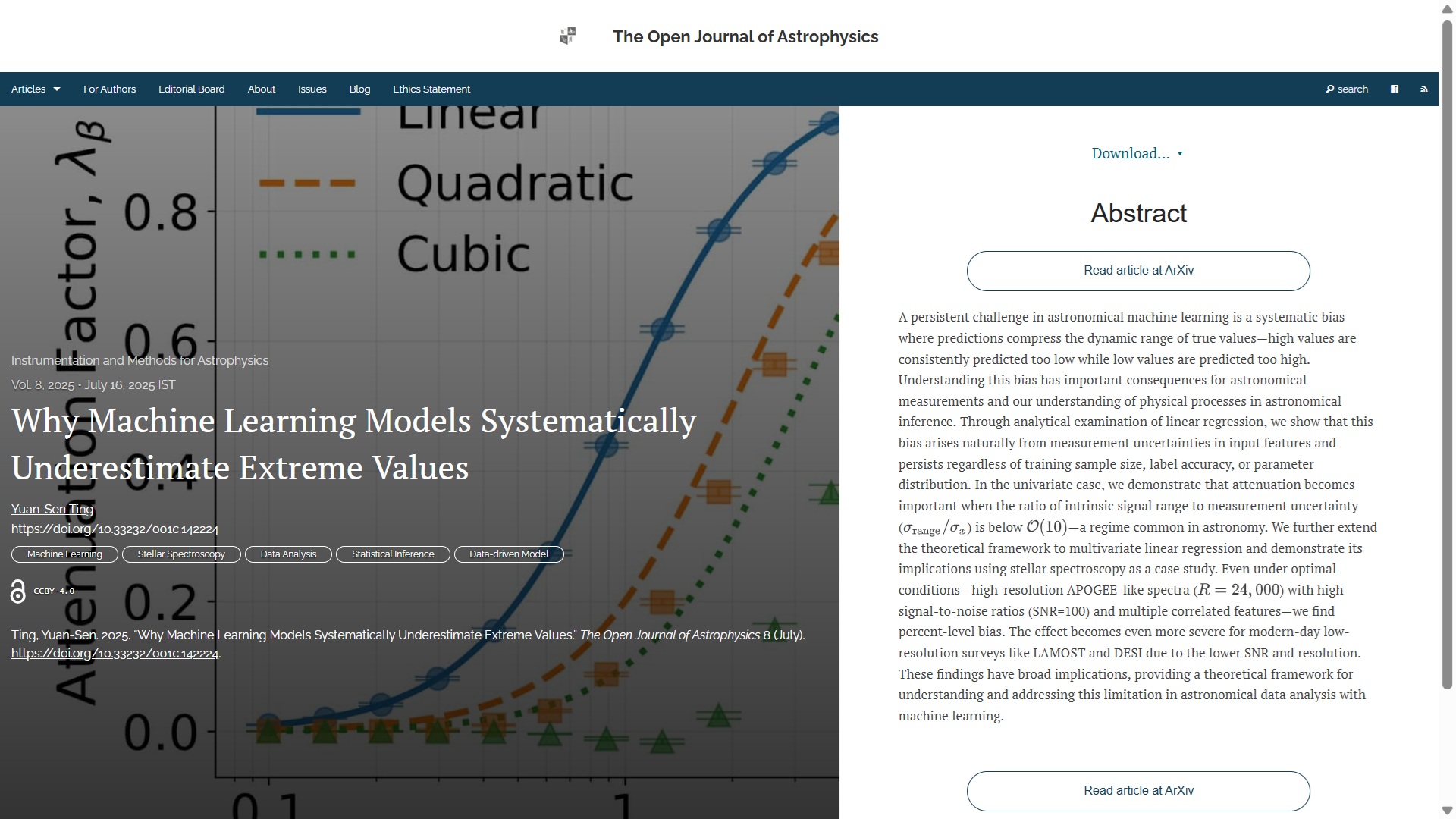
The fourth paper this week is “Why Machine Learning Models Systematically Underestimate Extreme Values” by Yuan-Sen Ting (Ohio State University). This one was published on July 16th in the folder marked Instrumentation and Methods for Astrophysics.  This paper presents a theoretical framework for understanding and addressing a bias that suppresses the dynamic range of variables in applications of machine learning to astronomical data analysis. Here is the overlay:

You can find the officially accepted version of this paper on arXiv here.

The penultimate article for this week is “Bridging Machine Learning and Cosmological Simulations: Using Neural Operators to emulate Chemical Evolution” by Pelle van de Bor, John Brennan & John A. Regan (Maynooth University) and Jonathan Mackey (Dublin Institute for Advanced Studies), all based in Ireland. This paper uses machine learning, in the form of neural operators, to emulate the Grackle method of solving non-equilibrium chemistry equations in cosmological hydrodynamic simulations and was published on 16th July also in the folder Instrumentation and Methods for Astrophysics. The overlay is here:

The final, accepted version of the paper is on arXiv here.

The last article published this week is “Astronomical Cardiology: A Search For Heartbeat Stars Using Gaia and TESS” by Jowen Callahan, D. M. Rowan, C. S. Kochanek and K. Z. Stanek (all of Ohio State University, USA). This paper presents a study of a sample of 112 new spectroscopic binaries called hearbeat stars (because their light curves resemble electrocardiagrams). It was published on 16th July 2025 in the folder marked Solar and Stellar Astrophysics. The overlay is here:

You can find the officially-accepted version on arXiv here.

And that’s all the papers for this week. I’ll do another update next Saturday.

All-Ireland Hurling Final Weekend

Posted in GAA with tags , , on July 18, 2025 by telescoper

Just a quick note, primarily for those of you not in Ireland, to point out that this weekend sees the All-Ireland Senior Hurling Championship Final at Croke Park. There’s always a fantastic atmosphere for this event and I’m looking forward to it enormously. It’s every bit as big as the FA Cup Final used to be when I was a kid.

This year’s final is between Cork and Tipperary and takes place on Sunday 20th July, with the throw-in at 3.30pm.

For those of you in the UK, there is live coverage on BBC2 from 3pm.

Global Talent Ireland

Posted in Maynooth, The Universe and Stuff with tags , , on July 18, 2025 by telescoper

The Government of Ireland has just announced details of a scheme called Global Talent Ireland. Full details of the scheme can be found here but, in a nutshell, the scheme aims to attract exceptional mid-career and established researchers from across the globe to Ireland. Researchers funded through this programme are required to transfer their research activities from their current location to any Eligible Research Body in Ireland. Given its commitment to equality, diversity and inclusion, Research Ireland welcomes applications from women and those from historically underserved communities.

The programme budget includes the resources to build a research team (e.g., staff, consumables and travel) to carry out high-impact, world-class research, and additional start-up costs to support the researcher’s move to Ireland. These positions are available for any area of research supported by Research Ireland.

The programme comprises two streams: Rising Stars and Research Leaders. High level details are outlined in the table below: 

The timescale for this is very short (as the window lies in the vacations for people likely to be recruited). In the case of Maynooth, which I assume is an Eligible Research Body, there is a first-stage internal process for Expressions of Interest to be completed by 29th July (i.e. less than two weeks away). There is then a selection for submissions to be forwarded to the Government by August 28th 2025.

As the timescale is so short I would ask anyone interested in taking up such a position in the Department of Physics at Maynooth University to contact me as soon as possible, as both the Head of Department and Dean of the Faculty of Science and Engineering are away at the moment. Ireland’s recent decision to join CERN as well as membership of the European Southern Observatory and the European Space Agency might be good strategic grounds for an application.

Those interested in other areas of research would be advised to contact the relevant Departments as soon as possible. The selection process is bound to be very competitive, but you can’t win the prize if you don’t buy a ticket!