Further to my earlier post, I refer you to this much more detailed article by someone actually involved in the LIGO experiment, former Cardiff colleague Bernard Schutz..
Archive for September, 2025
More on the 10th Anniversary of Gravitational Waves
Posted in The Universe and Stuff with tags Advanced LIGO, Bernard Schutz, Black hole merger, gravitational waves, GW Astronomy, GW150914 on September 14, 2025 by telescoperA Decade of Gravitational Waves
Posted in Biographical, The Universe and Stuff with tags Advanced LIGO, arXiv:2508.18082, Black hole merger, black holes, gravitational waves, GW150914, inspiral on September 14, 2025 by telescoperThis is just a quick post to mark the fact that it is now ten years to the day since the first detection of gravitational waves by Advanced LIGO. The acronym LIGO stands for Laser Interferometer Gravitational-wave Observatory, by the way. It wasn’t until February 11th 2016 that the result was announced at a press conference (which I blogged about here), but the signal itself arrived on 14th September 2015, exactly a decade ago; the name given to the event was GW150914.
Here are the plots for that first one:

That first signal corresponded to the coalescence of two black holes, of masses 29 and 36 times the mass of the Sun and produced a large response in the detectors very soon after Advanced LIGO was switched on. There’s synchronicity for you! The LIGO collaboration have done wondrous things getting their sensitivity down to such a level that they can measure such a tiny effect, but there still has to be an event producing a signal to measure. Collisions of two such massive black holes are probably extremely rare so it’s a bit of good fortune that one happened just at the right time. Actually it was during an engineering test.
There have been many subsequent detections and even more candidates waiting to be confirmed- here’s a full list. The official LIGO site states there are 90 confirmed detections, the 4th observational run (O4) (which is due to end in November 2025) has already found 200 candidates. The latest compilation of gravitational-wave transient sources can be found here.
Most of the detections have been binary black hole mergers, but I particularly remember the excitement in 2017 surrounding the first merger of a neutron star with a black hole. It was fun that rumours started to spread via this blog as people outside the LIGO/transient source community used a comments thread here to share information of what various telescopes were looking at. That was in August 2017, just over 8 years ago.
Anyway, here’s to the next decade. Assuming NSF does not follow Trump’s plan to slash the LIGO budget.
McTee, Mozart & Strauss at the National Concert Hall
Posted in Music with tags David Fray, Ein Heldenleben, Leonard Slatkin, Mozart Piano Concerto No. 20, music, National Concert Hall, National Symphony Orchestra Ireland, Richard Strauss, Wolfgang Amadeus Mozart on September 13, 2025 by telescoper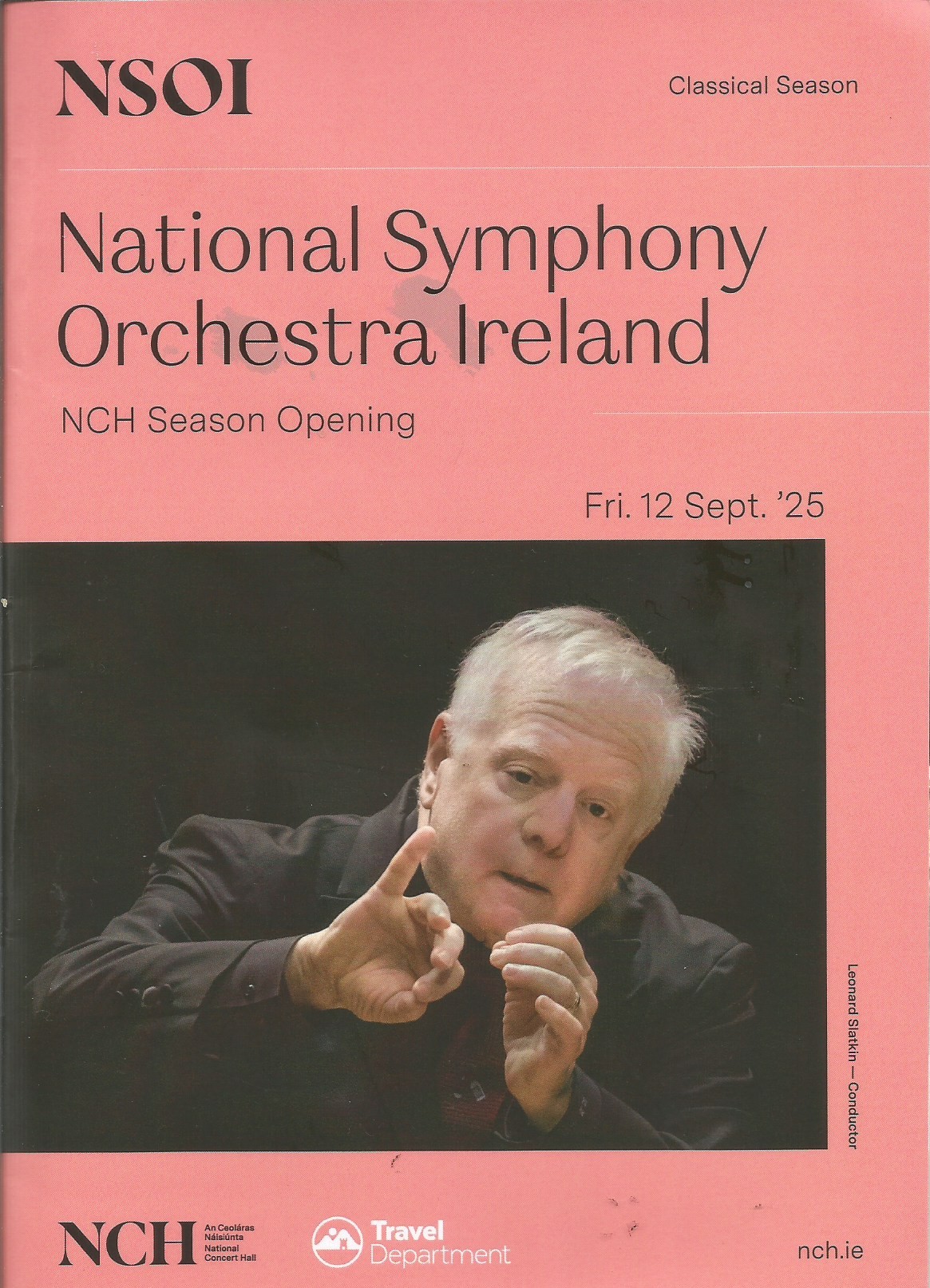
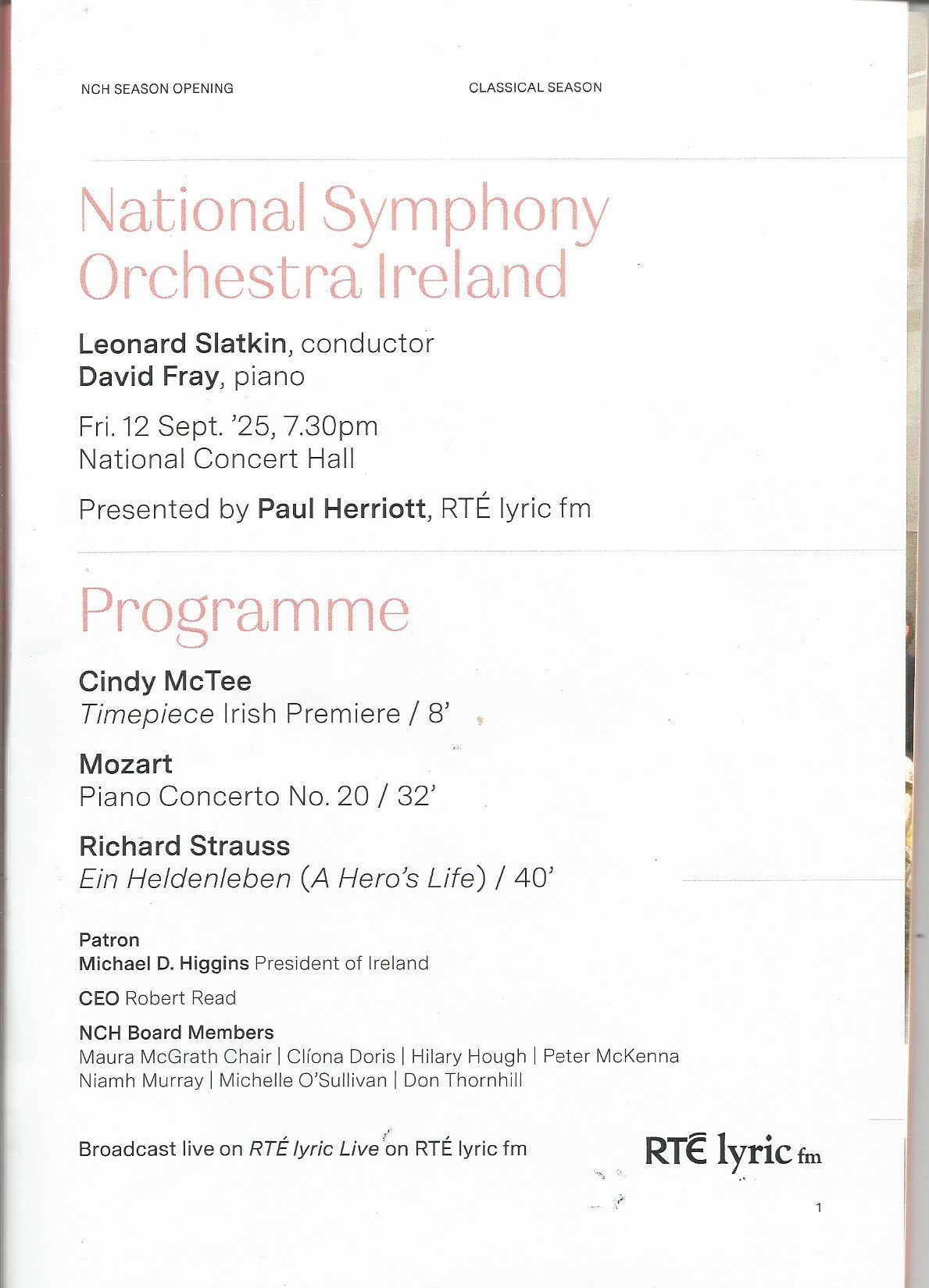
As it was foretold, last night I went to the National Concert Hall in Dublin for the opening performance of the new season by the National Symphony Orchestra Ireland, this time under the baton of veteran conductor Leonard Slatkin.
The appetiser for this concert was Timepiece by American composer Cindy Mctee. It’s a short piece, quite new to me before last night, with a slowish introduction leading into a very energetic main body of the work. This piece brought out some fine playing by the orchestra, especially the percussion section. You can read more about this intriguing and enjoyable composition in the composer’s own words here. She was in the audience last night, and came up on stage at the end of the performance to receive the plaudits.
Next we had a very familiar piece: the Piano Concerto No. 20 in D Minor by Wolfgang Amadeus Mozart, with David Fray at the piano. Mozart apparently composed this in a rush to meet the deadline of its first performance, but it doesn’t seem that way. The three movements (marked Allegro, Romanza and Allegro Assai) are very different in mood: the first (which is quite long) is brooding and rather Sturmy and Drangy, while the second is much gentler; both these movements feature memorable tunes; the third is much more pyrotechnical, with a very propulsive start and some virtuosic cadenzas. I think the last was played the best. David Fray is a curious performer to watch: he sat in the same sort of chair as the members of the orchestra – one with a back – rather than the usual stool, and had a very unusual posture. He slouched, in fact; he often turned round to look at the musicians behind him too. Anyway, he played very well indeed and for an encore he gave us some Bach (a solo piano arrangement of Air on the G String), which was lovely.
After the wine break we came back for a performance of Ein Heldenleben (“A Hero’s Life”) by Richard Strauss. I had never heard this piece in full before last night, and I have to say I didn’t like it much. There are some very nice passages in it, and there was some excellent playing by the brass and solo violin by NSOI leader Elaine Clark, but overall I found it a rather aimless reworking of some of Strauss’s other tone poems (some of which are actually very good). It’s also far too long for what it has to say.
The “Hero” of the title is of course meant to be the composer himself, which says something of the high regard in which Strauss held himself. At times the piece is tediously bombastic. The composer was 34 when he wrote this piece; about the same age that Mozart was when he died. I don’t think had he lived the latter would have written a self-indulgent piece like this crowing about his own achievements, which were far greater than those of the former.
Still, at least I can now say I’ve heard Ein Heldenleben…
P.S. For those of you wondering: no, the President of Ireland did not attend this concert.
Weekly Update from the Open Journal of Astrophysics – 13/09/2025
Posted in OJAp Papers, Open Access, The Universe and Stuff with tags arXiv:2309.03270v3, arXiv:2407.08718v2, arXiv:2504.06174v3, arXiv:2505.13145v2, arXiv:2506.13716v2, arXiv:2507.11801v2, arXiv:2507.21268v2, Atacama Large Aperture Submillimeter Telescope, AtLAST, Correlation Functions, Cosmology and NonGalactic Astrophysics, Diamond Open Access, Focused Transport Equation, galaxy clusters, Instrumentation and Methods for Astrophysics, Microwave Spectroscopy, Open Journal of Astrophysics, Protoplanetary Disk, protoplanetary disks, Solar and Stellar Astrophysics, solar observations, Spin-2 fields, Statistical methods, strong gravitational lensing, Superluminous Supernovae, SWIFT, The Open Journal of Astrophysics, weak gravitational lensing on September 13, 2025 by telescoperIt’s Saturday again, so it’s time for another summary of the week’s new papers at the Open Journal of Astrophysics. Since the last update we have published seven new papers, which brings the number in Volume 8 (2025) up to 134, and the total so far published by OJAp up to 369. We seem to be emerging for the slight late-summer hiatus we have experienced over the last few weeks.
Anyway, the first paper to report this week is “Observing the Sun with the Atacama Large Aperture Submillimeter Telescope (AtLAST): Forecasting Full-disk Observations” by Mats Kirkaune & Sven Wedemeyer (U. Oslo, Norway), Joshiwa van Marrewijk (Leiden U., Netherlands), Tony Mroczkowski (ESO, Garching, Germany) and Thomas W. Morris (Yale, USA). This paper discusses possible strategies and parameters for full-disk observations of the Sun using the proposed Atacama Large Aperture Submillimeter Telescope (AtLAST). It was published on Tuesday 9th September 2025 in the folder Solar and Stellar Astrophysics.
The overlay is here:

You can make this larger by clicking on it. The officially accepted version of this paper can be found on the arXiv here.
The second paper this week, published on Wednesday 10th September in the folder Cosmology and NonGalactic Astrophysics, is “The exact non-Gaussian weak lensing likelihood: A framework to calculate analytic likelihoods for correlation functions on masked Gaussian random fields” by Veronika Oehl and Tilman Tröster (ETH Zurich, Switzerland). This paper shows how to calculate likelihoods for the correlation functions of spin-2 Gaussian random fields defined on the sphere in the presence of a mask with applications to weak gravitational lensing.
The overlay is here:
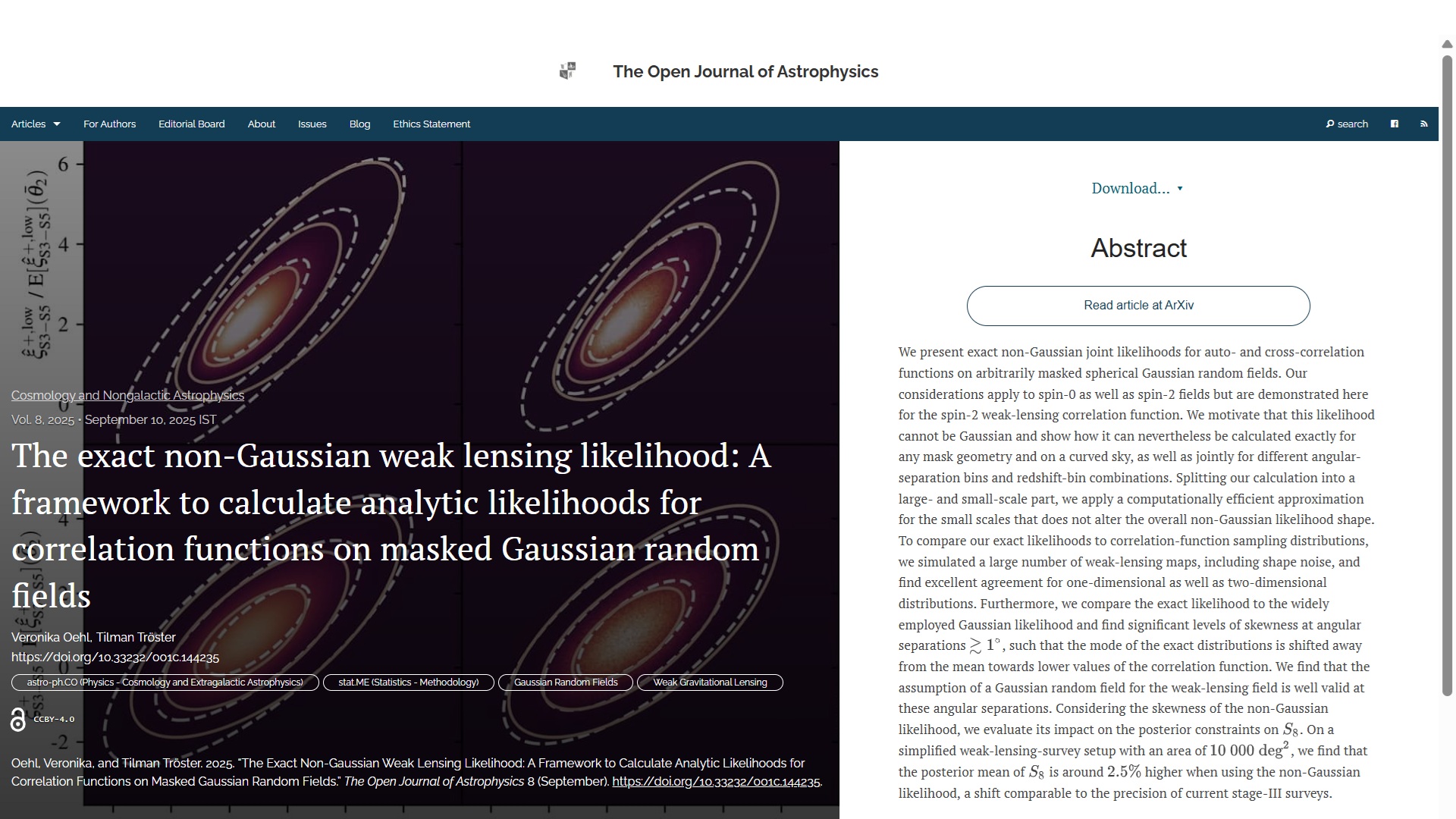
and you can find the final accepted version on arXiv here.
Next one up, the third paper this week, is “Subspace Approximation to the Focused Transport Equation. II. The Modified Form” by B. Klippenstein and Andreas Shalchi (U. Manitoba, Canada). This was also published on 10th September 2025 in the folder Solar and Stellar Astrophysics. It is about solving the focused transport equation analytically and numerically using the subspace method in two or more dimensions.
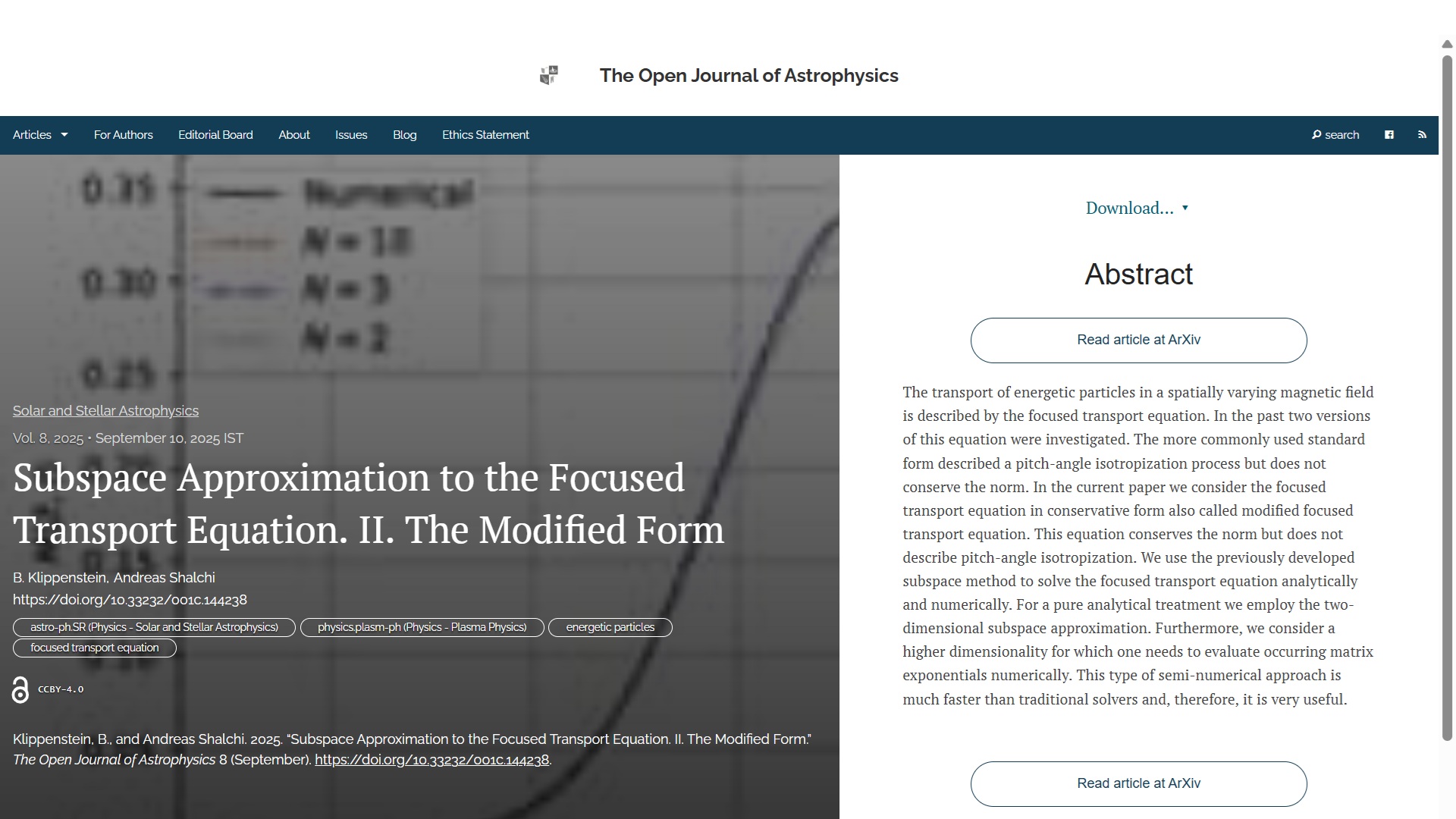
You can find the final accepted version on arXiv here.
The fourth paper of this week was also published on Wednesday 10th September. It is “Mass models of galaxy clusters from a non-parametric weak-lensing reconstruction” by Tobias Mistele (Case Western Reserve U., USA), Federico Lelli (INAF, Firenze, Italy), Stacy McGaugh (Case Western), James Schombert (U. Oregon, USA) and Benoit Famaey (Université de Strasbourg, France). Published in the folder Cosmology and NonGalactic Astrophysics, it presents new, non-parametric deprojection method for weak gravitational lensing applied to a sample of galaxy clusters. The overlay is here: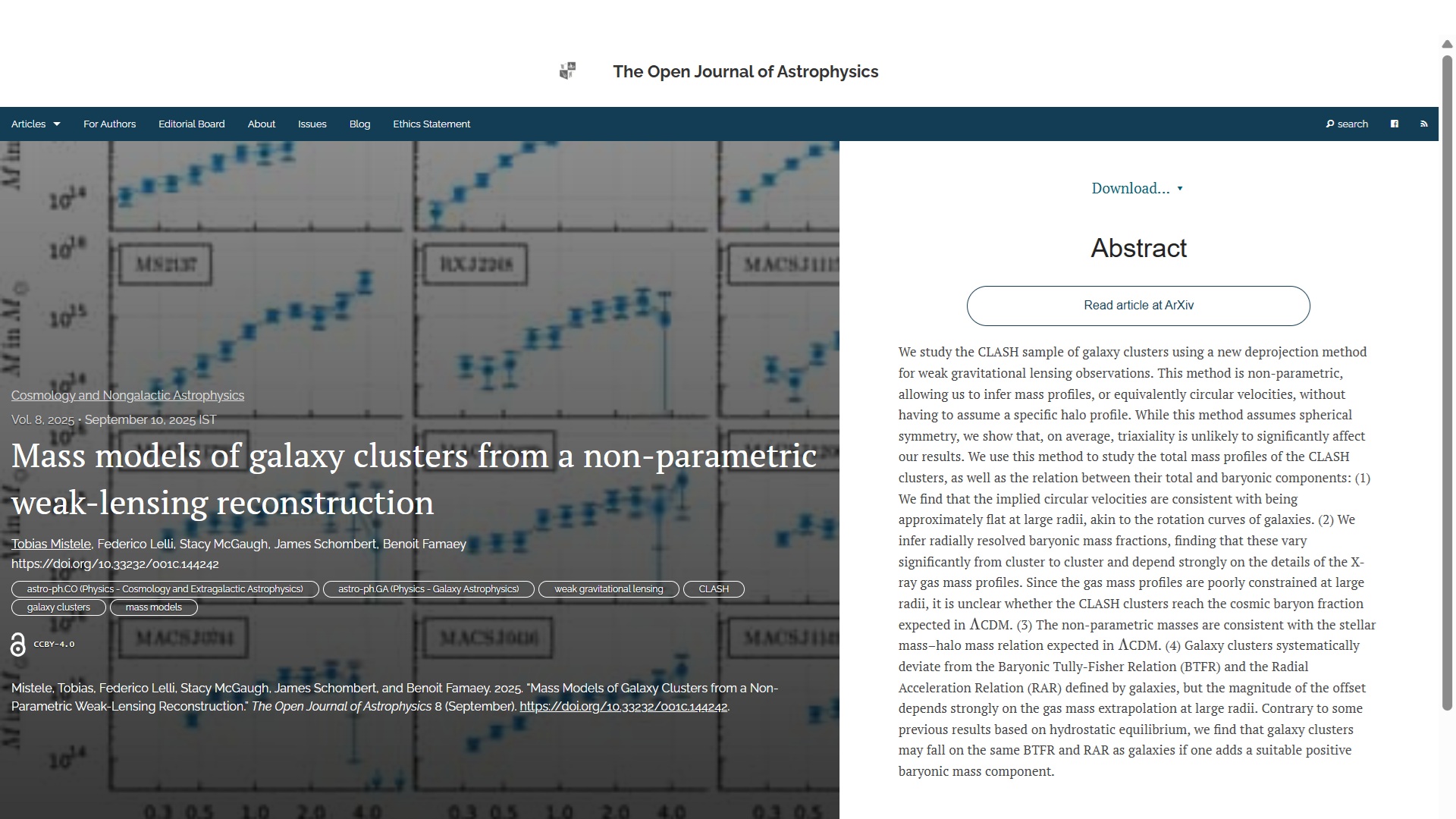
You can find the officially accepted version on arXiv here.
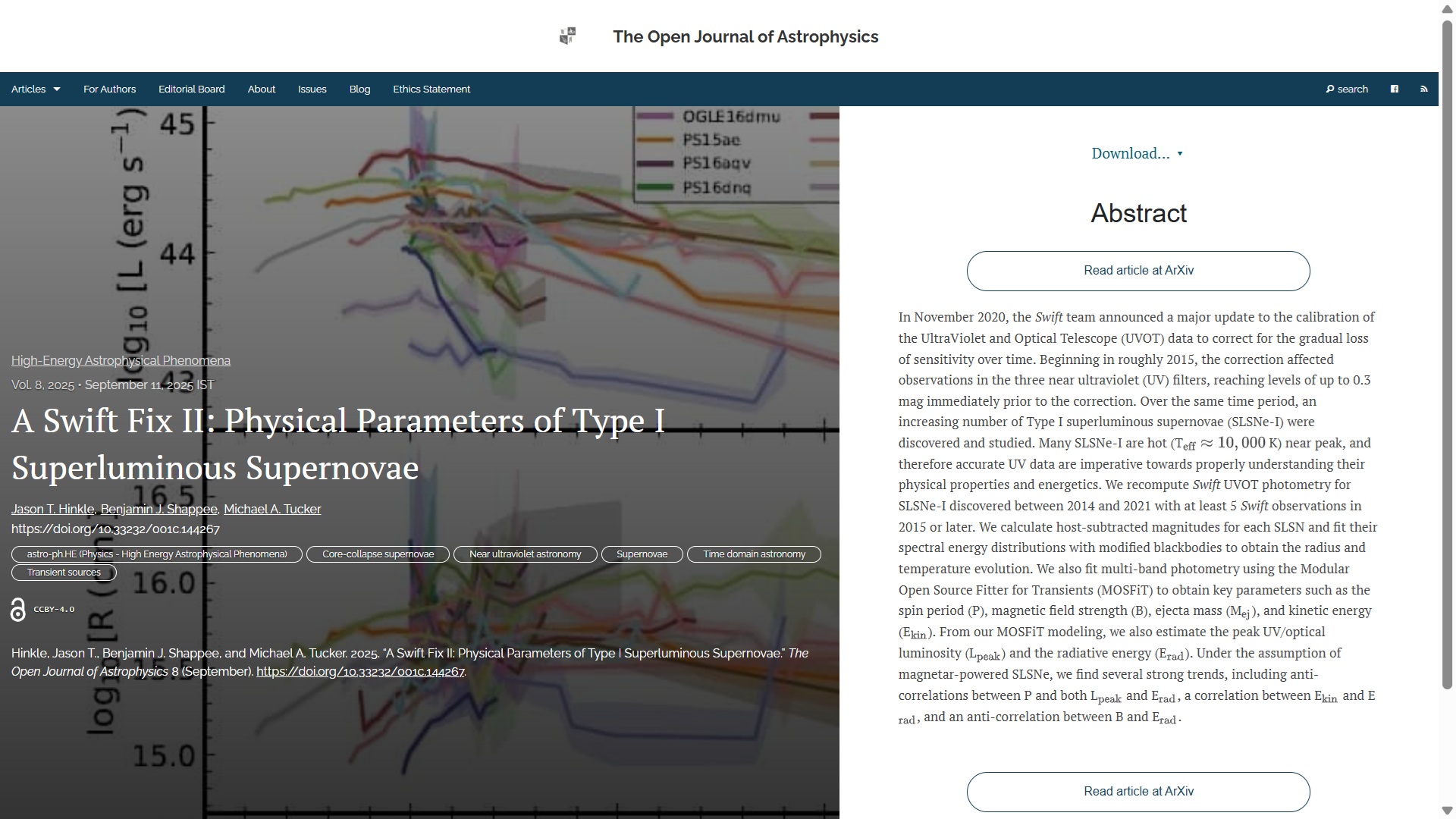
The fifth paper of the week is “A Swift Fix II: Physical Parameters of Type I Superluminous Supernovae” by Jason T. Hinkle & Benjamin J. Shappee (U. Hawaii, USA) and Michael A. Tucke (Ohio State, USA). This one was published on Thursday 11th September 2025 in the folder High-Energy Astrophysical Phenomena. The paper uses recalibrated Swift photometry to recompute peak luminosities and other properties of a sample of superluminous Type I supernovae. The overlay is here:
You can find the official accepted version on arXiv here.
Paper No. 6 for this week is “Detailed Microwave Continuum Spectra from Bright Protoplanetary Disks in Taurus” by Caleb Painter (Harvard, USA) and 11 others, too numerous to mention by name, based in the USA, Germany, Mexico and Taiwan. This one was published in the folder marked Solar and Stellar Astrophysics on September 11th 2025. It presents new observations sampling the microwave (4-360 GHz) continuum spectra from eight young stellar systems in the Taurus region. The overlay is here:

The final version can be found on arXiv here.
The last paper for this update is “On Soft Clustering For Correlation Estimators” by Edward Berman (Northeastern University, USA) and 13 others based in the USA, France, Denmark and Finland and Cosmos-Web:The JWST Cosmic Origins Survey. This was published on Friday 12th September 2025 in the folder Instrumentation and Methods for Astrophysics. It presents an algorithm for estimating correlations that clusters objects in a probabilistic fashion, enabling the uncertainty caused by clustering to be quantified simply through model inference. The overlay is here:

You can find the final version on arXiv here.
And that’s all the papers for this week. I’ve noticed a significant recent increase in the number of papers in Solar and Stellar Astrophysics, which means we’re broadening our impact across the community. Which is nice.
P.S. I found out last week that, according to NASA/ADS, papers in OJAp have now accumulated over 5000 citations.
Einstein’s First Lecture in Britain
Posted in Biographical, History, The Universe and Stuff with tags Albert Einstein, University of Manchester on September 12, 2025 by telescoperTidying a few things up ahead of the start of term I discovered this old clipping, yellowed with age, and decided to scan it before it disintegrates entirely:
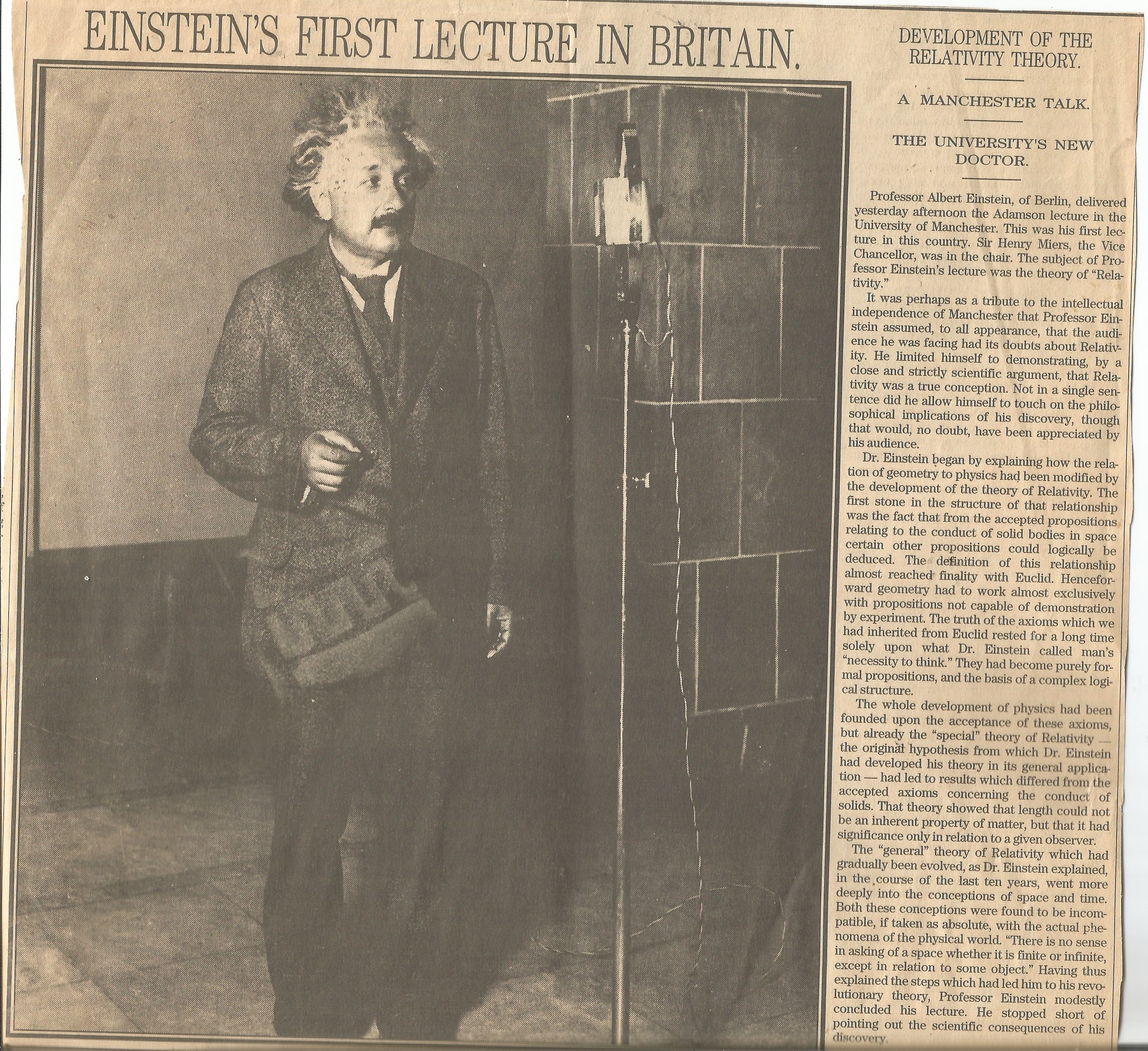
It is from the (then) Manchester Guardian which is now known as the Grauniad. The article is dated 1st October 1921, which implies that the talk must have been on the afternoon of Friday 30th September 1921. However, the University of Manchester website states that the talk was on June 9th 1921. During his visit, Einstein was awarded an Honorary Doctorate of Science by the University of Manchester, which is recorded here as having been presented on June 8th, so it appears the Guardian piece was published some time after the event. As usual, Einstein gave his lecture – to a packed house – entirely in German, as he did when he lectured in Nottingham almost a decade later.
Einstein was already famous by 1921 – largely thanks to the 1919 Eclipse results (see, e.g., here) – but it was still before he won his Nobel Prize (in 1922).
Anyway, the text down the right-hand side of the Guardian piece can be found here; it’s well worth reading!
De Valera Connections
Posted in History, mathematics, Maynooth, Television with tags Department of Mathematical Physics, Department of Physics, Department of Theoretical Physics, Dev:Rise and Rule, Eamon de Valera on September 11, 2025 by telescoperOn September 4th, when I posted a piece about the forthcoming Presidential Election in Ireland, I forgot to mention that just two days earlier was the 50th anniversary of the funeral of Éamon de Valera, founder of Fianna Fáil (one of the two largest political parties in Ireland) and architect of the Irish constitution, who died on 29th August 1975 at the age of 92. Here’s some coverage at the time by (British) Movietone News, the commentary is rather generous to him:
De Valera (nickname `Dev’) is an enigmatic figure, who was a Commandant in the Irish Republican Army during the 1916 Easter Rising, but despite being captured he somehow evaded execution by the British. There’s no evidence, incidentally, that he escaped the firing squad because he was born in America. Dev subsequently became Taoiseach (Prime Minister) and then President (Head of State) of the Irish Republic.
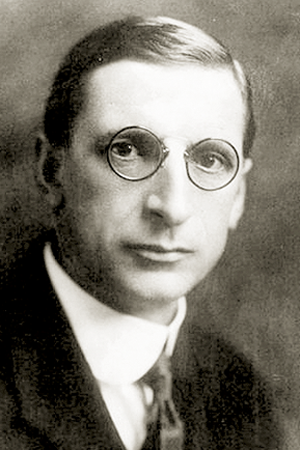
There’s no question in my mind that de Valera is the most significant Irish politician of the 20th Century, which is not to say I fid him an agreeable figure at all and his legacy isn’t particularly positive. Nevertheless, his funeral was perhaps as significant event for the Irish as that of Winston Churchill had been for the British just a decade earlier.
Over the past couple of weeks RTÉ television broadcast a two-part documentary called Dev: Rise and Rule; the second part was on last night. It is quite nicely made, but disappointingly superficial and lacking in any real historical insight. The suggestion that it would “decode” Dev was unfulfilled. This is a pity because RTÉ often does good documentaries.
Anyway, this gives me an excuse to mention again, Dev’s connection with Maynooth. De Valera was a mathematics graduate, and for a short time (1912-13) he was Head of the Department of Mathematics and Mathematical Physics at St Patrick’s College, Maynooth, which was then a recognised college of the National University of Ireland. The Department became incorporated in Maynooth University when it was created in 1997. Mathematical Physics is no longer a part of the Mathematics Department at Maynooth, having first become a Department in its own right, then changing its name to the Department of Theoretical Physics and then, just last year, being subsumed within a new Department of Physics.
De Valera missed out on a Professorship in Mathematical Physics at University College Cork in 1913. He joined the the Irish Volunteers, when it was established the same year. And the rest is history. I wonder how differently things would have turned out had he got the job in Cork?
Agricola’s Crossings
Posted in History with tags Agricola, Clanoventae, latin, Maryport, Ravenglass, Roman Britain, Tacitus on September 10, 2025 by telescoperOver the past few weeks since I wrote a post about the account by Tacitus of a potential Roman invasion of Ireland led by Agricola I’ve been thinking about a couple of open questions and digging around in various commentaries to try to shed light on them. Both of these pertain to the first section of Part 24 of the account, which is in the fifth year of his Agricola’s campaigning
Quinto expeditionum anno nave prima transgressus1 ignotas ad id tempus gentis crebris simul ac prosperis proeliis domuit; eamque partem2 Britanniae quae Hiberniam aspicit copiis instruxit...
The first question relates to transgessus meaning “crossed”. Where did he cross? I remembered all the way back to school days reading some of this, and found the following in Vol. 1 of the Latin textbook we used back then (Wilding’s Latin Course for Schools). On page 68 of that tome we find the following as part of an exercise to translate from Latin to English:
Agricola copias Clanoventae, ubi ora Britanniae ad Hiberniam spectat...
Clanoventae is a Roman name for the town of Ravenglass, near the Cumbrian coast. At the time I took this to be a direct quote from Tacitus, but it isn’t. Obviously Wilding made that bit up! There is evidence of substantial Roman activity at Ravenglass, but none that this was the place he placed the troops intended for a possible invasion of Ireland. Moreover, the actual quote from Tacitus makes it clear that he “crossed” with ships, but that doesn’t seem right when you look at the location (marked with the red thingy):

It’s quite a long way to “cross” from there to modern-day Scotland, and in any case what you would see from there is first and foremost the Isle of Man. From there he could definitely see both Britain and Ireland, but as far as I know there’s little or non direct evidence of Roman activity there, though the Romans did know it through trading interactions. They called it Insula Manavia. Tacitus does not use place names very often – there are only half-a-dozen – in the entire book about Agricola but it seems to me he would not have confused it with Hibernia.
Putting my school textbook away and turning to other commentaries, I didn’t find any real consensus but the best bet is that what Agricola crossed was the Solway Firth, and where he crossed from could well have been Maryport, also a well-known Roman military site (called Alauna). There is no direct evidence for that either, though, and the earliest directly dated evidence of significant activity there is much later, around 122AD. Agricola’s incursion to Scotland was around 81 AD.
If Agricola did cross the Solway Firth he and his army would have landed in what is now Dumfries and Galloway. Most commentaries now believe that the place from which he could see Ireland would be the Rhinns of Galloway, the hammer-shaped peninsula to the West of Stranraer. Now that isn’t the part of Scotland closest to Ireland – that would be the Mull of Kintyre, much further North – but it is pretty close, and it certainly does face across the Irish Sea with nothing in the way.
There is also plenty of evidence of Roman activity near Stranraer, including a settlement and fort in a place known to them as Rerigonium. There are also traces of a Roman road. That is important because, to the Romans, roads were primarily military structures, meant to facilitate the movement of troops and supplies quickly. Had the Romans ever invaded Ireland they would have built an extensive network of roads, as they did in England.
It seems to me that Rerigonium would have been a good choice of place to launch the putative invasion. Loch Ryan would have provided a natural harbour for the ships that would take troops the short distance to Ireland and it’s not difficult to imagine a Roman legion embarking there.
P.S. When I was a lad there were regular ferries from Stranraer to Belfast and back, but now they operate to and from Cairnryan, about 6 miles further up Loch Ryan.
Peasant Spreading Manure – Jean-François Millet
Posted in Art, Maynooth on September 9, 2025 by telescoperOne of the consequences of living in a (relatively) small Irish town surrounded by farmland is that every now and again you notice authentic countryside smells. This time of year is often accompanied by the whiff created by the slurry being spread on nearby fields. The farmers typically do this in mid to late September, depending on the weather; it is actually not allowed after 30th September). When I first noticed this sort of pong I thought there was something wrong with the drains, but you get used to it.
Anyway, this made me think of this painting

Of course the manure isn’t spread by hand nowadays. It’s done like this:
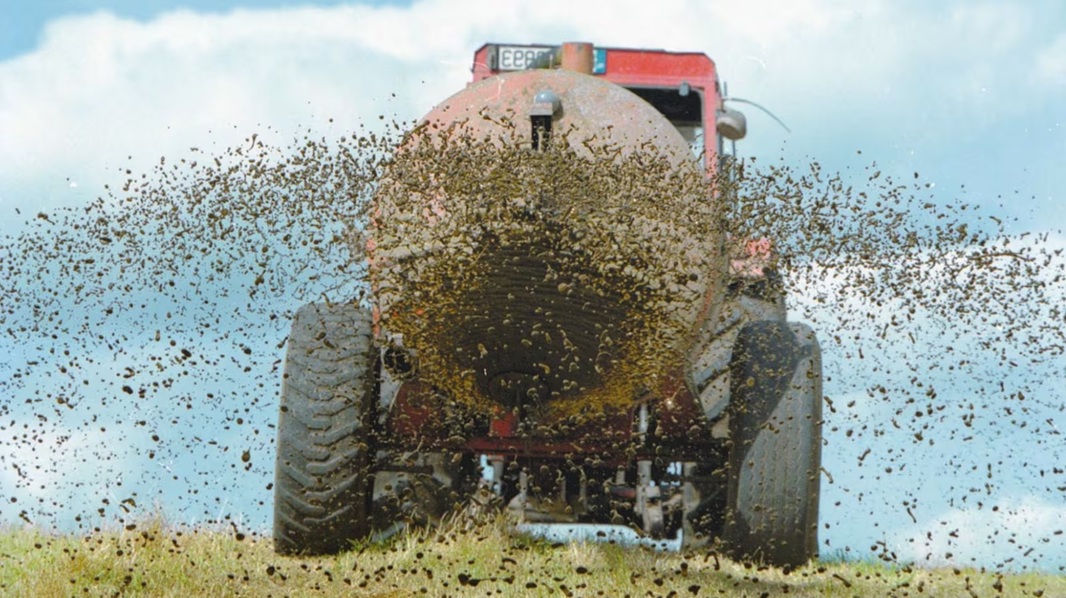
(I got this picture from a piece in the Irish Times about slurry as a poetic metaphor.)
The Bronze Shoes
Posted in Biographical, History, Maynooth with tags an Gorta Mór, Bronze Shoes, Dublin, Maynooth, National Famine Way, Strokestown, The Great Hunger on September 8, 2025 by telescoperAbout a month ago I posted an item about the National Famine Way, at the end of which I signalled my future intention to walk the 165 km 6-day route from Strokestown to Dublin. I was subsequently contacted by a number of people warning me that I might not be up to it. They didn’t put me off, but I have come up with a plan. This week – on Wednesday in fact – I will have the injections I get every six months or so to control the arthritis in my knees. Thus fortified, I intend next week to do a trial run walk consisting of the last stage of the Famine Way, from Maynooth to Dublin, along the Royal Canal. That’s about 27km and will take most of a day. I’ll stop on the way for lunch and when I get to the end I can get the train back to Maynooth. And if I run walk into difficulties I can stop at one of the intermediate stations and return from there; the canal runs right alongside the railway line for most of the way. If all goes to plan I’ll take time off next year to do the whole trip from Strokestown.
Meanwhile here’s a picture of one the poignant bronze sculptures of children’s shoes placed along the way. This one is at Maynooth harbour; there are 8 others on the way to Dublin.
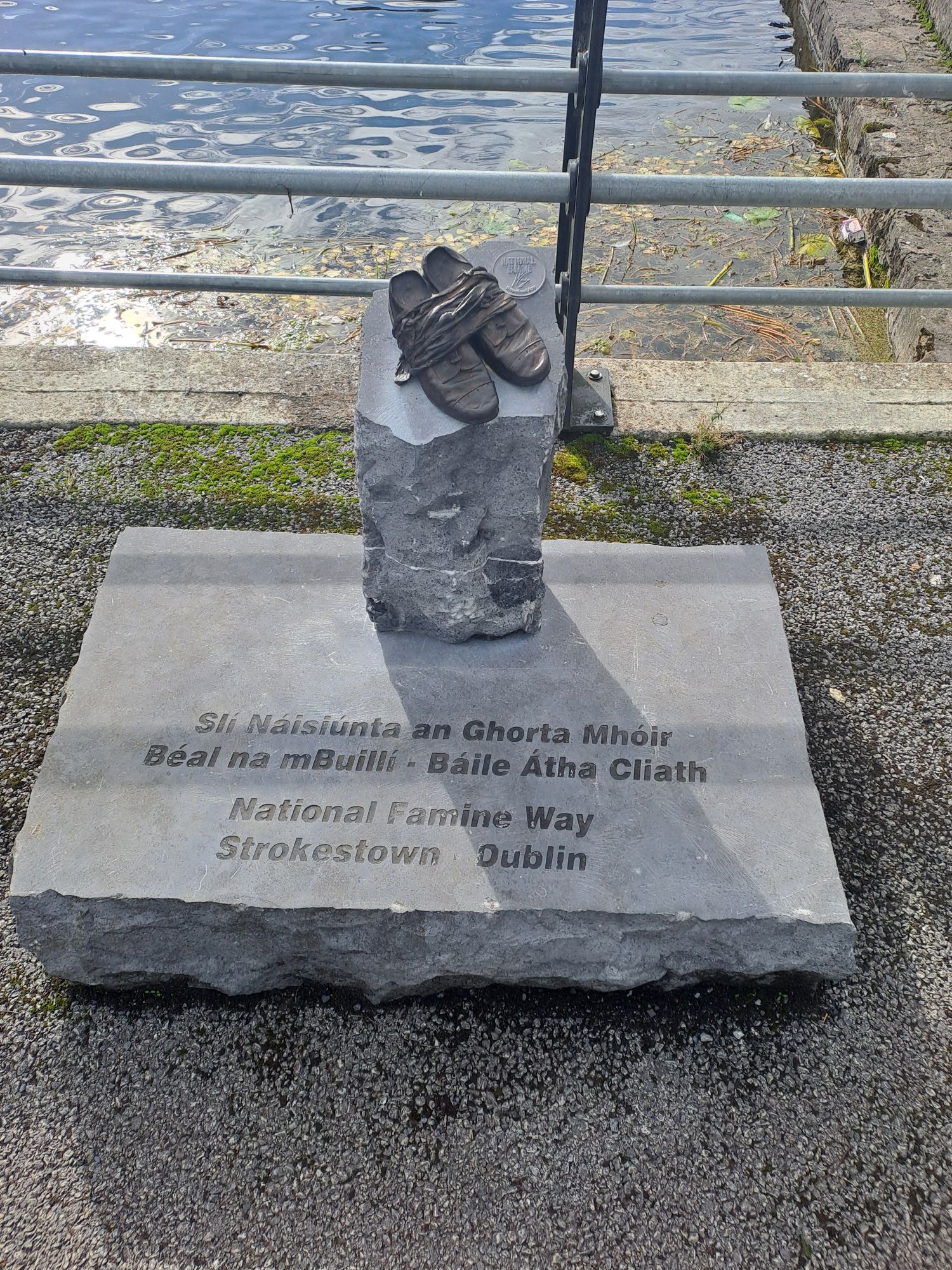
To learn more about these shoes, see here, and here’s a video telling the story
With Term Approaching…
Posted in Biographical, Maynooth with tags Maynooth University, MSc Theoretical Physics and Mathematics, Sabino Matarrese on September 7, 2025 by telescoperWith just two weeks to go before we resume teaching at Maynooth University, I find that next week I have no fewer than three medical appointments next week, on different days and in different locations. All of them are (or should be) routine, and none are particularly serious. Much as I dislike hospitals, etc, it will be good to get these bits of scheduled maintenance out of the way before the start of term.
On the other hand, they mean that I have to miss what looks like a very nice meeting in Italy in honour of Sabino Matarrese. I was invited, and initially accepted, but had to cancel. I hope that it goes well!
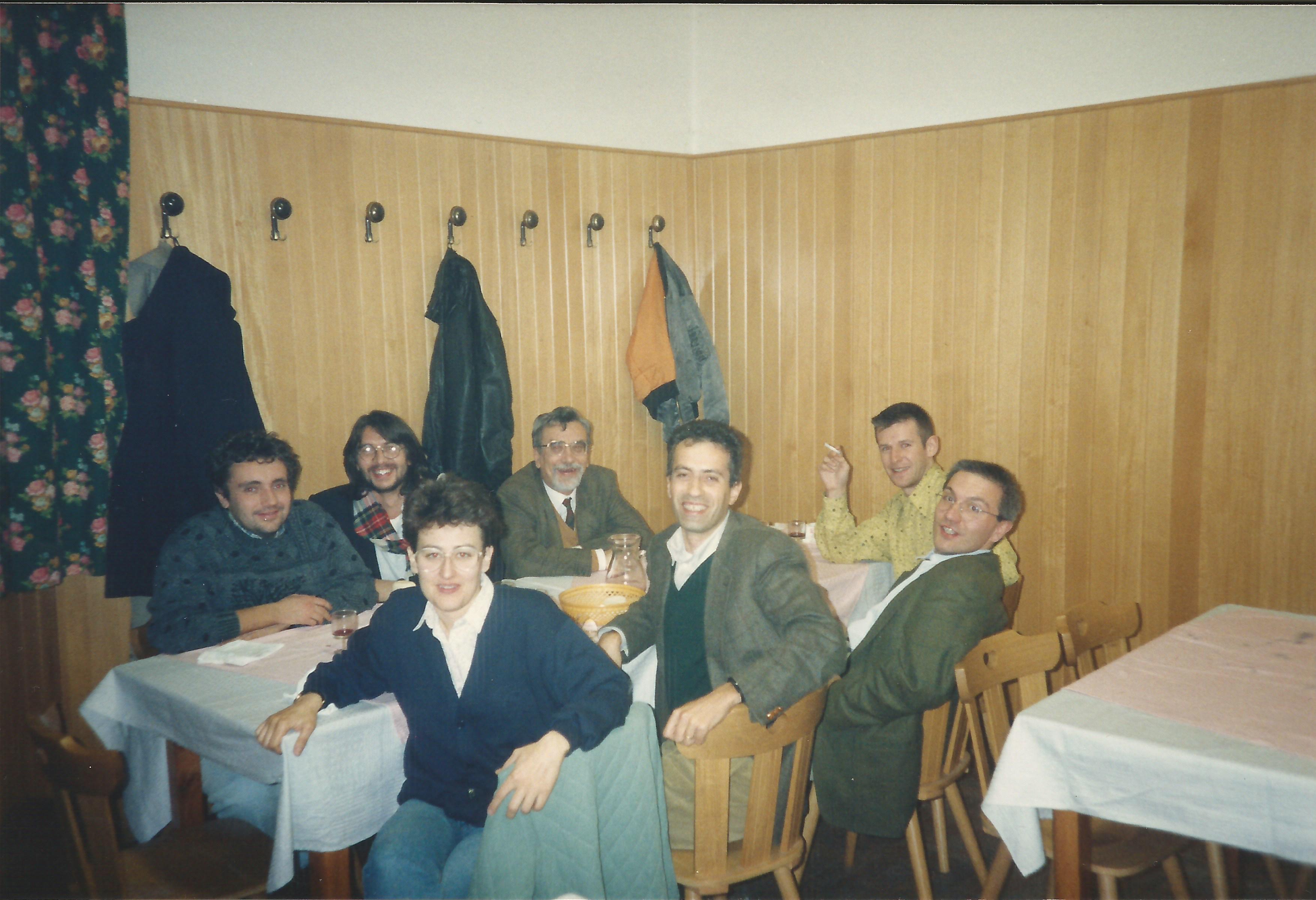
For old time’s sake I thought I’d post this picture of a youthful Sabino from years ago; he’s in the middle of the row nearest the camera; I’m at the end in the yellow shirt.
Anyway, last Friday our first cohort of MSc students in Theoretical Physics and Mathematics received their final results. This course lasts a calendar year so the results come out later than for the undergraduate courses. Congratulations to them all, but especially to Enda who completed a project under my supervision that we hope to turn into a paper before long.
Some familiar faces will no longer be around, but soon we will be joined by some new ones. Tomorrow, registration opens up for incoming first-year students at Maynooth and later in the week for returning second-, third-, and fourth-year students. By this time next week we’ll have a much better idea how many students there will be in our classes for the new academic year.
On Friday (12th September) I’ll be off to the National Concert Hall for the 2025/6 Season Opener with the National Symphony Orchestra conducted by Leonard Slatkin, another indication that Autumn Semester is nigh.

 In the Dark