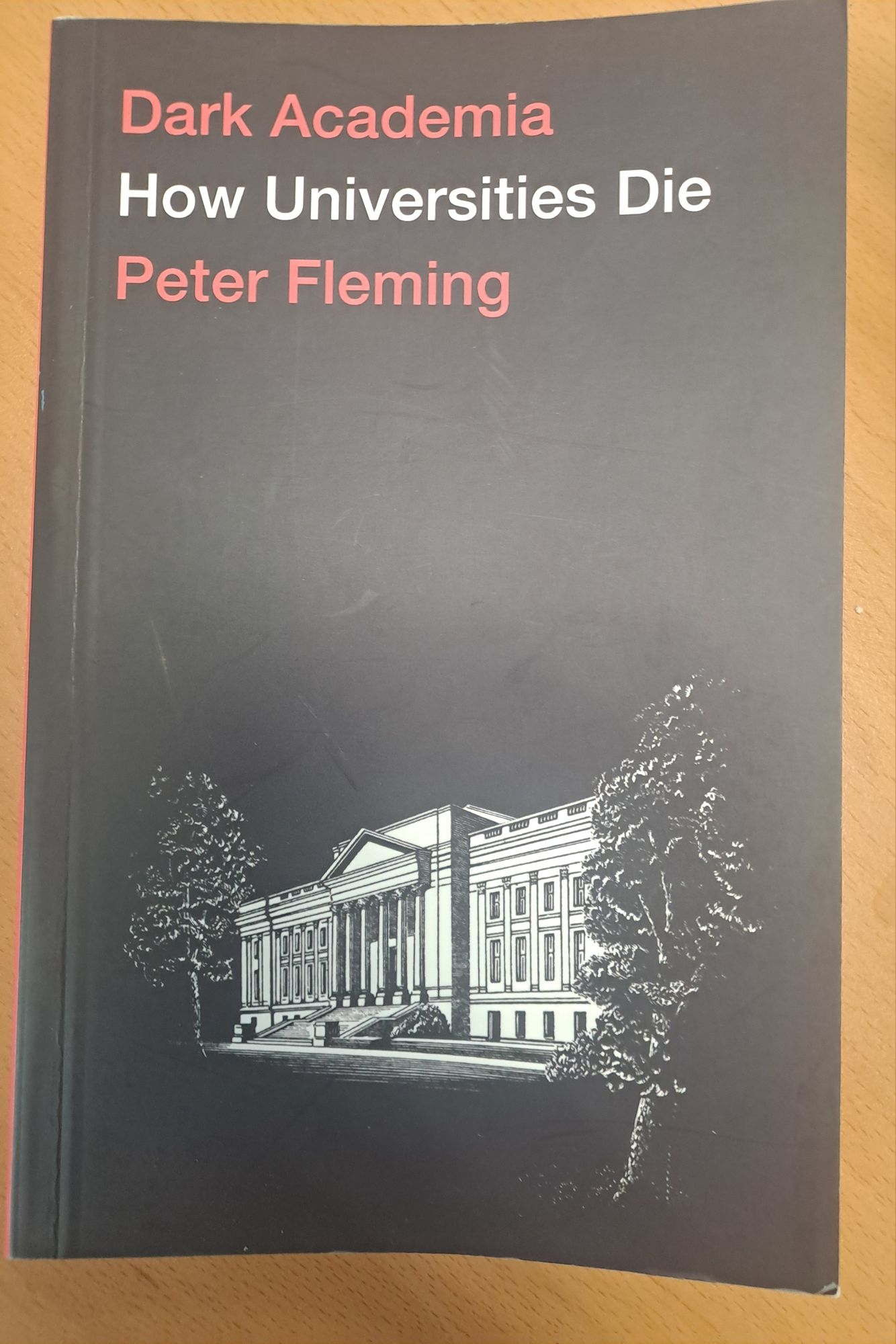
I ordered this book from our local bookshop a while ago but have only just found time to finish reading it. It’s an analysis of the decline of the neoliberal model of the university accompanied by the rise of commercialisation, managerialism and authoritarian models of governance. At 165 pages, not counting the notes and references, it’s a concise and compelling polemic, full of controlled anger and sprinkled with sardonic wit.
The problem I have in reviewing it is that almost every page contains something that rings so true that I’d want to include a quote. There wouldn’t be any point in doing that as I’d end up quoting almost the entire book, so I decided just to include one excerpt, part of a paragraph in the introduction:
Impersonal and unforgiving management hierarchies have supplanted academic judgement, collegiality and professional common sense. in many institutions, senior executives have no PhDs and have been trained in business or the military instead. Mindless performance targets dominate teaching and research to the point of caricature, designed by functionaries who’ve never taught a class or written a research article in their lives. Unfortunately, these hierarchies have become notoriously bossy. Coercion rather than volition compels much academic labour today, even tasks that scholars would have otherwise done willingly because it’s central to their vocation. This surfeit of duress, most of which is unnecessary and counterproductive, is a defining feature of the corporate university.
The book charts the rise of this fanatical managerialism, the consequent fall of academic institutions as places of education, scholarship and research, and their replacement by soulless teaching factories. I’ve been an academic for almost forty years and I’ve seen this process unfold in real time. As I approach retirement, I deeply regret that I didn’t do more to stop it.
Dark Academia was written around the time of the Covid-19 pandemic and published in 2021 so it does not cover the dreadful collapse of higher education in the UK since then. The author does make some presciently pessimistic comments, but the reality has turned out to be far worse than he imagined.
My own experience of the pandemic here in Maynooth illustrates what went on to a greater or lesser extent throughout the university system, namely that it was seen by Management as an opporunity to strengthen its grip. Staff workloads went through the roof as under-resourced departments struggled to deliver adequate teaching. Seeing that we were on our knees, the powers that be decided it was an ideal opportunity to kick us in the teeth. Witholding replacement positions for two lecturers who left at this time, showed a callous disregard for staff morale and student education alike. Needless to say, the person responsible was promoted.
Since the end of the pandemic, the Management of Maynooth University has been led frog-marched down the path towards Dark Academia. The past few years have been a jamboree for senior administrators, with the creation of umpteen new Vice-Presidents on high salaries and extensive perks, such €500,000 on a luxury chauffeur service and €1M. This profligate expenditure on management bloat has been accompanied by austerity everywhere else, especially for teaching and research. This new configuration of the University is clearly unsustainable. The only question is whether anything can be salvaged from the wreckage when it crashes.
The term The University used to have a collective meaning, referring to all staff and students, not just the leadership, but now it simply means The University Management. For example, it was rumbled last year that Maynooth University had paid €47,000 tax on the President’s behalf. The President eventually paid the bill and an anonymous spokesperson said “The University now considers this matter resolved”. I know I’m not the only person working at Maynooth who doesn’t consider it “resolved”: for one thing, I’d like to know who made the decision to pay the President’s tax bill in the first place; and for another I’d like to know who issued the statement that it was “resolved”. I mention this episode because it exemplifies a phrase used by Peter Fleming at the end of his book. Academics used to be able to say that that they worked “in” a university. Not any more we don’t. We work “under” a university.
I’m not very optimistic that academia can change for the better – I think it’s too far gone – but this book at least identifies most of what is wrong. Perhaps, if enough of us read it, we can start trying to reverse the decline.


