Today (Friday 13th March 2026) is 40 years to the day since the Giotto spacecraft started to send back images of Halley’s comet;it reached its closest approach on 14th March 1986. This guest post by my colleague in the Department of Physics at Maynooth, Dr Emma Whelan, was written to mark this anniversary and the connection with the eminent Irish astrophysicist Susan McKenna-Lawlor.
–o–
This week, as I mull over the importance of International Women’s Day, I am also thinking about the significance to Irish women scientists of the 40th anniversary of the historic flyby of Halley’s Comet by the European Space Agency’s first deep space mission Giotto. On 14 March 1986, Giotto passed within about 600 km of the nucleus of Halley’s comet at a relative speed of roughly 68 km/s. Despite being bombarded by dust particles in the comet’s coma, the spacecraft successfully returned unprecedented data. Maynooth University space scientist and former Head of the Department of Experimental Physics, Prof. Susan McKenna-Lawlor, made a key contribution to this mission and was the Principal Investigator for Giotto’s instrument, the Energetic Particle Analyser otherwise known as EPONA. EPONA was designed to measure high-energy charged particles in the vicinity of Halley’s comet. By analysing the flux and energy of these particles, the experiment helped scientists understand the interaction between the solar wind and a comet.

Giotto represents not only a major milestone in the history of ESA, but also an important moment in the history of the contribution of Irish Women to the field of Astrophysics and the involvement of Maynooth University women scientists, in Space Science. The Department of Physics now has a thriving Physics with Astrophysics degree (MH204) with many women (students, technicians, administrators and academics) making important contributions to the success of this programme. Prof. McKenna-Lawlor’s leadership in developing and operating the instrument represented one of Ireland’s earliest direct contributions to an international space mission. Her work helped establish Ireland’s reputation in space science and encouraged future Irish participation in European and international space research, especially by young women who were inspired by seeing an Irish woman succeeding in a field where women were very rarely visible.
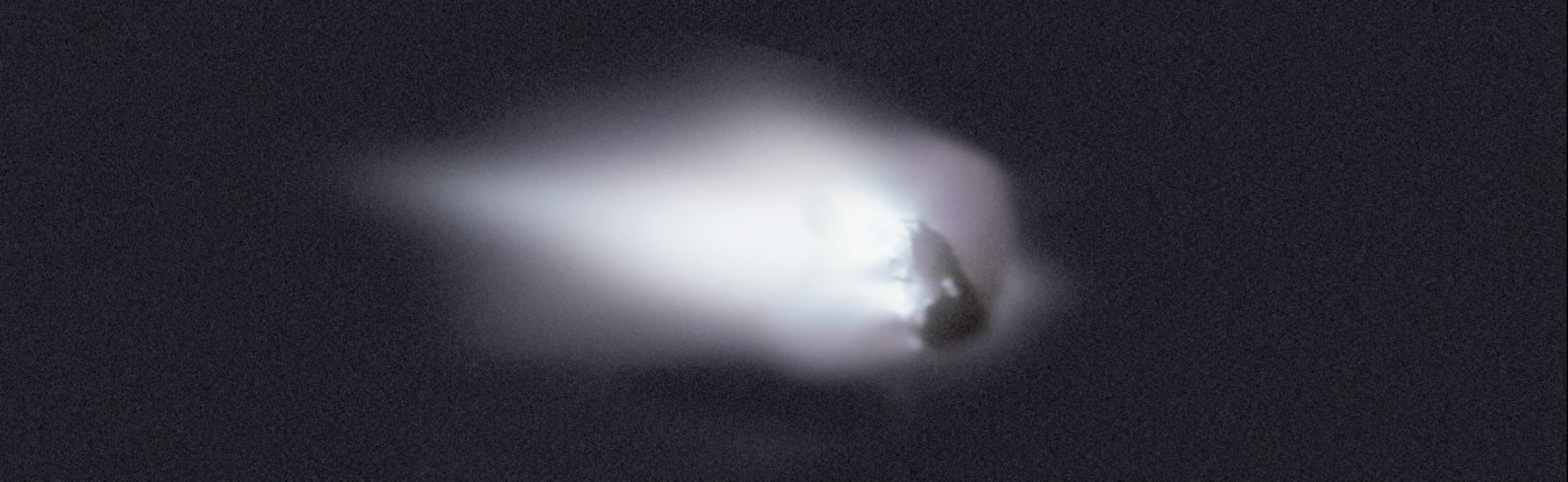
Launched in July 1985, Giotto’s primary objective was to encounter and study Halley’s Comet during its 1986 return to the inner Solar System. ESA have compiled a movie of its encounter which can be viewed here. At the time, Halley’s Comet was the most famous comet known, having been observed for centuries, yet very little was understood about comets and in particular the detailed structure of their nuclei and the physical processes occurring as they approach the Sun. Giotto provided the first close-up measurements of a comet and fundamentally changed scientific understanding of these Solar System bodies. One of Giotto’s most significant results was the first direct image of a comet’s nucleus. The images revealed that Halley’s nucleus is a dark, irregular object roughly 15 km long, far darker than expected, reflecting only a small fraction of sunlight. This confirmed the long-standing “dirty snowball” model proposed by astronomer Fred Whipple, in which a comet consists of volatile ices mixed with dust and rocky material. Giotto’s observations also showed jets of gas and dust erupting from localised regions on the nucleus, demonstrating that cometary activity is driven by sunlight heating specific surface areas rather than uniformly across the surface.
In addition to imaging, Giotto carried instruments designed to study the plasma, dust, and the energetic particle environment around the comet. These measurements revealed the complex interaction between the comet’s expanding atmosphere and the solar wind. Scientists were able to observe the formation of structures such as bow shocks and ion tails, helping to explain how cometary material becomes ionised and carried away through space. These results provided critical insights into the physics of cometary comae and their interaction with the heliosphere. The results from EPONA were crucial in identifying regions where energetic particles were produced by the interaction between the solar wind and the cometary plasma. These measurements contributed to the understanding of shock waves and particle acceleration processes occurring near the comet.

Prof. McKenna-Lawlor (pictured above, in 2017) was born in Dublin in 1935 and received a BSc, MSc and PhD from University College Dublin. She was a research assistant at The Dublin Institute for Advanced Studies and became a lecturer at the Department of Experimental Physics in Maynooth in the early 1970s. She has received numerous awards including the Russian Tsiokovsky Gold Medal for “Outstanding Contributions to Cosmonautics” in 1988. She has written several books on the history of Irish Astronomy including “Whatever Shines Should be Observed” that documents the pioneering contributions of five 19th-century Irish women to astronomy, photography, and science. The title is derived from the motto of the Royal Astronomical Society. In more recent times she was involved with ESA’s Rosetta mission which landed its Philae probe on comet 67P/Churyumov-Gerasimenko on November 12, 2014.


 In the Dark