Archive for Science and Technology Facilities Council

A Reprieve for Jodrell Bank?

Posted in Politics, Science Politics, The Universe and Stuff with tags , , , , , on September 4, 2026 by telescoper
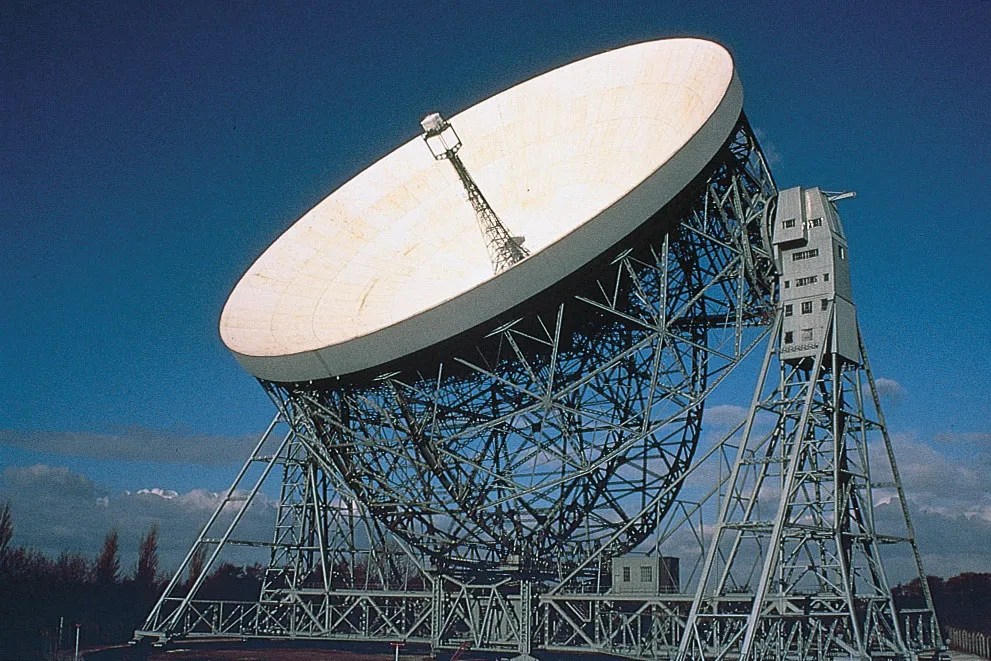
The Lovell Telescope at Jodrell Bank

Three days ago the latest Prime Minister of the United Kingdom, Andy Burnham, gave a commitment to rescue Jodrell Bank Observatory from the threat of closure resulting from funding cuts at the Science and Technology Facilities Council (STFC).

In a previous post about this I wrote

The last time STFC had a financial crisis was in 2009 and e-Merlin might well have been cut then but survived thanks to political intervention at the highest level. I suppose that could happen again, but I wouldn’t bet on it.

It looks like it has indeed happened again. The exact quote from Andy Burnham is:

There must be a way to save Jodrell Bank, and I give a commitment today, at this despatch box, we will find it.

That sounds like an unequivocal commitment, but it raises quite a few questions. One of these is that STFC was actually planning to cut funding to the e-MERLIN project and it is by no means clear that the £2.8 million needed for e-MERLIN will actually be reinstated in the STFC budget. It may transpire that Jodrell Bank Observatory emerges as more of a heritage site than a world-class research facility, which is what it will be if e-MERLIN disappears.

And if £2.8M is found to keep e-MERLIN going without changing the overall STFC budget, then the axe will just fall elsewhere in STFC. Jodrell Bank is a special site with special arguments for keeping it open, but other targets can no doubt be found that are equally excellent from a scientific point of view, but can’t mobilize political forces to mount such a strong defence. This is no way to perform a scientific prioritization exercise. In any case it is important to remember that there are cuts and cancellations elsewhere too; see here for a full list.

I think that there needs to be a complete review of funding across all the UKRI agencies. It is deeply unfair that physics and astronomy have to bear the brunt of cost overruns at facilities which are largely used by researchers in other scientific areas. Surely their funding councils should contribute. I can accept that belts might need to be tightened, but that shouldn’t just apply to STFC.

The Cuts to LHCb – Guest Post by William Barter

Posted in Science Politics, The Universe and Stuff with tags , , , , , , on August 19, 2026 by telescoper

The following is a guest post by William Barter, who recently finished a term as the ‘physics coordinator’ of LHCb-UK.

–o–

The European particle physics community recently undertook a two-year process to update our strategy – setting out the things that we, as a field, choose to prioritise. The highest priority in that update was “the full exploitation of the physics potential of the Large Hadron Collider”. Despite our consensus, UK Research and Innovation (UKRI) has decided to pull UK funding for the next-generation upgrade of LHCb, one of four large experiments at the LHC. This decision was made for financial reasons; the science case for the upgrade is not in question, and current LHCb operations are fully funded. With this cut, we are experiencing the same pain as many of our astrophysics colleagues. Our plans and ambitions have been hit by self-defeating decisions from the same funding body.

For decades we have known that our current theory of fundamental quantum physics – the Standard Model of Particle Physics – is incomplete, but a fuller picture eludes us. The LHCb Upgrade offers a unique way to explore this science. Our experiment, operated by around 2000 scientists from 28 countries, is dedicated to the study of beauty and charm quarks, fundamental particles whose behaviour can be measurably influenced by Beyond Standard Model phenomena. Through these studies we hope to unlock a new understanding of how nature works at its most fundamental levels. The upgrade, planned for the 2030s, would enable us to take five times more data than is possible with our current experiment.

LHCb has a tremendous record of success. We are responsible for discovering more particles than any other particle physics experiment in history, including new forms of matter: pentaquarks and tetraquarks. The LHCb Upgrade would be the only experiment capable of finding many more. That’s not all. One of the only things we know about the physics that lies beyond the Standard Model is that we expect it to introduce differences in the behaviour of matter and antimatter, in order to explain why our universe is made out of particles rather than antiparticles. LHCb is uniquely able to make the dedicated and precise measurements needed to probe this physics in the quark sector. Measurements at LHCb are also directly sensitive to the quantum imprints of new fundamental particles. We are able to explore energy scales far beyond those directly accessible at the LHC. In the same way that the discovery of radioactivity gave us key insights into the weak force more than 80 years before the observation of the fundamental particle responsible, the W boson, new fundamental particles can also influence our measurements of beauty and charm quarks. It will take us at least another 50 years to reach the same energies that LHCb probes using future particle colliders. Put simply: the LHCb Upgrade offers a unique and compelling physics programme that complements and extends what is possible at the other LHC experiments.

These opportunities were already recognised by UKRI, who had previously committed to funding the upgrade. In addition to making physics sense, this investment met UKRI’s funding strategy. UKRI has the goal of securing “an average of £3 of additional investment for every £1 of public funding”. International partners were expected to contribute their share of the overall cost of the project on top of the UK contribution, leveraging almost five times the UK contribution. Given the widespread international support for the project, it was no surprise when the previous executive chair of STFC, the part of UKRI responsible for funding particle physics, nuclear physics, and astrophysics, included the fact that he had “secur[ed] the UK’s investment in the LHCb Upgrade” in his successful government-backed manifesto for the CERN Director General role. The recent backpedalling from UKRI therefore has broader consequences: it has raised difficult questions about which promises our international partners can trust the UK to keep. It’s hard to see how we can be relied on in future international collaborations if we are the reason that the LHCb Upgrade falls apart now.

And there are other, potentially larger, ramifications. Other future projects across the STFC remit have seen similar cuts. The decisions amount to a lack of ambition for fundamental research in the 2030s. One of the key purposes of STFC is to fund research over long timescales, understanding that Big Science areas like particle physics and astronomy require a stable approach that goes beyond any individual government spending review period. However, the decision to resile from new particle physics goals and commitments for the 2030s because of claimed cost overruns in the next few years completely rejects this mission. This will have a lasting impact: LHCb is simply one of the first examples, with the UK programme in particle physics, astrophysics, and nuclear physics due to contract significantly in the coming years as a result of UKRI’s choices.

So, where does this leave things? All is not lost. These decisions were communicated to us by UKRI at a strange moment, when the UK government was handing over between Sir Keir Starmer and Andy Burnham, while DSIT – the government department that oversees UKRI – was being disbanded, and while its replacement, BIST, was being set up. We know that Big Science is key to the UK’s scientific strategy: our work enthuses and inspires the next generation of scientists and researchers. The people we train enter the workforce skilled in modern data science techniques, ready to tackle the biggest problems with new approaches. There is still a window of opportunity for BIST to act and find a solution to the problem they’ve been handed. When news of the UKRI cuts broke, the incoming Secretary of State, Jonathan Reynolds, committed to investing in “the next generation of scientific facilities and infrastructure”. We now wait to see whether he means what he said, and if he will save UK particle physics, astrophysics, and nuclear physics from the self-defeating damage unleashed by UKRI.

The STFC Cuts

Posted in Artificial Intelligence, Science Politics, The Universe and Stuff with tags , , , , , , , , on July 28, 2026 by telescoper

News came out yesterday of the results of the latest funding prioritization exercise by the UK Science and Technology Facilities Council (STFC). The total savings being made by cuts to astronomy and particle physics are less than the funds allocated to just one AI lab! It seems STFC has to bear the brunt of savings needed so that UKRI, the organization under which STFC sits, can gamble much more on Artificial Intelligence and Quantum Technology. It seems to me that these are two bubbles ready to burst and the decision to sink money into them is not only unwise, it places the UK science base at serious risk of collapse.

Anyway, you can find the list of specific cuts here. Radio astronomy is hit particularly hard. The interferometric network e-Merlin is not prioritized and its funding will run out in 2028. That puts Jodrell Bank Observatory in danger of complete closure unless an alternative source of funding can be found. The last time STFC had a financial crisis was in 2009 and e-Merlin might well have been cut then but survived thanks to political intervention at the highest level. I suppose that could happen again, but I wouldn’t bet on it. More bad news is that the UK Square Kilometre Array Regional Centre, with SKA itself already financially troubled, is also earmarked for cuts.

The 76m Lovell Telescope at Jodrell Bank, now under threat of closure

And that’s just radio astronomy and Jodrell Bank is one of the highest-profile casualties. There are cuts and cancellations in many other areas too; see here for a full list.

The Astronomer Royal for Scotland, Catherine Heymans, has used her platform to campaign against these damaging and short-sighted cuts to UK astronomy, including on social media:

Just off #BBCR4 World at One, arguing the importance of discovery science (like Jodrell) for long-term economic growth. I said I was heartbroken at the news: evidence just look at how exceptionally excited me & @mamaphysikerin.bsky.social were when we got to stand inside Lovell back in 2017 🥰 🔭🧪

Astronomer Royal for Scotland | Catherine Heymans (@astroroyalscot.bsky.social) 2026-07-27T12:38:30.873Z

The same can’t be said for the Astronomer Royal herself, Prof. Michele Dougherty. The reason for that is Prof. Dougherty is also Executive Chair of STFC and is therefore responsible for implementing the cuts. How it is possible for her to remain in both posts is nothing short of a scandal. Such a glaring conflict of interest cannot be allowed to stand. Indeed, Prof. Dougherty was elected to serve as President of the Institute of Physics from October 2025 but stepped down in January 2026 citing concerns of a conflict of interest with her role at STFC. It’s a slap in the face to the Astronomy community that it is not deemed worthy of such consideration.

Save Physics & Astronomy at Sussex!

Posted in Biographical, Education with tags , , , on June 25, 2026 by telescoper

Not long ago I posted an item about cuts to the School of Physics & Astronomy at the University of Nottingham, which included a link to an open letter protesting the decision. About 2700 people signed that letter. It remains to be seen whether it makes any difference.

At the end of that item about Nottingham I wrote

I fear more such news is coming. The UK Higher Education sector is shrinking rapidly. Nottingham University won’t be the last, and I doubt the contagion will be restricted to the UK either…

There have indeed been other announcements of redundancies, including Exeter and Hertfordshire and another at an institution I have worked at, the University of Sussex. The Department of Physics & Astronomy there has been informed that it is to lose 35% of its staff. That means about a dozen posts have to go, with letters going to those in Astronomy and Particle Physics. The authorities at Sussex are no doubt taking their cue from the decision of the Science and Technology Facilities Council to cut grant funding in those areas.

As regular readers of this blog will know, I was Head of School of Mathematical and Physical Sciences at Sussex, which encompassed the Department of Physics & Astronomy, from 2013 to 2016 (when I stepped down for personal reasons). That was a very upbeat period for Physics and Astronomy at Sussex, which makes it very painful to see how badly things are going now just a decade later. When I was Head I was very conscious of the danger of relying too much on STFC science, so we did diversify quite a bit, but even in my worst nightmares I had no idea things would come to this.

Anyway, there is an open letter about Physics & Astronomy at Sussex which I encourage you to sign. When I last looked it only had 336 signatories, but the cause is at least as worthy as at Nottingham.

Nottingham University Management Messages

Posted in Biographical, Education, Science Politics with tags , , on May 19, 2026 by telescoper

Last week I posted about the dire situation at Nottingham University and particularly in the School of Physics & Astronomy there. I since learned that I didn’t get the nunbers quite right: it appears that there are 71 staff in the School and 56 received notices that their jobs are at risk. There are 23 Professors in the School and 20 have received letters. The intention is that about 20 jobs will be lost across all academic and technical staff.

The open letter and petition here has already garnered over 2000 signatures, but more can’t do any harm.

I’ve heard also that staff at Notitngham are about to start a Marking and Assessment Boycott in response to the plans. This seems entirely reasonable to me and I would support further industrial action too. There is more about the situation in Physics World here.

I mentioned in my previous post that

Not all those in receipt of an “at risk” letter will actually be made redundant, but the intention is clearly to scare people into leaving in order to save on redundancy payments.

No doubt some positions will be saved by retirements and voluntary severance, but cuts on the scale being planned will be difficult to achieve without a significant number of compulsory redundancies. The messaging from the University Management is not subtle.

I have no idea what the management “plan” is at Nottingham, but I suspect it goes something like this, from the current Private Eye:

The effect of all this on staff morale will be devastating, but there will also be a practical effect. The more mobile, especially those with portable individual research grants, and those not tied to laboratories, will already be looking to move elsewhere. That will no doubt include some of Nottingham’s best researchers. It won’t be easy to move elsewhere in the UK, however, as the higher education system is collapsing. Other universities will no doubt follow a similar path,

Unfortunately, the recent goings-on at the Science and Technology Facilities Council will almost certainly be taken as a cue to shed posts in PPAN areas (Particle Physics, Astronomy and Nuclear Physics), as grants in these areas are to be drastically reduced. This is a clear signal that STFC wants the PPAN community to shrink. As far as I can see, Nottingham University currently employs about eleven Academic Staff in Astronomy and a similar number in Particle Cosmology.

On a personal note, in the interest of full disclosure, I joined Nottingham University as Professor of Astrophysics in January 1999. Neither of these groups existed then and the School of Physics (as it was) was struggling in the doldrums. The incorporation of Astronomy led to the name being changed to the School of Physics & Astronomy, led to a boost in undergraduate recruitment and improved research assessment outcome. The Particle Cosmology group came a bit later. The University’s original plan for Astronomy was just one Professor and two lecturers! I pushed particularly hard for this when I was there. I left Nottingham in 2007 and watched from the outside as both groups prospered over the years, due not only to teaching and research but also to an effective outreach campaign centered around Sixty Symbols. I feel very sad to see their future so drastically threatened.

While I am on the subject of messages, the Vice-Chancellor of Nottingham University, Jane Norman, has recently announced publicly that she thinks the University might go bust by 2031 without these cuts. Now, if you were a prospective Nottingham University student, how would you respond to a statement that the University you are thinking of applying to could run out of money in five years? The VC can’t possibly imagine that recruitment will remain buoyant in this situation, can she? Her blundering attempt to justify the planned cuts brings the prospect of a death spiral at Nottingham closer.

As James Binney put it in his comment on the open letter:

If these redundancies go ahead, the best physics faculty will leave Nottingham, outstanding candidates will no longer accept offers from Nottingham and the quality of the student body will rapidly decline. It takes generations to create a world-class department, but one can be destroyed in less than a decade.

Hopeful news about the STFC Crisis

Posted in Politics, Science Politics with tags , , , , on March 12, 2026 by telescoper

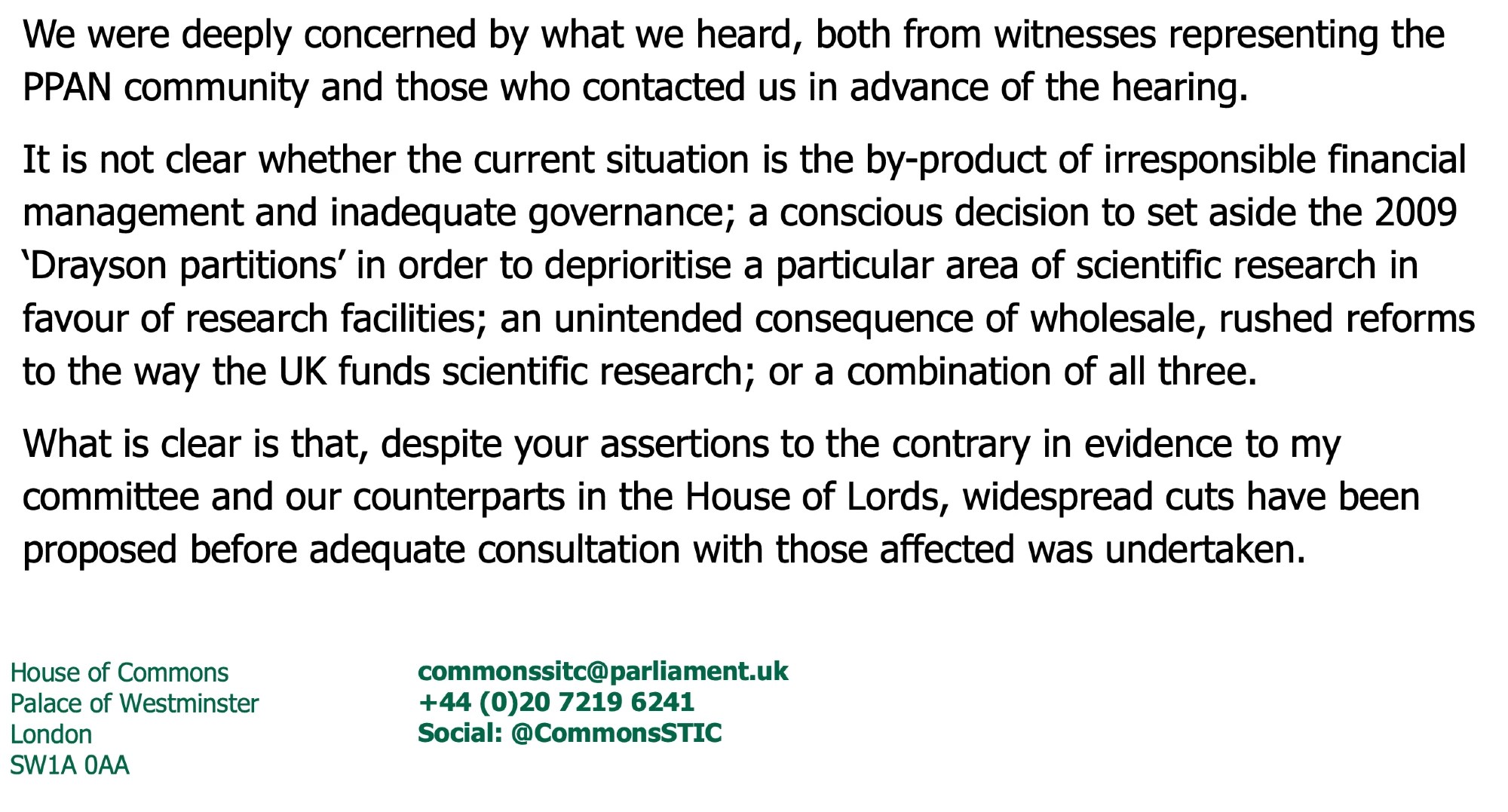
I’ve just got time this evening to pass on news that the Chair of the Parliamentary Select Committee looking at he current STFC debacle (see this account), Chi Onwurah, has responded to the events in extremely frank terms. Here is an excerpt:

The full response – which is definitely well worth reading because it doesn’t pull any punches – can be found here:

Such documents are not usually so forthright!

This isn’t by any means the end of the story of this fiasco, but it is certainly a positive sign that it is being taken very seriously in political circles. Credit is due not only to all those who attended and gave evidence to the Committee – Catherine Heymans, Jon Butterworth et al – but also to those who lobbied behind the scenes.

Open Letter about Cuts to UK Theoretical Physics Funding

Posted in Science Politics with tags , , , , , , , , on March 7, 2026 by telescoper

I am remiss in having forgotten until now to circulate an open letter that has been set up to express support for the high energy physics theory and particle theory communities in the United Kingdom. I signed the letter a few days ago but neglected to circulate it for further signature.

The letter reads:

We the undersigned wish to raise serious concerns about the current cuts to UK high energy particle physics theory grants by signing up to the letter below. The open letter and list of signatories are printed on this page. Individuals who wish to support this initiative may add their name as a signatory by completing the form below. This letter will be sent to Lord Patrick Vallance (Minister of State for Science, Innovation, Research and Nuclear), Liz Kendall (Secretary of State for Science, Innovation and Technology), Chi Onwurah MP (Chair of the UK House of Commons Science, Innovation and Technology Select Committee), and Prof. Sir Ian Chapman (CEO of UKRI).

We are signing this letter to raise serious concerns about the proposed cuts to high energy physics theory and particle theory in the United Kingdom. The UK is a world leader in this area: its historical activity led to the development of the Standard Model of particle physics and the ongoing development of string theory. UK theoretical physicists provide essential input to major international experiments, including the Large Hadron Collider at CERN and next-generation programmes in neutrino physics, gravitational waves, and cosmology, enabling rigorous interpretation of data and the extraction of fundamental insight. The strength of the UK community lies in its intellectual breadth and integration: researchers operate across phenomenology, formal theory, and their interface, and sustained dialogue between these areas underpins the UK’s leading role in global collaborations and internationally recognised research groups. In parallel, UK theorists advance the theoretical foundations of fundamental physics.

These groups and scientists can only operate thanks to critical funding by UK research council funding.

The current apparent scale of the cuts to the Particle Physics, Astronomy and Nuclear Physics area (30% to the overall budget) will result, when rising costs are taken into account, in a much greater than 50% cut in the number of postdoctoral researchers active in these areas in the UK. This will have a devastating effect on the ability of the UK to maintain its leading role in the subject.

Such funding decisions will affect the famously excellent reputation of the UK university sector. It will risk the health of UK physics departments and will therefore damage economic growth in the UK. Many scientists trained in this sector subsequently move into senior positions in technical industries such as machine learning and finance. Theorists at universities play a crucial role in the training and development of the inventors and disruptors of the future.

We urge UK politicians and leaders in the UK funding organisations to carefully consider the implications of the current direction of funding decisions before it is too late and irreparable damage is done to the UK theory community.

You can sign the letter and see a list of existing signatories here.

The STFC Funding Crisis – Guest Post by George Efstathiou

Posted in Science Politics with tags , , , on February 6, 2026 by telescoper

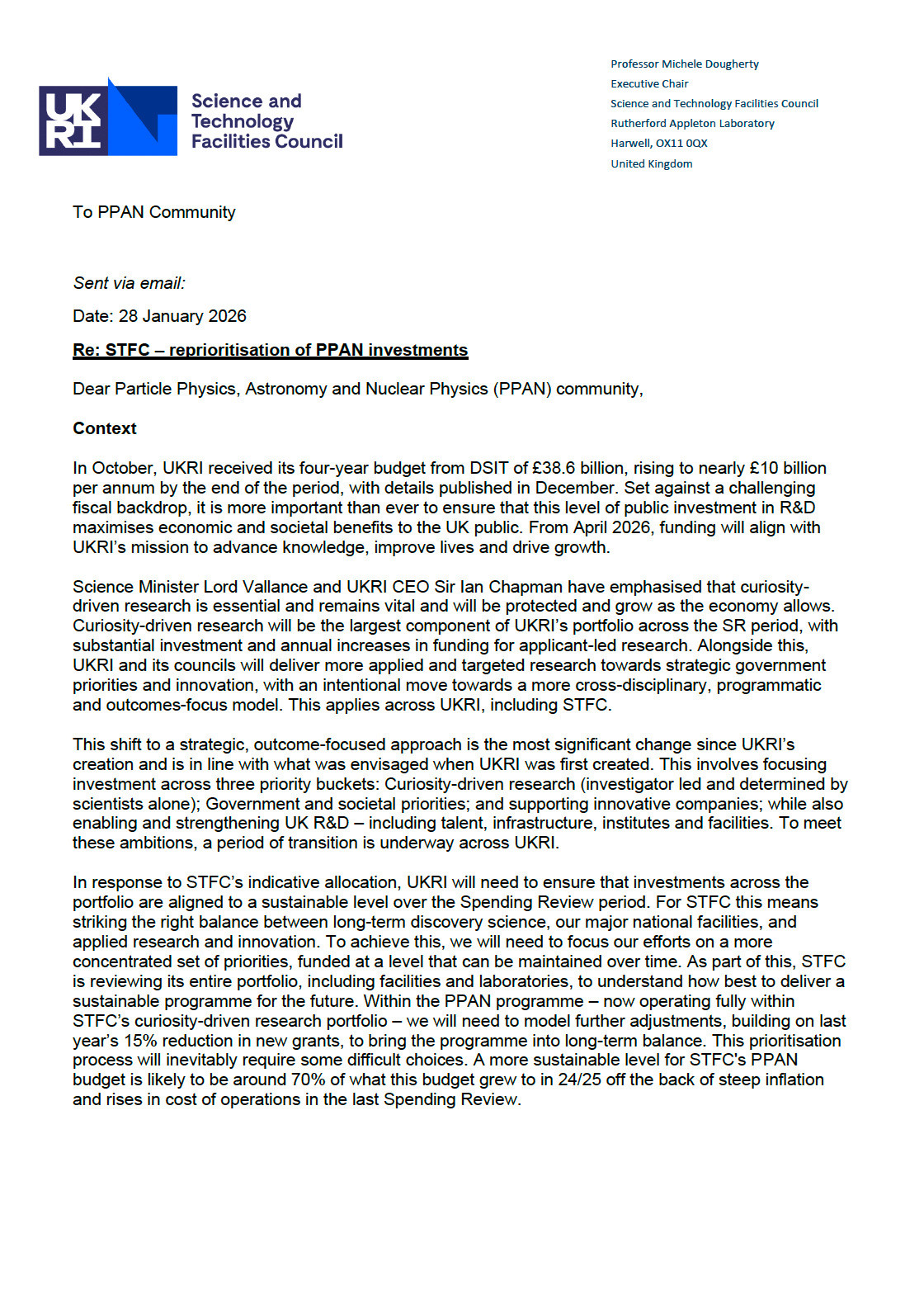
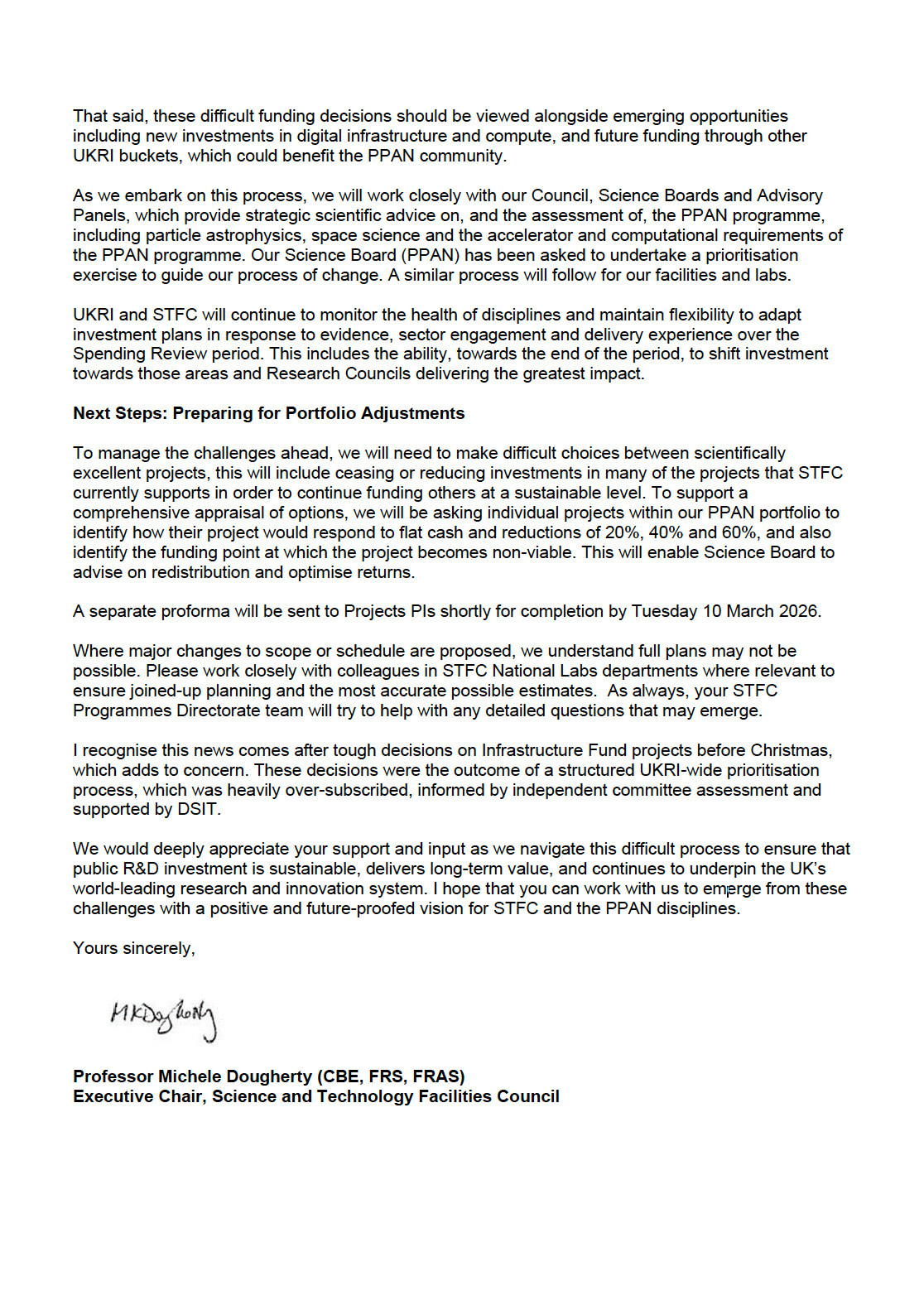
The following guest post by George Efstathiou is a response to the current STFC funding crisis I blogged about here, and specifically to a letter by the Executive Chair of STFC, Professor Michele Dougherty. I include the letter here for completeness:

George’s post follows:

–o–

I am glad that Michele Dougherty has finally communicated the position of STFC to the community.  There is a  glaring inconsistency between paragraphs 2 and 4 of her letter.

I have just finished a 5 year term on the STFC Science Board and now that the problems are in the public domain I am able to speak freely. In brief, the financial problems at STFC have arisen because of high inflation and high costs of energy against the backdrop of long term flat cash settlements. The national labs/facilities are particularly vulnerable to both. In addition, the labs invested heavily in ambitious upgrades that are now acknowldeged to be unsustainable. However, it is difficult to downsize programmes at the facilities quickly because it takes time to cut staff levels. In fact, money needs to be spent up front to achieve long term reductions in staff levels. From my time on Science Board, I can see no solution given the SR settlement other than for PPAN to take a big cut. Asking for more money from UKRI will likely fall on deaf ears, since the STFC problems are (to a large extent) of their own making.

The problem, as I see it, is whether it is possible for STFC to construct a recovery programme for PPAN science. The impression given in the Dougherty letter is that the ‘bucket’ allocation formula constrains STFC and so they are forced to reduce PPAN expenditure (Bucket 1) at the expense of ‘outcome driven’ growth related expenditure (Bucket 2) which goes mostly to the government labs/facilities. Science board was told that the new allocation formula was to blame for the huge cuts in the PPAN programme. Furthermore, the STFC plan to shift towards ‘growth related’ priorities is envisaged by STFC to lead to a long term cut in PPAN science. This situation was described to Science Board as the ‘new normal’. This is clearly inconsistent with paragraph 2 in Dougherty’s letter, which states that ‘curiosity-driven research will be the largest component of UKRI’s portfolio across the SR period, with substantial investment and annual increases in funding for applicant-led research’.

I discussed this contradiction with Paul Nurse, who told me that Patric Vallance had assured him that funding for basic research would not be cut under the new funding model. This prompted me to write to Michele Dougherty and Grahame Blair asking for clarification on the interpretation of the new funding model by STFC. I did not receive a reply.

This is what I think is going on. I believe that it is the STFC Executive Board that has decided to prioritise the facilities ahead of the PPAN programme. This is their decision and is not forced on them by the new allocation formula. I also believe that the their priorities are a reflection of conflicts of interest in the governance structure of STFC. Decisions at STFC are made by the Executive Board (EB) which is composed mostly of lab/facility directors and senior programme managers. The Council and Science Boards are advisory. The EB is therefore heavily biased in favour of the facilities component of the STFC portfolio. This bias has afflicted STFC since it was first created. I wrote to Michele Dougherty last July concerning the governance structure at STFC.  I did not get a reply.

The situation for PPAN science is very serious and I objected to Science Board being used to conduct a ‘prioritisation’ exercise. At these high levels of cuts, decisions depend on many programmatic factors that Science Board cannot judge.  Large cuts to key PPAN projects will surely raise questions of whether the UK should continue to pay international subscriptions. In addition, the UK Space Agency is being absorbed into DSIT and there is uncertainty concerning the relationship between UKSA and STFC. We also have the absurd spectacle of deep cuts to PPAN projects running alongside a call for white papers on future space missions.

I would urge the community to ask questions of STFC. It is important, in particular, to extract an answer from Michele Dougherty to the question of ‘how much freedom does STFC have to distribute funds between the three buckets?’. This is pertinent to the issue of whether STFC can construct a recovery plan for PPAN science. I also think that it is worth pursuing questions on the governance of STFC, which are at the heart of the problems. 

George Efstathiou FRS
Emeritus Professor of Astrophysics (1909)
Kavli Institute for Cosmology
Madingley Road
Cambridge

A New STFC Funding Crisis

Posted in Science Politics with tags , , , , on January 29, 2026 by telescoper

I started doing this blog back in 2008 and over the subsequent couple of years wrote many posts about a funding crisis affecting the Science and Technology Facilities Council, the UK funding agency that covers particle physics and astronomy research that had been created in 2007. I particularly remember the cancellation of the experiment Clover back in 2009 which had devastating and demoralising consequences for staff at Cardiff (where I was working at the time). It looks like a return to the Bad Old Days.

I moved from the UK eight years ago and haven’t really kept up with news related to the science funding situation there so I was very disturbed last night to see a message from the Royal Astronomical Society containing the following:

In a letter from its Executive Chair, Professor Michele Dougherty, the research council indicates that the budget for particle physics, astronomy and nuclear physics together will drop by around 30%. The letter also asks project teams to plan for scenarios where their funding is reduced by 20%, 40% and 60%.

All this is on top of a recent squeeze that has led to grants being delayed to make savings of around 15%. The full letter is here:

There’s a further report about this in Research Professional News which, unusually for that source, is not behind a paywall. It leads with

Exclusive: Science and Technology Facilities Council seeks £162m cost savings, with existing projects facing axe

The article goes on to point out the dangers of cuts of this scale to physics departments in the UK, many of which have a significant fraction of their activity in astronomy and particle physics.

The additional reduction and prospect of cuts to ongoing projects is likely to be felt as a hammer blow by physics departments in UK universities, of which a quarter are already at risk of closure.

Grim times indeed. It looks to me like the people running UKRI, the umbrella organization for all the UK research councils which has an annual budget of £8bn, have decided to throw STFC under the bus to chase shorter-term economically driven projects and to hell with the long-term funding of basic research. In Ireland we’re familiar with the consequences of that approach.

Still, at least the UK has the Astronomer Royal as an independent voice to speak up against these cuts. The current Astronomer Royal is… checks notes… oh… Michelle Dougherty, Executive Chair of STFC.

Enquiring into UK Astronomy

Posted in Science Politics, The Universe and Stuff with tags , , , on September 14, 2023 by telescoper

Apparently I still have a few readers in the UK, so I thought I’d share a bit of news aimed at them.

It seems the Science, Innovation and Technology Committee of the House of Commons has initiated an inquiry into ” how well placed the UK astronomy sector is to showcase the UK as a science superpower and maximise its leadership in international programmes”. Apparently this will examine the status of the UK’s astronomical research base and assets, UK access to international astronomical facilities and contribution to international programmes. It will also explore astronomy’s potential contribution to the UK economy and what considerations should inform the Science and Technology Facilities Council’s next Strategic Delivery Plan, due in 2026. 

I don’t know why STFC doesn’t just use ChatGPT to write its strategic plan like everyone else, but there you go.

Anyway, the Committee welcomes submissions addressing any or all of the following:

  • The strengths and weaknesses of UK astronomy and how these compare to other nations
  • The opportunities and challenges facing UK astronomy and whether it is receiving sufficient support
  • What the aims and focus of UK astronomy should be
  • The extent to which UK astronomy contributes to the UK’s status as a science superpower
  • Whether the UK is maximising the contribution that astronomy can make to the wider UK economy
  • What role astronomy is playing in encouraging greater diversity and inclusion in STEM and public interest in science

To find out more information and/or submit a submission go here. The deadline is 27th October.

Have fun!