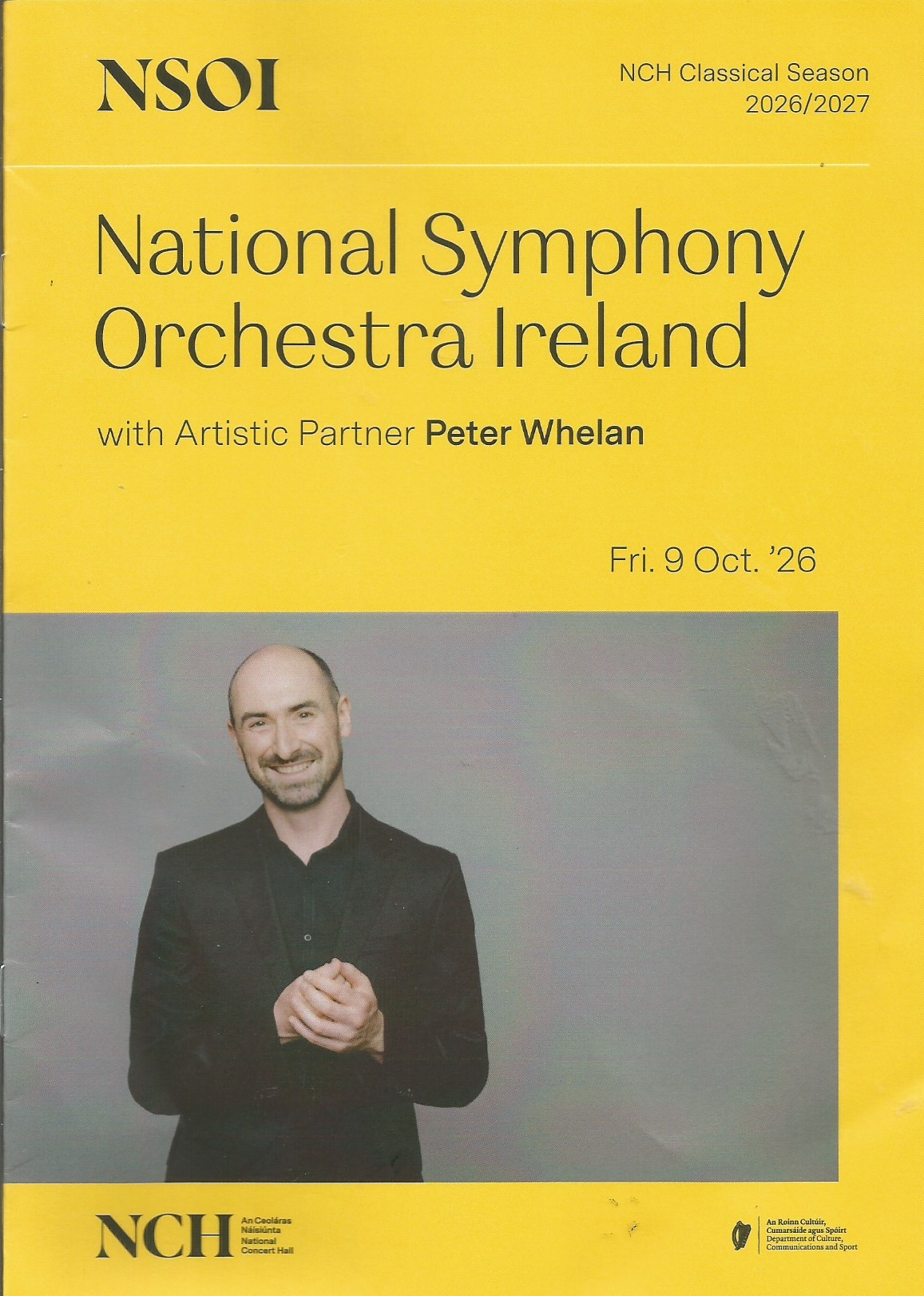
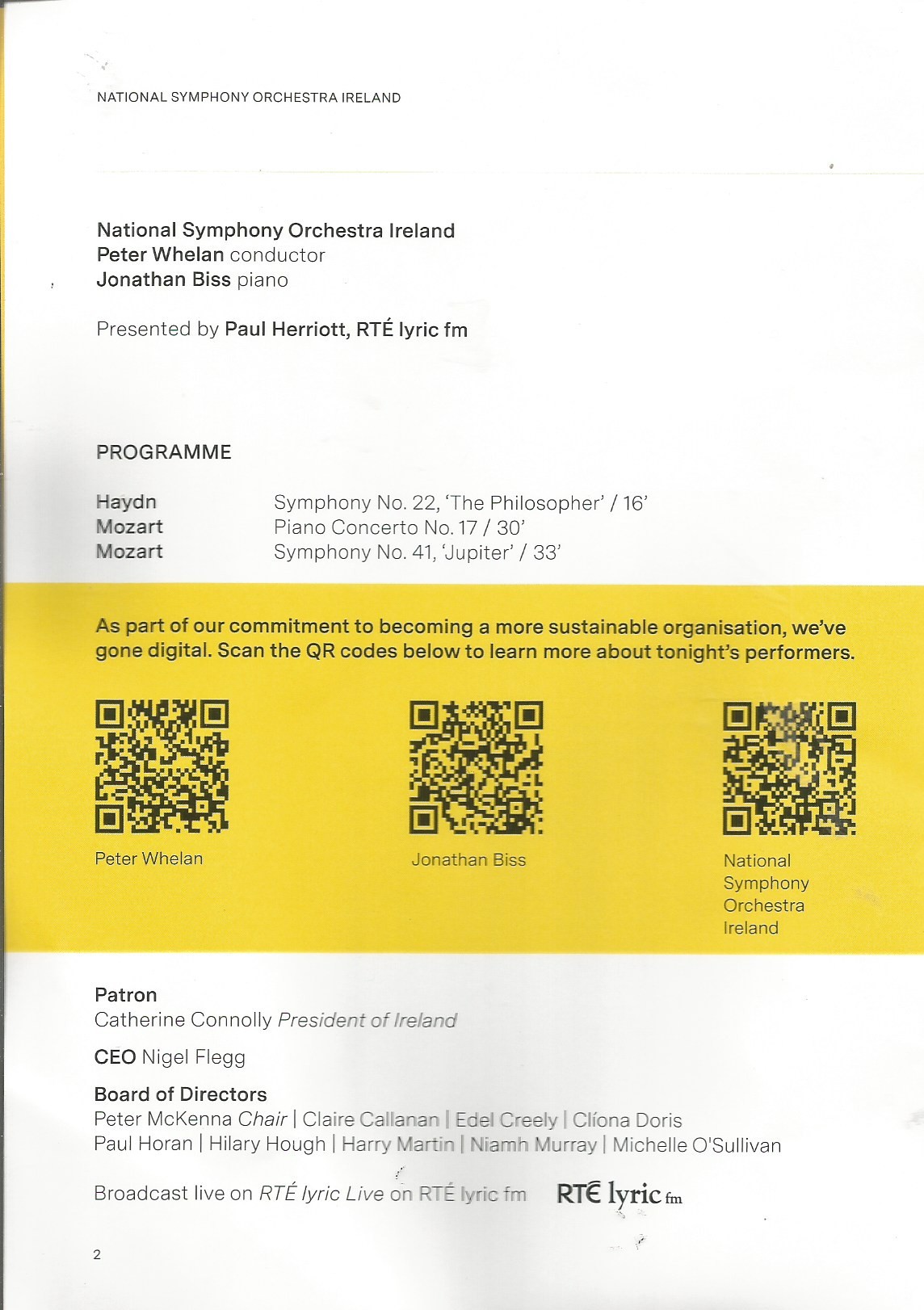
Yesterday evening I once again travelled into Dublin for a concert by National Symphony Orchestra Ireland at the National Concert Hall. No rain this time, I’m glad to say, either going there or coming back!
The concert, under the direction of Artistic Partner Peter Whelan, was very definitely classical music in the sense that all three works were from the classical period of the middle to late eighteenth century.
First up we had Symphony No. 22 in E♭ Major by Joseph Haydn. This is usually known as “The Philosopher”. I tend to think of Haydn’s music as expertly crafted but mostly a bit “middle-of-the-road” for my tastes. This symphony, written in 1764 has four movements. I found the first movement Adagio rather plodding but there is much to enjoy in this work, and it was given a good performance last night. I don’t think the nickname “The Philosopher” was given to this work by Haydn, incidentally.
Then, after the usual reorganization on stage to accommodate the NCH’s Steinway, we had Piano Concerto No. 17 in G Major by Wolfgang Amadeus Mozart, with soloist Jonathan Biss. Written in 1784, this is an enjoyable and entertaining piece, not perhaps as profound as some of the later piano concertos (Mozart wrote 27 altogether), but well worth listening to. I found it very witty and somewhat conversational in style, with lots of “call-and-answer” moments. It’s also interesting that the piano doesn’t start to play for quite a long time in the first movement. The three movements follow a standard fast-slow-fast pattern (Allegro-Andante-Alegretto/Presto). It certainly does motor towards the end!
The second half of the concert was devoted to another piece by Wolfgang Amadeus Mozart, his Symphony No. 41 “Jupiter”. Composed in 1788, just 24 years after the Haydn symphony we heard in the first part, it demonstrated very powerfully how much the symphonic form had evolved in relatively short time separating the two compositions. The Jupiter symphony is not only brim full of ideas, but the themes are woven into a much richer fabric. The reason it is such a great symphony – one of the greatest of all, not just the greatest by Mozart – is that the whole is even greater than the sum of its wonderful parts. It’s a familiar part of the concert repertoire, of course, but does stand up to repeated listening. Last night’s performance was very enjoyable.
On the way home on the train I found myself wondering at what point and for what reasons the “Minuet” that appeared as a fourth movement in many classical symphonies like the two we heard last night became the “Scherzo” that was de rigueur for later symphonies (in the romantic era). Answers on a postcard please…


