It’s time for another Saturday update of activity at the Open Journal of Astrophysics. Since the last update we have published a further seven papers, bringing the number in Volume 9 (2026) to 256 and the total so far published by OJAp up to 704.
I continue to include the posts made on our Mastodon account (on Fediscience); these announcements also contain a clickable form of the DOI for each paper. Our Mastodon account has regular updates and other announcements from OJAp too, including posts from the OJAp blog.
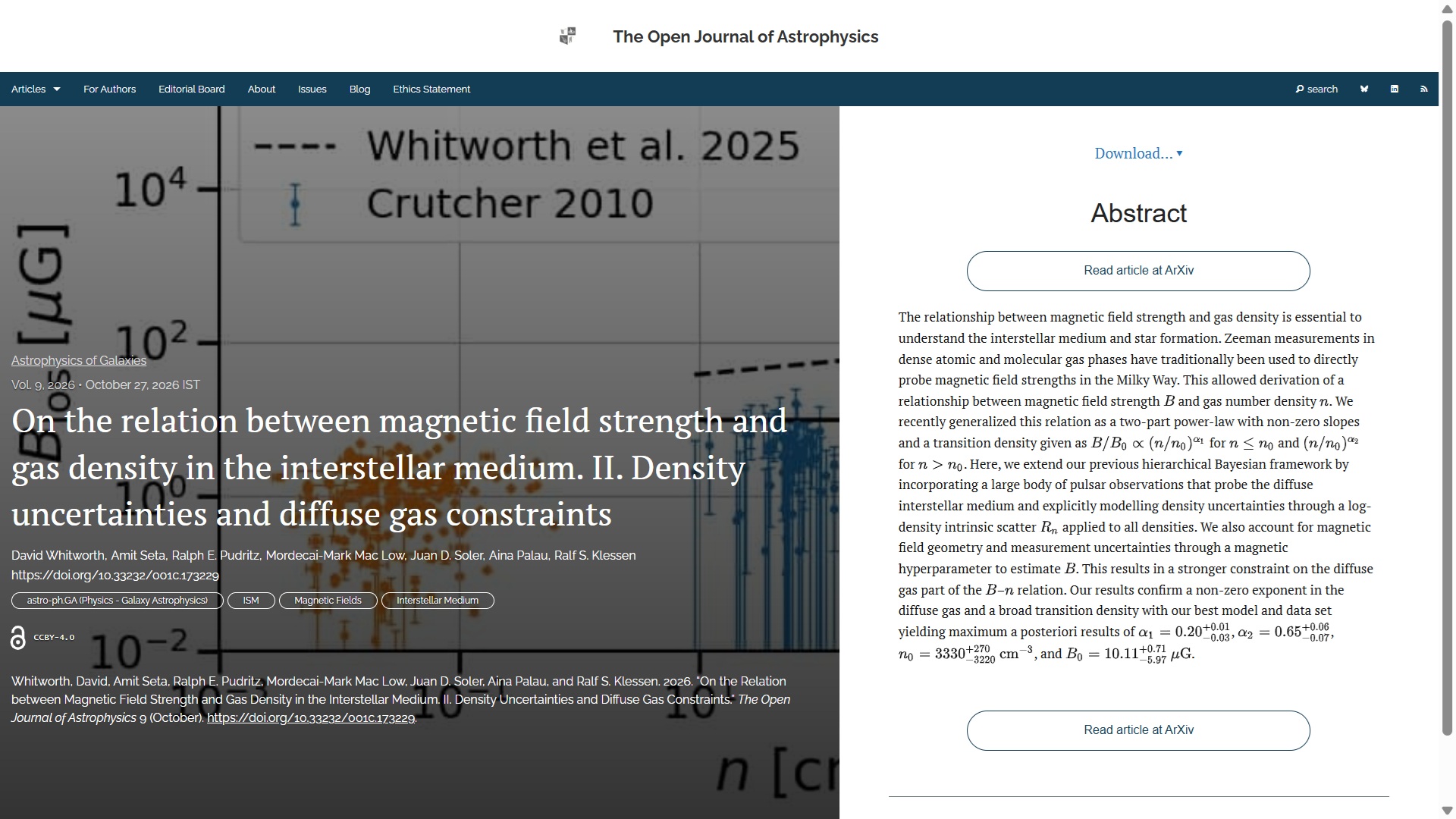
The first paper this week was published on Tuesday 27th October in the folder Astrophysics of Galaxies. The title is “On the relation between magnetic field strength and gas density in the interstellar medium. II. Density uncertainties and diffuse gas constraints” by David Whitworth (ENS Lyon, France) and 6 others based in Australia, Canada, USA, Austria, Mexico and Germany. This article uses pulsar observations that probe the diffuse interstallar medium to extend modelling of the relationship between magnetic field strength and gas number-density. accounting for field geometry.
The overlay for this one is here:
You can find the officially accepted version on arXiv here and the announcement on Fediverse here:

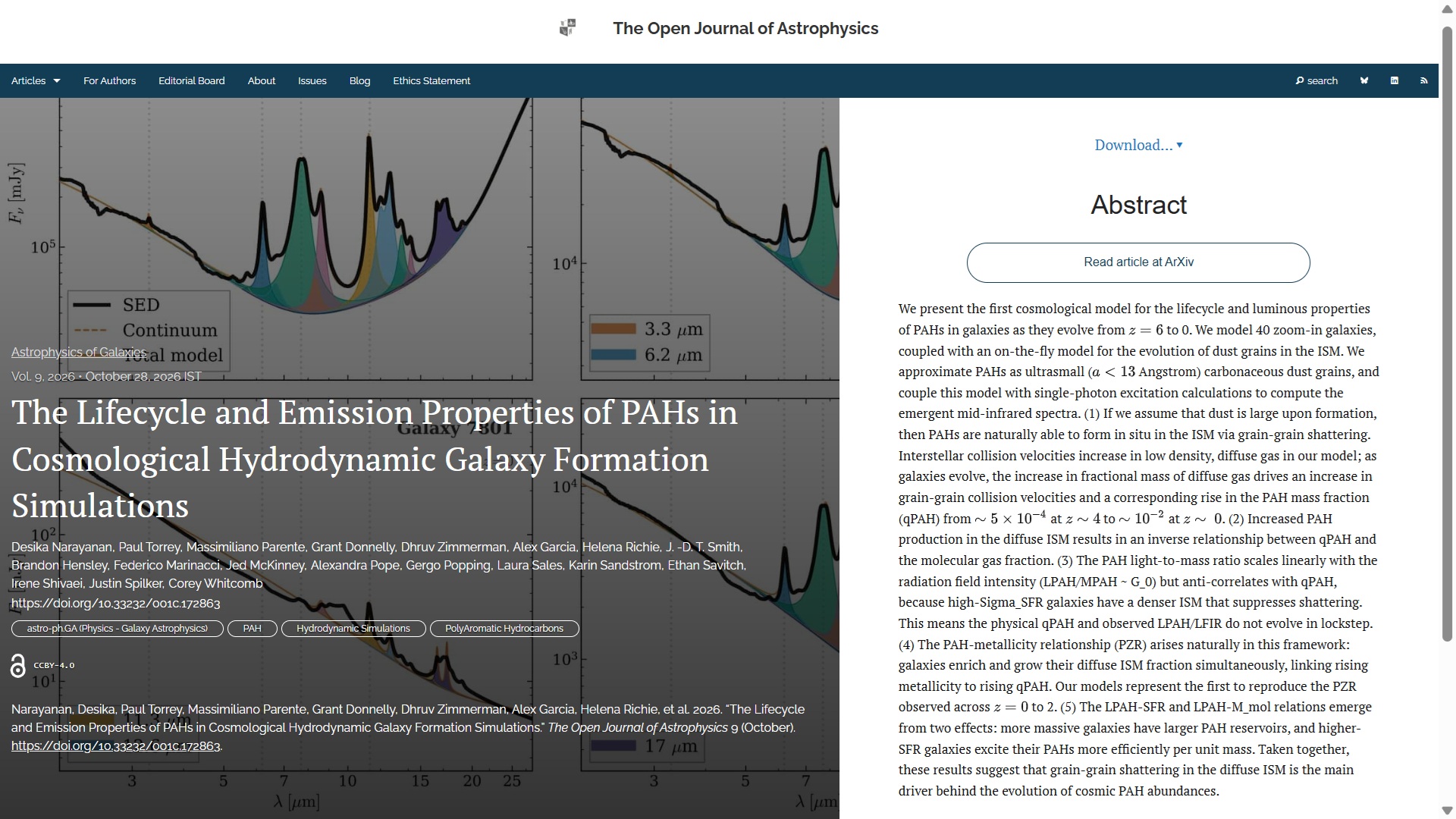
The second paper for this week, published on Wednesday 28th October in the folder Astrophysics of Galaxies, is “The Lifecycle and Emission Properties of PAHs in Cosmological Hydrodynamic Galaxy Formation Simulations” by Desika Narayanan (U. Florida, USA) and 18 others. The study presents the first cosmological model for the evolution and luminous properties of PAHs in galaxies, suggesting that grain-grain shattering in the diffuse ISM primarily drives cosmic PAH abundances.
The overlay looks like this:
The official version of the paper can be found on arXiv here and the Fediverse announcement here:
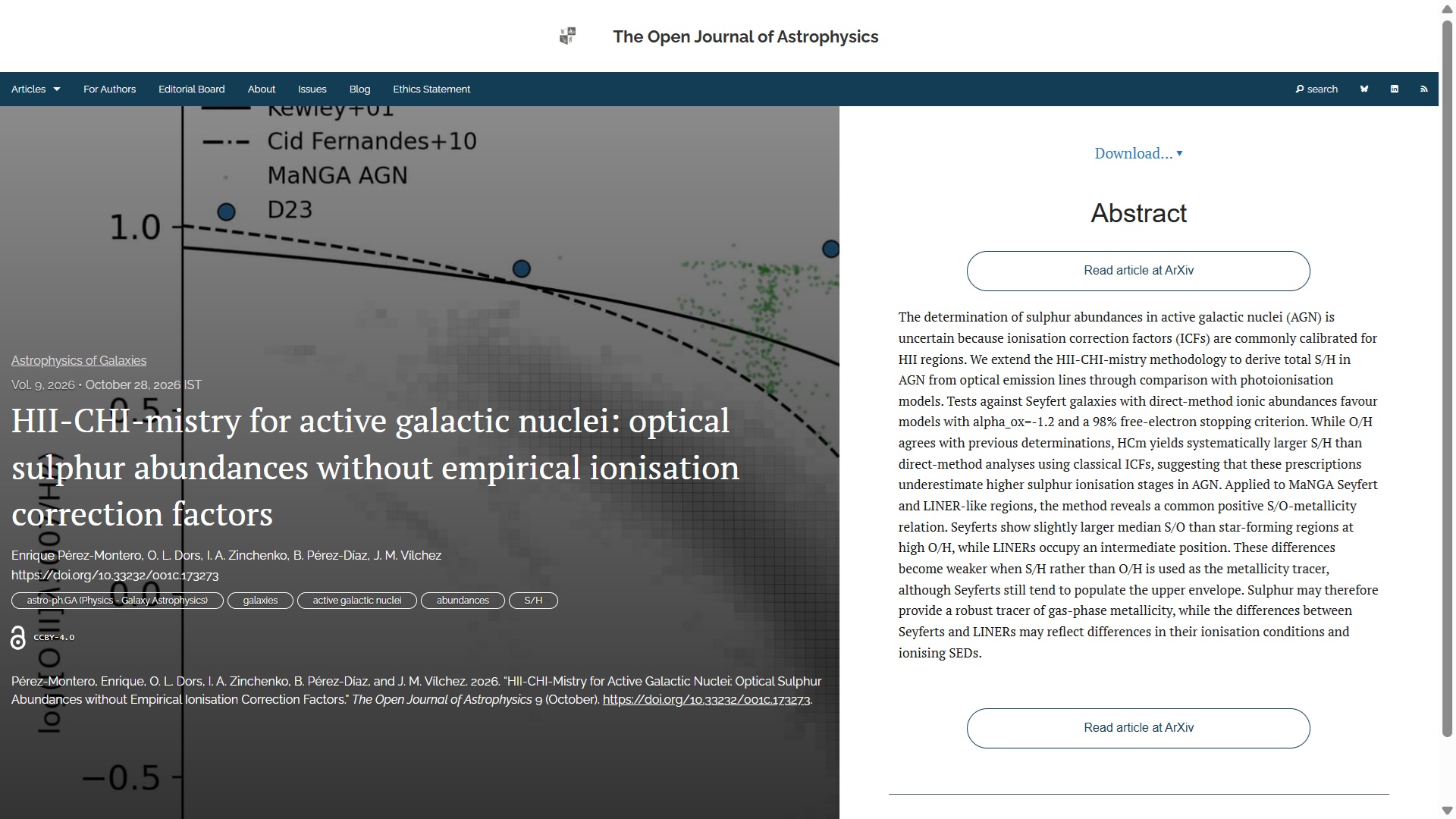
The third paper of the week, published on Wednesday October 28th 2026, is “HII-CHI-mistry for active galactic nuclei: optical sulphur abundances without empirical ionisation correction factors” by Enrique Pérez-Montero (Instituto de Astrofísica de Andalucía, Spain) and 5 others. This work, published in the folder Astrophysics of Galaxies, extends the HII-CHI-mistry methodology to derive total Sulphur to Hydrogen (S/H) ratios in AGN from optical emission lines through comparison with photoionisation models.
The overlay for this is here:
The accepted version of this one can be found on the arXiv here and the Mastodon announcement here:
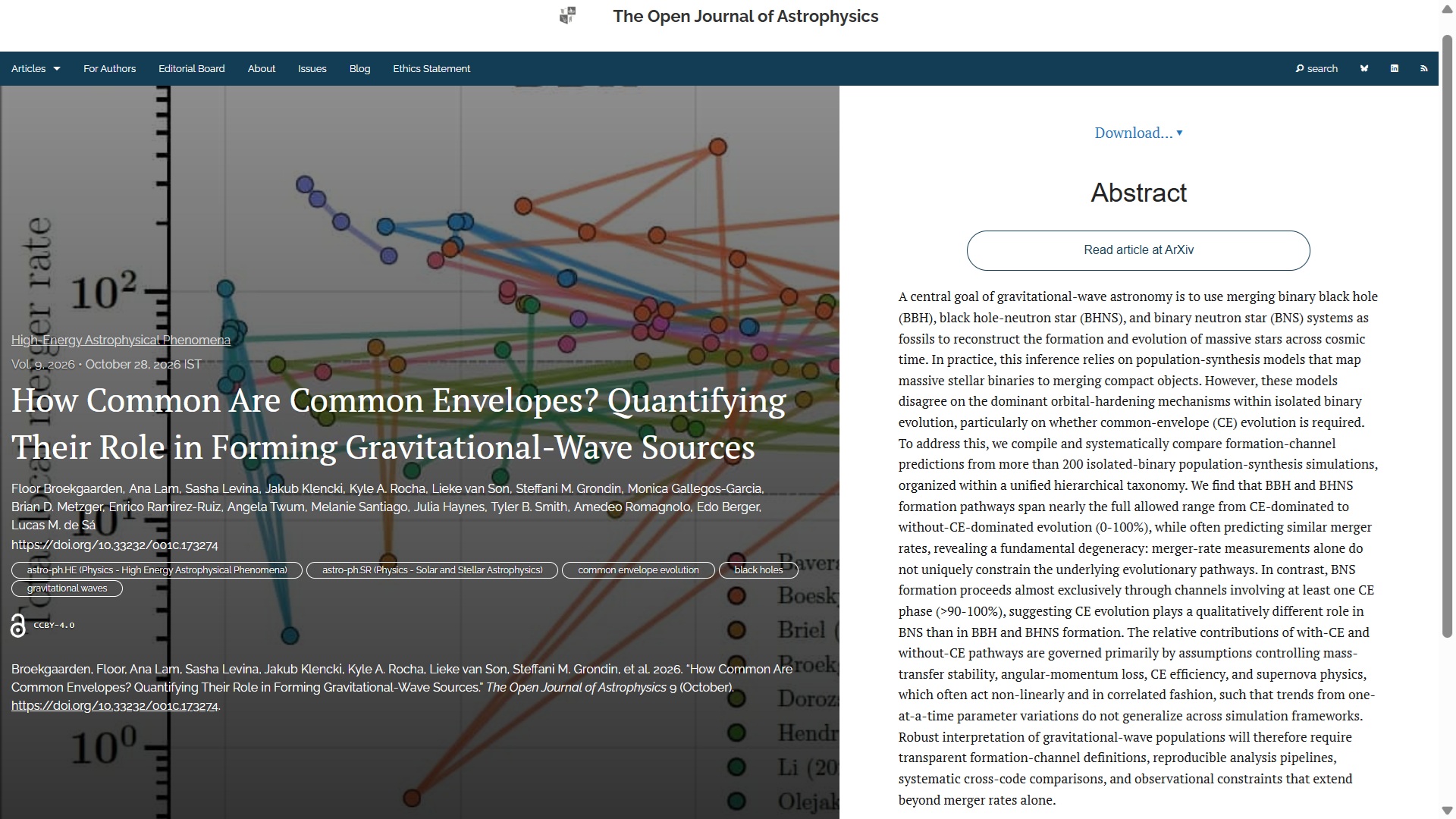
The fourth article of the week, also published on Wednesday 28th October but in the folder High-Energy Astrophysical Phenomena, is “How Common Are Common Envelopes? Quantifying Their Role in Forming Gravitational-Wave Sources” by Floor Broekgaarden (University of California San Diego, USA) and 16 others. This work involves a compilation and systematically comparison of formation-channel predictions from more than 200 isolated-binary population-synthesis simulations, organized within a unified hierarchical system identify the frequency of common-envelope evolution.
The overlay is here:
The official version of the paper can be found on arXiv here and the Fediverse announcement here:
The fifth paper of the week, published on Friday 30th October 2026, in the folder Astrophysics of Galaxies, is “From ASTRID to BRAHMA – The role of overmassive black holes in little red dots in cosmological simulations” by Patrick LaChance (Carnegie Mellon U., USA) and 10 others (all based in the USA). Having generated mock JWST observations using the BRAHMA cosmological hydrodynamic simulation, this research explores the possible role of overmassive black holes in the formation of Little Red Dots.
The overlay for this one is here:
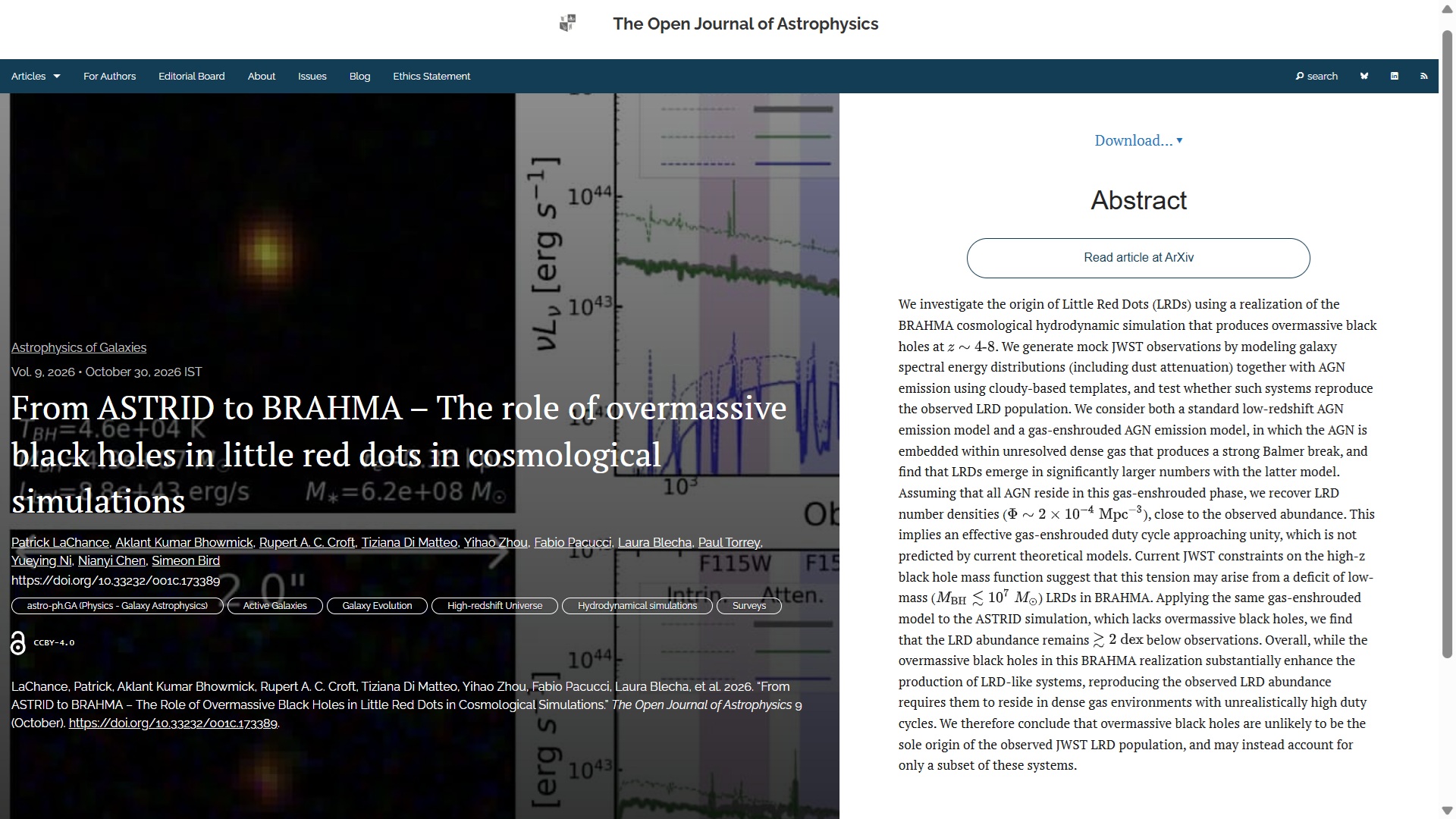
You can find the officially accepted version of this paper on arXiv here and the Mastodon announcement is here:
The penultimate, sixth, paper this week is “No Blue without Red: Evolutionary Properties of Super-Early Galaxies” by A. Ferrara (Scuola Normale Superiore, Pisa, Italy) and 5 others based in Italy and China. This was also published on Friday 30th October in the folder Astrophysics of Galaxies. This paper presents an interpretive scheme for the properties of extremely early galaxies highlighting the key role of radiation-driven outflows and indicating how JWST/ALMA observations will provide key tests.
The overlay is here:
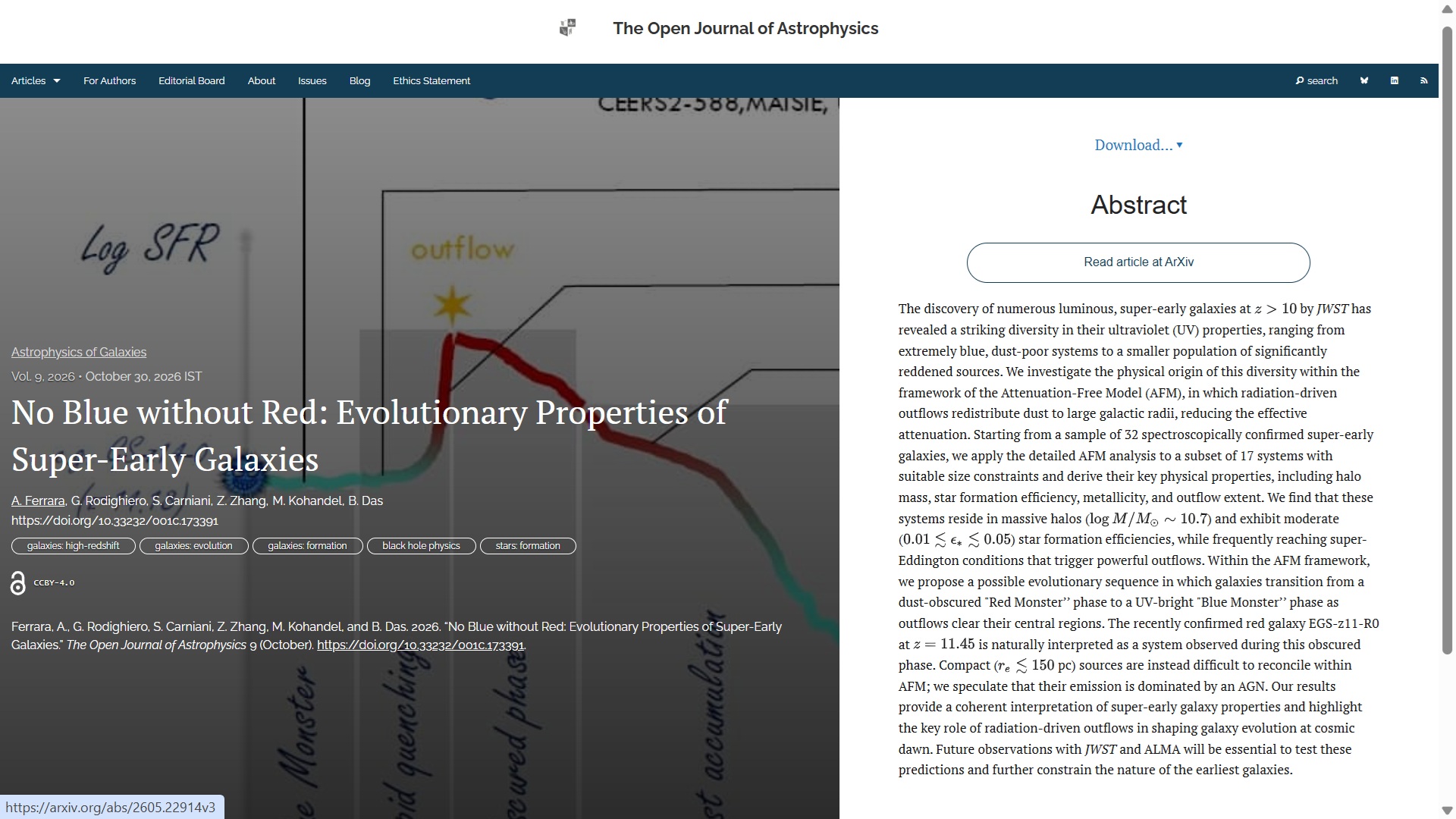
You can find the final version of this paper on arXiv here and the Mastodon announcement here:
The seventh and last paper to report this week is “Automatic astrometric calibration of low-cost all-sky cameras” by J. R. González Fernández (Universidad Internacional de La Rioja, Spain), Laura Hermosa Muñoz (Universidad de Oviedo, Spain) and María Fernández Alonso & Lucía González Cuesta (Allande Stars, Spain). This was published on Friday 30th October in the folder Instrumentation and Methods for Astrophysics. This paper describes an open-source procedure for astrometric calibration that combines a compact fisheye model, an exact rotation to account for camera tilt, and automatic star matching.
The overlay for this one is here:
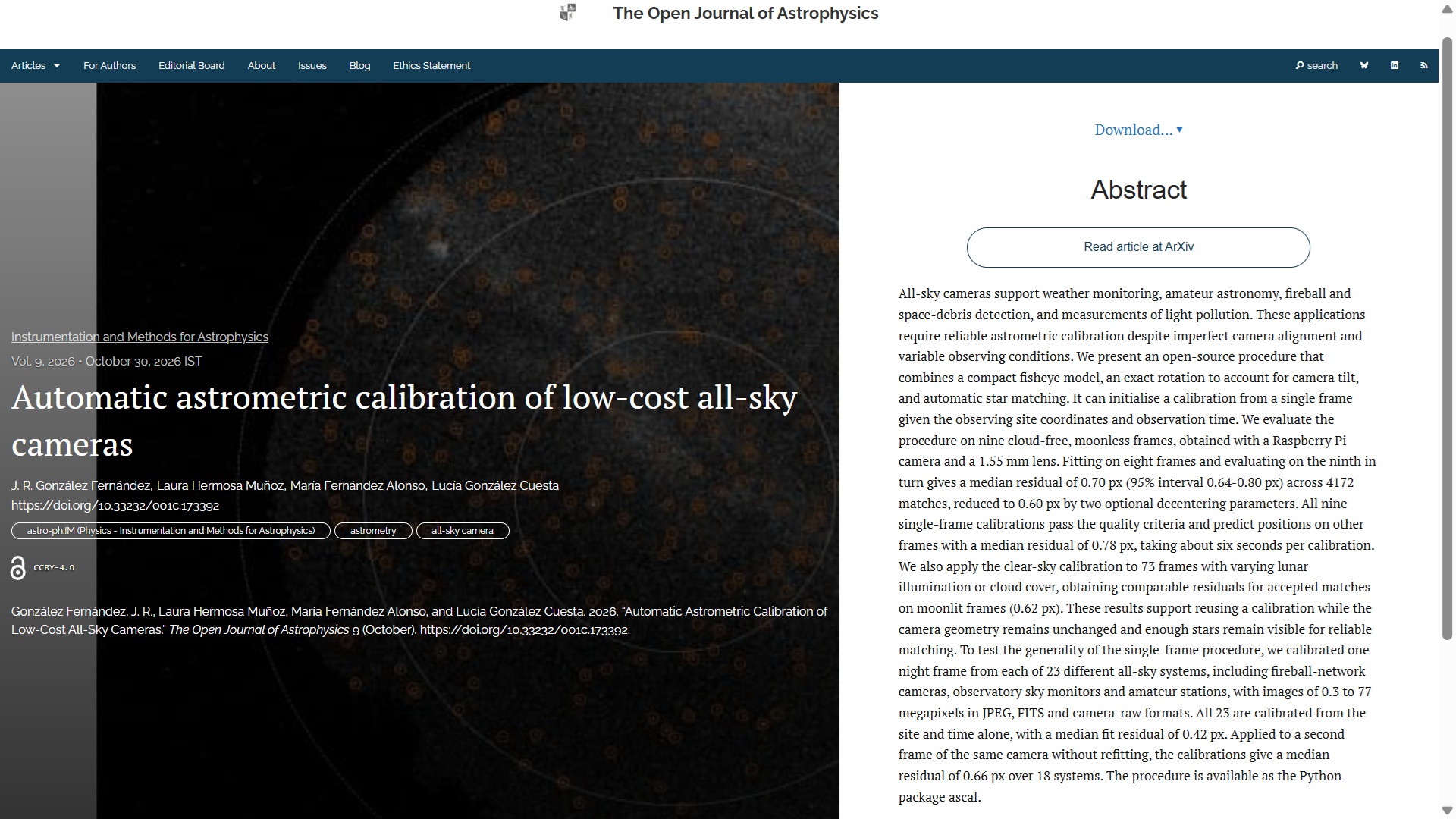
The officially accepted version is on arXiv here and this is the Mastodon announcement:
That concludes this week’s update. There was an interruption in publishing on Thursday 29th October as arXiv did not update on that day owing to its migration into the cloud. Anyway, we have now published over 700 papers in total. So far this year we have published 256, with 10 of the 12 months now complete. A rough estimate would take us to about 307 by the end of the year. We have in fact published more than 300 papers since this time last year. I’ll do another update next week.


