Author Archive

NANOGrav Newsflash!

Posted in Astrohype, The Universe and Stuff with tags , , , , , on June 29, 2023 by telescoper

In a post earlier this week I wrote that

There is a big announcement scheduled for Thursday by the NANOGrav collaboration. I don’t know what is on the agenda, but I suspect it may be the detection of a stochastic gravitational wave background using pulsar timing measurements. I may of course be quite wrong about that, but will blog about it anyway.

The press conference is not until 1pm EDT (6pm Irish Time) but the papers have already arrived and it appears I was correct in my inference. The papers can be found here, along with a summary. The main results paper is entitled The NANOGrav 15 yr Data Set: Evidence for a Gravitational-wave Background. Here is the abstract (click on the image to make it bigger):
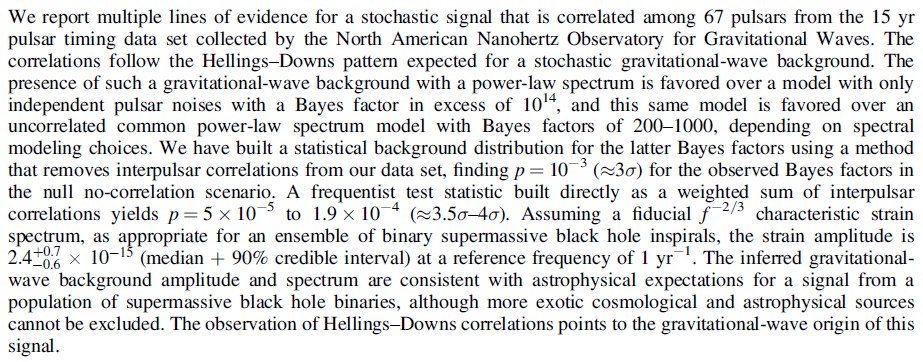
In a nutshell, this evidence differs from the direct detection of gravitational waves by interferometric experiments, such as Advanced LIGO, in that it: (a) does not detect individual sources but an integrated background produced by many sources; (b) it is sensitive to much longer gravitational waves (measured in light-years rather than kilometres).; and (c) the statistical evidence of this detection is far less clear-cut.

While Advanced LIGO can – and does – detect gravitational waves from mergers of stellar mass black holes, the NANOGrav signal would correspond to similar events involving much more massive objects – supermassive black holes (SMBHs) – with masses exceeding a million times the mass of the Sun, such as the one found in the Galactic Centre. If this is the right interpretation, the signal will provide important information about how many such mergers are happening across the Universe and hence about the formation of such objects and their host galaxies.

SMBH mergers are not the only possible source of the NANOGrav signal, however, and you can bet your bottom dollar that there will now be an avalanche of theory papers on the arXiv purporting to explain the results in terms of more exotic models.

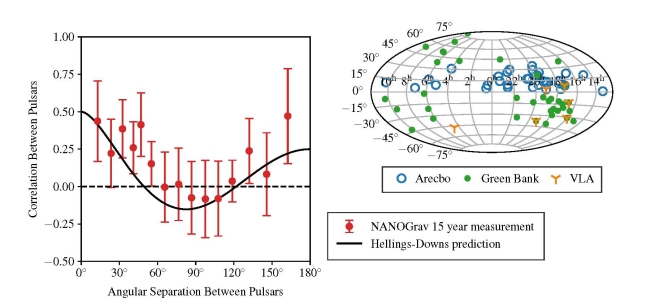
Incidentally, for a nice explanation of the Hellings-Downs correlation, see here. The figure from the paper is
I haven’t had time to go through the papers in detail so won’t comment on the results, at least partly because I find the presentation of the statistical results in the abstract a very confusing jumble of Bayesian and frequentist language which I find hard to penetrate. Hopefully it will make more sense when I have time to read the papers and/or when I watch the announcement later.

First Impression seeing the Euclid Telescope

Posted in Euclid, The Universe and Stuff with tags , , , on June 28, 2023 by telescoper

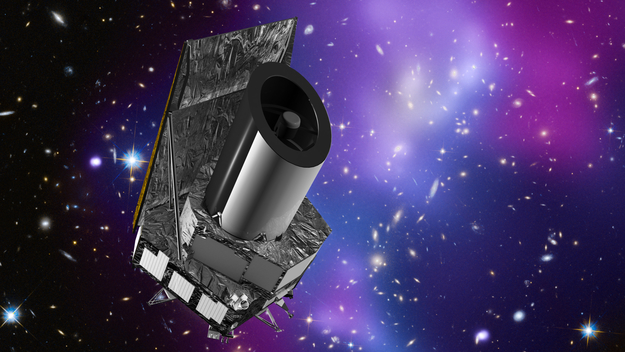
With just three days to go before the scheduled launch of the Euclid spacecraft on Saturday 1st July 2023, at 1612 Irish Time (GMT+1), the Education and Public Outreach (EPO) team have been continuing to ramp up its social media activity and the second YouTube video has now “dropped” (as you young people say).

This was filmed at Thales Alenia Space in Cannes, France, as members of the Euclid consortium from around the world gathered in anticipation to see the fully-assembled Euclid telescope for the first time as it underwent final tests before its journey to the launch site in Florida.

Two New Publications at the Open Journal of Astrophysics

Posted in OJAp Papers, Open Access, The Universe and Stuff with tags , , , on June 28, 2023 by telescoper

Time to catch up with a couple of recent publications at the Open Journal of Astrophysics.

The first paper was published on Friday 23rd June. It is the 21st in Volume 6 (2023) and the 86th in all.

The primary classification for this paper is Cosmology and Nongalactic Astrophysics and its title is “CosmoPower-JAX: high-dimensional Bayesian inference with differentiable cosmological emulators”. The paper is about a new method, based on machine learning, to construct emulators for cosmological power spectra for the purpose of speeding up inference procedures. The software described in the paper is available here.

The authors are Davide Piras (of the University of Geneva, Switzerland) and Alessio Spurio Mancini (of the Mullard Space Sciences Laboratory, University College, London, UK)

Here is a screen grab of the overlay which includes the abstract:

You can click on the image of the overlay to make it larger should you wish to do so. You can find the officially accepted version of the paper on the arXiv here.

The second paper was published yesterday. It is the 22nd in Volume 6 (2023) and the 87th in all. Although 87 is an unlucky number for Australian cricketers – 13 short of a century – we’re still well on track to reach 100 papers by the end of the year.

Once again the primary classification for this paper is Cosmology and Nongalactic Astrophysics. The title of this one is “The alignment of galaxies at the Baryon Acoustic Oscillation scale” by Dennis van Dompseler, Christos Georgiou & Nora Elisa Chisari all of Utrecht University, in The Netherlands.

Here is a screen grab of the overlay which includes the abstract:


You can click on the image of the overlay to make it larger should you wish to do so. You can find the officially accepted version of the paper on the arXiv here.

Euclid’s “Red Book”

Posted in Euclid, The Universe and Stuff with tags , , on June 27, 2023 by telescoper

With the scheduled launch of ESA’s Euclid mission coming up this weekend, it is perhaps topical to share the document written almost 12 years ago that outlines the design concepts and describes the detailed scientific case. It’s a compendious piece, running to well over 100 pages but, as with virtually everything in astrophysics, the full Euclid Definition Study Report can be found on arXiv.

Here is the abstract:

Euclid is a space-based survey mission from the European Space Agency designed to understand the origin of the Universe’s accelerating expansion. It will use cosmological probes to investigate the nature of dark energy, dark matter and gravity by tracking their observational signatures on the geometry of the universe and on the cosmic history of structure formation. The mission is optimised for two independent primary cosmological probes: Weak gravitational Lensing (WL) and Baryonic Acoustic Oscillations (BAO). The Euclid payload consists of a 1.2 m Korsch telescope designed to provide a large field of view. It carries two instruments with a common field-of-view of ~0.54 deg2: the visual imager (VIS) and the near infrared instrument (NISP) which contains a slitless spectrometer and a three bands photometer. The Euclid wide survey will cover 15,000 deg2 of the extragalactic sky and is complemented by two 20 deg2 deep fields. For WL, Euclid measures the shapes of 30-40 resolved galaxies per arcmin2 in one broad visible R+I+Z band (550-920 nm). The photometric redshifts for these galaxies reach a precision of dz/(1+z) < 0.05. They are derived from three additional Euclid NIR bands (Y, J, H in the range 0.92-2.0 micron), complemented by ground based photometry in visible bands derived from public data or through engaged collaborations. The BAO are determined from a spectroscopic survey with a redshift accuracy dz/(1+z) =0.001. The slitless spectrometer, with spectral resolution ~250, predominantly detects Ha emission line galaxies. Euclid is a Medium Class mission of the ESA Cosmic Vision 2015-2025 programme, with a foreseen launch date in 2019. This report (also known as the Euclid Red Book) describes the outcome of the Phase A study.

arXiv:1110.3193

Euclid was formally adopted as an ESA M Class mission in June 2012. I’ve added the emphasis to the penultimate sentence to draw your attention to the fact that the launch of Euclid is about four years late.

Last Call for the Maynooth MSc in Theoretical Physics & Mathematics!

Posted in Education, Maynooth with tags , , on June 26, 2023 by telescoper

While I remember, here’s another plug for our new MSc course in Theoretical Physics & Mathematics, further details of which may be found here. Maynooth University offers Taught Masters Scholarships for high-flying applicants but you need to apply by 30th June to get one, which is why I’m advertising this one more time.

The new postgraduate course will be run jointly between the Departments of Theoretical Physics and Mathematics & Statistics, with each contributing about half the material. The duration is one calendar year (full-time) or two years (part-time) and consists of 90 credits in the European Credit Transfer System (ECTS). This will be split into 60 credits of taught material (split roughly 50-50 between Theoretical Physics and Mathematics) and a research project of 30 credits, supervised by a member of staff in a relevant area from either Department.

This new course is a kind of follow-up to the existing undergraduate BSc Theoretical Physics & Mathematics at Maynooth, also run jointly. We think the postgraduate course will appeal to many of the students on that programme who wish to continue their education to postgraduate level, though applications are very welcome from suitably qualified candidates who did their first degree elsewhere.

Postgraduate admissions in Ireland operate differently from the UK, in that there is a central system in Ireland (called PAC) that is similar to the undergraduate admissions system; in the UK PG courses are dealt with by individual institutions. You will need to apply online via PAC after the following the instructions here. The requisite PAC code for the full-time version of the course is MHQ56.

Back to Maynooth; a Look Ahead

Posted in Biographical, Maynooth on June 26, 2023 by telescoper
A pensive Maynooth University Library Cat

I’m back on Maynooth University campus after a very busy but enjoyable week in Copenhagen. I spent the morning catching up on a few things, including a bit of OJAp business and a visit to Maynooth University Library Cat.

Tomorrow (Tuesday) I have to Chair a PhD viva (for a candidate in another Department). It’s interesting that viva voce examinations at Maynooth follow a similar practice to those at Cardiff University, my previous institution, in that each viva has a Chair as well as the internal and external examiners. The Chair is really present to ensure fair play and that proper procedure is followed, and is rarely (if ever) called upon to intervene in practice. I chaired a quite a few such examinations in Cardiff, but this will be my first in Maynooth.

On Wednesday there is the official handover of the position of Chair of the Euclid Consortium Diversity Committee during which I’ll be briefed about various ongoing matters, as well as generally being given the keys to the kingdom in terms of access to documents, websites and other paraphernalia.

There is a big announcement scheduled for Thursday by the NANOGrav collaboration. I don’t know what is on the agenda, but I suspect it may be the detection of a stochastic gravitational wave background using pulsar timing measurements. I may of course be quite wrong about that, but will blog about it anyway.

Then on Friday I have to prepare for another trip, a short one this time, to attend part of the UK National Astronomy Meeting in Cardiff.

Alongside those other things I have to make sure my repeat examinations are ready to be printed ahead of the examination session in August. Students received their final grades last week (while I was away). I don’t know how many will need to take repeat examinations, but there will undoubtedly be some.

Anyway, I have an article I really want to finish by the end of today, so I’ll stop there and get on with it.

What is Euclid?

Posted in Euclid, The Universe and Stuff with tags , on June 25, 2023 by telescoper

With less than a week to go before the scheduled launch of the Euclid spacecraft on Saturday 1st July 2023, at 1612 Irish Time (GMT+1), the Education and Public Outreach (EPO) team has been ramping up its social media activity. They’ve even got a blog! Anyway here is a nice video featuring many members of the Euclid Consortium – some of whom gave presentations at last week’s conference – talking about Euclid. The sense of enthusiasm shines through, I think. I will be sharing further videos when they appear.

Machiavelli on Mercenaries

Posted in History, Literature, Politics with tags , , on June 24, 2023 by telescoper

I thought I’d post this, from Il Principe (The Prince) by Niccolò Machiavelli for reasons of topicality. It’s from Chapter XII, entitled How Many Kinds of Soldiery There are, and Concerning Mercenaries:

Mercenaries and auxiliaries are useless and dangerous; and if one holds his state based on these arms, he will stand neither firm nor safe; for they are disunited, ambitious, and without discipline, unfaithful, valiant before friends, cowardly before enemies; they have neither the fear of God nor fidelity to men, and destruction is deferred only so long as the attack is; for in peace one is robbed by them, and in war by the enemy. The fact is, they have no other attraction or reason for keeping the field than a trifle of stipend, which is not sufficient to make them willing to die for you…

I wish to demonstrate further the infelicity of these arms. The mercenary captains are either capable men or they are not; if they are, you cannot trust them, because they always aspire to their own greatness, either by oppressing you, who are their master, or others contrary to your intentions; but if the captain is not skilful, you are ruined in the usual way.

Niccolò di Bernardo dei Machiavelli, The Prince (1513), Chapter XII

Copenhagen Looking Back

Posted in Biographical, Euclid, OJAp Papers, The Universe and Stuff on June 23, 2023 by telescoper

So here I am then, back in Maynooth. I had a relatively stress-free trip back, although my plane was a bit late and I had to run through Dublin Airport to catch the Hopper Bus I was booked on. Made it though.

The first thing I want to do is to thank the organizers for what was a wonderful event. I wasn’t able to attend the Euclid Consortium meeting in Oslo last year, largely because it was earlier in the year, in April (i.e. term-time) and I had teaching responsibilities. I gather it was a rather gloomy occasion because there was no concrete plan for the launch of Euclid thanks to the Russian war against Ukraine. I guess few would have predicted then that the 2023 meeting would be just a week or so before a launch on SpaceX!

I have to say the atmosphere was also helped by the excellent weather and very fine catering. The conference dinner was held in the Banqueting Hall, on the first floor of the Hans Christian Anderson Castle which stands at one of the entrances to the famous Tivoli Gardens, a few minutes from the conference venue.

Finally, one other memory that will stay with me for a while. It turned out that the week of the conference coincided with high-school graduation celebrations in Copenhagen, so every day we encountered lots of exuberant and largely inebriated teenagers around wearing funny hats and generally going a bit berserk. They made quite a lot of noise in the evenings, but it was all harmless. You’re only young once!

Having not been at an in-person conference for over four years, it was great to see some new faces and catch up with some people I haven’t seen for a long time. It was especially nice to talk to a couple of members of the Editorial Board of the Open Journal of Astrophysics. It was also nice to talk to some authors. Talking of which, here is Nicolas Tessore delivering a plenary presentation featuring work from one of the papers he has published with OJAp:

Anyway, I was up a stupid o’clock to catch my flight this morning so I think I’ll have a bit of rest and hope for the rain to stop so I can do some shopping.

Euclid Diversity Matters

Posted in Biographical, Euclid, Harassment Bullying etc with tags , , , , , on June 22, 2023 by telescoper

It was officially announced at the Euclid Consortium Meeting in Copenhagen this morning that I have been appointed to the role of Chair of the Euclid Consortium Diversity Committee (ECDC). This has been in the pipeline for a while, but I have refrained from saying anything publicly until the appointment was endorsed by the Euclid Consortium Lead (ECL) and Euclid Consortium Board (ECB) which has now happened.

The previous Chair, Prof. Mathilde Jauzac, is stepping down because her term on the ECDC has come to an end. I’ve been a member of the ECDC for three years during which time Mathilde has done a brilliant job as Chair and she’ll be a very difficult act to follow in this role. There was a standing ovation in the room this morning when Mathilde finished delivering her final ECDC report. It will be down to me to deliver next year’s report, at the 2024 Euclid Consortium Meeting, which will be in Rome.

Instead of trying to describe the role and activities of the ECDC generally, I will direct you to the information given on the brand new Euclid Consortium website which is a one-stop shop for everything to do with Euclid. You can find specific information about Equity, Diversity and Conduct there and/or on the ECDC’s own public website here from which I’ve taken a screengrab of the nice banner:

Just for information, the Euclid Consortium has about 2700 members so it really is a very large organization, and it is the aim of the ECDC to encourage a positive and inclusive environment within it for the benefit of everyone in it.

I’m looking forward to this role for the next year. I have only one year left of my term left on the ECDC so I will almost certainly be Chair for one year only. As regular readers of this blog – both of them – will know, I am on sabbatical next year which means I should have time to take on this responsibility, which I wouldn’t be able to do if I had my full teaching and admin load.