Author Archive
In the Name of JWST
Posted in LGBTQ+, Politics, The Universe and Stuff with tags ESA, James E. Webb, James Webb Space Telescope, NASA, RAS, Royal Astronomical Society on October 25, 2022 by telescoper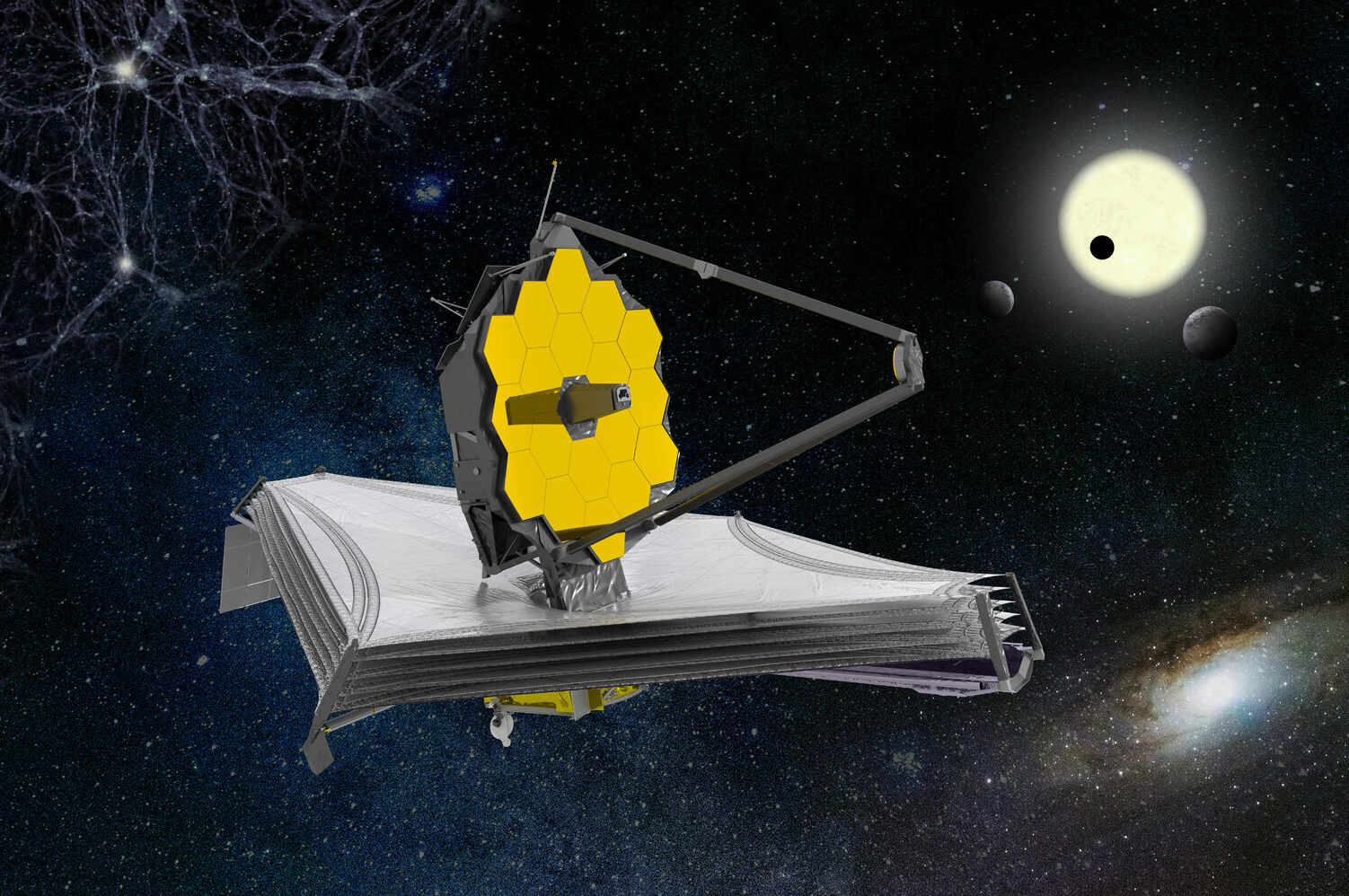
JWST – nice telescope, shame about the name
I’ve blogged before about the problematic naming of the James Webb Space Telescope. Its name was changed in 2002 from the Next Generation Space Telescope to the James Webb Space Telescope after James E. Webb, a civil servant who was NASA’s chief administrator from 1961 to 1968.
It’s not uncommon for scientific space missions like this to be named after people once the proposal has moved off the drawing board and into serious planning. That happened with the European Space Agency’s Planck and Herschel to give two examples. In any case Next General Space Telescope was clearly never anything but a working title. Yet naming this important mission after a Government official always seemed a strange decision to me. Then news emerged that James Webb had enthusiastically cooperated in a McCarthyite purge of LGBT+ people working in government institutions, part of a wider moral panic referred to by historians as the Lavender Scare. There have been high-profile protests (see, e.g., here) and a petition that received over a thousand signatures, but NASA has ruled out any change of name.
The main reason NASA give is that they found no evidence that Webb himself was personally involved in discrimination or persecution. I find that very unconvincing. He was in charge, so had responsibility for what went on in his organization. If he didn’t know then why didn’t he know? Oh, and by the way, he didn’t have anything to do with infrared astronomy either…
I still think it’s a shame that this fantastic telescope should have its image so tarnished by the adoption of an inappropriate name.
Anyway, yesterday I saw that the Royal Astronomical Society has issued a statement about this issue, which I encourage you to read in full. It begins
At its meeting in July the governing council of the Royal Astronomical Society (RAS) took a decision to write to the UK Space Agency, the European Space Agency (ESA) and NASA to express its concerns about the original JWST naming process, the apparent failure to investigate James Webb’s background and the dismissal of requests to rename the telescope.
Until that investigation takes place and the results are made public, the RAS now expects authors submitting scientific papers to its journals to use the JWST acronym rather than the full name of the observatory. In this case, the previous requirement for the acronym to be spelled out at first mention will not be observed. This change will also be reflected in our communications more generally.
This does at least acknowledge the problematic nature of the name and the message it sends to LGBT+ scientists around the world and it the statement as a whole is to be welcome.
I think I’ll continue to use the name James Webb Space Telescope on this blog, though, as a reminder that the name should just be changed. Even in shorthand it’s an insult.
Astrophysics & Cosmology Masterclass at Maynooth
Posted in Education, Maynooth, The Universe and Stuff with tags Astrophysics, Astrophysics & Cosmology Masterclass, Cosmology, Maynooth University on October 24, 2022 by telescoperRegular readers of the blog – both of them – may remember that we have twice previously presented a Masterclass in Astrophysics & Cosmology in Maynooth. Well, owing to popular demand, we’ve decided to do a re-run of the event on Wednesday 16th November 2022 during this year’s Science Week. Last year’s event was a big success, with over a hundred schools joining in, with probably over a thousand young people listening and asking questions.
Like last year’s event this year’s will be a half-day virtual event via Zoom. It’s meant for school students in their 5th or 6th year of the Irish system. There might be a few of them or their teachers who see this blog so I thought I’d share the news here. You can find more information, including instructions on how to book a place, here.
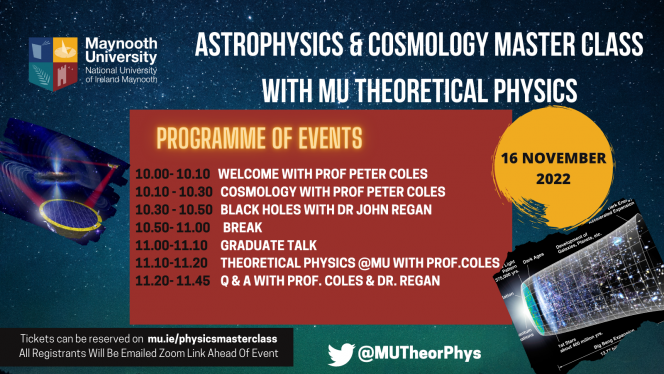
Here is the flyer for the event:

I’ll be talking about cosmology early on, and John Regan will talk about black holes later on. After the coffee break one of our students will talk about why they wanted to study astrophysics. Then I’ll say something about our degree programmes for those students who might be interested in studying astrophysics and/or cosmology as part of a science course. We’ll finish with questions either about the science or the studying!
Here is a more detailed programme:
Fortunately this year I don’t need to dash away at noon to do a lecture!
Remembering Violet Gibson
Posted in History, Politics with tags Benito Mussolini, Dublin City Council, Merrion Square, Violet Gibson on October 23, 2022 by telescoperA few years ago I posted an item about Violet Gibson. Last week Dublin City Council unveiled a plaque in her memory, outside her childhood home, which reminded me of her story.
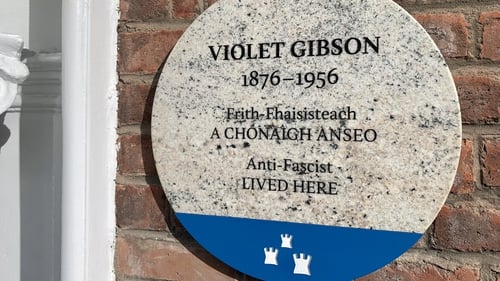
The story of Violet Gibson is both bizarre and tragic. She was born in 1876 into a well-to-do family living at No. 12 Merrion Square in Dublin, where the above plaque is now located. Her father, Edward Gibson, was made Baron Ashbourne in 1886. To cut a long story short, Violet Gibson turned up in Rome in 1926 where, at 11am on 26th April of that year, she attempted to shoot Fascist Leader Benito Mussolini with a pistol. She only failed in this task because Mussolini moved his head at the instant she pulled the trigger, and the bullet just grazed his nose. She tried to fire again, but her gun jammed. She was then seized by the angry mob of fascist supporters with whom she had mingled to get close enough to shoot. She was almost lynched but saved by the police. Eventually, the authorities came to the conclusion that she was insane and she was sent back to England. She spent the rest of her life in a psychiatric institution in Northampton. She died there in 1956, at the age of 79.
P.S. If you want to find out more about Violet Gibson, I recommend a book about her life called The Woman Who Shot Mussolini by Frances Stonor Saunders.
How to be good at Physics
Posted in Education, The Universe and Stuff with tags Carl Wieman, Ethan Siegel, Physics, problem solving on October 22, 2022 by telescoperA couple of articles appeared recently that I encourage people to read who are studying physics, or interested in studying physics.
The first article by Carl Wieman is from Physics Today and is entitled How to become a successful physicist. It is aimed at graduate students, though most of what it says is relevant to those at an earlier stage of their studies. Here’s an excerpt from near the beginning:
The primary characteristic of a successful physicist is being a good problem solver.
The article goes on to say some very interesting and instructive things, and is well worth reading in its entirety. There are one or two things that I don’t agree with though. One is the statement that…
…textbook problems provide all the information needed and have a single well-defined path to a solution.
That’s true of many problems at an elementary level, but problems at undergraduate or graduate level often have more than one way of finding the solution. That’s certainly true of many that I set as assignments. Indeed, sometimes the students come up with better ways of approaching them than I did! The important difference between textbook and research problems is that you know the textbook problems have a solution. Research is scarier because you don’t know at the outset that an answer can be found!
The second article, by Ethan Siegel, is called The secret to becoming an excellent physicist. Here is a quote from that, revealing the “secret”:
It’s simplicity itself: you become good at physics by solving physics problems. That’s it: that’s the secret. If you want to become competent at physics, you will solve physics problems in the area you wish to learn.
I hope you get the message. It’s not about rote-learning facts and formulae. The brain is much more than a memory device. It’s all about problem-solving. The ability to do that effectively can only be learned through practice.
I’m currently teaching two modules on Mathematical Physics and I devote most of the time in lectures for both of them to doing worked examples rather than proving theorems or presenting facts, theorems, derivations, formulae, etc to learn. I spend quite a lot of time in lectures giving students things to work out, which makes classes more interactive, but students also have tutorials built around problem-solving tasks to complement this.
If you’re interested you can see my post on How to Solve Physics Problems; there is also a video version here.
I’d add one piece of advice. If you really want to develop as a physicist, don’t just solve a lot of easy problems; challenge yourself by tackling difficult ones too. Don’t be afraid to get “stuck” or make a mistake, as those are both necessary parts of the learning process. Above all, develop the confidence in your ability to take on a problem and back yourself to solve it and don’t be deterred if the answer doesn’t come quickly!
A New Head for the UK
Posted in Biographical, Politics with tags Lettuce, Liz Truss, UK Politics on October 21, 2022 by telescoper
Although I no longer live in Britain, every morning I look at the UK news media to check the previous night’s football results and find out who is the latest Prime Minister.
I had a quick look this morning before work and unless I’ve misunderstood things, Liz Truss has been replaced as PM by a lettuce.
I think we need to know whether the lettuce voted leaf or romaine ‘cos the answer to that little gem could be the tip of the iceberg that may end up determining whether its popularity will rocket… (continued, p. 94)
SpaceX for Euclid
Posted in The Universe and Stuff with tags Ariane 6, Cosmology, Elon Musk, ESA, Euclid, European Space Agency, Falcon-9, SpaceX on October 20, 2022 by telescoper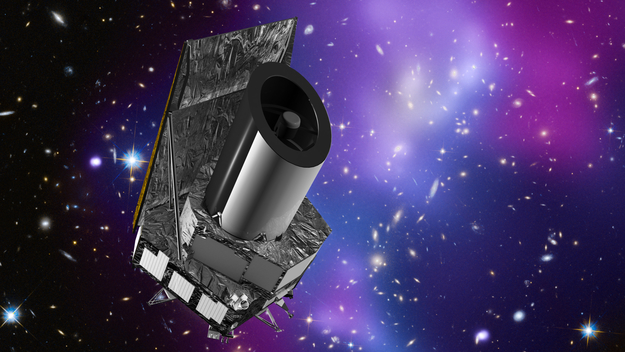
Aa few months ago I posted a piece about the European Space Agency’s Euclid Mission which had been due to be launched in 2023 on a Soyuz ST 2-1b rocket. That no longer being possible because of Russian’s invasion of Ukraine, it seemed there would be a lengthy delay in the launch of Euclid, with late 2024 seeming the earliest feasible date for launch on the obvious alternative, the new Ariane 6.
I ended that piece with this:
It seems to me that the best hope for a resolution of this problem would be for ESA to permit the launch of Euclid using something other than Ariane 6, which means using a vehicle supplied by an independent commercial operator. I sincerely hope ESA is able to come up with an imaginative solution to this very serious problem.
In the Dark, 17th June
Well I’ve just read official confirmation that a few hours ago ESA Council has approved the proposal to launch Euclid on a Falcon 9 rocket operated by SpaceX. If all goes well -specifically if the Euclid Consortium member states agree with this move – it might be possible to launch Euclid by the end of 2023. Although I don’t have any firm information about what date is being proposed I believe it could be as soon as July 2023.
Setting aside any personal opinions about Elon Musk, the Falcon 9 has proved to be very reliable, with the latest version having 110 out of 110 successful launches. Euclid will not be in an Earth orbit, like most of the satellites so far launched by SpaceX, but has to be delivered to the 2nd Lagrange Point, L2. That should not pose to much of a difficulty, however.
Simons Observatory News
Posted in Cardiff, Science Politics, The Universe and Stuff with tags Cosmic Microwave Background, Simons Observatory, STFC, UKRI on October 18, 2022 by telescoperIt seems a lot longer than four years ago that I drew the attention of readers of this blog to the science case for the Simons Observatory, the next big thing in ground-based studies of the cosmic microwave background.
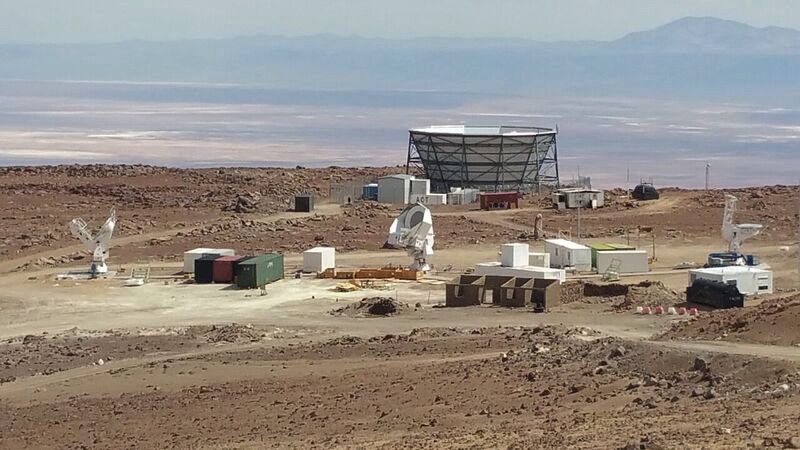
Obviously a couple of years of pandemic have intervened, amongst other things, but I was delighted to read yesterday that the UK has invested £18M in the Simons Observatory, which will enable further development of the facility at Cerro Toco, high above the Atacama Desert in Chile.

The project was already a large international collaboration led from the USA, but the new funds from UKRI mean that six UK institutions will now join. These are (in alphabetical order): Cambridge; Cardiff; Imperial College London; Manchester; Oxford; and Sussex. Although I’m not involved in this project myself I know many people at these institutions (two of which I have worked at) and elsewhere who will be absolutely thrilled to be able to participate in this exciting project. Congratulations to them!
It would have been great if Ireland had been able to get involved in the Simons Observatory, but sadly fundamental science of this type is not a priority for the powers that be in Irish science funding. This is unfortunate because I think membership of international consortia like this would enable a small country to punch above its weight in science. Still, at least the UK PI, Prof. Michael Brown (Manchester), is an Irishman…

 In the Dark