Author Archive

Sizes, Shapes and Minkowski Functionals

Posted in mathematics, The Universe and Stuff with tags , , , , on August 27, 2022 by telescoper

Before I forget I thought I would do a brief post on the subject of Minkowski Functionals, as used in the paper we recently published in the Open Journal of Astrophysics. As as has been pointed out, the Wikipedia page on Minkowski Functionals is somewhat abstract and impenetrable so here is a much simplified summary of their application in a cosmological setting.

One of things we want to do with a cosmological data set to characterize its statistical properties to compare theoretical predictions with observations. One interesting way of doing this is to study the morphology of the patterns involved using quantitative measures based on topology.

The approach normally used deals with Excursion Sets, i.e. regions where a field exceeds a certain level usually given in terms of the rms fluctuation or defined by the fraction of space above the threshold. The field could, for example, be the temperature field on the CMB Sky or the density field traced by galaxies. In general the excursion set will consist of a number of disjoint pieces which may be simply or multiply connected. As the threshold is raised, the connectivity of the excursion set will shrink but also its connectivity will change, so we need to study everything as a function of threshold to get a full description.

One can think of lots of ways of defining measures related to an excursion set. The Minkowski Functionals are the topological invariants that satisfy four properties:

  1. Additivity
  2. Continuity
  3. Rotation Invariance
  4. Translation Invariance

In D dimensions there are (D+1) invariants so defined. In cosmology we usually deal with D=2 or D=3. In 2D, two of the characteristics are obvious: the total area of the excursion set and the total length of its boundary (perimeter). These are clearly additive.

In order to understand the third invariant we need to invoke the Gauss-Bonnet theorem, shown in this graphic:
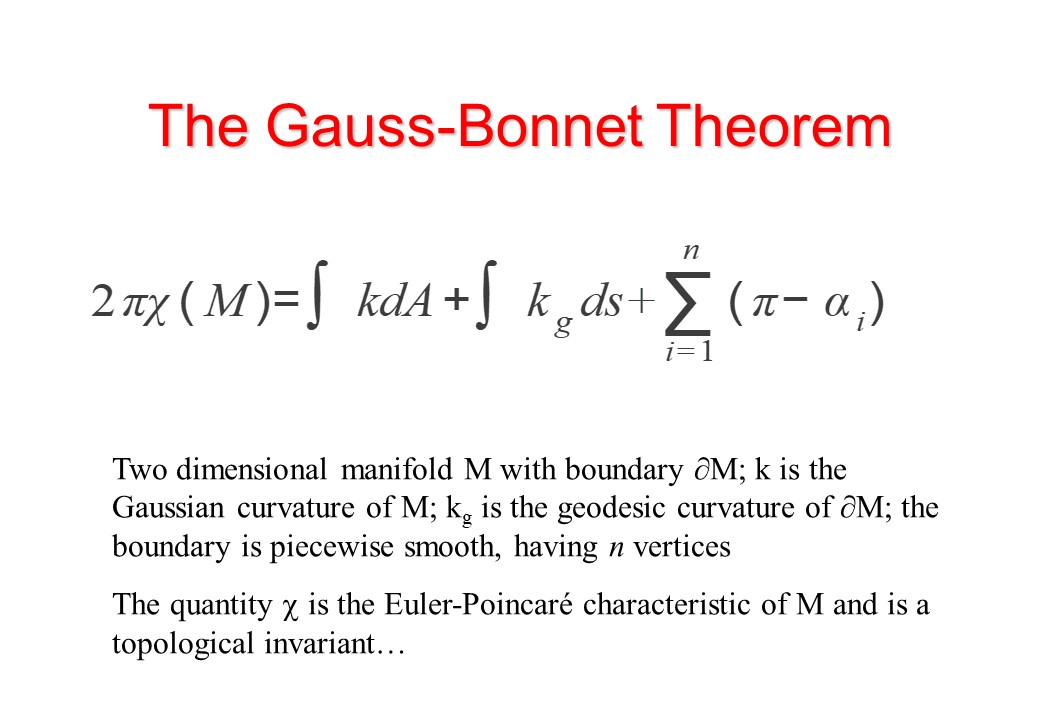
The Euler-Poincare characteristic (χ) is our third invariant. The definition here allows one to take into account whether or not the data are defined on a plane or curved surface such as the celestial sphere. In the simplest case of a plane we get:
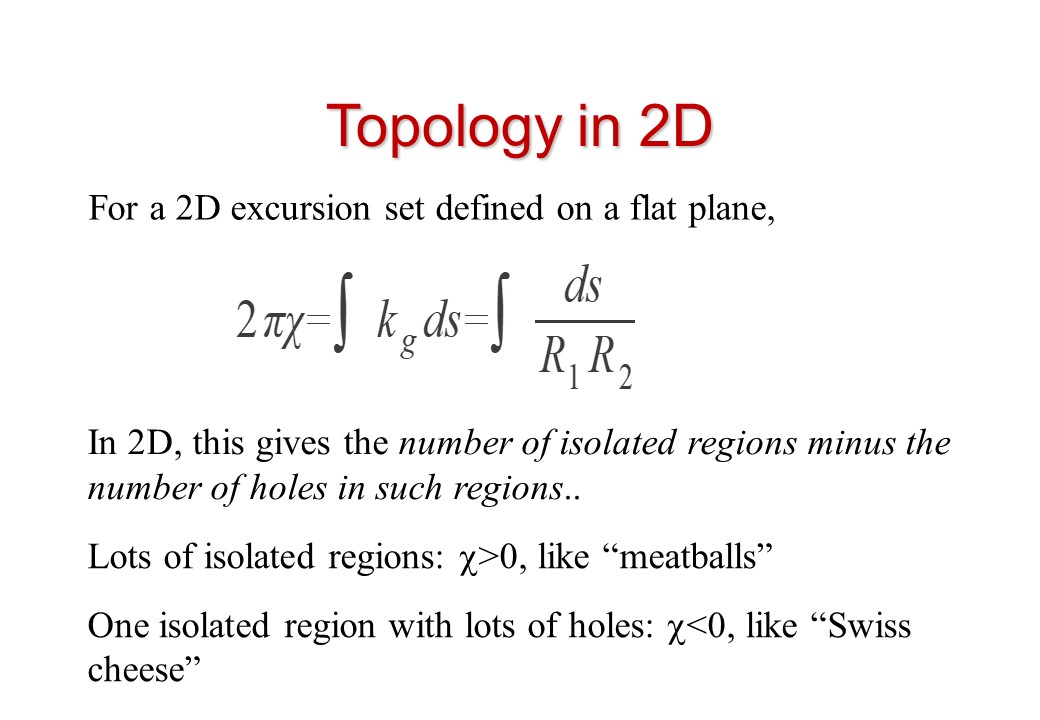
As an illustrative example consider this familiar structure:
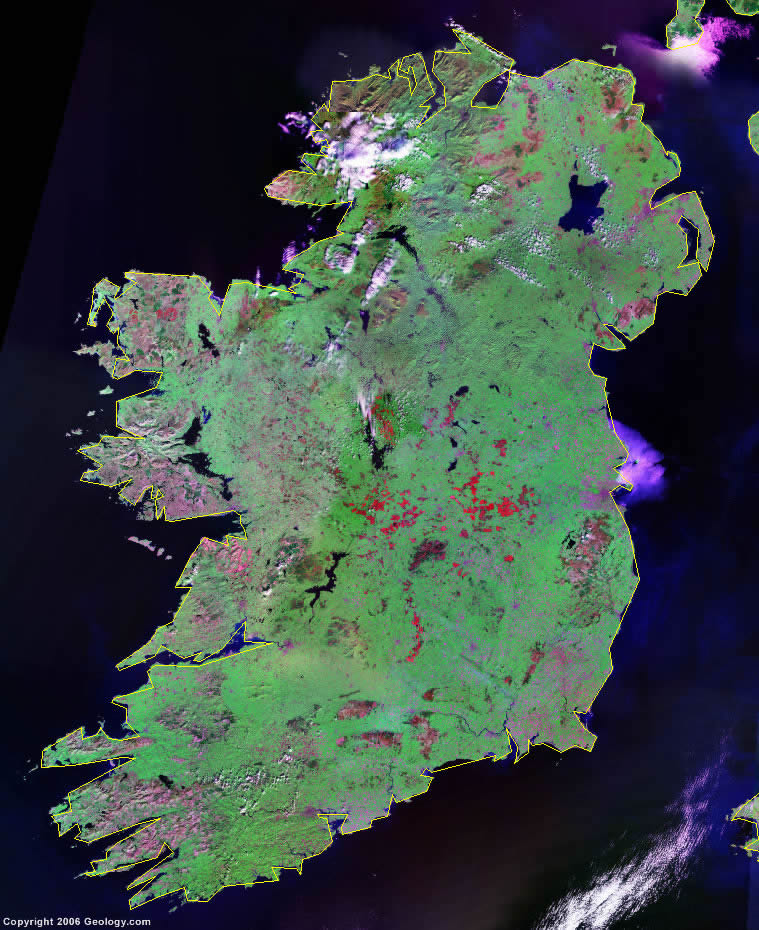
Instead of using a height threshold let’s just consider the structure defined by land versus water. There is one obvious island but in fact there are around 80 smaller islands surrounding it. That illustrates the need to define a resolution scale: structures smaller than the resolution scale do not count. The same goes with lakes. If we take a coarse resolution scale of 100 km2 then there are five large lakes (Lough Neagh, Lough Corrib, Lough Derg, Lough Ree and Lower Lough Erne) and no islands. At this resolution, the set consists of one region with 5 holes in it: its Euler-Poincaré characteristic is therefore χ=-4. The change of χ with scale in cosmological data sets is of great interest. Note also that the area and length of perimeter will change with resolution too.

One can use the Gauss-Bonnet theorem to extend these considerations to 3D by applying to the surfaces bounding the pieces of the excursion set and consequently defining their corresponding Euler-Poincaré. characteristics, though for historical reasons many in cosmology refer not to χ but the genus g.
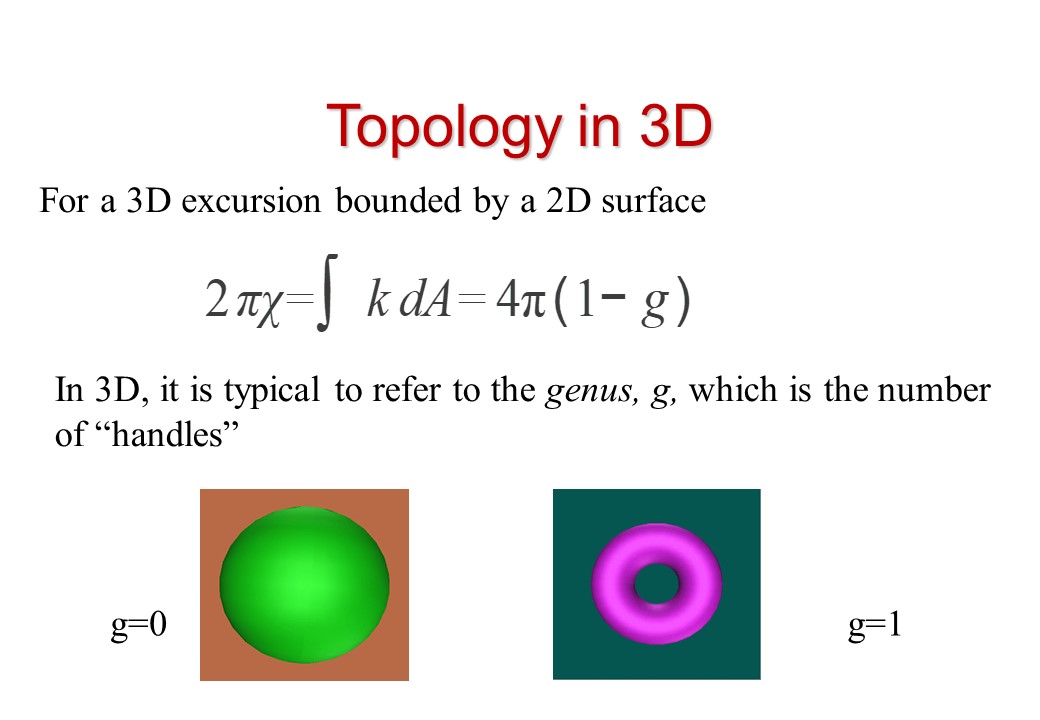
A sphere has zero genus (χ=1) and torus has g=1 (χ=0).

In 3D the four Minkowski Functionals are: the volume of the excursion set; the surface area of the boundary of the excursion set; the mean curvature of the boundary; and χ (or g).

Great advantage of these measures is that they are quite straightforward to extract from data (after suitable smoothing) and their mean values are calculable analytically for the cosmologically-relevant case of a Gaussian random field.

Here endeth the lesson.

Open Access USA

Posted in Open Access with tags , , on August 26, 2022 by telescoper

There was an important announcement yesterday about Open Access from the Office of Science & Technology Policy at the White House which I picked up from Twitter. Here is a summary:

More detailed documents can be found here and here.

The principle that research that is funded by the public should be available to the public is one of the foundations of Open Access publishing and it is laudable to see this enforced more strictly. Previously journals were able to keep articles behind a paywall for an embargo period, just withholding access for up to a year. The deadline for ending this practice is December 31st 2025. I would have made it sooner, but at least it has not been kicked into the very long grass.

The problem that I can see with the policy is that it will probably involve researchers having to pay thousands of dollars in article processing fees associated with the “Gold” Open Access of the form offered by commercial publishers. When the summary says “without cost” it means “without cost to the reader”. The way it will work is that these costs are transferred to the authors. The publishers will still gather their profits.

It will take stronger policies than this to break the stranglehold of the academic publishing cartels. It is more likely in my view that radical change will emerge from the grass roots, as researchers find novel ways of publishing their work without handing huge dollops of cash to profiteers.

The ABC of A-levels

Posted in Biographical, Education, Rugby with tags , , , on August 25, 2022 by telescoper

Yesterday I was having a bit of a clear-out of my office at home ahead of the new teaching term when I came across the above clipping at the back of a box of old papers. It’s from the Newcastle Evening Chronicle in 1981 and it shows the number of A-levels passed that summer by pupils at the Royal Grammar School in Newcastle, which I went to.

I don’t know why I’ve kept this for so long, neither do I know why the local paper felt important to list this information. It probably isn’t allowed to publish such things these days owing to Data Protection regulations but it did so routinely back then. I think it’s OK to publish it now because it has been in the public domain, technically speaking, for over 40 years. The Chronicle also published O-level passes with names, and I have the list with me in it from 1979.

A few things struck me about this list. One is that, while I can put faces to many of the names, there are many to which I can not. Indeed some of the names don’t ring any bells at all. I’m sure I’ve been forgotten by most people in the list too! When I arrived at the school in 1974 I was assigned to a “House” called Eldon along with about 30 other boys. In the first year we were placed at desks in our classroom in alphabetical order. Obviously the first people I got to know were those sitting in adjacent desks. It’s interesting that seven years on, the two names preceding mine in the list above were also in Eldon and had been sitting next to me on the very first day I arrived and they are among the few people from RGS that I am still in regular contact with.

The Sixth Form (two years, “Lower 6th” and “Upper Sixth” to coincide with the length of the A-level course) was divided into Arts and Sciences. The Arts are listed first in alphabetical order, then the Sciences. I was in the latter group. My 4 A-levels were Mathematics, Further Mathematics, Physics & Chemistry. I also did two special papers, in Physics and Chemistry. After A-levels, along with about 20 of the people on the above list, I stayed on for a “7th term” to do the Cambridge Entrance Examination, and the rest is history.

I also note that very few of us had only a single first initial like me. That’s a Coles family trait. My Dad always said that you only use one name so why have extras?

One final comment. Near the bottom of the list you will see the name “J M Webb”. That name is not to do with the James Webb of Space Telescope fame, but Jonathan Webb did go on to play Rugby for England. I didn’t know him well at school because, as well as being separated by alphabetical considerations, he was in a different House (Horsley if I remember correctly).

New Publication at the Open Journal of Astrophysics

Posted in OJAp Papers, Open Access, The Universe and Stuff with tags , , , , , , , , , on August 24, 2022 by telescoper

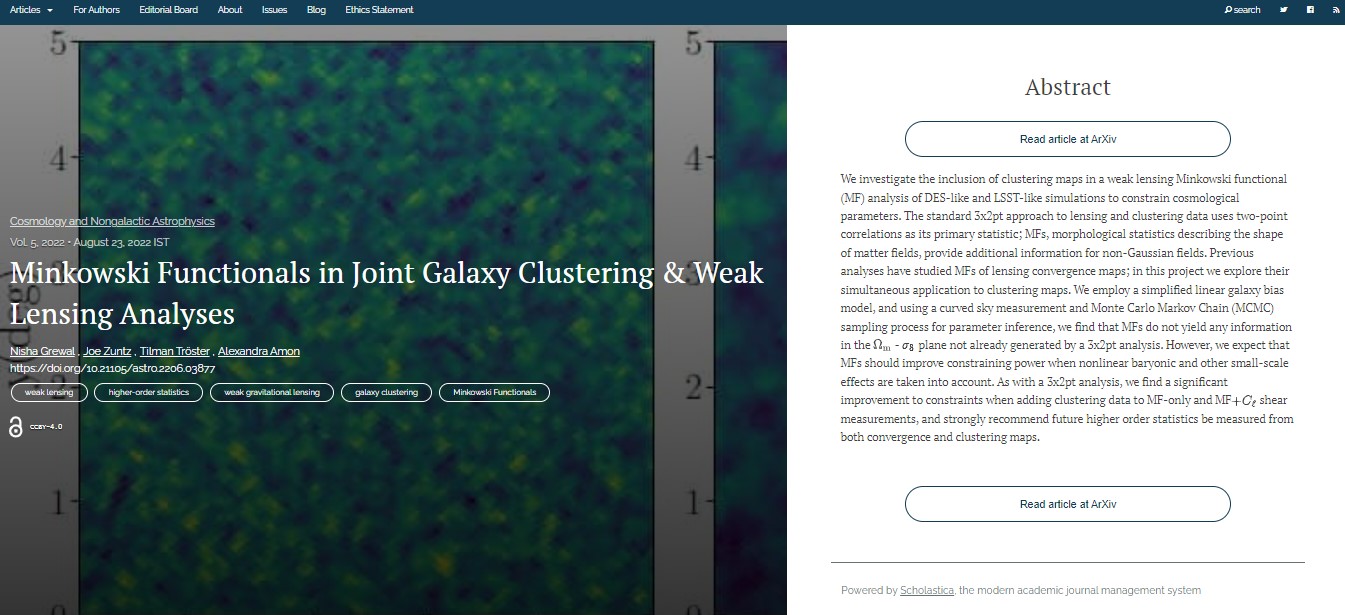
It’s time once again for me to announce another new paper at the Open Journal of Astrophysics. The new paper, published yesterday, is the 12th paper in Volume 5 (2022) and the 60th in all. The latest publication is entitled “Minkowski Functionals in Joint Galaxy Clustering & Weak Lensing Analyses” and the authors are Nisha Grewal, Joe Zuntz and Tilman Tröster of the Institute for Astronomy in Edinburgh and Alexandra Amon of the Institute of Astronomy in Cambridge. The paper is in the folder marked Cosmology and Non-Galactic Astrophysics.

Incidentally, Dr Alexandra Amon is the winner of this year’s Caroline Herschel Lectureship in Astronomy, so congratulations to her for that too!

The new paper is about the application of topological characteristics known as Minkowski Functionals to cosmological data. This approach has been used in the past to study the pattern cosmic microwave background temperature fluctuations; see e.g. here for one of my forays into this way back in 2008. Now there are more high-quality datasets besides the CMB so there are more opportunities to use this elegant approach. Perhaps I should do a blog post about Minkowski Functionals? Somewhat to my surprise I can’t find anything on that topic in my back catalogue here In The Dark

Anyway, here is a screen grab of the overlay which includes the  abstract:


You can click on the image to make it larger should you wish to do so. You can find the accepted version of the paper on the arXiv here.

How big were the biggest galaxies in the early Universe?

Posted in Biographical, Cardiff, The Universe and Stuff with tags , , , , , , , on August 23, 2022 by telescoper

Once upon a time (over a decade ago when I was still in Cardiff), I wrote a paper with PhD student Ian Harrison on the biggest (most massive) galaxy clusters. I even wrote a blog post about it. It was based on an interesting branch of statistical theory called extreme value statistics which I posted about in general terms here.

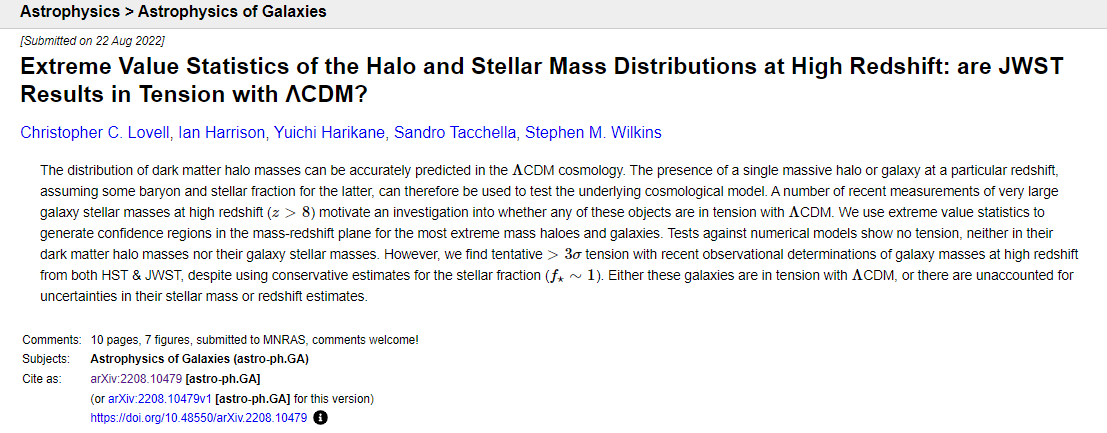
Well now the recent spate of observations of high-redshift galaxies by the James Webb Space Telescope has inspired Chris Lovell (who was a student at Cardiff back in the day then moved to Sussex to do his PhD and is now at the University of Hertfordshire) and Ian Harrison (who is back in Cardiff as a postdoc after a spell in the Midlands), and others at Cambridge and Sussex, to apply the extreme value statistics idea not to clusters but to galaxies. Here is the abstract:

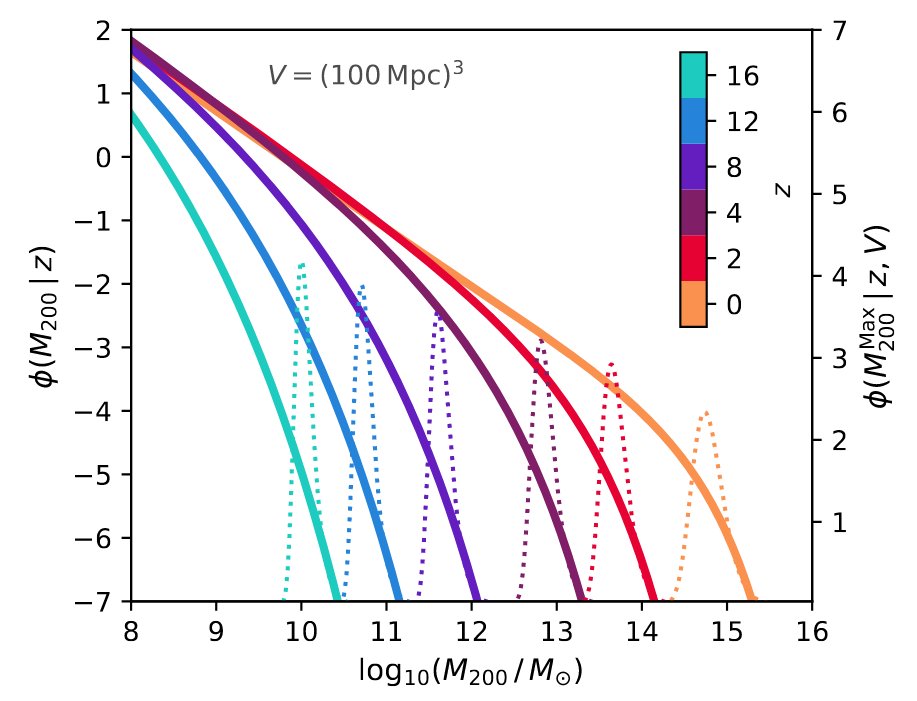
The basic idea of galaxy formation in the standard ΛCDM cosmological model is that galaxies form in dark matter haloes that grow hierarchically so that the typical size of galaxies increases with time. The most massive haloes at high redshift should therefore be less massive than the most massive haloes at low redshift, as neatly illustrated by this figure, which shows the theoretical halo mass function (solid lines) and the predicted distribution of the most massive halo (dashed lines) at a number of redshifts, for a fixed volume of 100 Mpc3.

The colour-coding is with redshift as per the legend, with light blue the highest (z=16).

Of course we don’t observe the halo mass directly and the connection between this mass and the luminosity of a galaxy sitting in it is likely to be complicated because the formation of the stars that produce the light is a rather messy process; the ratio of mass to light is consequently hard to predict. Moreover we don’t even have overwhelmingly convincing measurements of the redshifts yet. A brief summary of the conclusions of this paper, however, is that is some of the big early galaxies recently observed by JWST seem to be a big too big for comfort if we take their observed properties at face value. A lot more observational work will be needed, however, before we can draw definite conclusions about whether the standard model is consistent with these new observations.

The Death of Michael Collins

Posted in History with tags , , , , on August 22, 2022 by telescoper
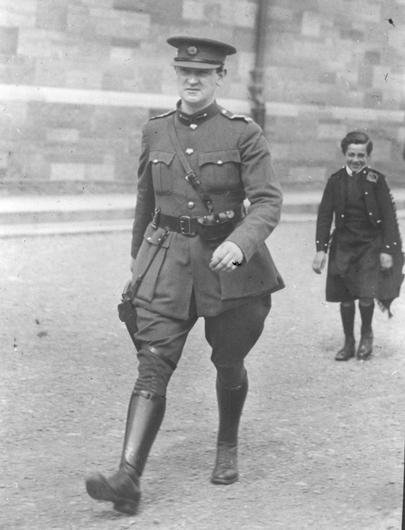
Michael Collins in full dress uniform, pictured a few days before his death.

Today marks the centenary of the death of Michael Collins during the Irish Civil War. The event was marked by a ceremony yesterday at Béal na Bláth, where Collins was shot in the head and killed by a sniper on 22nd August 1922. He was 31 years old.

The Civil War had erupted over the the Anglo-Irish Treaty with the pro-Treaty National Army (of which Collins was Commander-in-Chief) fighting against anti-Treaty forces. Opponents of the Treaty felt that the Irish Free State it created fell far short of the Republic they had fought for during the War of Independence. In particular the Treaty required an Oath of Allegiance to the British Crown, which many Republicans found totally unacceptable.

On 22nd August, with Free State forces gaining the upper hand, Collins was travelling through County Cork with a convoy including an armoured car, when it was ambushed by soldiers of the anti-Treaty IRA. Instead of trying to escape, the convoy stopped and a gunfight developed during which Collins was shot dead. He was the only fatality. There was no official inquiry into the events at Béal na Bláth and nobody knows for sure who fired the fatal shot. The death of Michael Collins, following the death a few days earlier of Arthur Griffith, was a big setback for the leadership of the Free State and the already bitter Civil War descended into cycle of atrocities and reprisals. The fighting was to grind on until May 1923.

In Defence of Blackboards

Posted in Covid-19, Education, Maynooth with tags , on August 21, 2022 by telescoper
Lecturing from Home

I wasn’t very surprised to find that the large lecture theatres in the swanky new building at Maynooth University are not equipped with chalkboards, as I had been told that the powers-that-be were finding it difficult to “source” boards of the appropriate size. I was more surprised and disappointed to find that none of the smaller teaching rooms have blackboards either; the best they have is very small whiteboards which are useless for teaching mathematical subjects.

I know people think I am very old fashioned in persistently using a chalkboard (a better word than “blackboard” as many chalkboards are actually dark green). They also find it quite amusing that I bought one especially so I could do lectures during the pandemic from home using it. One reason for that is that it’s far easier to get a decent contrast on camera than using a whiteboard. I also find that standing up and walking around allows me to communicate more effectively, at a decent pace and with a reasonable amount of energy which made the lectures from home a little less unbearable to give and, hopefully, to watch. Here’s the green blackboard in my office that I used to give some lectures during lockdown:

The very chalky chalkboard in my office on campus

It was never the intention of course that the board in my office would be used for lecturing. We have such things to facilitate the communication of ideas during a discussion by scribbling mathematical expressions or diagrams.

I found some time ago an article about why Mathematics professors at Stanford University still use chalkboards. I agree with everything in it. The renowned Perimeter Institute in Canada and the Isaac Newton Institute in Cambridge also have blackboards, not only in teaching rooms but also in corridors and offices to encourage scientific discussions.

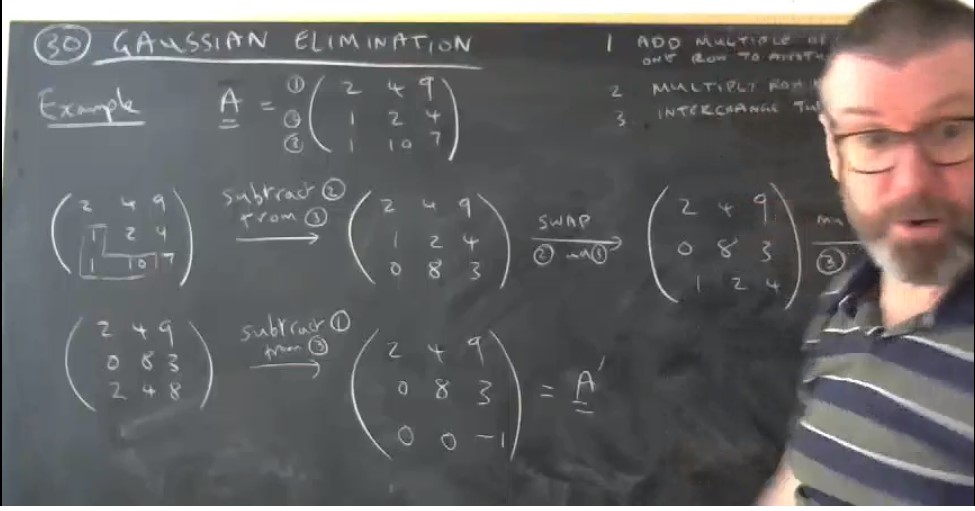
For teaching I think the most important thing for the students in a lecture on a subject like theoretical physics to see a calculation as a process unfolding step-by-step as you explain the reasoning, rather than being presented in complete form which suggests that it should be memorized rather than understood. Far too many students come to university with the impression that their brain is just a memory device. I fill it’s our job as lecturers to encourage students develop genuine problem-solving skills. The example in the first picture above – Gaussian Elimination – is a good illustration of this. Most of my colleagues in Theoretical Physics and in the Department of Mathematics and Statistics seem to prefer chalkboards too, no doubt for similar reasons.

I know that many in Senior Management think of us as dinosaurs for clinging to “old technology” but the fact is that new technology isn’t always better technology. Whiteboards are just awful. As well as being impossible to read in a large room or to record from, the marker pens are expensive, filled with nasty solvent, and impossible to recycle when empty. Unfortunately the purveyors of these items seem to have cornered the market I hate whiteboards so much I call them shiteboards.

Anyway, with the new academic year due to start in a month, and there being no likely resolution of the accommodation crisis, it looks like many students will be unable to attend lectures in person. It doesn’t matter whether rooms have blackboards or whiteboards or enhanced multimedia digital display screens if the students can’t get to the campus…

The Accommodation Crisis Again

Posted in Education, Maynooth with tags , , on August 20, 2022 by telescoper

There’s an article on the RTÉ website drawing attention to the national crisis in student accommodation. Included in the article is an example of a student at Maynooth:

Clara Battell is heading into her second year of studying Law and Criminology at Maynooth University. The Sligo student and her four friends thought they’d beat the crowd when they started looking for accommodation shortly after Christmas. However, eight months on, they’re still looking.

I checked this morning on daft.ie and there are just two properties currently available to rent in Maynooth; the rest are miles away and would require the tenant(s) to have a car. One is property is a studio apartment for €1,250 per month (which is way beyond the budget of a typical undergraduate student) and the other a four-bedroom shared house suitable at €3,800 per month. And remember that new students haven’t even started looking yet as this year’s CAO offers are not out until September. Clara Battell might end up having to commute from Sligo:

I’m from Sligo, it’s a three hour train journey and the only option at this stage appears to be commuting. It’s surely not feasible, six hours every day – and you’re not getting the best out of your education if you are travelling so much. We are all a bit stuck really.

Not to mention of course the inability to participate in clubs, societies and other extra-curricular activities. Clara’s situation is by no means atypical. Some brave students may try long-distance commuting this for a week or two, but few will keep it up for the entire academic year when they know how tough it is going to be.

The reality is that a great many students will have to choose between lengthy commutes and skipping lectures. This is particularly bad at Maynooth where the University Management has failed to invest in lecture recording equipment that would at least do something to mitigate the negatives of not being able to attend campus teaching sessions. I can see attendance on campus being very low this forthcoming term, as it was last term. The reality for many students is that they will be stuck at home just like during the lockdown, but without online classes. This was entirely predictable, but little has been done. It’s extremely frustrating for staff as well as students.

I heard this week of a much-needed proposal for a new housing complex including 260 student beds in Maynooth. It’s not on campus, but within walking distance on the other side of the Moyglare Road. This is good news, but the application for planning consent has only just been lodged; a decision is not expected until November 30th. Even if permission is granted it will take years to build and remember that there are 15,000 students in Maynooth so 260 beds is a drop in the ocean.

It is important to stress what is driving this. With costs increasing but income per student falling over many years, third-level institutions have had no choice but to recruit more and more students. The same Government that has driven this requirement is also responsible for inadequate investment in housing across the country. Some people are trying to blame the current crisis on the 48,000 Ukrainian refugees now in Ireland, but all their presence has done is to expose the long-term negligence of the Government at whose door the blame must rest.

It will take at least two years, and probably much longer, to fix this crisis. The big question is whether Ireland’s University system will survive that time without disintegrating.

La Même Chose

Posted in Uncategorized with tags , , on August 19, 2022 by telescoper
What is she saying?

You can’t move on Twitter these days without seeing the above photograph which seems to have become the latest viral meme. The game as always is to tweet the picture with a suggestion of what the girl is saying. Here is my effort:

You can play the game yourself at home by suggesting your own version of what she’s saying. There are quite a lot of astronomy-related attempts circulating already. The Hubble Tension is an obvious example topic.

Interestingly, just like ChorizoGate, the picture in question was first circulated a few years ago (in 2019) and was also apparently created in Spain. Perhaps there’s some kind of law that states that these things circulate on a 3-4 year cycle?

Talking of ChorizoGate, especially the French Dimension thereof, I wondered whether the French word for “Meme” is the same as it is in English. The French word however turns out to be “Mème”. So the English word “Meme” is not quite the same in French; the French word for Meme is “Mème” which is also not quite the same in French (“Même”). To put it another way, “Même” is the same in French but it’s not the same as either “Mème” or “Meme” neither of which are the same in French (nor in English).

I hope this clarifies the situation.

P.S. I chose the title from the well-known French saying “plus ça change, plus c’est la même chose”.

A-level Again

Posted in Education with tags , , on August 18, 2022 by telescoper

So once again it’s the day that students in United Kingdom are receiving their A-level results. It seems the number of top grades is down this year but as always my advice to students who got disappointing results is

There’s always the clearing system and there’s every chance you can find a place somewhere good. If you’re reading this blog you might be interested in Physics and/or Astronomy so I’ll just mention that both Cardiff and Sussex have places in clearing and both are excellent choices.

At least you’ve got your results; students here in Ireland will have to wait until September 2nd to get theirs!

My experience of over 30 years teaching in UK universities has convinced me that A-levels are not a very good preparation for higher education anyway and the obsession with them is unhealthy. Some of the best students I’ve ever had the pleasure of teaching came to University with poor A-level grades (for a variety of reasons).

In fact I’d go as far as to say that the entire system of University admissions in the United Kingdom needs to be overhauled. As I said in a post over a decade ago:

…if we had the opportunity to design a process for university admissions from scratch, there is no way on Earth we would end up with a system like the current one.

Of course I longer work in the UK so there’s no longer a “we”, but the system in Ireland is not that much different, with the Leaving Certificate playing the role of A-levels for the vast majority of students.

As things stand in the UK, students apply for university places through UCAS before they have their final A-level results (which don’t come out until August). Most applications are in by January of the year of intended admission, in fact. The business of selecting candidates and making offers therefore usually makes use of interim results or “predicted grades” as supplied by teachers of the applicant.

In my (limited) experience most teachers systematically overestimate the grades of their pupils, which is presumably why so many of this year’s A-level results are being downgraded, but there are lots of unconscious biases at play here and I accept that some teachers may be unduly pessimistic about their students likely performance.

But the inaccuracy of predicted A-level grades is not the only absurdity in the current system. Universities have to engage in enormous amounts of guesswork during the admissions process. Suppose a department has a quota of 100, defining the target number students to take in. They might reasonably get a minimum of 500 applications for these 100 places, depending on the popularity of university and course.

Each student is allowed to apply to 5 different institutions. If a decision is made to make an offer of a place, it would normally be conditional on particular A-level grades (e.g. AAB). At the end of the process the student is expected to pick a first choice (CF) and an insurance choice (CI) out of the offers they receive. They will be expected to go to their first choice if they get the required grades, to the insurance choice if they don’t make it into the first choice but get grades sufficient for the reserve. If they don’t make either grade they have to go into the clearing system and take pot luck among those universities that have places free after all the CFs and CIs have been settled.

Each university department has to decide how many offers to make. This will always be larger than the number of places, because not all applicants will make an offer their CF. They have to honour all offers made, but there may be penalties if they under or over recruit. How many offers to make then? What fraction of students with an offer will put you first? What fraction of them will actually get the required grade?

The answers to these questions are not at all obvious, so the whole system runs on huge levels of uncertainty. I’m amazed that each year any institution manages to get anywhere close to the correct number, but they do tend to get very close indeed by the end. Usually.

It’s a very skilled job being an admissions tutor, but there’s no question it would all be fairer on both applicants and departments to remove most of the guesswork by which I mean allowing students to apply to University after they have got their results. But there is the rub. There are two ways I can see of changing the timetable to allow this:

  1. Have the final A-level examinations earlier
  2. Start the university academic year later

The unavoidable consequence of the first option would be the removal of large quantities of material from the A-level syllabus so the exams could be held several months earlier, which would be a disaster in terms of preparing students for university.

The second option would mean starting the academic year in, say, January instead of September. This would in my opinion be preferable to 1, but would still be difficult because it would interfere with all the other things a university does as well as teaching, especially research. The summer recess (July-September), wherein much research is currently done, could be changed to an autumn one (September-December) but there would be a great deal of resistance, especially from the older establishments; I can’t see Oxbridge being willing to abandon its definitions of teaching term! And what would the students do between July and January?

Either of these options would cause enormous disruption in the short-term, which is presumably why they have never been implemented. However, this year everything is disrupted anyway so there’s an opportunity to redesign the whole process.

I don’t really imagine the Government is will do any of this but here are some suggestions of elements of a new admissions system:

  • Students to apply after receiving A-level* grades (i.e. implement 1 or, preferably, 2 above)
  • All university applications to be anonymous to prevent discrimination.
  • The identity of the applicant’s school to be withheld to prevent undue influence.
  • Teachers to play no part in the process.

*I don’t think A-levels are fit for purpose so here I mean grades of whatever examination replaces them.