Author Archive

Massive Excitement

Posted in The Universe and Stuff with tags , , , on April 9, 2022 by telescoper

Last week’s announcement of a new high-precision estimate of the mass of the W boson by the CDF collaboration at Fermilab has generated a lot of excitement in the news because it doesn’t seem to fit the predictions of the Standard Model of Particle Physics. Here is a graphic showing the latest result (which is not a new measurement, but a new analysis of old data) together with some previous values:

The units of the measurements are MeV/c2 and the latest number is 80,443.5 ± 9.4 MeV/c2 while calculations based on the standard model give 80,357± 4 [inputs]± 4[theory] MeV/c2. The difference is small but apparently significant, though I’m not sufficiently expert to understand all the details of the statistical analysis.

If true, this result has implications for the Standard Model because although this model has free parameters which have to be measured rather than obtained from theory, the model does imply relationships between these parameters. The reason this applies to particle masses is that these are affected to a greater or lesser extent by interactions with all the fields present in the theory. The first thing you learn when you study particle physics is that it’s not primarily about particles, it’s about fields. The mass of the W-boson is significantly affected by the mass of the top quark and the Higgs boson both of which have been measured to some level of accuracy, but the new W measurement doesn’t seem fit with these known values.

Anyway, here is the discrepancy with the top quark mass
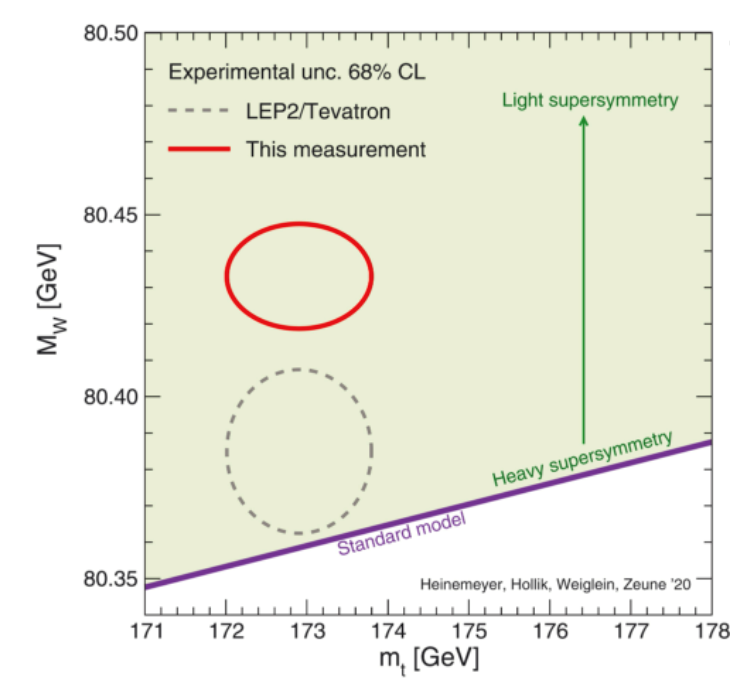
So it’s definitely interesting, though it clearly needs further analysis: there could be uncorrected systematics in the measurement, for example. Also, as far as I know, some of the other masses feeding into this calculation may turn out to be wrong.

Incidentally, a student asked me yesterday why there’s no corresponding measurement for the Z-boson. The answer I gave (which I think is correct) is that the mass of the Z is already known much better than the W because it, being neutral, can decay into an electron-positron pair, both of which are easy to measure, but the W, being charged, has to decay into a charged lepton and a neutrino (or antineutrino) combination and the latter is much harder to deal with experimentally.

P.S. For some comments by a physicist who knows much more about this stuff than I do, see here.
Meanwhile, back to Covid…

Posted in Covid-19, Education, Maynooth with tags , , on April 8, 2022 by telescoper

So here we are, at the end of the 9th teaching week of Semester 2 at Maynooth University. There are three more weeks of lectures before the end of term, either side of a one-week break for Easter.

It was decided weeks ago that we all have to proceed on the basis that the Covid-19 pandemic is all over.

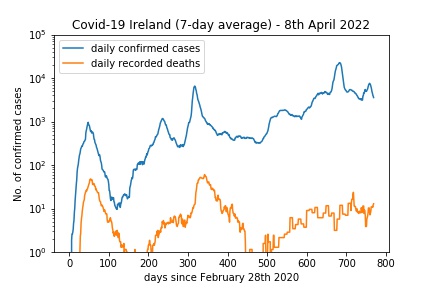
Case numbers are still very high though:

The above picture is a bit misleading because it shows only cases confirmed by PCR tests fewer of which are being done now than previously. The HSE data hub also records daily antigen tests which are typically of the same order but higher than the PCR results. The real level of infection is therefore at least twice the level shown in the picture. That’s the bad news. The good news is that positive results from both PCR and antigen tests do seem to be falling, as do hospitalizations and ICU admissions. The mortality rate has also remained low during this phase of the pandemic. The logical inference is that wall of protection afforded by vaccines is holding despite the high level of infections. We’re clearly in a less dangerous phase of the pandemic than we were last year.

But, equally clearly, the pandemic is not all over.

The number of absences due to illness or self-isolation is high for both staff and students. I’ve noted before on this blog that although third level institutions were put under great pressure to return to on-campus teaching, many students are just not attending lectures, tutorials and laboratories in person.

As well as having to look after their own health, many students haven’t been able to secure local accommodation for this Semester, partly because of a general shortage and partly because the 21/22 academic year started late and in chaotic fashion making it impossible for first years to sort out satisfactory living arrangements. It looks like this will happen next year too.

Third-level education isn’t the only sector feeling significant residual effects of the pandemic, but it is one in which problems have been exacerbated by the unrealistic expectations of Government and University managements.

Anyway, after so much disruption we approach the end-of-year examination period with considerable trepidation. For first- and second-year students these will be the first examinations they have taken on the campus; third-years will not have taken on-campus exams since January 2020. The style of our online examinations was necessarily different to the traditional format so in the Exam Halls the students will find themselves in very unfamiliar territory. In particular, we used “open-book” exams so students could use notes, textbooks and other resources to do the examinations. This won’t be the case in May.

How will the results turn out?

We can only wait and see.

Elliptical Discussions

Posted in Cute Problems, Education, Maynooth, The Universe and Stuff with tags , , on April 7, 2022 by telescoper

It’s the ninth week of Semester 2 and I’m coming to the end of lectures and laboratory sessions for my Computational Physics module; for the remaining three weeks (plus the Easter vacation) the students in this class will be mainly concentrating on the mini-projects that form part of the assessment.

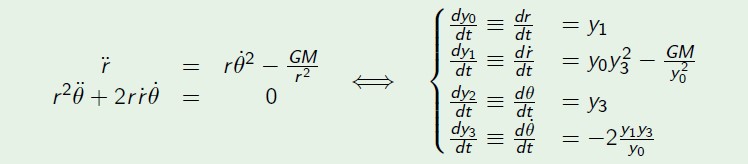
This afternoon, though we had a session on how to transform higher-order differential equations into sets of coupled first-order ODEs suitable for vectorization and consequent solution using standard techniques. The problem we focussed on today was the simple problem of orbital motion of a test particle under the gravitational force in plane-polar coordinates, which can be prepared for physical solution thusly:

This sort of thing reminds me of my undergraduate theory project at Cambridge, where I did a similar thing to solve the equations governing the action of a four-level laser, though that was in Fortran rather than Python. In my own solution I used Python’s off-the-shelf solver odeint.

I like the orbital motion problem a lot because it’s a bit more than a coding exercise: students have to think about how to choose initial data, how to test the their code and interpret the results. Even before that there’s the issue of what units to use; SI units are a bit daft for astronomical problems. For solar system calculations it makes sense to use Astronomical Units for distances and years for time; in such a system it’s easy to work out that GM is just 4π2, which avoids having to deal with ridiculously large or ridiculously small numbers.

Anyway, the fun thing about this lab was that once everyone had got their code working they could try setting initial data to get a circular orbit as a special case, explore how the shape of elliptical orbits depends on the input data, how to make an unbound orbit, and so on. It’s important to understand the output of a numerical calculation in terms of basic physical principles. All that led to a discussion in class of solar system exploration, transfer orbits, what would happen if the mass of the Sun suddenly changed, or if G was a function of time, and lots of other things.

I find sessions like this that encourage students to explore problems themselves very rewarding and I think they add a valuable extra dimension to standard teaching formats. I hope the projects that they’ll be doing from now on – involving topics in areas ranging from atomic physics, cosmology, particle physics and climate science, and done in groups – will provoke even more discussion of this type.

A Bird in Rhetoric House

Posted in Maynooth with tags , , , on April 6, 2022 by telescoper

Following on from my post of yesterday, I just remembered that I recently saw this on Twitter:

Geo the Jackdaw

This is Geo the Jackdaw paying a visitor to the Geography Department of Maynooth University which is located in Rhetoric House. He was a regular visitor there before the Covid-19 campus closure and suddenly reappeared a few days ago after a gap of two years.

Geo is very tame, as you can see, but also full of mischief – he especially enjoys playing with pencils, knocking things over, and tearing up bits of paper.

In fact there are a great many jackdaws on campus – and lots of rooks too – but they’re mostly not as bold as Geo. Two jackdaws regularly visit my garden but they’re not at all domesticated and scarper as soon as I make an appearance, which is just as well because they’re usually engaged in some sort of vandalism.

Accommodation Not Wanted

Posted in Biographical, Maynooth with tags , , on April 6, 2022 by telescoper

A month ago I posted an item about the fact that I had offered the spare room in my house as accommodation for a refugee from the War in Ukraine. Over 20,000 refugees have now arrived in Ireland but I have just been told that the accommodation I offered is not suitable. That’s mainly because the greatest need is for homes suitable for families with children rather than single persons; I only have one room and it doesn’t have en suite facilities. Also most of the refugees are female and the assessors would probably be nervous about placing a woman in a house with a strange man like me.

I feel slightly less bad about this than I might have done before reading that only about 40-50% of the accommodation pledged to the Irish Red Cross has been assessed as suitable.

I also note that a number of host families are finding the job of providing accommodation to often traumatized people very difficult and many refugees have been returned to processing centres because the hosts are unable to cope. I might well have ended up feeling the same.

Anyway, at least I offered. I would have felt bad if I hadn’t. Now I’ll just have to try to find some other way to help…

A Bird in the House

Posted in Biographical, Maynooth with tags , , on April 5, 2022 by telescoper

I’m told that in some cultures it is believed that a bird flying into your house is a sign of impending death. I hope that isn’t true because I’ve been having regular avian visitations recently.

It started last week when, after a spell of lovely sunny days, the weather suddenly took a turn for the worse. One day I went outside to put some rubbish in the bin. I left the patio doors from the kitchen/diner to the garden open for just a few minutes and closed them when I got back in. It was a few minutes later that I heard a flapping sound and looked up to see a robin trying to get out through one of the windows by my kitchen sink. It must have sneaked in while I was preoccupied, presumably because it was a lot warmer inside than out. It must have had the house under surveillance to have managed to get in during such a narrow window of opportunity.

I was a bit worried for the robin’s safety as I have seen birds get into a panic when they find themselves indoors and I thought it might do itself an injury. It was a regular event at my junior school years ago for a sparrow to get in and fly around in a panic before teacher managed to open a window and shoo it out. More recently I remember a pigeon somehow contrived to fall down the chimney in my house in Nottingham, emerging flapping and fluttering and scattering soot everywhere. It was very difficult to get that one to leave as it was completely disoriented. My cat nearly caught it a couple of times before it finally escaped.

Anyway, the robin situation wasn’t anything like that. Although I thought my reappearance in the kitchen might spook it, it seemed to recognize me as the human person who provides food. It just hopped onto the top of the open door leading from the kitchen to the hall and stared at me. I went slowly back to the patio doors, opened them both and stood aside. After sizing up the necessary flight path, the robin made a perfectly orderly exit. Robins seem harder to frighten than some other birds.

Since then the robin has been a regular visitor to the house, entering whenever the doors are open and leaving when it has had enough. It’s been inside more-or-less every day for a week (but not today).Once it helped itself to some leftovers in a pan on the hob but most visits have just taken the form of a general inspection: poking around in the shelves, checking out the furniture, and so on. I should try to take a photograph of it, but I’ve never yet had a camera to hand during a visit. I suppose the robin is now quite comfortable coming into my house and may become a regular guest. I don’t mind, although I hope it minimizes the amount of guano it deposits.

In The Dark Mode

Posted in Biographical with tags , , on April 4, 2022 by telescoper

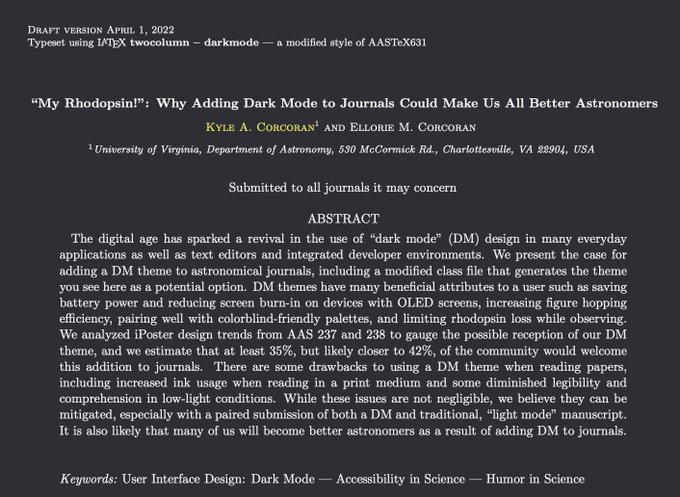
One of the many spoof posts that appeared on arXiv on April Fool’s Day was one about Dark Mode:

You will note that In The Dark has been using a kind of Dark Mode for over 13 years. The style is actually called Black Letterhead and I picked from among the available themes when I first started blogging because it seemed to me to match the title. This theme has actually been “retired” but still seems to work and I don’t feel any urge to change it.

A few people over the years have complained that the white text on black background is quite hard to read, but only a few. If you don’t like it you can easily change the colour via your web browser settings, of course. I think Dark Mode works better with a sans serif font, by the way.

I actually find it easier to read than black on white, actually, consistent with the fact that I find a chalkboard easier to read than a whiteboard which is why I have one in my study:

Although the paper was intended to be a joke, it does make some interesting points and is well worth reading!

Census Day

Posted in Bad Statistics, Biographical, The Universe and Stuff with tags , on April 3, 2022 by telescoper

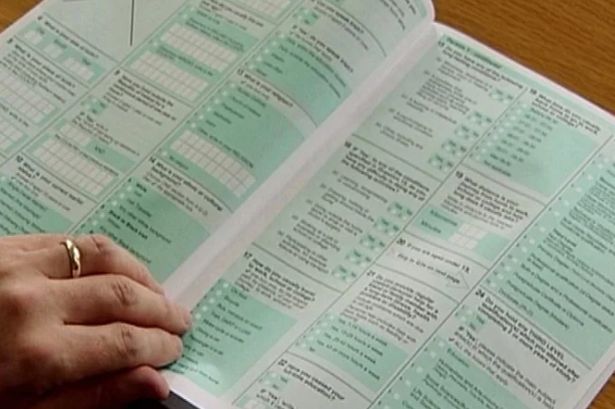
Today is April 3rd 2022 which means that it’s Census Day here in Ireland; I’ve just finished filling in the form, which is 24 pages long but it turns out lots of the pages are duplicates for use in homes with multiple occupancy, and others don’t apply to me at all, so in fact I only had to complete 8 pages and it didn’t take all that long.

The Census should have taken place last year but was postponed because of the Covid-19 pandemic. Apparently the corresponding 2021 census in the UK went ahead, though I wasn’t at, and couldn’t get to, the property I still own in Wales so couldn’t participate. Although I was initially threatened with a fine, the UK Census people seem to have given up trying to chase me. I blogged about the previous census in Wales in 2011 here.

On the holiday after St Patrick’s Day I was at home when I noticed a card had been pushed through my letterbox while I was still in the house. It was from a ‘Census Enumerator’ who said he had tried to deliver the form but I was out. I wasn’t out and he hadn’t rung the doorbell. More importantly he hadn’t simply put the census form through the letterbox. In the UK the census forms are just sent out in the post. This little episode didn’t inspire me with confidence. Anyway, the bloke came back a week later and gave me the form. He also asked me for some personal information such as my phone number, which I naturally refused to give him. Apparently he has to collect the form in person too, which seems daft to me. Why can’t people just send their census returns back in the post?

On the last page there is a so-called ‘time capsule’ in which to leave information for historians to read 100 years from now. All I could think of to write was any historians reading this in 2122 would probably think that it was absurd to be doing this wasteful paper-based census when the digital age started some time ago, so I just said for the record that I was one of the people who thought that in 2022…

Rory O’Neill aka Panti Bliss

Posted in Biographical, LGBTQ+, Maynooth, Politics with tags , , , on April 2, 2022 by telescoper

Yesterday I attended an event at the Maynooth Students Union featuring Rory O’Neill, an LGBT+ rights activist who strongly involved in the campaign for Equal Marriage leading up to the referendum of 2015. Rory is perhaps better known in his drag persona, Panti Bliss. Rory left Panti at home for this event but it was extremely interesting and enjoyable – and a bit sweary! – to hear him talk about his life and experiences, especially why he became an activist and how he started out as a drag performer.

One of the things I remember very well was how he has spent time in countries where homosexuality is still unlawful talking to young LGBT+ people who a lack of hope that life can get better. He countered that Irish society even just a couple of decades ago was deeply homophobic and is now much more inclusive towards LGBT+ people. It’s not perfect, of course, but it’s a heck of a lot better than it was. Ireland proves that things do get better.

Although I’m a bit older than Rory, didn’t grow up in Ireland, and have had a very different career, much of his story did nevertheless resonate with me. I’ve said a number of times on this blog that if someone had told me back in 1988 (when the infamous Section 28 was brought in by the Thatcher Government to attack a community already reeling from the effects of AIDS) that in 25 times there would be equal marriage in the UK I simply would not have believed them. Rory said something very similar yesterday.

Anyway, although there wasn’t a huge turnout for the event yesterday I’m very glad I attended and am grateful for the Maynooth Access Programme for organizing it. The event also gives me an excuse to post this clip of Panti Bliss giving a brilliant (and now famous) speech at the Abbey Theatre in 2014.

Distant Things!

Posted in The Universe and Stuff with tags , , , on April 1, 2022 by telescoper

I’m a bit late passing this on but there was a great deal of excitement this week at the news that the Hubble Space Telescope (HST) has made an astonishing discovery about the early Universe as illustrated by the above picture published in Nature. As well as an individual star (?) observed at redshift 6.2, so distant that its light set out when the Universe was just 8% of its current age, the image also reveals the presence in the early Universe of large geometric shapes (such as rectangles) as well as a remarkable giant arrow. The presence of these features at such high redshift is completely inconsistent with the standard theory of structure formation.