Author Archive

Maynooth Offers

Posted in Education, Maynooth with tags , , , on August 16, 2019 by telescoper

Well I’ve had a busy week here in Maynooth marking and checking repeat examinations (just finished this morning) during which from time to time I’ve been keeping an eye on things to do with students admissions for the forthcoming year, both here and in other institutions across Ireland. Universities and students received their Leaving Certificate results earlier in the week, but institutions then had a couple of days to decide on the basis of course capacity and the results obtained which students would receive offers of a place on which courses. This is usually expressed in terms of a points total: the more popular the course, and the better the results for applicants to that course, the higher the points required would be. Yesterday first-round offers went out from CAO across the country – there’s a summary in the Irish Times. Students who don’t get an offer from their first choice course can try in subsequent rounds to get a place at another institute.

As of yesterday afternoon, Maynooth University is expecting to admit 3,225 new first year students this year. This is the largest ever intake for the university and represents an increase of 3% from last year. This growth reflects a strong demand for places: more than 4,200 students chose Maynooth University as their first preference, an increase of 7% from last year (which I mentioned earlier this year).

At the moment it looks like being a particularly good year for our BSc Course in Theoretical Physics and Mathematics, but I’d rather wait until the process is over and numbers are confirmed before commenting further.

Anyway, as the CAO process is ongoing, I thought I’d include this little video about what Maynooth has to offer undergraduate students with particular emphasis on the flexibility of its programmes whether they be in Arts & Humanities or Sciences. I wrote about the advantages of the `Omnibus Science’ programme here. If you are reading this and didn’t happen to get the points for your first-choice course then you could do a lot worse than consider Maynooth!

What The World Needs Now

Posted in Jazz with tags , , , , on August 15, 2019 by telescoper

I’ve always been a not-so-secret admirer of American songwriter and record producer Burt Bacharach, but when someone told me the other day that there’s an album called Blue Note Plays Burt Bacharach I assumed it was a wind up because Blue Note Records has for many years been an uncompromising voice at the cutting edge of modern jazz rather than the lighter and more popular form of music exemplified by Mr B.
There’s no reason why two forms of excellence can’t exist together, however, and the album is definitely real and is a very nice compilation of Bacharach numbers from Blue Note albums featuring various musicians over the years. Here’s an example featuring Stanley Turrentine on tenor sax, with McCoy Tyner on piano, Bob Cranshaw on bass and Micky Roker on drums. The tune is What The World Needs Now Is Love. Doesn’t it just?

The Case of Norm versus Criterion

Posted in Education with tags , , on August 15, 2019 by telescoper

I saw a news item last night that revealed the grade boundaries for some of this year’s A-level examinations in the United Kingdom. Among the surprises were that for one board an A-grade in Mathematics corresponded to a mark of 55% and an A-grade in Physics was 59%. I’m sure I’m not the only one to find these results a bit disturbing.

The explanation given for these figures is basically that there’s a new style of A-level examination this year and the boundaries were adjusted so as not to penalize the current set of students with respect to previous years. In other words, students did much worse than expected on the new examinations so the grade boundaries were lowered.

Most assessments of academic performance such as A-levels can be classified into two broad types: criterion-referenced and norm-referenced. In the former performance is measured relative to defined goals, whereas in the latter it is defined relative to the performance of others taking the same test.

University assessments in the UK and Ireland (especially in the sciences) are usually criterion-based, meaning that the % score (and hence the grade) is determined by comparing the marks with a pre-prepared marking scheme based on the expected learning outcomes of the course. It is possible for all students taking an examination to get A-grades if they all meet the criteria. On a norm-referenced system one allocates the grades based on the distribution of scores and not on the absolute level of performance attained. In reality when marking examinations under a criterion-based system, one has a bit of discretion in how to award partial credit when a question is not done completely, so this is a bit of a simplification but those are the two approaches in a nutshell.

Some universities allow marks for a component of assessment to be scaled up (for example if there is a problem with an examination paper), which has the same effect as lowering the grade boundary, but this does not usually apply to the entire mark. Some universities don’t allow scaling at all in any circumstances.

In the universities with which I am familiar, an A-grade (corresponding to First-class performance) is fixed at a mark >70%, a B (2.1) is 60-69%, a C (2.2) is 50-59%, and so on. The pass mark at undergraduate level is 40%; it might be 50% at Masters level.

This is why the figure of 55% being an A-grade at mathematics comes as a such a shock to university-based academics: that score would be in the middle of the lower-second class range in a university examination.

This episode demonstrates one of the serious issues with A-levels as preparation for university entrance. On the one hand, especially in the sciences,  we want students to be equipped with certain basic skills and knowledge to enable them to cope with their course. That calls for a criterion-based system of assessment. On the other hand, in any one year, the `top’ universities want to recruit the `top’ students (in many cases because they want to have a high position the league tables because their entry tariff is high). It’s hardly surprising that the system is dysfunctional when it is being pulled in two mutually incompatible directions.

The upshot of this year’s mathematics and physics A-levels is that universities that take in students with an A-grade in Mathematics -can’t really have much confidence in what they have learned. To make matters worse, the grade boundaries differ from one Examination Board to the next. It’s a mess. At least here in Ireland there is a truly national examination system: there is a single Leaving Certificate examination in each subject that all students take.

While I am on about A-levels I’ll just mention another disadvantage that they have compared to the Leaving Certificate (and, for that matter, the International Baccalaureate) which is that they force students to choose a very narrow post-16 curriculum. Most students take three A-levels (not counting the useless `General Studies’) which for science students often means three science subjects (e.g. Maths, Physics & Chemistry). In the Leaving Certificate students take six or seven subjects and in the IB they take six. I’ve been in Ireland for less than two years so I’m not so familiar with the system here, but my experience with the IB over about 30 years in UK higher education, is that students are certainly no less prepared for university study if they took that than if they did A-levels.

There is currently a major review of the Irish Leaving Certificate going on. One of the things that surprises me about Ireland is that, despite its hard-won independence from the United Kingdom, it has a tendency to copy slavishly many of the silly things that the UK introduces, especially in higher education. I sincerely hope that the review of the Leaving Certificate does not fall into the trap of making it more like A-levels.

The Comet – The Video!

Posted in The Universe and Stuff with tags , , , on August 14, 2019 by telescoper

I couldn’t resist sharing this remarkable video about the rendezvous and subsequent landing of the European Space Agency’s Rosetta spacecraft on the comet Churyumov-Gerasimenko 67P. You can find a few posts I did about this at the time (2014) here. Here’s one of the memorable from one of those posts:


Anyway, after the end of the mission, in 2017, the European Space Agency released over 400,000 images from Rosetta, based on which Christian Stangl and Wolfgang Stangl worked together to create this short film. The sequences are digitally-enhanced versions of real pictures taken by the Rosetta Probe and they’re stunning!

Caltech astrophysics and harassment: Lessons learned

Posted in Harassment Bullying etc with tags , , on August 13, 2019 by telescoper

This is a lengthy but important post about the recent episodes of harassment at Caltech centred around Christian Ott. I’ve blogged in relation to this myself a few times; see here. It’s not a comfortable read, which is precisely why you should read it.

One of the worst things about the way institutions handle investigations into harassment and related disciplinary matters is that the system does not include any provisions to bring closure to the victims. Indeed, victims are sometimes not even informed as to the outcome of the investigation.

You can make your own mind up about the behaviour of Caltech as an institution. All I’ll say is that far more people were affected than I was previously aware of.

cjhandmer's avatarCasey Handmer's blog

Caltech astrophysics and harassment: Lessons learned

Casey Handmer 2019

What is this?

In the wake of major catastrophes, it is common practice for organizations to publish a “Lessons Learned” report to help prevent future occurrences. The largest public catastrophe in which I’ve ever been involved occurred in the Caltech astrophysics department between 2010 and 2019. Former Caltech professor and internationally disgraced astrophysicist Christian Ott harmed, harassed, and abused numerous students, postdocs, and research fellows. Despite thousands of hours of investigation, no public “findings” or “lessons learned” report has ever been made available. This document is my attempt to fill this need.

Why?

It has been historically conventional to conceal this sort of institutional malpractice, with the effect that the hard-learned lessons are forgotten and that harassment, particularly of underrepresented minorities, is still common. The intent of this document is to undermine the traditional assumption that abused students will graduate or…

View original post 11,100 more words

Happy 100th Birthday, Margaret Burbidge!

Posted in The Universe and Stuff with tags , , , , , on August 12, 2019 by telescoper

I was reminded by Twitter just now that today is the 100th birthday of Margaret Burbidge, who was born on August 12th 1919. Happy Birthday Margaret!


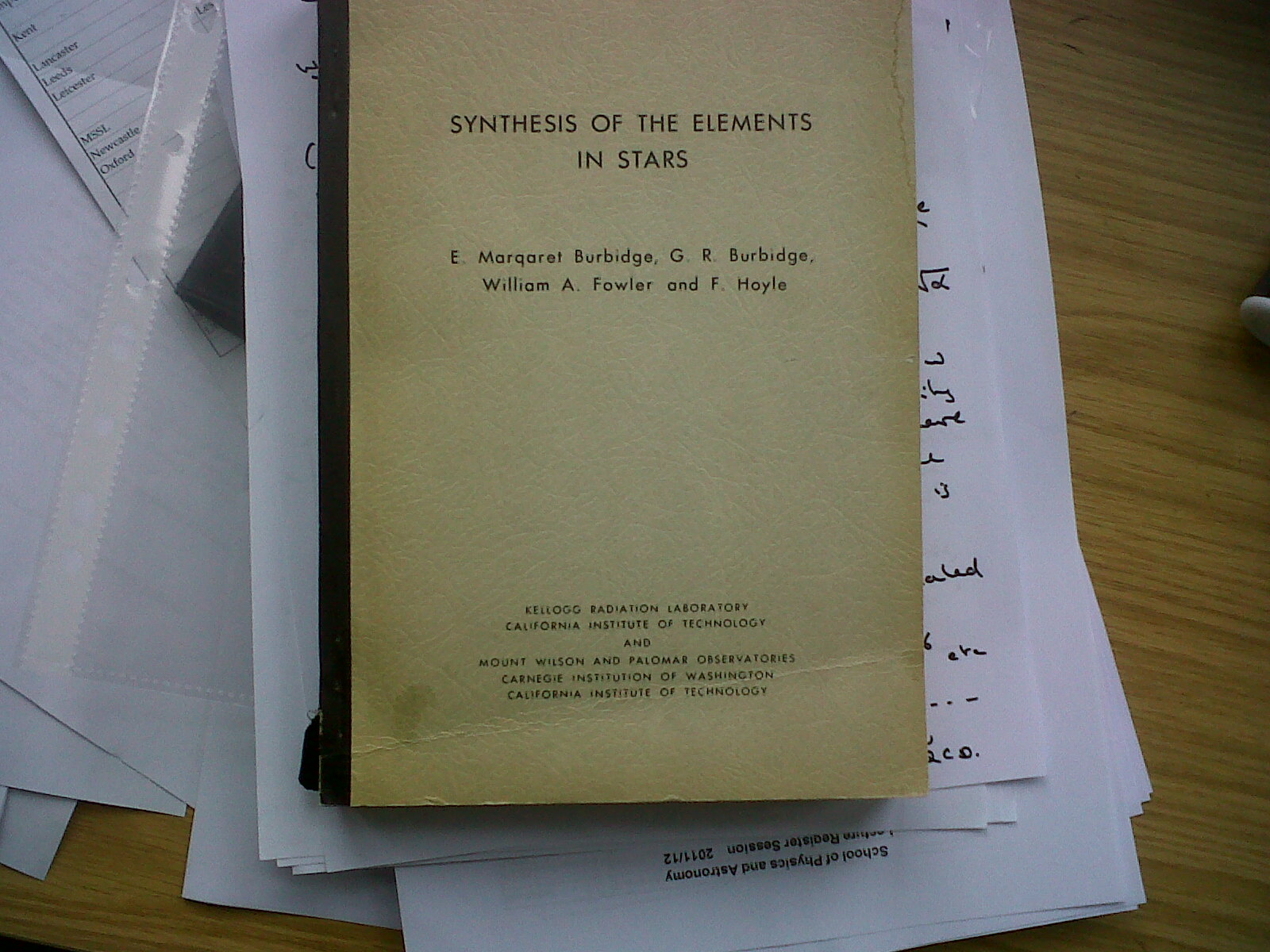
This anniversary of her birth gives me an excuse to mention the classic work of Burbidge, Burbidge, Fowler and Hoyle in 1957 (a paper usually referred to as B2FH after the initials of its authors). It’s such an important contribution, in fact, that it has its own wikipedia page. One of the interesting astronomical things I’ve acquired over the years is a preprint of the B2FH paper. Younger readers will probably not realize that preprints were not always produced in the electronic form they are today. We all used to make large numbers of these and post them at great expense to (potentially) interested colleagues before publication in order to get comments. In the age of the internet people don’t really bother to make hard copies of preprints for distribution any more.

Anyway, here’s a snap of it.

It’s a hefty piece of work, and an important piece of astronomical history. One thing I’ve never done, however, is check whether the preprint differs significantly from the published version..


Admissions Matters

Posted in Education, Maynooth with tags , , , , on August 12, 2019 by telescoper

Well, the wait is almost over. Tomorrow is the day that students in Ireland get their Leaving Certificate results. Tomorrow’s date is Tuesday 13th August, so I hope that’s not a bad omen! A couple of days later this week, on Thursday, UK students get their A-level results.

Here in Ireland, University admissions are dealt with through the Central Applications Office (CAO) which, for UK readers, is roughly equivalent to UCAS. Earlier this year we heard Maynooth University received its highest-ever number of first_preference applications, which is a very positive sign, but we don’t know yet exactly how many of those actually made the grade needed to start here next month.

As is the case in the UK with A-level results, Irish institutions receive the Leaving Certificate results a bit before the students do, which means that on both sides of the Irish sea higher education institutions will be very busy sorting through their applications to see who has made it onto what course. This is a very stressful time for all concerned, not only the prospective students but also the university staff involved in processing the results and academics wondering how many students they will have to teach next year.

From time to time one hears suggestions that the system could be made much fairer and less stressful if students could remove some of the uncertainty by applying  to university after getting their Leaving Cert (or A-level) results rather than, as is the case now, before. UPDATE: here’s a piece in the Guardian by Angela Rayner arguing this.

The problem is that there are only two ways that I can see to achieve this:

  • have the final school examinations earlier;
  • start the university academic year later.

The unavoidable consequence of the first option would be the removal of large quantities of material from the syllabus so the exams could be held several months earlier, which would be a disaster in terms of preparing students for university.

The second option would mean starting the academic year in, say, January instead of late Septembe. This would in my opinion be preferable to 1, but would still be difficult because it would interfere with all the other things a university does as well as teaching, especially research. The summer recess (July-September), wherein much research is currently done, could be changed to an autumn one (October-December) but there would be a great deal of resistance, especially from the older establishments; I can’t see Oxbridge being willing to abandon its definitions of teaching term! And what would the students do between July and January?

Preparatory Reading

Posted in History, Literature, Politics with tags on August 12, 2019 by telescoper

With less than a month to go before I take up a position as Head of Department, I thought I’d spend some of the book tokens I got from the Everyman Crossword prize on some preparatory reading material…

Rivers of Babylon – The Melodians

Posted in Music with tags , , , , on August 11, 2019 by telescoper

Those of your of a certain age will remember that Boney M had a hit in 1978 with a number called Rivers of Babylon. I knew that that song was based on words from Psalm 19 and Psalm 137 but I didn’t know until recently that the original song was a Rastafari hymn and that the Boney M version was a cover of this beautiful rocksteady version recorded by a Jamaican band called The Melodians in 1970. Note the differences in lyric, e.g. “How can we sing King Alpha’s song…”. Anyway, I really like this version with its excellent vocal harmony and gorgeously relaxed groove.

Health and the Season

Posted in Biographical, Cardiff, Maynooth, Mental Health with tags , , on August 10, 2019 by telescoper

After I came out as having arthritis a few months ago, I’m sure all both my readers are agog to hear news about the state of my knees. There’s only good news to report, actually. The warmer weather seems to have brought considerable respite. I have not taken any anti-inflammatory medicine for a couple of months now, and have largely dispensed with the walking stick too (at least for the time being). I still get the odd twinge, but nothing compared to what things were like during the winter.

I ended my earlier post about this with this paragraph:

One other thing worth mentioning is that this condition does seem to be highly temperature-dependent. This last week the weather suddenly turned a lot colder and the arthritis definitely got worse. Perhaps in future I could learn to use the colour of my knees as some kind of forecasting method?

Talk to anyone who suffers from arthritis and they will tell you a similar story – it gets worse in cold and/or damp weather. Talk to any medical expert, however, and they will tell you that there’s very little hard evidence about this and what evidence there is suggests that the effect is very weak. See, for example, this paper, which has the following abstract:

It is a common observation that pain and stiffness in patients known to have arthritis get worse in cold and damp weather conditions. The objective of this article is to review the available literature on this subject and to put forward an explanation for this common clinical finding. Literature search revealed twelve relevant articles including laboratory experiments and prospective questionnaire-based human studies. Various investigators have tried to study the effect of cold weather on arthritic symptoms and have suggested different theories. The effect of temperature changes localized to the joints has shown to increase stiffness at lower temperatures and decrease stiffness at higher temperatures. The effect of these changes has been found more pronounced in elderly population with arthritis and patients with advanced disease. The evidence to support this common observation is weak; however some studies have reported a trend towards worsening of pain and stiffness with falling temperature and barometric pressure in arthritic patients.

Among the problems associated with studying such effects is the issue of how to measure `pain’ in a reliable way. It may be in the winter people are generally less upbeat about their health which may affect the way they self-report the state of their arthritis. And even if one could measure the level of pain objectively, there are obvious confounding factors: people are generally more active during the summer months, for example, which may help ease joint pain. And what aspect of the weather really matters: temperature, humidity or atmospheric pressure? These tend to be correlated in complicated ways.

All I can say is that the last couple of months have been far better for me. Whether that is because of some direct causative influence of the weather or not I can’t say.

While I am on about health and the time of year, I’ll comment on another personal matter. Seven years ago I was suffering some serious mental health problems, which resulted in me being for some time on an acute ward in a psychiatric institution. That happened in July 2012. I’ve dreaded the arrival of July every year since because it reminds me of that very bad period in my life and I worry that might bring on something similar again. This year, though, has been much better. I can’t attribute this entirely to my move here to Ireland, but the change of scene has undoubtedly contributed.

As a final comment I’ll just say that 31st July was the third anniversary of my leaving Sussex (in 2016) to return to Cardiff on a three-year part-time contract back. I was planning to take early retirement when that expired, but things seem to have turned out rather differently. Things have a habit of doing that. Then again, if life were predictable it would be very dull. Anyway, it was very nice to meet up with quite a few former colleagues from Cardiff during recent week off, including at their summer barbecue at Llandaff. It seems quite a few will be spending the next week or so marking repeat resit examinations, so let me take this opportunity to wish them all the very best!