Author Archive

Royal Society University – Science Foundation Ireland University Research Fellowships

Posted in Uncategorized on August 9, 2019 by telescoper

It is now time for a quick public information broadcast.

Did you know about the scheme run jointly between the  Royal Society and Science Foundation Ireland that enables early career researchers in Ireland access to University Research Fellowships?

This scheme provides five years of research funding (with the possibility of renewal) and has proved to be a stepping stone to their first permanent academic position for a great many scientists.

This scheme covers, but is not limited to, physics and astronomy. For full details of the scheme, see here.

The deadline if you want to apply to hold a URF from 2020 in Ireland is 3rd September 2019, which is less than a month away,  so please get cracking!

You could go a lot worse than applying to hold your URF in Maynooth!

Oh, and five years residency in Ireland qualifies you for citizenship. Just saying…

Repeat Message..

Posted in Education, Maynooth with tags , , , on August 8, 2019 by telescoper

Back in Ireland and straight away it’s the repeat examination period at Maynooth University, which started yesterday. My first one was yesterday, actually, for just one student, and I’ve been virtuous and marked the script already.

I’ll be marking quite a few more repeat exams over the next week or so, so here’s a message for any student anywhere taking any at this time:
I thought it was worth mentioning for any university teachers out there reading this that although they are held at roughly the same time of year in the two countries there’s a difference in the way resits are handled in the institutions I’ve worked at in the United Kingdom and the way repeats work here in Maynooth which is implied by the slightly different name.

In UK institutions with which I am familiar students generally take resits when, because they have failed one or more examinations the previous May they have not accumulated sufficient credits to proceed to the next year of their course. Passing the resit allows them to retrieve lost credit, but their mark is generally capped at a bare pass. That means the student gets the credit they need for their degree but their average (which determines whether they get 1st, 2nd or 3rd class Honours) is negatively affected.

This is the case unless a student has extenuating circumstances affecting the earlier examination, such as bad health or family emergency, in which case they take the resit as a `sit’, i.e. for the first time with an uncapped mark.

Here in Maynooth, repeat examinations are generally taken for the same reason as in the UK but the mark obtained is not capped. Indeed, some students – though not many – elect to take the repeat examination even if they passed earlier in the summer, in order to increase their average mark. Another difference is that all students have to pay a fee  for each repeat they take; resits in the UK do not attract additional fees.

When I told former colleagues at Cardiff in the pub last week that repeat examinations are not capped they didn’t like the idea because they felt that it would lead to many students playing games, i.e. deliberately not taking exams in May with the intention of spreading some of their examination  load into August. There’s not much sign of students actually doing that here, to be honest, for the reason that the results from the repeat examination period are not confirmed until early September so that students that deploy this strategy do not know whether they are going to be able to start their course until a couple of weeks before term. That could cause lots of problems securing accommodation, etc, so it doesn’t seem to me to be a good ploy.

Anyway, I’d welcome comments for or against whether resits/repeats should be capped/uncapped and on what practice is adopted in your institution.

The Coles of Arms

Posted in Biographical, History with tags , , , , , , , , on August 8, 2019 by telescoper

Sparked by an exchange on Twitter last week with another person (who has the same surname as me) on the subject of heraldry, I did a little bit of googling about and found a little snippet I found quite intriguing. Although the name Coles is found all over England and Wales, with strong concentrations in the South West of England and in Northamptonshire, according to this source the name is of Anglo Saxon origin and is first recorded in Yorkshire as the family name of George Coles, which was dated 1555, in the “Register of the Freemen of the City of York”, during the reign of Queen Mary 1. The same source also points out that a branch of the Coles family subsequently moved to Ireland, though it gives no details (unless you pay for them).

I subsequently found that in Burkes General Armory (which details all the Coats of Arms registered in the UK and Ireland) the first entry under the surname Coles is indeed in Ireland, where it was confirmed in 1647. That date is during the Irish Confederate Wars, a couple of years before Oliver Cromwell arrived in Ireland with his army. One might surmise that this particular branch of the Coles lineage was somehow caught up in these hostilities, probably on the English side.

Anyway the description of the corresponding Coat of Arms, in typically cryptic heraldic language is:

Gu. on a chev. betw. two lions’ heads erased or, ten ogresses. Crest — A snake wreathed about a marble pillar ppr. garnished or.

The first part refers to the escutcheon (shield): Gu is short for Gules, a tincture (red), and it describes the main colour of the field of the escutcheon; chev is for chevron (an inverted v-shape), one of the Honorable Ordinaries (basic designs for the escutcheon). This and the two lions’ heads are described as `or’ (andother tincture, meaning gold-coloured); erased means `without the body’; an ogress is a special case of a roundel (filled circle) in which the circle is black (the word `pellet’ is also used).

The Crest is self-explanatory other than that `ppr’ is short for `proper’ which means, roughly speaking, `natural-coloured’. I’m not of the significance of the snake and the marble pillar.

Here is a mock-up of the whole thing:

There are several other entries for the name Coles in Burkes General Armory and I’m certainly not claiming that I have the right to use this Coat of Arms but I am intrigued by the Irish connection with the name Coles and will see what more I can find out about it.

New Publication at the Open Journal of Astrophysics!

Posted in OJAp Papers, Open Access, The Universe and Stuff with tags , , , , , , , on August 7, 2019 by telescoper

Just before I went off on my break I published another new paper at The Open Journal of Astrophysics, but I didn’t get time to write a post about before going on leave. In fact I completed the publication process using a WIFI connection in the departure lounge at Dublin Airport!


The authors are Miguel Aragon Calvo of Instituto de Astronomía at UNAM in Ensenada, Mexico , Mark Neyrinck of the University of the Basque Country and Joseph Silk – yes, that Joseph Silk! – of the Institut dAstrophysique de Paris Université Pierre et Marie Curie. If the Open Journal project is to succeed we need to get some big names submitting papers, and there aren’t many bigger than Joe Silk so I’m very glad to see him among the author list.

You can find the accepted version on the arXiv here. This version was accepted after modifications requested by the referee and editor. Because this is an overlay journal the authors have to submit the accepted version to the arXiv (which we then check against the copy submitted to us) before publishing; version 3 on the arXiv is the accepted version.

You will see that this is  one for the `Astrophysics of Galaxies’ folder. We would be happy to get more submissions from other areas, especially Stellar and Planetary astrophysics. Hint! Hint!

P.S. Just a reminder that we now have an Open Journal of Astrophysics Facebook page where you can follow updates from the Journal should you wish..

Found in Translation…

Posted in Books, Books, Talks and Reviews, Maynooth with tags , on August 7, 2019 by telescoper

Here I am, back in Maynooth, after taking the early flight back to Dublin from rainy Cardiff. By way of a gentle re-introduction to the habit of blogging after a gap of a week or so I thought I’d mention something I discovered when I returned:

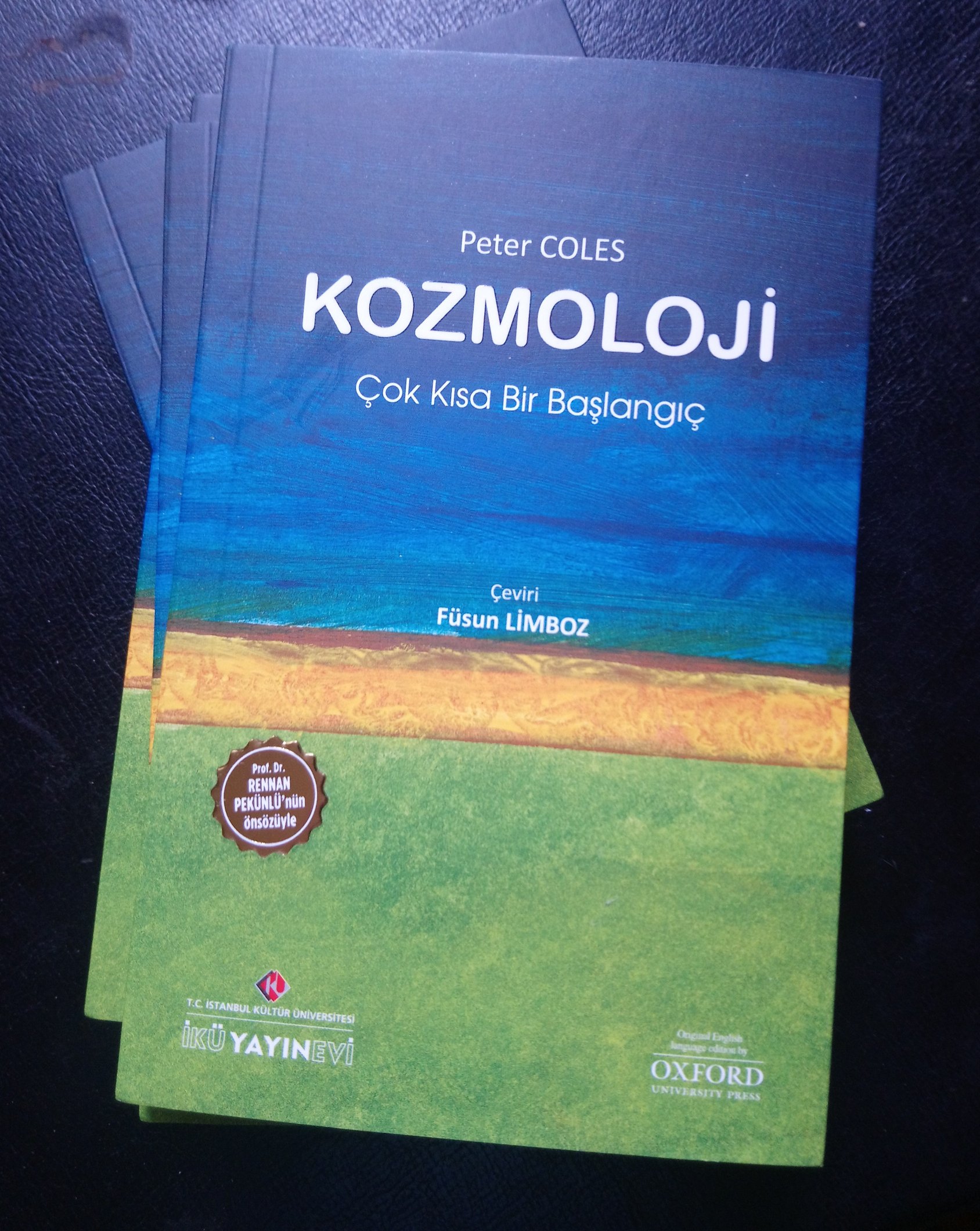
This pleasant surprise was a package from Oxford University Press containing five copies of the new Turkish edition of my book  Cosmology: A Very Short Introduction.I don’t know if there are any staff or students in Maynooth who (a) can read Turkish and (b) are interested in cosmology but if there are please contact me and you can have a copy!

(I’m particularly intrigued by how the first two words of the sub-title are to be pronounced…)

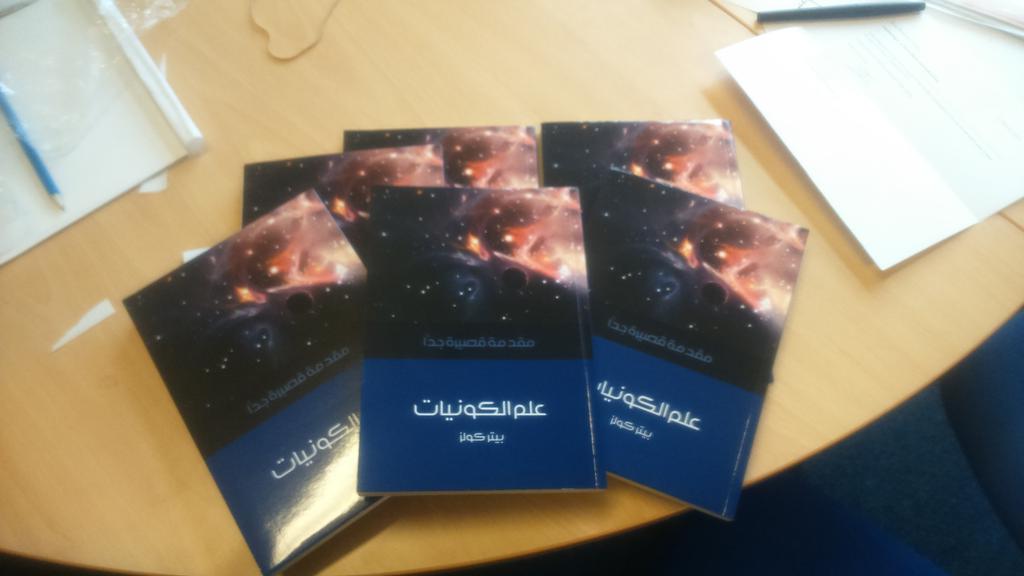
Anyway, I thought it would be nice to show some of the other translations of this book. This one is in Arabic. I was a bit confused when I first saw this edition, because books in Arabic open the opposite way to books in English, as Arabic is read from right to left rather than from left to right.

VSI-Arabic

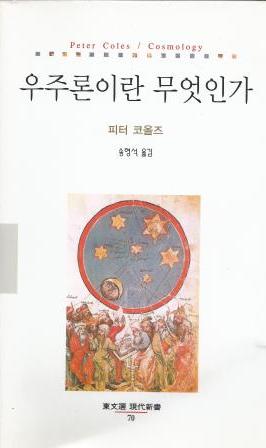
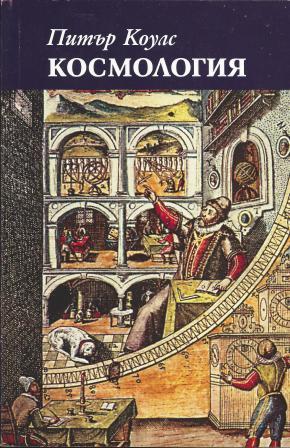
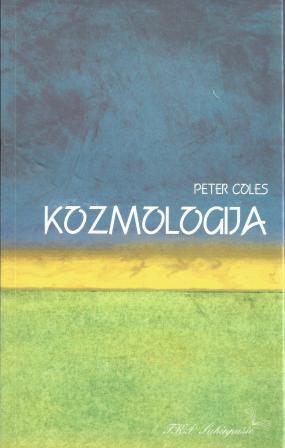
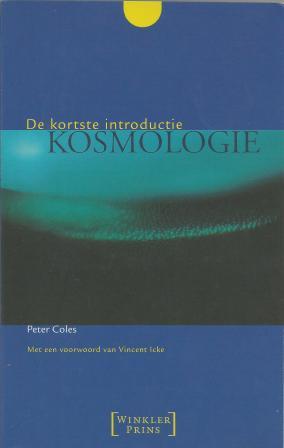
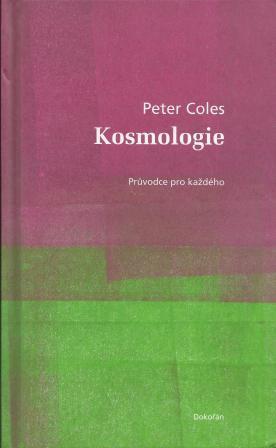
The following are in Korean, Bulgarian, Bosnian, Dutch and Czech, respectively:

vsi_6

vsi_2

vsi_3

Vsi_5

vsi_4

Anyway, I’m due to finish the 2nd Edition  – which will be a completely new book rather than an update – by the end of next month so hopefully there will be translations of the new version in due course!

Interlude

Posted in Uncategorized on July 29, 2019 by telescoper

I have only a short window of opportunity to take a bit of holiday before the  Repeat examination period begins (after which I take over as Head of Department)  so I’ve decided to take a week off starting tomorrow morning. I don’t think I’ll be blogging while I am away, so there will now follow a short intermission. Normal service will be resumed as soon as I’m back


News of the Views

Posted in Uncategorized on July 28, 2019 by telescoper

Just a quick post to mention that at some point in the early hours of Saturday morning the total number of views of this blog exceeded four million.

I have no idea whether that’s a lot or not for a blog , but I am vastly tickled by the level of interest, which has been fairly steady for about a decade now.

Thanks to everyone for reading (or at least viewing) my ramblings!

P. S. Interestingly, over the last year the six countries with most views were (in decreasing order): UK, USA, Hong Kong SAR China, Germany, Ireland and Australia. I’m quite surprised to see Hong Kong so high but wish all my readers there all the best in what seem to be turbulent times!

Crossword Collision

Posted in Biographical, Crosswords with tags , , , , on July 28, 2019 by telescoper

I was thinking recently that it’s been a while since I posted anything about crosswords, and today I got a nice surprise that gives me an excuse for a short post.

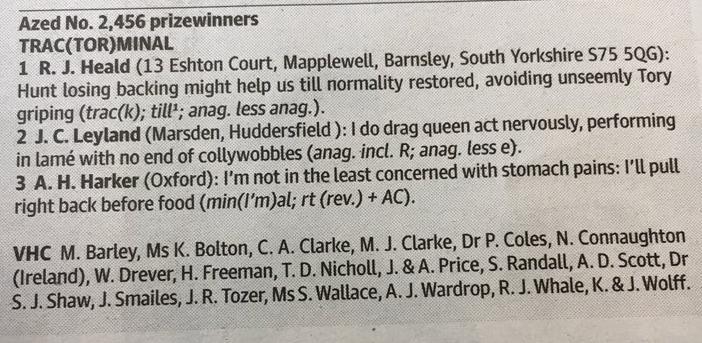
As a subscriber to the Azed Slip detailing the outcomes of the monthly Azed crossword puzzle competition, I knew a week or so ago that I’d got a VHC (`Very Highly Commended’) in Azed No. 2456. That’s not enough to merit a prize but at least gets me on the scoreboard for this year’s competition. I have been entering this competition for almost 20 years with decidedly modest success, though I did reach the dizzy heights of 15th place in 2010/11. I stopped for a while when I was at Sussex, as I switched to the Independent whose prize crossword yielded a steady stream of dictionaries. I resumed in 2017 but have found it difficult to get back into the swing of writing clues (at which I’ve never really been very good anyway).

Anyway, Azed No. 2456 was a `special’ puzzle of a type described as `Collisions’. All the Across solutions consisted of two words with one or more letters in common entered in such a way that the two words run into each other. The pairs of words are clued in such a way that the definition part relates to the full word, but the cryptic indication relates only to the part not involved in the collision, i.e. omitting the overlapping letters. Down clues were `normal’, which helped a lot in providing checked lights to help in solving the trickier across clues.

The puzzle was fairly tricky to solve but, as always with the Azed Competition entrants also have to compose a clue of their own. In this case the pair of colliding words was TRACTOR/TORMINAL. My clue (which I don’t think was all that good, really) was:

One feeds paper endless number of gripes threatening to replace Tory with Liberal

Here `One feeds paper’ defines TRACTOR (re: tractor-feed printer); `endless number’ is TRAC (i.e. TRACK with the end missing and with number meaning a track on a record); `of gripes’ defines TORMINAL; the rest is MINATORY (threatening) with TORY replaced by L for Liberal.

You can find the (far better) prize-winning clues here. There’s no actual prize for a VHC – except for a warm glow of satisfaction – but y effort was at least deemed good enough to get my name in this week’s Observer:

But if that wasn’t enough it turns out that I also won this week’s Everyman!

I’m pretty sure that’s the first time I’ve been named in both Observer Crossword competitions. Now that is a nice collision!

P.S. In case you’re wondering the reason it gives Cardiff as my address is that (a) I still have a house there and (b) I’ve had some problems with things being delivered to Ireland from the UK and (c) I recently found a stash of sticky address labels with the Cardiff address on which saves the hassle of writing my address out on each entry.


Old-School Physics

Posted in Education, History, The Universe and Stuff with tags , , , on July 27, 2019 by telescoper

The recent circulation to his staff of daft (and in some cases erroneous) rules to be used when writing documents has led to much hilarity on the media we call social. Among the obvious errors are that the correct abbreviation for `Member of Parliament’ is `MP’ not ‘M.P.’ and that `full stop’ is actually two words (not `fullstop’). On top of those his insistence that civil servants use Imperial units for everything actually may be unlawful as the official system of units for the United Kingdom is the metric system.

The latter exhortation has caused a particular outcry among people under the age of about 50 (who have never been taught Imperial units), and especially scientists (who understand the obvious superiority of the SI system).

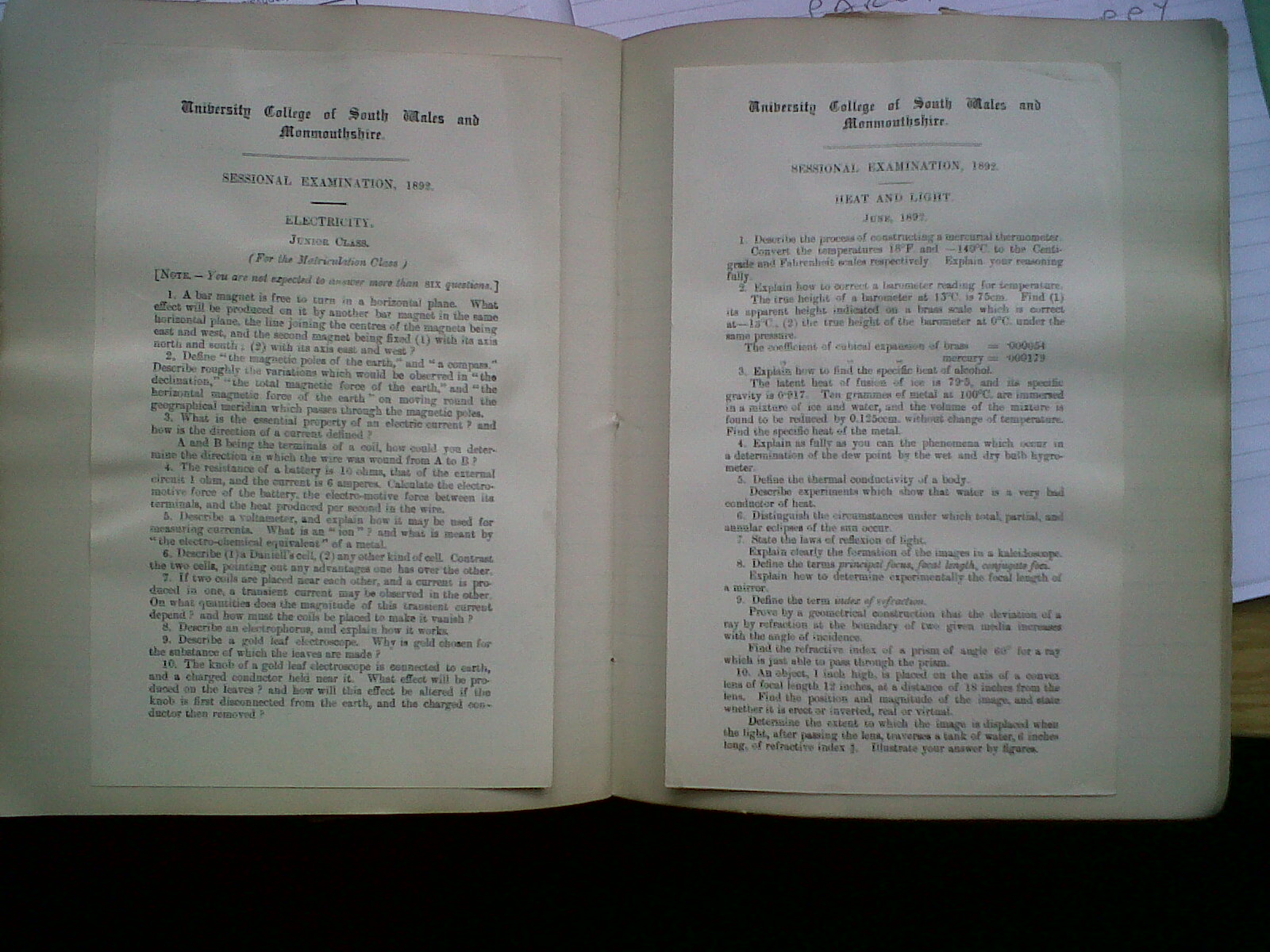
Anyway, all this reminded me that many years ago when at Cardiff there came into my possession a book of very old school and university physics examinations, which are of interest because I’ve been posting slightly less ancient examples in recent weeks. These examinations were set by the University College of South Wales and Monmouthshire, which was founded in 1883,  an institution which eventually became Cardiff University. I find them absolutely fascinating.

The papers are rather fragile, as is the book containing them, so I daren’t risk trying to scan them systematically in case flattening them out causes damage. Here instead are a few random examples that I photographed on my desk, in the manner of an old-fashioned secret agent. Sorry they’re not all that clear, but you can see them blown up if you click on them.

The collection is fairly complete, covering most of classical physics, at all examination levels from university entry to final Honours. Of course there are no questions on relativity or quantum physics appear (which had yet to be invented) but other than that – and the units! – they’re not too different from what you might find in the examinations for the early stages of contemporary physics programmes.

The Wonderful Barn

Posted in History, Maynooth with tags , , on July 26, 2019 by telescoper

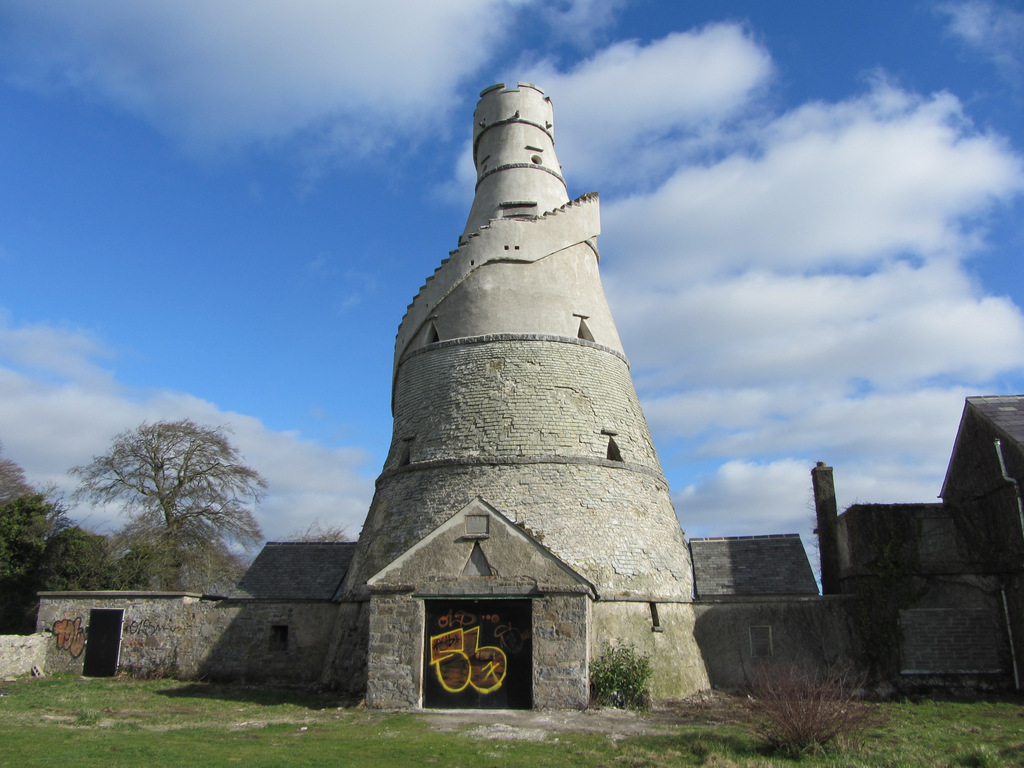
Despite the fact that it’s only a few miles away from Maynooth (in Leixlip) I had never heard of this extraordinary building until yesterday. The Wonderful Barn (for that is its name) is known to have been built in 1743 but nobody actually knows what its purpose was. Probably the best theory is that it was designed to be used as a granary, as it was built immediately after a severe famine (in possible anticipation of others in the future), but alternative possibilities to have been suggested are a tower from which people could shoot game birds, a folly (it was built by the Conolly family, owners of Castletown House and is on the Estate which has another famous folly), and simply as a means of providing work for poor people in a time of great hardship. Anyway, it’s a weird building, built from bricks but faced with what looks like recycled stone rubble.

Here’s a short video that includes some drone footage of the Wonderful Barn that gives you an idea of its corkscrew-shaped construction.