Author Archive

Off for Christmas!

Posted in Biographical on December 23, 2017 by telescoper

Well, as of now I’m offline as well as off-duty, off piste, off the beaten track, off-centre, offhand, off the wagon, off my face, off my head, off colour, off limits and off topic until after Christmas.

That means there won’t be any more blog posts, tweets, Facebook, emails or phone calls until next week at the earliest.

I’d just like to wish you all the compliments of the season and hope you have a peaceful and enjoyable holiday.

Nadolig Llawen!

The Fable of Mabel

Posted in Jazz with tags , , , , on December 22, 2017 by telescoper

Now, as a special Christmas treat, I present for you one of my all-time favourite pieces of music. It was recorded by Serge Chaloff Octet in Boston, in September 1954 and I’ve loved it ever since I first heard it on The Best of Jazz, the radio show that was presented by Humphrey Lyttelton for many years on Radio 2, way back in the 1980s. Humph had eclectic musical tastes and I am forever in his debt for introducing me to relatively obscure pieces such as this which have given me so much pleasure over the years. I can see I’m not the only WordPress blogger who loves this track too!

The lineup for this track is Serge Chaloff (baritone sax) Herb Pomeroy (trumpet) Gene DiStachio (trombone) Charlie Mariano (also saxophone) Varty Haritounian (trumpet) Dick Twardzik (piano) Ray Oliveri (bass) and Jimmy Zitano (drums). Serge Chaloff was a famously dissolute and chaotic character, who struggled to control a serious narcotics habit, but he was a marvellously accomplished player of the huge and unwieldy baritone sax. Chaloff plays beautifully on this track but the star is the amazingly innovative pianist and composer Dick Twardzik, who wrote the piece. Had he not died so young (in 1955, of a heroin overdose, on tour in Paris with Chet Baker, at the age of just 24) he would have become a household name in Jazz.

Twardzik had this to say about The Fable of Mabel on the sleevenote:

The Fable of Mabel was introduced to jazz circles in 1951-52 by the Serge Chaloff Quartet. Audiences found this satirical jazz legend a welcome respite from standard night club fare. In this legend, Mabel is depicted as a woman who loves men, music and her silver saxophone that played counterpoint (her own invention which proved impractical). The work is divided into three movements: first, New Orleans; second Classical; and third, Not Too Sad An Ending. The soulful baritone solo Serge Chaloff traces Mabel’s humble beginnings working railroad cars in New Orleans to her emergence as a practising crusader for the cause of Jazz. During her Paris days on the Jazz Houseboat, her struggle for self-expression is symbolized by an unusual saxophone duet Charlie Mariano and Varty Haritrounian. Mabel always said she wanted to go out blowing. She did.

This piece is radically different from the mixture of bop tunes and standards that provided the bulk of the repertoire for Chaloff’s band in the 1950s and it provides a superb example of how the musical revolution pioneered by Charlie Parker, Dizzy Gillespie, Thelonious Monk et al. opened the doors and ushered in a wave of creativity that fanned out in all kinds of unexpected directions. I love The Fable of Mabel for its quirkiness, the virtuosity of the playing, and for the edgy, Noir-ish atmosphere that it generates. Incidentally, it’s interesting that most of the musicians on this track are of Eastern European extraction, as were many of the leading lights of Film Noir. I always felt this track would make a perfect soundtrack for such a film.

If ever got asked to go on one of those radio programmes where you have to pick your favourite pieces of music, this would definitely be among my selections. I hope you enjoy it too!

The Winter Solstice

Posted in The Universe and Stuff with tags , , , , , on December 21, 2017 by telescoper

The winter solstice in the Northern hemisphere happens today, Thursday 21st December 2017, at 16.28 GMT (16.28 UTC). This marks the shortest day of the year: days will get longer from now until the Summer Solstice next June.  In fact the interval between sunrise and sunset tomorrow will be a whole two seconds longer tomorrow than it is today. Yippee!

Anyway, in advance of this forthcoming celestial event I thought I’d present some solstitial facts for your entertainment and edification or so you can bore people with them in the pub later on.

As we were discussing in the office today, however, this does not mean that sunrise will happen earlier tomorrow than it did this morning. In fact, sunrise will carry on getting later until the new year. This is because there is a difference between mean solar time (measured by clocks) and apparent solar time (defined by the position of the Sun in the sky), so that a solar day does not always last exactly 24 hours. A description of apparent and mean time was given by Nevil Maskelyne in the Nautical Almanac for 1767:

Apparent Time is that deduced immediately from the Sun, whether from the Observation of his passing the Meridian, or from his observed Rising or Setting. This Time is different from that shewn by Clocks and Watches well regulated at Land, which is called equated or mean Time.

The discrepancy between mean time and apparent time arises because of the Earth’s axial tilt and the fact that it travels around the Sun in an elliptical orbit in which its orbital speed varies with time of year (being faster at perihelion than at aphelion).

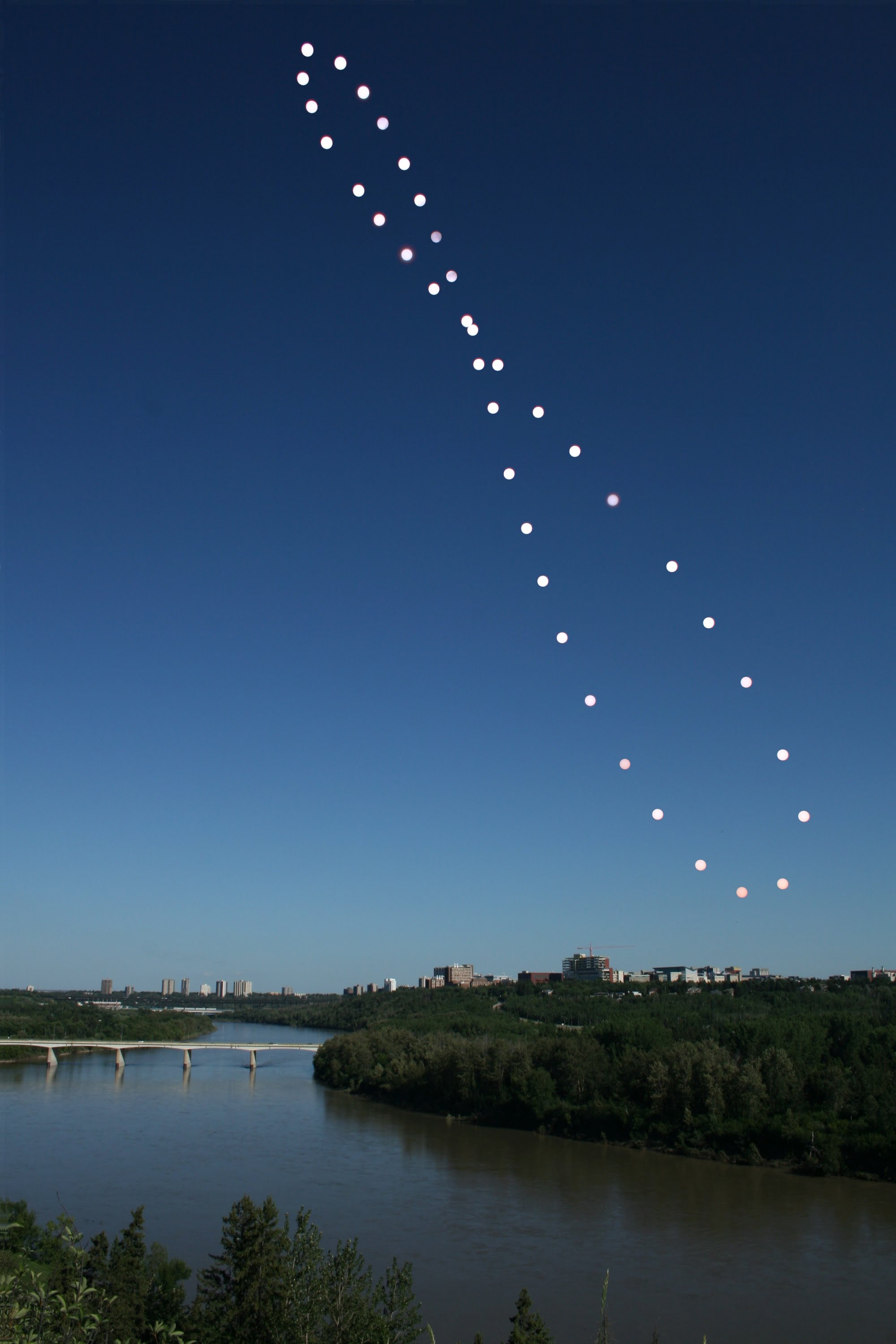
In fact if you plot the position of the Sun in the sky at a fixed time each day from a fixed location on the Earth you get a thing called an analemma, which is a sort of figure-of-eight shape whose shape depends on the observer’s latitude. Here’s a photographic version taken in Edmonton, with photographs of the Sun’s position taken from the same position at the same time on different days over the course of a year:

maxresdefault

The winter solstice is the lowermost point on this curve and the summer solstice is at the top. The north–south component of the analemma is the Sun’s declination, and the east–west component is the so-called equation of time which quantifies the difference between mean solar time and apparent solar time. This curve can be used to calculate the earliest and/or latest sunrise and/or sunset.

Using a more rapid calculational tool (Google), I found a table of the local mean times of sunrise and sunset for Cardiff (where I live) around the 2016 winter solstice. The table shows that today is indeed the shortest day (with a time between sunrise and sunset of 7 hours 49 minutes and 59 seconds).  The table also shows that sunset already started occurring later in the day before the winter solstice (although the weather has been too overcast to notice this), and sunrise will continue to happen later for a few days after the solstice. In fact the earliest sunset this year in Cardiff was on 12th December, and the latest sunrise will be on 30th December.

I hope this clarifies the situation.

Why I’m moving to Ireland

Posted in Biographical, Education with tags , , , , , , , , , on December 20, 2017 by telescoper

Over the past few weeks quite a number of people have asked me why I decided to move to Ireland, so thought I’d write a post about it in case anyone out there is interested.

The simple answer that I was offered a full-time permanent and rather well paid job at Maynooth University. I’m currently on a part-time fixed term contract at Cardiff University.  The salary wasn’t the main factor, but the low value of the £ relative to the € means that I will do quite well financially out of the move. On top of that I will be joining a final salary pension scheme which has far more favourable terms that the scheme that applies to UK academic staff. Oh, and there’s neither a Research Excellence Framework nor a Teaching Excellence Framework nor a Knowledge Exchange Framework nor punitive levels of student tuition fees nor any of the many other  idiocies that have been inflicted on UK universities in recent years. It will be a relief to be able to teach and do research in environment which, at least for the time being, regards these as things of value in themselves rather than as means of serving the empty cycle of production and consumption that defines the modern neoliberal state. Above all, it’s a good old-fashioned professorship. You know, teaching and research?

That’s the simple answer, but there’s a bit more to it than that. I left Sussex in 2016 with the intention of taking early retirement as soon as I could do so. My short exposure to  a role in senior management, as Head of the School of Mathematical and Physical Sciences at the University of Sussex, convinced me that I didn’t want to spend the rest of my life  in a system that I felt had lost all sight of what universities are and what they are for. I was (and still am) deeply grateful to Cardiff University for throwing me a lifeline that enabled me to escape from what I increasingly saw as a dead-end job, and giving me an interesting job to do to tide me over until next year, when I am 55 and therefore eligible for early retirement.

I think I have done everything that was asked of me in my current position at Cardiff, on a half-time salary but often up against very short timescales. The two MSc courses I was brought in to set up are both now running and looking to expand. On top of that we also managed to secure funding for a Centre for Doctoral Training. I only played a small part in doing that, but I think it has put the Data Innovation Research Institute on the map.  When both of these successes had been secured earlier this year, I felt that there was no way that leaving now would have a negative effect either on the Data Innovation Institute or the School of Physics & Astronomy. By about April this year I had firmly decided to retire completely from academia in mid-2018.

The problem with this plan had been apparent since 2016: Brexit.  I think it’s still quite possible that the Brexit project will fail under the weight of its own contradictions, but that no longer matters. The damage has already been done. The referendum campaign, followed by the callous and contemptuous attitude of the current UK Government towards EU nationals living in Britain, unleashed a sickening level of xenophobia that has made me feel like a stranger in my own country. Not everyone who voted `Leave’ is a bigot, of course, but every bigot voted for Brexit and the bigots are now calling all the shots. There are many on the far right of UK politics who won’t be satisfied until we have ethnic cleansing. Even if Brexit is stopped the genie of intolerance is out of the bottle and I don’t think it well ever be put back. Brexit will also doom the National Health Service and the UK university system, and clear the way for the destruction of workers’ rights and environmental protection. The poor and the sick will suffer, while only the rich swindlers who bought the referendum result will prosper. The country in which I was born, and in which I have lived for the best part of 54 years, is no longer something of which I want to be a part.

So, having spent most of my working life in the UK higher education system and decided that my heart was no longer in that, I then had to face that my heart was no longer in this country at all. Could I face years of retirement in mean-spirited down-market Brexit Britain? What was I to do?

I’ve mentioned many times on this blog how lucky I have been that opportunities have come along at exactly the right time. In May, a friend pointed out the advertisement for a job in Maynooth with an application deadline just a few days away. Cosmology was specifically mentioned as one of the possible areas. I felt that they would probably be looking for someone younger, and my research output over the last few years has been patchy given my other commitments, but at the last minute I sent off an application.

Ireland has a particularly strong attraction for me because I have Irish ancestry through which I am eligible for citizenship without having to go through the naturalisation process (which takes 5 years, still less than many EU countries). Together with an Irish EU passport comes a continuation of the rights – especially freedom of movement – that UK citizens will shortly lose.

It seemed like outrageously good luck that the position in Maynooth came up just at the right time, but the end of July came and went without any news. I assumed I hadn’t been shortlisted, so forgot about the idea.

Then, in September I received a letter inviting me for interview just a couple of weeks later. I’m not sure why the process was  so delayed, but was overjoyed to find out there was still a chance. The date clashed with a prior commitment, so I had to do the interview via Skype (over a flaky internet connection from a hotel room) rather than in person.  I thought it went very badly, but I ended up being offered the job. I visited Maynooth University shortly after being informed of this, to discuss terms.

The people at Maynooth were keen to have me start there as soon as possible, but given the lateness of the interview date I had already committed to teaching in Cardiff this forthcoming Semester and I wasn’t going to leave my current colleagues and students in the lurch. There was an obvious solution, however. I am employed here at 50% FTE so I could start in Maynooth at up to 50% without having to resign. We quickly agreed this transitional arrangement was workable, and I started there on 1st December.  The period from February to April will be very busy, as I will be working either side of the Irish Sea, but it’s only for a relatively short time. Next summer I plan to relocate completely to Ireland.

You probably think I’m a bit old to be starting a new life in another country, even one that’s relatively nearby, but I reckon I have time for this one last adventure before I retire. In the words of Tennyson’s Ulysses, `It is not too late to seek a newer world’.  I have worked in British universities since 1988. That’s almost 30 years. I reckon I can still contribute something in the last 10 I have before I pull down the shutters for good. Who knows, maybe I’ll even experience the joy of living in a United Ireland before long?

The press have covered a number of stories of EU nationals who have been living in Britain and who have decided to leave because of Brexit. Surprisingly little attention has been paid to those, like myself, who are also EU nationals but who happen have been born in Britain. I know more than a few academics who are weighing up their options, as well as those born abroad I know who have already departed.  The Brexodus has already begun and its pace seems likely to accelerate very quickly indeed. Others have personal situations that are more complicated than mine, especially those who have partners and children, so not everyone will find it easy to follow a similar path to the one I’ve chosen, but I those that can get out will do so.

Because I’ve lived here all my life I thought I would find it difficult to leave Britain. I was quite traumatised by the Brexit referendum, as one would be by the death of a close relative, but it made me reexamine my life. There is a time when you have to move on, and that’s what I’m doing. I’m done here.
A problem of fluid flowing through a hole

Posted in Cute Problems with tags , , , , on December 19, 2017 by telescoper

I’m sure you’re all already as bored of Christmas as I am so I thought I’d do you all a favour by giving you something interested to do to distract you from the yuletide tedium,
The cute problem of the water tank I posted a while ago seemed to provide a diversion for many – although only about 10% of respondents go it right – so here’s a similar one. It’s not multiple choice so you will have to write your answers to the two parts in the comments box. As a hint, I’ll  say that this is from some notes on dimensional analysis, and it’s one of the harder problems I have in that file!

An incompressible fluid flows through a small hole of diameter d in a thin plane metal sheet. The volume flow rate R depends on d, on the fluid viscosity η and density ρ, and on the pressure difference p between the two sides of the she

(a) Find the most general possible relationship between the quantities  R, d, η,  ρ, and p.

(b) Measurement of the flow rate R1  through this the hole for a pressure difference p1 is made using a particular fluid. What can be predicted for a fluid of twice the density and one-third the viscosity?


As usual, answers through the comments box please!


Christmas Lunch Report

Posted in Biographical with tags , on December 19, 2017 by telescoper

Well, yesterday’s annual Christmas Lunch for the School of Physics & Astronomy at Cardiff University went very well, with only the one member of staff having to be taken to hospital in an ambulance.

Prior to that we had the traditional meal at Aberdare Hall, following by the traditional pool competition at the Mackintosh Hotel, and the traditional karaoke upstairs in the Flute and Tankard. I got home about 2am, whereupon I remembered that Monday nights are when I have to put the rubbish out.

These occasions are a reminder of the true Christmas message of depravity and excess which, in my opinion, is increasingly lost by the regrettable encroachment of too much crass religion.

After the lunch, our Head of School gave an inspirational speech to the assembled throng in which he summed up our feelings for the festive season by quoting George Bernard Shaw:

Christmas is forced on a reluctant and disgusted nation by the shopkeepers and the press: on its own merits it would wither and shrivel in the fiery breath of universal hatred; and anyone who looked back to it would be turned into a pillar of greasy sausages.

Happy Christmas!

Frank Kelly’s Christmas Countdown

Posted in Uncategorized with tags , on December 18, 2017 by telescoper

It’s time for the famous Cardiff Physics & Astronomy Christmas Lunch, so I’ll get into the Christmas spirit and just leave this here:

The Taste and Tincture of Another Education

Posted in Education, Literature, The Universe and Stuff with tags , on December 17, 2017 by telescoper

This is what a University education meant to the poet and theologian Thomas Traherne (1636-1674), according to his Centuries of Meditations. In this astonishing book describing his own voyage of spiritual discovery, Traherne celebrates, among many other things, the beauty and complexity of creation as a manifestation of the power of God. Even  a non-religious person like myself can find much to appreciate in his words about the wonder of the natural world and the joy of learning for learning’s sake:

Having been at the University, and received there the taste and tincture of another education, I saw that there were things in this world of which I never dreamed; glorious secrets, and glorious persons past imagination. 

There I saw that Logic, Ethics, Physics, Metaphysics, Geometry, Astronomy, Poesy, Medicine, Grammar, Music, Rhetoric all kinds of Arts, Trades, and Mechanisms that adorned the world pertained to felicity; at least there I saw those things, which afterwards I knew to pertain unto it: and was delighted in it. 

There I saw into the nature of the Sea, the Heavens, the Sun, the Moon and Stars, the Elements, Minerals, and Vegetables. All which appeared like the King’s Daughter, all glorious within; and those things which my nurses, and parents, should have talked of there were taught unto me.

Trees, Graphs and the Leaving Certificate

Posted in Biographical, mathematics, Maynooth, The Universe and Stuff with tags , , , , , , on December 15, 2017 by telescoper

I’m starting to get the hang of some of the differences between things here in Ireland and the United Kingdom, both domestically and in the world of work.

One of the most important points of variation that concerns academic life is the school system students go through before going to University. In the system operating in England and Wales the standard qualification for entry is the GCE A-level. Most students take A-levels in three subjects, which gives them a relatively narrow focus although the range of subjects to choose from is rather large. In Ireland the standard qualification is the Leaving Certificate, which comprises a minimum of six subjects, giving students a broader range of knowledge at the sacrifice (perhaps) of a certain amount of depth; it has been decreed for entry into this system that an Irish Leaving Certificate counts as about 2/3 of an A-level for admissions purposes, so Irish students do the equivalent of at least four A-levels, and many do more than this.

There’s a lot to be said for the increased breadth of subjects undertaken for the leaving certificate, but I have no direct experience of teaching first-year university students here yet so I can’t comment on their level of preparedness.

Coincidentally, though, one of the first emails I received this week referred to a consultation about proposed changes to the Leaving Certificate in Applied Mathematics. Not knowing much about the old syllabus, I didn’t feel there was much I could add but I had a look at the new one and was surprised to see a whole `Strand’, on Mathematical Modelling with netwworks and graphs.

The introductory blurb reads:

In this strand students learn about networks or graphs as mathematical models which can be used to investigate a wide range of real-world problems. They learn about graphs and adjacency matrices and how useful these are in solving problems. They are given further opportunity to consolidate their understanding that mathematical ideas can be represented in multiple ways. They are introduced to dynamic programming as a quantitative analysis technique used to solve large, complex problems that involve the need to make a sequence of decisions. As they progress in their understanding they will explore and appreciate the use of algorithms in problem solving as well as considering some of the wider issues involved with the use of such techniques.


Among the specific topics listed you will find:

  • Minimal Spanning trees applied to problems involving optimising networks and algorithms associated with finding these (Kruskal, Prim);  
  • Bellman’s Optimality Principal to find the shortest paths in a weighted directed network, and to be able to formulate the process algebraically;
  •  Dijkstra’s algorithm to find shortest paths in a weighted directed network; etc.


For the record I should say that I’ve actually used Minimal Spanning Trees in a research context (see, e.g., this paper) and have read (and still have) a number of books on graph theory, which I find a truly fascinating subject. It seems to me that the topics all listed above  are all interesting and they’re all useful in a range of contexts, but they do seem rather advanced topics to me for a pre-university student and will be unfamiliar to a great many potential teachers of Applied Mathematics too. It may turn out, therefore, that the students will end up getting a very superficial knowledge of this very trendy subject, when they would actually be better off getting a more solid basis in more traditional mathematical methods  so I wonder what the reaction will be to this proposal!


A Python Toolkit for Cosmology

Posted in The Universe and Stuff with tags , , , , on December 14, 2017 by telescoper

The programming language Python has established itself as the industry standard for researchers in physics and astronomy (as well as the many other fields, including most of those covered by the Data Innovation Research Institute which employs me part-time). It has also become the standard vehicle for teaching coding skills to undergraduates in many disciplines. In fact it looks like the first module I will be teaching in Maynooth next term is in Computational Physics, and that will be delivered using Python too. It’s been a while since I last did any significant hands-on programming, so this will provide me with a good refresher. The best way to learn something well is to have to teach it to others!

But I digress. This morning I noticed a paper by Benedikt Diemer on the arXiv with the title COLOSSUS: A python toolkit for cosmology, large-scale structure, and dark matter halos. Here is the abstract:

This paper introduces Colossus, a public, open-source python package for calculations related to cosmology, the large-scale structure of matter in the universe, and the properties of dark matter halos. The code is designed to be fast and easy to use, with a coherent, well-documented user interface. The cosmology module implements FLRW cosmologies including curvature, relativistic species, and different dark energy equations of state, and provides fast computations of the linear matter power spectrum, variance, and correlation function. The large-scale structure module is concerned with the properties of peaks in Gaussian random fields and halos in a statistical sense, including their peak height, peak curvature, halo bias, and mass function. The halo module deals with spherical overdensity radii and masses, density profiles, concentration, and the splashback radius. To facilitate the rapid exploration of these quantities, Colossus implements about 40 different fitting functions from the literature. I discuss the core routines in detail, with a particular emphasis on their accuracy. Colossus is available at bitbucket.org/bdiemer/colossus.

The software can be downloaded here. It looks a very useful package that includes code to calculate many of the bits and pieces used by cosmologists working on the theory of large-scale structure and galaxy evolution. It is also, I hope, an example of a trend towards greater use of open-source software, for which I congratulate the author! I think this is an important part of the campaign to create truly open science, as I blogged about here.

An important aspect of the way science works is that when a given individual or group publishes a result, it should be possible for others to reproduce it (or not, as the case may be). At present, this can’t always be done. In my own field of astrophysics/cosmology, for example, results in traditional scientific papers are often based on very complicated analyses of large data sets. This is increasingly the case in other fields too. A basic problem obviously arises when data are not made public. Fortunately in astrophysics these days researchers are pretty good at sharing their data, although this hasn’t always been the case.

However, even allowing open access to data doesn’t always solve the reproducibility problem. Often extensive numerical codes are needed to process the measurements and extract meaningful output. Without access to these pipeline codes it is impossible for a third party to check the path from input to output without writing their own version assuming that there is sufficient information to do that in the first place. That researchers should publish their software as well as their results is quite a controversial suggestion, but I think it’s the best practice for science. There isn’t a uniform policy in astrophysics and cosmology, but I sense that quite a few people out there agree with me. Cosmological numerical simulations, for example, can be performed by anyone with a sufficiently big computer using GADGET the source codes of which are freely available. Likewise, for CMB analysis, there is the excellent CAMB code, which can be downloaded at will; this is in a long tradition of openly available numerical codes, including CMBFAST and HealPix.

I suspect some researchers might be reluctant to share the codes they have written because they feel they won’t get sufficient credit for work done using them. I don’t think this is true, as researchers are generally very appreciative of such openness and publications describing the corresponding codes are generously cited. In any case I don’t think it’s appropriate to withhold such programs from the wider community, which prevents them being either scrutinized or extended as well as being used to further scientific research. In other words excessively proprietorial attitudes to data analysis software are detrimental to the spirit of open science.

Anyway, my views aren’t guaranteed to be representative of the community, so I’d like to ask for a quick show of hands via a poll…

…and you are of course welcome to comment via the usual box.