For detailed maps of the early universe that greatly improved our knowledge of the evolution of the cosmos and the fluctuations that seeded the formation of galaxies.
The award, which is for the sizeable sum of $3 Million, will be shared among the 27 members of the WMAP team whose names I list here in full (team leaders are in italics):
Chris Barnes; Rachel Bean; Charles Bennett; Olivier Doré; Joanna Dunkley,;Benjamin M. Gold; Michael Greason; Mark Halpern; Robert Hill, Gary F. Hinshaw, Norman Jarosik, Alan Kogut, Eiichiro Komatsu, David Larson, Michele Limon, Stephan S. Meyer, Michael R. Nolta, Nils Odegard, Lyman Page, Hiranya V. Peiris, Kendrick Smith, David N. Spergel, Greg S. Tucker, Licia Verde, Janet L. Weiland, Edward Wollack, and Edward L. (Ned) Wright.
I know quite a few of these people personally, including Hiranya, Licia, Eiichiro, Joanna, Olivier and Ned, so it’s a special pleasure to congratulate them – and the other members of the team – on this well-deserved award.
This is the light of the mind, cold and planetary.
The trees of the mind are black. The light is blue.
The grasses unload their griefs at my feet as if I were God,
Prickling my ankles and murmuring of their humility.
Fumy spiritous mists inhabit this place
Separated from my house by a row of headstones.
I simply cannot see where there is to get to.
The moon is no door. It is a face in its own right, White as a knuckle and terribly upset. It drags the sea after it like a dark crime; it is quiet With the O-gape of complete despair. I live here. Twice on Sunday, the bells startle the sky – Eight great tongues affirming the Resurrection. At the end, they soberly bong out their names.
The yew tree points up. It has a Gothic shape. The eyes lift after it and find the moon. The moon is my mother. She is not sweet like Mary. Her blue garments unloose small bats and owls. How I would like to believe in tenderness – The face of the effigy, gentled by candles, Bending, on me in particular, its mild eyes.
I have fallen a long way. Clouds are flowering Blue and mystical over the face of the stars. Inside the church, the saints will be all blue, Floating on their delicate feet over cold pews, Their hands and faces stiff with holiness. The moon sees nothing of this. She is bald and wild. And the message of the yew tree is blackness – blackness and silence.
This morning, having a few hours free after breakfast before some househunting activities, I took a stroll to buy a newspaper and decided to take a few snaps.
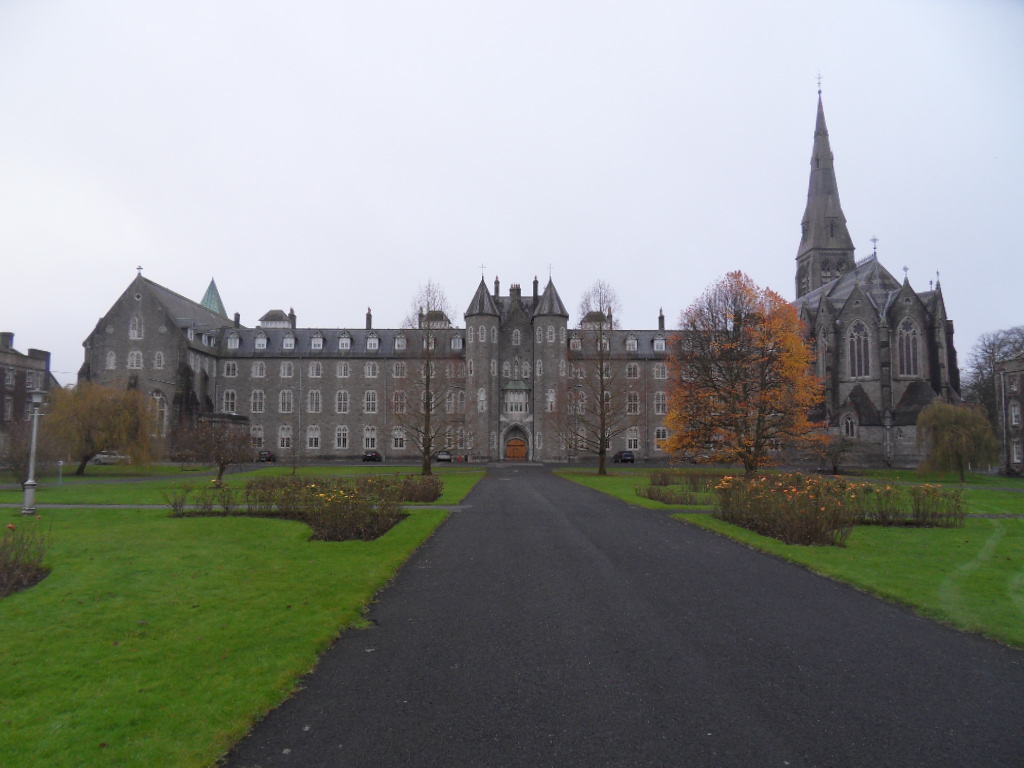
First, here are a couple of pictures of St Patrick’s College, where I am staying. My room is on the top floor, to the left in the wing that juts forward from the main building. The chapel (with the spire) is on the other side.
The building I’m in forms the most impressive side of a quadrangle, one other part of which you can see in the second photograph.
St Patrick’s College was founded in 1795, and its style could best be described as Gothic Revival. It was in fact built as a theological college with funds supplied by King George III. There was a political reason for his largesse. Roman Catholicism was brutally suppressed in Ireland during and after the Eleven Years War in the mid-17th Century, culminating in the vicious subjugation of Ireland by Oliver Cromwell. In effect, the Catholic Church in Ireland was outlawed. Starting from about 1766 some of the restrictions on Catholics began to be removed, but there were no institutions in Ireland capable of training priests so all of those wishing to join the priesthood had to study abroad, primarily in France. George was worried that this would lead to an influx of priests whose heads were filled with revolutionary ideas from the continent, so he decided to fund a place where they could be taught in Ireland, where at least there could be some control over their education.
The old theological college of St Patrick (the `Pontifical University’) forms the core of what is now the South Campus of Maynooth University. Some of the old buildings here seem to take their names from the components of the old Liberal Arts degree: there is a Music House, Logic House, Rhetoric House and so on.
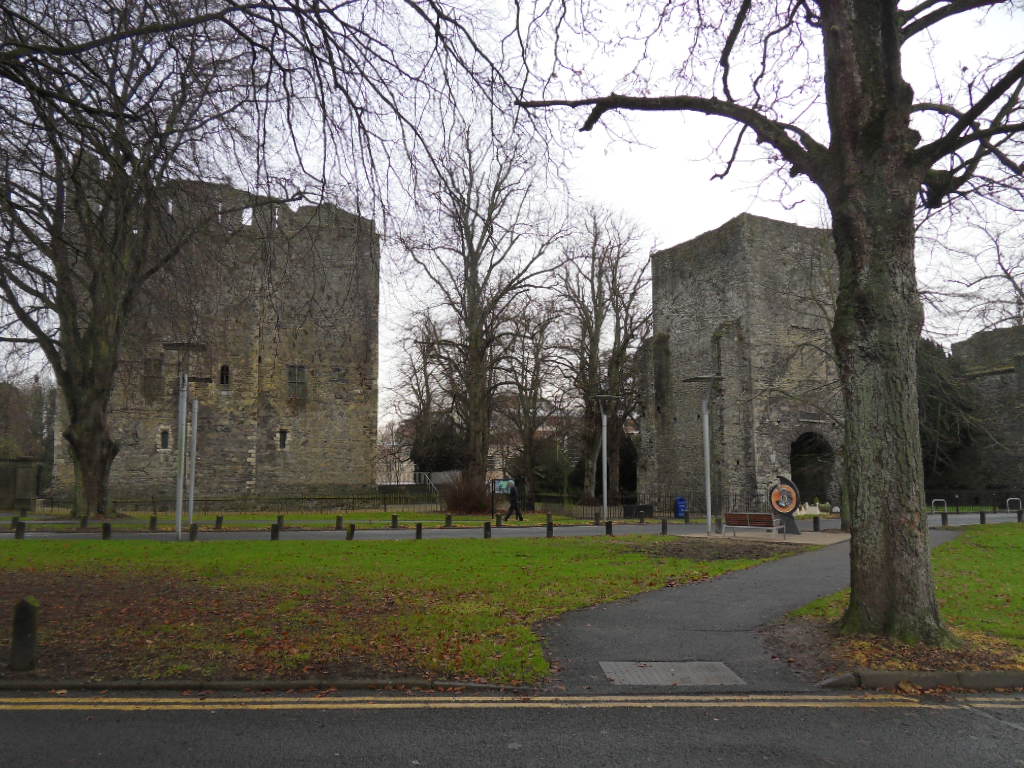
Next the entrance to the South Campus you can see this:
These are the remains of Maynooth Castle (or Geraldine Castle, after the Fitzgerald family), built around 1200. It was a huge and imposing fortress but now only the gatehouse and solar tower remain. It has violent history: heavily damaged in 1535 by siege cannons, its garrison surrendered only to be summarily executed. Rebuilt in the 1630s, it was destroyed completely in the 1640s during – you guessed it – the Eleven Years War. It has been a ruin ever since, but provides an intriguing entrance to the campus!
I’m by no means an architectural expert but I had a hunch that the Church (above) that stands opposite the Castle on the other side of the road leading into campus might also be quite old. Indeed it is. It was built in 1248 as the chapel to Geraldine Castle. It is now an Anglican Church, still used for regular worship.
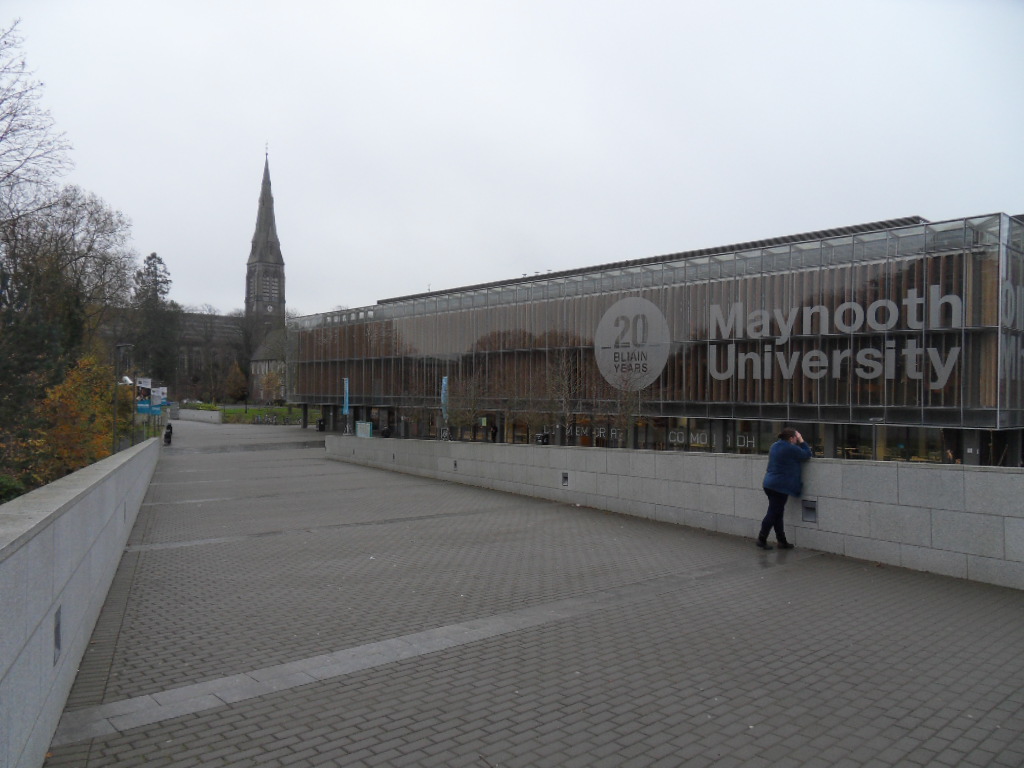
The South Campus is separated from the North Campus (where the Science Building and other modern facilities are) by a main road. The North Campus is very new, most of the buildings are less than 20 years old. Here’s a picture showing the splendid library, with the spire of the chapel of St Patrick’s College in the background. This is one of the few newer buildings on the South Campus: the pedestrian path you see leads to the main road that splits North and South Campuses.
I haven’t resigned my job at Cardiff University. I’m currently employed there only half the time – or at least that’s what my contract says! – and I’m joining Maynooth on a 50% basis also so I can do one job alongside the other. In particularly I will be teaching in Cardiff next semester as planned.
Although I will be sharing my time equally between Wales and Ireland for the immediate future, I do intend to relocate fully to Ireland, as and when this becomes practicable and can be done in such a way as to not have any impact on ongoing activities in Cardiff.
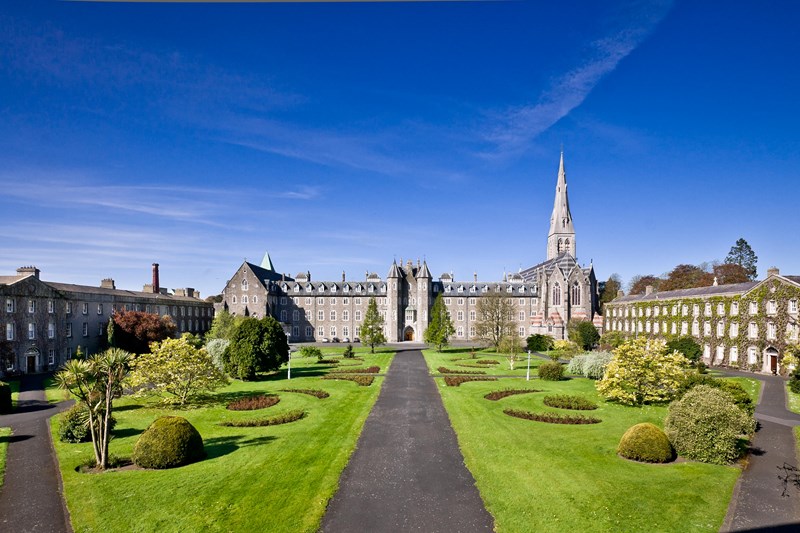
I’ll post more about Maynooth in due course, but today is filled with organisational things: getting on the IT system, arranging tax and related matters, and finding somewhere to live. In the meantime I’m staying in St Patrick’s House, part of the Catholic seminary on Maynooth University’s South Campus. It’s a lovely building, with rooms that are basic but clean, comfortable and very inexpensive. It was too dark when I arrived last night to take a picture of the place but here’s one from the net:
It’s not quite as summery at the moment, either. It was very cold when I arrived last night and that has continued into today. I will take a snap at some point, but there was a rather ugly-looking crane at the front of the building and would prefer to take a picture when it has gone!
I’ve never been in a seminary before. Although everyone I’ve met here has been wonderfully nice and friendly, I have to say the corridors have more than a hint of The Shining about them:
Anyway, that’s all for now. I hope to have some time at the weekend to have a look around Dublin, which is only 30 minutes or so away by train from Maynooth, and where I may end up living in the not-too-distant future!
I stumbled across a little video on Youtube (via Twitter, which is where I get most of my leads these days) with the title Why is it Dark at Night? Here it is:
As a popular science exposition I think this is not bad at all, apart from one or two baffling statements, e.g. “..the Universe had a beginning, so there aren’t stars in every direction”. A while ago I posted a short piece about the history of cosmology which got some interesting comments, so I thought I’d try again with a little article I wrote a while ago on the subject of Olbers’ Paradox. This is discussed in almost every astronomy or cosmology textbook, but the resolution isn’t always made as clear as it might be. Here is my discussion.
One of the most basic astronomical observations one can make, without even requiring a telescope, is that the night sky is dark. This fact is so familiar to us that we don’t imagine that it is difficult to explain, or that anything important can be deduced from it. But quite the reverse is true. The observed darkness of the sky at night was regarded for centuries by many outstanding intellects as a paradox that defied explanation: the so-called Olbers’ Paradox.
The starting point from which this paradox is developed is the assumption that the Universe is static, infinite, homogeneous, and Euclidean. Prior to twentieth century developments in observation (e.g. Hubble’s Law) and theory (Cosmological Models based on General Relativity), all these assumptions would have appeared quite reasonable to most scientists. In such a Universe, the intensity of light received by an observer from a source falls off as the inverse square of the distance between the two. Consequently, more distant stars or galaxies appear fainter than nearby ones. A star infinitely far away would appear infinitely faint, which suggests that Olbers’ Paradox is avoided by the fact that distant stars (or galaxies) are simply too faint to be seen. But one has to be more careful than this.
Imagine, for simplicity, that all stars shine with the same brightness. Now divide the Universe into a series of narrow concentric spherical shells, in the manner of an onion. The light from each source within a shell of radius falls off as , but the number of sources increases as . Multiplying these together we find that every shell produces the same amount of light at the observer, regardless of the value of . Adding up the total light received from all the shells, therefore, produces an infinite answer.
In mathematical form, this is
where is the luminosity of a source, is the number density of sources and is the intensity of radiation received from a source at distance .
In fact the answer is not going to be infinite in practice because nearby stars will block out some of the light from stars behind them. But in any case the sky should be as bright as the surface of a star like the Sun, as each line of sight will eventually end on a star. This is emphatically not what is observed.
It might help to think of this in another way, by imagining yourself in a very large forest. You may be able to see some way through the gaps in the nearby trees, but if the forest is infinite every possible line of sight will end with a tree.
As is the case with many other famous names, this puzzle was not actually first discussed by Olbers. His discussion was published relatively recently, in 1826. In fact, Thomas Digges struggled with this problem as early as 1576. At that time, however, the mathematical technique of adding up the light from an infinite set of narrow shells, which relies on the differential calculus, was not known. Digges therefore simply concluded that distant sources must just be too faint to be seen and did not worry about the problem of the number of sources. Johannes Kepler was also interested in this problem, and in 1610 he suggested that the Universe must be finite in spatial extent. Edmund Halley (of cometary fame) also addressed the issue about a century later, in 1720, but did not make significant progress. The first discussion which would nowadays be regarded as a correct formulation of the problem was published in 1744, by Loys de Chéseaux. Unfortunately, his resolution was not correct either: he imagined that intervening space somehow absorbed the energy carried by light on its path from source to observer. Olbers himself came to a similar conclusion in the piece that forever associated his name with this cosmological conundrum.
Later students of this puzzle included Lord Kelvin, who speculated that the extra light may be absorbed by dust. This is no solution to the problem either because, while dust may initially simply absorb optical light, it would soon heat up and re-radiate the energy at infra-red wavelengths. There would still be a problem with the total amount of electromagnetic radiation reaching an observer. To be fair to Kelvin, however, at the time of his writing it was not known that heat and light were both forms of the same kind of energy and it was not obvious that they could be transformed into each other in this way.
To show how widely Olbers’ paradox was known in the nineteenth Century, it is worth also mentioning that Friedrich Engels, owner of a factory in Manchester (in the Midlands) and co-author with Karl Marx of the Communist Manifesto also considered it in his book The Dialectics of Nature, though the discussion is not particularly illuminating from a scientific point of view.
In fact, probably the first inklings of a correct resolution of the Olbers’ Paradox were contained not in a dry scientific paper, but in a prose poem entitled Eureka published in 1848 by Edgar Allan Poe. Poe’s astonishingly prescient argument is based on the realization that light travels with a finite speed. This in itself was not a new idea, as it was certainly known to Newton almost two centuries earlier. But Poe did understand its relevance to Olbers’ Paradox. Light just arriving from distant sources must have set out a very long time ago; in order to receive light from them now, therefore, they had to be burning in the distant past. If the Universe has only lasted for a finite time then one can’t add shells out to infinite distances, but only as far as the distance given by the speed of light multiplied by the age of the Universe. In the days before scientific cosmology, many believed that the Universe had to be very young: the biblical account of the creation made it only a few thousand years old, so the problem was definitely avoided.
Of course, we are now familiar with the ideas that the Universe is expanding (and that light is consequently redshifted), that it may not be infinite, and that space may not be Euclidean. All these factors have to be taken into account when one calculates the brightness of the sky in different cosmological models. But the fundamental reason why the paradox is not a paradox does boil down to the finite lifetime, not necessarily of the Universe, but of the individual structures that can produce light. According to the theory Special Relativity, mass and energy are equivalent. If the density of matter is finite, so therefore is the amount of energy it can produce by nuclear reactions. Any object that burns matter to produce light can therefore only burn for a finite time before it fizzles out.
Imagine that the Universe really is infinite. For all the light from all the sources to arrive at an observer at the same time (i.e now) they would have to have been switched on at different times – those furthest away sending their light towards us long before those nearby had switched on. To make this work we would have to be in the centre of a carefully orchestrated series of luminous shells switching on an off in sequence in such a way that their light all reached us at the same time. This would not only put us in a very special place in the Universe but also require the whole complicated scheme to be contrived to make our past light cone behave in this peculiar way.
With the advent of the Big Bang theory, cosmologists got used to the idea that all of matter was created at a finite time in the past anyway, so Olber’s Paradox receives a decisive knockout blow, but it was already on the ropes long before the Big Bang came on the scene.
As a final remark, it is worth mentioning that although Olbers’ Paradox no longer stands as a paradox, the ideas behind it still form the basis of important cosmological tests. The brightness of the night sky may no longer be feared infinite, but there is still expected to be a measurable glow of background light produced by distant sources too faint to be seen individually. In principle, in a given cosmological model and for given assumptions about how structure formation proceeded, one can calculate the integrated flux of light from all the sources that can be observed at the present time, taking into account the effects of redshift, spatial geometry and the formation history of sources. Once this is done, one can compare predicted light levels with observational limits on the background glow in certain wavebands which are now quite strict .
They say there’s a first time for everything, and it turned out yesterday was the first occasion on which I encountered a Pembrokeshire Dangler:
It’s still there today. The Northerly airflow that is responsible for this phenomenon is causing a very cold snap here in Cardiff, but hopefully the Pembrokeshire Dangler will not hang around much longer.
The bees build in the crevices
Of loosening masonry, and there
The mother birds bring grubs and flies.
My wall is loosening; honey-bees,
Come build in the empty house of the stare.
We are closed in, and the key is turned On our uncertainty; somewhere A man is killed, or a house burned, Yet no cleat fact to be discerned: Come build in he empty house of the stare.
A barricade of stone or of wood; Some fourteen days of civil war; Last night they trundled down the road That dead young soldier in his blood: Come build in the empty house of the stare.
We had fed the heart on fantasies, The heart’s grown brutal from the fare; More Substance in our enmities Than in our love; O honey-bees, Come build in the empty house of the stare.
The views presented here are personal and not necessarily those of my employer (or anyone else for that matter).
Feel free to comment on any of the posts on this blog but comments may be moderated; anonymous comments and any considered by me to be vexatious and/or abusive and/or defamatory will not be accepted. I do not necessarily endorse, support, sanction, encourage, verify or agree with the opinions or statements of any information or other content in the comments on this site and do not in any way guarantee their accuracy or reliability.






 falls off as
  , but the number of sources increases as
  . Multiplying these together we find that every shell produces the same amount of light at the observer, regardless of the value of
 is the luminosity of a source,
  is the number density of sources and
  is the intensity of radiation received from a source at distance

 In the Dark