Author Archive

A Problem in Lagrangian Mechanics

Posted in Cute Problems with tags , , on April 28, 2016 by telescoper

Today, as well as saying goodbye to Sally Church, I managed to finish my lecture course on Theoretical Physics. There’s still another week of teaching to go, but I have covered all the syllabus now and can use the remaining sessions for revision. The last bit of the course module concerned the calculus of variations and a brief introduction to Lagrangian mechanics so for a bit of fun I included this example.

Professor Percy Poindexter of the University of Neasden has invented a new theory of mechanics in which the one-dimensional motion of a particle in a potential V(x) is governed by a Lagrangian of the form

L=mx\ddot{x} +2V(x).

Use Hamilton’s Principle and an appropriate form of the Euler equation to derive the equation of motion for such a particle and comment on your answer.

UPDATE: Since nobody has commented I’ll just reveal the point of this question, which is that if you follow the instructions the equation of motion you should obtain is

m\ddot{x}= -\frac{\partial V}{\partial x},

which is exactly the same as you would have got using the usual Lagrangian

L= \frac{1}{2}m\dot{x}^{2} - V(x).

Anyone care to comment on that?

Happy Retirement, Sally Church!

Posted in Biographical, Brighton with tags , , on April 28, 2016 by telescoper

Today marks the end of an era for the Department of Physics and Astronomy at the University of Sussex. Sally Church, pictured below, is retiring today after over 27 years in the Department (and almost 29 in the University). No doubt there are many readers of this blog who have passed through Sussex at one time or another and met Sally. In fact, she arrived in the Department when I was here in a previous incarnation as a PhD student in the late Eighties and was still here when I returned in 2013 as Head of School. She recently received a long service award from the University in recognition of her loyalty and hard work.

Sally Church

Sally has been our Course Coordinator for Physics and Astronomy and, as such, has been a key member of our office team, providing administrative support for a huge range of teaching and other activities. She will be extremely hard to replace as her understanding of the University’s systems and procedures is second to none, but she’s definitely earned a rest and on behalf of everyone in the Department, the School and the University as a whole I wish her a very happy retirement!

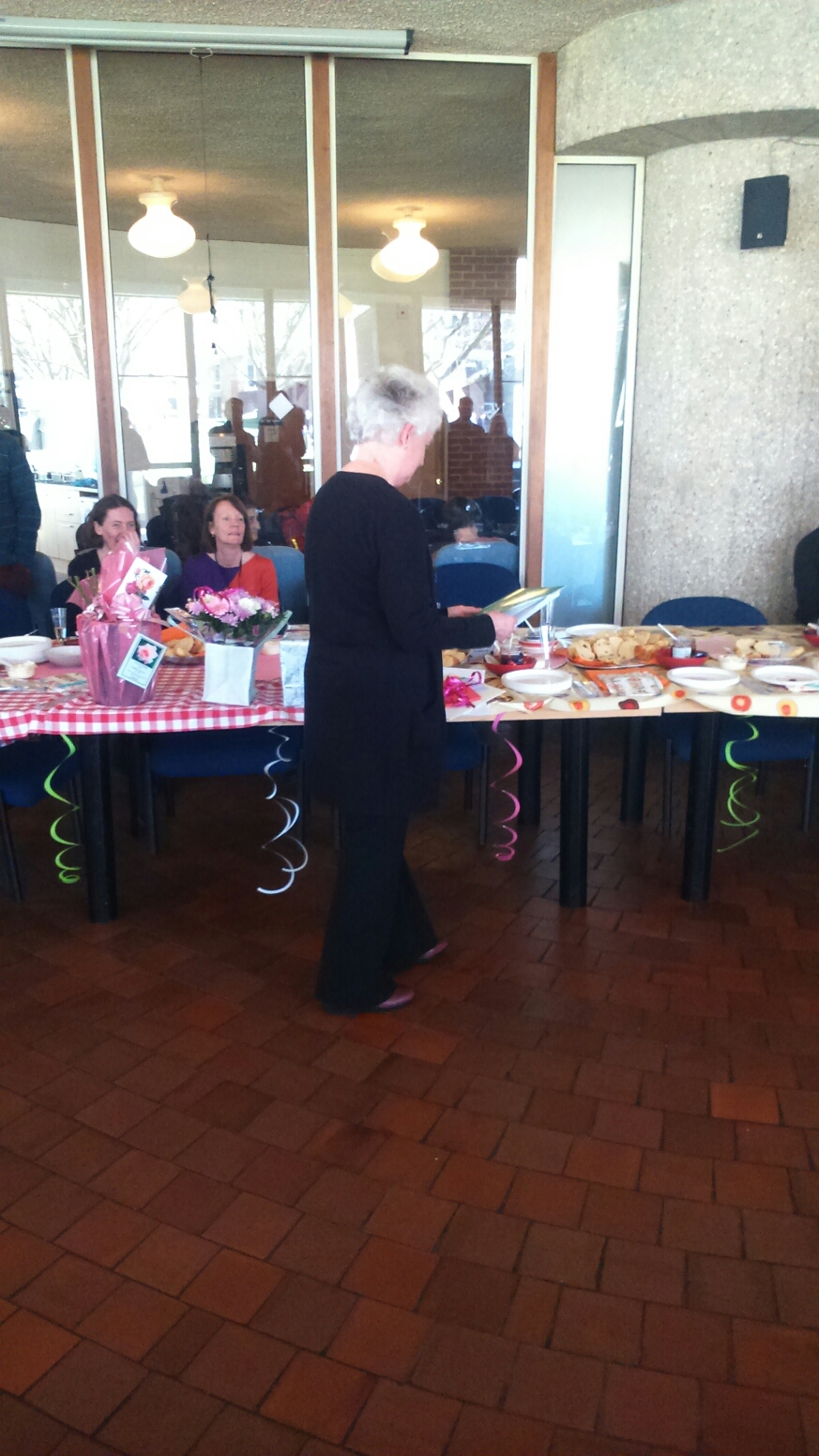
P.S. Shortly, at 2.30pm, there’s going to be a farewell gathering, with speeches and gifts, at which I hope to take a few pictures which I’ll post here later.

P.P.S. I only had time to take one picture, but here is Sally opening some of her gifts among the remains of the cakes and scones…

image

What has the European Convention on Human Rights ever done for us?

Posted in Politics with tags , , on April 27, 2016 by telescoper

In case there are some people who haven’t seen this yet, here is a short video featuring Sir Patrick Stewart the Guardian made in response to Home Secretary Theresa May’s suggestion that the United Kingdom should leave the European Convention on Human Rights. It owes more than a little to Monty Python’s Life of Brian but is none the worse for that. Make sure you watch right to the end as it exposes the hypocrisy of Home Secretary’s position on this.

What’s the point of ResearchGate?

Posted in Biographical, The Universe and Stuff with tags on April 26, 2016 by telescoper

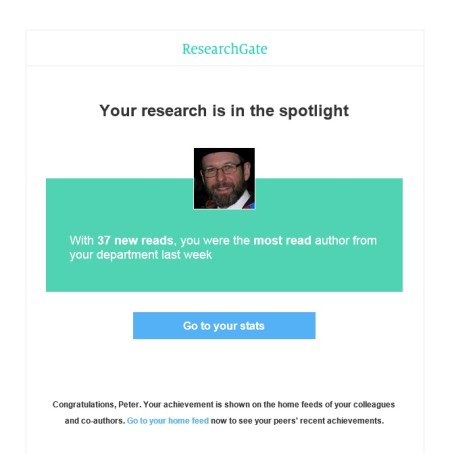
Some years ago, in a moment of weakness, I joined a website called ResearchGate. I’m not sure why, but it seemed a good idea at the time. I don’t visit the actual site very often, but it does send me large numbers of emails. Normally about things I’m not particularly interested in or asking me if I’m an author of a paper about biochemistry they’ve found somewhere on the net. Once a week I get one like this:

ResearchGate

I get a similar one every week without fail. It’s always flattering to be thought of as being in the spotlight, but the obvious inference to be made from the fact that I get such a message every week is that I am the only person in the Department silly enough to have joined ResearchGate.

Has anyone out there joined ResearchGate and found it worthwhile? Maybe there’s something worthwhile about it?

Do tell.

Nothing Compares

Posted in Biographical, Music with tags , , on April 25, 2016 by telescoper

For some reason I just remembered this morning that a song that is full of nostalgia for me was written by Prince, who died last week. The version I still have on vinyl was a huge hit for Sinead O’Connor in 1990:

Incidentally, I once saw Sinead O’Connor in person at the Zap Club in Brighton during my previous incarnation here as a research student and postdoc. I literally bumped into her trying to get to the bar to buy a drink. When she turned around I was staggered to see such a beautiful face looking at me, although to be honest I did for a moment assume she was a boy. It was, I should explain, a gay night at the club. Fortunately she was very nice and friendly and forgave my clumsiness with a gracious smile.

There aren’t many any other pop videos done like this, almost entirely in close-up. Can anyone think of any others?


In Praise of Natural Sciences

Posted in Biographical, Education with tags , , , , on April 24, 2016 by telescoper

The other day I was chatting with some students in the Department of Physics & Astronomy at the University of Sussex. One thing that came up was the fact that I’m basing the material for my Second Year Theoretical Physics module on the notes I took when I was a second-year undergraduate student at Cambridge over thirty years ago. I mentioned that to counter suggestions that are often made that the physics curriculum has been excessively “dumbed down” over the years. It may have been elsewhere, of course, but not on my watch. In fact, despite the misfortune of having me as a lecturer, many of the students in my class are picking up things far faster than I did when I was their age!

Anyway, that led to a general discussion of the changing nature of university education. One point was that in my day there weren’t any four-year “Integrated Masters” degrees, just plain three-year Bachelors. Teaching was therefore a bit more compressed than it is now, especially at Cambridge with its shorter teaching terms. We teach in two 12-week blocks here at Sussex. Week 11 of the Spring Term is about to start so we’re nearing the finishing line for this academic year and soon the examinations will be upon us.

The other thing that proved an interesting point of discussion was that the degree programme that I took was the Natural Sciences Tripos That meant that I did a very general first year comprising four different elements that could be chosen flexibly. I quickly settled on Physics, Chemistry and  Mathematics for Natural Sciences to reflect my A-level results but was struggling for the fourth. In the end I picked the one that seemed most like Physics, a course called Crystalline Materials. I didn’t like that at all, and wish I’d done some Biology instead – Biology of Cells and Biology of Organisms were both options – or even Geology, but I stuck with it for the first year.

Having to do such a wide range of subjects was very challenging. The timetable was densely packed and the pace was considerable. In the second year, however, I was able to focus on Mathematics and Physics and although it was still intense it was a bit more focussed. I ended up doing Theoretical Physics in my final year, including a theory project.

My best teacher at School, Dr Geoeff Swinden,  was a chemist (he had a doctorate in organic chemistry from Oxford University) and when I went to Cambridge I fully expected to specialise in Chemistry rather tha Physics. I loved the curly arrows and all that. But two things changed. One was that I found the Physics content of the first year far more interesting – and the lecturers and tutors far more inspiring – than Chemistry, and the other was that my considerable ineptitude at practical work made me doubt that I had a future in a chemistry laboratory. And so it came to pass that I switched allegiance to Physics, a decision I am very glad I made. It was only towards the end of my degree that I started to take Astrophysics seriously as a possible specialism, but that’s another story.

As we are now approaching examination season I’ve been dealing with some matters in my role as External Examiner for Natural Sciences (Physics) at Cambridge, a position I have held since last year. It’s certaintly extremely interesting to see things from the other side of the fence, thirty years on since my finals. In particular I was struck last year by how many senior physicists there are at Cambridge who actually came as undergraduates expecting, like I did, to do Chemistry but also then switched. No doubt some moved in the opposite direction too, but the point is that the system not only allowed this but positively encouraged it.

Looking back, I think  there were great educational advantages in delaying  the choice of speciality the way a Natural Sciences degree did. New students usually have very little idea how different the subject is at university compared to A-level, so it seems unfair to lock them into a programme from Year 1. Moreover – and this struck me particularly talking to current students last week – a Natural Sciences programme might well prove a way of addressing the gender imbalance in physics by allowing female students (who might have been put off Physics at school) to gravitate towards it. Only 20% of the students who take Physics A-level are female, and that’s roughly the same mix that we find in the undergraduate population. How many more might opt for Physics after taking a general first year?

Another advantage of this kind of degree is that it gives scientists a good grounding in  a range of subjects. In the long run this could encourage greater levels of interdisciplinary thinking. This is important, since some of the most exciting areas of physics research lie at the interfaces with, e.g. chemistry and biology. Unfortunately, adminstrative structures often create barriers that deter such cross-disciplinary activities.




Sonnet No. 121

Posted in Literature with tags , on April 23, 2016 by telescoper

Oh, go on then. Here’s another post for the 400th anniversary of the death of William Shakespeare. I’ve posted quite a few of Shakespeare’s sonnets over the years, and my book of them goes with me whenever I travel, so it seems appropriate to post another as a personal way of marking the quatercentenary. This is Sonnet 121, another in the “fair youth” sequence, although to some extent it stands apart from the verses preceding and following it.  It was apparently written about the time a mysterious scandal was circulating about the poet and it’s presumably a specific reaction to that. The message is basically that having a bad reputation  is even worse than actually being bad. The poet does not claim to be blameless, be argues that he is being insulted by those whose sins are far worse than his and who therefore have no right to criticise him. So he decides to reject hypocrisy and be himself no matter what people say. It’s a poem that will resonate for anyone who has been falsely, perhaps maliciously, accused of something they did not do.

‘Tis better to be vile, than vile esteemed,
When not to be, receives reproach of being,
And the just pleasure lost which is so deemed
Not by our feeling, but by others’ seeing:
For why should others’ false adulterate eyes
Give salutation to my sportive blood?
Or on my frailties why are frailer spies,
Which in their wills count bad what I think good?
No; — I am that I am, and they that level
At my abuses reckon up their own:
I may be straight, though they themselves be bevel;
By their rank thoughts my deeds must not be shown;
Unless this general evil they maintain,
All men are bad, and in their badness reign.


Next! – The Complete Animated Shakespeare

Posted in Literature, Television with tags , , , on April 23, 2016 by telescoper

I’m sure most readers are aware that today is the 23rd April 2016, which is the 400th anniversary of the death of William Shakespeare. Despite the fact that most modern scholars agree that many of Shakespeare’s plays were not actually written by Shakespeare, but by someone else who had the same name, it’s still a good excuse to celebrate the life and work of a towering figure in the world of literature and drama. I was trying to think I suddenly remembered this marvellous animated film I saw when it was first released over 20 years ago. I couldn’t remember the name so it took me a bit of time to find it, but I got there in the end. It’s by Aardman Animations (best known for the later Wallace and Gromit films) and it was part of a splendid series of animated shorts called Lip-synch commissioned by Channel 4 and broadcast in 1990. It’s hard to imagine Channel 4 doing anything this good nowadays.  This film, called Next,  is only 5 minutes long yet it manages to refer to every single one of Shakespeare’s plays by having the immortal bard himself do them all as an audition. It’s not only clever and visually appealing but also a lot of fun…


The UK Financial Contribution to the EU

Posted in Finance, Politics with tags , , on April 22, 2016 by telescoper

There’s so much misunderstanding and distortion flying around about the United Kingdom’s contribution to the European Budget and what it might be spent on if we left the EU that I just thought I would post this for information. It shows official figures from HMRC for 2014. Similar pie charts are available for other years, but often they include the EU contribution under “other” which is why I’ve chosen this particular one. Also, I’m very lazy and it came up first on Google…

fat cut

Although it’s a lot of money in cash terms, it’s very small compared to current expenditure on, e.g. Health, Education and Welfare and even compared to the interest payments on our national debt. Saving this contribution would not make sufficient financial resources  available to make a significant difference to these other big ticket  items. Note also that if the UK loses its current credit rating, the expense of servicing our debt will increase by an amount that could easily on its own wipe out the saving on our EU subscription.

And of course what we get for that relatively small contribution is access to beneficial trade agreements, inward investment from EU companies and other sources, and access to the science programmes. You may disagree, of course, but I think it’s money very well spent.


Buddy DeFranco Plays Rhythm Changes

Posted in Jazz with tags , , , on April 21, 2016 by telescoper

The late great Buddy DeFranco was the musician who finally convinced me that I’d never be any good at playing the clarinet, though I still make the occasional half-hearted attempt. He nevertheless remains a musical hero of mine, not least because he was one of the few people to play clarinet in a “modern” style. I found this transcription of one of his solos on Youtube a while ago and thought I’d share it here. Twelve choruses of rhythm changes at a brisk tempo provide the foundation for a great jazz musician who unleashes a flood of improvisation. Feel free to play along at home!