Author Archive

Thelonious Monk – Misterioso

Posted in Jazz with tags , , , , on September 26, 2015 by telescoper

A couple of days ago I posted a piece of music by Eric Dolphy that was inspired by Thelonious Monk , so today I thought I’d post something by Monk himself together with my own appreciation of his music.

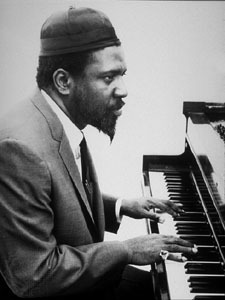
Thelonious Monk was a remarkable musician. His self-taught style of piano-playing was unlike that of anyone who came before or after him, including those followers who tried to copy him. He broke many rules, especially in the way he used his fingers – keeping them straight as he played to get a uniquely percussive sound from the instrument, well matched, on the track I’ve posted below, to the vibraphone of Milt Jackson.

Monk was often called “The High Priest of Bop” and regarded as one of the leaders of the post-war bebop revolution in Jazz alongside Charlie Parker and Dizzy Gillespie. Actually, I don’t think Monk ever really played bebop at all. I’ve always thought the archetypal bop pianist was Bud Powell whose style was totally different to Monk’s. But the “High Priest” tag owed at least something to his eccentric personality: he hardly ever spoke and, aside from his music, he seemed to communicate with the outside world largely through his choice of hat.

Monk’s piano style is hard to describe – his wife Nellie once described it as “Melodious Thunk” – but I’ve always loved his music. To me his solos sound like someone talking directly at you in a strange and wonderful language that you don’t quite understand but which sounds beautiful anyway. His use of syncopation is quite different from the usual bebop musicians and it seems, to me anyway, to echo the rhythms of everyday speech. But, above all, when you hear Monk play the piano, you know immediately who it is. He had many admirers, but nobody could play like him. He was a genius.

In later life his behaviour became disturbingly erratic; he would sometimes stand up in the middle of a performance and go wandering around the stage.  In my opinion his music also deteriorated from the early sixties onwards.  I think it was generally assumed that he had a drugs problem, which he may well have had, but it was eventually realised that he was suffering from a serious mental illness. Although attempts were made to treat this, he stopped playing in the 1970s and lived out the rest of his life as a virtual recluse.

I remember very well the day he died, in February 1982. It was during the Newcastle Jazz Festival, on the day when the great British jazz pianist Stan Tracey was due to give a concert there. As we took our seats in the Newcastle Playhouse for the gig, an announcement was made that Thelonious Monk had died. Stan Tracey, for whom Monk had been a major musical inspiration, responded to the occasion by playing two sets exclusively consisting of tunes by his hero. It was one of the best concerts I’ve ever been to and remains strong in my memory to this day.

I think Monk’s best records are from the 40s and 50s, and he was certainly in his prime in 1948 when he recorded this classic performance, for the Blue Note label, of his own composition, Misterioso.

A Life – R.S. Thomas

Posted in Poetry with tags , on September 25, 2015 by telescoper

A Life

Lived long; much fear, less
courage. Bottom in love’s school
of his class; time’s reasons
too far back to be known.
Good on his knees, yielding,
vertical, to petty temptations.
A mouth thoughts escaped
from unfledged. Where two
were company, he the unwanted
third. A Narcissus tortured
by the whisperers behind
the mirror. Visionary only
in his perception of an horizon
beyond the horizon. Doubtful
of God, too pusillanimous
to deny him. Saving his face
in verse from the humiliations prose
inflicted on him. One of life’s
conscientious objectors, conceding
nothing to the propaganda of death
but a compulsion to volunteer.

An obituary of his own hand.

posted on the 15th anniversary of the death of R.S. Thomas (1913-2000).


Flexible Degrees through Sussex Choice

Posted in Education with tags , , , , , , on September 24, 2015 by telescoper

I just noticed an item in the Times Higher about a new development in the approach to degree structures at the University of Leicester. The piece begins

A growing number of students undertake several work placements and internships over the course of their degree to increase their chances of securing a graduate-level job. But an initiative at the University of Leicester aims to make it easier for undergraduates to learn the range of skills that employers are looking for during their studies.

I feel obliged to point out that, in fact, here at the University of Sussex we already have a scheme (called “Sussex Choice”) that already allows this, as well as a number of other initiatives under the same banner. The University of Leicester’s “initiative” is of course a good development, but it’s not as ground-breaking as the Times Higher story suggests.

Sussex choice allows students the following opportunities:

  • “Electives” in topics not connected with the main subject of their course, e.g. science modules for Arts and Humanities students. I teach on one of these, actually.
  • “Pathways” allowing students to transform their degree into a major/minor combination. This is basically what the University of Leicester is proposing to start.
  • “Placements”, i.e. paid internships, which can be either professional (e.g. in industry) or research-based (e.g. working with a research group inside our outside the University). These can be either integrated within the course of study, leading to (for example) a  degree title which includes (“with a Professional Placement” or “with a Research Placement”) or “voluntary”, usually in subject not directly related to the degree subject.
  • “Study Abroad” opportunities, allowing students to take a term or a year abroad at one of our partner universities.

With very few exceptions – generally due to restrictions imposed by accrediting bodies for some degree programmes – It is possible, for example,  in the Department of Physics & Astronomy, for students to do a Research Placement abroad, combining the latter two of these opportunities; two of our students went to Tsinghua University in China to do precisely this, as part of an exchange agreement. You can read about the students’ experiences of these and other opportunities at Berkeley and  Texas in the United States and Uppsala University (Sweden) here.

Here is the PVC Clare Mackie (my boss!)  explaining the Sussex Choice scheme in a little video…

Can UK Science Survive Outside the EU?

Posted in Politics, Science Politics with tags , , on September 23, 2015 by telescoper

Please watch the following video made by the organization Scientists for EU. You could also read the document referred to in the video (“International Comparative Performance of the UK Research Base – 2013”) which can be found here.

Hat and Beard

Posted in Jazz with tags , , , , on September 22, 2015 by telescoper

I haven’t posted much Jazz recently, and was reminded of this fact when I listened to the following track on my iPod yesterday while travelling back from Cardiff to Brighton.  Hat and Beard is an original composition by one of my favourite jazz artists, saxophonist Eric Dolphy and was written in honour of another of my favourite jazz artists, Thelonious Monk, who not only sported a splendid beard but also had a famously eccentric taste in headgear…

hat and beard

Anyway, Hat and Beard is taken from the pioneering free jazz album Out to Lunch. This album is without doubt one of the high points of 1960s avant-garde jazz, primarily because of Dolphy’s extraordinary playing (in this case on bass clarinet) but also because of the brilliance of the other musicians: Freddie Hubbard on trumpet; Bobby Hutcherson on vibes; Richard Davis on bass; and the superb Tony Williams on drums (who was only 18 when this track was recorded).

Amplitude & Energy in Electromagnetic Waves

Posted in Cute Problems, The Universe and Stuff with tags , , , on September 22, 2015 by telescoper

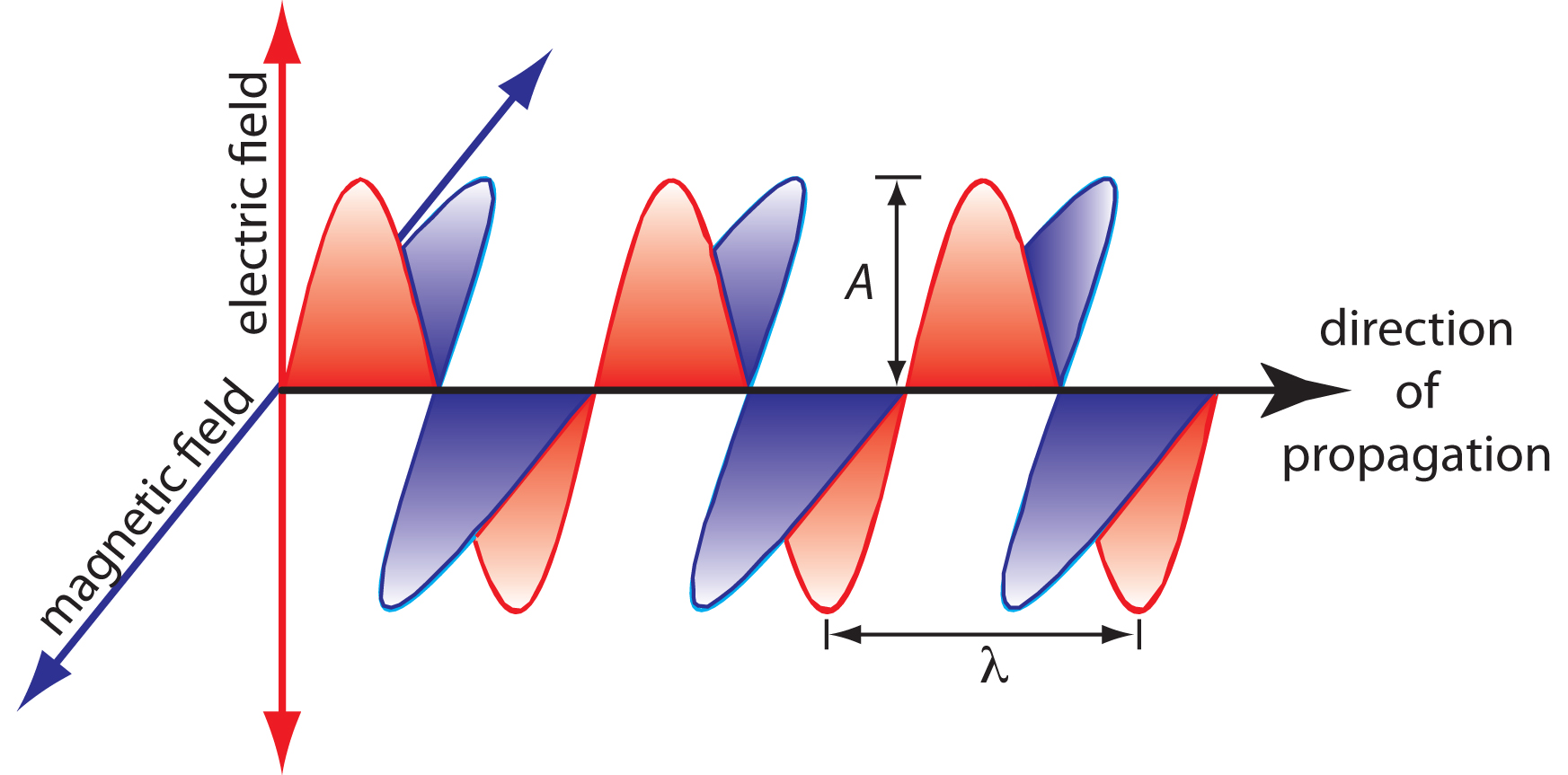
Here’s a little physics riddle. As you all know, electromagnetic radiation consists of oscillating electric and magnetic fields rather like this:

Figure10.1(Graphic stolen from here.) The polarization state of the wave is defined by the direction of the Electric field, in this case vertically upwards.

Now the energy carried by an electromagnetic wave of a given wavelength is proportional to the square of its amplitude, denoted in the Figure by A, so the energy is of the form kA2 in this case with k constant. Two separate electromagnetic waves with the same amplitude and wavelength would thus carry an energy = 2kA2.

But now consider what happens if you superpose two waves in phase, each having the same wavelength, polarization and amplitude to generate a single wave with amplitude 2A. The energy carried now is k(2A)2 = 4kA2, which is twice the value obtained for two separate waves.

Where does the extra energy come from?

Answers through the Comments Box please!

PigGate Latest

Posted in Politics with tags , , on September 21, 2015 by telescoper

Unless someone has been telling porkies, it seems our Prime Minister committed a sexual act with dead pig.

I have been looking for updates on the BBC website but there’s not a sausage. There is however plenty of coverage on Sty News.

Although David Cameron apparently didn’t go the whole hog, I wonder if he has ever committed a rasher act? I think he might even be for the chop. Can anything save his bacon now? He needs to draw a loin under this very quickly.

Anyway, it’s a crackling story. On the other hand the whole thing might just be a poke in a pig pig in a poke..

Meanwhile, Conservative Party Central Office has issued new guidelines to all Tory MPs..

image

Only in English

Posted in Uncategorized on September 20, 2015 by telescoper

Taking a break from work this weekend today I’ve been reading the latest edition of The Oldie magazine, and doing the crossword therein.

I noticed a reader’s letter about the importance of correct positioning of the word “only” in an English sentence, illustrated with the following example:

“The bishop gave the bun to the baboon”.

The point is that you can put the word “only” anywhere in this sentence (at the beginning, at the end, or between any two consecutive words) and the result each time is grammatically correct, but each choice yields a different meaning..

It’s a funny language, English!

A Botanic Garden of Planets

Posted in Poetry, The Universe and Stuff on September 19, 2015 by telescoper

I’ve been reading, with rapidly growing delight and astonishment, an amazing poem called The Botanic Garden , which was written by Erasmus Darwin in 1789. It is a truly wonderful work which depicts the Universe as a vast laboratory set up by a Divine Creator through verses that generate a thrilling sense of  momentum and vitality. Take this example, a passage from the First Canto, dealing with the creation of the stars and planets:

‘Let there be Light!’, proclaimed the Almighty Lord,
Astonish’d Chaos heard the potent word: – 
Through all his realms the kindly Ether runs,
And the mass starts into a million suns; 
Earths round each sun with quick explosions burst,
And second planets issue from the first; 
Bend, as they journey with projectile force, 
In bright ellipses bend their reluctant course; 
Orbs wheel in orbs, round centres centres roll, 
And form, self-balanced, one revolving Whole.

It doesn’t quite fit with modern theories of star and planet formation, but it’s certainly beautifully expressed!

How to Solve Physics Problems

Posted in Cute Problems, Education with tags , , , , , , on September 18, 2015 by telescoper

It’s Friday afternoon at the end of Induction Week here at the University of Sussex. By way of preparation for lectures proper – which start next Monday – I gave a lecture today to all the new students in Physics during which I gave some tips about how to tackle physics problems, not only in terms of how to solve them but also how to present the answer in an appropriate way.
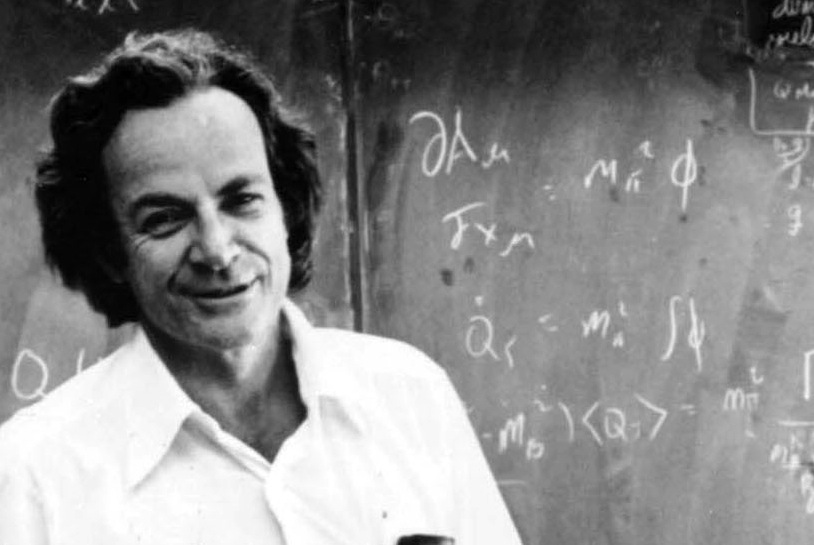
Richard-Feynman-cornellI began with Richard Feynman’s formula (the geezer in the above picture) for solving physics problems:

  1. Write down the problem.
  2. Think very hard.
  3. Write down the answer.

That may seem either arrogant or facetious, or just a bit of a joke, but that’s really just the middle bit. Feynman’s advice on points 1 and 3 is absolutely spot on and worth repeating many times to an audience of physics students.

I’m a throwback to an older style of school education when the approach to solving unseen mathematical or scientific problems was emphasized much more than it is now. Nowadays much more detailed instructions are given in School examinations than in my day, often to the extent that students  are only required to fill in blanks in a solution that has already been mapped out.

I find that many, particularly first-year, students struggle when confronted with a problem with nothing but a blank sheet of paper to write the solution on. The biggest problem we face in physics education, in my view, is not the lack of mathematical skill or background scientific knowledge needed to perform calculations, but a lack of experience of how to set the problem up in the first place and a consequent uncertainty about, or even fear of, how to start. I call this “blank paper syndrome”.

In this context, Feynman’s advice is the key to the first step of solving a problem. When I give tips to students I usually make the first step a bit more general, however. It’s important to read the question too. The key point is to write down the information given in the question and then try to think how it might be connected to the answer. To start with, define appropriate symbols and draw relevant diagrams. Also write down what you’re expected to prove or calculate and what physics might relate that to the information given.

The middle step is more difficult and often relies on flair or the ability to engage in lateral thinking, which some people do more easily than others, but that does not mean it can’t be nurtured.  The key part is to look at what you wrote down in the first step, and then apply your little grey cells to teasing out – with the aid of your physics knowledge – things that can lead you to the answer, perhaps via some intermediate quantities not given directly in the question. This is the part where some students get stuck and what one often finds is an impenetrable jumble of mathematical symbols  swirling around randomly on the page. The process of problem solving is not always linear. Sometimes it helps to work back a little from the answer you are expected to prove before you can return to the beginning and find a way forward.

Everyone gets stuck sometimes, but you can do yourself a big favour by at least putting some words in amongst the algebra to explain what it is you were attempting to do. That way, even if you get it wrong, you can be given some credit for having an idea of what direction you were thinking of travelling.

The last of Feynman’s steps  is also important. I lost count of the coursework attempts I marked this week in which the student got almost to the end, but didn’t finish with a clear statement of the answer to the question posed and just left a formula dangling.  Perhaps it’s because the students might have forgotten what they started out trying to do, but it seems very curious to me to get so far into a solution without making absolutely sure you score the points.  IHaving done all the hard work, you should learn to savour the finale in which you write “Therefore the answer is…” or “This proves the required result”. Scripts that don’t do this are like detective stories missing the last few pages in which the name of the murderer is finally revealed.

So, putting all these together, here are the three tips I gave to my undergraduate students this morning.

  1. Read the question! Some students give solutions to problems other than that which is posed. Make sure you read the question carefully. A good habit to get into is first to translate everything given in the question into mathematical form and define any variables you need right at the outset. Also drawing a diagram helps a lot in visualizing the situation, especially helping to elucidate any relevant symmetries.
  2. Remember to explain your reasoning when doing a mathematical solution. Sometimes it is very difficult to understand what students are trying to do from the maths alone, which makes it difficult to give partial credit if they are trying to the right thing but just make, e.g., a sign error.
  3.  Finish your solution appropriately by stating the answer clearly (and, where relevant, in correct units). Do not let your solution fizzle out – make sure the marker knows you have reached the end and that you have done what was requested. In other words, finish with a flourish!

There are other tips I might add – such as checking answers by doing the numerical parts at least twice on your calculator and thinking about whether the order-of-magnitude of the answer is physically reasonable – but these are minor compared to the overall strategy.

And another thing is not to be discouraged if you find physics problems difficult. Never give up without a fight. It’s only by trying difficult things that you can improve your ability by learning from your mistakes. It’s not the job of a physics lecturer to make physics seem easy but to encourage you to believe that you can do things that are difficult.

To illustrate the advice I’ve given I used this problem, which I leave as an exercise to the reader. It is a slightly amended version the first physics problem I was set as tutorial work when I began my undergraduate studies way back in 1982. I think it illustrates very well the points I have made above, and it doesn’t require any complicated mathematics – not even calculus! See how you get on…

problem