To what purpose, April, do you return again? Beauty is not enough. You can no longer quiet me with the redness Of little leaves opening stickily. I know what I know. The sun is hot on my neck as I observe The spikes of the crocus. The smell of the earth is good. It is apparent that there is no death. But what does that signify? Not only under ground are the brains of men Eaten by maggots. Life in itself Is nothing, An empty cup, a flight of uncarpeted stairs. It is not enough that yearly, down this hill, April Comes like an idiot, babbling and strewing flowers.
I’m a bit late onto this story which has already been quite active in the media today, and has generated an associated flurry of activity on social media, but I thought it was still worth passing it on via the medium of this blog. The Dark Energy Survey has just released a number of papers onto the arXiv, the most interesting of which (to me) is entitled Wide-Field Lensing Mass Maps from DES Science Verification Data. The abstract reads as follows (the link was added by me):
Weak gravitational lensing allows one to reconstruct the spatial distribution of the projected mass density across the sky. These “mass maps” provide a powerful tool for studying cosmology as they probe both luminous and dark matter. In this paper, we present a weak lensing mass map reconstructed from shear measurements in a 139 deg^2 area from the Dark Energy Survey (DES) Science Verification (SV) data overlapping with the South Pole Telescope survey. We compare the distribution of mass with that of the foreground distribution of galaxies and clusters. The overdensities in the reconstructed map correlate well with the distribution of optically detected clusters. Cross-correlating the mass map with the foreground galaxies from the same DES SV data gives results consistent with mock catalogs that include the primary sources of statistical uncertainties in the galaxy, lensing, and photo-z catalogs. The statistical significance of the cross-correlation is at the 6.8 sigma level with 20 arcminute smoothing. A major goal of this study is to investigate systematic effects arising from a variety of sources, including PSF and photo-z uncertainties. We make maps derived from twenty variables that may characterize systematics and find the principal components. We find that the contribution of systematics to the lensing mass maps is generally within measurement uncertainties. We test and validate our results with mock catalogs from N-body simulations. In this work, we analyze less than 3% of the final area that will be mapped by the DES; the tools and analysis techniques developed in this paper can be applied to forthcoming larger datasets from the survey.
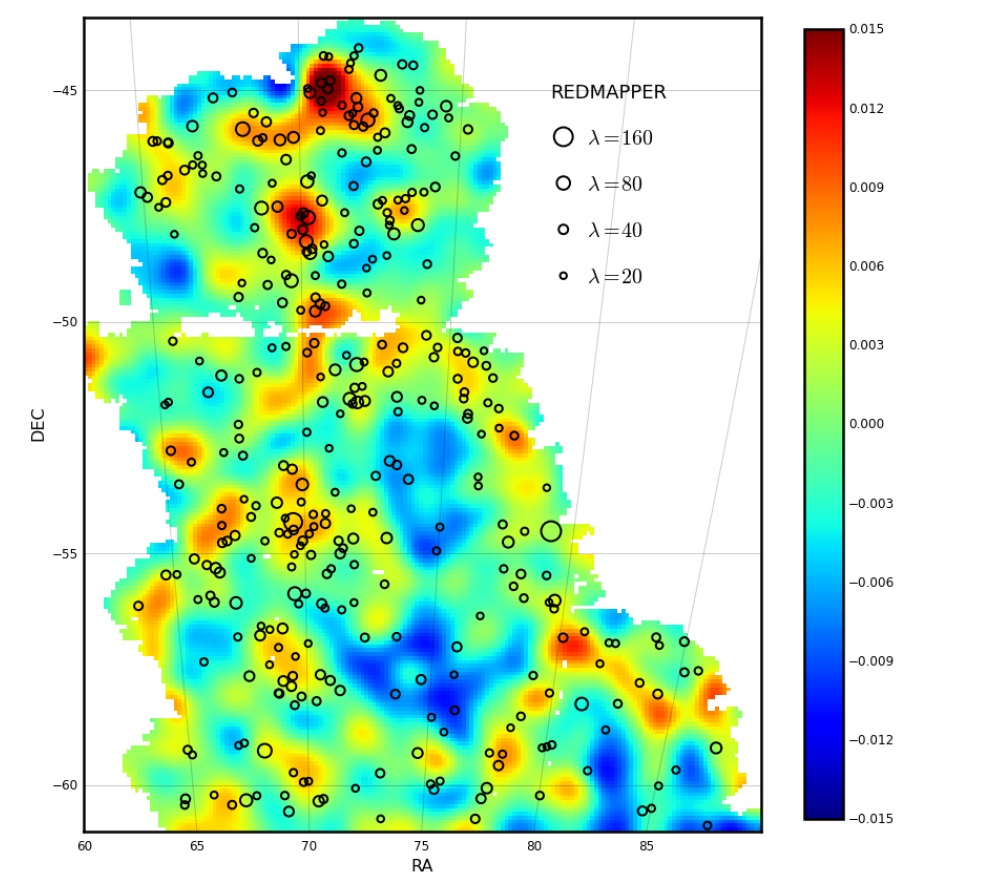
This is by no means a final result from the Dark Energy Survey, as it was basically put together in order to test the telescope, but it is interesting from the point of view that it represents a kind of proof of concept. Here is one of the key figures from the paper which shows a reconstruction of the mass distribution of the Universe (dominated by dark matter) obtained indirectly by the Dark Energy Survey using distortions of galaxy images produced by gravitational lensing by foreground objects, onto which the positions of large galaxy clusters seen in direct observations have been plotted. Although this is just a small part of the planned DES study (it covers only 0.4% of the sky) it does seem to indicate that the strong concentrations of dark matter (red) do corrrelate with the positions of concentrations of galaxy clusters.
It all seems to work, so hopefully we can look forward to lots of interesting science results in future!
P.S. When I first saw the map it looked like a map of the North of England Midlands and I was surprised to see that the survey showed such strong support for the Greens…
I haven’t posted much about the forthcoming General Election but I couldn’t resist making a short comment about the situation here in Brighton & Hov, which is actually quite interesting. The three constituencies in the city are all marginal: Hove, Brighton Pavilion, and Brighton Kemptown. All of these were Conservative strongholds until 1997, when they all fell to the Labour party which held them until the last General Election 2010. Hove and Brighton fell to the Conservatives in 2010 while Brighton Pavilion was taken by the UK’s only Green MP, Caroline Lucas. Much of the media attention in Brighton is focussing on the latter seat, where (surprisingly to my mind), Caroline Lucas seems set to retain her place in the House of Commons having apparently succeeded in her campaign of distancing herself from the local Green Party’s abject performance in running Brighton and Hove City Council.
I am currently living in Brighton Kemptown, a two-way marginal in which the Labour candidate (Nancy Platts) is fighting the incumbent Conservative (Simon Kirby). The seat encompasses the eastern part of Brighton and the semi-rural suburbs and villages stretching out to the east of the seat. At its western end it includes Queen`s Park ward, the centre of Brighton`s vibrant gay community, then Kemptown, the council estates of Whitehawk and Moulscoomb and then, beyond the racecourse, more affluent and genteel coastal villages like Woodingdean, Saltdean and the town of Peacehaven. At the north of the seat is Brighton University`s Falmer campus – despite Moulscoomb itself being in the constituency, Moulscoomb campus lies just over the boundary marked by the A27 in Brighton Pavilion. The University of Sussex, where I work, also has a campus at Falmer, but it is also in Brighton Pavilion.
Here is a map showing the constituency boundaries:
I often get the No. 23 bus home from work in the evenings. The route of this bus takes it down the A27 to Elm Grove, where it turns left up the hill into Elm Grove which runs uphill into Hanover, which is (more-or-less) that segment at the Western boundary of Brighton Kemptown that has been eaten into by Brighton Pavilion. The bus then turns right and travels south taking it into Queen’s Park and then left again to take it along towards the Marina (the bit that sticks out into the sea).
I know it’s not a very scientific guide to the likely election result, but it is noticeable that the posters showing in the windows in the houses of the Hanover salient of Brighton Pavilion are almost exclusively for Caroline Lucas while those along the rest of journey in Kemptown are almost exclusively for Nancy Platts. It’s a remarkably sudden transition that coincides with the constituency boundary in fact. I’m not sure how much it is reasonable to infer from this observation, but I’d say based on other evidence that Caroline Lucas will probably hold Brighton Pavilion and Nancy Platts will be the next Member of Parliament for Brighton Kemptown.
Just a quick post about this year’s forthcoming Royal Astronomical SocietyNational Astronomy Meeting, which will be taking place at the splendid Venue Cymru conference centre, Llandudno, North Wales, from Sunday 5th July to Thursday 9th July 2015. I’m on the Scientific Organizing Committee for NAM 2015 and as such I’ll be organizing a part of this meeting, namely a couple of sessions on Cosmology under the title Cosmology Beyond the Standard Model, with the following description.
Recent observations, particularly those from the Planck satellite, have provided strong empirical foundations for a standard cosmological model that is based on Einstein’s general theory of relativity and which describes a universe which is homogeneous and isotropic on large scales and which is dominated by dark energy and matter components. This session will explore theoretical and observational challenges to this standard picture, including modified gravity theories, models with large-scale inhomogeneity and/or anisotropy, and alternative forms of matter-energy. The aim will be to both take stock of the evidence for, and stimulate further investigation of, physics beyond the standard model.
The deadline for submitting abstracts for this and other sessions was originally 1st April, but this has been extended until 14th April (i.e. tomorrow). The cosmology sessions are shaping up to be very interesting indeed, but I might be able to squeeze in one or two more talks. If you’ve been prevaricating about submitting a proposal, then please get your finger out and visit the NAM2015 website right now. This is your last chance!
NAM is a particularly good opportunity for younger researchers – PhD students and postdocs – to present their work to a big audience so I particularly encourage such persons to submit abstracts. Would more senior readers please pass this message on to anyone they think might want to give a talk?
If you have any questions please feel free to use the comments box (or contact me privately).
Interesting proposal from Keith Flett for a new module for university students on uncovered pitches in cricket. My own view is that the syllabus on this fascinating subject should also discuss the physics behind the variable bounce and turn such pitches produced.
In its issue of 21st January 2015 the Times Higher reported that the University of the Highlands and Islands is to offer a degree in professional golf.
I responded that it was surely time to offer a degree in cricket too (28th January 2015).
Subjects covered could well include the Laws of Cricket, the history of the game (a very substantial subject in itself) Gentleman v Players and class in cricket, Race and Imperialism in cricket. There is also scope for modules on cricket management and coaching and like many degrees no doubt students would select those areas of most relevance to their interests and future careers.
One area that must certainly should be covered however is that of Uncovered Pitches. To mark the start of the English cricket season and indeed the start at nearly the same time of a West Indies…
On Friday being the second Friday of the month of April I went up to London for the regular Open Meeting of the Royal Astronomical Society and afterwards to dinner with the RAS Club. Unusually for club dinners, we were provided with champagne before the toasts but it was a while before I realized why. A distinguished member and indeed former President of the club, Prof. Donald Lynden-Bell, had recently celebrated his eightieth birthday and we were all invited to drink his health.
Donald is an amazing character, not least because he hasn’t changed a bit since I first met him over thirty years ago when he was lecturer for one of the courses I took in the first year. His research has spanned an enormous breadth of subjects, from theoretical topics in classical and quantum physics to astrophysics and cosmology, including data analysis. Anyway, it was great that he was there to receive the toast in person. I’ll take the opportunity here to say a more public Happy Birthday!
On the way home I posted on Facebook that Donald had just celebrated his eightieth birthday. One of my astronomer friends, Manuela Magliocchetti, posted a charming comment about him that I’m sharing here (below) publicly in a slightly edited form, with her permission. By the way, in the interest of full disclosure, I should point out that I subsequently had the honour to be the External Examiner for Manuela’s PhD…
–o–
I just learnt that today from Peter there were celebrations at the RAS Dining Club for the 80th birthday of Professor Donald Lynden-Bell. Since I basically owe my scientific carrier to him, I thought I’d thank him publicly now.
It was summer 1995 and I had pestered my undergraduate supervisor to send me to Cambridge to attend the conference on Gravitational Dynamics that had been organized for the 60th birthday of Donald (gee, already 20 years ago!), since all my undergrad thesis was on some evidence of a phenomenon (gravothermal catastrophe) that he first theorized in a breakthrough paper published in 1968 that by then I knew by heart. So he definitely was my scientific hero.
At the end of the conference I knocked at his office door to ask him whether it was possible for me to apply for a PhD position at Cambridge. He let me in, but did not even allow me to start talking. Instead he started asking me about the thesis work I had done, since in Italy everyone in Physics has to produce some original work in order to be awarded the undegraduate degree. He had me writing on his blackboard for about an hour (which felt like centuries to me) about all my results, asking genuinely interested questions, discussing, and in some bits criticizing my work. He was very pushy (as I learned later, this was his style) and was talking oh-so-very fast.
I was soo unsettled and scared and not even sure I was understanding all his points correctly: my English was so basic… After all this torture, he suddently stopped and, with his slightly squeaky voice, went:” So, why are you here?” I very humbly answered that it was to have information on how to apply to Cambridge for a PhD position. He then looked at me, then at the blackboard, then at me again and told me what I wrote on the blackboard indeed was PhD work. I answered that no, it was just undergraduate work. At that point he jumped off his chair, grabbed my arm and dragged me to the secretary of the Isaac Newton Scholarship, introducing me to her and telling her that I would be applying for both a PhD position at the Institute of Astronomy at University of Cambridge and for the scholarship. So I did apply, and in the end got both and found myself thrown in that fantastically stimulating environment which is Cambridge and the IoA.
Thank you so much Donald! Forever grateful. Without you all this and what happened next, including my present job and career and even my kids, since I met their (astronomer) dad over there, would not have been possible!
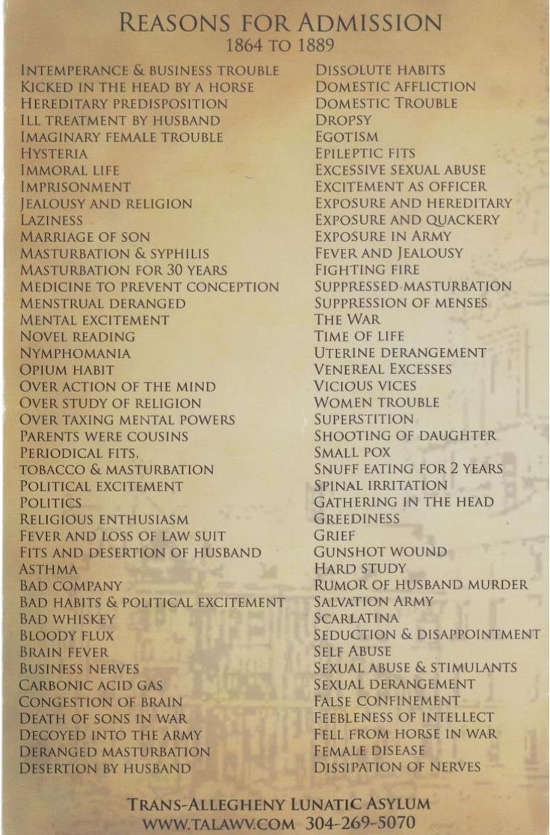
I came across this on Twitter yesterday as I travelled back to Brighton from the RAS Club. It’s an official record of the reasons stated for patients being admitted to the Trans-Allegheny Lunatic Asylum located in Weston, West Virginia in the USA. Formerly known as the Weston State Hospital, this facility was constructed between 1858 and 1881. The first phase of the original hospital, designed to house 250 people, was opened to patients in 1864 but its population expanded to a peak in the 1950s with about 2400 patients in overcrowded and generally poor conditions. It was closed as a hospital in 1994 but remains open as a kind of museum. Like most such institutions it was founded with good intentions and was designed with long rambling wings arranged in a staggered formation, assuring that the patients received an abundance of sunlight and fresh air. Just as was the case with similar institutions in the United Kingdom, however, the lack of effective treatment for the mentally ill led to it becoming more a place of incarceration than therapy and no doubt many troublesome individuals were committed there simply to keep them out of the way.
Anyway, here is the list:
When I first saw this I didn’t know whether to laugh or cry. The mind boggles, for example, at a diagnosis of “masturbation and tobacco”, or was that the treatment? Among the baffling entries, however, you can see a clear thread of misogyny and considerable evidence of the traumatising effect of the American Civil War, not only on combatants but also on grief-stricken relatives of the fallen. It was on April 9th 1865, almost exactly 150 years ago, that Robert E. Lee surrendered the 28,000 troops of the Confederate Army to Ulysses S. Grant, thereby ending the American Civil War so it is not surprising so many entries refer to “The War”.
Psychiatric hospitals are no longer called “lunatic asylums”, and the approach to the mentally ill is no longer simply to lock them away out of sight, but despite the progress that has been made they remain far from happy places even if you’re only there voluntarily and for a short time. You can take my word for that.
Just a short post to pay my respects to a great cricketing legend, Richie Benaud, who has died at the age of 84. It’s no surprise that the media are filled with tributes because he was admired by players and spectators alike. He retired as a player way back in 1964, so many would know him as a commentator, but he was a fine cricketer in his time. A shrewd tactician, he captained Australia with great distinction but was also an excellent leg-spinner, who took 248 wickets in Test matches, and a capable batsman. In fact he was the first cricketer in history to reach 2000 runs and 200 wickets at Test level, in an era when far fewer Test matches were played.
When he retired from the game as a player he turned to a career in broadcasting and soon established himself as a peerless comentator on the game. The deep knowledge of the game he acquired in his playing years helped of course, but he also had a natural feeling for when to comment and when to just let it happen. Too many commentators feel the urge to babble on during slower passages of play, but Richie Benaud understood the varying tempo of the game too much to spoil the experience with tittle-tattle. He was unfailingly courteous, generous and respectful, but never afraid to be critical when that was justified. His succinct and perceptive expert analyses during the intervals and after the close of play were especially good. I was going to describe him as a “class act” but I don’t think it was an act at all. I never met him in person, but I think he was as much of a gentleman in real life as he was in the commentary box or on the cricket field. His balanced, even-handed commentary won him as many admirers here as he had in his native Austrlia.
He was a regular commentator on English cricket during what passes for summer in the Northern hemisphere until the memorable Ashes series of 2005. He started his career in commentary in 1963, which was the year I was born, and he played a very big part Here are the last few moments of his last appearance as a commentator in England.
Rest in peace, Richie Benaud (1930-2015), and thank you for all you gave to the world of cricket.
I have half an hour to spare this lunchtime so I thought I would do a quick review of the production of Giacomo Puccini‘s Madama Butterfly I saw last Saturday (4th April) at the Royal Opera House in Covent Garden. I got up at 4.30 on Saturday morning to get the 6am bus from Cardiff into London in order to see this Matinee, which started at 12.30, as the trains were screwed up by engineering work over the Easter weekend. As it happened the National Express coach ran right on schedule so I had plenty of time to get breakfast and pick up the tickets from the Box Office before the performance.
The story of Madama Butterfly must be familiar enough to opera-goers. Cio-Cio-San – the Madam Butterfly of the title – a 15 year old Geisha, is betrothed to Lieutenant BF Pinkerton of the United States Navy who has come to Japan with his ship. Pinkerton is contemptuous of all things Japanese, and shows his true nature by explaining that he has paid just 100 Yen for his new wife via a marriage broker. She, however, is devoted to her new husband; so much so that she renounces her religion in favour of that of her man (although I doubt Pinkerton ever goes to church). Act I culminates with their wedding and a gorgeous love duet with the kind of ravishing music that only Puccini can supply. Butterfly, who is really just a child, has certainly fallen for Pinkerton but the music seems to suggest that he has even convinced himself that it’s real love.
Act II is set three years later. Pinkerton has gone back to the States, but Butterfly waits patiently for his return, singing the beautiful aria Un bel di vedremo, or One Fine Day as it is usually translated. Her maid Suzuki thinks that he will never come back – she never liked Pinkerton anyway – and points out that they’re running out of money, but Butterfly refuses to contemplate giving up on him and marrying again. She has had a son by Pinkerton and intends to remain faithful. At the end of Scene 1 we find that Pinkerton’s ship has arrived and Butterfly waits all night to greet him. The exquisitely poignant cora a bocca chiusa (humming chorus) accompanies her vigil.
After this intermezzo, Scene 2 finds us at dawn the following day. Butterfly is asleep. Pinkerton shows up, but he has brought with him a new American wife who offers to rescue Butterfly from poverty by adopting her son and taking him to America. Butterfly awakes, finds out what has happened. Pinkerton has left money for her but she refuses to take it, having already decided to kill herself. She says goodbye to her son with the heartbreaking aria Tu, tu piccolo iddio, binds his eyes so he can’t see, then kills herself. Pinkerton and his wife arrive to see her bloody corpse.
Well, what did you expect from an opera, a happy ending?
In this production the principals were the brilliant soprano Kristine Opolais as Butterfly and tenor Brian Jagde, who was a solid but unspectacular Pinkerton. It turned out to be the last performance with these particular leading performers before a cast change. In fact this performance came up as “sold out” when I first looked on the website, but I persevered and managed to find a couple of tickets a few days later. I’m certainly glad we got to see Kristine Opalais who was in superb voice as the tragic heroine and acted with great subtlety and conviction. I’d also like to mention Enkelejda Shkosa as Suzuki, who was also very good.
The performance got off to a strange start, with an announcement from the stage that it would be delayed by about 30 minutes due to “serious problems backstage”. I wondered whether it was some mechanical problem with the set or a bust-up between members of the cast that needed to be calmed down. The orchestra began a bit hesitantly too, perhaps unsettled by the delay, but soon recovered.
The original production of Madam Butterfly was staged in 1904 (although it took several revisions before the two-act version we saw last night emerged). It therefore dates from a time when Europeans (including Puccini) were quite ignorant about Japanese culture. Modern audiences probably find some of the stereotypes rather uncomfortable. I would say, however, that the only two characters in the Opera to show any moral integrity and nobility of spirit are the maid Suzuki and Butterfly herself. The rest are unpleasant in some way or other, especially Pinkerton who is completely odious. So the Opera is not at all nasty about Japan, although its attitudes are a bit dated and the whole opera glosses over the reality that the world of Cio-Cio-San is basically one in which child prostitution is commonplace.
Madama Butterfly is worth it for the music alone. Call me a softi,e but I love Puccini’s music which, after a slightly ropy start, was handled beautifully by the Orchestra of the Royal Opera House under the direction of Nicola Luisotti. This production was also visually beautiful, with exquisite costumes and a set consisting of a simple open space, accentuated from time to time with splashes of cherry blossom and glimpses of landscape and night sky revealed through sliding panels.
Here’s the trailer of the 2011 version of this production (with the same scenery and costumes) to give you an idea:
There’s only a couple of performances left of this run, but something tells me it will be revived again in the not too distant future.
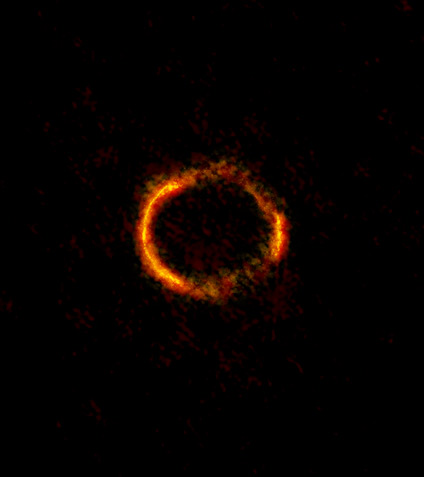
Just back from a short Easter holiday, I thought I’d resume blogging activities by showing you this remarkable image.
What you see is a near-perfect example of an Einstein Ring which is a result of a chance alignment between a background galaxy and a foreground concentration of mass, sometimes a cluster of galaxies but in this case another galaxy. A more usual effect is the formation of a number of bright arcs; here there are two bright segments, but there is enough detail to see the rest of the circle. The lensed galaxy has a redshift about 3, so that light from it was emitted when the Universe was about one-quarter its current size, about 12 billion years in the past.
This object, codenamed SDP81, was initially detected as a potential lens system by the Herschel Space Observatory, which turned out to be superb at identifying gravitational lenses. I posted about this here, in fact. Working in the far-infrared makes it impossible to resolve the detailed structure of lensed images with Herschel – even with a 3.5m mirror in space, λ/D isn’t great for wavelengths of 500 microns! However, the vast majority of sources found during the Herschel ATLAS survey with large fluxes at this wavelengths can be identified as lenses simply because their brightness tells us they’ve probably been magnified by a lens. Candidates can then be followed up with other telescopes on the ground. A quick look during the Science Demonstration Phase of Herschel produced the first crop of firmly identified gravitational lens systems published in Science by Negrello et al. This one was followed up last year by the Atacama Large Millimetre Array (ALMA), itself a remarkable breakthrough in observational technology; the image was actually made in an extended configuration during the commissioning tests of ALMA’s long-baseline interferometric capability, which gives it stunning resolving power of about 23 milli-arcseconds. It’s absolutely amazing to see such detail in an image made in the submillimetre region of the spectrum.
The press release accompanying this can be found here and the full scientific paper by Vlahakis et al. is already on the arXiv here.
For the specialists the abstract of the journal paper reads:
We present initial results of very high resolution Atacama Large Millimeter/submillimeter Array (ALMA) observations of the z=3.042 gravitationally lensed galaxy HATLAS J090311.6+003906 (SDP.81). These observations were carried out using a very extended configuration as part of Science Verification for the 2014 ALMA Long Baseline Campaign, with baselines of up to 15 km. We present continuum imaging at 151, 236 and 290 GHz, at unprecedented angular resolutions as fine as 23 milliarcseconds (mas), corresponding to an un-magnified spatial scale of ~180 pc at z=3.042. The ALMA images clearly show two main gravitational arc components of an Einstein ring, with emission tracing a radius of ~1.5″. We also present imaging of CO(10-9), CO(8-7), CO(5-4) and H2O line emission. The CO emission, at an angular resolution of ~170 mas, is found to broadly trace the gravitational arc structures but with differing morphologies between the CO transitions and compared to the dust continuum. Our detection of H2O line emission, using only the shortest baselines, provides the most resolved detection to date of thermal H2O emission in an extragalactic source. The ALMA continuum and spectral line fluxes are consistent with previous Plateau de Bure Interferometer and Submillimeter Array observations despite the impressive increase in angular resolution. Finally, we detect weak unresolved continuum emission from a position that is spatially coincident with the center of the lens, with a spectral index that is consistent with emission from the core of the foreground lensing galaxy.
ALMA will only work in long baseline mode for a small fraction of its time, and it is bound to be in very heavy demand, so it’s not clear how many of the hundreds of candidate lenses flagged up by Herschel will ever be mapped in such detail, but this is definitely one for the album!
The views presented here are personal and not necessarily those of my employer (or anyone else for that matter).
Feel free to comment on any of the posts on this blog but comments may be moderated; anonymous comments and any considered by me to be vexatious and/or abusive and/or defamatory will not be accepted. I do not necessarily endorse, support, sanction, encourage, verify or agree with the opinions or statements of any information or other content in the comments on this site and do not in any way guarantee their accuracy or reliability.




 In the Dark