Author Archive

Remember, Remember the 5th of November

Posted in Biographical with tags , , on November 5, 2014 by telescoper

Tonight is a big night for the town of Lewes, which is just up the road from the Sussex University campus at Falmer. The traditional bonfire night celebration draws thousands into the town. I won’t be going, as I have too much work to do and in any case the combination of huge crowds and fireworks is not one that I find particularly attractive.

The occasion for the festivities is of course Guy Fawkes’ Night, which celebrates the Gunpowder Plot of 1605, which intended to blow up the Houses of Parliament. Guy Fawkes was supposed to light the blue touchpaper on that occasion and it has been a tradition to burn his effigy on the bonfire on the anniversary of the attempt, every November 5th, while letting off fireworks. It’s all a bit more involved in Lewes, where many different figures are usually burnt in effigy and there’s a lot of dressing up and parading around to boot.

When I was young, Guy Fawkes’ Night was the thing we celebrated rather than Halloween. Although we didn’t put on anything as elaborate as the Lewes event, most families held their own bonfire in their garden and fireworks could easily be bought from local shops who stocked up at this time of year. Since we had open ground right in front of our house, we had very big bonfires where I grew up in Benwell which lots of other kids came to. The number of private bonfire parties has decreased markedly since then, owing to safety concerns and they have largely been replaced by large scale organized celebrations.

Another tradition associated with November 5th also seems to have died completely. When I was a kid the thing to do was to make an effigy of Guy Fawkes (called a “Guy”) and parade him from door to door asking for “Penny for the Guy”. The idea was if you had an impressive effigy, people would give you money which you used to buy fireworks for the forthcoming party. Of course you were hoping for a bit more than a penny.

I suppose that this tradition has been displaced by the American import “Trick-or-Treat”, which I think is a shame. It’s true that many bonfire celebrations have an unpleasant anti-catholic undertone which is a reminder of the religious intolerance that blights much of British history. But although it may be an ugly history, but at least its ours. Next thing you know we won’t have Guy Fawkes’ Night at all; we’ll have to call it 5/11.

I remember one year spending ages making a really good Guy with a head made from papier mâché and plasticine for his eyes, nose and mouth. I was really proud of him, especially when he sat on top of the huge pile of wood that was going to form the bonfire. When it was lit – which happened before the fireworks started – the heat from the flames started to melt the plasticine features of the Guy.

The other kids rushed around in excitement as the adults sorted out the Roman Candles, Catherine Wheels and the rest of the soon-to-be-ignited pyrotechnics, things that would go bang and whizz though not necessarily in that order.  But I stood transfixed, staring at the Guy. After a few minutes I started sobbing and ran to my mum in anguish as molten plasticine dripped from his eyes.

Guy Fawkes was crying…


Wind versus Nuclear: The real story in pictures

Posted in Science Politics, The Universe and Stuff with tags , , , on November 5, 2014 by telescoper

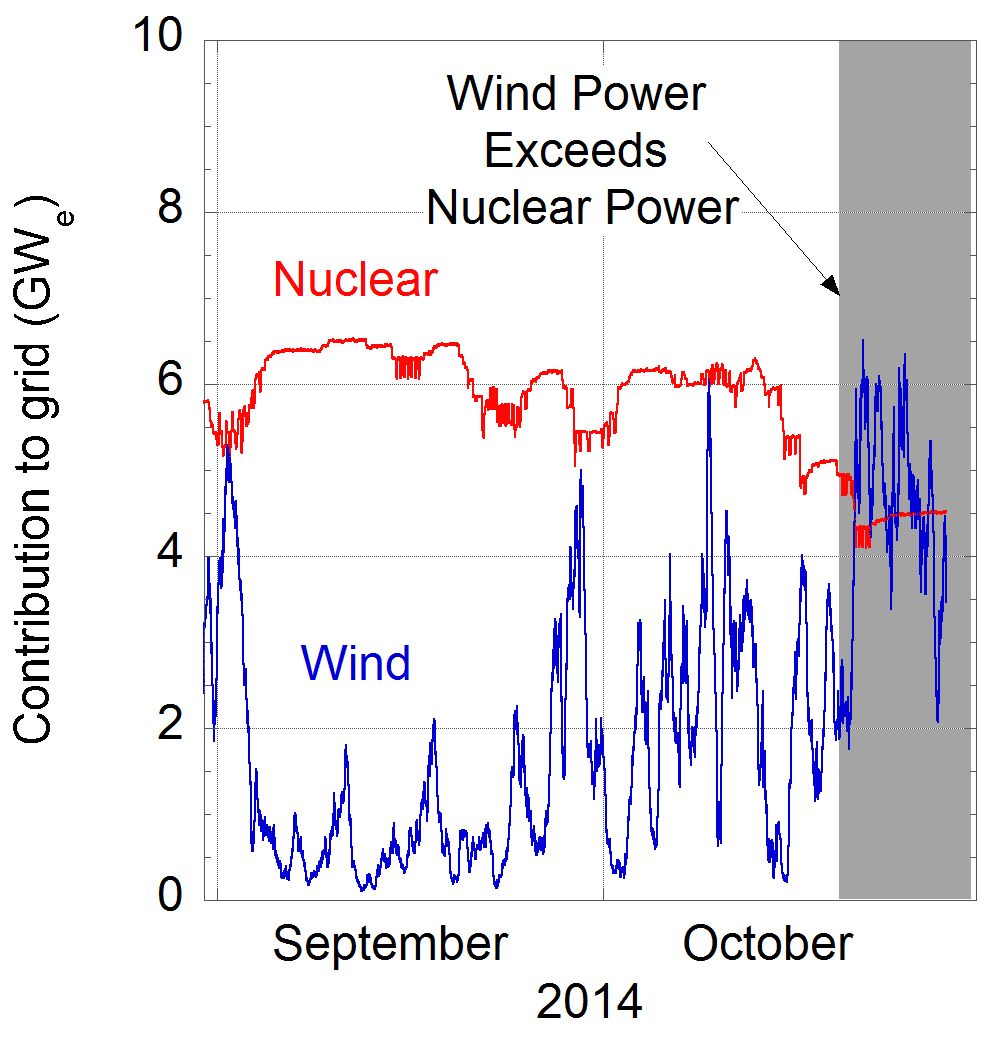
Here’s an interesting, balanced analysis of the statistics of wind power versus nuclear power in the UK over the past couple of months. There’s obviously room for more growth in renewable energy generation, but I still think we’ll need to increase nuclear capacity to provide a counter to the intermittent variability of wind power if we are to reduce our dependency on fossil fuels, which still produce most of the UK’s energy…

Michael de Podesta's avatarProtons for Breakfast

Graph showing the electricity generated by nuclear and wind power (in gigawatts) every 5 minutes for the months of September and October 2014. The grey area shows the period when wind power exceeded nuclear power. Graph showing the electricity generated by nuclear and wind power (in gigawatts) every 5 minutes for the months of September and October 2014. The grey area shows the period when wind power exceeded nuclear power. (Click Graph to enlarge)

For a few days in October 2014,  wind energy consistently generated more electricity in the UK than nuclear power. Wow!

You may have become aware of this through several news outlets. The event was reported on the BBC, but curiously the Daily Mail seems not to have noticed .

Alternatively, you may like me, have been watching live on Gridwatch – a web site that finally makes the data on electricity generation easily accessible.

I was curious about the context of this achievement and so I downloaded the historically archived data on electricity generation derived from coal, gas, nuclear and wind generation in the UK for the last three years. (Download Page)

And graphing the…

View original post 548 more words

Science, Poetry and Romanticism

Posted in Poetry, The Universe and Stuff with tags , , , , , , on November 4, 2014 by telescoper

I listened to a very interesting programme on BBC Radio 3 on Sunday evening, part of which was a documentary about science and poetry presented by Gregory Tate. Given that both these subjects feature heavily on this blog I couldn’t resist a quick post about it.

The feature explored why so many scientists have been inspired to write poetry, and the nature of the relationship between their artistic work and their science.

Among the famous scientists included in the programme was chemist and inventor Humphry Davy who, inspired by his friendship with the poets Wordsworth and Coleridge, wrote poems throughout his life. Others to do likewise were: physician Eramus Darwin; mathematician William Rowan Hamilton; astronomer William Herschel (who was also a noted musician and composer); J. Robert Oppenheimer; and Erwin Schrödinger.

Doing a quick google about after the programme I came across this example by Hamilton, which I searched for because he is the scientist from the list above with whose mathematical work I am most familiar because of its huge influence on physics, and because he seems to have been a very colourful character as well as a superb mathematician. Interestingly, he too was a very close friend of Wordsworth, to whom he often sent poems with requests for comments and feedback. In the subsequent correspondence, Wordsworth was usually not very complimentary even to the extent of telling Hamilton to stick to his day job (or words to that effect). What I didn’t know was that Hamilton regarded himself as a poet first and a mathematician second. That just goes to show you shouldn’t necessarily trust a man’s judgement when he applies it to himself.

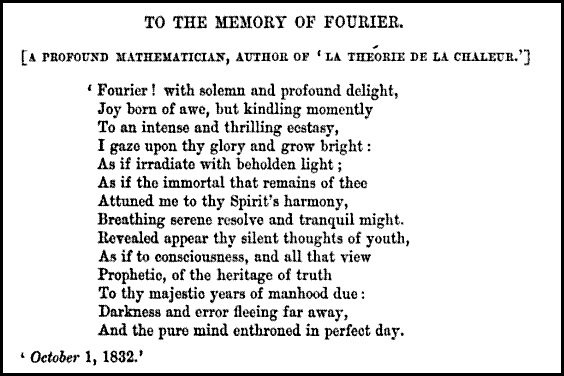
Here’s an example of Hamilton’s verse – a poem written to honour Joseph Fourier:

Hamilton-for Fourier

If that’s one of his better poems, then I think Wordsworth may have had a point!

The serious thing that struck me about this programme though was how many scientists of the 19th Century, Hamilton included, saw their scientific interrogation of Nature as a manifestation of the human condition just as the romantic poets saw their artistic contemplation. It is often argued that romanticism is responsible for the rise of antiscience. I’m not really qualified to comment on that but I don’t see any conflict at all between science and romanticism. I certainly don’t see Wordsworth’s poetry as antiscientific. I just find it inspirational:

I HAVE seen
A curious child, who dwelt upon a tract
Of inland ground, applying to his ear
The convolutions of a smooth-lipped shell;
To which, in silence hushed, his very soul
Listened intensely; and his countenance soon
Brightened with joy; for from within were heard
Murmurings, whereby the monitor expressed
Mysterious union with its native sea.
Even such a shell the universe itself
Is to the ear of Faith; and there are times,
I doubt not, when to you it doth impart
Authentic tidings of invisible things;
Of ebb and flow, and ever-during power;
And central peace, subsisting at the heart
Of endless agitation.

R.I.P. Acker Bilk (1929-2014)

Posted in Jazz with tags , , , on November 3, 2014 by telescoper

Yesterday evening I heard the sad news that “trad” jazz stalwart Acker Bilk had died, aged 85. With his trademark bowler hat and goatee beard, he was one of the leading figures of the post-war British jazz scene. He scored considerable commercial recording success with the Paramount Jazz Band, especially with Stranger on the Shore which was in the British Charts for 50 weeks in 1962, was the first record by a British artist to hit No. 1 in the American Billboard charts, and was greatly admired by no less a figure than Duke Ellington. There are tributes all over today’s newspapers (e.g. here) that do better justice to Acker Bilk than I could, so I’ll just post one track as a special tribute. This track, Train Song, the B-side of The Harem, was recorded in the year of my birth and I have loved it since I was a kid.

Rest in peace, Acker Bilk (1929-2014)


Charlie Christian: Swing to Bop

Posted in Jazz with tags , , , , , , , on November 2, 2014 by telescoper

I was transferring some old CDs onto my iPod the other day, and in the process of doing that I realized that in all the six years I’ve been running this blog I haven’t posted a single item about the great guitarist Charlie Christian, who did more than any other individual to promote the use of the electrical guitar and thus had an enormous influence on the development of  20th century music. The only reason I can think of why his is not a household name is that he died so young, in 1942, of tuberculosis, at the age of just 25.

Born in 1916, Charlie Christian came to prominence with Benny Goodman‘s orchestra during the 1930s. That in itself merits a remark. Benny Goodman was one of the first white bandleaders in the Swing Era to have black musicians in his band at a time when both musicians and audiences were generally racially segregated in the United States of America. Goodman deserves great credit for picking the best musicians he could find, regardless of the colour of their skin; Lionel Hampton is another prominent example. Bringing the young Charlie Christian into his band also testifies not only to his refusal to pander to racism, but also his willingness to experiment with new musical ideas, not least taking the guitarist out of the rhythm section and placing him as front-line soloist.

Here’s an excellent example of Charlie Christian playing with Benny Goodman’s Orchestra in 1939. I remember that my Dad wasn’t all that keen on Benny Goodman’s clarinet playing, which he regarded as “too clinical”. In fact many jazz writers also tend to refer to Benny Goodman’s playing as “unemotional”. I can’t agree. I admit that the band is a bit “slick”, but the clarinet on this track is absolutely sensational to me, and I find it a joy to listen to over and over again.  There’s also fine Cootie Williams on trumpet on this version of Fats Waller’s composition Honeysuckle Rose:

Commercial records from the 1930s were strictly limited by the available technology to 3 minutes’ duration, so Charlie Christian’s solo on that track  is necessarily brief.  You can hear much more of him on the historically important amateur recordings made during the early 1940s of late-night jam sessions at Minton’s Playhouse in New York City. This is an excerpt from a piece called Swing to Bop recorded in 1941, which shows how far Charlie Christian had advanced in just a couple of years. His improvised solo is way ahead of its time in the way it develops through an effortless string of musical ideas into an exploration of the harmonic possibilities of the chord sequence that I find absolutely sensational to listen to.

Not many people knew it at the time, because tracks like this weren’t made commercially available, but a musical revolution was brewing. Charlie Christian changed the course of jazz history, helping to usher in the bebop era, but his influence on rock-and-roll guitar is also incalculable.

Incidentally, I think Swing to Bop is actually the Count Basie tune Topsy in disguise, or at least the chords thereof. Listen to Topsy here and see if you agree..

Working for Different Masters

Posted in Education with tags , , , , , , , on November 1, 2014 by telescoper

Quite a few times recently, current and prospective students (or parents thereof) have asked me what the difference is between the different forms of Masters degrees that you can get in the United Kingdom, chiefly the distinction between an MSc  and one of the variations on the MPhys or MMath we have here in the School of Mathematical and Physical Sciences here at the University of Sussex. I have to admit that it’s all very confusing so here’s my attempt to explain.

The main distinction is that the MSc “Master of Science” is a (taught) postgraduate (PG) degree, usually of one (calendar) year’s duration, whereas the MPhys etc are undergraduate (UG) degrees usually lasting 4 years. This means that students wanting to do an MSc must already have completed a degree programme (and usually have been awarded at least Second Class Honours)  before starting an MSc whereas those doing the MPhys do not.

Undergraduate students wanting to do Physics in the Department of Physics & Astronomy at the University of Sussex, for example, can opt for either the 3-year BSc or the 4-year MPhys programmes. However, choosing the 4-year option does not lead to the award of a BSc degree and then a subsequent Masters qualification;  graduating students get a single qualification usually termed an “integrated Masters”.

It is possible for a student to take a BSc and then do a taught MSc programme afterwards, perhaps at a different university, but there are relatively few MSC programmes for Physics  in the UK because the vast majority of students who are interested in postgraduate study will already have registered for 4-year undergraduate programmes. That’s not to say there are none, however. There are notable MSc programmes dotted around, but they tend to be rather specialist; examples related to my own area include Astronomy and Cosmology at Sussex and Astrophysics at Queen Mary.  To a large extent these courses survive by recruiting students from outside the UK because the market from home students is so small. No department can afford to put on an entire MSc programme for the benefit of just one or two students. Often these stand-alone courses share modules with the final year of the undergraduate Masters, which also helps keep them afloat.

So why does it matter whether one Masters is PG while the other is UG? One difference is that the MSc lasts a calendar year (rather than an academic year). In terms of material covered, this means it contains 180 credits compared to the 120 credits of an undergraduate programme. Typically the MSc will have 120 credits of courses, examined in June as with UG programmes, followed by 60 credits worth of project work over the summer, handed in in September, though at Sussex some of our programmes are split 90 credits coursework and 90 credits of project.

The reason why this question comes up so frequently nowadays is that the current generation of applicants to university (and their parents) are facing up to fees of £9K per annum. The cost of doing a 3-year BSc is then about £27K compared to £36K for an MPhys. When rushing through the legislation to allow universities to charge this amount, the Powers That Be completely forgot about PG programmes, which have accordingly maintained their fees at a similar level. For example, the MSc Astronomy at Sussex attracts a fee of about £5K for home students and about £15K for overseas students. These levels are roughly consistent with the UG fees paid by  home students on the previous fee regime (approx £3.5K per annum, bearing in mind that you get 1.5 times as much teaching on an MSc compared to a year of an MPhys).

Being intelligent people, prospective physicists look at the extra £9K they have to pay for the 4th year of an MPhys and compare it with the current rate for an entire MSc and come to the conclusion that they should just do a BSc then switch. This seems to be not an unreasonable calculation to make.

However, there are some important things to bear in mind. Firstly, unlike UG programmes, the fee for PG programmes is basically unregulated. Universities can charge whatever they like and can increase them in the future if they decide to. See, for example, the list at Sussex University which shows that MSc fees already vary by more than a factor of four from one school to another. Incidentally, that in itself shows the absurdity of charging the same fee for UG degrees regardless of subject…

Now the point is that if one academic year of UG teaching is going to cost £9K for future students, there is no way any department can justify putting on an entire calendar of advanced courses (i.e. 50% more teaching at an extremely specialist level) for less than half the  income per student. The logical fee level for MSc programmes must rise to a mininum of about 1.5 times the UG fee, which is a whopping £13.5K (similar to the current whopping amount already paid by overseas students for these programmes). It’s therefore clear that you cannot take the current MSc fee levels as a guide to what they will be in three years’ time, when you will qualify to enter a taught PG programme. Prices will certainly have risen by then.

Moreover, it’s much harder to get financial support for postgraduate than undergraduate study.  MSc students do not qualify for student loans as undergraduates do, for example. Also the MSc fee usually has to be paid in full, up front, not collected later when your income exceeds some level. Some PG courses do run their own bursary schemes, such as many of those at Sussex, for example, but generally speaking students on taught PG programmes have to find their own funding. On the other hand,  undergraduate students often qualify for generous packages, including fee waivers and reduction in accommodation, especially if they qualify for support for widening participation, such as the “First Generation Scholar” scheme at Sussex.

I’d say that, contrary to what many people seem to think,  if you take into the full up-front fee and the lack of student loans etc, the cost of a BSc + MSc is  already significantly greater than doing an MPhys, and in future the cost of the former route will inevitably increase. I therefore don’t think this is a sensible path for most Physics undergraduates to take, assuming that they want their MSc to qualify them for a career in Physics research, either in a university or a commercial organization, perhaps via the PhD degree, and they’re not so immensely rich that money is no consideration.

The exception to this conclusion is for the student who wishes to switch to another field at Masters level,  to do a specialist MSc in a more applied discipline such as medical physics or engineering. Then it might make sense, as long as you can find a way to deal with the need to pay up-front for such courses.

There are indications that the government might be planning to introduce student loans for postgraduate degrees similar to those currently offered for undergraduates, but for me that would only make sense if the fees were to increase as described above, so this would not be an entirely positive move (to say the least).

In conclusion, though, I have to say that, like many other aspects of Higher Education in the Disunited Kingdom, this system is a mess. I’d prefer to see the unified system of 3 year UG Bachelor degrees, 2-year Masters, and 3-year PhD that pertains throughout most of continental Europe. To colleagues there, the system of two types of Masters degree looks like a complete mess.  Which it is. In fact some countries do not accept out integrated Masters as preparation for a PhD at all.

P.S. In the interest of full disclosure, I should point out an even worse anomaly. I did a 3-year Honours degree in Natural Science at Cambridge University for which I was awarded not a BSc but a BA (Bachelor of Arts). A year or so later this – miraculously and with no effort on my part – turned into an MA. Work that one out if you can.

MPS Halloween Fundraiser

Posted in Uncategorized with tags , , on October 31, 2014 by telescoper

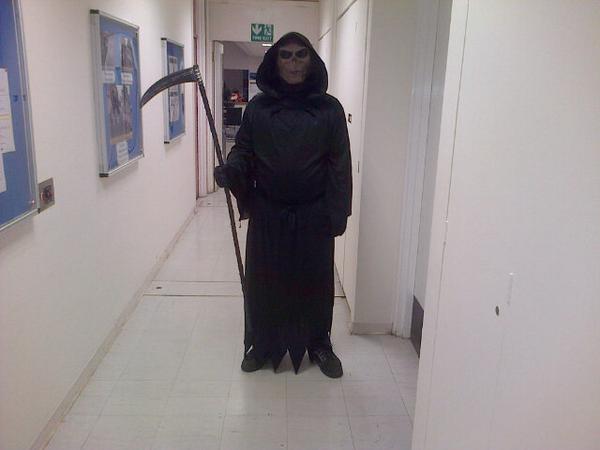
As previous items on In The Dark have made clear I’m not really a big fan of Halloween. I’m glad to say that the office staff in the School of Mathematical and Physical Sciences at the University of Sussex clearly agree with me and have decided not to dress up for the occasion or anything daft like that:

Halloween

I will, however, point out to all of you in internet land who are charitably disposed that you may nevertheless decide to get into the spirit by making a donation to the MPS Halloween fundraiser, which is on behalf of Chestnut Tree House, the only children’s hospice in Sussex, which cares for 300 children and young adults from 0-19 years of age with progressive life-limiting conditions.

Update: 16.45. But I didn’t have the Salmon Mousse..

reaper

Ice Watch

Posted in Art, Politics with tags , , , , , , on October 30, 2014 by telescoper

I thought I’d share this video about an installation called Ice Watch, which involves one hundred tonnes of inland ice from Greenland meltinging on the Radhusplads, Copenhagen’s City Hall Square. With Ice Watch, Olafur Eliasson and Minik Rosing direct attention to the publication of the IPCC’s 5th Assessment Report on the Earth’s Climate. The ice now melted, which happened faster than expected owing to the unusually warm weather for this time of year…


Three Minutes of Cosmology

Posted in The Universe and Stuff with tags , , on October 29, 2014 by telescoper

Not much time today to do anything except help one of my former PhD students become a Youtube sensation by sharing this video of Ian Harrison. Ian did his doctorate with me in Cardiff but now works in the Midlands, at the University of Manchester. Here he is talking about part of his PhD work for just three minutes without repetition, hesitation, deviation, or repetition:


STFC Consolidated Grants Review

Posted in Finance, Science Politics with tags , , , , , , , , on October 28, 2014 by telescoper

It’s been quite a while since I last put my community service hat on while writing a blog post, but here’s an opportunity. Last week the Science and Technology Facilities Council (STFC) published a Review of the Implementation of Consolidated Grants, which can be found in its entirety here (PDF). I encourage all concerned to read it.

Once upon a time I served on the Astronomy Grants Panel whose job it was to make recommendations on funding for Astronomy through the Consolidated Grant Scheme, though this review covers the implementation across the entire STFC remit, including Nuclear Physics, Particle Physics (Theory), Particle Physics (Experiment) and Astronomy (which includes solar-terrestrial physics and space science). It’s quite interesting to see differences in how the scheme has been implemented across these various disciplines, but I’ll just include here a couple of comments on the Astronomy side of things.

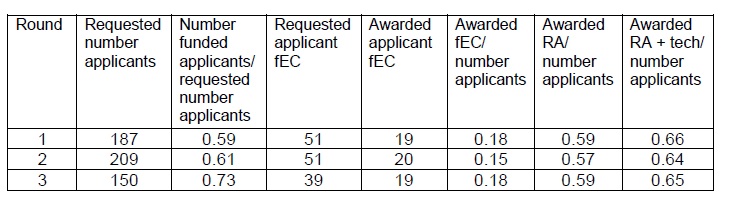
First, here is a table showing the number of academic staff for whom support was requested over the three years for which the consolidated grant system has been in existence (2011, 2012 and 2013 for rounds 1, 2 and 3 respectively).  You can see that the overall success rate was slightly better in round 3, possibly due to applicants learning more about the process over the cycle, but otherwise the outcomes seem reasonably consistent:

STFC_Con1

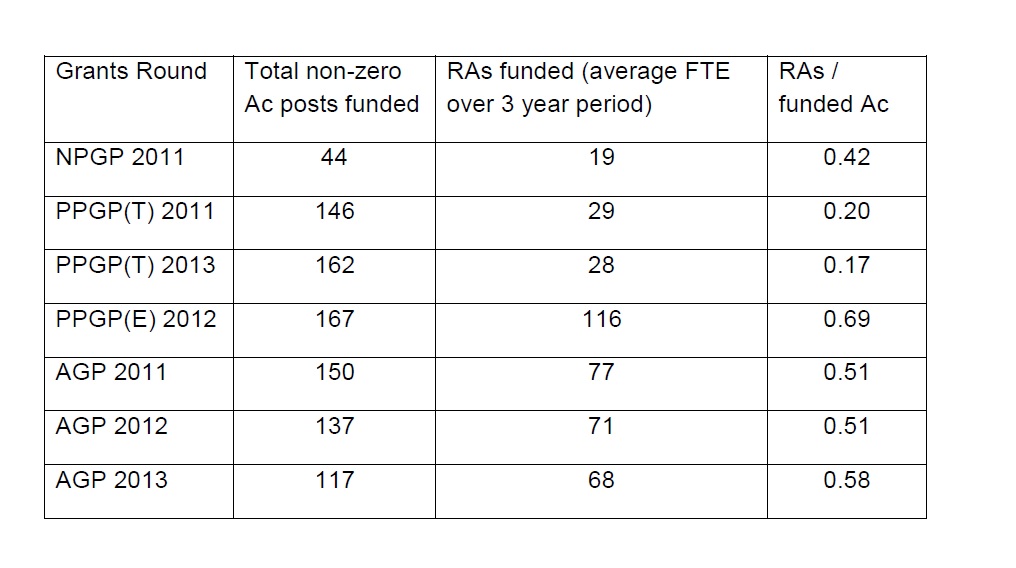
The last three rows of this table  on the other hand show quite clearly the impact of the “flat cash” settlement for STFC science funding on Postdoctoral Research Assistant (PDRA) support:
STFC_Con

Constant cash means ongoing cuts in real terms; there were 11.6% fewer Astronomy PDRAs supported in 2013 than in 2011. Job prospects for the next generation of astronomers continue to dwindle…

Any other comments, either on these tables or on the report as a whole, are welcome through the comments box.