It’s now ten years since Olafur Eliasson’s amazing instllation, Weather Project at Tate Modern. To celebrate this event people can share their responses to this unique experience online here or via the Grauniad website by contributing videos and photographs to a special archive.
Follow @telescoperAuthor Archive
Share Your Sun
Posted in Art with tags Olafur Eliasson, Weather Project on October 19, 2013 by telescoperImportant Announcement
Posted in Uncategorized on October 18, 2013 by telescoperVery busy this morning before heading off on some travels this afternoon, so only time for a brief post. One of the advantages of having a personal blog is that I can use it to relay important messsages from the Head of School to staff and students in the School of Mathematical and Physical Sciences here at Sussex University, so I’ll take this opportunity to do just that..
–o–
From the Desk of the Supreme Leader:
I regret to announce that, owing to an unfortunate administrative error arising from a confusion over three-letter acronyms, there will be no new Graduate Teaching Assistantships available in the School next academic year.
On the other hand, the School has acquired a large number of copies of the new edition of the computer game Grand Theft Auto which are now available for purchase at a discount from the School Office.
I hope this clarifies the situation.
Follow @telescoperDid I Miss Anything?
Posted in Education, Poetry with tags Did I Miss Anything?, Poetry, Teacher's Strike, Tom Wayman on October 17, 2013 by telescoperQuestion frequently asked by
students after missing a class
Nothing. When we realized you weren’t here
we sat with our hands folded on our desks
in silence, for the full two hours
Everything. I gave an exam worth
40 per cent of the grade for this term
and assigned some reading due today
on which I’m about to hand out a quiz
worth 50 per cent
Nothing. None of the content of this course
has value or meaning
Take as many days off as you like:
any activities we undertake as a class
I assure you will not matter either to you or me
and are without purpose
Everything. A few minutes after we began last time
a shaft of light descended and an angel
or other heavenly being appeared
and revealed to us what each woman or man must do
to attain divine wisdom in this life and
the hereafter
This is the last time the class will meet
before we disperse to bring this good news to all people on earth
Nothing. When you are not present
how could something significant occur?
Everything. Contained in this classroom
is a microcosm of human existence
assembled for you to query and examine and ponder
This is not the only place such an opportunity has been gathered
but it was one place
And you weren’t here
by Tom Wayman (b. 1945)
Follow @telescoperHow do physicists and astronomers team up to write research papers?
Posted in Science Politics with tags astronomy, bibliometrics on October 16, 2013 by telescoperBusy busy today so just time to reblog this, an interesting article about the irresistible rise of the multi-author paper. What fraction of the “authors” actually play any role at all in writing these papers? Am I the only one that thinks this has very profound implications for the way we interpret bibliometric analyses?

The way in which physicists and astronomers team up to write technical papers has changed over the years, and not only is it interesting to look at this behavior for its own sake, but by analyzing the data it may be possible to better understand what role, if any, does the number of authors have on the scientific impact of a paper. Likewise, such an analysis can allow physics and astronomy journals to make decisions about their publishing policies.
I was curious about the trends in the number of authors per refereed astronomy paper, so I set out to write an R script that would read in data from the NASA Astrophysics Data System, an online database of both refereed and non-refereed academic papers in astronomy and physics. The script counts the monthly number of refereed astronomy and physics papers between January 1967 and September 2013, as well as…
View original post 670 more words
Emmy Noether on Ada Lovelace Day
Posted in History, The Universe and Stuff with tags Ada Lovelace, Emmy Noether, Noether's Theorem on October 15, 2013 by telescoperIt’s been an interesting morning. We had no electricity in the School for most of the morning owing to a power cut, but it was eventually restored while I was away at a meeting elsewhere on campus. Before that I was delayed getting into work because there was an explosion in central Brighton which disrupted the bus service I use to get to Falmer campus. That palaver provides me with a reasonable justification for not having much time to write a blog today.
However, since today is Ada Lovelace day, on which we celebrate inspiring stories of women in science and technology, I thought I’d post a (rather long) video about pioneering mathematical physicist Emmy Noether who is undoubtedly one of the most underrated physicists of all time. When I used to teach Theoretical Particle Physics many moons ago I spent quite a bit of time talking about the very deep connections that Noether uncovered between symmetry and conservation laws. Most of the students were well aware of the laws of conservation of energy and momentum, say, but unaware of the relationship between these laws and symmetries under time and space translations respectively. Making this connection helps to develop a much deeper understanding of many areas of physics. It’s also a very beautiful bit of mathematical analysis.
Follow @telescoperAustralia: Cyclones go up to Eleven!
Posted in Bad Statistics with tags Australia, Cyclones, Eleven, expectation value, mean, mode, Spinal Tap, statistics on October 14, 2013 by telescoperI saw a story on the web this morning which points out that Australians can expect 11 cyclones this season.
It’s not a very good headline, because it’s a bit misleading about what the word “expected” means. In fact the number eleven is the average number of cyclones, which is not necessarily the number expected, despite the fact that “expected value” or “expectation value” . If you don’t understand this criticism, ask yourself how many legs you’d expect a randomly-chosen person to have. You’d probably settle on the answer “two”, but that is the most probable number, i.e. the mode, which in this case exceeds the average. If one person in a thousand has only one leg then a group of a thousand has 1999 legs between them, so the average (or arithmetic mean) is 1.999. Most people therefore have more than the average number of legs…
I’ve always found it quite annoying that physicists use the term “expectation value” to mean “average” because it implies that the average is the value you would expect. In the example given above you wouldn’t expect a person to have the average number of legs – if you assume that the actual number is an integer, it’s actually impossible to find a person with 1.999! In other words, the probability of finding someone in that group with the average number of legs in the group is exactly zero.
The same confusion happens when newspapers talk about the “average wage” which is considerably higher than the wage most people receive.
In any case the point is that there is undoubtedly a considerable uncertainty in the prediction of eleven cyclones per season, and one would like to have some idea how large an error bar is associated with that value.
Anyway, statistical pedantry notwithstanding, it is indeed impressive that the number of cyclones in a season goes all the way up to eleven..
Follow @telescoperElektra
Posted in Opera with tags Elektra, Elektra Complex, Opera, Richard Strauss on October 13, 2013 by telescoperI seem to have spent more time in London than in Brighton over the last week, and on Saturday I was in the Big Smoke again, for a Night at the Opera. This was a trip I’ve been looking forward to for some time, because it was made possible by the good folks of the School of Physics & Astronomy at Cardiff University: when I left at the end of January this year they presented me with a gift voucher for the Royal Opera House in Covent Garden, which I’ve only just around to using. So before going on, let me take the opportunity express my gratitude for such a lovely gift!
The Opera I went to see was Elektra by Richard Strauss, in a revival of Charles Edwards’s production that first ran in 2003. Elektra is a complex story (geddit?) set in ancient Mycenae, whose ruling class is gripped by a terrible family feud. The Opera begins with Elektra deranged with grief because of the murder of her father, Agamemnon, by her mother, Clytemnestra. She resolves to take revenge on her mother and her allies. Her hopes are initially thwarted when her sister Chrysothemis refuses to help and she hears of the death of her brother Orestes. However, Orestes is not dead; he returns to the Palace and, together with a companion, goes on a bloody rampage. The final scenes see the stage covered with dead bodies and the murderers drenched in blood. Elektra rejoices that her revenge is complete, but the fulfilment of her goal leaves her with nothing left to live for; the collapses and dies.
That’s what you go to the Opera for, a happy ending!
I thoroughly enjoyed the performance. Elektra is an opera in one Act, so it runs for about two hours without an interval. Christine Goerke was absolutely outstanding as Elektra, as was Iain Paterson as Orestes. The music by Richard Strauss is full of contrasts: at times dark and brooding, but at others with a radiant beauty. Those extremes represent the psychological extremes of the story: Elektra’s obsession with revenge is a distorted reflection of her love for her father. The Orchestra of the Royal Opera House conducted by Christopher Willis, standing in for Andris Jansons who was ill, added excellent colour and dynamics to the action on stage.
With all the corpses coming back to life in bloodstained costumes, the curtain call looked the Zombie Apocalypse had started, but we managed to escape and made it to an excellent Italian restaurant in time for a splendid supper followed by too much grappa. I didn’t get back to Brighton until late this afternoon…
Follow @telescoperOde to a Small Lump of Green Putty I Found in my Armpit One Midsummer Morning
Posted in Poetry on October 12, 2013 by telescoperPutty. Putty. Putty.
Green Putty – Grutty Peen.
Grarmpitutty – Morning!
Pridsummer – Grorning Utty!
Discovery….. Oh.
Putty?….. Armpit?
Armpit….. Putty.
Not even a particularly
Nice shade of green.
As I lick my armpit and shall agree,
That this putty is very well green.
(Excerpt) by Grunthos the Flatulent (translated by Douglas Adams)
Follow @telescoperRAS Council
Posted in Biographical, Science Politics with tags A Day of Council on October 11, 2013 by telescoperUp in London once more, this time in Burlington House, Piccadilly, for my first meeting as a duly elected Member of the Royal Astronomical Society Council. I’ll update on any non-confidential news later on if there is any and if I get time, but we’re about to start so that’s it for now…
Follow @telescoper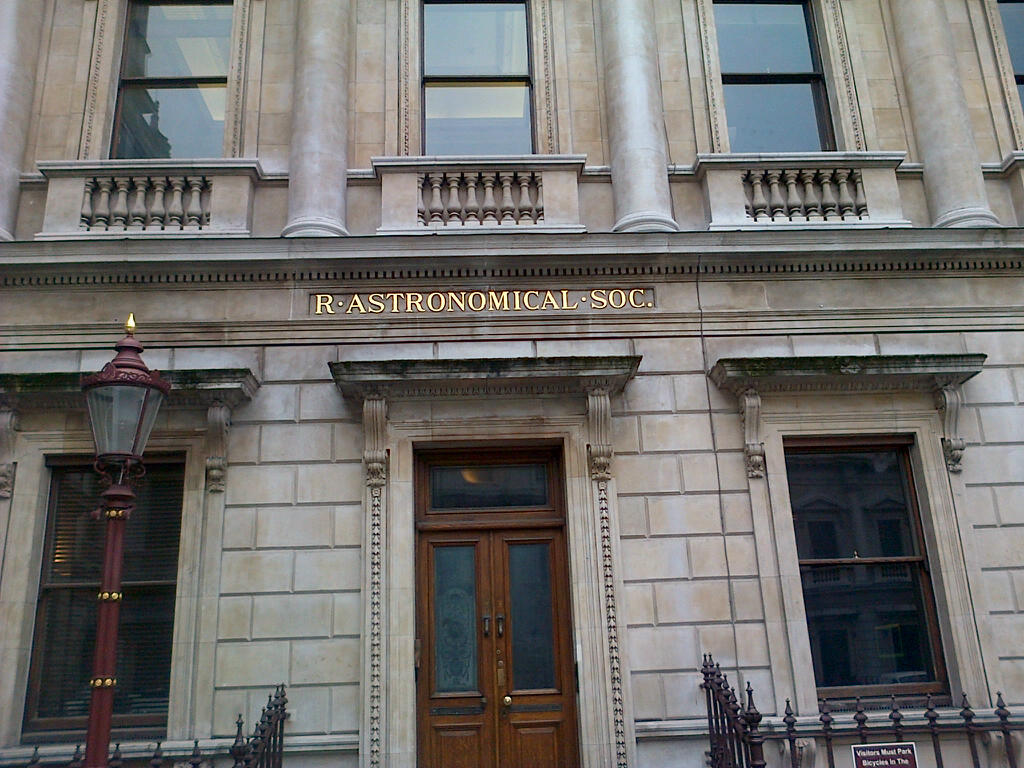
Picture Postscript
Posted in Uncategorized with tags Wales Millennium Centre on October 10, 2013 by telescoperI thought you might like to see the dedication written on the back of the seat in front of me at Roberto Devereux on Sunday..
Follow @telescoper

 In the Dark