Author Archive

No more ripples?

Posted in Biographical, The Universe and Stuff with tags , , , on July 27, 2013 by telescoper

Well, that’s the Ripples in the Cosmos meeting in Durham over and done with, and I’m back in Newcastle for a few days before moving on to Edinburgh next week. I’m not sure I’ll be able to blog much over the next few days because my internet connectivity will be a bit limited.

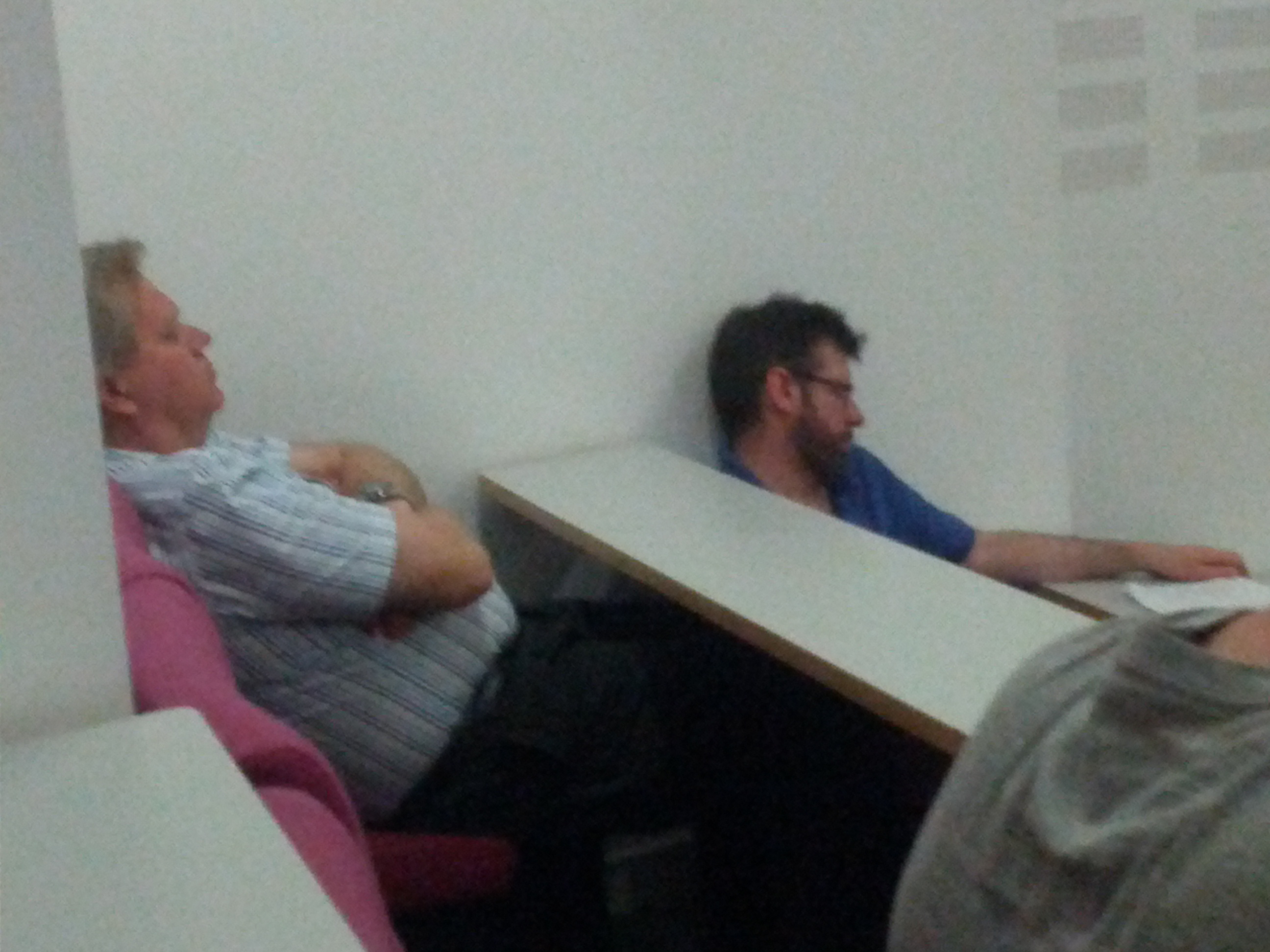
Anyway, the meeting was very exciting, as you can tell from the picture showing me (with the beard) and Brian Schmidt (with the Nobel Prize):
IMG_20130725_144131

Yesterday it was my job to round off the meeting with some concluding remarks leading into a panel discussion. I have to admit that although the programme for the conference was clearly designed in order to generate provoke discussion, I was a little disappointed that so few people said anything controversial. I’ve long held that there are too many cosmologists willing to believe too much, and this was further evidence that the scepticism that is a necessary part of a healthy science has been replaced by widespread conformity, especially among the young; when I was a lad the students and postdocs were a lot more vocal at meetings than they are now. Perhaps this is characteristic of a change in culture of cosmology? To get a job nowadays it’s virtually essential to climb onto one of the big bandwagon projects, and to keep your place you have to toe the party line, refrain from rocking the boat, not speak out of turn, and avoid making ripples (That’s enough metaphors. Ed).

Anyway, I think there are still a great many things in modern cosmology we don’t understand at all, and I think a few more of the older generation should show the way by questioning things in public. In fact only got asked to do the concluding remarks because Jim Peebles was unable to come to the meeting. Jim’s an immensely distinguished physicist who has probably done more than any other living person to develop the standard cosmology, but he’s also never been afraid to play devil’s advocate. We need more like him, willing to articulate the doubts that too many of us feel the need to suppress.

It’s amazing how much progress we have made in cosmology over the last few decades, but we shouldn’t use that as an excuse to get complacent. Cosmology is about the biggest questions in science. That alone makes it an exciting subject to work in. It’s an adventure. And the last thing you want on an adventure is for the journey to be too comfortable.

The Lindisfarne Gospels

Posted in Art, History with tags , , , , on July 25, 2013 by telescoper

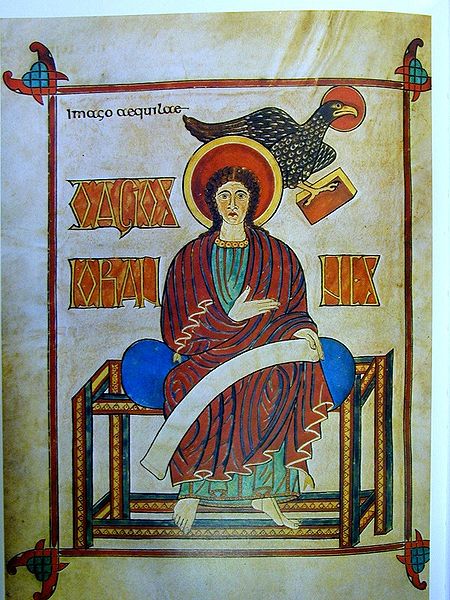
450px-Lindisfarne_Gospels_folio_209vOne of the interesting things going on in Durham during the week of this conference is an exhibition relating to the Lindisfarne Gospels. This extraordinary book was written around 715AD, just after the death of St Cuthbert. For those of you not familiar with Lindisfarne, or “Holy Island” as it is often called, it’s a small island off the Northumbrian coast, connected to the mainland by a causeway which is covered by the tide twice a day.

Although the Lindisfarne Gospels are about 1300 years old, the colours remain extremely vivid. It’s a remarkable thing to look at the pages on view in the exhibition to see the marks made by a human hand all that time ago; it’s difficult not to wonder about the life of the person who devoted what must have been a huge amount of time compiling this exquisite work.

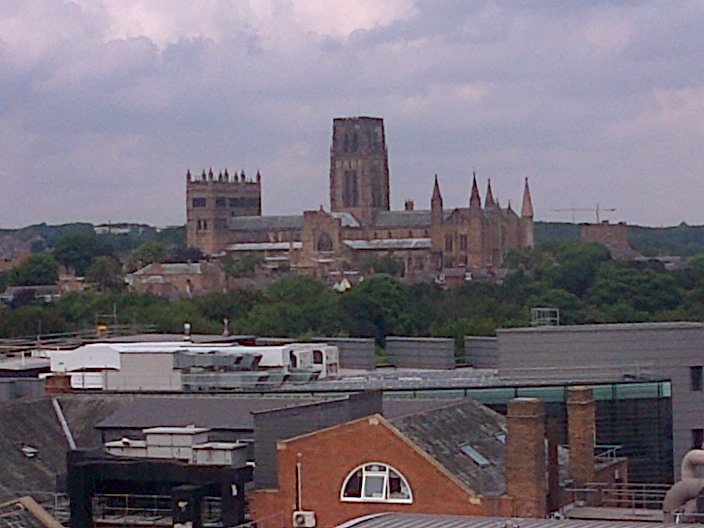
Incidentally, St Cuthbert’s remains now lie in a tomb inside Durham’s magnificent cathedral, of which we have a fine view from the balcony of the Calman Learning  Centre during the coffee breaks:

IMG-20130724-00154

The Mysterious Mr Ripples

Posted in Biographical, The Universe and Stuff with tags , , on July 24, 2013 by telescoper

So here I am in the fine city of Durham, in the North Midlands, for a meeting entitled Ripples in the Cosmos. I travelled by plane from Gatwick to Newcastle on Sunday afternoon, and got there eventually – after a two-hour delay caused by the aircraft we were meant to fly on having a technical problem and needing to be replaced by another. Anyway, I spent Sunday with my folks. Thinking it was only going to be a half-hour drive to Durham, we left early on Monday morning so I’d be in time to chair the first session.

Unfortunately, major roadworks on A1 intervened and we got stuck in traffic near the Metro Centre in Gateshead. Fortunately, various people at the conference caught my Twitter updates and a deputy was arranged. I got there about 30 minutes late and I took over after the coffee break.

300px-Yard2
After the day’s conference I wandered up to Durham Caste (left), where I had a room booked for the week. However, when I got there they had no record of my reservation. The porter was very helpful and let me connect to my email to check, and I retrieved the confirmation of my booking. In exasperation, I looked through the papers he had relating to room bookings, and found one in the name of “Mr Ripples”. Not even “Professor Ripples”, mark you.


The mysterious Mr Ripples not having appeared to claim his room I surmised that the similarity of his name to the title of the conference might indicate that perhaps some administrative error might have been made. The porter agreed, changed the name from Mr Ripples to Professor Coles and gave me a key.

Anyway, Durham Castle is a rather splendid place to stay.  Breakfast is to be had in grand surroundings complete with walls decorated with suits of armour, swords and other historical weapons. This environment, together with the continuing warm weather, as well of course as the excellent conference talks, has made this very enjoyable week so far.  Apart from the nagging doubt that Mr Ripples could suddenly turn up and demand his room, the only problem is the ringing of bells all through the night.

The conference dinner is this evening, and it’s in the Great Hall of Durham Castle so I won’t have far to stagger home to bed…

Newsflash: Direct Detection of B-mode Polarization

Posted in The Universe and Stuff with tags , , , , , on July 23, 2013 by telescoper

I’m not meant to be blogging these days but I thought I’d break radio silence to draw attention to a new paper on the arXiv by Hanson et al. from SPTpol, an experiment which aims to measure the polarization of the cosmic microwave background using the South Pole Telescope. One of the main aims of experiments such as this is to measure the so-called “B-mode” of polarization (the “curl” component of the polarization signal, which possesses a handedness) because this holds the key to direct detection of a number of interesting cosmological phenomena such as the existence of primordial gravitational waves.  However, primordial effects aren’t  the only way to generate B-mode polarization. Other “foreground” effects can do the job too, especially gravitational lensing can also generate a signal of this form. These “late-time” effects have to be understood before the primordial contribution can be isolated.

Before today there was no direct measurement of B-mode polarization at all, primordial nor not.

The abstract basically says it all:

Gravitational lensing of the cosmic microwave background generates a curl pattern in the observed polarization. This “B-mode” signal provides a measure of the projected mass distribution over the entire observable Universe and also acts as a contaminant for the measurement of primordial gravity-wave signals. In this letter we present the first detection of gravitational lensing B modes, using first-season data from the polarization-sensitive receiver on the South Pole Telescope (SPTpol). We construct a template for the lensing B-mode signal by combining E-mode polarization measured by SPTpol with estimates of the lensing potential from a Herschel-SPIRE map of the cosmic infrared background. We compare this template to the B modes measured directly by SPTpol, finding a non-zero correlation at 7.7 sigma significance. The correlation has an amplitude and scale-dependence consistent with theoretical expectations, is robust with respect to analysis choices, and constitutes the first measurement of a powerful cosmological observable.

This measurement is not unexpected. Indeed, the B-mode contribution from lensing by the known distribution of galaxies can be calculated fairly straightforwardly because the physics is well understood; failure to find the expected signal would therefore have been somewhat embarrassing.  It’s a different story for the primordial B-mode because that depends strongly on what is going on in the very early universe, and that is much less certain. Although the new result doesn’t itself tell us anything new about the very early Universe it is definitely an important step on the way, and it’s a fairly safe prediction that there will be a great deal of activity and interest in CMB polarization over the next few years, including next year’s planned release of polarization data from Planck.

I’ll also note the use of Herschel-SPIRE images in tracing the galaxy images, in deference to my former colleagues in Cardiff who played a key role in developing that instrument!

Interlude

Posted in Uncategorized on July 20, 2013 by telescoper

Well, dear readers, the next few days are going to be very busy so I’m going to be taking a short break from blogging until next week.  Normal services will be resumed as soon as possible but, for the time being, there will now follow a short intermission…

Mad Dogs and Englishmen

Posted in Music with tags , on July 19, 2013 by telescoper

Game, Set and Maths & Physics

Posted in Sport with tags , , , , , on July 18, 2013 by telescoper

One of my fellow Heads of School at the University of Sussex yesterday pointed out to me a fact that I’d somehow missed for all these years which prompted me to make a quick post about it. Here’s a short video showing the Wimbledon Ladies’ Singles Final in 1977.

Although I’m not really a fan of tennis I remember watching this match, between Virginia Wade and Betty Stove, on the telly. I particularly remember the priceless commentary of the great Dan Maskell who at one point remarked “Miss Stove seems to have gone off the boil…”

Anyway, the reason for posting this clip as that the winner of this match, and thus of the Ladies Singles Championship in 1977 was Virginia Wade. A lot of fuss was made at the time because “Ginny” is British and her victory took place in the year of the Queen’s Silver jubilee. Please note all those who think Andy Murray is the first British Champion since before the Second World War.

More relevantly, given my current job, I learned yesterday that in 1966 Virginia Wade graduated from the University of Sussex with a degree in Mathematics and Physics…..

I’ll Walk Beside You

Posted in Music with tags , on July 17, 2013 by telescoper

I heard a short recording of a chap called Walter Glynne on the radio yesterday morning, which prompted me to see if there was anything by him on Youtube. I’m glad that I did, because I found this. I think it’s charming.

Walter Glynne (born Thomas Glyn Walters) was born in  Gowerton (Wales) in 1890 and educated at Gowerton Grammar School. He was a bank clerk until he decided to take up a musical career, and won a scholarship to the Royal College of Music in London in 1910. He served in the Welsh Guards during World War I. In 1921, on the recommendation of Sir Landon Ronald, HMV’s music advisor, he secured a recording contract with the company. He was one of the first singers in Britain to broadcast on the radio, and because his voice suited the microphone he had a successful career in that medium. He sang in the lyric concerts held by the companies of Boosey, Chappell and Cramer in London, and also with the Carl Rosa and D’Oyly Carte opera companies. He made very many recordings, excelling as a lyrical singer; he was known in particular for his rendering of ballads, but he was also a good tenor in oratorios, and in 1935 he recorded arias from Handel’s Messiah. His disciplined singing and pure tone are heard to excellent effect on this lovely (if a bit crackly) old record; these, together with his pleasant personality, made him a very popular performer. In 1947 he retired and moved to the Gower peninsula; he died at home in Port Einon on  29 July 1970.

This version of I’ll Walk Beside You probably sounds very old-fashioned to most of my readers, but I think it’s wonderful.

Rest In Peace, Alex Jansons

Posted in Uncategorized on July 16, 2013 by telescoper

Today the  School of Mathematical and Physical Sciences at Sussex University is in a state of collective shock after receiving some terrible news. Alex Jansons, a first-year Mathematics student in the School,  died suddenly at the weekend near his family home in Penn, Buckinghamshire.

Now you all know why I posted that poem by John Donne this morning..

It’s so devastating for all of us in MPS to have lost such a bright and popular student at such a young age that I can barely begin to imagine what his family and friends must be going through at this difficult time.

A funeral service for Alex will be held next Friday, and we will be organizing a memorial event to be held on the Sussex University campus near the start of the next academic year so that it can be attended by students from Alex’s year when they return from the summer recess.

But for now, on behalf of everyone in MPS, all I can do is offer my sincerest condolences and deepest sympathy to everyone who knew Alex Jansons.

May he rest in Peace.

Death be not Proud

Posted in Poetry with tags , , on July 16, 2013 by telescoper

Death be not proud, though some have called thee
Mighty and dreadful, for thou art not so,
For those whom thou think’st thou dost overthrow,
Die not, poor Death, nor yet canst thou kill me.
From rest and sleep, which but thy pictures be,
Much pleasure: then from thee much more must flow,
And soonest our best men with thee do go,
Rest of their bones, and soul’s delivery.
Thou art slave to fate, chance, kings, and desperate men,
And dost with poison, war, and sickness dwell;
And poppy or charms can make us sleep as well
And better than thy stroke; why swell’st thou then?
One short sleep past, we wake eternally,
And death shall be no more; Death, thou shalt die.

by John Donne (1572-1631).