Author Archive

Time To Change

Posted in Biographical, Mental Health with tags , , , , , , on January 20, 2013 by telescoper

I suppose you could consider this post to be my New Year’s resolution, so apologies that it’s three weeks overdue. Apologies too if it’s a bit too personal for comfort; it’s difficult to get the mixture of public and private right when you run a blog.

Anyway, regular followers of this blog will know that I had some problems with my mental health last summer;  I posted a partial explanation here.  I completed a course of treatment last autumn and have since been feeling much better.  Words can’t express my gratitude to the people who looked after me when I was unwell nor to the friends and colleagues who put up with my unexplained absences for so long.

In November last year I came across a website run by Time to Change Wales which was in the middle of a campaign to get people talking about mental health issues. Among the things they were doing was getting people to post short blogs about their experiences in order to help people overcome the stigma that sadly still surrounds mental health. It seemed right to contribute something to this campaign, so I decided to write a piece for them. I probably don’t have to explain that I didn’t find this easy to do, and I changed my mind several times about what to include or indeed whether to send anything in at all. In the end I plucked up enough courage, and my piece went live last week.

I was given permission to post it here also but, on reflection, I decided that might detract from the campaign by deflecting traffic from the Time to Change website. I also thought I’d leave it a while before referring to it on here; as it happens, there were also practical reasons why I haven’t had much time to blog in recent days.

If you’d like to read the piece you can do so here. And while you’re there, why not check out the rest of the site? Or maybe even follow them on Twitter?

Closer friends who know the whole story will realise that I’ve edited it quite severely; they’ll probably also understand why. I’d just like to add here a few things I left out because I didn’t think they were relevant in the context of the Time to Change campaign.

First, you will probably now appreciate the irony in the fact that I’ll shortly be returning to live in Brighton when I take up my new job as Head of Mathematical and Physical Sciences at the University of Sussex. That this opportunity came along when it did seemed so implausible a coincidence that  I’ve almost started to believe in fate. I feel a bit like a character in a play with a very strange plot; I haven’t a clue how it’s going to end, but I’m obliged to act out my part regardless.

In case anyone is wondering, before being appointed to my new job I did have to complete a medical questionnaire, and I did make a written statement about the problems I’ve had. I was more than a bit nervous about doing that, actually, and for a time I thought I’d get turned down. But instead of being declared unfit, all that happened was that I had a discussion with an Occupational Health Adviser who was very supportive. I know that my problems may recur, but now I know how to handle them I don’t see any reason why I can’t handle this new job either. I’m very much looking forward to it, in fact.

I’m by no means an expert on mental health, but I couldn’t resist ending with a comment arising from my recent experiences. The human brain is an incredibly complicated thing which means that even when it’s functioning “normally” it gives rise to a vast range of personalities and behaviour patterns that largely defy categorization. Likewise, when things go wrong they can go wrong in so many ways that simple descriptions such as “anxiety” or “depression” aren’t really all that useful or even complete.

You might think, for example, that panic disorder describes a fairly well-defined condition, but it really doesn’t. The things I have experienced during panic attacks – which includes alarming visual and auditory hallucinations as well as an overwhelming impulse to flee – are quite different from what others with panic disorder may describe. Post-traumatic stress disorder can likewise manifest itself in a wide range of behaviours, including extreme aggression. In my own case the dominant factor has been hypervigilance and I’ve never showed any sign at all of some of the other indicators.

It’s no surprise, therefore, that there’s no ab initio theoretical understanding of what causes such conditions, and that treatment is largely by trial and error. In short, neuroscience isn’t at all like physics. It’s also very very much harder.

Tough Tenors

Posted in Jazz with tags , , , on January 19, 2013 by telescoper

I found this on Youtube recently and couldn’t resist posting it. I actually have a vinyl LP of the album Tough Tenors, featuring Eddie “Lockjaw” Davis and Johnny Griffin as the eponymous rugged saxophonists, but it’s one I haven’t yet transferred to digital. As the album title suggests, Messrs Davis and Griffin play their instruments in a  very muscular fashion, so at teams it seems like music to lift weights by, but they play with a great deal of imagination too. Here, for example, is very original version of the Dizzy Gillespie/Chano Pozo composition Tin Tin Deo, with a particularly fabulous solo by Johnny Griffin.

P.S. The album was recorded in 1962, and the other musicians were Horace Parlan (piano), Ben Riley (drums) and Bud Catlett (bass).

REF moves the goalposts (again)

Posted in Bad Statistics, Education, Science Politics with tags , , , on January 18, 2013 by telescoper

The topic of the dreaded 2014 Research Excellence Framework came up quite a few times in quite a few different contexts over the last few days, which reminded me that I should comment on a news item that appeared a week or so ago.

As you may or may not be aware, the REF is meant to assess the excellence of university departments in various disciplines and distribute its “QR” research funding accordingly.  Institutions complete submissions which include details of relevant publications etc and then a panel sits in judgement. I’ve already blogged of all this: the panels clearly won’t have time to read every paper submitted in any detail at all, so the outcome is likely to be highly subjective. Moreover, HEFCE’s insane policy to award the bulk of its research funds to only the very highest grade (4* – “internationally excellent”) means that small variations in judged quality will turn into enormous discrepancies in the level of research funding. The whole thing is madness, but there seems no way to inject sanity into the process as the deadline for submissions remorselessly approaches.

Now another wrinkle has appeared on the already furrowed brows of those preparing REF submissions. The system allows departments to select staff to be entered; it’s not necessary for everyone to go in. Indeed if only the very best researchers are entered then the typical score for the department will be high, so it will appear  higher up  in the league tables, and since the cash goes primarily to the top dogs then this might produce almost as much money as including a few less highly rated researchers.

On the other hand, this is a slightly dangerous strategy because it presupposes that one can predict which researchers and what research will be awarded the highest grade. A department will come a cropper if all its high fliers are deemed by the REF panels to be turkeys.

In Wales there’s something that makes this whole system even more absurd, which is that it’s almost certain that there will be no QR funding at all. Welsh universities are spending millions preparing for the REF despite the fact that they’ll get no money even if they do stunningly well. The incentive in Wales is therefore even stronger than it is in England to submit only the high-fliers, as it’s only the position in the league tables that will count.

The problem with a department adopting the strategy of being very selective is that it could have a very  negative effect on the career development of younger researchers if they are not included in their departments REF submission. As well as taking the risk that people who manage to convince their Head of School that they are bound to get four stars in the REF may not have the same success with the various grey eminences who make the decision that really matters.

Previous incarnations of the REF (namely the Research Assessment Exercises of 2008 and 2001) did not publish explicit information about exactly how many eligible staff were omitted from the submissions, largely because departments were extremely creative in finding ways of hiding staff they didn’t want to include.

Now however it appears there are plans that the Higher Education Statistics Agency (HESA) will publish its own figures on how many staff it thinks are eligible for inclusion in each department. I’m not sure how accurate these figures will be but they will change the game, in that they will allow compilers of league tables to draw up lists of the departments that prefer playing games to   just allowing the REF panels to  judge the quality of their research.

I wonder how many universities are hastily revising their submission plans in the light of this new twist?

Winter Weather Contrasts

Posted in Biographical with tags , , , on January 18, 2013 by telescoper

The world-famous British weather has been pulling out all the stops over the last few days. During a short break in the proceedings yesterday I did a bit of flat-hunting in Brighton. It was a lovely bright morning, with the winter sun low in the sky making the city look absolutely beautiful. Here’s a pic I took with my Blackberry of the Palace Pier from Marine Parade…
IMG-20130117-00042

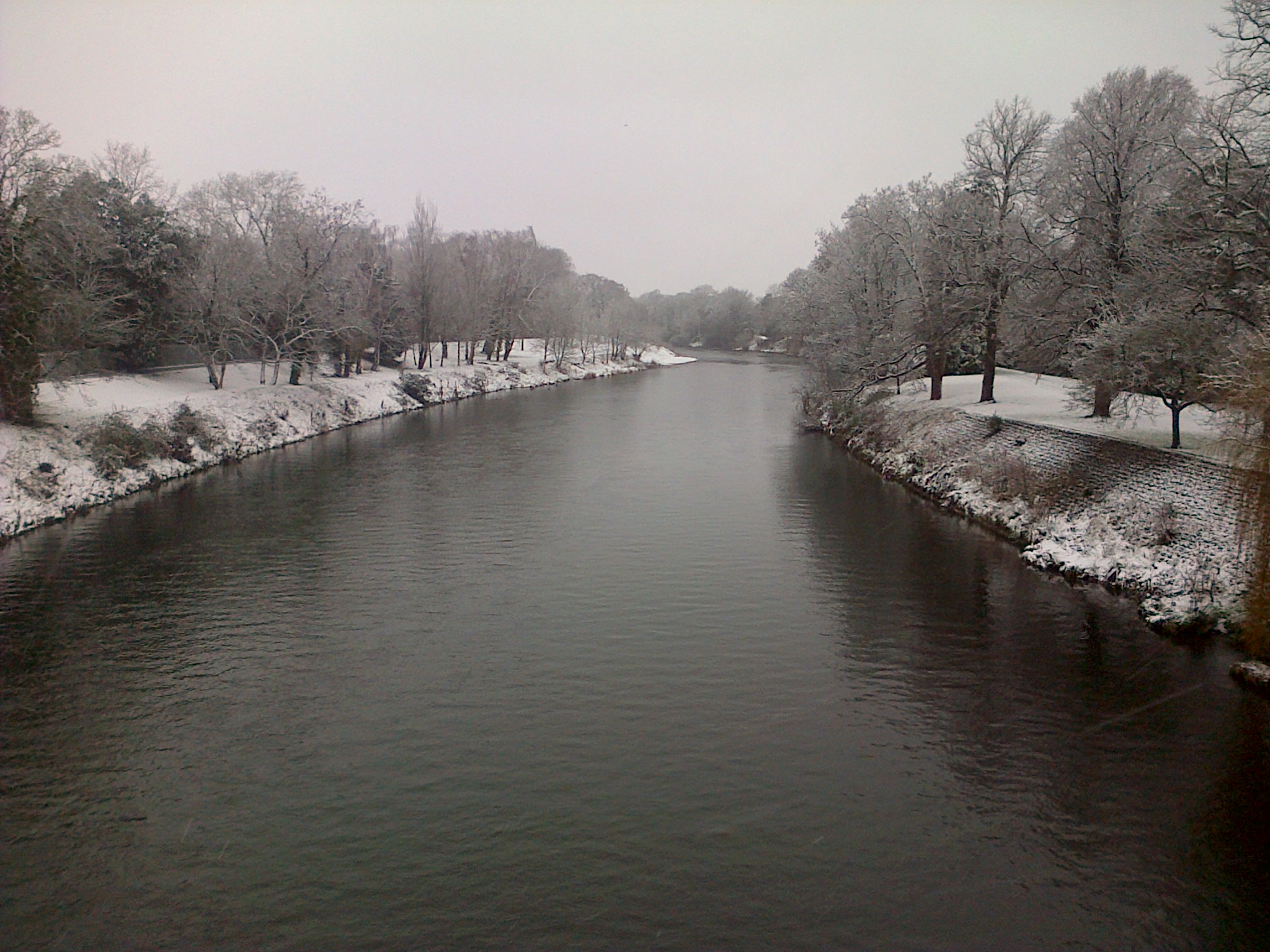
I managed to get away at a reasonable hour after the end of the interviews and made it home to Cardiff before the snow arrived, which it eventually did around one o’clock in the morning. It’s still snowing a bit, actually, but it’s now mixed with drizzle. The slushy streets are unusually quiet. There’s not all that much in Cardiff itself, but the examinations due to start at 9am this morning were delayed until 9.30 to allow students and staff extra time to get to the various venues. The main thing is that it’s very dark, with grey clouds filling the sky. Here’s another Blackberry pic, taken on my walk into work this morning..

IMG-20130118-00043

The contrast with Brighton yesterday is considerable, except for the temperature. Bright and dry in Brighton, dark and damp in Cardiff and cold in both.

Still, at least the “red snow alert” broadcast by the BBC came to nothing. This lot is definitely white.

Open and Direct

Posted in Open Access with tags , on January 17, 2013 by telescoper

Again, no time to post properly today but here’s another variation on the theme of Open Access. The idea described in this post sounds very familiar, actually…

gowers's avatarGowers's Weblog

For some months now I have known of a very promising initiative that until recently I have been asked not to publicize too widely, because the people in charge of it did not have a good estimate for when it would actually come to fruition. But now those who know about it have been given the green light. The short version of what I want to say in this post is that a platform is to be created that will make it very easy to set up arXiv overlay journals.

What is an arXiv overlay journal? It is just like an electronic journal, except that instead of a website with lots of carefully formatted articles, all you get is a list of links to preprints on the arXiv. The idea is that the parts of the publication process that academics do voluntarily — editing and refereeing — are just as…

View original post 879 more words

Brighton Blog

Posted in Biographical with tags , , , on January 16, 2013 by telescoper

Back to the splendid Cavalaire Hotel after an exhausting day of lectureships interviews, following on from yesterday’s exhausting day of presentations by the candidates and the subsequent (much less exhausting) dinner with the candidates in the Coach House. It’s such a packed schedule because we’re appointing three lecturers at the same time, so have a bigger group of candidates than at a normal recruitment event. I’m going to go out with an old friend for a relaxing pint and a meal later on, but I thought I’d just put up a quick post before I go out into the chilly seaside air.

The first thing I have to say is that I’ve been completely blown away by the quality of the applicants we have to select from. In fact, watching the succession of excellent presentations and participating in today’s interviews made me wonder how I ever managed to get a permanent job at all. It’s a shame we’re going to have to disappoint some of them, as we clearly can’t appoint them all, but fortunately I’m sure they’ll all have other opportunities in the near future. Not that we’ve made any decisions yet. There’s another bunch of interviews tomorrow and then we’ll be locked in a room in Sussex House until we make a decision. It won’t be easy, but it’s a good problem to have: like a football manager having to pick a team from a very strong squad.

Other than that this trip has been a process of gradually rediscovering Brighton. One thing that has changed for the better since I lived here in the late 80s  is the public transport system. The buses from the City Centre to the University Campus at Falmer are very frequent and quite cheap, only £2 for a single full-price and a lot cheaper if you buy a return or have a season ticket. Cardiff’s buses  are expensive and poorly organized in comparison.

One other thing struck me last night as I walked through town to the Coach House for dinner. Large parts of Brighton try very hard to be quite posh. There are many fancy restaurants and upmarket boutiques all over the place. But however hard they try they can’t quite shake off that slightly seedy image that I think Brighton will always possess, and which makes it such a fun place to live. It’s a bit like how a dirty joke is always funnier when it’s told by someone dressed as a vicar.

Further thoughts on the death of Aaron Swarz

Posted in Open Access with tags , on January 15, 2013 by telescoper

No time for a proper post today, but I couldn’t resist reblogging this thoughtful reflection on the same subject as my most recent offering.

Aaron Swartz and Open Access

Posted in Open Access with tags , , , on January 14, 2013 by telescoper

Just time for a very brief comment about the tragic death, apparently by his own hand,  of Aaron Swartz on Friday.  For those of you who haven’t followed the story, or perhaps don’t even know who he was, Aaron Swartz was an “internet activist” and leading champion of the open data movement. He was  a young man, only 26 when he died, who was prepared to fight for a cause he truly believed in. And to die for it.

Aaron Swartz was being prosecuted for alleged illegal downloads of scientific papers from the JSTOR system so he could make them available to the public. If convicted he would have faced a sentence of up to 35 years in prison.

Whether his prosecution was according to the letter of the law is a question I’ll leave for others to discuss. I’ll just say that it’s profoundly objectionable that the papers in the JSTOR are behind a paywall in the first place, just another example of how the academic publishing industry now actively stifles the free communication of scientific ideas and results that it purports to facilitate.

Aaron Swartz was a controversial character, but I know I’m not alone in thinking that his prosecution  was at the least heavy-handed and at the worst downright vindictive. Academics have been using the hashtag #PDFtribute on Twitter to pay tribute to his courage and to follow his example by posting their own research publicly free of charge.

Astronomers have making their results available in this way for years, through the arXiv.  We have also been paying through the nose for subscriptions to journals that do little more than duplicate the arXiv submission at such a prohibitive cost for access that the public can’t access them. In future we’re supposed to pay huge fees up front to academic publishing houses, to duplicate the arXiv in a different but equally pointless way. Pointless, that is, from any perspective other than their own profits.

As regular readers of this blog will know, I’ve suggested a way to bypass traditional journals and achieve a form of publication that is both open to all and run at a minimal cost to authors. That will be going on-line in the not-too-distant future. One thing remaining to be resolved is the name for the new system. I still haven’t decided on that, but at least I now know to whose name it will be dedicated.

R.I.P. Aaron Swartz (1986-2013).

Examination Period

Posted in Biographical, Education with tags , , on January 14, 2013 by telescoper

Up early this morning as I have to chair my final meeting of the Board of Studies in the School of Physics and Astronomy at Cardiff University before heading off to the Sussex-by-the-Sea for a three days of lectureship interviews and related matters. I’ll therefore probably only have time for brief posts over the next week or so.

Today is also the start of our mid-year examination period which goes on for a fortnight at Cardiff University. It’s therefore a good opportunity to send a hearty “good luck” message to all students about to take examinations, whether in Cardiff or elsewhere, especially those who are further on in their courses and for whom these papers have greater importance.

I’m a bit too busy for anything new so I thought I’d just post a rehash of a rehash of an excerpt from something I posted a while ago on the subject of examinations.

My feelings about examinations agree pretty much with William Wordsworth, who studied at the same University as me, as expressed in this quotation from The Prelude:

Of College labours, of the Lecturer’s room
All studded round, as thick as chairs could stand,
With loyal students, faithful to their books,
Half-and-half idlers, hardy recusants,
And honest dunces–of important days,
Examinations, when the man was weighed
As in a balance! of excessive hopes,
Tremblings withal and commendable fears,
Small jealousies, and triumphs good or bad–
Let others that know more speak as they know.
Such glory was but little sought by me,
And little won.

It seems to me a great a pity that our system of education – both at School and University – places such a great emphasis on examination and assessment to the detriment of real learning. The biggest bane of physics education is the way modular degrees have been implemented in this respect…

Don’t get me wrong. I’m not opposed to modularisation in principle. I just think the way we teach modules in British universities fails to develop any understanding of the interconnection between different aspects of the subject. That’s an educational disaster because what is most exciting and compelling about physics is its essential unity. Splitting it into little boxes, taught on their own with no relationship to the other boxes, provides us with no scope to nurture the kind of lateral thinking that is key to the way physicists attempt to solve problems. The small size of each module makes the syllabus very “bitty” and fragmented. No sooner have you started to explore something at a proper level than the module is over. More advanced modules, following perhaps the following year, have to recap a large fraction of the earlier modules so there isn’t time to go as deep as one would like even over the whole curriculum.

Our students take 120 “credits” in a year, split into two semesters. These are usually split into 10-credit modules with an examination at the end of each semester. Laboratories, projects, and other continuously-assessed work do not involve a written examination, but the system means that a typical  student will have 5 written examination papers in January and another 5 in May. Each paper is usually of two hours’ duration.

This means that the ratio of assessment to education has risen sharply over the last decades with the undeniable result that academic standards have fallen in physics. The system encourages students to think of modules as little bit-sized bits of education to be consumed and then forgotten. Instead of learning to rely on their brains to solve problems, students tend to approach learning by memorising chunks of their notes and regurgitating them in the exam. I find it very sad when students ask me what derivations they should memorize to prepare for examinations. A brain is so much more than a memory device. What we should be doing is giving students the confidence to think for themselves and use their intellect to its full potential rather than encouraging rote learning.

You can contrast this diet of examinations with the regime when I was an undergraduate. My entire degree result was based on six three-hour written examinations taken at the end of my final year, rather than something like 30 examinations taken over 3 years. Moreover, my finals were all in a three-day period. Morning and afternoon exams for three consecutive days is an ordeal I wouldn’t wish on anyone so I’m not saying the old days were better, but I do think we’ve gone far too far to the opposite extreme. The one good thing about the system I went through was that there was no possibility of passing examinations on memory alone. Since they were so close together there was no way of mugging up anything in between them. I only got through  by figuring things out in the exam room.

I don’t want to denigrate the achievements of students who are successful under the current system.  What I’m saying is that I don’t think the education we provide does justice to their talents. That’s our fault, not theirs…

Fire Escapes

Posted in Biographical, The Universe and Stuff with tags , , , , , on January 13, 2013 by telescoper

When I checked into Twitter this morning I was perturbed to see a flurry of panicky messages from astronomers down under. No wonder. The bush fires that have been raging in New South Wales for some time yesterday threatened to engulf the world-famous Siding Spring Observatory – the largest optical observatory in Australia – where 12 important telescopes are located, not to mention the people that operate them.

I’ll direct you to Amanda Bauer’s blog piece for dramatic coverage of what was obviously a terrifying and exhausting night, as flames and smoke crept remorsely closer to the observatory buildings.

SSO_fire1

At about 3.30pm local time, the buildings were evacuated and soon afterwards the fire penetrated the perimeter of the Observatory itself and subsequently swept through the complex. Temperatures inside some of the domes went as high as 100 °C and a lot of the electrical equipment has clearly been damaged.

Scary stuff but, most importantly of all, at least nobody was hurt. It also seems that damage to the observatory buildings and equipment was relatively slight. That however is a preliminary assessment, and may well be revised when it’s safe to enter the area again. Wildfires of this sort are extremely frightening things, so this must have been a very difficult time for those involved but, fingers crossed, it seems not to have turned out as badly as some feared.

Coincidentally, I had a little fire drama at home myself last night, although I hasten to add it was not on the same scale as the goings-on in Siding Spring. The weather in Cardiff being rather inclement I decided to complete my Saturday afternoon shopping with the purchase of a sack of logs for the fire. I have central heating, so don’t actually need the open fire for warmth, but it does add an extra level of cosiness on a winter evening. It also provides something to look at which is more interesting than the television I no longer possess…

It’s not all that easy to get a fire started in my grate, but I managed at the first attempt yesterday. Wood has a tendency to spit and crackle while burning so I put the fireguard around..
IMG-20130112-00037

(The flames weren’t actually that purple colour, more of a reddish orange; I think the flash on the camera is responsible for the change of hue.)

Anyway, I kept the fire going all through the evening which meant by the time I was ready for my nightcap I had no logs left. I then remembered a bit of wood (or, more accurately, MDF) that was left over when I had some shelves fitted. I found it in a cupboard and chucked it on the fire and left the room to make a drink.

A couple of minutes later my smoke alarm went off. Bemused, I ran back into the living room and found it filled with acrid smoke, produced by the veneer that coated the bit of surplus shelf, which was being produced in quantities too large for the chimney to cope with.

I hastily switched off the alarm and opened all the windows and doors on the ground floor, much to the amusement of the folk passing my house on the way home from the pub. Ironically my attempts to stay warm and cosy all through the evening had ended with arctic winds blowing through the house. The smoke cleared fairly soon, although the smell of it was still lingering this morning.

Still, nobody was hurt and there was no serious damage to buildings or equipment. And at least now I know my smoke alarm does actually work…