I came across this bit of poetry by William Wordsworth and thought I’d post here because quite a few of the readers of this blog might share his low opinion of University Life!
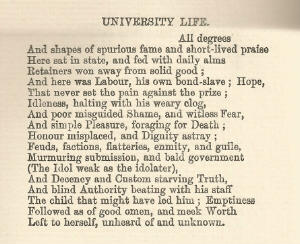
I came across this bit of poetry by William Wordsworth and thought I’d post here because quite a few of the readers of this blog might share his low opinion of University Life!
Just time for a very quick one before I scoot off to London for this month’s Royal Astronomical Society meeting (and subsequent Club dinner).
Today is the last day of “Revision Week” so I had a two-hour revision class this morning. I gave my final proper lecture at Cardiff University before Christmas, in fact, but this morning was the last teaching of any sort I’ll be doing here before I move to Sussex at the end of the month. If any of the students taking The Physics of Fields and Flows happens to read this, then I wish them the best of luck in next week’s examination!
I won’t be able to mark the scripts (and thus find out how well they’ve all done) until I return from a trip to Brighton next week to carry out interviews for three lectureships in astronomy at Sussex recently advertised. I’m looking forward to that, but I think the three days will be just as gruelling for the panel as for the candidates.
There were some sarcastic comments at the start of today’s class about the fact that I was wearing a suit and tie. It reminded me of an old joke: “Q: What do you call a ‹insert name of institution> graduate who’s wearing a suit? A: The Accused.” I think I can guess which institution most Cardiff students would pick as the butt of that one.
In fact the reason I’m wearing a suit today is that there’s a dress code for the RAS Club, which dines at the Athenaeum. It’s not very strict, actually, just jacket-and-tie, but I usually dust off one of my suits for the occasion as I don’t mind dressing up now and again. The only other clubs I’ve been to that operate a dress code have been very different, but I’ll draw a hasty veil over that.
The RAS Club isn’t particularly posh, actually, nor is it as stuffy as people seem to think. This evening is the Parish Dinner at which the Club elects new members. It’s nice to see quite a few youngsters among the candidates, but the election procedure is so dotty it’s impossible to predict who will get in!
Coincidentally, I got an email about the dress code for next week’s interviews. “Smart casual”, apparently. Since I don’t really know what that means I think I’ll wear a suit, which presumably most of the male candidates will too.
It always seems to me rather peculiar, this thing of dressing up for interviews. The default style of dress for academics is “scruffy”, so it’s a bit odd that we all seem to pretend that it’s otherwise for interviews. I suppose it’s just to emphasize that it’s a formal occasion from the point of view of the interview panel, and to show that the candidates are taking it seriously. I don’t really pay much attention to what interviewees wear, other than that if they look like they’ve just been dragged through a hedge one might infer that they’re a bit too disorganized even to be a member of the academic staff at a University or that they’re not really putting enough effort into the whole thing.
On the other hand, some people feel so uncomfortable in anything other than jeans and a T-shirt that putting on a suit would either be an unbearable ordeal for them or conflict with their self-image in some fundamental way. Neither of these are intended, so if that’s going to be the case for you, just dress as you normally do (but preferably with something reasonably clean).
This is the time of year that many undergraduate students are putting in their applications for PhD places too. I sometimes get asked (and did yesterday, in fact) whether a (male) candidate for a PhD place should wear a suit and tie for the interview. Having conducted interview days for many years at a number of different institutions, my experience is that a small proportion dress formally for PhD interviews than for job interviews. My advice to students asking about this is just to say that they should try to look reasonably presentable, but suit–and-tie are definitely not compulsory. It’s unlikely the staff interviewing you will dress formally, actually…
Anyway, my views may well differ from those of my readers so here’s a poll.
I realise this post is written from a male perspective, as women’s clothes are a mystery to me. I hope someone can explain through the comments box what the equivalent categories are for female persons? At least women are spared the choice of whether or not to wear a tie. Is there an equivalent quandary?
I thought I’d try out the WordPress app for my Blackberry by posting this old picture, taken in the Arena di Verona while we were waiting for the start of the sumptuous production of Verdi’s Aida on 30th July 2006. The Opera doesn’t start there until it gets dark, but the evening sun was glinting on the gold pyramid sitting in the centre of the stage, so I couldn’t resist getting a picture. The late start meant we enjoyed a nice dinner before the performance, along with a very nice bottle of Amarone…

I noticed a news item this morning which explains that the Supernova Cosmology Project have found a supernova with a redshift of 1.71, which makes it the most distant one found so far (about 10 billion light-years away). That – and hopefully others at similar distances – should prove immensely useful for working out how the expansion rate of the Universe has changed over its history and hence yield important clues about the nature of its contents, particularly the mysterious dark energy.
Of particular relevance to this blog is the name given to this supernova, Mingus, after the jazz musician and composer Charles Mingus. Both the discovery and the great choice of name are grounds for celebration, so here’s one of my favourite Mingus tracks – the delightfully carefree and exuberant Eat that Chicken, from the Album Oh Yeah. Enjoy!
Follow @telescoperI’m so excited to have won something other than a dictionary for a change!
I’ve just received delivery of the Little Sun that I was promised after entering a little competition on Twitter. It’s a solar-powered light that charges during daylight hours to provide a bright safe source of illumination at night. “Little Sun transforms the light that is for all of us into light that is for each of us…”

This gives me an excuse to mention that later this month my contribution to the Charter of Light will go live on the website. Please follow the campaign, which aims to improve light and energy access in the developing world.
Follow @telescoperI came across this old map of Cardiff the other day and thought I’d post it to make up for the fact that I’ve not posted much about the local history of this fascinating city over the years.

I can’t find a date for the map, but I guess it is from the early 20th Century.
The most interesting thing about the map is the pretty extensive network of canals. The Dock Feeder Canal still runs down from the top of the map then turns East and past the North side of the Castle, and then South again towards Cardiff Bay. Some of its route is now underground, including the section that used to be Edward Terrace and Pembroke Terrace, which now form the two sides of Churchill Way under which the canal still flows.
It’s worth mentioning in passing that most of the present Cardiff Castle is basically a late 19th Century folly, but it is the site of much older buildings, including a Norman Keep and a Roman fort. When the Romans occupied the location, the area from the Castle down to the sea was basically a swamp, flanked by the flood plain of the Taff to the West, with the salt marshes of Cardiff Bay to the South. Almost all of present-day Cardiff is reclaimed land.
The Dock Feeder Canal was constructed around 1840 in order to supply water to the Docks in Cardiff Bay so that they could be operated even when the tide was out. This gave Cardiff one of the world’s first 24-hour docks and led to a rapid expansion of commerce and population in the city during the mid-19th Century.
Among the quite surprising facts about the City of Cardiff is its spectacular population growth. The first official census was held in 1801 and it showed Cardiff to have a population of 1,870 – much smaller than other Welsh towns like Merthyr Tydfil (7,700) and Swansea (6,000). Every ten years another census was carried out, with the figures for Cardiff growing as follows:
1801 – 1,870
1811 – 2,457
1821 – 3,251
1831 – 6,187
1841 – 10,079
1851 – 18,351
1861 – no data
1871 – 57,363
1881 – no data
1891 – 128,915
1901 – 164,333
1911 – 182,259
1921 – 222,827
1931 – 226,937
1941 – no data
1951 – 243,632
1961 – 283,998
1971 – 293,220
1981 – 286,740
1991 – 296,900
2001 – 305,353
The expansion of the docks in Cardiff Bay, driven by the export of coal from the valleys, seems to have been the main factor in driving the population increase, and this accelerated markedly from the middle of the 19th century until the early 20th century.
Early on in the industrial revolution the South Wales valleys were primarily concerned with the production of iron. In February 1794, the 25-mile-long Glamorganshire Canal was opened between Cardiff and Merthyr Tydfil to bring iron products down to the coast and for nearly 50 years was unchallenged as the main transport link between the two towns. It was later to become the primary route for carrying coal to the Bay. The Glamorganshire Canal can be seen on the map too, but has now virtually vanished, the route it used to follow now just being marked by new roads; for example, the route it used to take to the East of Bute Park is now covered by North Road.
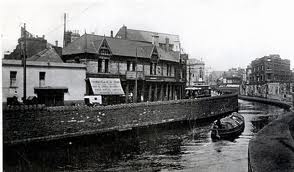
Here is an old photograph of Mill Lane, now the site of a number of not-very-salubrious eating and drinking establishments. I suspect not many Cardiff residents know that less than half a century ago, these were canalside properties..
In October 1839, the Bute West Dock covering 19 acres with 9,400 feet of quays was opened, and the construction of the Dock Feeder to regulate the water supply to the dock from the River Taff was completed. Entirely paid for by the second Marquis of Bute, this new dock set in motion Cardiff’s amazing growth to become the world’s biggest coal exporting port. The Taff Vale Railway was opened in 1841 between Cardiff and Abercynon and soon overtook the Glamorganshire Canal in economic importance. Coal shipments from Cardiff exceeded one million tons for the first time in 1851. In December 1855, the first historical trainload of Rhondda steam coal arrived at Cardiff, where the Bute East Dock was opened. By 1883 the docks handled six million tons of coal and by 1913 this figure had grown to a staggering 10.7 million tons.
Much of the labour needed to handle this volume of coal came from immigrants, including very large numbers of Irish but also lots of other people from all around the world. By 1850 there were no less than 20 foreign consulates in Cardiff and the city quickly established the cosmopolitan reputation it has kept to this day.
After the end of the First World War the coal trade suffered because the market was flooded with cheap German coal used for war reparations. That, and the subsequent depression, led to a decline in Cardiff as a port, although it was very busy during the Second World War. About 75 per cent of the supplies for the American forces in Europe were shipped out through Cardiff docks following the D-Day landings in June 1944. This was a short-lived renaissance; the last ever shipment of coal left Bute Dock in 1950.
Other random but possibly interesting points about the map are:
I was making a start at cleaning out some of the stuff in my office yesterday and came across a bunch of foreign editions of my book Cosmology: A Very Short Introduction. I’d forgotten I had these, and am not even certain what languages they are all in. Is the first in Japanese or Korean? I really can’t remember.
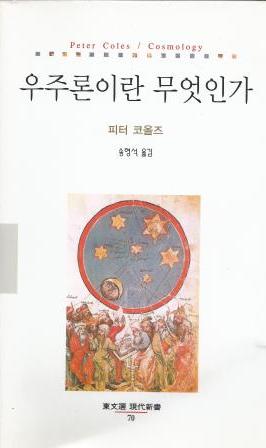
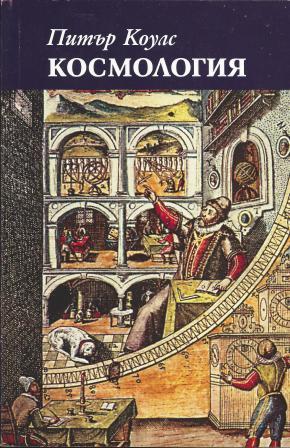
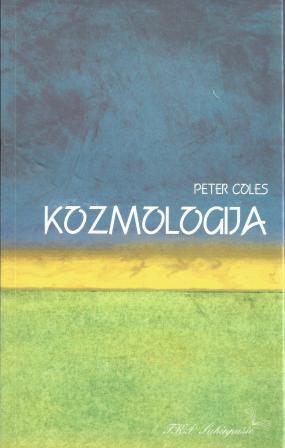
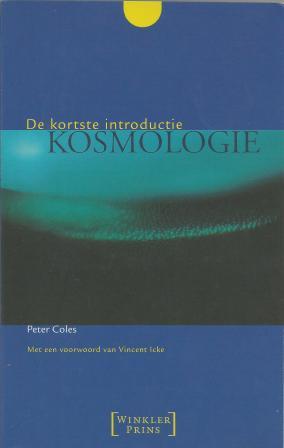
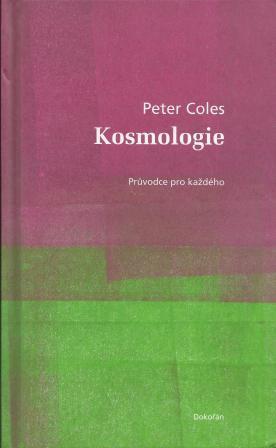
…still, it’s interesting to see how they’ve chosen different covers for the different translations, and at least I know what my name looks like in Russian Bulgarian!
Bit busy today so I thought I’d just post this talk by Cardiff’s own Prof. Bangalore Sathyaprakash at last year’s TEDX event in Cardiff.
The title is Cosmic Sirens although given that the topic is gravitational waves I hope that “sirens” isn’t intended to mean those entirely mythical entities that lure unsuspecting PhD students to their ultimate destruction…
Anyway, here’s the blurb:
In 1916 Einstein predicted that dynamical mass distribution generates ripples in the very fabric of spacetime that propagates outwards at the speed of light.
For over two decades B.S. Sathyaprakash (Sathya for his family and friends) is engaged in research to detect these ripples called gravitational waves, from cataclysmic cosmic events such as exploding stars, colliding black holes and the big bang. His personal goal is to observe and understand black holes and gravity using gravitational radiation. He is the head of the gravitational physics group at Cardiff University — a centre for modelling astronomical sources of gravitational radiation, discovering innovative algorithms to search for this radiation and analyzing data from gravitational-wave detectors using massive computer clusters.
Although there is firm indirect evidence that certain astronomical systems do emit gravitational waves, so far no one has detected them directly. Sathya and his team are part of a worldwide effort, called the LIGO Scientific Collaboration, to detect these elusive waves using kilometer long laser interferometers in the US, Europe and Japan. Recently, Sathya helped develop the science case for building such a detector in India. He has been involved in the European design study of a third generation underground detector with a 30 km baseline called the Einstein Telescope, chairing the group that developed the science case for this ambitious venture.
And here is the actual talk..
Follow @telescoperHow will I amuse myself when I’ve got no TV or internet connection?
Here’s the answer…
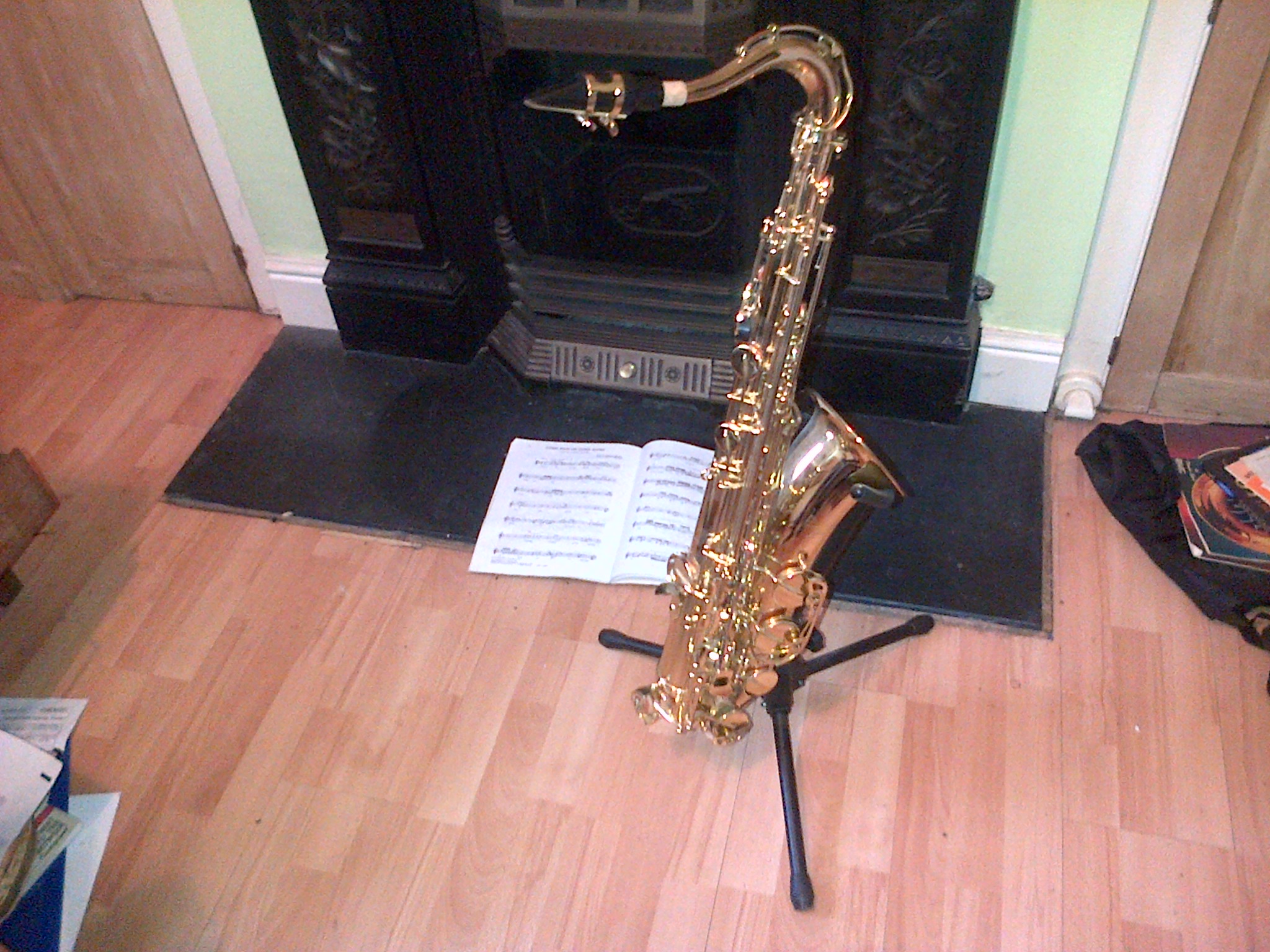
..although I’m not sure the neighbours are going to be very happy about it!
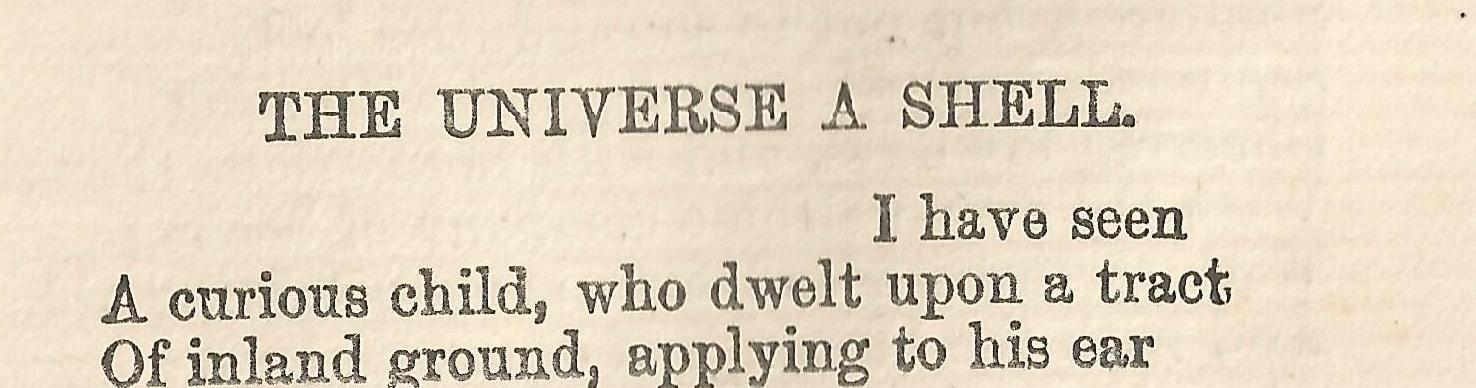
Follow @telescoperOne of my very first blog posts (from way back in 2008) was inspired by an old book of poems by William Wordsworth that I’ve had since I was a child. I was reading it again this evening and came across this short excerpt, near the end of the book, from The Excursion, and entitled for the purposes of the book The Universe a Shell. It struck me as having a message for anyone who works on the science of things either too big or too small to be sensed directly on a human scale, so I thought I’d post it.
I decided to scan it in rather than copy it from elsewhere on the net, as I really love the look of that old faded typeface on the yellowing paper, even if it is a bit wonky because it went over two pages. I’ve been fond of Wordsworth for as long as I can remember and, like a few other things, that’s something I’ll never feel the need to apologize for…


 In the Dark