Author Archive

Winter landscape, with rocks

Posted in Poetry with tags , on December 29, 2012 by telescoper

Water in the millrace, through a sluice of stone,
plunges headlong into that black pond
where, absurd and out-of-season, a single swan
floats chaste as snow, taunting the clouded mind
which hungers to haul the white reflection down.

The austere sun descends above the fen,
an orange cyclops-eye, scorning to look
longer on this landscape of chagrin;
feathered dark in thought, I stalk like a rook,
brooding as the winter night comes on.

Last summer’s reeds are all engraved in ice
as is your image in my eye; dry frost
glazes the window of my hurt; what solace
can be struck from rock to make heart’s waste
grow green again? Who’d walk in this bleak place?

by Sylvia Plath (1932-1963)

The Planck Rumour Mill

Posted in The Universe and Stuff with tags , , , , on December 28, 2012 by telescoper

I gather the internet is crawling with people searching for rumours about the Planck mission. It would obviously be entirely inappropriate for me to direct my readers to any website where they might obtain access to confidential information about this experiment, the results from which are embargoed until well into the New Year. So naturally that’s what I’m going to do. Well, blog traffic doesn’t generate itself does it?

As a Telescoper exclusive I am able to offer you a sneak preview of the top secret Planck data well in advance of official release. If you want to see what Planck scientists have been looking since Planck was launched in 2009, just click here.

Around the old home

Posted in Biographical with tags , , , on December 28, 2012 by telescoper

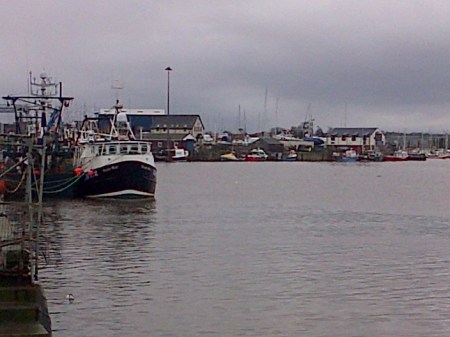
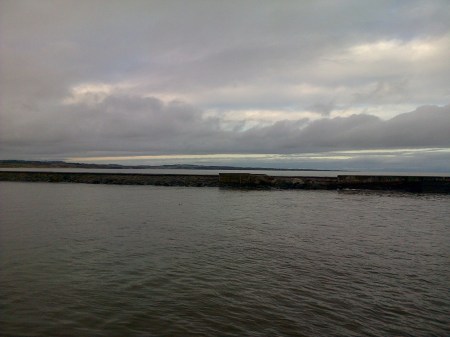
Back from a brief Christmas visit up North I thought I’d post a few snaps I took on our traditional Boxing Day spin around Northumberland. The weather wasn’t exactly marvellous, but it did at least stop raining for a while when we reached Amble  so we got out of the car and went for a stroll around the little harbour…

IMG-20121226-00023

IMG-20121226-00024

Although it was a cold and wet day it wasn’t too windy. They must be tough fishermen who go out into the North Sea in those little boats, but they’re friendly folk too – waving to us landlubbers as they came in and out of the harbour.

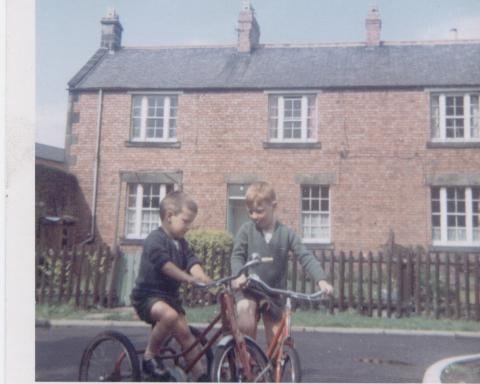
On the way home we stopped at Benwell, not a picturesque place but the part of Newcastle in which I was brought up. I’ve posted about the little house where my first memories live here, and there’s an old photograph of it here:

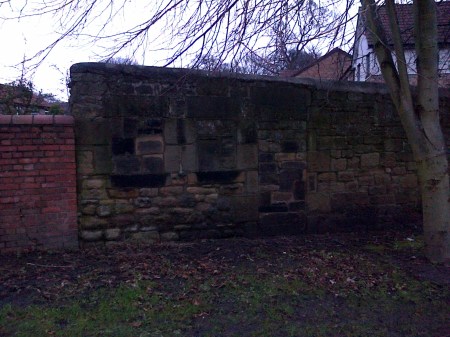
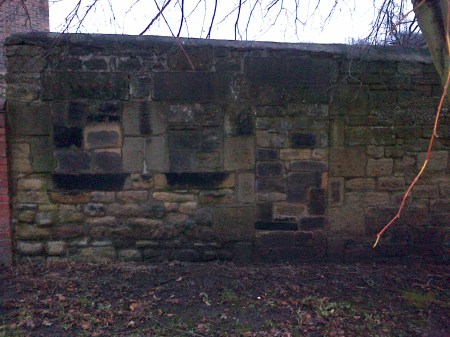
The house itself (ours was the one on the left on this picture) was built of brick but to the left hand side you can just see a stone wall. The two cottages were demolished some time ago, along with Pendower School which was behind them as viewed from the picture. The whole area has now been covered with new houses, but for some reason they left the stone wall. I hopped out of the car to take a couple of pictures, as this is all that remains of the first place I can remember living. These were both taken from Ferguson’s Lane, which is immediately behind the stone wall I mentioned earlier, i.e. to the left of the two cottages in the old photograph.

IMG-20121226-00026

IMG-20121226-00027

In the second picture you can see the filled in outlines of the door which led to our backyard (on the right) and (on the left) the holes through which the coalman used to deliver the coal that was the only form of heating in the house. There was no central heating and no heating at all upstairs, incidentally, so we had very cold bedrooms in winter!

Back in the ‘Diff

Posted in Biographical with tags , , on December 27, 2012 by telescoper

Well, I made it back to Cardiff more-or-less in one piece despite the best efforts of Cross Country Trains. The train I took from Newcastle was three carriages shorter than expected, so my reserved seat was in a carriage that didn’t exist. Obviously not many people travel at Christmas so they thought they didn’t need a full size train. I had decided to treat myself to a First Class ticket to make the long journey to Newcastle and back as pleasurable as possible, but I ended up having to scramble for a seat in second class. By the time we reached Darlington it was standing room only throughout the train, including First Class, and each station stop took ages as scores of travellers tried to board the already packed carriages.

The train was 45 minutes late into Birmingham, but the connecting train from there to Cardiff was also delayed so I managed to catch it. However, never willing to let any cloud show its silver lining, Cross Country Trains decided to terminate the Cardiff train at Newport so I had to scramble again onto another train with a host of similarly disgruntled passengers. You might have thought they would have tried their best to help their customers out on a day that the whole railway network has been in chaos, but no.

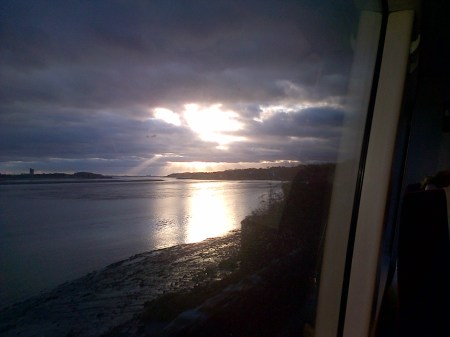
Anyway, I got home only an hour late so perhaps shouldn’t complain too much. Expectations must be kept low when travelling on the British railway network. At least I got a lovely view along the Severn in the late afternoon as the train headed towards Newport…

IMG-20121227-00028

It’s nice to be home. I think I’ll chill out this evening and defer writing my claim for compensation until tomorrow!

Nadolig Llawen i chi gyd

Posted in Uncategorized with tags , on December 25, 2012 by telescoper

Having spent most of the afternoon setting up a new laptop and  wireless router, and installing various bits of software on the computers here at the old family home, I thought the least I could do is sign in for a moment and wish you all a very Merry Xmas while we prepare for dinner.

If your Christmas Day has been half as good as mine, then mine has been twice as good as yours!

A Child’s Christmas in Wales

Posted in Literature with tags , on December 24, 2012 by telescoper

Well, I’m up early to get the train Up North, so I thought I’d just sign off for the holiday with a little gift. I have posted this before but, on the grounds that you can’t have too much of a good thing, here it is again. Plus, of course, this will be my last Christmas in Wales…

There are only two kinds of people in the world: those who have heard Dylan Thomas reading his wonderful short autobiographical story A Child’s Christmas in Wales; and those who haven’t. I’ve heard it hundreds of times, like a favourite piece of music. Technically it’s a prose work, but it’s prose that’s so close to poetry that it really defies categorisation. Either way, the language certainly has a musical quality, and the author’s voice brings it to life in a way nobody else has ever been able to. It’s also shot through with flashes of a dry offbeat humour that tickles my fancy any time of the year but at Christmas time I think it’s just magical.

Swingin’ Them Jingle Bells

Posted in Jazz with tags , on December 23, 2012 by telescoper

It’s with some trepidation that I find myself facing the long journey to Newcastle tomorrow. There’s been heavy rain overnight (even leading to a Flood Alert along the Taff near my house) and quite a lot of disruption on the railways today as a consequence. Nevertheless I’m determined to make an attempt to get into the Christmas spirit. If Fats Waller can’t do it, nobody can. Here’s his classic version of Jingle Bells on which the general atmosphere of hilarity and inspired chaos allows his superb musicianship to shine all the more brightly. Few ever managed to play Harlem Stride piano as well as Fats Waller, and he’s on top form in the opening choruses of this record.

Will I make it home on Christmas Eve? In the immortal words of Mr Waller “One never knows, do one?”

Science and Politics

Posted in Politics, Science Politics with tags , , , , on December 22, 2012 by telescoper

It’s a dark dreary December day with a downright deluge descending outside to add to the alliteration.  Fortunately, it being almost Christmas, this weekend is offering a glut of crosswords with which I’ve been occupying myself while waiting for a break in the rain.

Among the puzzles I’ve done was a moderately challenging one in the New Statesman.  I have a subscription to the New Statesman, which means that I get it delivered in the post approximately two days after everyone else has had a chance to read it. After finishing the crossword, which contain a number of hidden (unclued) famous pseudonyms, I had a look at the rest of the magazine and discovered that this issue, the Christmas one, was edited by Brian Cox (who needs no introduction) and Robin Ince (who I believe is a comedian of some sort). It’s nice to see science featured so strongly in a political magazine, of course, but I did raise an eyebrow when I read this (about the LHC) in a piece written by Professor Cox:

The machine itself is 27 kilometres in circumference and is constructed from 9,300 superconducting electromagnets operating at -271.3°C. There is no known place in the universe that cold outside laboratories on earth…

Not so. The cryogenic systems on ESA’s Planck mission achieved a stable operating temperature at the 0.1 K level. This experiment has now reached the end of its lifetime and is warming up, but  the Herschel Space Observatory with a temperature of 1.4 K is still cooler than the Large Hadron Collider. Moreover, there are natural phenomena involving very low temperatures. The Boomerang Nebula has a measured temperature of −272.15°C, also lower than the LHC.  How does this system manage to cool itself down below the temperature of the cosmic microwave background, I hear you asking.  A detailed model is presented here; it’s “supercooled” because it is expanding so quickly compared to the rate at which it is absorbing CMB photons.

Anyway, if this all seems a bit pedantic then I suppose it is, but if prominent science advocates can’t be bothered to check their facts on things they claim to be authorities about, one wonders why the public show pay them any attention in the broader sphere. Fame and influence bring with them difficult responsibilities.

That brings me to another piece in the same issue, this one co-authored by Cox and Ince, about Science and Society entitled Politicians must not elevate mere opinion over science. I’d realised that there was a bit of a Twitter storm brewing about this item, but had to wait until the horse and cart arrived with my snail mail copy before I could try figure out what it was about. I still haven’t because although it’s not a particularly focussed piece it doesn’t seem to say anything all that controversial. In fact it just struck me that it seems to be a bit self-contradictory, on the one hand arguing that politicians should understand science better and on the other calling for a separation of science and politics.   There are two more detailed rejoinders here and here.

For my part I’ll just say that I think it is neither possible nor desirable to separate science from politics.  That’s because, whether we like it or not, we need them both. Science may help us understand the world around us, and (to a greater or lesser degree of reliability) predict its behaviour, but it does not make decisions for us. Cox and Ince argue that

Science is the framework within which we reach conclusions about the natural world. These conclusions are always preliminary, always open to revision, but they are the best we can do.

I’d put it differently, in terms of probabilities and evidence rather than “conclusions”, but I basically agree. The problem is that at some point we have to make decision which may not depend solely on the interpretation of evidence but on a host of other factors that science can say nothing about. Definite choices have to be made, even when the evidence is ambiguous. In other words we have to bring closure, much as we do when a jury delivers a verdict in a court of law, which is something that science on its own can rarely do. Mere opinion certainly counts in that context, and so it should. The point is that science is done by people, not machines. People decide what questions to ask, and what assumptions to proceed from. Choices of starting point are political (in the widest sense of the word) and sometimes what you get out of a scientific investigation  is little more than what you put in.

It’s always going to a problem in a democratic society that scientific knowledge is confined to a relatively small number of experts. We can do our best to educate as many as possible about what we do, but we’re always going to struggle to explain ourselves adequately. There will always be conspiracy theories and crackpots of various kinds. The way to proceed is not to retreat into a bunker and say “Trust me, I’m a scientist” but to be more open about the doubts and uncertainties and to present a more realistic picture of the strengths and limitations of science. That means to engage with public debate, not by preaching the gospel of science as if it held all the answers, but by acknowledging that science is a people thing and that as such it belongs in politics as much as politics belongs in it.
WMAP: The Last Judgement

Posted in The Universe and Stuff with tags , , , , , , on December 21, 2012 by telescoper

It seems the the Wilkinson Microwave Anisotropy Probe, or rather the estimable team of people working on it, have produced yet another set of maps and key results. I believe this will be the final release from WMAP. The paper is on the arXiv here and it represents a synthesis of no less than nine years of measurements of the cosmic microwave background radiation:

Here’s the abstract:

We present the final nine-year maps and basic results from the WMAP mission. We provide new nine-year full sky temperature maps that were processed to reduce the asymmetry of the effective beams. Temperature and polarization sky maps are examined to separate CMB anisotropy from foreground emission, and both types of signals are analyzed in detail. The WMAP mission has resulted in a highly constrained LCDM cosmological model with precise and accurate parameters in agreement with a host of other cosmological measurements. When WMAP data are combined with finer scale CMB, baryon acoustic oscillation, and Hubble constant measurements, we find that Big Bang nucleosynthesis is well supported and there is no compelling evidence for a non-standard number of neutrino species (3.26+/-0.35). The model fit also implies that the age of the universe is 13.772+/-0.059 Gyr, and the fit Hubble constant is H0 = 69.32+/-0.80 km/s/Mpc. Inflation is also supported: the fluctuations are adiabatic, with Gaussian random phases; the detection of a deviation of the scalar spectral index from unity reported earlier by WMAP now has high statistical significance (n_s = 0.9608+/-0.0080); and the universe is close to flat/Euclidean, Omega_k = -0.0027 (+0.0039/-0.0038). Overall, the WMAP mission has resulted in a reduction of the cosmological parameter volume by a factor of 68,000 for the standard six-parameter LCDM model, based on CMB data alone. For a model including tensors, the allowed seven-parameter volume has been reduced by a factor 117,000. Other cosmological observations are in accord with the CMB predictions, and the combined data reduces the cosmological parameter volume even further. With no significant anomalies and an adequate goodness-of-fit, the inflationary flat LCDM model and its precise and accurate parameters rooted in WMAP data stands as the standard model of cosmology.

The main reason for posting this is to acknowledge the remarkable impact WMAP has had on the field of cosmology. The standard model does indeed account for most available cosmological data extremely well. I’m not entirely sure about the “no significant anomalies” bit in the last sentence, in fact, but I won’t argue with it as it depends entirely upon what you mean by significant. It’s not exactly proven that the fluctuations have “random phases” either. We’ll just have to see whether data from Planck, due to be released next year, will reveal evidence of any physics beyond the standard framework WMAP did so much to establish.

Das Letzte Gericht

Posted in Art, Astrohype, The Universe and Stuff with tags , , , on December 20, 2012 by telescoper

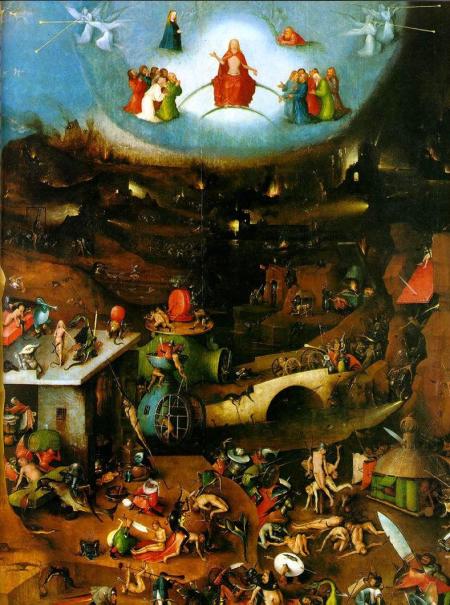
Apparently the world is due to end tomorrow, so I’ve saved quite a lot of money by not having done my Christmas shopping yet. Anyway, the forthcoming Apocalypse reminded me of the painting that I often use to introduce cosmology talks. I usually use this piece of Hieronymus Bosch Das letzte Gericht (The Last Judgement) to illustrate my feelings about the standard cosmological model:

das_letzte_gericht

The top part represents the concordance cosmology. It clearly features an eminent cosmologist surrounded by postdoctoral researchers. Everything appears to be in heavenly harmony, surrounded by a radiant glow of self-satisfaction. The trumpets represent various forms of exaggerated press coverage.

But if you step back from it, and get the whole thing in a proper perspective, you realise that there’s an awful lot going on underneath that’s not so pleasant or easy to interptet. I don’t know what’s going down below there, although the unfortunate figures slaving away in miserable conditions and suffering unimaginable torments, are obviously supposed to represent graduate students. The large knife visible in the bottom right corner clearly symbolises budget cuts looming in the next Comprehensive Spending Review.

The main point is that the concordance model is based on rather strange foundations: nobody understands what the dark matter and dark energy are, for example. Even more fundamentally, the whole thing is based on a shotgun marriage between general relativity and quantum field theory which is doomed to fail somewhere along the line.

Far from being a final theory of the Universe I think we should treat our standard model as a working hypothesis and actively look for departures from it. I’m not at all against the model. As models go, it’s very successful. It’s a good one, but it’s still just a model.