At the Winter School I attended recently I was struck by the not inconsiderable similarity in both sound and appearance between Dr Jonathan Pritchard of Imperial College and former Prime Minister Sir John Major. Oh yes. I wonder if, by any chance, they might be related?
Follow @telescoperAuthor Archive
Astronomy Look-alikes, No. 81
Posted in Astronomy Lookalikes with tags John Major, Jonathan Pritchard on December 19, 2012 by telescoperWhat’s Your Lecture Face?
Posted in Biographical, Education with tags Higher Education, Lecturing, Students, University on December 19, 2012 by telescoperI was thinking the other day – it doesn’t happen that often so I try to make the most of it when it does – about what a strange situation it is when someone stands up in front of a bunch of students and lectures at them for an hour. In the course module I’ve just finished teaching I’ve had the best part of a 100 people watching, and occasionally listening to, me drone on about something or other. What’s strange is that all those people see basically the same thing, whereas the lecturer gets to see all those different facial expressions. I wonder if the students are even aware that each one has a characteristic lecture face?
I’m one of those people who finds it very difficult to give a lecture without looking at the audience. It’s partly to try to establish some kind of rapport with them, notably in order to encourage them to answer when I ask a question or to offer questions of their own, but also to try to figure out whether anyone at all is following what I’m saying. Not all students are helpful in this regard, but some have very responsive mannerisms, nodding when they understand and frowning when they don’t. When I’m teaching a class for the first time I usually look around a lot in an attempt to identify those students who are likely to help me gauge how well things are going. Usually, there are only a few barometers like this but I would be lost without them. Fortunately most students seem to sit in the same place in the theatre for each lecture so you can usually locate the useful ones fairly easily, with a discreet look around before you start.
Most other students seem to have a default lecture face. The expressions range from a perpetual scowl to a vacant smile (each of which is in its own way a bit scary). There’s the “wish I wasn’t here” face of pure boredom, not to mention those who are fast asleep; I don’t mind them as long as they don’t snore. There’s the Bookface of someone who’s not listening but messing around on Facebook, and the inscrutable ones whose faces are masks yielding no clues as to what, if anything, is going on behind. The brightest students often seem to belong to the last group, although I haven’t done a statistical study of this so that must be taken as purely anecdotal.
Anyway, I feel a Christmas Poll coming on. Please participate if you can be bothered. If you don’t know what your own lecture face is, then you could always ask….
Follow @telescoperTalking about Winterreise
Posted in Music with tags Benjamin Britten, Franz Schubert, Peter Pears, Winterreise on December 18, 2012 by telescoperWell, here’s a find! A fascinating bit of film featuring Benjamin Britten and Peter Pears discussing and performing Franz Schubert‘s great song cycle, Winterreise.
Follow @telescoperPasso del Tonale Winter School 2012
Posted in Biographical, Books, Talks and Reviews with tags Cosmology, Passo Del Tonale, Winter School on December 18, 2012 by telescoperI’m having a restful morning at home because (a) it was our Departmental Christmas Lunch yesterday meaning that I’m feeling a bit fragile and (b) there’s a planned electrical shutdown in our building this morning meaning that there’s not much point going in until it’s all back up anyway.
Anyway, since various people made the odd facetious comment accusing me of skiving off last week, I thought I’d take the opportunity to reflect a little on the Winter School that I was lecturing at last week. This took place at Passo del Tonale, in the Italian Alps and was the Sixth in a series of schools for graduate students and postdocs held there annually. When I was invited to take part, I was asked to give five lectures as a sort of overview of the current state of cosmology. Subsequently one of the other speakers dropped out so instead of inviting a replacement, the remaining four were given an extra lecture each. Then one of those was taken ill during the summer school so I stepped in at short notice to give another one. And so it came to pass that I gave seven lectures altogether, in the space of five days. That’s considerably more lecturing than I would have done had I stayed in Cardiff.
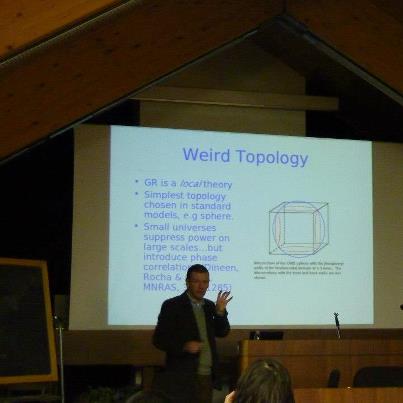
Anyway, here’s a picture of me during one of the lectures (taken by one of the participants, Chris Crowe).
Afternoons were kept free for skiing and snowboarding, but my dodgy knees don’t allow me to participate in such activities. I am not shap’d for sportive tricks nor made to court an amorous looking-glass. I had lectures to prepare anyway.
However the hosts looked after us well and there was a fine conference dinner on Wednesday evening,
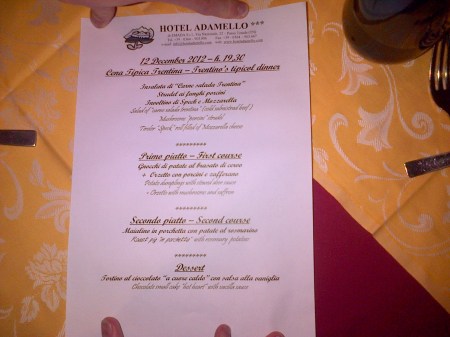
the main course featuring a roast pig brought into the room by the chefs with some aplomb:
Everything was eaten. I was given the honour of having one of the ears, in fact. A bit chewy, but quite tasty in case you were wondering. I don’t know what the vegetarians did.
Anyway, at the end of the school the lecturers were presented with bottles of fine Grappa. I’ll no doubt be sampling mine over the Christmas vacation!
Follow @telescoperDebt
Posted in Poetry with tags Debt, Poetry, Sara Teasdale on December 17, 2012 by telescoperWhat do I owe to you
Who loved me deep and long?
You never gave my spirit wings
Or gave my heart a song.
But oh, to him I loved,
Who loved me not at all,
I owe the open gate
That led through heaven’s wall.
by Sara Teasdale (1884-1933)
Follow @telescoperKettles, pots and metonymic shifts….
Posted in Uncategorized on December 17, 2012 by telescoperAs our Departmental Christmas lunch is looming I only have time for a brief reblog of this nice discussion of boiling water in pots. It might strike you as as a bit obsessive to write about the physics of such an everyday phenomenon, but I think a bit of an obsession about physics is a very good thing indeed.
P.S. As a fully paid-up member of Pedants Anonymous I couldn’t resist drawing attention to the metonymic shift involved in the title “Watching pots boil”. Of course the pot doesn’t boil – the water in it does….
My previous article about kettles left me wondering: Can gas hobs really waste more than half of the calorific energy in the gas? I decided to try a few more experiments and finally I think I have an answer: ‘Yes’. Gas hobs really do fail to transfer a great deal of the calorific energy in the gas to the pan or kettle they are heating.
Experiment#1 Rather than measuring the total time to reach 100 °C, I measured the rate of temperature rise. Because the heat capacity of water is well known, this allowed me to estimate how much thermal power was entering the water. So I spent a happy hour or so heating up various amounts of water: first 200g, then 400 g, 600g and finally 800g and I measured the temperature every 20 seconds.
I knew the burner power was 1.75 kW, and after a little jiggery pokery with a…
View original post 639 more words
Another Refusal to Mourn
Posted in Poetry with tags A Refusal to Mourn the Death by Fire of a Child in London, connecticut, Dylan Thomas, murders, newtown on December 17, 2012 by telescoperI posted this poem after the terrible events in Norway last year. Sadly the awful killings in Newton, Connecticut make it relevant again.
The full title is A Refusal to Mourn the Death by Fire of a Child in London and it was written by Dylan Thomas. Published just after the end of the Second World War, it was written some time earlier when Thomas heard news of a young girl who had burned to death when the house she was in was set on fire during an air raid. Here is the poet himself reading it.
The idea behind the poem is complex, and its message double-edged, but Thomas finds a perfect balance between horror and sadness, and between indignation and heartbreak. Children shouldn’t have to die, and neither should anyone else whose life is cut short by another’s hand, but we have to accept that they can and do. There’s no consolation to be found in mourning and in any case it’s hypocritical to favour one death with elegies, when suffering is so widespread. The best we can do is allow the dead some dignity and their families and loved ones some time to grieve.
Never until the mankind making
Bird beast and flower
Fathering and all humbling darkness
Tells with silence the last light breaking
And the still hour
Is come of the sea tumbling in harness
And I must enter again the round
Zion of the water bead
And the synagogue of the ear of corn
Shall I let pray the shadow of a sound
Or sow my salt seed
In the least valley of sackcloth to mourn
The majesty and burning of the child’s death.
I shall not murder
The mankind of her going with a grave truth
Nor blaspheme down the stations of the breath
With any further
Elegy of innocence and youth.
Deep with the first dead lies London’s daughter,
Robed in the long friends,
The grains beyond age, the dark veins of her mother,
Secret by the unmourning water
Of the riding Thames.
After the first death, there is no other.
God sent the shooter….
Posted in Uncategorized with tags Westboro Baptist Church on December 16, 2012 by telescoperSometimes I just despair. Watch this and weep. If this is your God, I weep for you too.
Follow @telescoperElsevierballs
Posted in Open Access with tags Elsevier, Open Access, Peer Review on December 16, 2012 by telescoperHave you heard all the stories about the carefully-managed system of peer review that justifies the exorbitant cost of Elsevier journals? Then read this…
For several months now, we’ve been reporting on variations on a theme: Authors submitting fake email addresses for potential peer reviewers, to ensure positive reviews. In August, for example, we broke the story of a Hyung-In Moon, who has now retracted 24 papers published by Informa because he managed to do his own peer review.
Now, Retraction Watch has learned that the Elsevier Editorial System (EES) was hacked sometime last month, leading to faked peer reviews and retractions — although the submitting authors don’t seem to have been at fault. As of now, eleven papers by authors in China, India, Iran, and Turkey have been retracted from three journals.
Here’s one of two identical notices that have just run in Optics & Laser Technology, for two unconnectedpapers:
View original post 556 more words
Astronomy Look-alikes, No. 80
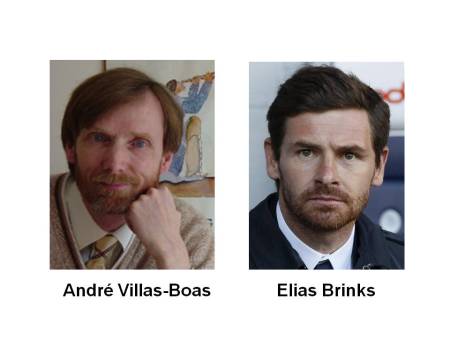
Posted in Astronomy Lookalikes with tags Andre Villas-Boas, Elias Brinks on December 16, 2012 by telescoperApparently, while I was away, Elias Brinks, the manager of Tottenham Hotspur (which seems to be some sort of football team), came to Cardiff to examine a PhD thesis scouting for new players to sign. One of the locals was struck by his resemblance to Andre Villas-Boas, the well-known astrophysicist from the University of Hertfordshire. I wonder if by any chance they might be related?