Author Archive

Jephtha

Posted in Opera with tags , , , , , on October 5, 2012 by telescoper

I took time out from a busy week yesterday evening for a performance by Welsh National Opera of Jephtha by George Frideric Handel. Based on a biblical story (from the Book of Judges), Jephtha was written late in Handel’s life (indeed it was the last major work Handel wrote) as an oratorio rather than an opera, and was first performed as such in 1752.

Last night’s production brought movement, scenery and costumes to Handel’s lovely music in an attempt to turn it into an opera. It was only partially successful in doing that. Owing to the nature of the piece, it appeared as a series of rather static tableaux rather than a compelling music drama. It did however, feature excellent music and singing, and very imaginative use of a rather simple set, an interior of faded and battered opulence, complete with broken plaster and bullet holes, and costumes that evoke the period leading up to World War II.

You can get a good idea of the look of the performance in the following WNO trailer:

The story revolves around the character Jephtha who is called upon to lead the people of Gilead in battle against Ammon. He takes up the challenge, and when he proves victorious he rashly (and cruelly) vows to make a sacrifice of the first human being to greet him when he returns home. That turns out to be his daughter, Iphis. Will he carry out his pledge and turn Iphis into a burnt offering? Will an Angel of the Lord intervene and spare her? I won’t spoil the plot, except that that the operatorio does not end in the same way as the bible story seems to…

As for the singers, I thought Fflur Wyn (Iphis) was the pick – her voice beautifully conveyed the innocence and fragility of the young daughter. Robin Blaze as Hamor (Iphis’ betrothed) was also excellent in the counter-tenor role. I wasn’t so keen on Robert Murray as Jephtha, whose voice was rather thin and undistinguished especially early on in the performance. But it was really Handel’s music that took centre stage. Although the performance contained much to savour, I’m not convinced that staging Jephtha as an opera was really worth it. I would probably have enjoyed it just as much if it had been performed as an oratorio, like Messiah.

Sonnet No. 25 (for National Poetry Day)

Posted in Poetry with tags , , , on October 4, 2012 by telescoper

I’m a bit ashamed that being very busy I forgot that today, Thursday 4th October, is National Poetry Day the theme of which this year is “stars”. I wish I’d remembered and would have posted something appropriate to mark the occasion, but this will have to do…


Let those who are in favour with their stars
Of public honour and proud titles boast,
Whilst I, whom fortune of such triumph bars,
Unlook’d for joy in that I honour most.
Great princes’ favourites their fair leaves spread
But as the marigold at the sun’s eye,
And in themselves their pride lies buried,
For at a frown they in their glory die.
The painful warrior famoused for fight,
After a thousand victories once foil’d,
Is from the book of honour razed quite,
And all the rest forgot for which he toil’d:
Then happy I, that love and am beloved
Where I may not remove nor be removed.

Sonnet No.25 , by William Shakespeare (1564-1616)

Pseud’s Council

Posted in Uncategorized with tags , , on October 4, 2012 by telescoper

No time for a proper post today – busy busy busy with Week 1 business – but I couldn’t resist passing on the news that the Engineering and Physical Sciences Research Council has finally made the headlines in a positive way – by appearing in the esteemed column Pseud’s Corner of the high-impact academic journal Private Eye.

This honour arose as a result of the following advertisement:

The Engineering and Physical Sciences Research Council invites expressions of interest from eligible individuals to attend a five-day interactive sandpit on the theme of digital personhood.

I would have applied had I seen it in time but although I’m a bachelor there’s a strong possibility I wouldn’t have been eligible.


Lover Man

Posted in Jazz, Literature with tags , , , on October 3, 2012 by telescoper

I huddled in the cold, rainy wind and watched everything across the sad vineyards of October in the valley. My mind was filled with that great song “Lover Man” as Billie Holiday sings it; I had my own concert in the bushes. “Someday we’ll meet, and you’ll dry all my tears, and whisper sweet, little things in my ear, hugging and a-kissing, oh what we’ve been missing, Lover Man, oh where can you be …” It’s not the words so much as their great harmonic tune and the way Billie sings it, like a woman stroking her man’s hair in soft lamplight.

Jack Kerouac, On the Road.

Lectures by Video

Posted in Education, The Universe and Stuff with tags , , , , on October 2, 2012 by telescoper

I spent a short while this morning sitting in on a lecture from one of our fourth-year modules, on Quantum Field Theory. Nothing obviously remarkable about that, except that the lecture was in fact delivered by Prof. Graham Shore of Swansea University and I was sitting in the School of Physics & Astronomy at Cardiff University with a group of twenty or so Cardiff undergraduates.

This was the first lecture our students have received from Swansea as part of an arrangement to share some teaching. There was a plan to do it last year, but it fell apart owing to technical problems. When I took over as Director of Teaching and Learning earlier this year I was determined to make it work. I have long felt that many of our 4th-year students were losing out on some advanced topics, especially in particle physics, owing to the lack of expertise in that area here. Indeed, the lack of expertise in particle physics here in Cardiff is so extreme that our students have had to put up with being taught by me! Likewise Swansea’s undergraduates have missed out a bit on some topics we do here, especially astrophysics and gravitational physics. This division of labour dates back to the old federal University of Wales where it was decided for strategic reasons not to compete in these two areas of “big science” but to allow Cardiff to do astronomy, astrophysics and gravitational physics and Swansea the particle stuff. It was a sensible decision from a research point of view, but it meant that the two relatively small physics departments here in South Wales could offer their undergraduates more restricted choices of advanced topics  than at bigger universities.

Not for the first time, the web has furnished a solution. After a few technical problems – not entirely sorted out, to be honest – we’ve finally established a video link. The initial setup is temporary, but we will (hopefully by next week) have a permanent, high quality videoconferencing suite for future use. It will probably take some time for lecturers and students on both sides to get used to it, but sitting in this morning I found it more than satisfactory from the point of view of audibility and legibility. The only problem really is that the static camera shot makes it a bit claustrophobic. I’m not sure whether there’s a way around that without spending a fortune on multiple cameras.

Anyway, to mark this historic occasion I thought I post another video lecture on Quantum Field Theory just to give you a flavour of the content and the experience. This is by David Tong of Cambridge University as seen in a lecture recorded by the Perimeter Institute in Canada.


Anyway, in the spirit of openness, and because I couldn’t stay for the whole session,  I’d be interested to hear what any Cardiff students thought of the experience either in private or through the comments box..

Whither the Learned Societies?

Posted in Open Access with tags , , , , on October 1, 2012 by telescoper

An interesting aspect of the ongoing debate about Open Access publishing is the extent to which “learned societies”, such as the Royal Astronomical Society and the Institute of Physics, rely for their financial security upon the revenues generated by publishing traditional journals.

IOP Publishing is a wholly-owned subsidiary of the Institute of Physics that generates annual income  in the region of £40M from books and journals. This is the largest source of the revenue that the IoP needs to run its numerous activities relating to the promotion of physics.  A similar situation pertains to the Royal Astronomical Society, although on a smaller scale, as it relies for much of its income from Monthly Notices of the Royal Astronomical Society, in which as a matter of fact I publish quite regularly.

Not surprisingly, these and other learned societies are keen to protect their main source of cash. When I criticized the exploitative behaviour of IoP Publishing in a recent blog post, I drew a stern response from the Chief Executive of the Institute of Physics, Paul Hardaker. That comment seems to admit that the high prices charged by IOP Publishing for access to  its journals is nothing to do with the cost of disseminating scientific knowledge but is instead a means of generating income to allow the IoP to pursue its noble aim of  “promoting Physics”. This explains why such organizations have lobbied very hard for the “Gold” Open Access that is being foisted on the research community, rather than the “Green” Open Access that it really wants.

I recently came across another blog post, pointing out that other learned societies around the world are also opposing Green Open Access:

There is also great incentive for the people who manage and run these organisations to defend their cartel. For example, the American Chemical Society, a huge opponent to open access, pays many of its employees, as reported in their 990 tax return, over six figures. These salaries range from $304,528 to $1,084,417 in 2010.

I don’t know the salary of the Chief Executive of the IoP.

The problem with the learned societies behaving this way is twofold. First, I consider it to be inevitable that the traditional journal industry will very soon be completely bypassed in favour of Green Open Access. The internet has changed the entire landscape of scientific publication. It’s now so cheap and so easy to disseminate knowledge that journals are already  redundant, especially in my field of astrophysics. The comfortable income stream that has been used by the IoP to “promote Physics”, as well as to furnish its spacious  buildings in Portland Place and pay the no doubt “competitive” salaries of its officers, will therefore surely dry up in the near future.  The “Gold” OA favoured by such organizations is unjustifiable and unsustainable and it won’t last. The IoP, RAS et al need to find another way of funding their activities pronto, or downsize accordingly.

The other problematic aspect of this  approach is that I think it is fundamentally dishonest. University and institutional libraries are provided with funds to provide access to published research, not to provide a backdoor subsidy for a range of extraneous activities that have nothing to do with disseminating research. The learned societies do many good things – and some are indeed oustandingly good – but that does not give them the right to syphon off funds from their constituents in this way.  Institutional affiliation, paid for by fee, would be a much fairer way of funding these activities.

I should point out that, as a FRAS and a FInstP, I pay annual subscriptions to both the RAS and the IoP. I am happy to do so, as I feel comfortable spending some of my own money supporting astronomy and physics. What I don’t agree with is my department having to fork out huge amounts of money from an ever-dwindling budget for access to scientific research that should be in the public domain because it has already been funded by the taxpayer.

Some time ago I had occasion to visit the London offices of a well-known charitable organization which shall remain nameless. The property they occupied was glitzy, palatial and obviously very expensive. I couldn’t help wondering how they could square the opulence of their headquarters with the quoted desire to spend as much as possible on their good works. Being old and cynical, I came to the conclusion that, although charities might start out with the noblest intentions, there is a grave danger that they simply become self-serving, viewing their own existence in itself as more important than what they do for others.

The academic publishing industry has definitely gone that way. It arose because of the need to review, edit, collate, publish and disseminate the fruits of academic labour. Then the ease with which profits could be made led it astray. It now fulfils little or no useful purpose, but simply consumes financial resources that could be put to much better effect actually doing science. Fortunately, I think the scientific community knows this and the parasite will die a natural death.

But I wonder if the learned societies will go the same way.  Is there a financial model according to which they can enjoy a stable and sustainable future?  Are they actually needed? After all, if we can publish our own physics, why can’t we ourselves also promote it?

Credentialism and Overexamination

Posted in Biographical, Education with tags , , , , , , , , on September 30, 2012 by telescoper

Only time for a quick post this morning as I have to go into the department to get my things ready for tomorrow, when the Autumn Semester starts and I have to begin lecturing (at 9am on a Monday morning). Anyway, the text for today’s sermon is provided by Ed Smith’s Left Field column in the New Statesman, the latest issue of which I read yesterday. His topic is the rise of credentialism and the resulting excessive amount of examination in the British school system:

It is now widely accepted that British pupils are excessively over-examined. Teachers are so busy focussing on examinations that there is little time left for education. Exam-led cramming has become the year-round norm – like an election campaign that consumes the whole political cycle. Exams are obviously necessary. But there is an optimal amount of assessment and it has been far exceeded. Grade inflation – notwithstanding this year’s controversial “crackdown” – is simply accepted as a fact.

It’s well said, and it’s not just the school system that suffers from disproportionate emphasis on assessment over education. It’s rife throughout the university system too, starting with the reliance on A-level grades as criteria for assessing students’ suitability for university study, through the “modular” undergraduate degree programmes with examinations twice a year for three or four years.

We examine far too frequently and the effect of this has been to turn the entire education system into a meaningless exercise in box-ticking.

It is an unfortunate irony: in our age of credentialism, exams have never mattered more. And yet they have never been more unreliable as gauges of academic quality.

I’ve felt for some time that in my discipline, Physics (and Astronomy) A-levels are virtually useless as indicators of the suitability of a student for doing an undergraduate degree. Some of the very best students I’ve ever had the pleasure to teach came into my university with modest A-level scores; and some students who came in with perfect grades at school never adjusted to the different, more independent type of study required of an undergraduate.

As Ed Smith points out, the increased emphasis on examination grades hasn’t expanded opportunity either.  It may appear to be fairer to base university entrance or award jobs on examination results rather than, say, interviews, but this has just led to a system that can be easily gamed – private tutors, cramming, re-sits to improve grades, and so on. He rightly concludes that the “correlation between exam results and intelligence has been steadily weakening”.

So what’s the alternative? Smith mentions the admissions process at Harvard University, which famously ignores high-school grades and relies on its own interview system. Interviews can be very biased if carried out in an inappropriate way. Subjecting a young person to a 30-minute grilling  in a room with a complete stranger can be enormously stressful for applicants who are shy, and would also play into the hands of those whose educational background has involved specific training for such ordeals. But one thing I’ve found by talking to students face-to-face is that it doesn’t take very long to identify precisely those things that the examination system does not: imagination, enthusiasm for the subject,  and a flair for thinking on your feet:

One teacher told me with regret that she had to advise her most academic pupil not to display her full intellectual range: in order to secure all the ticks, first you have to stop thinking freely.

If you don’t believe this, take a look at this GCSE Science Examination. A truly intelligent student would struggle to find any correct answer for many of the questions on that paper!

This is why we still place so much emphasis on interviews in the postgraduate admissions system: we take it for granted that all applicants for PhD places will have good undergraduate degrees. What marks out an excellent candidate for a position as  research student, however, is not the ability to pass exams but a mixture of creative flair and almost obsessive determination to surmount the difficult challenges involved in independent research. The correlation between these characteristics and degree results is by no means strong.

The problem for a UK University in adopting the Harvard approach is that credentialism is now running the system. Students apply to universities largely on the basis of their predicted A-level grades, lowering their sights if their predicted grades would not be expected to get them into a more “presitigious” department. But departments that take in students with low A-level scores also get marked down in the league tables for taking in “weaker” students. We’re all aware that A-levels are basically useless, but both sides are  bound so tightly into the system that there seems to be no escape.

So what’s the answer? I don’t know if there is one, but I’d love to see what would happen if all universities abandoned A-levels and instead set their own entrance examinations and interviews. It would be a huge amount of work, but it would make a refreshing change if universities could gather useful information rather than relying on the uninformative guff produced by the national examination boards.

And here is Smith’s closing remark that rings very true to me for personal reasons,

There is a further dimension to the problem of credentialism. It encourages life’s winners to underestimate their good fortune and to over-rate the extent to which they deserve their success. Far from advancing talent over privilege, credentialism has strengthened the grip of people already at the top.

Giving up smoking…

Posted in Poetry with tags , , , on September 29, 2012 by telescoper

There’s not a Shakespeare sonnet 
Or a Beethoven quartet 
That’s easier to like than you 
Or harder to forget. 

You think that sounds extravagant? 
I haven’t finished yet – 
I like you more than I would like 
To have a cigarette. 

by Wendy Cope (b. 1945).

Cosmology Webcasts Coming Up…

Posted in The Universe and Stuff with tags , , , , on September 29, 2012 by telescoper

Courtesy of freelance science writer Bruce Lieberman, whom I met briefly at the recent “Origin of the Expansion of the Universe” meeting in Flagstaff, AZ,  here’s a plug for two live webcasts on topical topics that are coming up in the next couple of weeks. On behalf of the Kavli Foundation, Bruce will be interviewing astronomers about the new Hubble XDF image (Oct. 4) and the new Dark Energy Survey camera, which just saw First Light (Oct. 11).

Live Q&A and Webcast: What Does Hubble’s Deepest Image of the Universe Reveal?

Click on the above heading for  direct link to webcast.

October 4, 11-11:30 am PDT (18-18:30 GMT; 19-19:30 BST)

Using data from the Hubble Space Telescope, a multi-national team of astronomers recently released our deepest-ever image of the
universe. Pascal Oesch, a Hubble Fellow at the University of California at Santa Cruz, and Michele Trenti, a researcher at the Kavli Institute for Cosmology, Cambridge at the University of Cambridge in the U.K., answer your questions about how the image was created and what it reveals about the early universe.

Viewers may submit questions to the two Hubble researchers via Twitter using #KavliAstro or email to info@kavlifoundation.org.

Live Q&A and Webcast: Can a New Camera Unravel the Nature of Dark Energy?

Click on the above heading for  direct link to webcast.

October 11, 9-9:30 am PDT (16-16:30 GMT; 17-17:30 BST)

Scientists have great expectations for the newly operational Dark Energy Camera, which may significantly advance our understanding of the mysterious force expanding the universe at an ever accelerating rate. Fermilab scientists Brenna Flaugher, project manager for the Dark Energy Camera, and Joshua Frieman, director of the Dark Energy Survey, answer your questions about the camera and what it’s expected to reveal.

Viewers may submit questions via Twitter using #KavliAstro or email to info@kavlifoundation.org.

Alternative London Underground Signs

Posted in Uncategorized on September 28, 2012 by telescoper

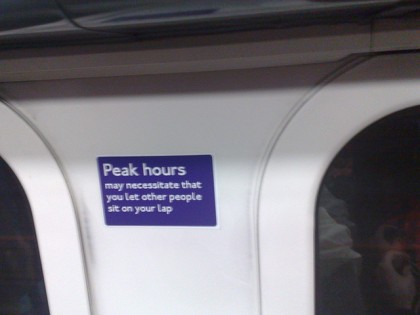
Some of these are pure genius :)

Joe Blogs's avatarJoe Blogs / JVB

My friend Darren sent me a linkto these rather excellent alternative London Underground signs…

(click image above for link to original photographers blog)

Apparently they’ve been appearing for some time now, but like 99% of passengers, I’m sad to say I’ve missed them..

They’ve been done so well, that to a regular commuter, their utter familiarity as part of an accepted, everyday visual clutter, results in them becoming almost invisible, losing all meaning beyond their colour and shape..

Well it’s a lesson learnt for me. I usually pride myself on at least attempting to see beyond the day to day, and resist the automatic filters that city life can generate.

Rest assured, that I will certainly be keeping a much sharper lookout for these signs from now on… How I would’ve loved to have noticed Shepherd’s Pie, overground, Gas mark 4 on a journey into work, it would have…

View original post 3 more words