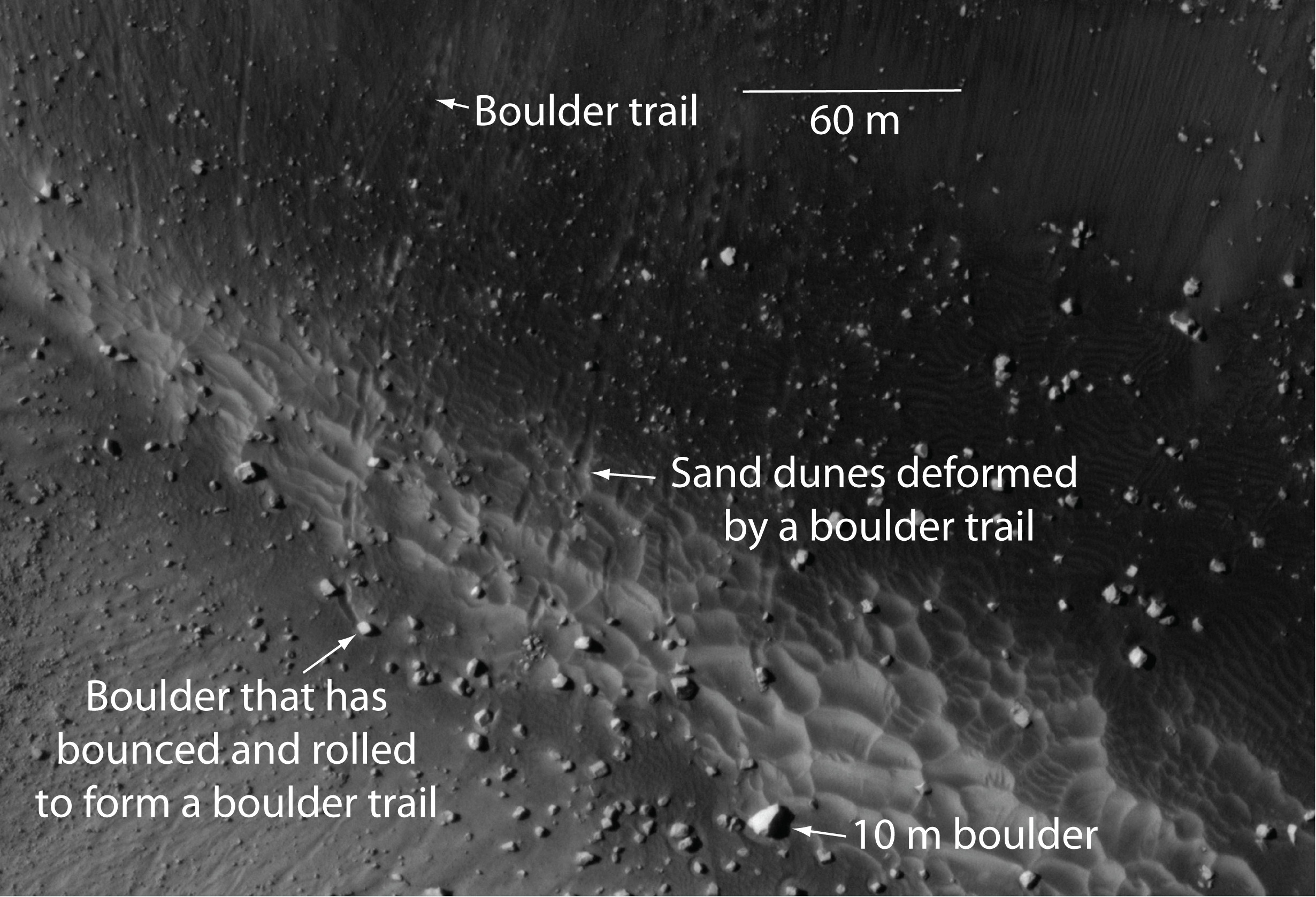
I’m a bit slow to get started this morning, since I didn’t get home until the wee small hours after a trip to the Royal Astronomical Society yesterday, followed by a pleasantly tipsy dinner at the Athenaeum with the RAS Club. Anyhow, one of the highlights of the meeting was a presentation by Prof. Gerald Roberts from Birkbeck on Marsquakes: evidence from rolled boulder populations, Cerberus Fossae, Mars. The talk was based on a recent paper of his (unfortunately behind a paywall), which is about trying to reconstruct the origin and behaviour of “Marsquakes” using evidence from the trails made by rolling boulders, dislodged by seismic activity or vulcanism. Here is a sample picture showing the kind of trails he’s using – the resolution is such that one pixel is only 20cm!
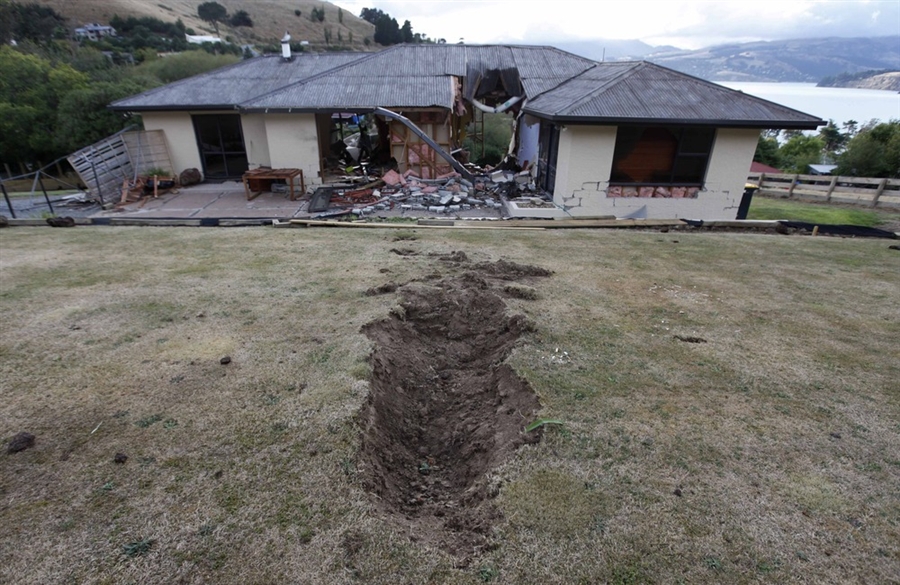
There are enough trails to allow a statistical analysis of their distribution in space and in terms of size (which can be inferred from the width of the trail). I had some questions about the analysis, but I haven’t been able to read the paper in detail yet so I won’t comment on that until I’ve done so, but the thing I remember most from the talk were these remarkable pictures of what a rolling boulder can do on Earth. They were taken after the earthquake in Christchurch, New Zealand, in 2011.
A large boulder was dislodged from the top of the hill behind the house in the second picture. It didn’t just roll, but bounced down the slope (see the large furrow in the first picture; similar bouncing trajectories can be seen in the picture from Mars), smashed straight through the house, exited the other side and came to rest on a road. Yikes.
Up early because a busy day lies ahead, I thought I’d just post this video produced by the National Health Service on the subject of Cognitive Behaviour Therapy. I’m posting it just in case there might be someone out there who has been recommended for such a treatment and is reluctant to try it, like I was at first, thinking that it is just a load of psycho-babble.
Well, it isn’t psycho-babble. It works. So if you need it, go for it!
Here’s one of those things from Blogland that is flying around the Twittersphere today..
The original post revealed a leaked email “sent to the entire graduate student body enrolled in the well-regarded astronomy program at Unnamed Academy” containing such gems as this:
We have received some questions about how many hours a graduate student is expected to work. There is no easy answer, as what matters is your productivity, particularly in the form of good scientific papers. However, if you informally canvass the faculty (those people for whose jobs you came here to train), most will tell you that they worked 80-100 hours/week in graduate school. No one told us to work those hours, but we enjoyed what we were doing enough to want to do so. We were almost always at the office, including at night and on weekends.
This missive has already provoked a number of responses (e.g. here and here), but I couldn’t resist putting in a few comments myself.
The first and most obvious thing is that I don’t think the faculty members mentioned above were telling the truth. It’s by no means a new phenomenon for oldies to pretend that they worked harder than the younger generation. “When I were a lad…”, etc. This is either form of delusion that accompanies ageing or a kind of one-upmanship designed to create a impose some sort of authority over the junior members of the department. A supervisor who demands such things of a PhD student is likely to be someone who regards a grad student simply as a form of cheap labour and doesn’t care at all about their development as a researcher or indeed as a human being.
The following sentence gives the game away
No one told us to work those hours, but we enjoyed what we were doing enough to want to do so.
It is clearly intended to mean “No one told us, but we’re sure as hell telling you…“.
My advice to a young PhD student would be: if your supervisor tells you to put in 100 hours per week on the project, find another supervisor – because he/she clearly hasn’t put sufficient thought into the practical feasibility of your project. The fact is if you have to work 100 hours per week to get your work done you must be exceptionally inefficient or working on a stupid project or simply nuts. Or all three.
The email is correct in saying that it’s “productivity” that counts. I’m sure there are many people who can sit at their desks for 11 hours a day without producing anything very much at all. It’s not the hours that matter, but what you do with them. In no way will indulging your outside interests (sporting, cultural, political, or “other”…), or simply relaxing, detract from your ability to do research. I think such diversions actually improve your work, as well as (of course) your general well-being.
I had plenty of outside interests (including music, sport and nightlife) and took time out regularly to indulge them. I didn’t – and still don’t – feel any guilt about doing that. I’m not a robot. And neither are you.
In fact, I can think of many times during my graduate studies when I was completely stuck on a problem – to the extent that it was seriously bothering me. On such occasions I learned to take a break. I often found that going for a walk, doing a crossword, or just trying to think about something else for a while, allowed me to return to the problem fresher and with new ideas. I think the brain gets into a rut if you try to make it work in one mode all the time.
But there is an element of truth in the paragraph quoted above. There were indeed many times during my time as a research student – and have been since – that I worked extremely long hours. I wouldn’t say exactly that was because I “enjoyed” it, but that I wanted to know the answer and couldn’t get the problem out of my head. I’ve stayed up into the early hours of the morning trying to finish a crossword too. Not because I had to, but because I couldn’t put it down unfinished. I know that makes me a saddo in many minds, but I think that’s the sort of obsessiveness and tenacity a researcher needs: becoming so absorbed by the task in hand that you don’t notice the passage of time.
Anyway, as a research student I certainly didn’t work 80-100 hours per week routinely, although I might have done a few times when things were getting interesting. I think an average working week of 40 hours is perfectly fine for a PhD student, as long as you use that time efficiently and are prepared to step up a gear when motivated to do so.
It’s been a while since I last had a poll, so let’s see if we can generate some statistics on this…
It’s been a while since I blogged about Bridge, primarily because I haven’t played much recently. However, last week I had the good fortune to attend the Llanishen Invitational Mixed Pairs Competition where the following unusual deal appeared:
Dealer (West) opened flirtatiously with a reverse Polish cue bid of 1♥ indicating four good suits but no decent shoes to go with them. North passed. Unsure of how many high card points should be assigned to Mrs Bun the Baker’s Wife, East responded with One No Trump whilst coughing and banging his fist on the table to indicate a weak heart. Despite having eaten a large amount of curry, West decided that No Trumps was feasible, and bid directly to a grand slam, gambling that nobody would notice he’d clearly been cheating by fiddling with the deck while they weren’t looking.
Against North’s lead of 8♣, East passes a spade (with some difficulty), swings his partner to the right and emerges to confront South eight miles to the East, from where his artillery can operate out of range of North’s radar. What should South do next to best defend the contract? (Hint: Winds Southerly, Force 8).
Solution to Bridge Problem No. 234: Across the Bosphorus, joining Europe to Asia Minor, with a single span of 4389 feet.
P.S. Readers of a certain age (like Mr Money; see comments below) will recognize that the picture and some of the skit is taken from an item in the following book published in 1981, which I still have…
You may recall that I gave a talk recently at a meeting called The Origins of the Expanding Universe in Flagstaff, Arizona. I put the slides up here. Well, the organizers have now put videos of the presentations online so you have the chance to see mine, warts and all.
I was relieved when I saw this on Youtube that the organizers were kind enough to edit out the embarrassing bit at the start when my laptop refused to talk to the data projector and I had to swap to another one. Sorting all that out seemed to take ages, which didn’t help my frame of mind and I was even more nervous than I would have been anyway given that this was my first public appearance after a rather difficult summer. Those are my excuses for what was, frankly, not a particularly good talk. But at least I survived. Better is the end of a thing than the beginning thereof.
The announcement this morning of the 2012 Nobel Prize for Medicine or Physiology reminded me that tomorrow will see the announcement of the 2012 Nobel Prize for Physics. This is due to happen tomorrow morning at 11.45 CET (which I think is 10.45 BST) or thereabouts. It would be unseemly to speculate on the outcome, of course, so that’s what I’ll do.
Although the discovery of a scalar particle at the Large Hadron Collider that may well be the Higgs boson happened only recently, and is yet to be definitively proven to be the Higgs, the smart money has to be on an award relating to that, presumably to Peter Higgs. However, given that the award can go to up to three individuals, who else might earn a share? Gerald Guralnik, Tom Kibble and Carl Richard Hagen came up with the same idea about the same time as Higgs, but all four of them can’t win according to the rules. Answers to that little conundrum on a postcard…
But of course the Prize might go to something else altogether. An interesting bet would be Alain Aspect for his important work on experimental studies of quantum entanglement. Also with an outside chance is Sir Michael Berry for his brilliant work on the Geometric Phase.
That’s by no means an exhaustive list of runners and riders, but I have to get back to business now. I’d be interested to have further nominations via the comments box and will of course be getting an early night ahead of the expected phone call from Stockholm tomorrow morning…
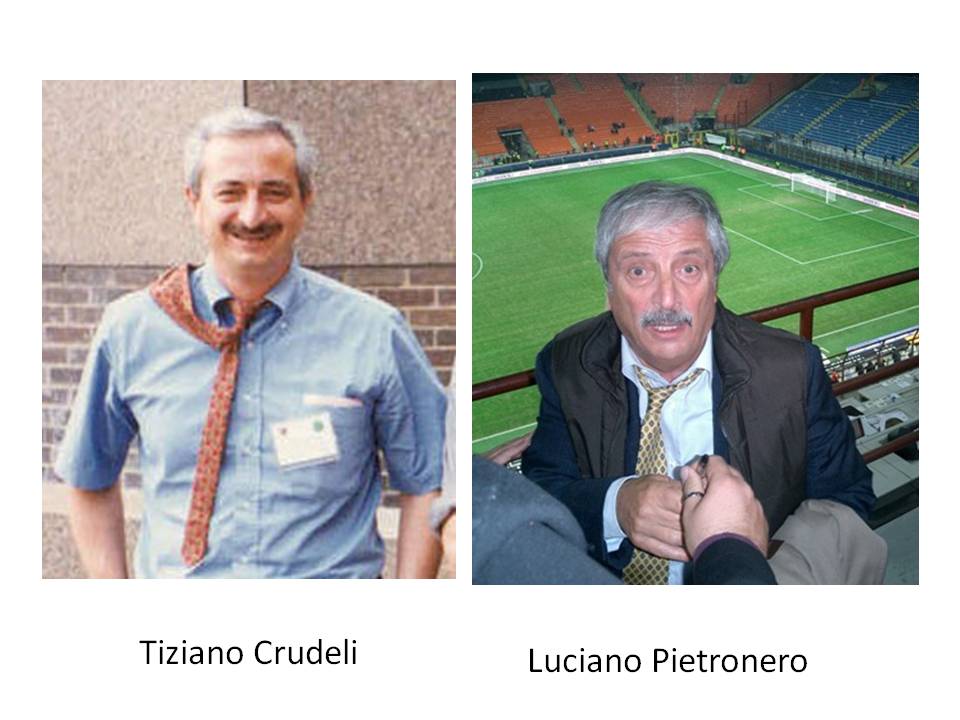
Has anyone noticed the remarkable similarity between the crazy star of the Ladbrokes TV commercial , Italian football commentator Tiziano Crudeli, and Italian physicist and advocate of inhomogeneous cosmological models, Luciano Pietronero? I wonder what odds Ladbrokes are offering against a fractal Universe? Game on!
I’ve been rummaging through my old second-year undergraduate notes and papers trying to compare what I did when I was a student with what we’re asking current second-year undergraduates to do. Since I’m now teaching a fairly mathematical second-year course, it is interesting to look at how the content compares with the Mathematics papers I took way back in 1984.
Looking at these two examinations it’s clear that some of the content is similar (e.g. vector calculus, Fourier transforms) but some big things are entirely missing from our second-year syllabus, specifically Laplace transforms and group theory. The absence of the latter is a matter of particular regret because it’s such a beautiful subject that I think leads onto a deeper understanding of physics than a lot of the other things we make the students learn.
The other striking thing is that the marks for different bits of the questions are not given. That was standard in my day, but nowadays we usually indicate how many marks are available for each part. Moreover, the style of examination is such that even the number of correct answers needed for full marks isn’t given; it just says “You are advised to answer complete questions rather than fragments”.
Anyway, as usual, I’d be interested in comments on the content and difficulty especially from current students in the unlikely event that they have nothing better to do on a Sunday afternoon than have a look at it! For my part, I’ll be in the department getting next week’s lecture materials sorted. Heigh-ho.
When you are old and grey and full of sleep, And nodding by the fire, take down this book, And slowly read, and dream of the soft look Your eyes had once, and of their shadows deep;
How many loved your moments of glad grace, And loved your beauty with love false or true, But one man loved the pilgrim soul in you, And loved the sorrows of your changing face;
And bending down beside the glowing bars, Murmur, a little sadly, how Love fled And paced upon the mountains overhead And hid his face amid a crowd of stars.
A later post than usual for a weekend. I’ve been feeling a bit fragile all day after a very late night last night “playing Bridge” (i.e. drinking and gossiping into the early hours of the morning, with the occasional hand of cards thrown in for good measure). My broadband connection has also been playing up nearly as badly as the connections in my brain, although I don’t think there’s a causal relationship between the two. Anyway, just time for a round-up of, and some reflections on, the events of the past seven days.
This has been the first week of term, so has naturally been extremely busy. I got my first week’s second-year lectures, examples sheets and handouts together last Sunday for a 9am start on Monday morning. There were 104 students on the register, and I was delighted to find that 100 of them actually showed up bright and early for the first session. The lecture wasn’t brilliant unfortunately – I misjudged how many worked examples I could fit into an hour and got a bit rushed as a consequence. Still, at least nobody threw anything at me, and I survived. At the end of the week the students were asked to hand in solutions to some problems, which most of them seem to have done. Unfortunately, however, I neglected to ask for the key to the box in which they are posted before the support staff went home at 5pm, so the scripts are still all in the box. At least that gives me an excuse for not having started to mark them yet.
I gave another lecture this week to the 4-th year Cardiff students taking the Quantum Field Theory lectures from Swansea, to try and fill in a bit of background our lot won’t have learned in other lectures on relativistic quantum mechanics, chiefly the Dirac equation. I really love that sort of stuff, so didn’t mind stepping up to do an impromptu class on it. They seemed to find it reasonably useful, although I went on a bit longer than I should.
Two other events this week in the School were a colloquium by Dr Anupam Mazumdar from Lancaster on Wednesday and a seminar by Prof. Pedro Ferreira from Oxford yesterday (Friday), both of which were related to alternative theories of gravity (i.e. modifications of Einstein’s theory of general relativity). Pedro has co-authored a comprehensive review article on such things if anyone is interested in following up the details. The basic point, however, is that standard cosmology almost all develops from the assumption that gravity and space-time are described by general relativity. That theory is well tested on solar-system scales, but independent tests on the much larger scales involved in cosmology are hard to come by. It’s clearly therefore an important goal to work towards testing alternative theories, as is the case in any scientific discipline.
As well as these specific events there was a steady stream of problems and irritations to do with the teaching timetable: rooms too small, clashes, and so on. This is part of my responsibility as Director of Teaching and Learning in the School of Physics and Astronomy, and I don’t mind telling you that it’s a royal pain in the derrière. However, I think all the bugs have been ironed out and we can hopefully now carry on with a settled teaching programme into the new year.
Looking back on the week I can see so many things I would not long ago have found unbearably stressful, even going to the pub after Friday’s seminar. Such victories, however insignificant they may seem to others, have given me the confidence to face the greater challenges that I know the future has in store.
The views presented here are personal and not necessarily those of my employer (or anyone else for that matter).
Feel free to comment on any of the posts on this blog but comments may be moderated; anonymous comments and any considered by me to be vexatious and/or abusive and/or defamatory will not be accepted. I do not necessarily endorse, support, sanction, encourage, verify or agree with the opinions or statements of any information or other content in the comments on this site and do not in any way guarantee their accuracy or reliability.



 In the Dark