Author Archive

Mozart and Strauss, and the End of Term

Posted in Music with tags , , , , on June 16, 2012 by telescoper

Yesterday (Friday 15th June) was officially the last day of teaching term at Cardiff University. I think most of our students toddled off  some time ago when their last exams were finished,  so for us on the staff side the teaching term has fizzled out gradually rather than go out with a bang. Yesterday I met with a couple of next year’s project students to give them some background reading to do over the summer and that was that for another year of undergraduate teaching.

There was something of an “end-of-term” feeling too to last night’s concert at St David’s Hall, which was also broadcast live on BBC Radio 3; you can listen to it yourself by clicking on that second link. This was not only the last concert of the 2011/12 season by the BBC National Orchestra of Wales, but also  last concert at St David’s Hall to be conducted by Thierry Fischer, who has been principal conductor for the BBC NOW for the past six years. Next year Thomas Søndergård will take over.The concert turned out to be a fitting finale to the season and a fine farewell to Thierry Fischer.

The first item on the agenda was Mozart’s Piano Concerto No. 22 played by none other than the wonderful Angela Hewitt.  I wasn’t all that familiar with this piece beforehand, and was surprised to see such a large orchestra on stage before the start. Apparently  this work was the first time Mozart had used clarinets in a piano concerto, and the larger force than I’d normally have associated with a Mozart piece of this type gave the performance a much more opulent sound than I’d expected. It’s an interesting work, with a particularly fine Andante second movement which is both sombre and expansive sandwiched between two quicksilver Allegro movements, the last being a kind of rondo. Angela Hewitt played it with crisp elegance and perfect articulation. Some people find her playing a bit fussy and punctilious, and indeed there were times when I thought the performance could have had a bit more fire in it, but for my part it was a treat to get the chance to see a great artist in the flesh; she has an engaging presence on stage too, clearly enjoying the performance, and smiling from time to time in appreciation at the orchestral playing. We even got a nice little solo encore, which is quite unusual for a live broadcast from St David’s.

Then there was an interval so we could all check the football score, and guzzle a quick glass of overpriced wine before returning to hear the Alpine SymphonyOp. 64 by Richard Strauss. If the orchestra for Part 1 had been large by Mozartian standards, then this one was immense! Well over a hundred musicians, with a huge brass section (supplemented by many more standing off-stage and just visible to me through an open door), harps, percussion (including cow bells and a wind machine), and some unusual instruments including a Heckelphone (what the heck?…). Oh, and the fine organ in St David’s Hall got a full workout too.

Strictly speaking, this is not actually a symphony; it’s more of a tone poem. But Strauss was rather good at them and this one is a wonderful evocation of a day’s journey in the Bavarian Alps, from a resplendent dawn to a tranquil sunset, with summits to be scaled, thunderstorms to be endured, glaciers to be traversed, and so on. It’s certainly a very vivid piece of programmatic music.

As you might have inferred from huge band gathered on stage, this is a work that gets very loud, especially when the organist literally pulls out all the stops. What was especially fine about the performance was that, although the musicians of BBC NOW weren’t afraid to give it some welly whenever it was called for, their playing never became wild or ragged. I don’t know what it sounded like on the radio, but it was a thrilling experience to be in the hall.  I lost count of the number of towering crescendo passages, and just let the waves of wonderful noise wash over me. At times I could feel it through my feet too.

There were cheers at the end, and a standing ovation for Thierry Fischer not only for this performance but for his service to the BBC National Orchestra of Wales.  And that brought the term and the season to a close; both start again in late September 2012. There are some cracking concerts in store in the next season in St David’s Hall.

Power versus Pattern

Posted in Bad Statistics, The Universe and Stuff with tags , , , , , on June 15, 2012 by telescoper

One of the challenges we cosmologists face is how to quantify the patterns we see in galaxy redshift surveys. In the relatively recent past the small size of the available data sets meant that only relatively crude descriptors could be used; anything sophisticated would be rendered useless by noise. For that reason, statistical analysis of galaxy clustering tended to be limited to the measurement of autocorrelation functions, usually constructed in Fourier space in the form of power spectra; you can find a nice review here.

Because it is so robust and contains a great deal of important information, the power spectrum has become ubiquitous in cosmology. But I think it’s important to realise its limitations.

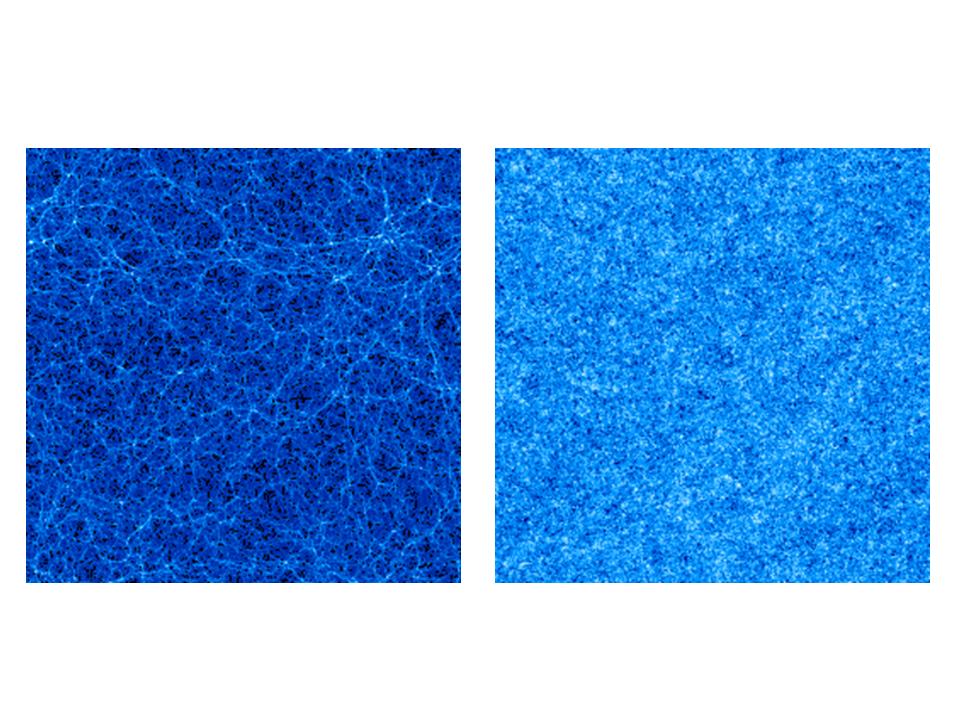
Take a look at these two N-body computer simulations of large-scale structure:

The one on the left is a proper simulation of the “cosmic web” which is at least qualitatively realistic, in that in contains filaments, clusters and voids pretty much like what is observed in galaxy surveys.

To make the picture on the right I first  took the Fourier transform of the original  simulation. This approach follows the best advice I ever got from my thesis supervisor: “if you can’t think of anything else to do, try Fourier-transforming everything.”

Anyway each Fourier mode is complex and can therefore be characterized by an amplitude and a phase (the modulus and argument of the complex quantity). What I did next was to randomly reshuffle all the phases while leaving the amplitudes alone. I then performed the inverse Fourier transform to construct the image shown on the right.

What this procedure does is to produce a new image which has exactly the same power spectrum as the first. You might be surprised by how little the pattern on the right resembles that on the left, given that they share this property; the distribution on the right is much fuzzier. In fact, the sharply delineated features  are produced by mode-mode correlations and are therefore not well described by the power spectrum, which involves only the amplitude of each separate mode.

If you’re confused by this, consider the Fourier transforms of (a) white noise and (b) a Dirac delta-function. Both produce flat power-spectra, but they look very different in real space because in (b) all the Fourier modes are correlated in such away that they are in phase at the one location where the pattern is not zero; everywhere else they interfere destructively. In (a) the phases are distributed randomly.

The moral of this is that there is much more to the pattern of galaxy clustering than meets the power spectrum…

Aedh wishes for the cloths of heaven

Posted in Poetry with tags , , , , on June 15, 2012 by telescoper

Had I the heavens’ embroidered cloths,
Enwrought with golden and silver light,
The blue and the dim and the dark cloths
Of night and light and the half light,
I would spread the cloths under your feet:
But I, being poor, have only my dreams;
I have spread my dreams under your feet;
Tread softly because you tread on my dreams.

by W.B. Yeats (1865-1939)

To the dark, and the endless skies….

Posted in Music with tags , on June 14, 2012 by telescoper

The Communications Data Bill is both Stupid and Wrong

Posted in Politics with tags , , , on June 14, 2012 by telescoper

No time for a lengthy post today, but then again I don’t think this topic merits one.

The government’s draft Communications Data Bill has now been published. The measures contained in this Bill would allow the security services to snoop at will on emails, web browsing, social network sites, internet phone calls, etc.

In other words it will give the government license to pry into personal communications between law-abiding individuals without any need for a warrant. The potential for abuse is obvious, so much so that it can only have been drafted by a government that intends to abuse it if and when it becomes law. It’s yet another deliberate erosion of our civil liberties and a further step towards a totalitarian state. Big Brother is here.

On top of all that, the proposed law is also entirely useless. All the measures proposed can be circumvented by anyone with even a rudimentary knowledge of IT. Even me. It won’t catch criminals, at least not important ones, because they’ll know the (easy) ways around it. This law will simply be used by the government to spy on anyone it doesn’t like the look of.

And that could be you.

My Even Newer Theory of the Universe

Posted in The Universe and Stuff with tags , , on June 13, 2012 by telescoper

I have decided this evening to unveil my new cosmological theory.

My previous work  was based on the idea that the Universe was obtained from the Swedish furniture and home accessory emporium IKEA. This “Easy Self Assembly” hypothesis dispenses with the need for creation from nothing, and also accounts naturally for the observed geometry of space (it came in a flat pack).

My subsequent study of this scenario has focussed on properties of the Universe that can’t be explained in the earlier version of the theory, specifically  the cosmic microwave background. However, making my supper just now I suddenly hit upon the answer to that particular puzzle. Clearly, wanting to achieve the best results possible, on his/her way back from IKEA the Divine Creator stopped off at Marks and Spencer …

The End of the Viva

Posted in Biographical, Education with tags , , , , , on June 13, 2012 by telescoper

I’m stuck at home today, waiting for UPS to come and collect a defective printer. Any time between 9am and 7pm, they said. Very helpful. Anyway, I’ve got plenty to do while I’m here, catching up on STFC Astronomy Grant Panel business that I’ve been too busy to attend to. Also, this week’s Private Eye has just arrived in the post, so I’ll take a break at some point to do the crossword by Cyclops. It’s a lovely day. Pity I can’t sit in the garden. I’d miss the doorbell when the carrier arrives.

Anyway, the past two days have been largely given over to the business of examinations in the School of Physics & Astronomy at Cardiff University. The External Examiners spent a big slice of Monday doing viva voce examinations of selected candidates; not just those on borderlines, but also some others for “calibration”. I wasn’t involved in them this year, but have taken part in the past as External in various places. Obviously these examinations are very stressful for the students, and also quite difficult to conduct fairly, but sometimes provide useful insights in the cases where a student’s marks put them on a knife-edge between two degree classifications (or even between pass and fail).

Anyway, in its infinite wisdom Cardiff University has decided to scrap the viva voce examination after next year. From 2014 onwards we’ll just have to apply a formula to deal with borderline cases; the algorithm involves counting how many modules were passed at the higher level, etc. Actually, I probably agree with this for the purposes of classifying degrees. Twenty minutes’ questioning under stress can hardly be expected to yield much objective  information about a candidate’s knowledge of the subject that dozens of written papers and other assessments. Often, in my experience, students (especially the shy ones) are so nervous that the shutters come down almost straight away.  I would  prefer a system which is algorithmic as possible, so everyone knows what the rules are, rather than relying on subjective judgements.

As external, I always found the viva examinations a useful way of getting feedback from the students on their course which can be fed back – either usefully or not – to the department. In losing the viva  for drawing up the classification lists, I hope that we can find another way for the externals to talk to students in some other context to get some feedback about the course. Perhaps they could attend for project talks, or something like that?

Yesterday, the entire Board of Examiners (including Externals) gathered to go through all the individual cases and draw up the Honours List. I was delighted when I saw all the consolidated marks in advance of the meeting, to see how well how many of our students had done. There were one or two difficult cases, but in the end we produce the lists. As I went back to my office, students were already gathering in the corridor by the noticeboard where it is always placed as soon as the definitive final version has been prepared, shortly after the meeting closed.

Soon I heard whoops of joy and laughter and had a quick look to see the students congratulating one another. As always on such occasions, I was tempted to go along and chat to a few of them but, as always, I resisted doing so. It’s a time for them, the students, not us, the staff.

Anyway, congratulations to all those who had good news yesterday!

I hope your hangovers aren’t too bad…

Astronomy’s Next Big Thing

Posted in Science Politics, The Universe and Stuff with tags , , , , on June 12, 2012 by telescoper

I woke up this morning to hear an item about astronomy on the 7 o’clock news on BBC Radio 3. That doesn’t happen very often so I thought I’d follow it up with a short post before I head off to work.

The news item I heard followed up an announcement yesterday that the governing Council of the European Southern Observatory (ESO) had  approved the European Extremely Large Telescope (E-ELT) programme – which is to produce what will be the world’s largest ground-based optical telescope. Extremely Large is putting in mildly, of course. Its main mirror will be a colossal 39 metres in diameter (with a collecting area of almost a thousand square metres) and will have to made in bits with a sophisticated adaptive optics system to ensure that it can counter the effects of the Earth’s atmosphere and the limitations  of its own structure to  reach a phenomenal angular resolution of 0.001 arc seconds.

For more details on the telescope, see the official website here or the wikipedia article here, where you can also read more about the science to be done with E-ELT.

This telescope has been in planning for many years, of course. In fact, it began as an even more ambitious concept, a 100-metre diameter monster which I used to call the FLT. Over the years, however, for a mixture of technical and financial reasons, this was progressively de-scoped.

Yesterday’s announcement doesn’t mean that work will start immediately on building the E-ELT. That won’t happen until sufficient funding is secured and in the case of some countries, governmental approval obtained. Recent decisions by the UK Science and Technology Facilities Council to close down telescopes in Hawaii clearly anticipated the need to make some headroom in future budgets to enable this to happen. The best-case scenario is probably for E-ELT to take a decade or so to complete.

Of course the concentration of funding in ever and ever larger international facilities – such as E-ELT and the Square Kilometre Array – does create tensions within the UK astronomical community. Many scientists do excellent work with relatively small facilities, including those about to be closed down to make room for E-ELT. In the near future, the only ground-based optical facilities to which UK astronomers will have access will be operated by the European Southern Observatory. With fewer but larger (and more expensive) facilities operated by international agencies carrying out projects run by vast consortia, observational astronomy is definitely going the way of particle physics…

The problem  comes when the Next Big Thing  is too big to be built.  We might have already seen X-ray astronomy bubble burst in this way. To quote my learned friend Andy Lawrence:

Fundamentally, the problem is that X-ray astronomy has hit the funding wall. Everything gets inexorably bigger and more ambitious. Eventually its all or nothing… so when the answer is nothing … ah.

What will come after the Large Hadron Collider, or the E-ELT?  Is Big Science about to get too big?

Sic Transit Gloria Monday

Posted in The Universe and Stuff with tags , , , on June 11, 2012 by telescoper

I can never resist a terrible pun, so thought this would be an especially  good day to post this video from NASA’s Solar Dynamics Observatory,  showing views of last week’s Transit of Venus taken at several different wavelengths..


Teaching (about) Physics

Posted in Education with tags , , , on June 10, 2012 by telescoper

So the academic year nears its end. This week we have the dreaded meetings of the Examination Boards, complete with External Examiners, ordeal by viva voce for selected students, and finally the lists go up announcing success (or otherwise) for this year’s finalists. It’s all a lot of work – and I’m sure also extremely stressful for the students waiting for their results.

If it’s any consolation for any students reading this post, I can assure you that there’s no lack of stress on this side of the fence either. I always feel a sense of dread opening the packets of examination scripts, and this year was no different. Have I set the exam too hard? Will the marks be a fair reflection of the students’ ability? Have they learned anything at all from the hours I spent droning on? These questions are all the more apt for a third-year class, since these are the papers that really count in determining the final outcome of their course. When the lists go up later this week, one’s delight at the sight of happy (or relieved) faces is always tempered by sadness when things have obviously gone wrong.

Coincidentally, I noticed the other day that a former student from the School of Physics and Astronomy at Cardiff University posted an item on her blog giving her view of her degree. It’s a very frank assessment of her own opinion of the course she took, including a list of her  three favourite courses. None of the ones I lectured are amongst them, by the way, in case you think I’m mentioning it for egocentric reasons. Indeed, I’m pretty confident that I’m one of the lecturers she didn’t like at all!

The main thing is that, for better or worse, our course involves an enormous amount of contact time with academic staff.  In the new fee regime students will pay the same £9K for a science course as they would for the Arts and Humanities:

See, doing a Physics and Astronomy degree, I had about 20 contact hours. With lab time. so in one month I had out stripped the BA people for an entire academic year. So in the 12 weeks of one semester, I have had more contact time than they will get in their entire degree. Worth it?

As for whether we make the best use of the time we devote to teaching, that’s a different matter. We have in fact recently overhauled the entire curriculum so we’ll see whether that has the desired effect. One can’t please all of the people all of the time, so we’ve tried to introduce new teaching methods – e.g. fewer lectures, more problems classes – to try to engage better with more students. Only time will tell whether it works.

Anyway, although it’s not one of the topics of her post, Harriet’s blog brought something from the back of my mind where it usually lurks ready to trouble me when I start to think about teaching physics. The point is that most of us involved in teaching physics at University level think that what we should be doing is training people to be professional physicists. That means teaching them to do physics the way it is actually done by people who do research. That means that, especially in Astronomy, students have to grapple with strange unit systems, peculiar terminology and quite a lot of maths. Those aren’t put into our courses in order to torment students – they’re there in the curriculum because they’re there in the world of (astro)physics research. It would be dishonest for us to pretend we were training physicists if we made out that it was all easier than it actually is.

What I mean to say is that I don’t think it should be our job to present physics in a way that’s different from (specifically easier than) the way it is  done at the coalface, in the world of scientific research.  What we should be doing is giving students the skills and confidence to solve the difficult problems a scientist can expect to confront in that situation. To be honest I don’t think we do that particularly well either, but that’s the aim. And that’s why our courses are mainly taught by people who actually do physics and why we claim our teaching is research-led.

That’s an oversimplification, of course. Especially in earlier years, much of the undergraduate curriculum – Newtonian Mechanics, Electromagnetism, Quantum Mechanics, etc  – is not “frontier” stuff so probably doesn’t require an active researcher to teach it. On the other hand, none of that is exactly easy so anyone who is going to teach it competently needs to have mastered it themselves. And in later years, the more specialist material and projects certainly require an active research environment.

Anyway, the point is that  in the new fee regime science courses will attract the same level of funding as courses in, e.g. English Literature. But a course in Physics requires physicists to teach it, while a course in literature does not require a team of successful novelists. Given the fact that the way we teach physics is more expensive by a very large margin, should we be rethinking our approach to the basic physics degree, and leave all the fancy research-led stuff to Masters courses?

Should we really be trying to teach all our students how to do physics? Or should we just be teaching them about physics?