Author Archive

A Ghost of a Jet?

Posted in Astrohype, The Universe and Stuff with tags , , on June 4, 2012 by telescoper

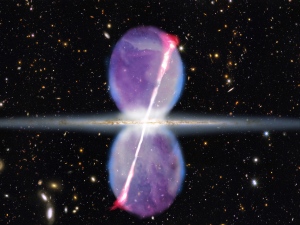
Last week an article in Nature News caught my eye. Ghostly jets seen streaming from Milky Way’s core was the headline. It’s based on a paper by Su & Finkbeiner recently submitted to the arXiv. There’s even a picture showing the jets in glorious technicolour:

Wow! Impressive stuff. If the jets look like that it’s amazing nobody ever saw them before!

Oh, hang on. The picture is an “artist’s conception”. In other words, it’s what the jets might look like if they actually existed, as imagined by a bloke with a box of crayons.

And how strong is the evidence that they do exist? Here’s the last paragraph of the Nature article (my emphasis):

Although the emissions are dim and the observations don’t have the statistical significance that astronomers require for proof, Baganoff says that several properties make them compelling evidence of jets. They are brighter at higher γ-ray energies and also brighter than the surrounding interstellar medium. They also seem to be long and thin, as would be expected of jets. “Taking all of the evidence together, it appears highly plausible that the features are jets emanating from the Galactic Centre,“ he says.

If they “don’t have the statistical significance that astronomers require for proof” then one wonders why they’re being given so much publicity. In any case the “ghostly jets seen streaming from the Milky Way’s core” can’t be said to have really been “seen” for certain. But they are “highly plausible”. In other words, the authors would like them to be there.

All I can say is that it must have been a slow news day at Nature.

Still, nice drawing.

The Rain Falls Down

Posted in Music with tags , on June 3, 2012 by telescoper

The rain falls down on last year’s man, 
that’s a jew’s harp on the table, 
that’s a crayon in his hand. 
And the corners of the blueprint are ruined since they rolled 
far past the stems of thumbtacks 
that still throw shadows on the wood. 
And the skylight is like skin for a drum I’ll never mend 
and all the rain falls down amen 
on the works of last year’s man. 

I met a lady, she was playing with her soldiers in the dark 
oh one by one she had to tell them 
that her name was Joan of Arc. 
I was in that army, yes I stayed a little while; 
I want to thank you, Joan of Arc, 
for treating me so well. 
And though I wear a uniform I was not born to fight; 
all these wounded boys you lie beside, 
goodnight, my friends, goodnight. 

I came upon a wedding that old families had contrived; 
Bethlehem the bridegroom, 
Babylon the bride. 
Great Babylon was naked, oh she stood there trembling for me, 
and Bethlehem inflamed us both 
like the shy one at some orgy. 
And when we fell together all our flesh was like a veil 
that I had to draw aside to see 
the serpent eat its tail. 

Some women wait for Jesus, and some women wait for Cain 
so I hang upon my altar 
and I hoist my axe again. 
And I take the one who finds me back to where it all began 
when Jesus was the honeymoon 
and Cain was just the man. 
And we read from pleasant Bibles that are bound in blood and skin 
that the wilderness is gathering 
all its children back again. 

The rain falls down on last year’s man, 
an hour has gone by 
and he has not moved his hand. 
But everything will happen if he only gives the word; 
the lovers will rise up 
and the mountains touch the ground. 
But the skylight is like skin for a drum I’ll never mend 
and all the rain falls down amen 
on the works of last year’s man.

The Boy in the Boat

Posted in Jazz with tags , , on June 3, 2012 by telescoper

I’ve written over a hundred posts about Jazz since this blog started, during which time I hope I’ve demonstrated that my ears are open to all its forms, from the traditional Jazz of New Orleans through the bebop era and on to the avant garde. In fact I enjoy writing about the music almost as much as listening to it. I guess it’s a form of evangelism. Or something.

I’m not at all sure who the typical reader of this blog is, but on the occasions when I’ve met people who say they follow my ramblings I’m quite surprised how many say that they enjoy the jazzy bits. Perhaps they’re just being polite. Some people say they like the traditional stuff and can’t bear “all that modern rubbish”; others say that I’m too conservative and should post some more challenging material. I guess that means I’ve accidentally got it about right. In any case I’ll continue posting whatever takes my fancy, and if anyone else out there likes it too then so much the better.

All of which unnecessary preliminaries bring me to a rare old record that I heard years ago on Humphrey Lyttelton’s radio show The Best of Jazz. It’s by Charlie Johnson’s Paradise Orchestra which played at the Paradise Club in Harlem, New York City, in the late 1920s. It’s simplifying the history of jazz a bit too much to put its evolution in one-to-one correspondence with  geographical locations, but the “New York” style of that period does represent the third phase of the music’s evolution; “New Orleans” and “Chicago” preceded it. The New York of the 1920s was home to a phenomenal concentration of great bands led by great bandleaders: Duke Ellington, Fletcher Henderson, Don Redman, Luis Russell; the list is almost endless. I suppose given the competition it shouldn’t be too much of a surprise that in this environment some very good bands didn’t become as famous as they deserved. This is definitely the case with Charlie Johnson’s Band (or Orchestra, I should say; everything was an “Orchestra” in those days).

In some ways this was a pretty rough old band, but it had a very distinctive voice all of its own and some superb soloists. Indeed in the track below – heard scratchily on an old gramophone – you can hear one of the very best solos from one of the very best soloists of that period, the brilliant trombonist Jimmy Harrison, whose name is not famous for the simple reason that he died young, in 1931. Unusually for a trombone player, Harrison was inspired and influenced by trumpeter Louis Armstrong, to the extent that he often used Satchmo’s favourite entry into a solo as demonstrated on this track, announcing his arrival (about 1.04) with a three-note BA-DA-DAA. His solo is beautifully poised, rhythmically assured, and over the insistent syncopated clarinet riffs, he builds up a wonderful sense of forward momentum. You can always tell the very best jazz musicians, as they can produce that sense of propulsion even when the tempo is not particularly fast.

Anyway, I think this track, The Boy in the Boat, is a forgotten masterpiece that belongs in the same class of atmospheric classics as Luis Russell’s Call of the Freaks, Don Redman’s Chant of the Weed and Duke Ellington’s The Mooche.

P.S. As far as I’m aware, this tune doesn’t have any connection with the rude song of the same name upon which Fats Waller based his tune Squeeze Me.

Jubilee

Posted in Film with tags , , on June 2, 2012 by telescoper

Since it’s the Diamond Jubilee of Her Majesty Queen Elizabeth II (60 years 59 years since her coronation on 2nd June 1952 1953; I’m grateful to fervent royalist Bryn Jones for correcting my error in the comments below), I thought I’d dig out something to mark the occasion. This is the opening sequence of Jubilee, by Derek Jarman, made to mark the Silver Jubilee in 1977. It’s hardly a celebration, however. In fact it’s a grimly ironic dystopian satire, in which Queen Elizabeth I travels forwards in time to 1970s London and finds a city and a society in a state of terminal decay. It was very controversial when it first came out primarily because, although the cast includes a number of punk icons, it’s as much an anti-punk film as it is anti-establishment. Over the years it has become something of a cult primarily, I suspect, among us oldies who remember what things were like in 1977. Anyway, do watch the whole thing if you get the chance. I think it’s brilliant.

Something for the Weekend?

Posted in Uncategorized with tags , , on June 1, 2012 by telescoper

I can’t think of a more appropriate form of official celebration for the Queen’s Diamond Jubilee than a show by the Lady Boys of Bangkok

Astronomy Jobs at Cardiff!

Posted in The Universe and Stuff with tags , , , , , on June 1, 2012 by telescoper

Just a quick post to advertise a couple of job opportunities in the School of Physics & Astronomy at Cardiff University. For further details you can look at the official website, but here is an outline:

Two Faculty Positions in Astrophysics

Observational and theoretical studies of star-formation and/or extrasolar planetary systems.

The School of Physics and Astronomy at Cardiff University has immediate vacancies for two permanent faculty appointments in Astrophysics.  We are seeking experts in observational and theoretical studies of star-formation and/or extra-solar planetary systems to conduct world-class research and research-led teaching at undergraduate and postgraduate level.  The appointments will be at any level from Lecturer to Professor depending on the experience of the candidate; we expect at least one of the appointments to be at a junior level.

Physics and Astronomy at Cardiff University has undergone substantial expansion in the past few years and has very strong research groups in gravitational-wave physics, astronomical instrumentation, extragalactic astronomy and cosmology, star-formation and condensed matter physics.  There are presently 18 academic staff involved in astrophysics and relativity, with 15 post-doctoral researchers and 22 PhD students.

The appointment will be made at a level commensurate with experience.

The advertisement is also available on the AAS Jobs Register, or will be when they get their act together and put it online. The AAS website is just one of a number that have been recently improved, with the result that they’re much less efficient than they were before.

Anyway, I’m just passing on the advertisement so please don’t send me your CVs! If you’d like to apply please do so using the official Cardiff University jobs page, which also has a lot of general information about the City and the University.

P.S. There have been quite a few job vacancies in astronomy around the UK recently – Edinburgh, Surrey, Liverpool, Exeter etc. I wonder why that is, and where the money is coming from?

Astronomy Lost and Found

Posted in Science Politics, The Universe and Stuff with tags , , , , , on May 31, 2012 by telescoper

Just finished my last postgraduate lecture, so that’s the teaching out of the way for this academic year. Time, methinks, for a short post to pass on two little bits of astronomy news for reaction and perhaps comment?

The first item concerns the balloon-borne polarimeter experiment known to its friends as EBEX. A truly bizarre story emerged this week concerning the disappearance of this telescope and associated equipment while it was in transit via lorry from the University of Minnesota to the launch site in Palestine, Texas. The truck failed to arrive at its destination, and seemed to vanish for about three days.

Obviously scientists working on EBEX were getting very nervous about its whereabouts , but finally it showed up. Apparently undamaged. The truck had apparently been stolen when the driver at stayed at a motel for the night; it was eventually found, three days later, abandoned not far from the motel.

Curiously, though, the driver hadn’t reported the theft of the truck to the local police. I wonder why? Something tells me there might be more to this story than meets the eye…

The other item of news I thought I’d pass on is an official announcement from the Science and Technology Facilities Council  of the forthcoming closure of both the James Clerk Maxwell Telescope (JCMT) and the UK Infra-red Telescope (UKIRT), both based at Hawaii;  UKIRT will close in September 2013, and JCMT the following year.

There’s been much reaction to this announcement on Twitter. Andy Lawrence has posted about it, for example.  Most colleagues of mine who have commented on the STFC decision have expressed dismay at the decision to lose UKIRT and JCMT and surprise at the decision to extend the operations of the Isaac Newton Group of Telescopes (ING) at the Observatorio del Roque de los Muchachos on La Palma in the Canary Islands, primarily the William Herschel Telescope (WHT) until at least 2015. I’m not sure of the extent to which these decisions were made on scientific grounds.

The decision to close UKIRT/JCMT isn’t exactly a surprise as they have been living on borrowed time since the STFC prioritisation exercise in 2009. It remains to be seen how the astronomical community reacts to the decision. I gather a statement is expected from the Royal Astronomical Society later today.

Comments and reaction are invited via the comments box, but please don’t shoot the messenger!

UPDATE: The statement from the RAS can be found here.

The End of May

Posted in Poetry with tags , , on May 31, 2012 by telescoper

How the wind howls this morn
About the end of May,
And drives June on apace
To mock the world forlorn
And the world’s joy passed away
And my unlonged-for face!
The world’s joy passed away;
For no more may I deem
That any folk are glad
To see the dawn of day
Sunder the tangled dream
Wherein no grief they had.
Ah, through the tangled dream
Where others have no grief
Ever it fares with me
That fears and treasons stream
And dumb sleep slays belief
Whatso therein may be.
Sleep slayeth all belief
Until the hopeless light
Wakes at the birth of June
More lying tales to weave,
More love in woe’s despite,
More hope to perish soon.

by William Morris (1834-96).

The Transparent Dishonesty of the Research Excellence Framework

Posted in Open Access, Science Politics with tags , , , , , , on May 30, 2012 by telescoper

Some of my colleagues in the School of Physics & Astronomy recently attended a briefing session about the  forthcoming Research Excellence Framework. This, together with the post I reblogged earlier this morning, suggested that I should re-hash an article I wrote some time ago about the arithmetic of the REF, and how it will clearly not do what it says on the tin.

The first thing is the scale of the task facing members of the panel undertaking the assessment. Every research active member of staff in every University in the UK is requested to submit four research publications (“outputs”) to the panel, and we are told that each of these will be read by at least two panel members. The Physics panel comprises 20 members.

As a rough guess I’d say that the UK has about 40 Physics departments, and the average number of research-active staff in each is probably about 40. That gives about 1600 individuals for the REF. Actually the number of category A staff submitted to the 2008 RAE was 1,685.57 FTE (Full-Time Equivalent), pretty close to this figure. At 4 outputs per person that gives 6400 papers to be read. We’re told that each will be read by at least two members of the panel, so that gives an overall job size of 12800 paper-readings. There are 20 members of the panel, so that means that between 29th November 2013 (the deadline for submissions) and the announcement of the results in December 2014 each member of the panel will have to have read 640 research papers. That’s an average of about two a day. Every day. Weekends included.

Now we are told the panel will use their expert judgment to decide which outputs belong to the following categories:

  • 4*  World Leading
  • 3* Internationally Excellent
  • 2* Internationally Recognized
  • 1* Nationally Recognized
  • U   Unclassified

There is an expectation that the so-called QR  funding allocated as a result of the 2013 REF will be heavily weighted towards 4*, with perhaps a small allocation to 3* and probably nothing at all for lower grades. In other words “Internationally recognized” research will probably be deemed completely worthless by HEFCE. Will the papers belonging to the category “Not really understood by the panel member” suffer the same fate?

The panel members will apparently know enough about every single one of the papers they are going to read in order to place them  into one of the above categories, especially the crucial ones “world-leading” or “internationally excellent”, both of which are obviously defined in a completely transparent and objective manner. Not.

We are told that after forming this judgement based on their expertise the panel members will “check” the citation information for the papers. This will be done using the SCOPUS service provided (no doubt at considerable cost) by   Elsevier, which by sheer coincidence also happens to be a purveyor of ridiculously overpriced academic journals. No doubt Elsevier are  on a nice little earner peddling meaningless data for the HECFE bean-counters, but I haven’t any confidence that it will add much value to the assessment process.

There have been high-profile statements to the effect that the REF will take no account of where the relevant “outputs”  are published, including a recent pronouncement by David Willetts. On the face of it, that would suggest that a paper published in the spirit of Open Access in a free archive would not be disadvantaged. However, I very much doubt that will be the case.

I think if you look at the volume of work facing the REF panel members it’s pretty clear that citation statistics will be much more important for the Physics panel than we’ve been led to believe. The panel simply won’t have the time or the breadth of understanding to do an in-depth assessment of every paper, so will inevitably in many cases be led by bibliometric information. The fact that SCOPUS doesn’t cover the arXiv means that citation information will be entirely missing from papers just published there.

The involvement of  a company like Elsevier in this system just demonstrates the extent to which the machinery of research assessment is driven by the academic publishing industry. The REF is now pretty much the only reason why we have to use traditional journals. It would be better for research, better for public accountability and better economically if we all published our research free of charge in open archives. It wouldn’t be good for academic publishing houses, however, so they’re naturally very keen to keep things just the way they are. The saddest thing is that we’re all so cowed by the system that we see no alternative but to participate in this scam.

Incidentally we were told before the 2008 Research Assessment Exercise that citation data would emphatically not be used;  we were also told afterwards that citation data had been used by the Physics panel. That’s just one of the reasons why I’m very sceptical about the veracity of some of the pronouncements coming out from the REF establishment. Who knows what they actually do behind closed doors?  All the documentation is shredded after the results are published. Who can trust such a system?

To put it bluntly, the apparatus of research assessment has done what most bureaucracies eventually do; it has become  entirely self-serving. It is imposing increasingly  ridiculous administrative burdens on researchers, inventing increasingly  arbitrary assessment criteria and wasting increasing amounts of money on red tape which should actually be going to fund research.
Yet another side of the academic journal racket…

Posted in Open Access with tags , , on May 30, 2012 by telescoper

Another illustration of how the Academic Journal Racketeers (in this case one of the usual suspects, Elsevier) have a stranglehold on research. As well as levying huge subscription charges they also supply a service called SCOPUS which the panels in the Research Excellence Framework will use to inform their deliberations. Needless to say, SCOPUS itself is a subscription-only resource. The academic publishing industry is of course very keen on the Research Excellence Framework. It’s certainly an Excellent Framework when it comes to making money. Pity about the actual Research though.

Mike Taylor's avatarSauropod Vertebra Picture of the Week

Scopus bills itself as “the largest abstract and citation database of research literature and quality web sources covering nearly 18,000 titles from more than 5,000 publishers.”

Sounds useful. But it’s useless. Literally.

Because it’s a subscription-only resource:

Now I am an associate researcher at the University of Bristol. UoB is part of the UK Access Management Federation, so I select that in the Shibboleth authentication page:

But the list of member universities doesn’t include Bristol, instead skipping straight from “University of Birmingham” to the intriguingly named “University of Bolton – Do Not Use”:

I can’t use it.

So it’s useless to me. Literally.

This is why it’s frustrating to me when I read statements like this from Elsevier’s Alicia Wise:

Commercial publishers are especially able to command resources to … develop new technologies and platforms to access journal content and improve researcher productivity (e.g., ScienceDirect, Scopus, Scirus, CrossRef, CrossCheck. Article of…

View original post 453 more words