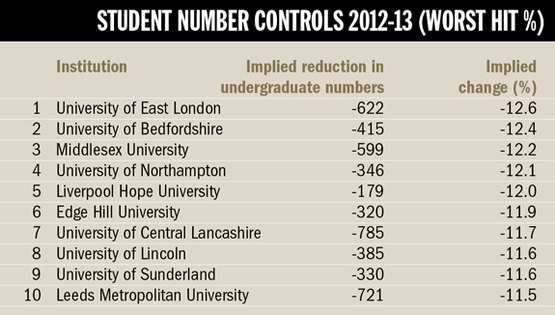
As reported in the Times Higher , the Higher Education Funding Council for England (HEFCE) has announced its allocations to English Higher Education Institutions for 2012/13. As expected, many universities are receiving substantial cuts next year. Here is a table of the biggest losers:
The Times Higher article describes this as the “Squeezed Middle”. It looks more like the “Squeezed Bottom” to me, but then I suppose that would have made an inappropriate headline.
Is there really a University of Sunderland?
Anyways, this allows me the chance to congratulate the former Director of Learning and Teaching in the School of Physics & Astronomy at Cardiff University on his move to the University of Central Lancashire, currently riding high at Number 7 in the above table…
Posted in Uncategorized on March 29, 2012 by telescoper
At a Staff Meeting yesterday it was officially announced that I’ve been “promoted” to Deputy Head of School, with responsibility for Teaching and Learning. Actually, it’s not so much a promotion as a battlefield commission, as the current holder of this prestigious position is shortly moving to pastures new. People have asking me if anything is going to be re-organized in the new regime. I’m going to suggest quite a few things, in fact, but the main idea I’ve come up with is to separate the administration of the “Teaching” part entirely from that of the “Learning” in order to reflect the fact that there’s absolutely no connection between the two activities. If we then appoint a Director of Teaching and a Director of Learning, I can leave them to do everything while I go down the pub.
As Deputy Head of School, I will be joining the all-powerful Management Group, the School’s elite Politburo which has only four members. One of my aims is to make this organization less secretive and more open. In this spirit, I can reveal this exclusive behind-the-scenes footage taken at the last Management Group meeting. I’m sure the members of the School will sleep more easily in their offices knowing that they’re managed by four such capable individuals.
Yesterday evening as I walked home through Bute Park I thought I’d take a few pictures with my phone to remind myself at a future date what beautiful weather we’re having and how splendid the trees and flowers are looking. It’s great to see so many people enjoying this beautiful park these days; fortunately the Council seems to have suspended the regular traffic of heavy vehicles along the paths, at least for the time being.
Unfortunately at around the time I took these pictures, something much less pleasant was happening a few hundred yards away near Cardiff Station. I’ve no idea what went on, but thankfully it looks like nobody received life-threatening injuries…
Anyway, neither Cherry nor May Blossom lasts very long – the Magnolias are already dropping their flowers – so let’s make the most of them while we can!
Cardiff Castle behind the trees
Even the Weeping Willow looks happy...although it's a bit of a concern that the water level in the Taff is so low...
Now here’s a question. Is it just me, or is the May Blossom appearing earlier nowadays than it used to? It’s definitely out now and it’s not even April yet…
Having an early morning cup of tea in the garden just now, as the fine weather continues, I suddenly remembered this classic from 1954. Fortunately someone has put it on Youtube so I can share it right away. This piece will forever be associated with the late great Clifford Brown who plays trumpet and leads the band, but the real star of the show for me is the arranger, Jack Montrose, who wove a rich texture around the melody of Joy Spring, with more than a hint of the West Coast “Cool” that was to dominate the US jazz scene in later years.
I found this image while reading an interesting piece about same-sex marriages in the early Christian era. Here’s an excerpt:
In the famous St. Catherine’s monastery on Mount Sinai, there is an icon which shows two robed Christian saints getting married. Their ‘pronubus’ (official witness, or “best man”) is none other than Jesus Christ.
The happy couple are 4th Century Christian martyrs, Saint Serge and Saint Bacchus — both men.
Severus of Antioch in the sixth century explained that “we should not separate in speech [Serge and Bacchus] who were joined in life.” More bluntly, in the definitive 10th century Greek account of their lives, Saint Serge is described as the “sweet companion and lover (erastai)” of St. Bacchus.
It’s interesting how religious conservatives keep going on about how legal recognition of same-sex relationships would destroy the “traditional” view of marriage. What tradition would that be, then? The tradition that gave us the Spanish Inquisition? Clearly not the tradition of the early Christian church.
I’m not a Christian and wouldn’t dream of telling Christians what they should think about same-sex marriage. I actually don’t mind if heterosexual people – Christian or otherwise – disapprove. They’re welcome to, in fact. They don’t have to marry a person of the same sex if they don’t want to. That’s not the same as allowing them to deny that right to others who feel differently.
And what’s this tripe about same-sex marriage “threatening” of “devaluing” traditional marriage? Is the function of marriage simply to make married people feel superior to those who aren’t allowed to be married? That’s what that argument sounds like to me. If that’s what it’s for I think the state should withdraw legal recognition from all forms of marriage and let us all be treated equally by the law, as individuals.
So the glorious weather continues. Unfortunately, unlike most UK universities, we’re not finished for Easter yet; at Cardiff University we only get three weeks for the Easter recess instead of the four that colleagues over the border seem to enjoy.
One of the consequences of this is that the annual National Astronomy Meeting (NAM) often falls in Cardiff term time. This year NAM is taking place in the fine city of Manchester (which, for those of you unfamiliar with British geography, is in the Midlands). Many colleagues in the School of Physics & Astronomy are attending NAM, and most of my research group are either there already or travelling up today. I particularly wish Jo and Ian well when they give their talks; one of the excellent things about NAM is the opportunity it offers for younger researchers to talk about their work to a large audience. Nerve-wracking, no doubt, but invaluable experience.
I’m not going to NAM this year because I have too much to do back here at the ranch, including filling in a few lectures for staff who are away. I’m always reluctant to cancel lectures during term-time, but in the current spell of good weather I doubt if any students would complain too much! I did a cosmology lecture this morning – only the second I’ve done here – and it the room was uncomfortably stuffy. A few of the students failed to fall asleep, however, so I regard that as a major success.
It’s strange how often good weather coincides with times of great stress for students. I recall that most of my undergraduate examinations took place in glorious sunshine, which seemed to have been laid on by some malevolent being to make us suffer. This week our students have project reports and presentations to worry about and other coursework to finish before term ends, as well as revision for the exams that take place in May; being couped up inside is no fun on days like this and I’m sure they’d prefer it to be raining outside so as not to distract them from the tasks in hand…
It’s so quiet around here today that it occurred to me now would be a good time to stage a Coup d’Etat. Come to thank of it, there’s a Staff Meeting been called on Wednesday which may well amount to something pretty similar…
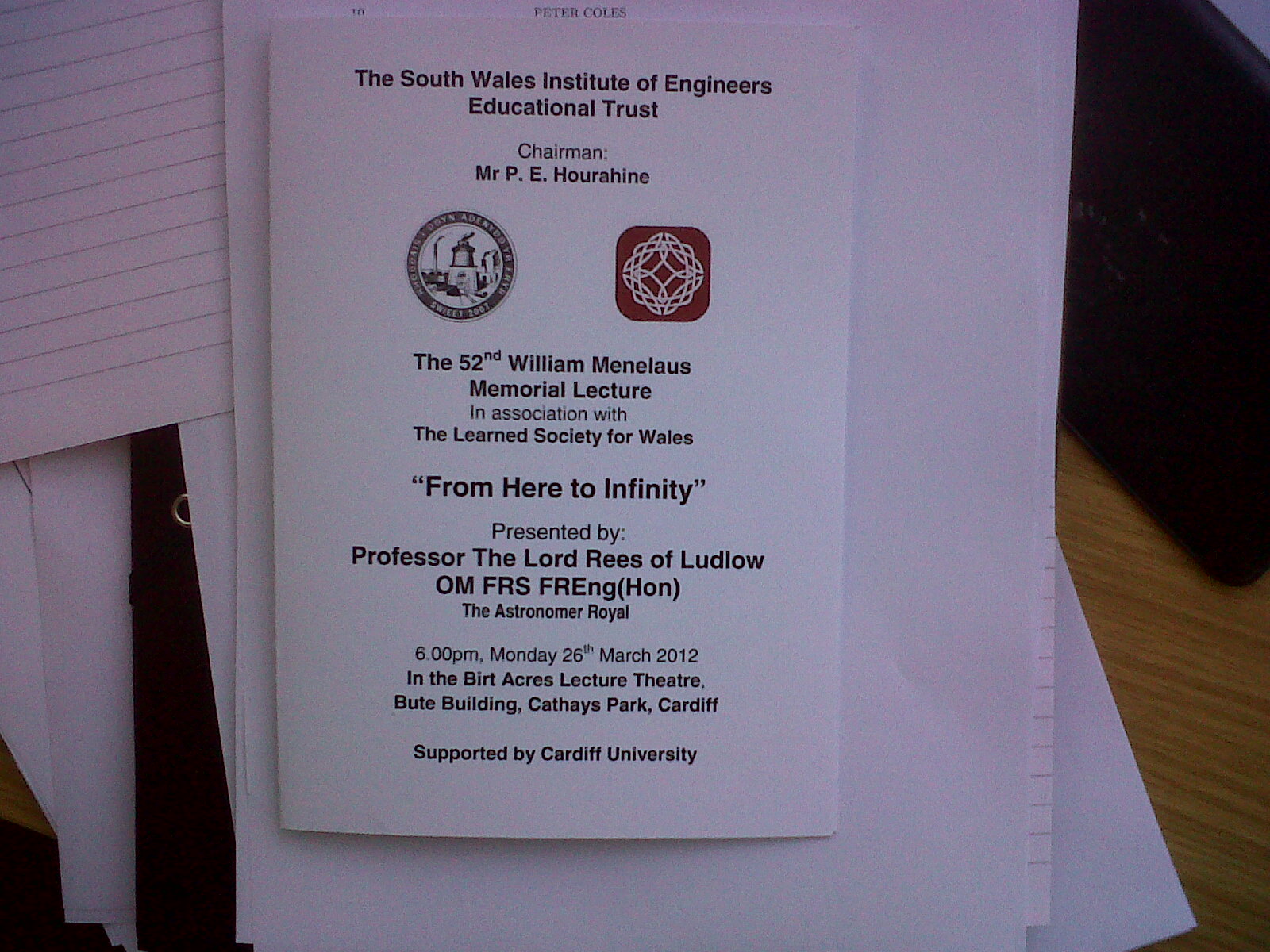
Anyway, those of us around today have a nice event this evening to look forward to, a lecture by Lord Rees followed by a nice dinner in Aberdare Hall. Here’s the invitation:
You’ll see that this is organized “in association with The Learned Society for Wales“, which I only just learned about when I saw it on the invitation!
Anyway, the prospect of a slap-up dinner persuaded me to just have a sandwich for lunch. Now that’s eaten methinks I’ll get back to work!
UPDATE: It was indeed a very interesting and entertaining lecture by Lord Rees; here he is, in action, watched by Prof. Disney…
We’re enjoying a spell of perfect weather at the moment, so I’m going to be out most of the afternoon enjoying the flowers and trees in Bute Park. I assume I’m not in danger of being run over by a lorry speeding along the paths, since I don’t think they work on Sundays. Anyway, BBC Radio 3 is devoting the period until the end of March to a “Spirit of Schubert” festival, so I thought I’d join in by posting an appropriately seasonal ditty. This is Im Frühling (D. 882) (“In Spring”), sung by Peter Pears with piano accompaniment by Benjamin Britten way back in 1950. Gives me a lovely glow inside listening to this. I hope you feel the same..
O’er the midnight moorlands crying, Thro’ the cypress forests sighing, In the night-wind madly flying, Hellish forms with streaming hair; In the barren branches creaking, By the stagnant swamp-pools speaking, Past the shore-cliffs ever shrieking; Damn’d daemons of despair.
Once, I think I half remember, Ere the grey skies of November Quench’d my youth’s aspiring ember, Liv’d there such a thing as bliss; Skies that now are dark were beaming, Gold and azure, splendid seeming Till I learn’d it all was dreaming— Deadly drowsiness of Dis.
But the stream of Time, swift flowing, Brings the torment of half-knowing— Dimly rushing, blindly going Past the never-trodden lea; And the voyager, repining, Sees the wicked death-fires shining, Hears the wicked petrel’s whining As he helpless drifts to sea.
Evil wings in ether beating; Vultures at the spirit eating; Things unseen forever fleeting Black against the leering sky. Ghastly shades of bygone gladness, Clawing fiends of future sadness, Mingle in a cloud of madness Ever on the soul to lie.
Thus the living, lone and sobbing, In the throes of anguish throbbing, With the loathsome Furies robbing Night and noon of peace and rest. But beyond the groans and grating Of abhorrent Life, is waiting Sweet Oblivion, culminating All the years of fruitless quest.
The Welsh Government’s vision for a world-leading science base in Wales was unveiled on Thursday 15 March during a keynote address by Wales’ Chief Scientific Officer, Professor John Harries, who delivered a public lecture at Cardiff University to reveal how he thinks this strategic agenda can steer Welsh science and engineering into the future.
Here is the lecture in its entirety
One the principal components this strategy is the Sêr Cymru (“Star Wales”) project which will involve expenditure of about £50 million over 5 years to attract research leaders to Wales. This announcement attracted quite a lot of local news coverage, e.g in the Western Mail, but it isn’t exactly a new proposal. In fact I blogged about it several months ago. Here is a summary of the points I made back then together with some new comments.
The basic point is that Welsh universities currently only attract about 3% of the UK’s total research funding whereas the famous Barnett formula allocates Wales about 5% of the total in other areas of public expenditure. Nobody involved in research would argue for funds to be allocated on any other basis than through quality, so there’s no clamour for having research funding allocated formulaically a là Barnett; the only way to improve the success rate is to improve the quality of applications. John Harries suggests that means poaching groups from elsewhere who’ve already got a big portfolio of research grants…
The problem with that strategy is that it’s not very easy to persuade such people to leave their current institutions, especially if they’ve already spend years acquiring the funding needed to equip their laboratories. It’s not just a question of moving people, which is relatively easy, but can involve trying to replace lots of expensive and delicate equipment. The financial inducements needed to fund the relocation of a major research group and fight off counter-offers from its present host are likely to be so expensive that the benefit gained from doing this takes years to accrue, even they are successful.
I agree with Prof. Harries that Welsh universities need to raise their game in research, but I don’t think this “transfer market” approach is likely to provide a solution on its own. I think Wales needs a radical restructuring of research, especially in science, across the whole sector, which I think is unacceptably complacent about the challenges ahead.
For a start, much more needs to be done to identify and nurture younger researchers, i.e. future research stars rather than present ones. Most football clubs nowadays have an “academy” dedicated to the development of promising youngsters, so why can’t we do a similar thing for research in Wales? Research groups in different Welsh universities also need to develop closer collaborations, and perhaps even full mergers, in order to compete with larger English institutions.
More controversially, I’d say that the problem is not being helped by Welsh universities continuing to be burdened by the monstrous bureaucracy and bizarre practices of the Research Excellent Framework, which allocates “QR” research funds according to priorities set by HEFCE in a way that reflects the thinking of the Westminster parliament. The distribution of QR funding in Wales, which is meant to supplement competitive grant income from UK funding bodies, should be decided by HEFCW in line with Welsh strategic priorities. Wales would be far better off withdrawing from the REF and doing its own thing under the auspices of the Welsh Assembly Government.
In fact there are dark rumours circulating that HEFCW will not have enough money to pay any QR funding anyway. If that’s true then the widening funding gap between Wales and England will do more damage than can possibly be remedied by importing a few big shots from elsewhere. The sum involved (£50 million) seems like a lot, but it won’t pay for more than a few groups around Wales if they are in experimental science or engineering technology, because the cost of setting up new labs and acquiring new equipment is considerable. Although buying in mercenaries might be of short-term benefit, what are the chances that they’ll take someone else’s dollar in the near future?
Wales needs a sustainable research base, so at very least I’d like to see a bottom-up project, encouraging younger researchers at PhD and PDRA level, perhaps through a system of national fellowships, to complement the “top-down” of the Star Wales project. Unless that happens, we might have leaders with no-one to follow them.
The views presented here are personal and not necessarily those of my employer (or anyone else for that matter).
Feel free to comment on any of the posts on this blog but comments may be moderated; anonymous comments and any considered by me to be vexatious and/or abusive and/or defamatory will not be accepted. I do not necessarily endorse, support, sanction, encourage, verify or agree with the opinions or statements of any information or other content in the comments on this site and do not in any way guarantee their accuracy or reliability.





 In the Dark