Author Archive

VISTA on Video

Posted in The Universe and Stuff with tags , , , , , on March 23, 2012 by telescoper

A chance tweet brought to my attention this video that fits well with a news story that’s been doing the rounds for a few days.   This concerns a very deep and wide survey called UltraVISTA, that has been made using the VISTA telescope at the European Southern Observatory’s Paranal Observatory in Chile. You can find the full press release from ESO that started the media interest here, where some lovely images can also be found.

VISTA is the world’s largest infra-red survey telescope, and is unusual among telescopes for having only one instrument on it, an Infra-red camera.  Technically, therefore,  it should really be called ISTA; owing to cost constraints the Visible camera that was initially proposed to accompany the Infra-red one and supply the V in its acronym,  was never built. Anyway, VISTA was designed explicitly to do survey work involving very distant and faint objects; its forte is to allow very deep images to be made with a very wide field of view, as demonstrated on the video…

Since I’m using the handle “telescoper” on this blog, I suppose I really should post about telescopes a bit more often than I do but I hope this will do for now!

Lines Written in Early Spring

Posted in Poetry with tags , on March 23, 2012 by telescoper

I heard a thousand blended notes,
While in a grove I sate reclined,
In that sweet mood when pleasant thoughts
Bring sad thoughts to the mind.

To her fair works did Nature link
The human soul that through me ran;
And much it grieved my heart to think
What man has made of man.

Through primrose tufts, in that green bower,
The periwinkle trailed its wreaths;
And ’tis my faith that every flower
Enjoys the air it breathes.

The birds around me hopped and played,
Their thoughts I cannot measure:–
But the least motion which they made
It seemed a thrill of pleasure.

The budding twigs spread out their fan,
To catch the breezy air;
And I must think, do all I can,
That there was pleasure there.

If this belief from heaven be sent,
If such be Nature’s holy plan,
Have I not reason to lament
What man has made of man?

by William Wordsworth (1770-1850)

B2FH

Posted in The Universe and Stuff with tags , , , , , , , , on March 22, 2012 by telescoper

I spent a pleasant evening yesterday at a public lecture arranged by Cardiff Scientific Society and given by Professor Mike Edmunds, former Head of the School of Physics & Astronomy at Cardiff University and now Emeritus Professor here. The subject of his talk was Origin of the Chemical Elements, a subject Mike has worked on for many years. Here’s the abstract of his talk:

When the Universe was 300,000 years old, the only chemical elements with significant abundance were hydrogen, helium and a small amount of lithium. All the atoms of all the other elements in the Periodic Table have been synthesised during the 13.7 billion years since that time. Research in physics and astronomy over the last 64 years has allowed us to identify the nuclear processes involved, including the importance of the humble neutron in the manufacture of the heavier elements. We now have a good picture of the astronomical sites where elements such as the carbon, nitrogen, oxygen and iron in our bodies were made, including violent supernova explosions. It is a picture that appears almost, but not quite, complete.

That last sentence is tempting fate a bit, but it’s fair comment! The lecture, which I had the pleasure of chairing, was both entertaining and informative, and very warmly received by the large audience in the Reardon Smith Lecture Theatre (in the National Museum of Wales).

Inevitably in a talk on this subject, the subject came up of the classic work of Burbidge, Burbidge, Fowler and Hoyle in 1957 (a paper usually referred to as B2FH after the initials of its authors). It’s such an important contribution, in fact, that it has its own wikipedia page

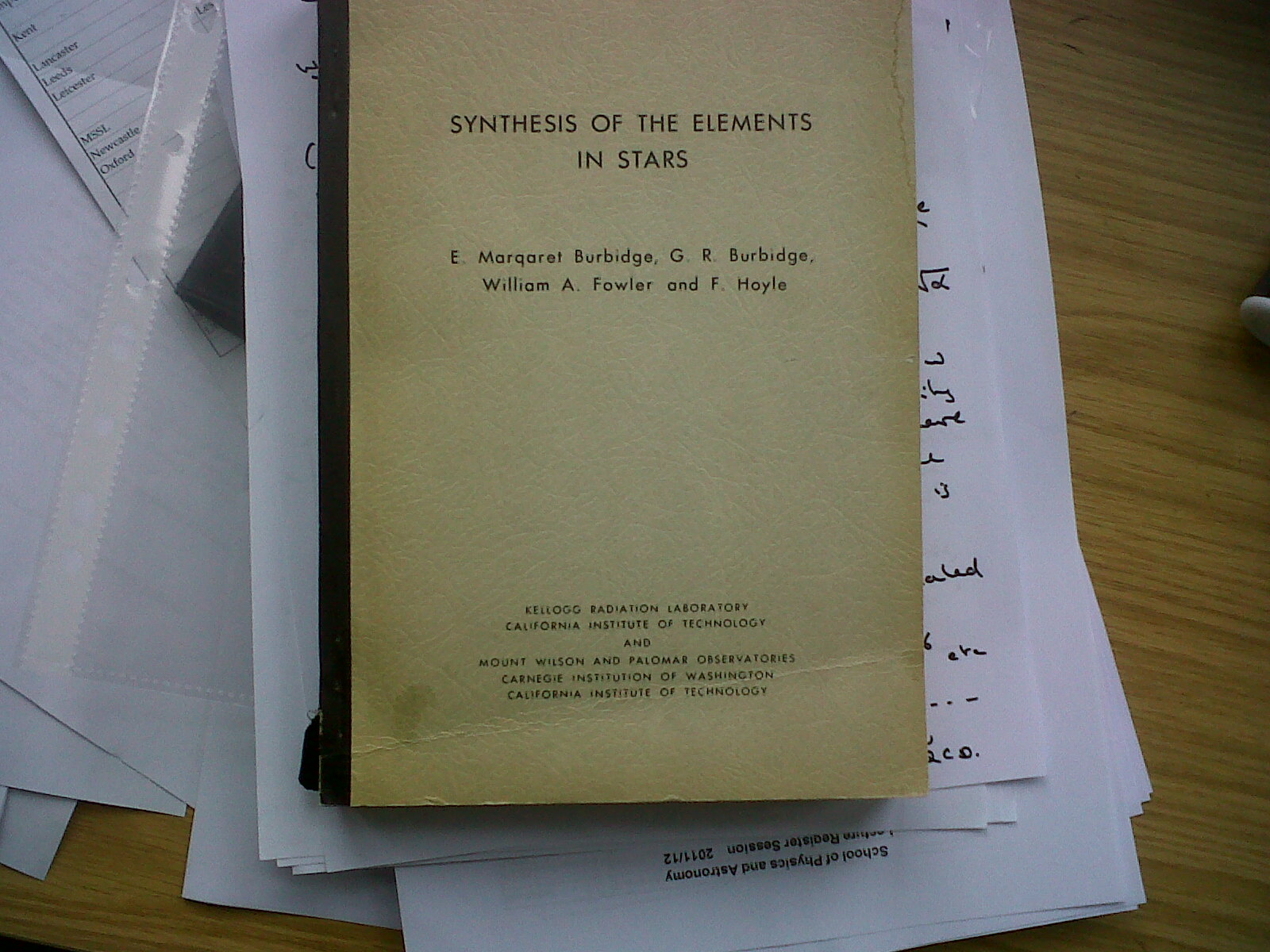
This reminded me that one of the interesting astronomical things I’ve acquired over the years is a preprint of the B2FH paper. Younger readers will probably not be aware of preprints – we all used to post them in large numbers to (potentially) interested colleagues before publication to get comments – because in the age of the internet people don’t really bother to make them any more.

Anyway, here’s a snap of it.

It’s a hefty piece of work, and an important piece of astronomical history. In years to come perhaps it may even acquire some financial value. Who knows?

Teaching Physics

Posted in Education, The Universe and Stuff with tags , , on March 22, 2012 by telescoper

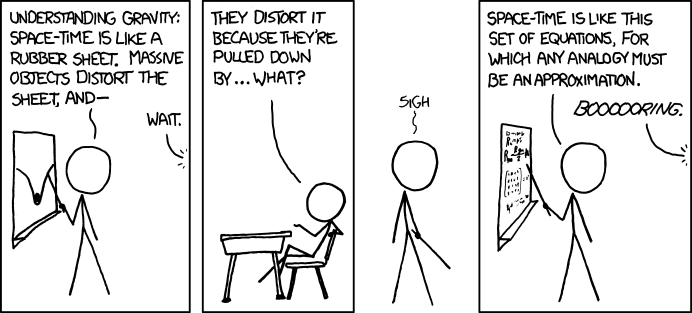
More on this weeks’ theme, from the inestimable xkcd

The Budget – a Pictorial Guide

Posted in Finance, Politics with tags , , on March 21, 2012 by telescoper

Courtesy of the BBC Webshite.

Posted in Uncategorized on March 21, 2012 by telescoper

Elsevier redefines the meaning of “free”…their open access articles in fact cost over £10 each to download.

Mike Taylor's avatarSauropod Vertebra Picture of the Week

Well, I’ve spent a lot of time on this blog trying to determine what the terms are for Elsevier’s elective open-access articles — what they term “Sponsored Articles“.  [For anyone who needs to catch up: part 1, part 2, part 3, unofficial part 3-and-a-bit, part 4.]

We are as far as ever from getting a good, clear, explicit statement like the one Springer provide on their “Open Choice” page (“all Open Choice articles are published under the Creative Commons Attribution (CC BY) license”.  There — that wasn’t so hard, was it?)  But we do have an important new nugget of information, thanks to a pair of tweets from Erin McKiernan (@emckiernan13).

We start at this page, the table of contents for Neuron 73(5).  Neuron is published by Cell Press, which is an imprint of Elsevier.  As you…

View original post 375 more words

A Style of Loving

Posted in Poetry with tags , , on March 21, 2012 by telescoper

Light now restricts itself
To the top half of trees;
The angled sun
Slants honey-coloured rays
That lessen to the ground
As we bike through
The corridor of Palm Drive.
We two

Have reached a safety the years
Can claim to have created:
Unconsummated, therefore
Unjaded, unsated.
Picnic, movie, ice-cream;
Talk; to clear my head
Hot buttered rum — coffee for you;
And so not to bed.

And so we have set the question
Aside, gently.
Were we to become lovers
Where would our best friends be?
You do not wish, nor I
To risk again
This savoured light for noon’s
High joy or pain.

by Vikram Seth (b. 1952).

Cosmology, Escher and the Field of Screams

Posted in Art, Education, The Universe and Stuff with tags , , , , , on March 20, 2012 by telescoper

Up early this morning for yet another busy day I thought I’d post a quick follow-up to my recent item about analogies for teaching physics (especially cosmology).

Another concept related to the cosmic microwave background that people sometimes have problems understanding is that of last scattering surface.

Various analogies are useful for this. For example, when you find yourself in thick fog you may have the impression that you are surrounded by an impenetrable wall at some specific distance around you. It’s not a physical barrier, of course, it’s just the distance at which there sufficient water droplets in the air to prevent light from penetrating further. In more technical terms the optical depth of the fog exceeds unity at the distance at which this wall is seen.

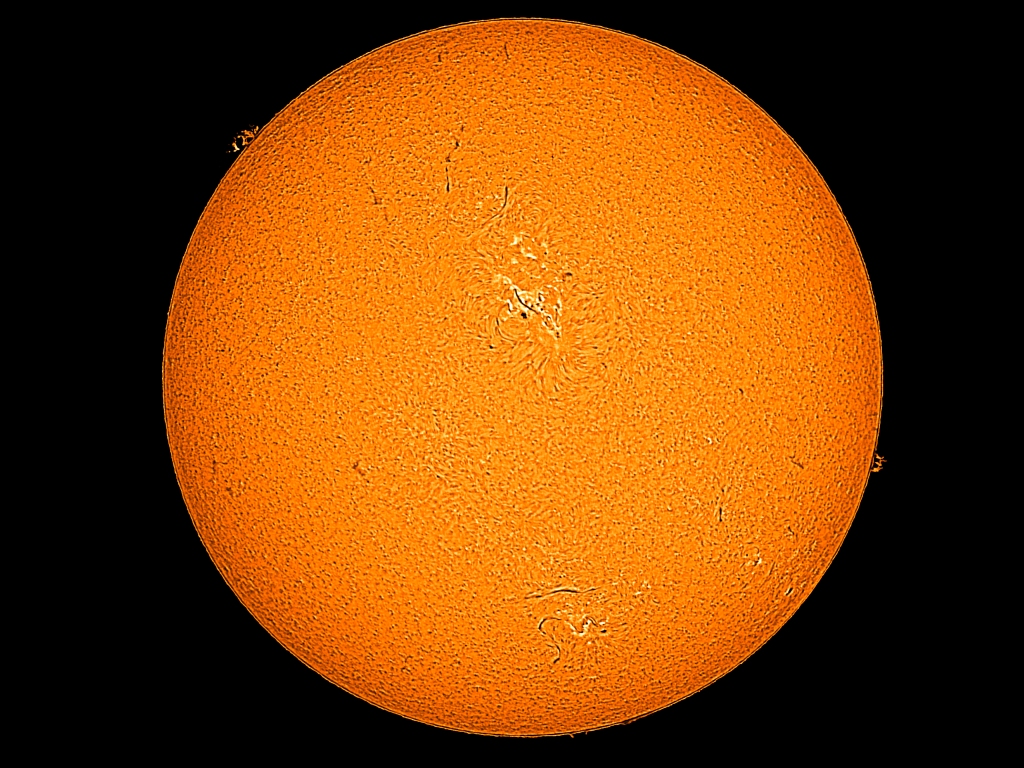
Another more direct analogy is provided by the Sun. Here’s a picture of said object, taken through an H-α filter..

What’s surprising to the uninitiated about an image such as this is that the Sun appears to have a distinct edge, like a solid object. The Sun, however, is far from solid. It’s just a ball of hot gas whose density and temperature fall off with distance from its centre. In the inner parts the Sun is basically opaque, and photons of light diffuse outwards extremely slowly because they are efficiently scattered by the plasma. At a certain radius, however, the material becomes transparent and photons travel without hindrance. What you see is the photosphere which is a sharp edge defined by this transition from opaque to transparent.

The physics defining the Sun’s photosphere is much the same as in the Big Bang, except that in the case of the Sun we are outside looking in whereas we are inside the Universe trying to look out. Take a look at this image from M.C. Escher:

The universe isn’t actually made of Angels and Demons – at least not in the standard model – but if you imagine you are in the centre of the picture  it nicely represents what it is like looking out through an expanding cosmology. Since light travels with finite speed, the further you look out the further you look back into the past when things were denser (and hotter). Eventually you reach a point where the whole Universe was as hot as the surface of a star, this is the cosmic photosphere or the last scattering surface, which is a spherical surface centred on the observer. We can’t see any further than this because what’s beyond is hidden from us by an impenetrable curtain,  but if we could just a little bit further we’d see the Big Bang itself where the density is infinite, not as a point in space but all around us.

Although it looks like we’re in a special place (in the middle) of the image, in the Big Bang theory everywhere is equivalent; any observer would see a cosmic photosphere forming a sphere around them.

And while I’m on about last scattering, here’s another analogy which might be useful if the others aren’t. I call this one the Field of Screams.

Imagine you’re in the middle of a very large, perhaps infinite, field crammed full of people, furnished with synchronised watches, each of whom is screaming at the top of their voice. At a certain instant, say time T, everyone everywhere stops screaming.

What do you hear?

Well , you’ll obviously  notice that it gets quieter straight away as the people closest to you have stopped screaming.  But you will still hear a sound because some of the sound entering your ear set out at a time before t=T. The speed of sound is 300 m/s or so, so after 1 second you will still hear the sound arriving from people further than 300 metres away. It might be faint, but it would be there. After two seconds you’d still be hearing from people further than 600 metres away,. and so on. At any time there’ll be circle around you, defined by the distance sound can have travelled since the screaming stopped – the Circle of Last Screaming. It would appear that you are in the centre of this circle, but anyone anywhere in the field would form the same impression about what’s happening around them.

Change sound to light, and move from two dimensions to three, and you can see how last scattering produces a spherical surface around you. Simples.


Nora the Piano Cat

Posted in Music with tags , , , on March 19, 2012 by telescoper

A busy day, filled with meetings meetings and more meetings. Time to relax with some music. This is a complete performance of a work by Mindaugas Piecaitis, featuring Nora the Piano Cat….


Failed Physics Teaching Analogies

Posted in Education, The Universe and Stuff with tags , , , , , , , on March 18, 2012 by telescoper

Last week I deputized for a colleague who was skiving off away at an important meeting so, for the first time ever in my current job, I actually got to give a proper lecture on cosmology. As the only out-and-out specialist in cosmology research in the School of Physics and Astronomy at Cardiff, I’ve always thought it a bit strange that I’ve never been asked to teach this subject to undergraduates, but there you are. Ours not to reason why, etc. Anyway, the lecture I gave was about the cosmic microwave background, and since I have taught cosmology elsewhere in the past it was quite easy to cobble something together.

As a lecturer you find, over the years, that various analogies come to mind that you think will help students understand the physical concepts underpinning what’s going on, and that you hope will complement the way they are developed in a more mathematical language. Sometimes these seem to work well during the lecture, but only afterwards do you find out they didn’t really serve their intended purpose. Sadly it also  sometimes turns out that they can also confuse rather than enlighten…

For instance, the two key ideas behind the production of the cosmic microwave background are recombination and the consequent decoupling of matter and radiation. In the early stages of the Big Bang there was a hot plasma consisting mainly of protons and electrons in an intense radiation field. Since it  was extremely hot back then  the plasma was more-or-less  fully ionized, which is to say that the equilibrium for the formation of neutral hydrogen atoms via

p+e^{-} \rightarrow H+ \gamma

lay firmly to the left hand side. The free electrons scatter radiation very efficiently via Compton  scattering

\gamma +e^{-} \rightarrow \gamma + e^{-}

thus establishing thermal equilibrium between the matter and the radiation field. In effect, the plasma is opaque so that the radiation field acquires an accurate black-body spectrum (as observed). As long as the rate of collisions between electrons and photons remains large the radiation temperature adjusts to that of the matter and equilibrium is preserved because matter and radiation are in good thermal contact.

Eventually, however, the temperature falls to a point at which electrons begin to bind with protons to form hydrogen atoms. When this happens the efficiency of scattering falls dramatically and as a consequence the matter and radiation temperatures are no longer coupled together, i.e. decoupling occurs; collisions can longer keep everything in thermal equilibrium. The matter in the Universe then becomes transparent, and the radiation field propagates freely as a kind of relic of the time that it was last in thermal equilibrium. We see that radiation now, heavily redshifted, as the cosmic microwave background.

So far, so good, but I’ve always thought that everyday analogies are useful to explain physics like this so I thought of the following. When people are young and energetic, they interact very effectively with everyone around them and that process allows them to keep in touch with all the latest trends in clothing, music, books, and so on. As you get older you don’t get about so much , and may even get married (which is just like recombination, in that it dramatically  reduces your cross-section for interaction with the outside world). Changing trends begin to pass you buy and eventually you become a relic, surrounded by records and books you acquired in the past when you were less introverted, and wearing clothes that went out of fashion years ago.

I’ve used this analogy in the past and students generally find it quite amusing even if it has modest explanatory value. I wasn’t best pleased, however, when a few years ago I set an examination question which asked the students to explain the processes of recombination and decoupling. One answer said “Decoupling explains Prof. Coles’ terrible fashion sense”. Grrr.

An even worse example happened when I was teaching particle physics some time ago. I had to explain neutrino oscillations, a process in which neutrinos (which have three distinct flavour states, associated with the electron, mu and tau leptons) can change flavour as they propagate. It’s quite a weird thing to spring on students who previously thought that lepton number was always conserved so I decided to start with an analogy based on more familiar physics.

A charged fermion such as an electron (or in fact anything that has a magnetic moment, which would include, e.g. the neutron)  has spin and, according to standard quantum mechanics, the component of this in any direction can  can be described in terms of two basis states, say |\uparrow> and |\downarrow> for spin in the z direction. In general, however, the spin state will be a superposition of these, e.g.

\frac{1}{\sqrt{2}} \left( |\uparrow> + |\downarrow>\right)

In this example, as long as the particle is travelling through empty space, the probability of finding it with spin “up” is  50%, as is the probability of finding it in the spin “down” state. Once a measurement is made, the state collapses into a definite “up” or “down” wherein it remains until something else is done to it.

If, on the other hand, the particle  is travelling through a region where there is a  magnetic field the “spin-up” and “spin-down” states can acquire different energies owing to the interaction between the spin and the magnetic field. This is important because it means the bits of the wave function describing the up and down states evolve at different rates, and this  has measurable consequences: measurements made at different positions yield different probabilities of finding the spin pointing in different directions. In effect, the spin vector of the  particle performs  a sort of oscillation, similar to the classical phenomenon called  precession.

The mathematical description of neutrino oscillations is very similar to this, except it’s not the spin part of the wavefunction being affected by an external field that breaks the symmetry between “up” and “down”. Instead the flavour part of the wavefunction is “precessing” because the flavour states don’t coincide with the eigenstates of the Hamiltonian that describes the neutrinos’ evolution. However, it does require that different neutrino types have intrinsically different energies  (which, in turn, means that the neutrinos must have different masses), in quite  a similar way similar to the spin-precession example.

Although this isn’t a perfect analogy I thought it was a good way of getting across the basic idea. Unfortunately, however, when I subsequently asked an examination question about neutrino oscillations I got a significant number of answers that said “neutrino oscillations happen when a neutrino travels through a magnetic field….”. Sigh. Neutrinos don’t interact with  magnetic fields, you see…

Anyhow, I’m sure there’s more than one reader out there who has had a similar experience with an analogy that wasn’t perhaps as instructive as hoped. Feel free to share through the comments box…