No time for a proper post today, so I’ll just offer a lovely bit of jazz from the late great Ben Webster that I bookmarked for future posting some time in the past. Webster was a big boozy brutish kind of bloke, but he played ballads with a heartwarming tenderness, as you can tell from this performance which also features the vastly underrated British pianist, Stan Tracey, who is still going strong after over 60 years in the business. Enjoy!
Follow @telescoperAuthor Archive
Over the Rainbow
Posted in Jazz with tags Ben Webster, Jazz, Over the Rainbow, Stan Tracey on October 15, 2011 by telescoperThe Astronomy Career Problem – it starts with the PhD
Posted in Science Politics with tags astronomy, careers, postgraduate, STFC, Twitter, Universities on October 14, 2011 by telescoperJust time for a quickie today, as I’ve got to run an examples class before dashing off on the train to London to attend the annual George Darwin Lecture which, this year, is to be given by Michael Turner with the title From Quarks to the Cosmos. I expect it to be very enjoyable and may well write a report at the weekend.
Yesterday evening there was a discussion on twitter (#astrojc) about the astronomy careers problem. I didn’t take part – in fact I didn’t realise it was happening – as I was slaving over the Private Eye crossword at the time.
Anyway, it gives me the excuse to rehash an argument I have presented before, which is that most analyses of the problems facing young postdoctoral researchers in astronomy are looking at the issue from the wrong end. I think the crisis is essentially caused by the overproduction of PhDs in this field. To understand the magnitude of the problem, consider the following.
Assume that the number of permanent academic positions in a given field (e.g. astronomy) remains constant over time. If that is the case, each retirement (or other form of departure) from a permanent position will be replaced by one, presumably junior, scientist.
This means that over an academic career, on average, each academic will produce just one PhD who will get a permanent job in academia. This of course doesn’t count students coming in from abroad, or those getting faculty positions abroad, but in the case of the UK these are probably relatively small corrections.
Under the present supply of PhD studentships an academic can expect to get a PhD student at least once every three years or so. At a minimum, therefore, over a 30 year career one can expect to have ten PhD students. A great many supervisors have more PhD students than this, but this just makes the odds worse. The expectation is that only one of these will get a permanent job in the UK. The others (nine out of ten, according to my conservative estimate) above must either leave the field or the country to find permanent employment.
The arithmetic of this situation is a simple fact of life, but I’m not sure how many prospective PhD students are aware of it. There is still a reasonable chance of getting a first postdoctoral position, but thereafter the odds are stacked against them.
The upshot of this is we have a field of understandably disgruntled young people with PhDs but no realistic prospect of ever earning a settled living working in the field they have prepared for. This problem has worsened considerably in recent years as the number of postdoctoral positions has almost halved since 2006. New PhDs have to battle it out with existing postdoctoral researchers for the meagre supply of suitable jobs. It’s a terrible situation.
Now the powers that be – in this case the Science and Technology Facilities Council – have consistently argued that the excess PhDs go out into the wider world and contribute to the economy with the skills they have learned. That may be true in a few cases. However, my argument is that the PhD is not the right way to do this because it is ridiculously inefficient.
What we should have is a system wherein we produce more and better trained Masters level students and fewer PhDs. This is the system that exists throughout most of Europe, in fact, and the UK is actually committed to adopt it through the Bologna process. Not that this commitment seems to mean anything, as precisely nothing has been done to harmonize UK higher education with the 3+2+3 Bachelors+Masters+Doctorate system Bologna advocates.
The training provided in a proper two-year Masters programme will improve the skills pool for the world outside academia, and also better prepare the minority of students who go on to take a PhD. The quality of the PhD will also improve, as only the very best and most highly motivated researchers will take that path. This used to be what happened, of course, but I don’t think it is any longer the case.
The main problem with this suggestion is that it requires big changes to the way both research and teaching are funded. The research councils turned away from funding Masters training many years ago, so I doubt if they can be persuaded to to a U-turn now.
This won’t solve the existing careers crisis, of course, but in order to make things better you first have to stop them getting worse.
Follow @telescoperAnother day, another tutorial…
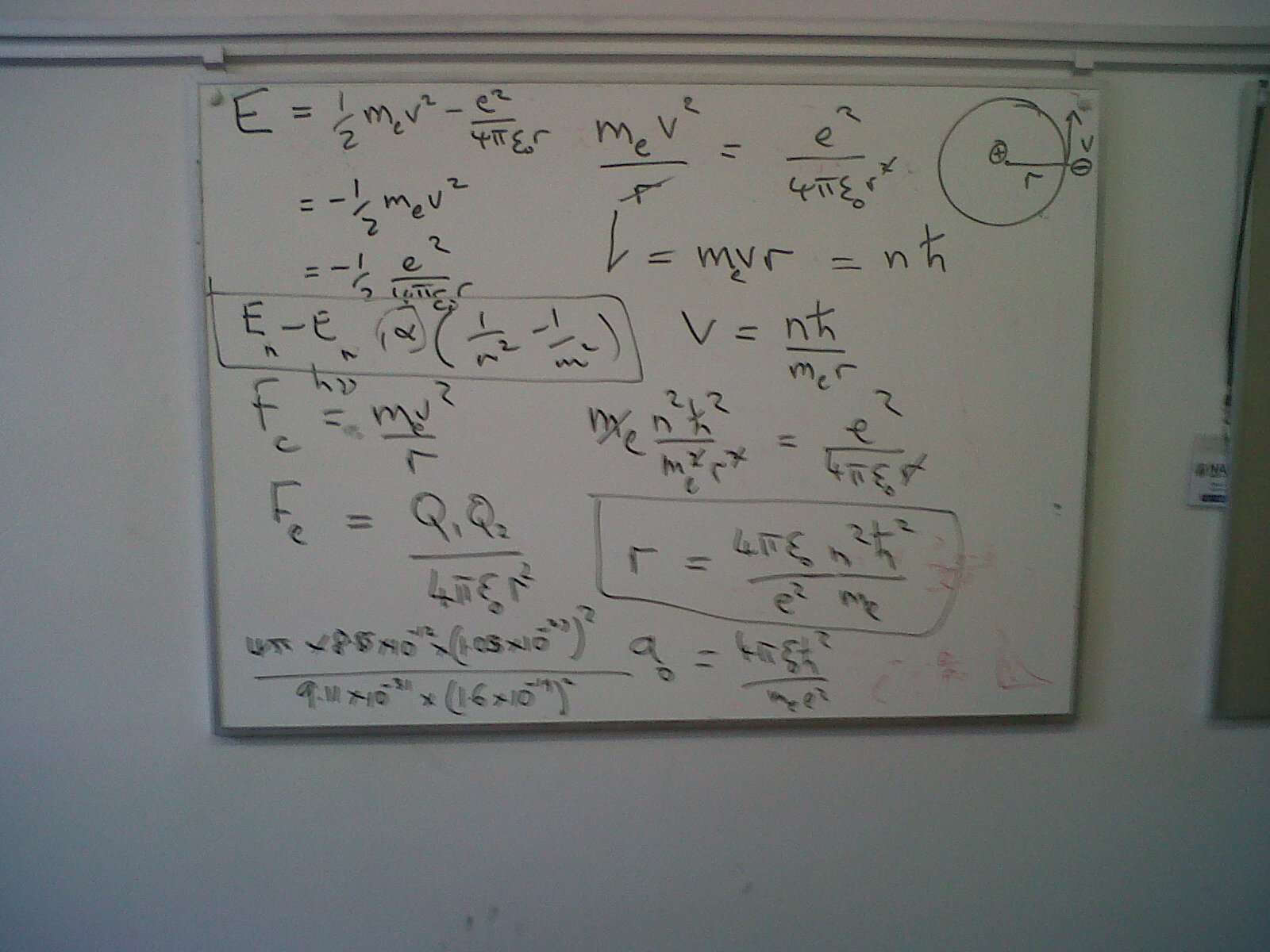
Posted in Education, The Universe and Stuff with tags Bohr atom, Bohr radius, Physics, Quantum Mechanics, tutorial on October 13, 2011 by telescoperOh what fun it is to derive the Bohr radius. At least the camera on my Blackberry works!
My Blackberry (still) is not Working!
Posted in Uncategorized with tags Blackberry, Harry Enfield, Ronnie Corbett on October 13, 2011 by telescoperWho needs the University of Wales?
Posted in Education, Politics with tags academic, Higher Education, Leighton Andrews, Universities, University of Wales, UWIC, Wales on October 12, 2011 by telescoperI couldn’t resist a quick and possibly inflammatory, comment about the University of Wales affair.
I’m not sure how much this story has spread outside Wales, but it’s relatively easy to summarise quickly. The University of Wales has had a complicated history which I won’t go into details about, but in essence it used to be the only University in Wales; my current employer, Cardiff University, for example, was for a long time a College of the University of Wales. In 1992 the special status of the University of Wales changed when the former Polytechnic of Wales became the University of Glamorgan. In subsequent years a number of institutions within the University of Wales, including the College of Cardiff in 2004, sought and were granted the ability to award their own degrees rather than degrees accredited by the University of Wales and so effectively became independent. As a consequence, the importance of the University of Wales in the landscape of Welsh Higher Education rapidly dwindled to the point where it was a “rump” of an institution accrediting degrees for just a few relatively small institutes.
Having spent some time in my career working in London, it seems to me that there’s at least superficially a striking parallel between the situation in Wales and that surrounding the former colleges of the University of London, most of which now award their own degrees rather than University of London degrees. The University of London nevertheless still exists, though I’ve never really understood why.
It tends to be the case that administrative structures refuse to die a natural death but instead try to find new things to administer. In order to justify itself, the University of Wales diversified into accrediting degrees from a host of smaller institutions both at home and abroad. To cut several long stories very short, much of its business in recent years has been dodgy to say the least. The University of Wales’ involvement in visa scams and the selling of bogus degrees are just two of the revelations that have led to many calling for the organisation to be scrapped altogether, prominent among them being the Welsh Assembly Minister responsible for higher education, Leighton Andrews.
The University of Wales “brand” has now become so tarnished that some of Welsh Higher Education institutions whose degrees it accredits now seem anxious to sever their ties altogether. The University of Wales, Institute of Cardiff (UWIC) wishes to change its name to Cardiff Metropolitan University and award its own degrees.
I think it’s quite clear that the University of Wales is now damaged beyond repair and should be dissolved, although the mechanism by which this can be achieved is unclear as universities are independent charitable institutions, not run directly from government. So egregious has been the conduct of the senior management of this organisation, however, that I’m sure a way can be found to wind it up. I just can’t see how it can possibly survive these scandals.
Unfortunately, dissolution in itself will not repair the damage already done; some institutions under the University of Wales umbrella will surely find that, through no fault of their own, a great deal of mud will stick.
Leighton Andrews has already called – rightly, in my view – for a reduction in the number of universities in Wales, most of which are small. In my neck of the woods, South-east Wales, for example, a game of musical mergers has been going on for months already between UWIC, Glamorgan and the University of Wales, Newport but no concrete plans have emerged. In my opinion the region can only sustain one world-class, research intensive university and one teaching led “new” university. Will the chaos generated by the public disintegration of the University of Wales make it easier or harder to achieve this?
But I can’t help feel sad about the inevitable demise of the University of Wales, which seems to me to be more of a tragedy than a farce. Its problems can all be traced back to the terrible decision, taken by the Conservative government in 1992, to allow the polytechnics to call themselves universities. Wales was much better off when it had one University and one Polytechnic, and neither had to prostitute itself to make ends meet.
Follow @telescoperWave your hands and think of Astronomy….
Posted in The Universe and Stuff with tags astronomy on October 12, 2011 by telescoperHere’s a short video presentation in which it is demonstrated that astronomers like to move their hands while talking. It’s frightfully amusing, but I can’t help thinking it would have been even better if the musical accompaniment had been, well, musical. Anyway, keep watching until 2:17 or thereabouts and you’ll see that I have a small part.
Follow @telescoperWelsh Testament
Posted in Poetry with tags R. S. Thomas, Welsh Testament on October 11, 2011 by telescoperThe video recalls the snows of last winter but the poem, read by the poet R.S. Thomas, is deeper still…
All right, I was Welsh. Does it matter?
I spoke a tongue that was passed on
To me in the place I happened to be,
A place huddled between grey walls
Of cloud for at least half the year.
My word for heaven was not yours.
The word for hell had a sharp edge
Put on it by the hand of the wind
Honing, honing with a shrill sound
Day and night. Nothing that Glyn Dwr
Knew was armour against the rain’s
Missiles. What was descent from him?
Even God had a Welsh name:
We spoke to him in the old language;
He was to have a peculiar care
For the Welsh people. History showed us
He was too big to be nailed to the wall
Of a stone chapel, yet still we crammed him
Between the boards of a black book.
Yet men sought us despite this.
My high cheek-bones, my length of skull
Drew them as to a rare portrait
By a dead master. I saw them stare
From their long cars, as I passed knee-deep
In ewes and wethers. I saw them stand
By the thorn hedges, watching me string
The far flocks on a shrill whistle.
And always there was their eyes’ strong
Pressure on me: You are Welsh, they said;
Speak to us so; keep your fields free
Of the smell of petrol, the loud roar
Of hot tractors; we must have peace
And quietness.
Is a museum
Peace? I asked. Am I the keeper
Of the heart’s relics, blowing the dust
In my own eyes? I am a man;
I never wanted the drab role
Life assigned me, an actor playing
To the past’s audience upon a stage
Of earth and stone; the absurd label
Of birth, of race hanging askew
About my shoulders. I was in prison
Until you came; your voice was a key
Turning in the enormous lock
Of hopelessness. Did the door open
To let me out or yourselves in?
Einstein and your Gas Bill
Posted in History, Television, The Universe and Stuff with tags Albert Einstein, calorific value, dimensional analysis, Edward Enfield, Fritz Hasenohrl, Watchdog on October 11, 2011 by telescoperTaking refuge in my office this lunchtime for a sandwich and a cup of coffee I turned to the latest edition of Physics World and came across an funny little story about a physicist (who is completely new to me) with the splendid name of Fritz Hasenöhrl.
The news story relates to a paper on the arXiv, part of the abstract of which I’ve copied below:
In 1904 Austrian physicist Fritz Hasenohrl (1874-1915) examined blackbody radiation in a reflecting cavity. By calculating the work necessary to keep the cavity moving at a constant velocity against the radiation pressure he concluded that to a moving observer the energy of the radiation would appear to increase by an amount
, which in early 1905 he corrected to
…
Since I’ve been doing a bit of dimensional analysis with first-year students, I’m a bit surprised that the authors of this paper read so much into the fact that Hasenöhrl’s formula bears a superficial resemblance to Einstein’s most famous formula 


Expressing energy in terms of the basic dimensions mass 


Anyway, all this suddenly reminded me of a day long ago when I appeared on peak-time television in the consumer affairs programme Watchdog, explaining – or, rather, attempting to explain – the physics behind the way gas bills are calculated. Apparently someone had written in to the programme asking why it was that they weren’t just being charged for the volume of gas that had flowed through their meter, but that the cost involved a complicated calculation involving something called the calorific value of the gas.
The answer is fairly obvious, actually. The idea is that to make competition fairer between different forms of energy (particularly gas and electricity) the bills should be for the amount of energy you have used rather than the amount of gas. Since the source of fuel varies from day to day so does its chemical composition and hence the amount of energy that can be extracted from it when it is burned. Gas companies therefore monitor the calorific value, using it to convert the amount of gas you have used into an amount of energy.
On the programme I was confronted by the curmudgeonly Edward Enfield (father of comedian Harry Enfield) who took the line that it was all unnecessarily complicated and that the bill should just be for the amount of gas used, rather in the same way that petrol is sold. When I tried to explain that the way it was done was really fairer, because it was really the energy that mattered, it quickly became obvious that he didn’t really understand what energy was or how it was defined. He didn’t even get the difference between energy and power. I suspect that goes for many members of the general public.
It was all a bit tongue-in-cheek, but I enjoyed the sparring. Eventually he came out with a question about why energy was given by 
My brief career on BBC1 was over.
Follow @telescoperHave you been Drexlered?
Posted in The Universe and Stuff with tags charged dark matter, Cosmology, dark matter, Jerome Drexler, protons on October 10, 2011 by telescoperEvery time something interesting is announced in astrophysics or cosmology – which is quite often, these days – I get an email from a chap called Jerome Drexler. Last week’s announcement of the 2011 Nobel Prize for Physics proved to be no exception and this morning I got yet another message.
It’s interesting that Drexler always writes about himself in the third person, e.g.
Beginning in 2002, Bell Labs-educated (under a three year
fellowship) applied physicist Jerome Drexler utilized this same astronomical set of non-homogeneous-expansion-rate data in conjunction with his dark matter cosmology to find a compatible explanation for the accelerating expansion of our universe. The compatible explanation he discovered did not use either Friedmann’s solutions or the General Theory of Relativity, which rely entirely on gravitational forces. The successful results from his endeavor are reported in Chapter 21 of Drexler’s March 2008 paperback book entitled “Discovering Postmodern Cosmology” and in Chapter F of his October 2009 paperback book “Our Universe via Drexler Dark Matter.”
Indeed, having read a few of Drexler’s publications – none of which has actually appeared in an authentic scientific journal – it seems that his output will be of much greater interest to psychologists than physicists. Drexler, you see, insists that the dark matter, whose presence astronomers have inferred from the dynamics of self-gravitating systems, exists in the form of highly relativistic protons.
There are many problems with this suggestion, most of which will be obvious to anyone with first-year undergraduate knowledge of physics. Most important of all is the fact that protons are charged and therefore accelerate in the presence of a magnetic field. Protons accelerating in the Milky Way’s magnetic field would produce copious electromagnetic radiation and would not therefore be at all dark! Still, we don’t want a little bit of basic physics get in the way of a mania for self-promotion.
Incidentally, it’s not a crazy idea that dark matter could be charged but, if it is, it must consist of particles with mass many thousands of times greater than that of a proton. That way their inertia will keep their acceleration low and restrict the radiation they produce.
I’ve often thought that it might be an interestingly novel way of teaching physics to get students to unpick contributions like this. I’ve got a filing cabinet full of similar “alternative” theories of the Universe and from time to time give one to a student to find fault with. Usually it doesn’t take long. Sometimes they’re wrong, sometimes they’re not even that. I’ll therefore leave it to my highly educated and knowledgeable readership to suggest other failings of the Drexler Universe.
I don’t know what I did to deserve the honour of being placed on Drexler’s mailing list and in any case suspect that I’m just one among many recipients of his missives. I’m sure others have tried to convince him that his model doesn’t make any sense from the point of view of physics, but I’m sure that their attempts have fallen on stony ground. It’s another aspect of the psychology of such individuals that it is inconceivable to them (a) that they could be wrong about anything and (b) that anyone else might know more than they do. Real scientists have quite the opposite attitude.
Here’s how Jerome Drexler describes himself on his email:
Jerome Drexler is a former member of the technical staff and group supervisor at Bell Labs, former research professor in physics at New Jersey Institute of Technology (NJIT), founder and former Chairman and chief scientist of LaserCard Corp. (Nasdaq: LCRD). He has been awarded 76 U.S. patents (see Google Scholar), honorary Doctor of Science degrees from NJIT and Upsala College, a degree of Honorary Fellow of Israel’s Technion, an Alfred P. Sloan Fellowship at Stanford University, a three-year Bell Labs graduate study fellowship in applied physics, the 1990 “Inventor of the Year Award” for Silicon Valley and recognition as the original inventor in 1978 of the now widely-used digital optical disk “Laser Optical Storage System” and the LaserCard(R) nanotech data memory used in six countries. He is a member of the Board of Overseers of New Jersey Institute of Technology and an Honorary Life Member of the Technion-Israel Institute of Technology Board of Governors.
Anyone know any more about Professor Doctor Mr Drexler? If so, the comments box awaits your contribution…
Astronomy Look-alikes, No. 65
Posted in Astronomy Lookalikes with tags Steve Jobs, Toby Moore on October 9, 2011 by telescoperChairing a PhD examination last week I noticed that the external examiner bore a striking resemblance to the late Steve Jobs (except for the “late” bit of course). To cap it all, I even found pictures of them both wearing the same headgear…

Steve Jobs
Toby Moore

 In the Dark