Author Archive

Scientific Process Rage (via Electron Café)

Posted in Uncategorized on May 10, 2011 by telescoper

A look inside the madness of the scientific method…

Scientific Process Rage I came across a student online who was wondering: What do scientists do? What is being a scientist like? In pondering possible responses I started to think about what science and research is actually like, versus what it is portrayed as in popular culture. I actually find myself thinking about this topic quite a bit. I realize I am a scientist, but even when I am just trying to enjoy some TV shows or movies and I see a scene that involves a bit o … Read More

via Electron Café

Across the Universe

Posted in Biographical, Music with tags , , , , , on May 9, 2011 by telescoper

My first day back at the office for a while meant loads of forms, a revision lecture, and lots of time chatting with students about project choices for next year. I hope I convinced them all that I’m a terrible project supervisor and they really should pick someone else’s projects…

Anyway the upshot of all this is that I’m fair knackered, so in lieu of my usual meandering posts I’ll offer you a musical treat, one that’s quite different from the usual fare I serve up on this blog. Quite a few people pull my leg about my old-fashioned musical tastes, but I’m notpretending to be young and trendy by posting this piece. After all, the vocal artist, Brian Molko, lead singer of the popular beat combo Placebo,  is himself nearly forty and therefore nearly the same age as me. Oh well, perhaps not. Anyway, I found out about this recording, made last summer, from a friend and thought I’d post it because of its vaguely cosmic title and, well, other reasons.

The song Across the Universe was penned by John Lennon and appeared on the Beatles’ final album Let it Be. The appearance of the Sanskrit phrase “jai guru veda om” dates it to the time when the Beatles were dabbling with transcendental meditation; it involves a greeting to guru dev (a.k.a. Brahmananda Saraswati) as well as the mystic symbol om used as a mantra.

It’s impossible to translate “om” properly – that’s the whole point of a mantra, I guess – but one meaning attributed to it is a kind of primordial vibration. I’m tempted to suggest that it means the acoustic oscillations that created the temperature variations in the cosmic microwave background and seeded the formation of the large-scale structure of the Universe, but I won’t.

There’s a bonus second song in this clip, a cover version of Ne Me Quitte Pas by Jacques Brel, a singer and songwriter who should be on everybody’s list of famous Belgians, as indeed should Brian Molko as he was born in Belgium. That might be why he got to perform in the unlikely setting of the European Parliament in Brussels at event called I♥EU. I suspect there weren’t many UKIP members there…

Share/Bookmark

A review of my attempt at stand-up

Posted in Books, Talks and Reviews with tags , on May 8, 2011 by telescoper

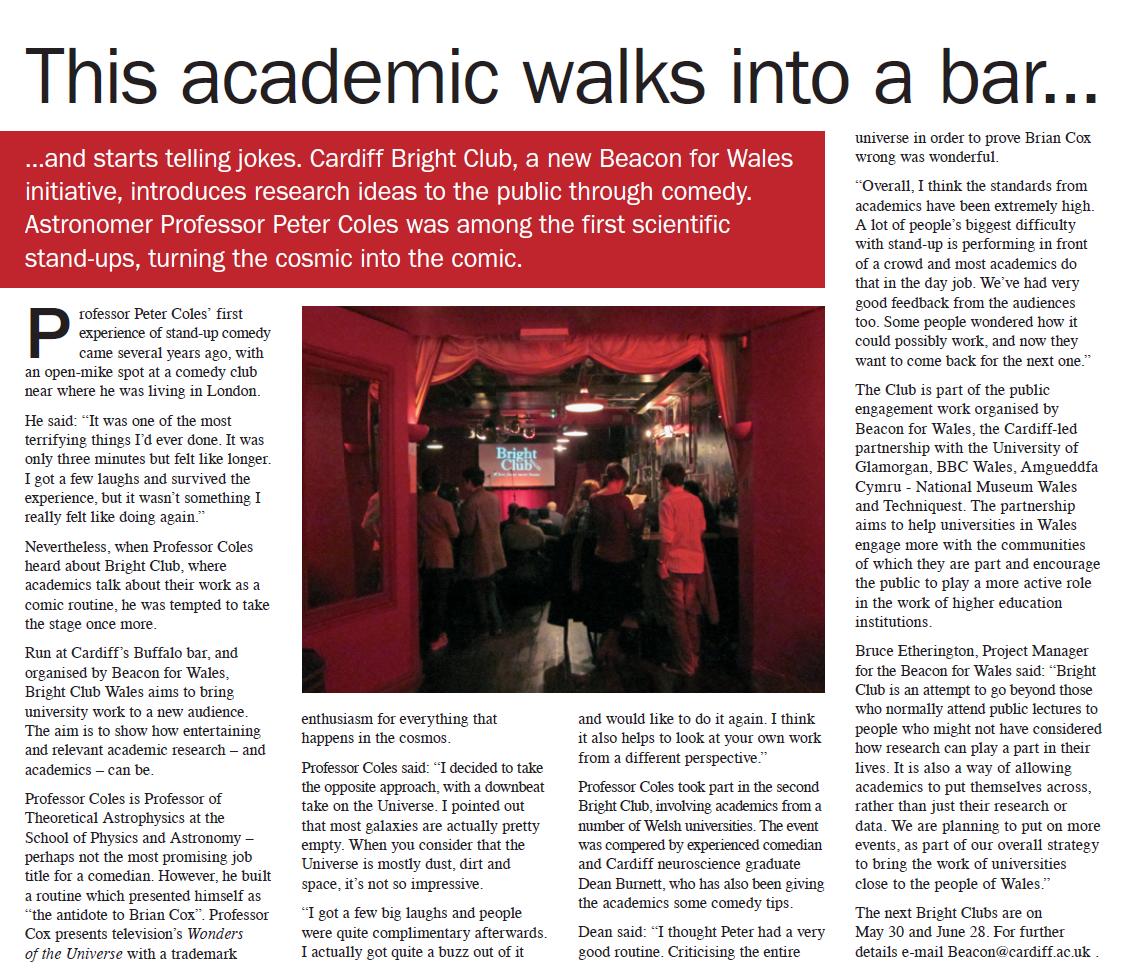
It seems my 12-minute stab at being a comedian at Bright Club Wales has led me to the dizzy heights of fame. So much so that I’ve even appeared in the latest issue of Cardiff University News (which you can read online here). Here’s the piece, though you might need to click on it to make it big enough to read..

Incidentally, the next Bright Club Wales will be on Monday 30th May, at the Buffalo Bar in Cardiff. I’m sure it will be fun!

Share/Bookmark

Astronomy Grants: The Harsh Reality

Posted in Science Politics with tags , , , , on May 8, 2011 by telescoper

Time, I think, to return to my role as selfless servant of the astronomical community, with a bit of news about astronomy grants. I was prompted to do this by the following cartoon (from the excellent PhDComics) which I saw this morning:

It’s all completely untrue, of course. *Cough*.

Anyway, as you will probably  know, the Science and Technology Facilities Council (STFC) is introducing a new system of grants this year and the deadline for the first set of applications for the new “consolidated grants” was 4th May, which passed last week while I was away on holiday. Just before leaving I attended a preliminary meeting in London of the Astronomy Grant Panel, of which I am a member. In fact, I delayed my departure specifically in order to attend the meeting. The things I do for science.

At the meeting we discussed a number of issues relating to the new system in order to be ready to get on with the business as quickly as possible when the applications are all in. The timetable is very tight if we’re going to be able to get our recommendations finalised in time for STFC to make announcements in October, as is planned. Thew new system is  going to mean a huge amount of extra work over the summer for the panel members, doing what was always a thankless task in the first place.

Of course I’m not going to write anything on here about the actual process of assessing grants, and certainly not about individual proposals or outcomes. Anything that’s not confidential about the procedure is already explained quite clearly on the STFC website too, so there’s not much point going over that again here. It would also be inappropriate for me to give the impression that anything I put on here is in any way the official AGP (or STFC) line.

What I can do, though, is make a few comments about the current situation using information that is already in the public domain or is otherwise not a breach of confidentiality. The most important observation relates to the following figure, borrowed from the e-astronomer (who also happens to be Chair of the AGP):

The graph shows the number of astronomy postdoctoral research positions funded by STFC (or its forerunner PPARC) as a function of time. The steep decline in recent years has been widely discussed. My own view is that it will be disastrous in the long term if steps are not taken to rectify it soon. The  STFC budget for astronomy grants is fixed for the next few years at a level corresponding to about 60 per year, similar to the number announced in 2010/11.

Now the new consolidated grants will incorporate existing roling grants (which were reviewed on a three-year cycle) and standard grants (which usually lasted three years). A large number of positions announced in 2008 will therefore be hoping for renewal this year. On top of those there will be proposals requesting new positions and other rolling grants coming into this round before their usual renewal date in order to merge with others from the same institution.

I don’t know the actual numbers applied for this year – and couldn’t tell you even if I did – but it’s not unreasonable based on the figures shown in the graph above to estimate that  about 100 PDRA requests will be made, and possibly many more. A significant fraction of these (perhaps 2/3) will be people employed on existing rolling grants hoping to be continued in a new consolidated grant from 2011 onwards.

I probably don’t have to spell it out any further, but it’s clear from the graph that the arithmetic is very tough. Even without any new requests this year, only about 2/3 of the positions funded in 2008 can survive. In reality there may be more than 100 souls standing on deck, but the lifeboats can only hold 60….

Share/Bookmark

What a difference a day makes

Posted in Biographical with tags , , on May 8, 2011 by telescoper

My body clock is having a bit of struggle adjusting to Welsh Summer Time so I thought I’d confront my insomnia by posting the following story….

One summer morning in 2005 I rose early and left my house – I was living in Nottingham then – and took a train to London. I was quite excited. I was going to be interviewed later that day for a programme in the BBC TV series Horizon called The Hawking Paradox. The filming was to take place inside the Café de Paris near Piccadilly Circus, for the simple reason that it wasn’t used during the daytime, and would therefore be both quiet and cheap to hire. I was keen not to be late so I got a train that was due to arrive at St Pancras Station in London at about 9.30am.

On the train I dealt with a few bits of correspondence, filling in forms and writing out cheques to pay bills, so had a couple of  items of mail to post when I got to London. The train was on time, and it was a fine morning, so I decided to walk from the station down through Soho to the location of the shoot.

I crossed Euston Road and walked down towards Bloomsbury. Spying  a bright red Royal Mail postbox across the road  in Tavistock Square, I waited for a bus to go past, crossed the road and popped my letters into the box. I looked at my watch to see if I had time for coffee on the way to Piccadilly. It was exactly 9.45am, on July 6th 2005.

I enjoyed the filming, although it took quite a long time – as these things do. Breaking for lunch in a local pizzeria, we were surrounded by a hubbub of excitement when news broke that London had been awarded the right to stage the 2012 Olympics. We finished the filming and I headed back to Nottingham on the train. All-in-all it had been a very pleasant day.

Last week the inquest into the terrorist attacks on London delivered its long awaited verdict into the terrible events of 7th July 2005, the day after my trip. Here is a picture of the postbox in Tavistock Square taken on 7/7/2005. The bomb that tore the roof off the bus and killed 13 people went off at 9.47am, almost exactly 24 hours after I had been in precisely the same spot. Spooky.

Share/Bookmark

Returning

Posted in Biographical, Politics with tags , , , , on May 7, 2011 by telescoper

Well chaps and chapesses, I’m back to base after a very enjoyable break in foreign climes. I won’t bore you with interminable holiday snaps and the like, however. Suffice to say that, although it was good to get away from it all for a bit, it’s also nice to be back to Blighty. I’ve got quite a few things to catch up with on at home, at work, and on the blog, and I’ll try to return to fairly frequent postings now that I’m home.

I thought I’d start with one of the big events that happened while I was away. Not the Royal Wedding, which I successfully avoided completely although I only narrowly escaped seeing some of it on an outdoor  big screen (which I had assumed would be showing some form of sporting contest). Not the killing of Osama Bin Laden, either. Nor even the AV referendum, which went the way I expected. No, I think the first thing I should comment on is the result of the elections to the National  Assembly for Wales which I followed, as best I could, by Twitter and on the net via my Blackberry while I was away. I wasn’t helped by the fact that North Wales decided not even to start counting votes until the morning after Polling Day, thus holding up the final results by half a day. Perhaps that’s because the count was done in Llandudnno, where people generally go to bed about 10pm?

This was the first Senedd election I have had the opportunity to vote in, even though I had to do it postally. For the Welsh Assembly elections, each voter gets two votes. One is cast just as in a General Election, i.e. by picking one candidate for one’s own consituency – in my case Cardiff West. This is a safe Labour seat, previously held by former First Minister Rhodri Morgan, and it was no surprise to see the Labour candidate romp home with an increased majority. Of the 60 members of the Welsh Assembly, 40 are elected directly through constituency votes like this.

Incidentally, one of the other candidates in this constituency was Neil McEvoy, standing for Plaid Cymru. McEvoy is currently deputy leader of Cardiff City Council (which is run by a coalition of LibDems and Plaid Cymru councillors) and is an enthusiastic champion of the building of a major road into Bute Park for use by heavy lorries. It might have been better for the people of Cardiff – especially those who appreciate its wonderful green spaces – had Councillor McEvoy been elevated to the Senedd, because that would prevent him doing further damage on behalf of the Council. In the end, though, he trailed in third place in the Welsh Assembly poll so will presumably remain on the Council.

Meanwhile, back at the polls. Voters in the Welsh Assembly elections get another regional vote in addition to their constituency vote, which they can cast for a  closed party list. There are 5 regions in Wales, each of which elects 4 members to the Assembly taking its full complement to 60. The so-called Additional Member system uses the d’Hondt divisor formula to allocate regional AMs in accordance with the following algorithm:

  1. Party list votes are totalled from each of the constituencies making up the region.
  2. These totals are then divided by the number of constituency seats each party has won – plus one.
  3. The party with the highest resulting total elects one Additional Member.
  4. That party’s divisor is then increased by one (because of its victory)
  5.  Step 2 is repeated with the updated number of seats.; again, the highest resulting total wins a seat.
  6. The process is then repeated until all Additional Members are elected.

The aim of the system is to compensate parties which pile up lots votes in constituencies but fail to win many seats there. Under the d’Hondt system, they are much more likely to gain additional regional members. Conversely, parties which do well in constituency elections will do less well in the top-up seats. The idea is that the final outcome is much more proportional than it would be based on constituency votes alone. It’s not perfect, of course. Welsh Labour won precisely 50% of the seats in the Senedd, but with considerably less than 50% of the popular vote.

This system probably sounds quite complicated – especially considering the difficulty many people seem to have had understanding the Alternative Vote, which is much simpler! – but it is actually fairly straightforward to operate. It does, however produce a few unexpected consequences.

In the 2011 Welsh Assembly elections the constituency vote held up very well for the Conservative Party. This was probably helped by a relatively low turnout of just over 40%, because ensuring the core Tory voters turned out for the poll was probably all the campaign strategists needed to do. However, the unexpected success of the Conservatives in the constituency vote led to one notable casualty when the additional members were calculated. The Conservative leader in the Welsh Assembly, a regional member, Nick Bourne, found himself a victim of the party’s own success: he lost his seat, and the Tories now need a new leader.

In summary, Welsh Labour did pretty well, returning 30 out of the total of 60 Assembly Members, up 4 on the last election. The Conservatives, somewhat surprisingly, were up 2 on 14. It was a bad night for Plaid Cymru, who lost four members to end on 11. The Liberal Democrats did poorly in the constituency vote, losing all but one of their seats, but picked up 4 regional members courtesy of d’Hondt. No other parties won any seats.

What happens next? Labour could try to form a minority administration on their own, but it seems more likely that they will try to find a coalition partner. The previous administration involved a combination of Labour and Plaid Cymru, but the latter did so badly in these elections that they may decide that they don’t want to play anymore. That would make the LibDems favourites, although they might be considered a bit toxic after their poor showing elsewhere in the UK. We’ll just have to wait and see what emerges from the discussions (which have presumably already started). I’ll be following it all with particular interest because, amongst other things, there might be important implications for Higher Education in Wales if Labour go it alone or the LibDems replace Plaid in the governing coalition.

There were, of course, elections going on last week throughout the United Kingdom. I haven’t got time to comment on all the results, but fortunately I found this interesting and informative summary of the situation Nationwide

Share/Bookmark

Interlude

Posted in Uncategorized on April 28, 2011 by telescoper

Well, dear readers, I’m going on a spot of holidays until term resumes on 9th May and have made a conscious decision not to take my blogging machine with me on my journey to distant lands. So, until then, there will follow a short intermission…

Dust to Dust

Posted in The Universe and Stuff with tags , , , on April 27, 2011 by telescoper

Hey look! It’s our very own Haley Gomez (interviewed by Gemma Lavender) last week in Llandudno!

Share/Bookmark

Best movement illusion I have ever seen…. (via Richard Wiseman’s Blog)

Posted in Uncategorized on April 27, 2011 by telescoper

This sort of thing doesn’t usually work with my wonky eyes, but this one is pretty spectacular even for me. Click on the image to get the full size version

Best movement illusion I have ever seen.... First, if you enjoy the Friday Puzzle, I have just posted 101 of them here. Second, I now can't figure out who kindly sent this to me, but I love it (to get the full effect, it might be good to click on the image and open it up full size)….. Does it work for you? … Read More

via Richard Wiseman's Blog

Gravity and Grace

Posted in Biographical, The Universe and Stuff with tags , , , , , on April 26, 2011 by telescoper

This morning I came across the following quotation, which is translated from the book Le Pesanteur et la Grace (i.e. “Gravity and Grace“), written in 1947 by French philosopher Simone Weil:

Science today must search for a source of inspiration higher than itself or it must perish.

Science offers only three points of interest: 1. technical applications; 2. as a game of chess; 3. as a way to God.

I’m not sure I agree with what is written, and in any case the options don’t seem to me to be mutually exclusive, but a number of things did strike me reading it.

For a start, and for what it’s worth, I do think science has value within itself, so I’m at odds a bit with the initial premise. On the other hand, science is a human activity and it therefore doesn’t stand apart from other thing humans are interested in.

Then there is the extent to which we now all have to pretend that pretty much the only point of interest in science is “1. technical applications”. I don’t believe that’s true, actually, and I’m worried that by continually saying that it is, scientists might be sowing the seeds of their own destruction.

And then there’s “the game of chess”. I’m actually hopeless at chess, but I understand this as representing some form of abstract mental challenge.  If that’s what it does mean, then I’d agree that’s probably what got me interested in science. I’ve always been pathologically interested in puzzles. When I look at galaxies and stars, I don’t tend to gaze at them in awe at their enormity or beauty, I just tend to wonder how they work and what they’re made of. I don’t really mind people having a sense of awe, of course, but there’s a danger that if we take that too far we end up being over-awed which might make us shy away from the biggest questions. To me the Universe is just a great big puzzle, though it’s actually rather a tough one. I’m still stuck on 1 across, in fact…

Finally, we have science as “a way to God”. I find it quite interesting that a Christian philosopher could present science as that, especially when so many of my atheistic colleagues regard science and religion as polar opposites. It seems likely to me that anyone who studies science primarily as a means of finding God is probably in for a disappointment. I’m reminded of a quote  from Thomas à Kempis I learned at school:

The humble knowledge of thyself is a surer way to God than the deepest search after science.

But that’s not to say that science and religion are incompatible with each other. I think they’re basically orthogonal, although in an abstract space with an extremely complicated geometry…

One of the interesting things about working in cosmology is that the big questions are very big indeed, which may be the reason why cosmologists tend to have strong views on matters of religion (and metaphysics in a general sense).  Just take the Templeton Prize, for example. The arguments about this year’s award to Lord (Martin) Rees are still simmering on, but it’s worth remembering that many recent winners of this prize, including John Barrow (my PhD supervisor, in fact) and  George Ellis (former collaborator of mine), are most noted for their work in cosmology. Both are religious: John Barrow is a member of the United Reformed Church, and George Ellis is a Quaker. Martin Rees is an atheist. But their religious views are not in conflict with their research. All are outstanding scientists.

I’ve been thinking a lot over the Easter holiday about religion and science. It’s partly the Templeton prize saga, partly the occasion of Easter itself, and partly the fact that I’ve been reading even more of the poems of R.S. Thomas. In case you didn’t know I was brought up in the (Anglican) Christian tradition, attended Sunday School, sang in the local Church Choir, and was confirmed in the Church of England. When I went to seconday school – the Royal Grammar School, Newcastle – I joined the Christian Union and remained in it for 3-4 years.

Although  I was immersed in Christianity – the Christian Union was vigorously Evangelical – it didn’t really stick and eventually all melted away.   I don’t really remember precisely what it was then that made me turn away from religion, although the sins of the flesh might have had something to do with it…

However, although I became an atheist I’ve never been a particularly devout one. The only thing that I’m really sure about is that I don’t know the answers. Does that make me an agnostic rather than an atheist? I don’t know. Perhaps I could just describe myself as a non-believer? That wouldn’t do either, because we all have to believe in some things in order to function at all. Even science starts with unprovable axioms.

A career in cosmology has given me the opportunity to think about many Big Questions. Why does the Universe have laws? Why is there something rather than nothing? And so on. I’m not much of a philosopher, though, and  I don’t have the answers. I do, however, refuse to take the easy way out by denying that the questions have meaning. Of course it’s not entirely satisfactory having to answer “I don’t know”, but I don’t agree with those of my atheist colleagues who think religion is an easy way out. I’m sure that a thinking Christian has just as many difficult issues to grapple with as a thinking atheist. Not thinking at all is the only really easy way out.

A few years ago I spoke at an interesting meeting in Cambridge entitled God or Multiverse? In fact there’s a picture below of the panel discussion at the end -I’m second from the right:

I thought it was an interesting dialogue, but I have to say that, if anything, it strengthened my non-belief. Prof. Keith Ward argued that the primary motivation for belief in God was the existence of “Good”. I have to admit that I find the Universe as a whole amoral and although humans have done good from time to time they have done evil in at least equal measure. The vast majority of people on this Earth live in poverty, many of them in abject misery. Good is a bad word to describe this state of affairs.

I just can’t accept the idea of a God that is interested in the Universe at the level of human beings. We’re so insignificant on the scale of the cosmos, that it seems very arrogant to me to suppose that it’s really got much to do with us. We appeared somehow, miraculously perhaps, but could disappear just as easily. I doubt the Universe would miss us much.

But I might be wrong.

Share/Bookmark