Author Archive

Good Morning Llandudno!

Posted in Uncategorized with tags , on April 19, 2011 by telescoper

Well, here I am in Llandudno for the 2011 National Astronomy Meeting. The journey up yesterday was as slow as expected, but ran to its timetable, and I got here just in time for the STFC “Community Meeting” in the early evening. That was very interesting, and has probably given me food for a few other blog posts.

After that it was off to the St George’s Hotel for the RAS Club dinner, which was an enjoyable affair including several distinguished guests including John Harries, Chief Scientific Advisor to the Welsh Assembly, who made a short speech after dinner.

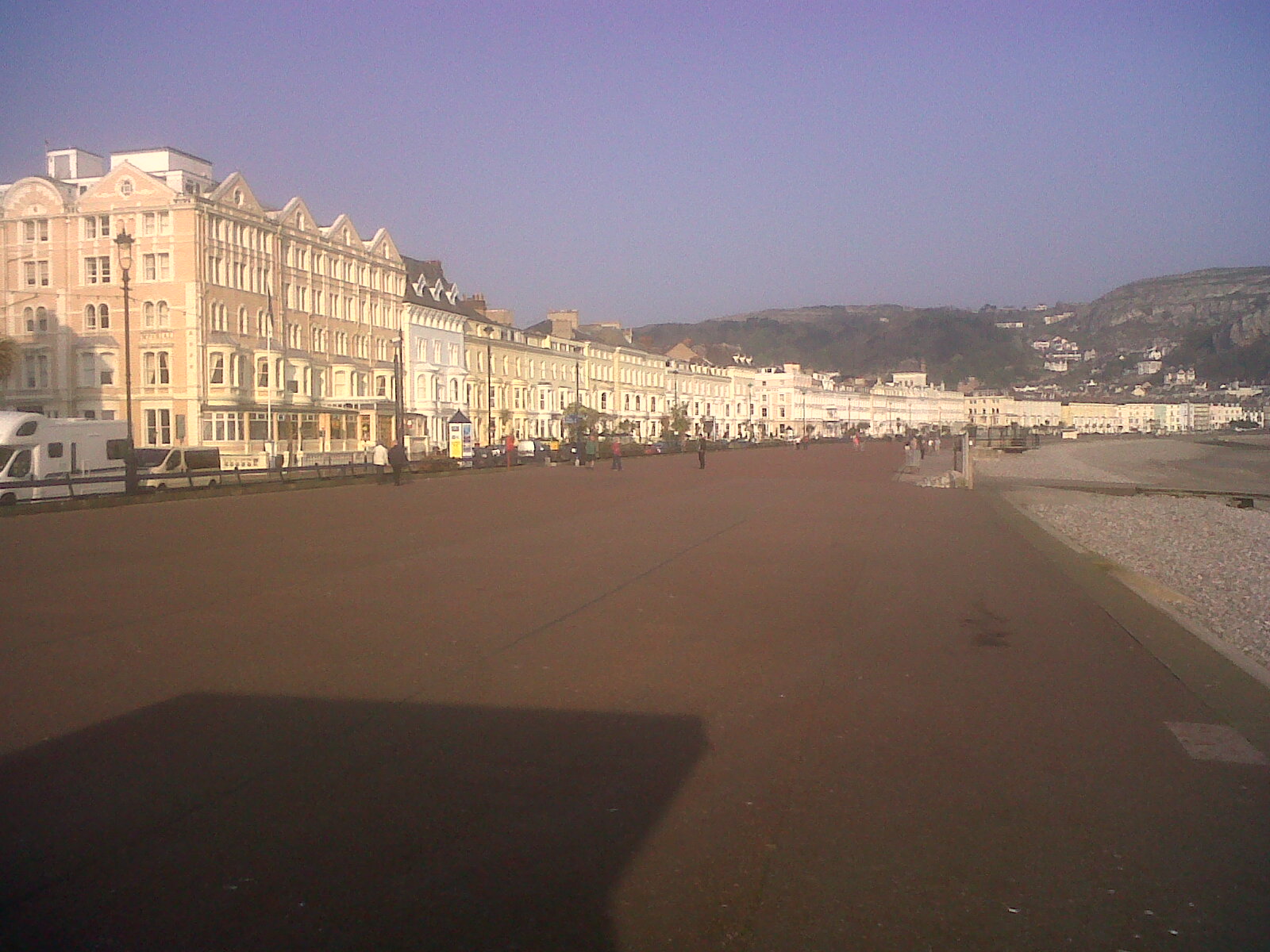
Getting back to the hotel – the Imperial, shown below – I ran into a crowd of astronomers and STFC bods drinking in the bar, so stayed with them until the early hours. Despite this, I managed to get up early and had a stroll along the promenade before a hearty breakfast. I must say Llandudno is looking resplendent in the spring sunshine. It’s rather more upmarket than I imagined, although it does seem to be frequented by the older generation of holiday makers…

Anyway, here are a few phone snaps I took this morning. I have to run now because I’ve got a session to chair at 9am and I have to find the room it’s in.

Toodle-pip!

On the Train

Posted in Poetry with tags on April 18, 2011 by telescoper

This poem was written by Gillian Clarke on a train in October 1999, the day after a terrible rail accident just outside London Paddington Station in which 31 people lost their lives.

Cradled through England between flooded fields
rocking, rocking the rails, my head-phones on,
the black box of my Walkman on the table.
Hot tea trembles in its plastic cup.
I’m thinking of you waking in our bed
thinking of me on the train. Too soon to phone.

The radio speaks in the suburbs, in commuter towns,
in cars unloading children at school gates,
is silenced in dark parkways down the line
before locks click and footprints track the frost
and trains slide out of stations in the dawn
dreaming their way towards the blazing bone-ship.

The vodaphone you are calling
may have been switched off.
Please call later. And calling later,
calling later their phones ring in the rubble
and in the rubble of suburban kitchens
the wolves howl into silent telephones.

I phone. No answer. Where are you now?
The train moves homeward through the morning
Tonight I’ll be home safe, but talk to me, please.
Pick up the phone. Today I’m tolerant
of mobiles. Let them say it. I’ll say it too.
Darling, I’m on the train.

Nam et ipsa scientia potestas est

Posted in Biographical, Cricket, The Universe and Stuff with tags , on April 17, 2011 by telescoper

Well, dear readers, I’ve had a lovely day of gardening and watching cricket; the former hacking down the dead half a Forsythia this morning, the latter watching Glamorgan gain their first win of the Championship season by beating Gloucestershire in fine style here in Cardiff. I also managed to catch a bit of the sun, which has left me a bit woozy. I’ll have to buy myself a hat to wear on days like this. With fair skin and blue eyes, I don’t tan – I stroke.

Anyway, tomorrow morning I’ll be heading off up to the fine seaside resort of Llandudno in North Wales for this years National Astronomy Meeting (NAM for short). It starts this evening, in fact, with a wine reception and other festivities, but unfortunately the journey by train from Cardiff takes absolutely ages on a Sunday, so I decided to eschew the delights of the first evening and travel up tomorrow morning. On a weekday it only takes 5 hours from Cardiff to Llandudno….

I’ll probably miss most, and possibly all, of tomorrow’s talks but should get there in good time for the out-of-town meeting of the RAS Dining Club which will be held in the St George’s Hotel in Llandudno and to which a number of illustrious guests have been invited. On Tuesday morning there’s the session I organised on astrostatistics, which I am looking forward to chairing, and then the conference dinner in the evening. The following day I’m chairing a session on astroparticle physics too. There’s no rest for the wicked. Most of the rest of the time I’ll probably be at the numerous cosmology or extragalactic astronomy sessions or, more likely, in the bar. If the weather stays like this, however, I might wander along the beach and, rolling my trousers up and donning a knotted handkerchief, go for a paddle in the sea.

I’m told there will be wireless connectivity in Llandudno throughout NAM 2011 so I hope to post a few brief blogettes about interesting events, but possibly not tomorrow as I might not have time. The excellent RAS Press Office will no doubt be hard at it for the duration, so watch out for a stream of press releases. I’m not sure whether the mass media will be bothered to get off their backsides and travel all that way from their London offices, so we’ll just have to see how much gets onto the main news.

I’m not particularly looking forward to the journey by the slow train tomorrow, but am definitely looking forward to the change of scenery and to catch up not only with the astronomy but also with some old friends.

If anyone I’ve never actually met before who reads this blog is there, do please say hello! You’ll find I’m quite a friendly chap, really…

P.S. The latin quotation I used in the title here isn’t really relevant. I just picked it because it starts with the word “NAM”. If you’re interested, however, it’s by Francis Bacon and it means, roughly speaking, “knowledge is power”.


Share/Bookmark

Whispering Death

Posted in Cricket with tags , , on April 16, 2011 by telescoper

..and while I’m on the subject of cricket, here’s some examples of one of the all-time greats in action. This is Michael Holding destroying England at the Oval in 1976, when he was only 22. I remember that summer very well, in fact, as  there was a very long and intense heatwave, punctuated by regular visions of England’s cricketers being thrashed by the West Indies;  just look at the parched state of the outfield at the Oval if you don’t believe English summers can be like that!

Holding acquired the nickname “Whispering Death” because his run-up was so smooth and perfectly balanced that you could hardly hear him approaching the wicket, in contrast to some fast bowlers who charged in like a herd of elephants. No arguments, then, with Richie Benaud’s comments on the replay from about 58s onwards. It’s almost as if the phrase “poetry in motion” was invented to describe Michael Holding’s bowling action. I’ll allow anyone – even Brian Cox – to call this awesome.

Note also that this is from an era in which batsmen didn’t wear head protection. Even with a helmet I would have been terrified. Cricket’s not a game for faint hearts…

…  Brian Close had been brought into open the England batting earlier in the series in an attempt to stiffen their resistance to the West Indian attack. He wasn’t the greatest player in the world nor the cricketing world’s most agreeable character, and as you can tell he wasn’t in the first flush of youth in 1976 either, but there is no denying his courage and determination. Here he is enduring a vicious battering at the hands of Michael Holding. One short-pitched delivery in this sequence came within a whisker of hitting him on the head; had it done so the consequences would have been horrendous. As it was, he “only” had to take  a succession of blows to his body. He scored 20 runs at Old Trafford, off 108 balls in 162 minutes, and was dropped for the next Test as was his opening partner John Edrich,  although both had stood their ground and defended their wickets (and themselves) manfully.

Has there ever been another bowler with an action as beautiful as Michael Holding? I don’t think so, but you’re welcome to disagree through the comments box!


Share/Bookmark

Soul Limbo

Posted in Cricket, Music with tags , , , on April 16, 2011 by telescoper

Yesterday after I finished work I shunned the usual Friday-night trip to the Poet’s Corner in favour of dropping in to Sophia Gardens to catch my first County Cricket of the season. It’s actually Glamorgan‘s second game – they lost the first , away at Leicestershire – but they’re doing much better in this one, against Gloucestershire. There was a sparse crowd, but there was some absorbing cricket as Glamorgan’s batsmen fended off some good bowling to end the day on 185 for 3. The game is finely poised, with Glamorgan carrying on this morning to build a handy lead but the game could still go either way.

Anyway, in belated honour of the start of this year’s cricket season, here’s a piece of music that will bring back a lot of memories to those who, like me, used to spend a lot of their time glued to the BBC’s cricket coverage. It’s Soul Limbo, by Booker T and the M.G.’s, the long-time theme tune for the BBC’s cricket coverage. And there’s also a few clips of cricket action to go with it…


Share/Bookmark

Salty Dog

Posted in Jazz with tags , , on April 16, 2011 by telescoper

Well, that’s the end of term and I’m now free, from teaching at least, for three weeks. I thought I’d celebrate by posting a piece of bawdy good-time jazz. Here’s the fabulous Lizzie Miles singing with a band led by the shamefully underrated but wonderfully named New Orleans trumpeter Sharkey Bonano.


Share/Bookmark

(Guest Post) Physics and Binary Creep

Posted in Education, Finance, Science Politics with tags , , , , , , on April 15, 2011 by telescoper

His Excel-lence (geddit?) Paul Crowther has been at it again, using his favourite packages sophisticated graph-plotting facilities to produce the interesting figures that go with another guest post….

–0–

Last week’s Times Higher Ed included a news item headlined ‘binary creep’, in which HEFCE were considering restricting support for PhD research students to universities of the highest research quality. Concerns were expressed in the article about a two stream future for universities – research intensives in the fast lane and ‘the rest’ in the slow lane. This reminded me of a recent Times Higher Ed interview with the former Commons’ Science and Technology Committee chairman, Lord (Phil) Willis. Lord Willis argued that the UK could probably sustain “no more than 30” universities with the capacity to attract the best global researchers and carry out world-class research, a view no doubt shared by ministers and civil servants within BIS. I should qualify the following line of thought by emphasising that this is not Government policy, although both stories reflect moves by funding agencies to further concentrate increasingly scarce resources on the highest ranked research universities. For example, in England HEFCE is expected to withdraw all quality-related (QR) support from 2* RAE research from 2012 onwards.

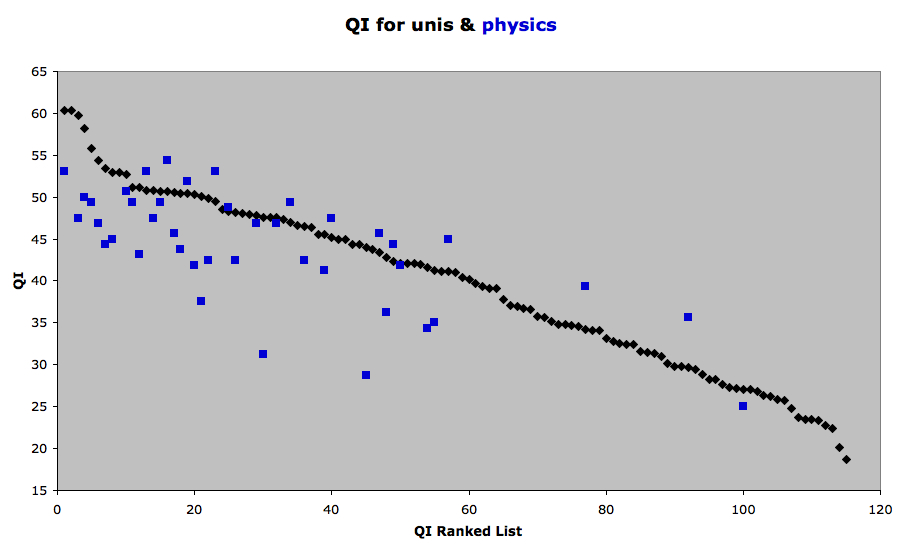
Mindful of the fact that in such a vision for the future, there would be a comparatively few, research intensive universities (`winners’) where would that leave the remainder (‘losers’), especially for physics? Research quality can be quantified in all manner of ways, but for simplicity I have adopted the Quality Index (QI) from Research Fortnight which provides a single mark out of 100 based on RAE quality profiles (4*:3*:2*:1* weighted 8:4:2:1). The chart below shows the  QI-ranked list of more-or-less all 120 UK universities who were rated in RAE 2008. It will come as no surprise to anyone that Oxbridge, LSE and Imperial top the rankings, closely followed by UCL and a few other high flyers, but beyond the top 10 perhaps more surprising there are no natural breaks in quality from Durham and QMUL in joint 11th place, to Bolton at 107th.
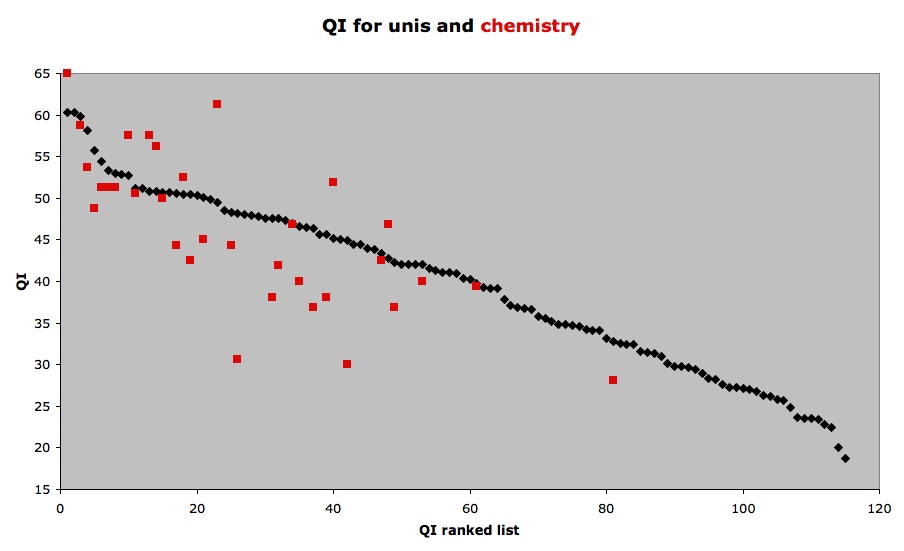
Thinking out loud about Willis’ assertion that the UK should not be spreading the jam more thinly than, say, the leading 30 universities, there would obviously be individual physics departments currently outside the top 30 which are ranked significantly higher than those within the top 30. To illustrate this, the chart also includes (in blue) physics QI scores for all teaching institutions that were assessed under the UOA 19 in RAE 2008. To blindly follow Lord Willis’ suggestion, 16 out of 42 institutions involved with physics research – comprising 37 per cent of all academic staff – would be clear losers. These would include one physics department raked within the top 10 (scoring 49) because its host institution is ranked 34th overall, while winners would include a department scoring 31, i.e. ranked 40th (out of 42) for physics, as a result of its university squeezing into the top 30. Chemistry – within the same RAE sub-panel as physics – reveals a broadly similar distribution, although there is perhaps a greater concentration of the highest research quality in the overall top 20, as the chart below illustrates.
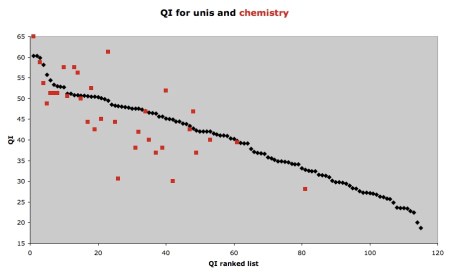
Alternatively, if there is to be further concentration, one could argue that research funding should focus on, say, the top 20 physics departments regardless of the performance of their host institution. Indeed, already 80 percent of STFC spending goes to only 16 universities. Still, as RAE grades indicate, a strength of UK physics is the breadth of high quality research, with no natural break points until beyond 30th place in the rankings, as the final chart shows. Of course, RAE scores aren’t the sole criterion being discussed, with “critical mass” the other main driver. Due in large part to the big four, 70 per cent of physics academic staff submitted for RAE 2008 are in departments that are currently ranked in the top 20. Chemistry has a similar story to tell in the chart, albeit displaying a somewhat steeper QI gradient.

What might be the long-term consequences of a divergence between a small number of “research-facing” universities and the rest? It is apparent that if the number of physics departments involved in research were reduced by a third, some high quality research groups would be lost, regardless of precisely where the cleaver ultimately fell. Let’s too not forget that astrophysics represents the largest sub-field of physics from the last IOP survey, as measured in numbers of academics.

If policy makers don’t see anything fundamentally wrong with A-level physics being taught by teachers qualified, say, in biology, then they might too wonder whether physics degrees could be taught by academics lacking a physics research background? This might work for first year undergraduate courses, but thereafter isn’t more specialist knowledge needed that a research background most readily provides? How would the third of physics academics outside the top 30 universities react to the prospects of a teaching-only future? Many surely would consider jumping ship either to one of the chosen few or overseas, further decreasing the pool of those with research experience in the remaining physics departments. This is further complicated by the expected political desire that physics departments should be appropriately distributed geographically across England, Scotland, Wales and Northern Ireland.

As a final thought experiment, the fate of physics departments facing the prospect of a teaching-only future might also be binary in nature, either (a) whither and die, decreasing the range of institutions offering degrees in physics (or physical sciences, natural sciences etc.); perversely at a time when the Government are anxious to maintain the number of students studying Science, Technology, Engineering and Mathematics (STEM) subjects, or (b) thriving – free from the distractions of chasing dwinding research grants – by adapting to offer shorter duration physics degrees, described as “cheap and cheerful” by Dr David Starkey during the discussion on student fees on last Thursday’s Newsnight. To reiterate, it is not explicit Government policy to actively reduce the number of physics departments that receive research allocations, but this seems to be the general “direction of travel” in policy-makers speak, so I fear a rocky path ahead..


Share/Bookmark

Lost in Translation

Posted in Uncategorized on April 14, 2011 by telescoper

I recently purchased, and placed in my possession, a remote control device for a Canon digital camera. Last night I got it out with the intention of playing with it – the camera, I mean – and was forced to read the instructions that came with the remote controller. I decided to pass them on verbatim via this blog in case any of my readers is wondering how to operate this sort of gadget. I quote:

When the use group racket function, need transmitter’s digit code switch to establish completely only as 1234, then all receivers implements the active control to the region, realizes to camera focusing, the shutter and the B mode control.

I hope that’s clear. Any questions?


Share/Bookmark

A Discovery At the Tevatron! – Maybe (via Collider Blog)

Posted in The Universe and Stuff with tags , on April 13, 2011 by telescoper

I mentioned during a particle physics lecture today that sometimes big results grow from small statistical indications, but more often than not these turn out to be false detections. I wonder what this will turn out to be?

A Discovery At the Tevatron! - Maybe The CDF Collaboration released this plot today (arXiv:1104.0699, 6-April-2011): The blue peak at MJJ = 145 GeV is not predicted by the standard model, of course. The CDF paper is very clear and sober, and it is good that the collaboration reported these results. Let me outline the analysis in a few paragraphs. Th … Read More

via Collider Blog


Share/Bookmark

Storm

Posted in Poetry with tags on April 13, 2011 by telescoper

And now, as they say, for something completely different. I heard about this at a boozy dinner last Monday night and tracked it down on Youtube. I’m a bit late onto this gem, but I love it. See what you think. It’s by the brilliantly talented Tim Minchin. Oh, and there’s some (actually quite a lot of) off-colour language in it, so if that bothers you then please listen with earplugs in.


Share/Bookmark