Author Archive

Intimations of Immortality

Posted in Poetry with tags , on April 12, 2011 by telescoper

One of my very first blog posts was inspired by a book of poems by William Wordsworth. That piece included an excerpt from this poem, and since I’m a bit pressed for time these days I thought I’d post the whole thing. It also seems to suit a theme that’s been running through a few recent items. The full title is ODE: Intimations of Immortality from Reflections of Early Childhood, and it was written in the period 1803-1806. In the poem, Wordsworth returns to a theme he developed in Tintern Abbey, which provides an interesting contrast with this later masterpiece. You might disagree with Wordsworth’s metaphysical viewpoint, but I think few will argue that there’s sheer genius in his use of language.

I found a nice critique on the net, from which I decided to post the following extract:

Wordsworth consciously sets his speaker’s mind at odds with the atmosphere of joyous nature all around him, a rare move by a poet whose consciousness is so habitually in unity with nature. Understanding that his grief stems from his inability to experience the May morning as he would have in childhood, the speaker attempts to enter willfully into a state of cheerfulness; but he is able to find real happiness only when he realizes that “the philosophic mind” has given him the ability to understand nature in deeper, more human terms—as a source of metaphor and guidance for human life. This is very much the same pattern as “Tintern Abbey” ’s, but whereas in the earlier poem Wordsworth made himself joyful, and referred to the “music of humanity” only briefly, in the later poem he explicitly proposes that this music is the remedy for his mature grief.

The structure of the Immortality Ode is also unique in Wordsworth’s work; unlike his characteristically fluid, naturally spoken monologues, the Ode is written in a lilting, songlike cadence with frequent shifts in rhyme scheme and rhythm. Further, rather than progressively exploring a single idea from start to finish, the Ode jumps from idea to idea, always sticking close to the central scene, but frequently making surprising moves, as when the speaker begins to address the “Mighty Prophet” in the eighth stanza—only to reveal midway through his address that the mighty prophet is a six-year-old boy.

And here is the Ode in full. It’s a poem that moves me in ways I can’t explain.

THERE was a time when meadow, grove, and stream,
The earth, and every common sight,
To me did seem
Apparelled in celestial light,
The glory and the freshness of a dream.
It is not now as it hath been of yore;–
Turn wheresoe’er I may,
By night or day,
The things which I have seen I now can see no more.

II

The Rainbow comes and goes,
And lovely is the Rose,
The Moon doth with delight
Look round her when the heavens are bare,
Waters on a starry night
Are beautiful and fair;
The sunshine is a glorious birth;
But yet I know, where’er I go,
That there hath past away a glory from the earth.

III

Now, while the birds thus sing a joyous song,
And while the young lambs bound
As to the tabor’s sound,
To me alone there came a thought of grief:
A timely utterance gave that thought relief,
And I again am strong:
The cataracts blow their trumpets from the steep;
No more shall grief of mine the season wrong;
I hear the Echoes through the mountains throng,
The Winds come to me from the fields of sleep,
And all the earth is gay;
Land and sea
Give themselves up to jollity,
And with the heart of May
Doth every Beast keep holiday;–
Thou Child of Joy,
Shout round me, let me hear thy shouts, thou happy
Shepherd-boy!

IV

Ye blessed Creatures, I have heard the call
Ye to each other make; I see
The heavens laugh with you in your jubilee;
My heart is at your festival,
My head hath its coronal,
The fulness of your bliss, I feel–I feel it all.
Oh evil day! if I were sullen
While Earth herself is adorning,
This sweet May-morning,
And the Children are culling
On every side,
In a thousand valleys far and wide,
Fresh flowers; while the sun shines warm,
And the Babe leaps up on his Mother’s arm:–
I hear, I hear, with joy I hear!
–But there’s a Tree, of many, one,
A single Field which I have looked upon,
Both of them speak of something that is gone:
The Pansy at my feet
Doth the same tale repeat:
Whither is fled the visionary gleam?
Where is it now, the glory and the dream?

V

Our birth is but a sleep and a forgetting:
The Soul that rises with us, our life’s Star,
Hath had elsewhere its setting,
And cometh from afar:
Not in entire forgetfulness,
And not in utter nakedness,
But trailing clouds of glory do we come
From God, who is our home:
Heaven lies about us in our infancy!
Shades of the prison-house begin to close
Upon the growing Boy,
But He beholds the light, and whence it flows,
He sees it in his joy;
The Youth, who daily farther from the east
Must travel, still is Nature’s Priest,
And by the vision splendid
Is on his way attended;
At length the Man perceives it die away,
And fade into the light of common day.

VI

Earth fills her lap with pleasures of her own;
Yearnings she hath in her own natural kind,
And, even with something of a Mother’s mind,
And no unworthy aim,
The homely Nurse doth all she can
To make her Foster-child, her Inmate Man,
Forget the glories he hath known,
And that imperial palace whence he came.

VII

Behold the Child among his new-born blisses,
A six years’ Darling of a pigmy size!
See, where ‘mid work of his own hand he lies,
Fretted by sallies of his mother’s kisses,
With light upon him from his father’s eyes!
See, at his feet, some little plan or chart,
Some fragment from his dream of human life,
Shaped by himself with newly-learned art;
A wedding or a festival,
A mourning or a funeral;
And this hath now his heart,
And unto this he frames his song:
Then will he fit his tongue
To dialogues of business, love, or strife;
But it will not be long
Ere this be thrown aside,
And with new joy and pride
The little Actor cons another part;
Filling from time to time his “humorous stage”
With all the Persons, down to palsied Age,
That Life brings with her in her equipage;
As if his whole vocation
Were endless imitation.

VIII

Thou, whose exterior semblance doth belie
Thy Soul’s immensity;
Thou best Philosopher, who yet dost keep
Thy heritage, thou Eye among the blind,
That, deaf and silent, read’st the eternal deep,
Haunted for ever by the eternal mind,–
Mighty Prophet! Seer blest!
On whom those truths do rest,
Which we are toiling all our lives to find,
In darkness lost, the darkness of the grave;
Thou, over whom thy Immortality
Broods like the Day, a Master o’er a Slave,
A Presence which is not to be put by;
Thou little Child, yet glorious in the might
Of heaven-born freedom on thy being’s height,
Why with such earnest pains dost thou provoke
The years to bring the inevitable yoke,
Thus blindly with thy blessedness at strife?
Full soon thy Soul shall have her earthly freight,
And custom lie upon thee with a weight
Heavy as frost, and deep almost as life!

IX

O joy! that in our embers
Is something that doth live,
That nature yet remembers
What was so fugitive!
The thought of our past years in me doth breed
Perpetual benediction: not indeed
For that which is most worthy to be blest–
Delight and liberty, the simple creed
Of Childhood, whether busy or at rest,
With new-fledged hope still fluttering in his breast:–
Not for these I raise
The song of thanks and praise;
But for those obstinate questionings
Of sense and outward things,
Fallings from us, vanishings;
Blank misgivings of a Creature
Moving about in worlds not realised,
High instincts before which our mortal Nature
Did tremble like a guilty Thing surprised:
But for those first affections,
Those shadowy recollections,
Which, be they what they may,
Are yet the fountain light of all our day,
Are yet a master light of all our seeing;
Uphold us, cherish, and have power to make
Our noisy years seem moments in the being
Of the eternal Silence: truths that wake,
To perish never;
Which neither listlessness, nor mad endeavour,
Nor Man nor Boy,
Nor all that is at enmity with joy,
Can utterly abolish or destroy!
Hence in a season of calm weather
Though inland far we be,
Our Souls have sight of that immortal sea
Which brought us hither,
Can in a moment travel thither,
And see the Children sport upon the shore,
And hear the mighty waters rolling evermore.

X

Then sing, ye Birds, sing, sing a joyous song!
And let the young Lambs bound
As to the tabor’s sound!
We in thought will join your throng,
Ye that pipe and ye that play,
Ye that through your hearts to-day
Feel the gladness of the May!
What though the radiance which was once so bright
Be now for ever taken from my sight,
Though nothing can bring back the hour
Of splendour in the grass, of glory in the flower;
We will grieve not, rather find
Strength in what remains behind;
In the primal sympathy
Which having been must ever be;
In the soothing thoughts that spring
Out of human suffering;
In the faith that looks through death,
In years that bring the philosophic mind.

XI

And O, ye Fountains, Meadows, Hills, and Groves,
Forebode not any severing of our loves!
Yet in my heart of hearts I feel your might;
I only have relinquished one delight
To live beneath your more habitual sway.
I love the Brooks which down their channels fret,
Even more than when I tripped lightly as they;
The innocent brightness of a new-born Day
Is lovely yet;
The Clouds that gather round the setting sun
Do take a sober colouring from an eye
That hath kept watch o’er man’s mortality;
Another race hath been, and other palms are won.
Thanks to the human heart by which we live,
Thanks to its tenderness, its joys, and fears,
To me the meanest flower that blows can give
Thoughts that do often lie too deep for tears.

Share/Bookmark

Raising the Veil

Posted in Biographical, Politics with tags , , , , , , on April 11, 2011 by telescoper

We’re now into the last week of teaching term here in Cardiff, and I’m feeling like I’m running the final stages of a marathon. I like the idea of fitting all the second semester’s teaching in before the Easter break but I have to admit I’m struggling to make the distance, especially because so many things have to be done this week before we finish. Next week I’m off to the National Astronomy Meeting in Llandudno too. For all these reasons (and a few others) I won’t have much blogging time for a bit, so my posts may be a bit thin on the ground (or whatever it is that the blogosphere rests on).

However, I couldn’t resist using this blog to express my opinion about one of the big news items of the day, the introduction, today, in France, of a ban on women  wearing of the veil in public. I think it’s particularly interesting timing after the discussion of religion and science that arose after I reblogged a post by Andy Lawrence about the Templeton Prize.

Frankly, I think the new French law is monstrous. I’m not a Muslim, but it is  abhorrent to me that the state should seek to prevent individuals expressing their religious beliefs. I obviously don’t think anyone should be forced to wear the veil against their will, but in an open society those who choose to wear it  should be allowed to do so.    And I don’t buy the argument that it’s some sort of identification issue, either. What’s next, a ban on sunglasses and balaclavas? No. In any case there are only about 2,000 women in France who regularly wear the veil. Let’s make no bones about it, this law is specifically intended to pander to anti-Muslim sentiments. It stinks. I like to think we’d never allow such a thing in this country.

But here’s the flip side. I read at the weekend of the case of a candidate for the forthcoming Welsh Assembly Elections. Sion Owens is on the South Wales West Regional List for the British National Party (BNP). At the weekend he was arrested under the Public Order Act after a video emerged in which he was seen to be burning a copy of the Qur’an. Apparently the original charge was dropped today when Mr Owens appeared before the Magistrates Court in Swansea, but investigations are still continuing.

I haven’t seen the video so can’t comment further on what precisely Mr Owens is alleged to have done. I’m not an expert on the Public Order Act(s)  either- or at least not the parts that deal with religiously motivated offences – but some sections are open to extremely broad interpretations, and that’s really what the problem is.

I would say though that I’m the last person to want to support the BNP,  which as far as I’m concerned is an extremist organisation run by right-wing thugs for the benefit of other right-wing thugs.  It seems possible, therefore, and perhaps even likely, that this person did set alight to the Qur’an with the specific intention of  provoking religious tension. If that were the case then it would clearly fall within the law as defined by the Public Order Act.

However, even if that were the case I have to say I do not think that what he did should be a criminal offence. It might be  abusive, uncivilised, and reprehensible – words not infrequently applied to the BNP, I might add – but I don’t think it should be illegal. If we’re going to have a truly  free society we have to get used to the idea that people have the right to do and say things we wouldn’t do or say ourselves. And if people even want to vote for creatures like Mr Owens, they should be allowed to do so….

..although I’ll be hoping he loses his deposit.


Share/Bookmark

For Charity’s Sake…

Posted in Art, Biographical with tags , , on April 10, 2011 by telescoper

Our beautiful spring continues. It’s another lovely day here in Cardiff so I’m going to get some work done in the garden then catch up with the weekend’s crosswords. I was too busy yesterday to get round to the Saturday Guardian Prize Crossword, so now I’ve got it and the Observer ones to do today.

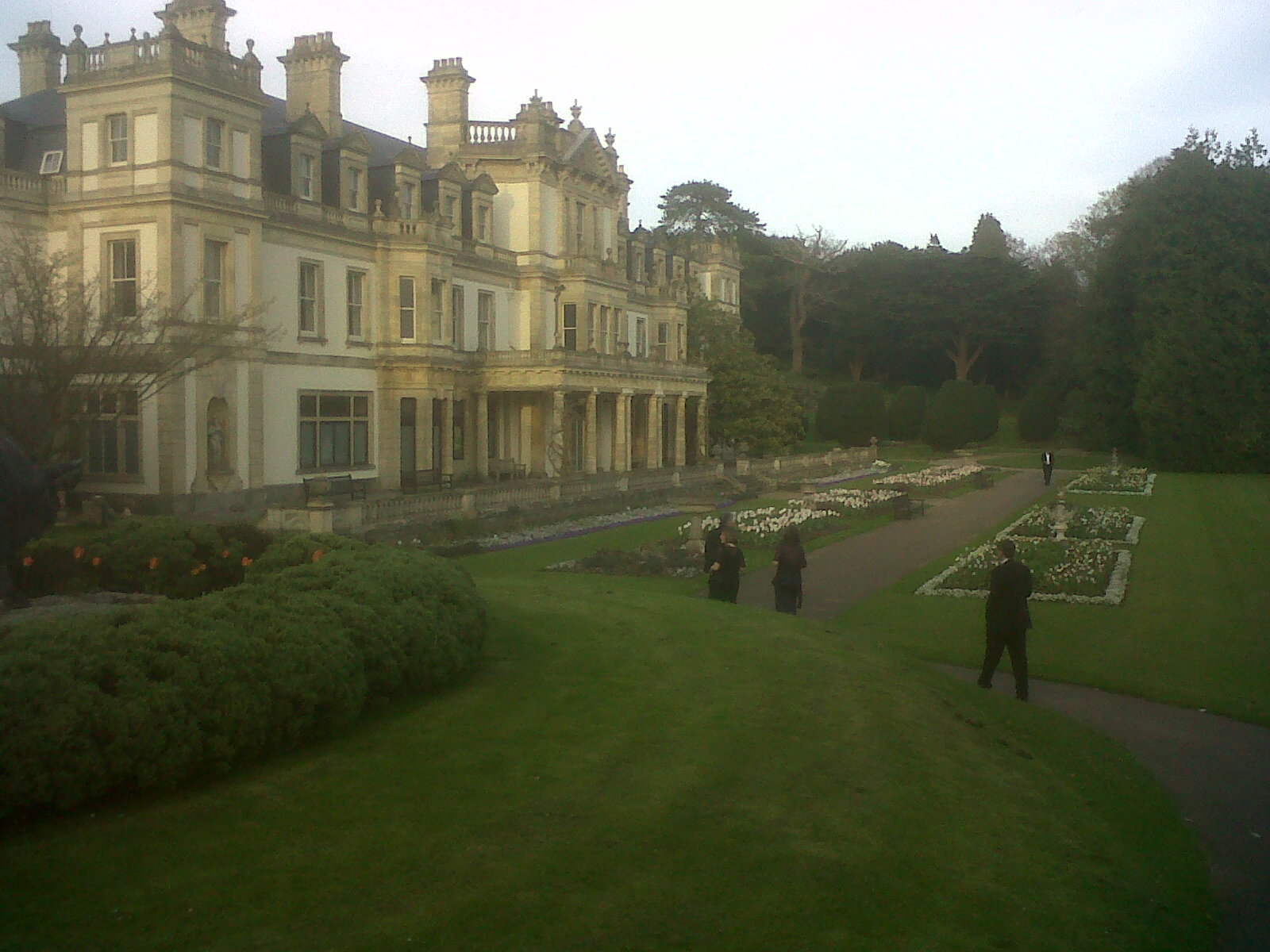
I went to a posh do last night. The Vale of Glamorgan County Council is renowned for the splendour of its Balls, and last night the Mayor held one of them for Charity. This event took place in a Marquee which had been specially erected in the magnificent setting of Dyffryn Gardens. I’ve never been there before, but am definitely planning togo again, as we didn’t get very much time to see the gardens and no time at all to see the famous arboretum there. Anyway, here’s a shot of us wandering around the (slightly dilapidated) Dyffryn House, which forms the centrepiece of the Dyffryn Estate, with champagne glasses in hand. How very decadent.

The Ball itself was very pleasant. The food was good, and there was plenty of wine to go around. The dance band was a little ropey, in my opinion, but plenty of people were dancing and it was all jolly good fun. Also I was one of the youngest people there, so it was quite nice, for once, not to be one of the oldies.

Since it was a fundraising event for Charity there was the obligatory raffle, followed by an auction. Among the items being sold were two paintings by local artist Charles Byrd. I ended up buying one of them, which happened to have been painted in 1963 – the year of my birth. I’m very pleased with my acquisition, but haven’t figured out where I’m going to hang it yet; here’s a blurry phone picture of it in my study.


Share/Bookmark

Footprints in the Sands of Time

Posted in Poetry with tags , , on April 9, 2011 by telescoper

A busy day – and a beautiful one – and I’m off to a posh do this evening, so I just have time for a brief contribution. I thought I’d share these few verses from the inspirational poem A Psalm of Life by Henry Wadsworth Longfellow. I hope Tom Shanks reads them…

Tell me not, in mournful numbers,
Life is but an empty dream!
For the soul is dead that slumbers,
And things are not what they seem.

Life is real! Life is earnest!
And the grave is not its goal;
Dust thou art, to dust returnest,
Was not spoken of the soul.

In the world’s broad field of battle,
In the bivouac of Life,
Be not like dumb, driven cattle!
Be a hero in the strife!

Lives of great men all remind us
We can make our lives sublime,
And, departing, leave behind us
Footprints on the sands of time;

and here they are, read by the late great Paul Scofield:


Share/Bookmark

Gravity waves goodbye to LISA?

Posted in Science Politics, The Universe and Stuff with tags , , , on April 8, 2011 by telescoper

It seems that we’re not allowed to have any good news these days without a bit of bad to go with it. This week it has emerged here and there that the US National Aeronautics and Space Administration (better known as NASA) is pulling the plug on one of the most exciting space missions on its drawing board. Feeling the pressure of budget constraints and a ballooning overspend on the James Webb Space Telescope (JWST), NASA has decided not to participate further in the Laser Interferometric Space Antenna, a.k.a. LISA. The project teams working on LISA have been disbanded, and the shutters have been pulled down on a project which would have revolutionised astrophysics by opening up new possibilities of observing astronomical objects using gravitational waves, rather than electromagnetic radiation.

This does not mean that LISA is necessarily completely dead. For one thing, it was always planned to be a partnership between NASA and its European counterpart ESA (the European Space Agency); you can find ESA’s LISA page here. In fact a technological demonstrating mission LISA-Pathfinder, operated by ESA, is scheduled for launch in 2013.
It remains possible that ESA will proceed on its own with some version of LISA, although given its own financial constraints it is unlikely that it will be able to fund the full original mission concept. The best we can hope for, therefore, is probably some slimmed-down low-budget version and perhaps an even later launch date.

I still hold out some hope that LISA might come out of mothballs when gravitational waves are actually detected. This may well be accomplished by Advanced LIGO, a ground-based interferometric system based in the states, although it has to be said that gravitational waves have been “on the brink of detection” for at least 30 years and still haven’t actually been found. When detection does become a reality it might galvanise NASA into finding room in its budget again.

This news will be a particularly concern for the sizeable Gravitational Physics group here in the School of Physics & Astronomy at Cardiff University. However, LISA was very much in the planning and development stages so it won’t impact their current work. I haven’t had the chance to discuss the news about LISA with members of this group, so I’d be interested to receive comments from them, or indeed anyone else who knows more about what NASA’s decision may or not mean for the future of gravitational wave physics.


Share/Bookmark

On My Radio (Telescope) …

Posted in Science Politics, The Universe and Stuff with tags , , , , , , on April 7, 2011 by telescoper

A piece of news I should have passed on sooner than this is the announcement that the  Headquarters for the Square Kilometre Array will be based at the Jodrell Bank Observatory which, as you all know, is situated in the English Midlands.

The Square Kilometre Array (known to the astronomical community as SKA) will be, when it’s built, the largest radio telescope, and in fact the largest telescope of any kind, ever constructed.  Building it will be a huge technical challenge, and it involves teams from all around the world. Although it hasn’t yet been decided where the actual kit will be sited – Australia and South Africa are two strong contenders – it’s definitely a coup for the UK to be hosting the Project Office. So congratulations to Jodrell Bank and to John Womersley, Director of Science Programmes at the Science and Technology Facilities Council who will be heading up the operation.

I think  that the SKA is by far the most exciting project in ground-based astronomy on the STFC books: it has a significantly stronger science case than its competitor in the optical part of the spectrum, the European Extremely Large Telescope (E-ELT), although it is admittedly more of a challenge to build it from a technological point of view. Over the last few years I’ve feared on many occasions that STFC would have to pull out of one of these two very expensive projects and that E-ELT would be the one that survived because it is within the remit of the European Southern Observatory (ESO) to which we pay a hefty subscription. Fortunately the clouds seem to have lifted a bit and it looks like we’re going to remain in both, which is excellent news for UK astronomy.

I was thinking of putting up a bit of music to celebrate the good news. Hmmm….Ska….radio. No brainer really. I wonder who was The Selecter for the  location of the SKA Project Office?

P.S. I just looked at the date when On My Radio was in the charts. October 1979, when I was 16.  I have to confess that in those days I had a massive crush on lead singer Pauline Black


Share/Bookmark

Rees on Religion (via The e-Astronomer)

Posted in Uncategorized on April 6, 2011 by telescoper

I agree wholeheartedly with Andy Lawrence on this, and since this is the first time this has ever happened I thought I’d mark the occasion by reblogging his post…

Bit of a Twitter Buzz this morning about Martin Rees winning the Templeton Prize. For those who don't know, the Templeton Foundation is an organisation founded by billionaire John Templeton, to encourage open minded and progressive thinking in religion. In the 1980s they also started funding science, where they felt there was some philosophical (not necessarily directly religious) interest. Most interestingly, in 2006 they gave nine million dolla … Read More

via The e-Astronomer


Share/Bookmark

Brush up your CVs!

Posted in Science Politics with tags on April 6, 2011 by telescoper

A  job vacancy caught my eye this week, so I thought I’d pass it on (at no extra charge).

This is the long-awaited announcement of a much-needed vacancy as Chief Executioner Executive of the Science and Technology Facilities Council (STFC). The incumbent, Professor Keith Mason, will be leaving the job (although not until next year) and I’m sure his successor will be grateful for the fact that STFC has much less activity to manage now than it did  four years ago. Indeed, if you download the further information you’ll find there’s so much talk of “management of change” and “new structures” that you wouldn’t have thought STFC had already existed for four years…

A notable requirement is that the successful candidate must have

…strong emotional intelligence, excellent listening skills; good relationship and influencing skills and the ability to reach out and build consensus and trust;

which will certainly make a change. The ability to “manage budgets” is apparently also necessary.

I gather special training is provided so the successful candidate can learn to read and write TreasurySpeak and that there  is a substantial budget for travel. A luxurious office is provided in Swindon, but the Chief Executive is not required to visit it except on special occasions, such as when there is a celebration of the closure of a major national facility. The salary is “competitive”, although it doesn’t say with what.

But, seriously, it’s going to be a tough but vitally important job for UK Science so I hope someone of sufficient stature to take it on does emerge, poisoned chalice though it undoubtedly is. A rumour mill has already started, and I might open a book on the race if there are enough nominations through the comments box…


Share/Bookmark

What’s your mixing angle?

Posted in Science Politics, The Universe and Stuff with tags , , , , on April 5, 2011 by telescoper

Today I’ve been preparing tomorrow’s particle physics lecture on the Cabibbo mechanism for quark mixing, which inspired me to go back to Paul Crowther’s guest post of a couple of days ago to present the data in a slightly different way.

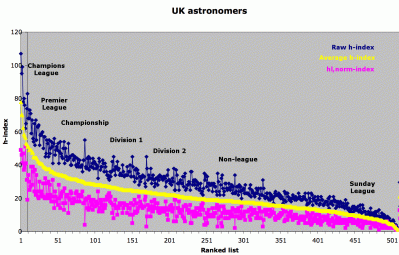
The centrepiece of Paul’s post was the following graph which shows the distribution of two different bibliometric measures for the UK astronomical community. There is the h-index (which is the number h such that the author has h papers cited at least h times) and a normalised version of h in which each paper’s citations are divided by the number of authors of that paper before the index is formed; I call this index hnorm. The results are shown below:

Generally speaking the two indices track each other fairly well, but there are clearly some individuals for whom they diverge. These correspond to researchers whose main mode of productivity is through large consortia and for whom h is correspondingly much larger than hnorm.

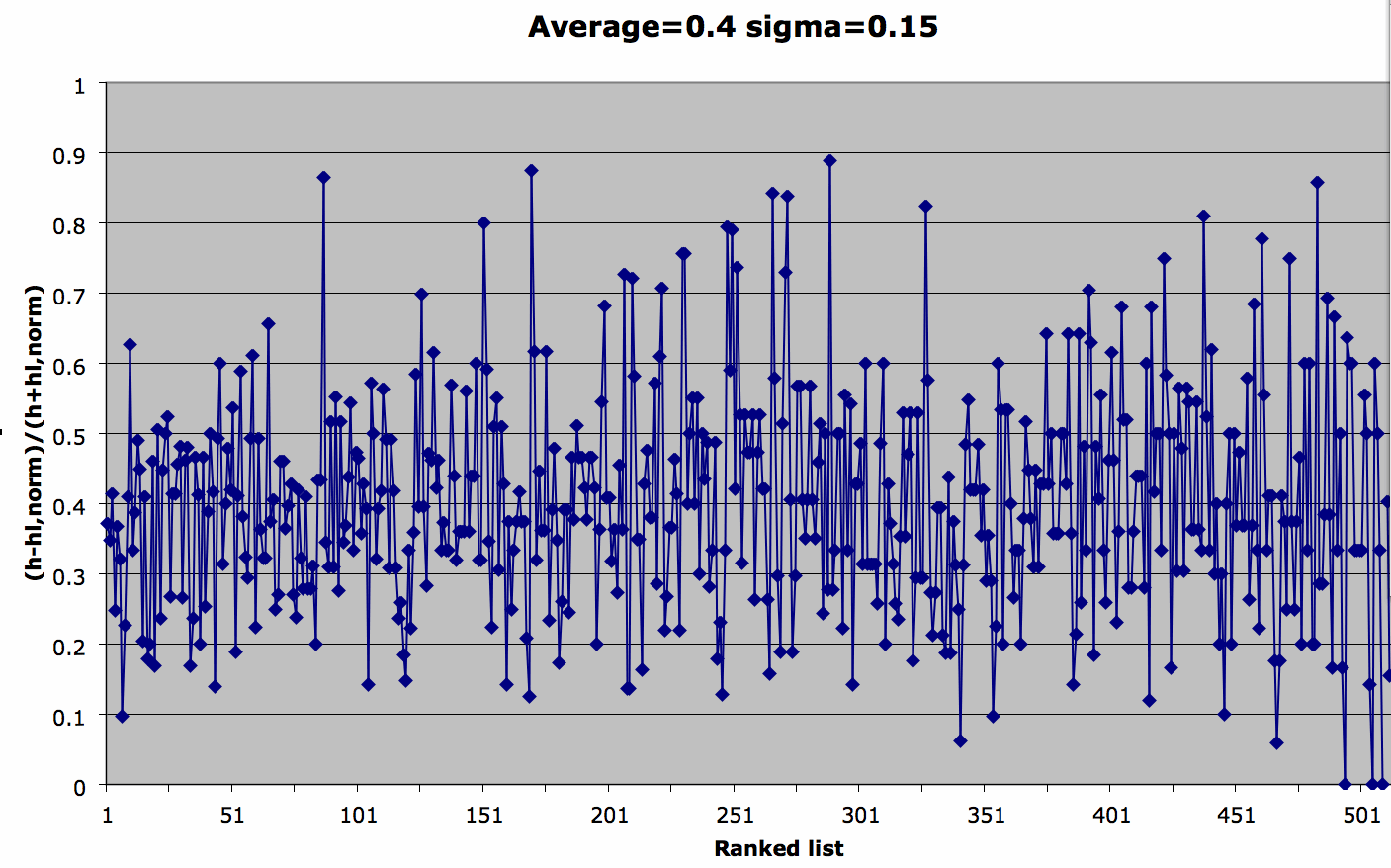
The “outliers” are more easily identified by forming the ratio

l= \frac{h-h_{\rm norm}}{h+h_{norm}}

which is plotted in the graph below kindly provided by Paul Crowther.

Notice that the “lurker index” l is constructed to normalise out any general trend with h and the data do seem consistent with a constant mean across the ranked list. There is, however, a huge spread even among the top performers.

If this were particle physics rather than astronomy the results wouldn’t be presented in terms of a ratio like l but as a mixing angle like the Weinberg angle or the Cabibbo angle. In this scheme we envisage each researcher’s output publication list as involving a mixture of “solo” and “collaborator” basis states, i.e.

|output>=cos(θ) |solo>+sin(θ) |collaborator>

The angle θ gives a quantitative indication of an author’s inclination to lurk in other people’s publication lists. If θ=0 then the individual’s papers are going to be all single-author affairs with no question marks over attribution of impact. If θ=90° then the individual does primarily  collaborative research – perhaps he/she is a good mixer? Most researchers  lie somewhere between these two extremes.

I therefore suggest that we should measure bibliometric productivity and impact not just through one “amplitude”, say h, but by the addition of a mixing angle, i.e. the whole output should be summarised as (h,θ). One could estimate the relevant angle fairly straightforwardly as

\sin\theta = l= \frac{h-h_{\rm norm}}{h+h_{norm}},

but alternative definitions are possible and a more complete understanding of the underlying process is needed to make this more rigorous.

Stephen Hawking has a particularly small mixing angle (~5.7°); many members of the astronomical Premiership have much larger values of this parameter. The value of θ corresponding to the average value of l is about 23.5° and my own angle is about 8.6°.

And here, courtesy of the ever-reliable Paul Crowther, is a graph of mixing angle versus raw h-index for the whole crowd shown in the above diagram.

P.S. If you thinking this application of mixing angle is daft, then you should read this post.


Share/Bookmark

Back to Bach

Posted in Music with tags , on April 4, 2011 by telescoper

Another very busy and tiring day gave me no time to post anything until I got home this evening. Still, Ye Olde Blogge seems to be managing well these days without me. I’m going to have an early and largely blog-free night tonight, but I thought I’d share this with you before I slump onto the sofa. I heard this piece on the radio a few days ago. I usually wake up when my alarm clock turns the radio on. Sometimes the music doesn’t get me going straight away and I slumber on for a while. When this came on, however, I was mesmerised and couldn’t have gone back to sleep if I’d wanted to.

I’ve loved the music of Johann Sebastian Bach for a very long time, but a lot of his work is still new to me, as this piece was until very recently. It’s one of the trio sonatas for organ that he wrote relatively late in life, apparently to help his sons learn to play the organ. The trio sonata format usually involved two different solo instruments playing over a bass accompaniment called a continuo, but here all three parts are played on the organ by one musician. The result is absolutely beautiful, especially played as this recording on a lovely sounding organ.

I’ve listened to this piece repeatedly over the last week or so and every time I hear it I’m filled with a sense of euphoria. I think awesome is an understatement for such music as this.

PS. The pictures are of the town of Leipzig, which was Bach’s home for many years.


Share/Bookmark