I couldn’t resist putting up this jaunty duet version of the old Hoagy Carmichael song “Up a Lazy River”, which I first heard over 30 years ago, not only because the (British-born) pianist George Shearing plays so wonderfully on it (listen to his little foray into Harlem Stride around 3.00), but also because it gives me a chance to pay homage to the bass player Brian Torff. Just listen to his solo (starting around 1.55) and you’ll immediately understand why he’s revered amongst jazz musicians for his incredible technique and musical imagination and why so many other double bass players are completely terrified of him!
Author Archive
Lazy River
Posted in Jazz with tags Brian Torff, George Shearing, Hoagy Carmichael, Jazz on May 20, 2010 by telescoperAstronomy Look-alikes, No. 25
Posted in Astronomy Lookalikes with tags Lembit Opik, Rob Ivison on May 20, 2010 by telescoperOne of the best things about having visiting seminar speakers here in Cardiff is that they often tend to bring ideas for my astronomy look-alike series with them. One of the best I’ve had for a while was suggested last night over dinner with yesterday’s speaker.
I wonder how many of you have noticed the similarity – tonsorial issues apart – between cheeky boy Rob Ivison and former Liberal Democrat Member of Parliament Lembit Opik? I wonder if by any chance they might be related?
Incidentally, it might be worth mentioning that Lembit Opik himself has an interesting family connection with astronomy.

Lembit Opik

Rob Ivison
Astronomy Look-alikes, No. 24
Posted in Astronomy Lookalikes with tags Mr Mackey, Roger Davies, Royal Astronomical Society, South Park on May 19, 2010 by telescoperIn view of the recent installation of Professor Roger Davies as the new President of the Royal Astronomical Society, I feel obliged to do him the honour of adding to my collection of look-alikes. How about Mr Mackey from South Park?


Exam Time
Posted in Education with tags PhD examination, postgraduate, Rockhee sung on May 18, 2010 by telescoperA busy day today, marking undergraduate examinations most of the time, but also keeping an eye on the viva voce examination for a PhD student too. In the end both tasks went off satisfactorily. I finished my batch of marking third-year examinations scripts and my PhD student Rockhee Sung also passed her PhD. The completion of the former task wasn’t so much of a cause for celebration, because I still have a second paper to do, but Rockhee’s successful PhD defence definitely was. The viva was probably no more than the formality I expected it to be, but it was great to see the look on her face when she emerged from the room. In anticipation of a successful outcome I’d bought a few bottles of champagne which I had secreted in the departmental fridge. A few minutes after the viva had finished, I sprang into action, corks were popped, and we were all congratulating Rockhee on her success. We then adjourned to a local bar and thence to dinner in a nice restaurant.
Rockhee started her PhD with me when I was at Nottingham. When I decided to move in 2007, she moved with me and transferred her registration to Cardiff. Moving wasn’t as easy as I had anticipated owing to the Credit Crunch. It took me the best part of a year to fully relocate, causing considerable disruption to my research (and Rockhee’s PhD). However she managed to complete her thesis some time ago and managed to get a postdoctoral position in the beautiful city of Cape Town, South Africa. She flew back yesterday for her viva, just escaping the dreaded Icelandic Volcano Ash, and passed (with flying colours) today. Well done Rockhee!
Although the outcome of the examination was hardly unexpected, I don’t mind saying that I was absolutely delighted, as I am every time one of my PhD students passes this final hurdle. It’s one of the things that makes this job so very special. That’s a round dozen now, and I’m so very proud of all of them. Especially considering what a crap supervisor they all had.
That’s not to say that I won’t feel proud when this year’s undergraduates finally qualify for their degrees, but postgraduates have a much closer personal connection than undergraduates do to their tutors and lecturers, and that inevitably makes their success that bit more special…
The Remorseful Day
Posted in Biographical, Poetry with tags A. E. Housman, Inspector Morse, John Thaw, Wagner on May 17, 2010 by telescoperNot for the first time, I’m going to make an admission that will no doubt expose me to public ridicule. I can’t watch the last episode of the TV series Inspector Morse (The Remorseful Day) without bursting into tears at the end when it is revealed that the eponymous detective has died. Not that it comes as a surprise – the story has plenty of scenes that make it clear that Morse knows his days are numbered. Take this one, for example, wonderfully acted by John Thaw who was himself very ill while this episode was being filmed; he died in 2002.
The poignant quotation is from a poem by A. E. Housman. Here’s the poem in its entirety.
Yonder see the morning blink:
The sun is up, and up must I,
To wash and dress and eat and drink
And look at things and talk and think
And work, and God knows why.
Oh often have I washed and dressed
And what’s to show for all my pain?
Let me lie abed and rest:
Ten thousand times I’ve done my best
And all’s to do again.
How clear, how lovely bright,
How beautiful to sight
Those beams of morning play;
How heaven laughs out with glee
Where, like a bird set free,
Up from the eastern sea
Soars the delightful day.
To-day I shall be strong,
No more shall yield to wrong,
Shall squander life no more;
Days lost, I know not how,
I shall retrieve them now;
Now I shall keep the vow
I never kept before.
Ensanguining the skies
How heavily it dies
Into the west away;
Past touch and sight and sound
Not further to be found,
How hopeless under ground
Falls the remorseful day.
When Morse talks about Wagner in the clip, you know this is a man coming to terms with his own mortality. It even makes me feel a bit guilty for not being all that keen on Wagner myself. Perhaps I should persevere too. In that respect, as well as many others, I’m rather more like Lewis than Morse, although I do share the Chief Inspector’s love of crossword puzzles.
I watched this episode when it was first broadcast in 2000 and cried at the end then. I’ve seen it many times since, including a late-night repeat last saturday night, and it’s always had the same effect. The very first episode, The Dead of Jericho, was screened way back in 1987 and I’d enjoyed the series right from the word go. Morse became like an old friend to me over the following twenty-odd years and it’s never easy saying goodbye to people you’ve grown accustomed to for a long time.
Should I be embarrassed about crying whenever Inspector Morse dies? Perhaps. But I’m not.
A Star is Porn
Posted in The Universe and Stuff with tags astronomy, Cosmology, pornography, virtual reality on May 16, 2010 by telescoperI started thinking about the analogy between astronomy and pornography after seeing a hilarious blog post by Amanda Bauer that has a connection with my forthcoming (popular) book, which has the working title Naked Universe. It’s basically a collection of essays about cosmology, trying to look at the subject from unusual and provocative angles. I decided to give you a bit of a flavour of this connection here. It’s intended to be a bit of a joke, but it does make a semi-serious point about the difference between astronomy and other branches of science.
Although it’s one of the oldest fields of scientific enquiry, astronomy possesses a number of features that set it apart from most other branches of science. One of the most important is that it isn’t really an experimental science, but an observational one. Hands-on disciplines, specifically those involving laboratory experiments, require a dialogue between the scientist and nature. The scientist can control the physical parameters of the system under scrutiny and explore its behaviour under different conditions in order to establish patterns and test theoretical explanations. The scientist chooses the questions to ask, the experiment is run, and nature gives its answer. If more information is needed, another experiment is set up with different parameter choices.
Astronomy is different. Its subject matter, the Universe of stars and galaxies, is remote and inaccessible. We only have what is “out there” already. We had no hand in setting it up, and we can’t intervene if it behaves in an unexpected way. We are forced to work only with what has been given to us. Out there in the darkness the Cosmos may be beautiful, but all we can do is look at pictures of it. We never get to experience it in the flesh. Experimentalists have real intercourse with nature, but astronomers have to be content with being mere voyeurs.
This is not to say that all astronomers are dirty old men in grubby raincoats – although I have to say that I know a few who could be described like that – but many mainstream scientists do indeed tend to look down on us, at least partly because of the unconventional practices I’ve alluded to. On the other hand, I suspect they also secretly envy us. From time to time they probably also have a guilty peek at their favourite pictures too. Every time physicists look at astronomical images, do they feel just a little bit guilty?
You can hardly go on the internet these days without finding a website devoted to pornography astronomy.This is hardly surprising because both astronomy and pornography have led to technological advances that helped fuel the digital revolution. Astronomy gave us the CCD camera, which ushered in the digital camera that has made it much easier for both amateurs and professionals to make their own pornographic astronomical images. On the other hand, the porn industry was largely responsible for the rapid evolution of video-streaming technology. That must be why astronomers spend so much of their time doing video conferences…
Astronomers also led the way in the development of virtual reality. Frustrated by their inability to get up close and personal with the objects of their desire, they have resorted to the construction of elaborate three-dimensional computer simulations. In these they can interact with and manipulate what goes on until they reach a satisfactory outcome. I’ve never found this kind of thing at all rewarding – the simulations are just not sufficiently realistic – but large numbers of cosmologists seem to be completely hooked on them.
The Club Guest
Posted in Uncategorized with tags astronomy, RAS Club, Royal Astronomy Society on May 15, 2010 by telescoperYesterday I went, as I do from time to time, to the Royal Astronomical Society’s monthly meeting and thence to the RAS Club for dinner. This was the last such meeting before the summer hiatus – they resume in October – and also incorporated the Society’s Annual General Meeting at which new officers are elected, amongst them the new President. Andy Fabian was the outgoing President, having completed his two-year tour of duty, and he was replaced by Roger Davies.
It was also revealed at this meeting that next year’s National Astronomy Meeting would be in Llandudno. Usually this event is organized by a university and is held in a university town. This year it was in Glasgow, for example. However, the University of Sheffield has pulled out of organizing the 2011 NAM and no other was willing to take on the considerable task of organizing it at such short notice. It was therefore decided to break with tradition and hold the event not on a university campus but at a holiday resort. I’ve never been to Llandudno, but I think it could be great for us astronomers here in Wales to have the Principality host NAM. I suspect, however, that it wasn’t regional politics, but economics, that held sway in reaching the decision. Llandudno is perhaps a bit cheaper than most English seaside towns. I can already hear some of my English colleagues starting to whinge about how difficult it will be to get there, but we’ll see. I just hope I can persuade them to hold it outside Cardiff’s teaching term otherwise I won’t be able to go even if it is in Wales.
It was interesting to learn about all these developments, and the subsequent Open Meeting was not without interest either. We had talks about volcanic ash (topical, that one), martian meteorites, high-altitude balloon flights and stellar disks. A mixed bag of talks, but all of them very enjoyable.
However, this meeting turned out to be remarkable for a completely different reason. At the end of one of the lectures in the open meeting, a strange woman entered the lecture theatre, walked down the aisle and took a seat in the front row. In fact she first tried to sit in Roger Davies’ seat – he was standing in order to supervise the question-and-answers at the end of the talk – but he asked her to move. Finding a free seat a bit further along, she removed her hat and proceeded to brush her hair ostentatiously. As the other talks went on she appeared to pay very little attention to them, preferring instead to look around the room. I had never seen her before, but open meetings like this often attract visitors and in any case acting a bit strangely is by no means inconsistent with being an astronomer.
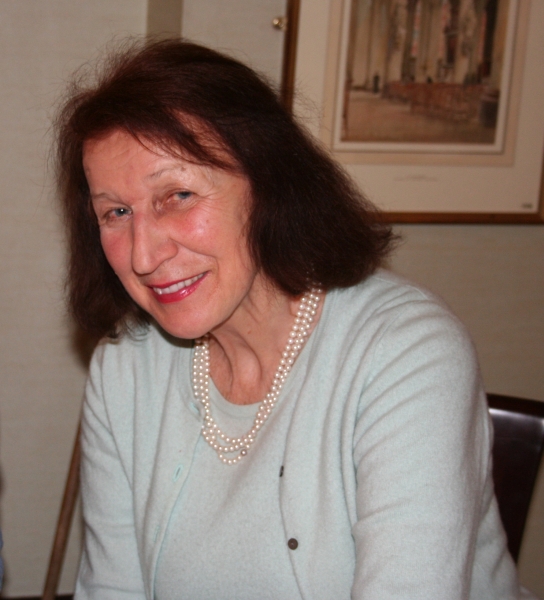
The Mystery Guest
After the meeting closed I went for a glass of wine to Burlington House and then to the Athenaeum. There was quite a crowd there and as usual we all had a glass of wine before sitting down. It was only when we started to eat that I realised that this mysterious lady (left) was actually sitting at another table. Since the RAS Club is for members (and their guests) only, I assumed she was with one of the invited speakers at the meeting who, as is usual in such cases, had been invited to the club afterwards as a club guest.
I thought nothing more about this until I saw the Club Treasurer, Margaret Penston, looking a bit agitated, go to her table and ask The Mystery Guest a question. I couldn’t hear what. Our visitor then stood up, announced she had to be going and left quickly before anyone could do anything about it. It turned out she wasn’t anyone’s guest at all, but had just latched onto a group of people leaving for the club, each of whom assumed one of the others knew her. It being England, nobody asked her who she was or what she was doing there. I have no idea who she was or why she had decided to attach herself to the RAS Club that evening.
All this was hilarious enough but, after she’d gone, it emerged that she had paid for her dinner by “borrowing” money from a genuine club guest, an American astronomer who happened to be sitting next to her and to whom she had introduced herself as the “Contessa” of something or other. Our American friend may have thought it was all an elaborate practical joke, but he was clearly completely dumbfounded by the episode. The Club had a whip round to pay him back the money he had lent her.
On top of all this, some other members of the Club then pointed out that she had done something similar on at least three previous occasions, in locations ranging from Paris to London. Why none of her previous victims had identified her yesterday and drawn attention to her past history I have no idea. If they had she would have been removed earlier.
If the relatively small gathering we had on Friday could furnish three previous examples of this kind of behaviour, then it seems likely that it’s part of a pattern. However, it doesn’t seem likely that she makes her living doing this sort of thing because she’s only “borrowed” amounts from £5 to £70. Perhaps astronomers aren’t the best choice of target.
I wonder if anyone reading this blog recognizes her and can shed light on her curious behaviour?
Herschel’s First Year in Space
Posted in The Universe and Stuff with tags ESA, Herschel, RAS on May 14, 2010 by telescoperJust about to journey to the RAS for the Annual General Meeting and the last club dinner before the summer break, I’m reminded by a tweet from Chris North that it’s exactly a year since we gathered nervously, fortified by booze, to watch the launch of the far-infrared observatory Herschel, together with its sister spacecraft Planck. I haven’t got time to write much about this because I’ve got a train to catch, but you can in any case find a nice retrospective of the Herschel’s first year in space here. I couldn’t resist, however, putting up the nice video that’s been put together by the European Space Agency to mark the anniversary.
It’s all been going swimmingly on the Herschel front since the launch, and the first science papers have been making their way onto the ArXiv this week. Thankfully it’s not been quite the deluge that I’d feared, more of a steady stream. I’ve even had a chance to read a few of them.
The next major milestone coming up will be announcement of opportunity for open time access (OT1) which will be released on 20th May with a deadline of 22nd July. I’m sure the huge success that Herschel has been so far will mean a lot of people putting in proposals. There is talk of putting in a proposal for a big cosmology survey – a sort of son of ATLAS and HERMES – which will be good timing for me and my little team at Cardiff because our theoretical models are almost ready to rumble…
Anyway, here’s to at least another three years of Herschel, although I’ll have to wait until this evening to raise a glass!
A Reith Lecture
Posted in Politics, The Universe and Stuff with tags BBC, Martin Rees, Reith Lectures on May 13, 2010 by telescoperI’m a bit late getting around to blogging today, primarily because I spent the evening at a lecture by Martin Rees. Not just any lecture, but one of the annual series of Reith Lectures that he has been chosen to present this year. This event took place in the splendid Reardon Smith Theatre in the National Museum in Cardiff, and was preceded by a wine reception where we mingled amongst the relics of Welsh prehistory. The audience for the lecture included academics, politicians, journalists and students and there was a lively question-and-answer session afterwards.
The Reith Lectures were inaugurated in 1948 by the BBC to mark the historic contribution made to public service broadcasting by Sir John (later Lord) Reith, the corporation’s first director-general. John Reith maintained that broadcasting should be a public service which enriches the intellectual and cultural life of the nation. It is in this spirit that the BBC each year invites a leading figure to deliver a series of lectures on radio. The aim is to advance public understanding and debate about significant issues of contemporary interest.
The very first Reith lecturer was the philosopher, Bertrand Russell who spoke on “Authority and the Individual”. Among his successors were Arnold Toynbee (The World and the West, 1952), Robert Oppenheimer (Science and the Common Understanding, 1953) and J.K. Galbraith (The New Industrial State, 1966). More recently, the Reith lectures have been delivered by the Chief Rabbi, Dr Jonathan Sacks (The Persistence of Faith, 1990) and Dr Steve Jones (The Language of the Genes, 1991). Since 2002, the Reith Lectures have been presented as was tonight’s, by Sue Lawley.
I think this is the first time any of these lectures have been delivered in Cardiff. Martin Rees is, in fact, almost a Welshman himself , being born in Ludlow in Shropshire only about a mile the wrong side of the border; since being elevated to the peerage a few years ago, he is now known as Baron Rees of Ludlow. He is, of course, an immensely distinguished astrophysicist (he has been Astronomer Royal since 1995) but now has a broader portfolio of responsibility in the higher echelons of British science as President of the Royal Society.
As well as being an eminent scientist, Martin Rees is also a very fine public speaker, possessing an effortless gravitas that any politician would die for. He speaks with great clarity, thoughtfully and to the point, but with an economical use of language. He comes across as not only highly intelligent , which he undoubtedly is, but also deeply humane, another rare combination. Martin Rees was therefore an excellent choice to give the Reith Lectures. I had been looking forward to the evening for months after I got a phone call from Auntie Beeb asking me if I’d like to attend.
His lecture this evening wasn’t about astrophysics, and neither are the others in the series which has the pretty vague overall title Scientific Horizons. This lecture, the second of the series of four, was entitled Surviving the Century,and it concerned the role of science in identifying and possibly counteracting the threats facing humanity over the next few decades. He touched on climate change, renewable energy, and the possibility of nuclear or bio-terrorism. Although he spelled out the dangers in pretty stark terms he nevertheless claimed to be an optimist to the extent that he believed science could find solutions to the most pressing problems facing our planet, but I also sensed he was more of a pessimist as to whether the necessary measures could be implemented owing to socio-economic and political constraints. Science is vital to safeguarding the future of the planet, but it isn’t sufficient. People need to change the way they live their lives.
I won’t say any more about the lecture – or the interesting audience discussion that followed it – because you’ll be able to hear it yourselves on BBC Radio 4. The Lectures will be broadcast at 9am on Radio 4 starting on Tuesday 1st June (Lecture 1, called The Scientific Citizen). The lecture I attended tonight will be broadcast at the same time the following week (8th June). Lectures 3 and 4 will follow on 15th and 22nd June. Of course they will also be available as podcasts from the BBC website. If you want to be informed, enriched and challenged then I recommend you check them out.
Into the Blue
Posted in Education, Finance, Politics, Science Politics with tags HEFCE, HEFCW, SFC, STFC on May 12, 2010 by telescoperSo there we are. Britain has a new government. For the time being. Last night David Cameron became the Prime Minister of a coalition government involving the Conservative and Liberal Democrat parties (as I predicted). This is hardly a surprise given the arithmetic; Labour and the LibDems wouldn’t have had enough seats to command a majority anyway. It took five days from the election for the new Prime Minister to take over, much longer than the few hours it normally takes when there is a conclusive result, but nowhere near as long as it takes on the continent where coalition-building involves smaller and more diverse parties. In the UK the three main political parties are all centre-right, at least when it comes to economic policy, and they share a great deal of common ground, so I never thought there would be much problem with the Conservatives and LibDems coming to a deal, which they have done.
Another prediction I got right was that Gordon Brown would resign as leader of the Labour Party, which he has also done. Who will lead the Labour Party now, and for how long, is anyone’s guess.
My third prediction was that the coalition government would fall within a year and there’ll be another general election. As for that, we’ll have to wait and see. It is, after all, a marriage of convenience. I think it won’t be long before a big row develops and the coalition unravels. There’s a lot of overlap between the two parties, but it’s a long way from the left of the LibDems to the right of the Tories. I give it 6 months to the first vote of confidence, assuming the Queen’s Speech passes.
Now that we have a government once more, the unreal business of electioneering is going to be set aside and all the facts that the media have kept quiet about during the election campaign will start to come out. For example, a story in the Financial Times of 11th May (yesterday), which has clearly been on the spike for the duration of the election campaign, reveals how huge cuts in university funding are set to fall hardest on science departments. Vice-chancellors have been making contingency plans for 25% cuts in recurrent funding for some time now, and there’s an obvious temptation to cut the more expensive subjects first.
I’ve already confessed my annoyance that the main parties connived to keep the details of the deep cuts they were all planning to implement out of the election campaign. Now we’re going to find out the true extent of what’s in store, and it’s too late to change.
Niels Bohr once said “Prediction is very difficult, especially about the future”, and I have no idea whether I’m being overly pessimistic here, but here are some of the things I think will affect my own life as an astrophysicist working in a British university.
First, it’s now clear that there’s no chance of a reversal in the fortunes of STFC. There never was much of a chance of that, to be honest. It’s more likely now that STFC will now face further cuts on top of what it has endured already. Fundamental science in the UK is in for a very lean time.
Second, university funding – the part that comes directly from central government – will be cut by at least 25%, probably more. This could be achieved in a number of ways. The unit of resource (the payment made per student by the government to a university) could be cut. The number of students funded could be cut. Students could be charged higher fees or have less generous loan arrangements. These options are by no means exclusive, of course. They might all happen.
University V-Cs will have to make very difficult decisions where to make savings: some may tighten budgets across the board; others may shut entire departments to save the rest.
Another issue with university funding, however, is that it is not entirely the preserve of central government. The Scottish Assembly runs higher education in Scotland, not the Westminster government. The Scottish Funding Council has generally funded universities more generously than HEFCE has in England. It’s also much less likely to implement higher tuition fees. More generally, with only one Scottish Tory MP in Westminster and a Scottish Nationalist-flavoured Assembly government, there’s no way of knowing what will happen in Scotland or, indeed, how much strain will be generated there by an English Tory government very few Scots voted for.
In Wales its a bit different. Here higher education is run by the Welsh Assembly government, which currently comprises a Labour-Plaid Cymru coalition. With the Westminster government consisting of an alliance between the other two major parties in Wales we have two levels of administration roughly orthogonal to each other. In principle, the WAG could decide to protect the university system in Wales against the level of cuts being imposed in England, but since we already get a lower unit of resource from HEFCW than HEFCE allocates to English universities, I doubt we’ll be any different in future.
So this is where we’re headed: fewer science departments with fewer staff with increased teaching loads with less time to do research and with less funding to carry it out and vanishing career opportunities for the scientists they’re supposed to be training.
Still, at least the bankers will get their bonuses.

 In the Dark