
by Edwin Morgan (1920-2010)
by Edwin Morgan (1920-2010)
Today, Jueves Santo (Holy Thursday, aka Maundy Thursday), is a public holiday in many parts of Spain but not here in Catalonia, where all the shops have been open. I mentioned that Barcelona is not the most religious city in Spain and this is another demonstration of that. I am glad the shops were open because I used the occasion to stock up for the approaching long weekend.
Nice weather having resumed, the tourist areas of Barcelona were extremely busy today. I’m not sure what the Spanish or Catalan words are for Chuggers but they were out in force. One guy stepped right in front of me and I couldn’t avoid bumping into him. As someone who is often very nervous in large crowds I find this sort of thing very irritating. I gave him an earful (in English) and walked on. I still don’t know what he was plugging.
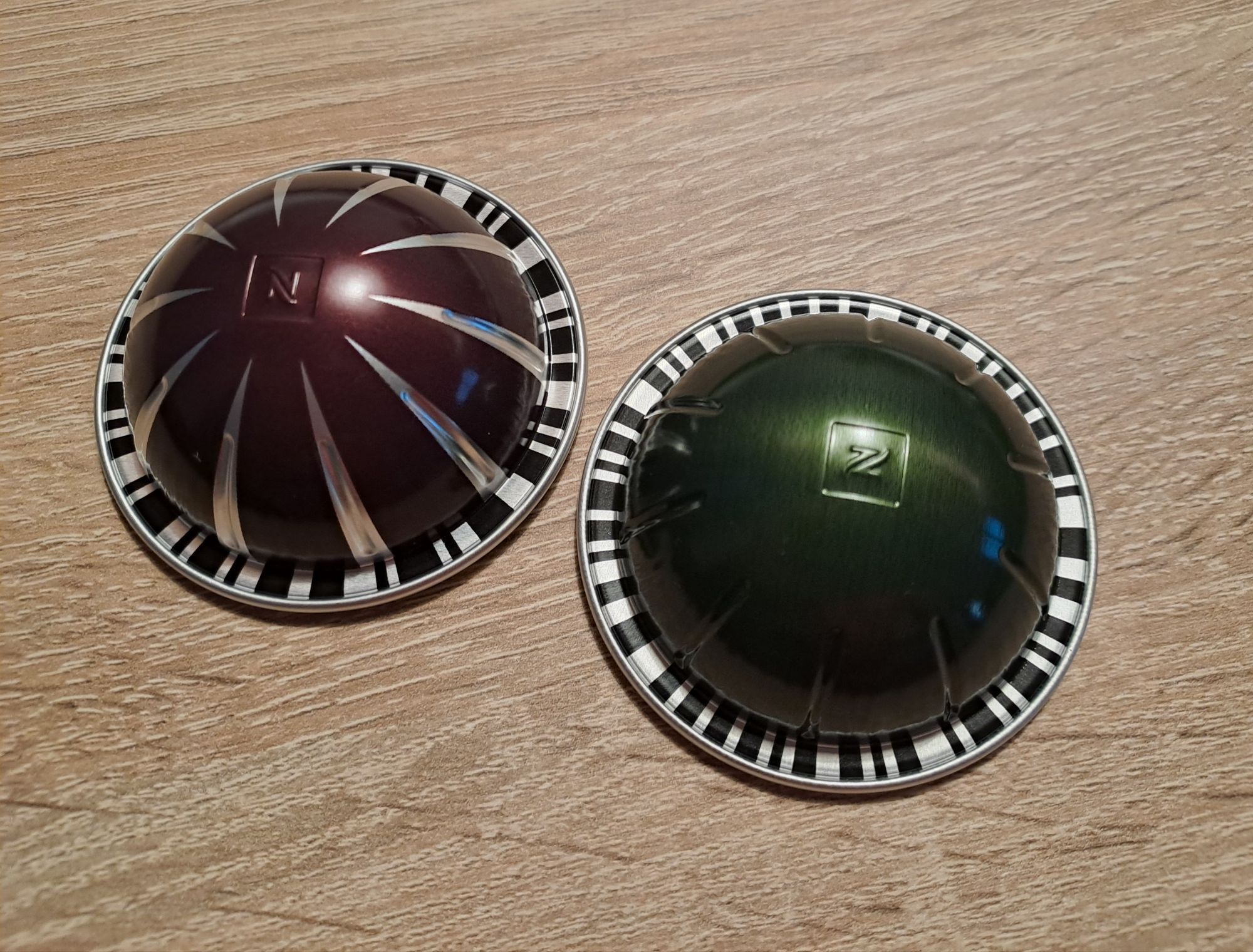
Like everywhere I’ve stayed during this sabbatical, the apartment I’m on is equipped with a Nespresso machine. This one, however, is different from the usual type and takes larger capsules like those shown above. While you can get standard Nespresso pods in supermarkets and other stores, these funny hemispherical pods have to be purchased in a Nespresso shop. There are plenty of these shops around – there’s one just over the street from my apartment – but it’s quite hard work just buying the capsules at them. You can’t just pick up a box of capsules and take it to a till: you have to queue to see one of the assistants who will try to sell you some sort of subscription. On the other hand, they also offer you a coffee to taste if you don’t know which of the myriad types you want. You can also recycle used capsules there. Anyway, despite my broken Spanish, I did succeed in buying what I wanted and will be sufficiently caffinated for the next few weeks.
P.S. As well as the ceremonial purchase of coffee, one of the other rites performed on Jueves Santo is the Lavatorio de Pies which means “the washing of the feet” and has nothing to do with lavatories or pies.
At a press conference earlier today, scientists from the Event Horizon Telescope revealed an exciting new picture of the environs of Sgr A* the black hole at the centre of the Milky Way that shows structures associated with a powerful magnetic field:
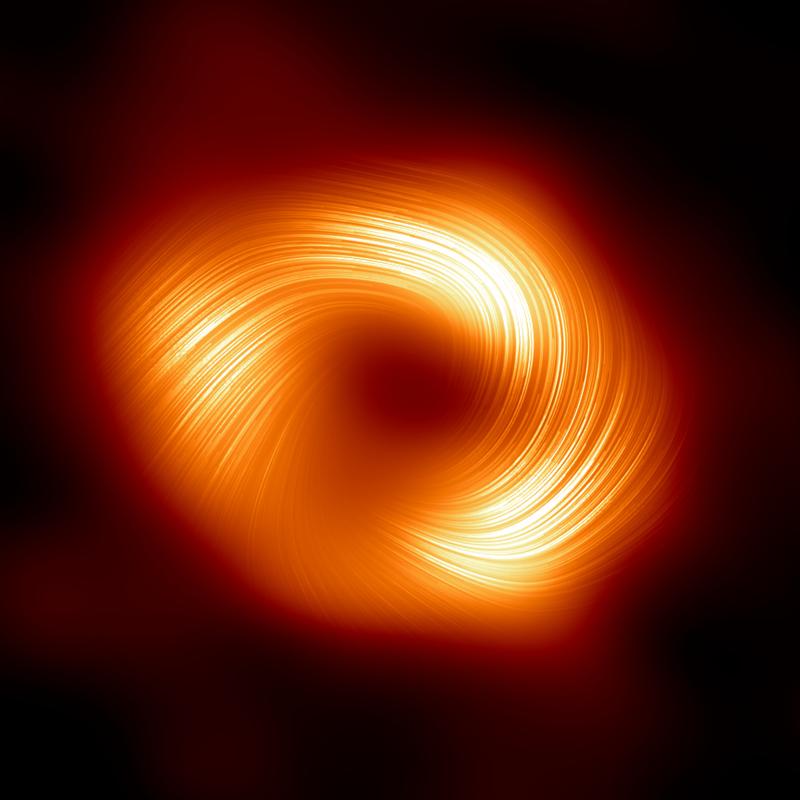
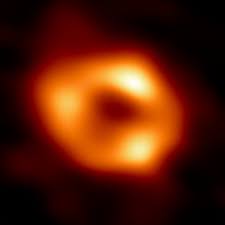
You can see immediately the enormous advantage of using a paintbrush (left) rather than a crayon (right) to make such images. For more details, see the press release here or the two papers about this work, here and here.
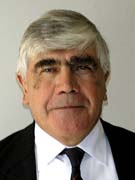
It is my sad duty to pass on the news that Professor Peter Clegg, formerly of Queen Mary University of London, passed away last Friday, 22nd March 2024.
Peter Clegg was an expert in observational and instrumental aspects of infrared astronomy. He was in the School of Physics at Queen Mary when I was in the School of Mathematical Sciences and I got to know him through the MSc in Astronomy that the two Schools delivered jointly, and latterly through the RAS Club. He was well known to colleagues in the Astronomy Instrumentation Group at Cardiff, many of whom worked for some time at Queen Mary.
I understand that Peter had been ill for some months, and that he passed away peacefully in his sleep. The funeral is to be on 12th April. Please contact me privately for details if you knew Peter and would like to attend.
It has rained more in the past 24 hours in Barcelona than it did in the three months I spent here before Christmas. In fact it rained so hard last night that it woke me up. More precipitation is forecast in the next few days too, but it will take a lot more than a few days of rain to fill up the empty reservoirs. The drought emergency is still a thing and water restrictions are still in force.
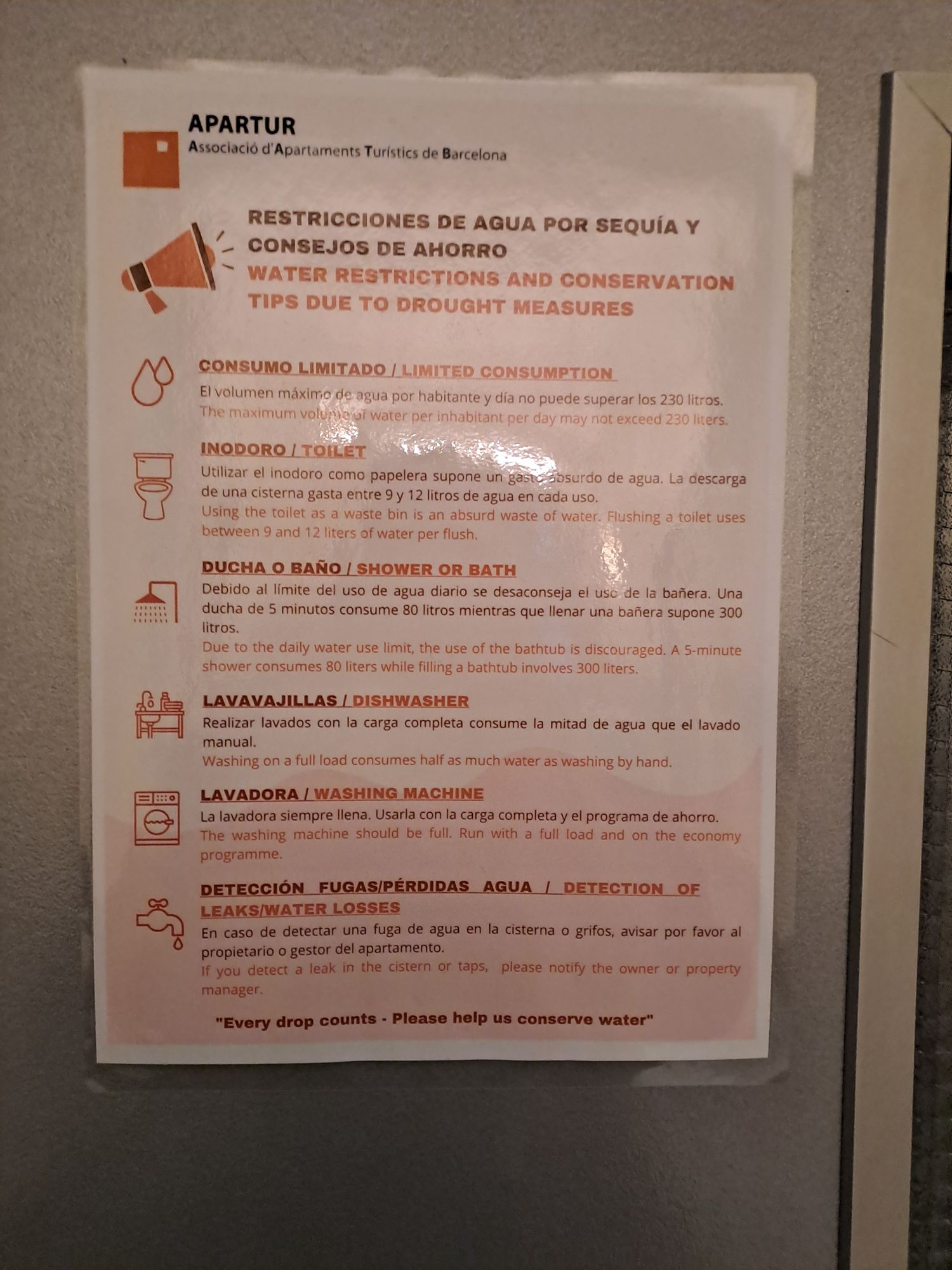
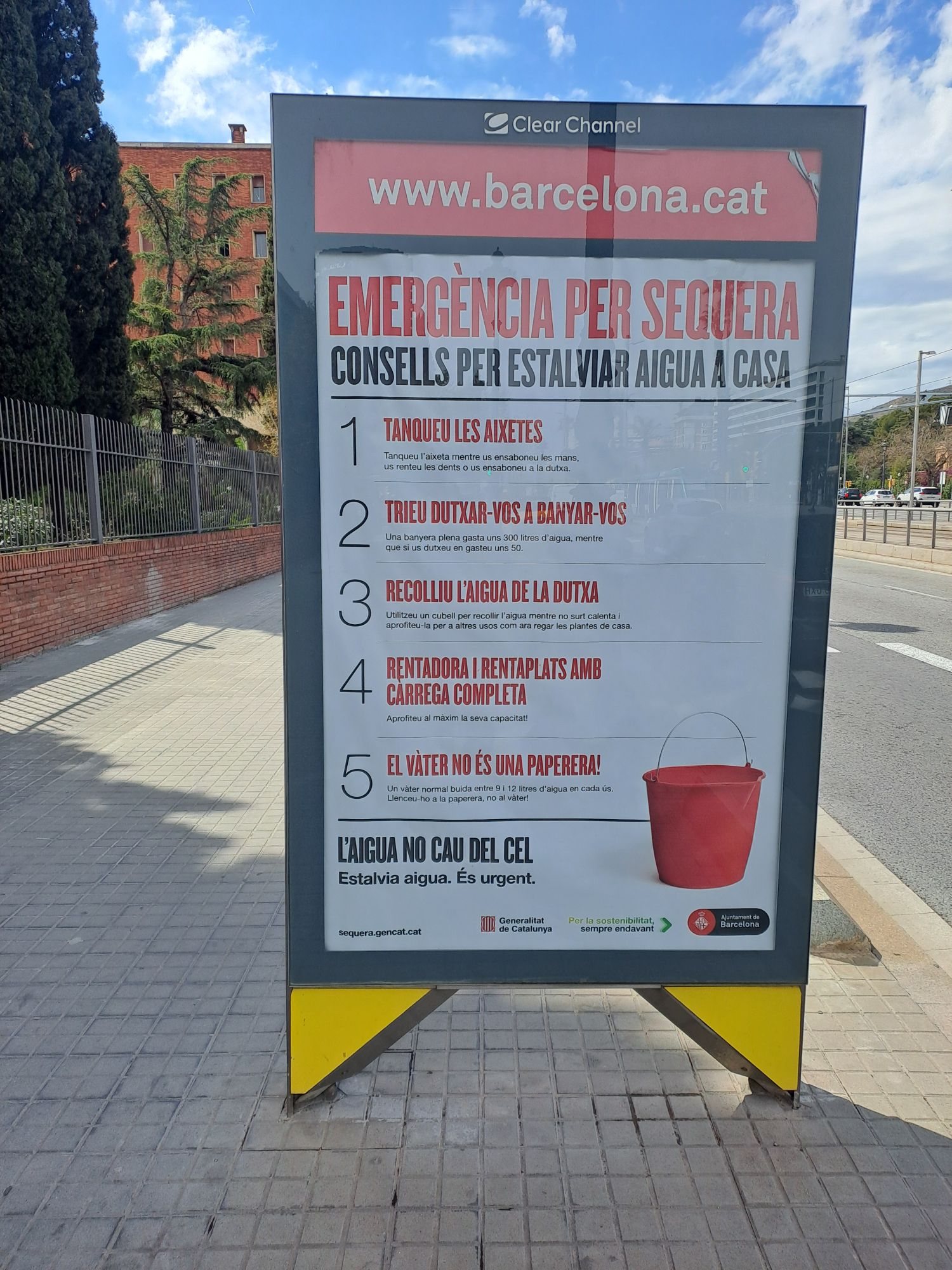
I’m doing my bit for the situation by only drinking wine.
There’s an interesting preprint on arXiv by Andrew Gray entitled ChatGPT “contamination”: estimating the prevalence of LLMs in the scholarly literature that tries to estimate how many research articles there are out there that have been written with the help of Large Language Models (LLMs) such as ChatGPT. The abstract of the paper is:
The use of ChatGPT and similar Large Language Model (LLM) tools in scholarly communication and academic publishing has been widely discussed since they became easily accessible to a general audience in late 2022. This study uses keywords known to be disproportionately present in LLM-generated text to provide an overall estimate for the prevalence of LLM-assisted writing in the scholarly literature. For the publishing year 2023, it is found that several of those keywords show a distinctive and disproportionate increase in their prevalence, individually and in combination. It is estimated that at least 60,000 papers (slightly over 1% of all articles) were LLM-assisted, though this number could be extended and refined by analysis of other characteristics of the papers or by identification of further indicative keywords.
Andrew Gray, arXiv:2403.16887
The method employed to make the estimate involves identifying certain words that LLMs seem to love, of which usage has increased substantially since last year. For example, twice as many papers call something “intricate” nowadays compared to the past; there are also increases in the use of the words “commendable” and “meticulous”.
I found this a commendable paper, which is both meticulous and intricate. I encourage you to read it.
P.S. I did not use ChatGPT to write this blog post.
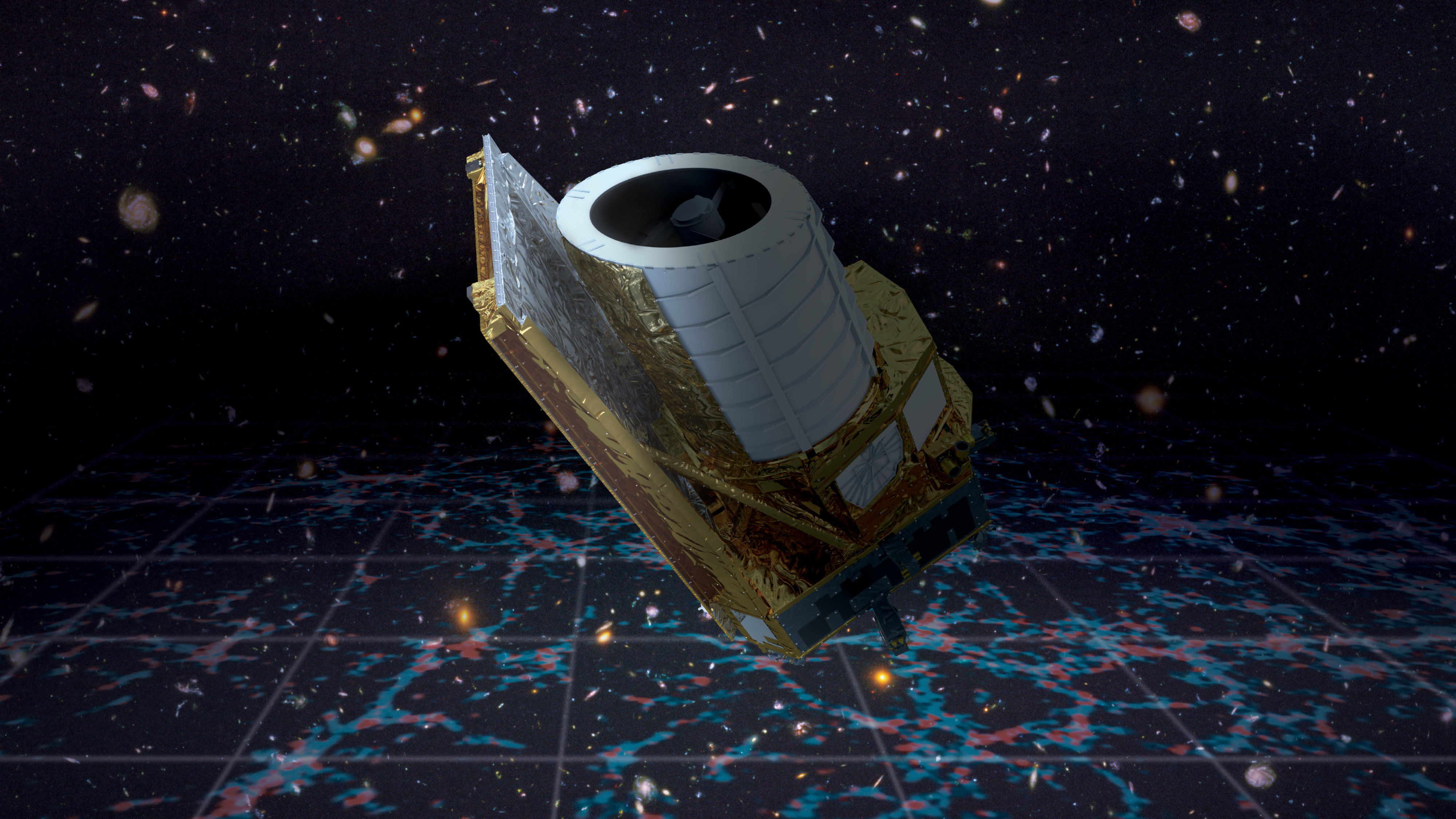
I thought it would be appropriate to add a little update about the European Space Agency’s Euclid mission. I’ll keep it brief here because you can read the full story on the official website here.
You may have seen in the news that the Euclid telescope has been having an issue with ice forming on surfaces in its optical systems, especially the VIS instrument. This is a common problem with telescopes in space, but the extent of it is not something that can be predicted very accurately in advance so a detailed strategy for dealing with it had to be developed on the go.
The layers of ice that form are very thin – just tens of nanometres thick – but that is enough to blur the images and also reduce the throughput of the instruments. Given that the objects we want Euclid to see are faint, and we need very sharp images then this is an issue that must be dealt with.
Soon after launch, the telescope was heated up for a while in order to evaporate as much ice as possible, but it was not known how quickly the ice would return and to what parts of the optical system. After months in the cold of space the instrument scientists now understand the behaviour of the pesky ice a lot better, and have devised a strategy for dealing with it.
The approach is fairly simple in principle: heat the affected instruments up every now and again, and then let them cool down again so they operate; repeat as necessary as ice forms again. This involves an interruption in observations, it is known to work pretty well, but exactly how frequently this de-icing cycle should be implemented and what parts of the optical system require this treatment are questions that need to be answered in practical experimentation. The hope is that after a number of operations of this kind, the amount of ice returning each time will gradually reduce. I am not an expert in these things but I gather from colleagues that the signs are encouraging.
For more details, see here.
UPDATE: The latest news is that the de-icing procedure has worked better than expected! There’s even a video about the result of the process here:
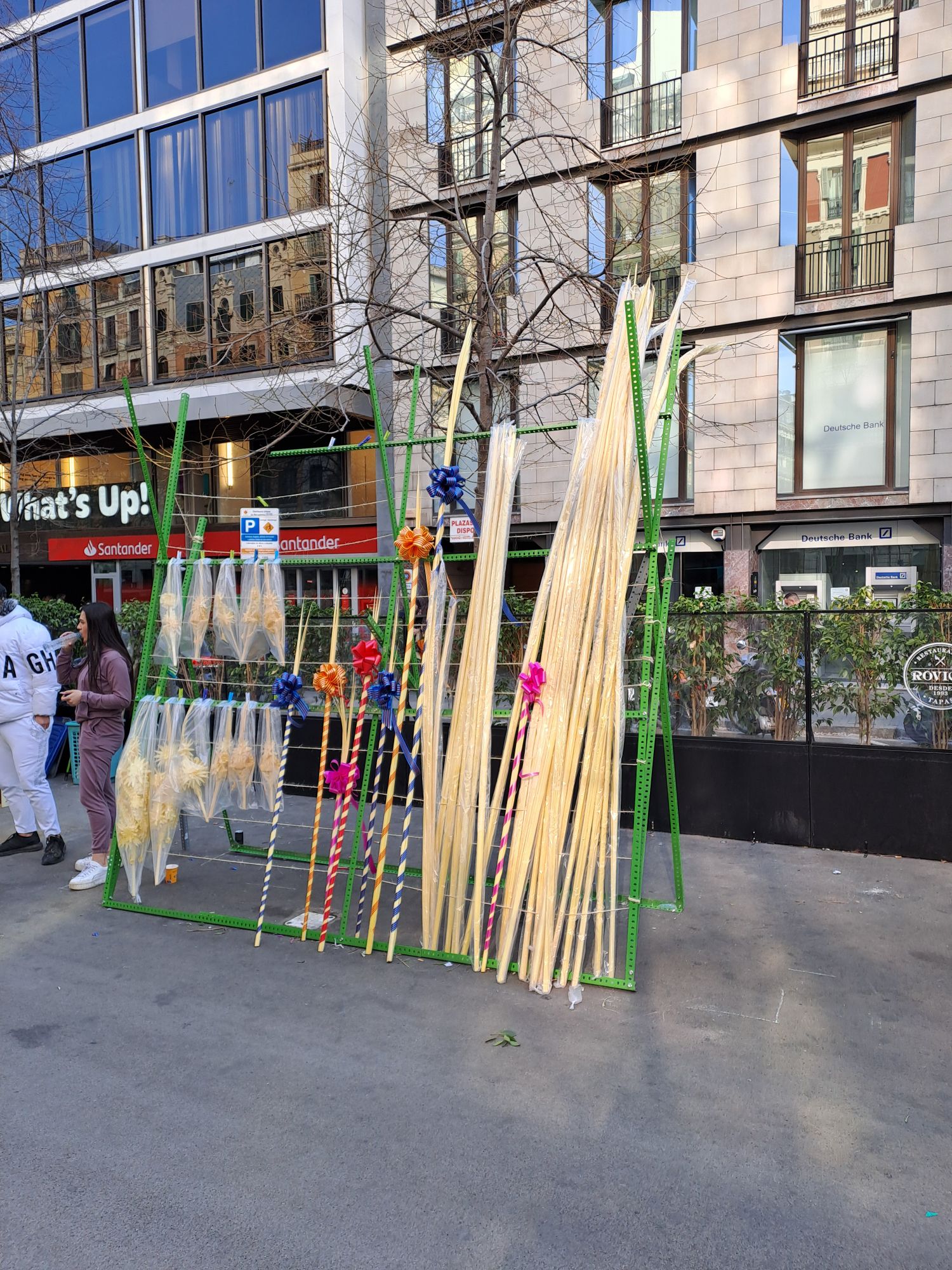
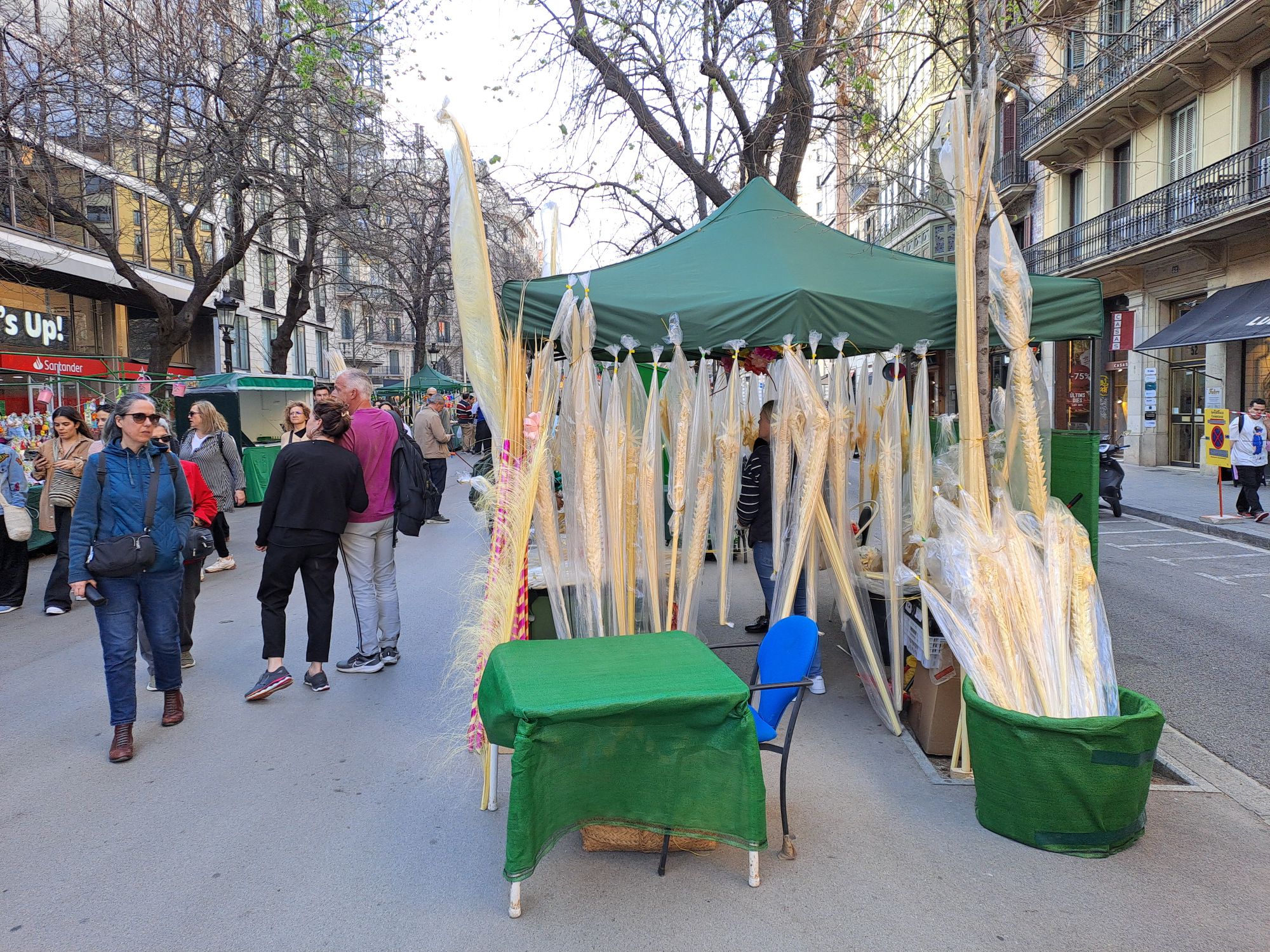
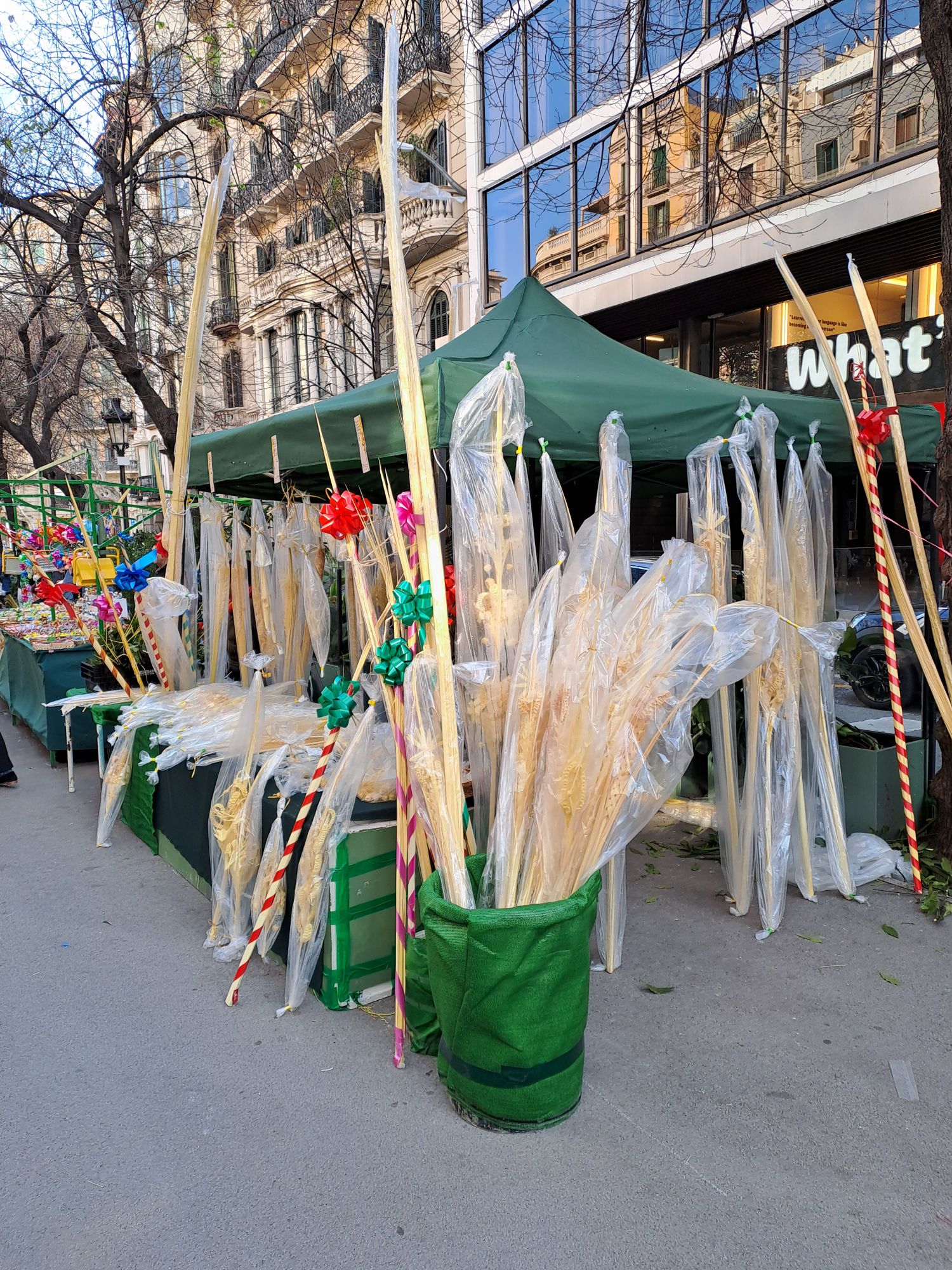
Walking about yesterday I noticed that, not far from my apartment, on the Rambla de Catalunya, there was a street market offering a variety of curious merch. I was a bit confused until I realized that today is Palm Sunday, which is Domingo de Ramos in Spanish or Diumenge de Rams in Catalan; both mean “Sunday of Branches”. The long branches, some festooned with sweets and/or ribbons, are meant to be held by boys, while girls carry the smaller stems with intricate woven crosses. There is a procession called La Borriquita (“The Little Donkey”) which goes around the town today. It involves a statue rather than a real donkey, in case you were wondering.
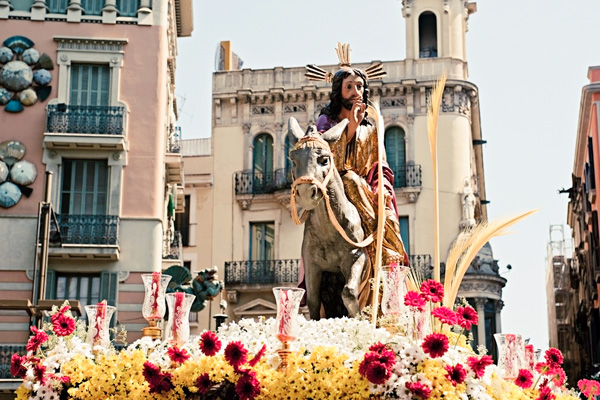
Palm Sunday marks the start of Holy Week (Semana Santa), leading up to Easter Sunday, which lies on March 31st this year. There are no lectures for students next week at the University of Barcelona, though I believe the Faculty of Physics will remain open up to Thursday; Good Friday (Viernes Santa) is a public holiday, as is Monday. I think these holidays are more strictly observed here than in Ireland; most stores are closed on Sundays anyway, and this will be even more the case on Easter Sunday. Having said that, Barcelona is by no means the most religious Spanish city. I have been in Spain at Easter a few times before, and the ceremonies vary considerably from place to place, some sombre and some celebratory.
In practical terms this all means that I have to remember to get some serious shopping in on Thursday. Although stores will be open on Saturday, I think they will be very busy!
It’s Saturday morning, and this week has been very busy and stressful, mostly for reasons that I can’t blog about, but it helped yesterday to come back to my very pleasant top-floor apartment on the Rambla de Catalunya to have a glass or several of wine on the terrace and enjoy the lovely weather. It reached 22°C yesterday afternoon, and my flat gets the sun most of the day.
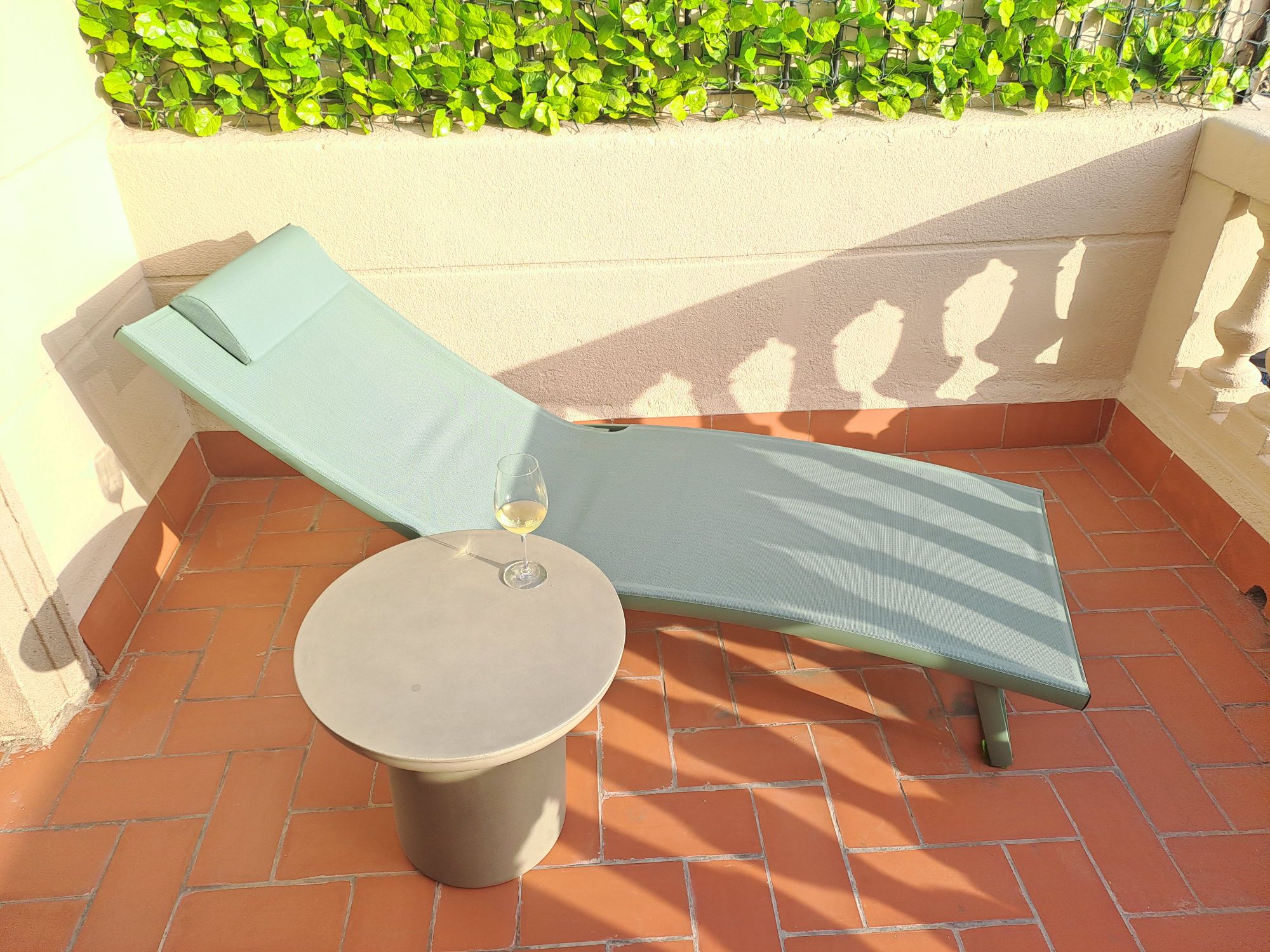
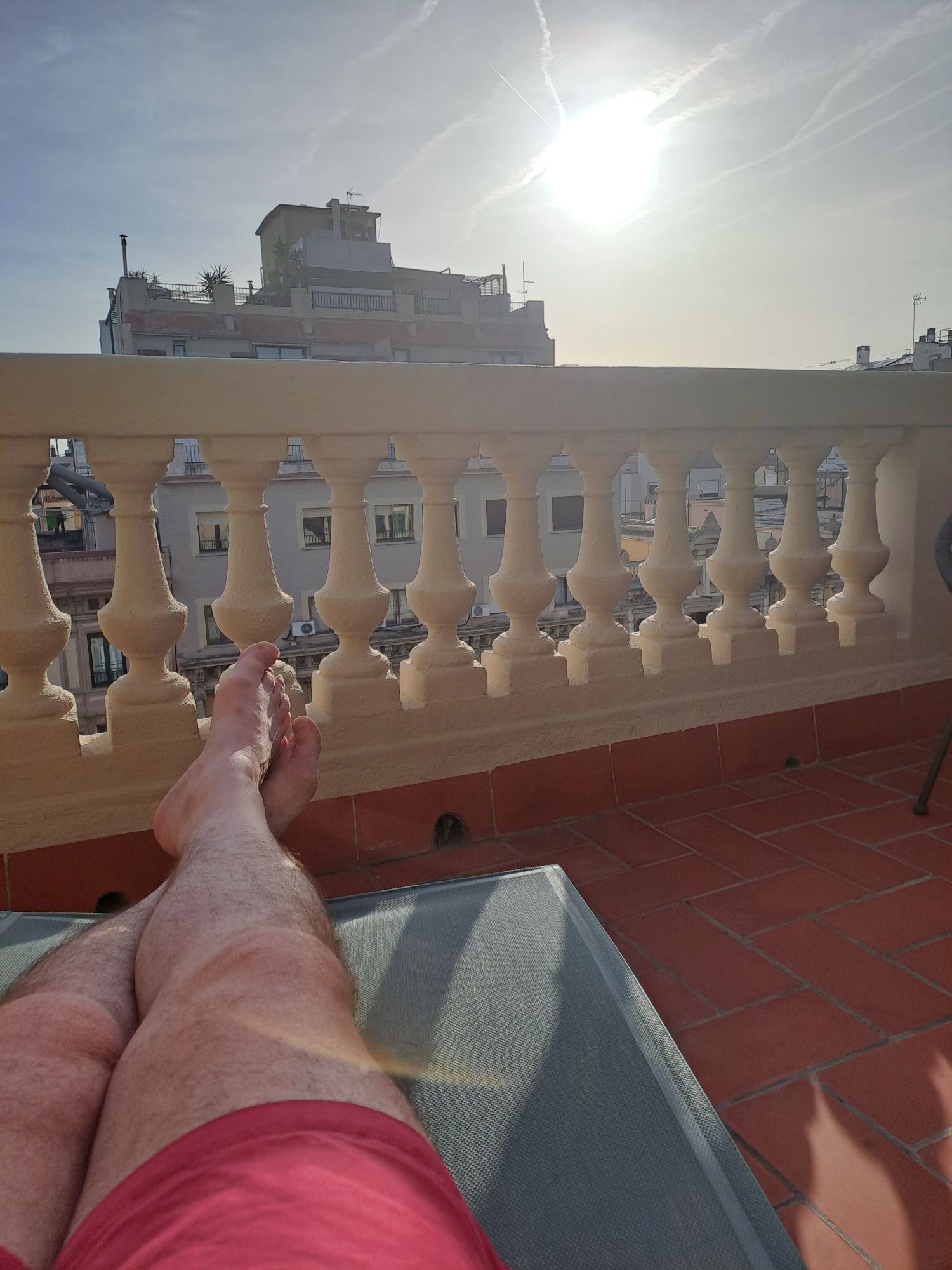
I chose the angle for the second pic carefully, as a lady on the side of the street had obviously done her laundry recently and hung the smalls out to dry. I thought it would be indelicate to photograph them.
When the apartment was refurbished recently they took down the ceiling to reveal some interesting brickwork with the distinctive red clay that features in many buildings; the bricks are often covered with decorative ceramic tiles in a style called Bóveda Catalana in Spanish (Volta Catalana in Catalan), but along with the bare brickwork on the wall, this is a much plainer look.

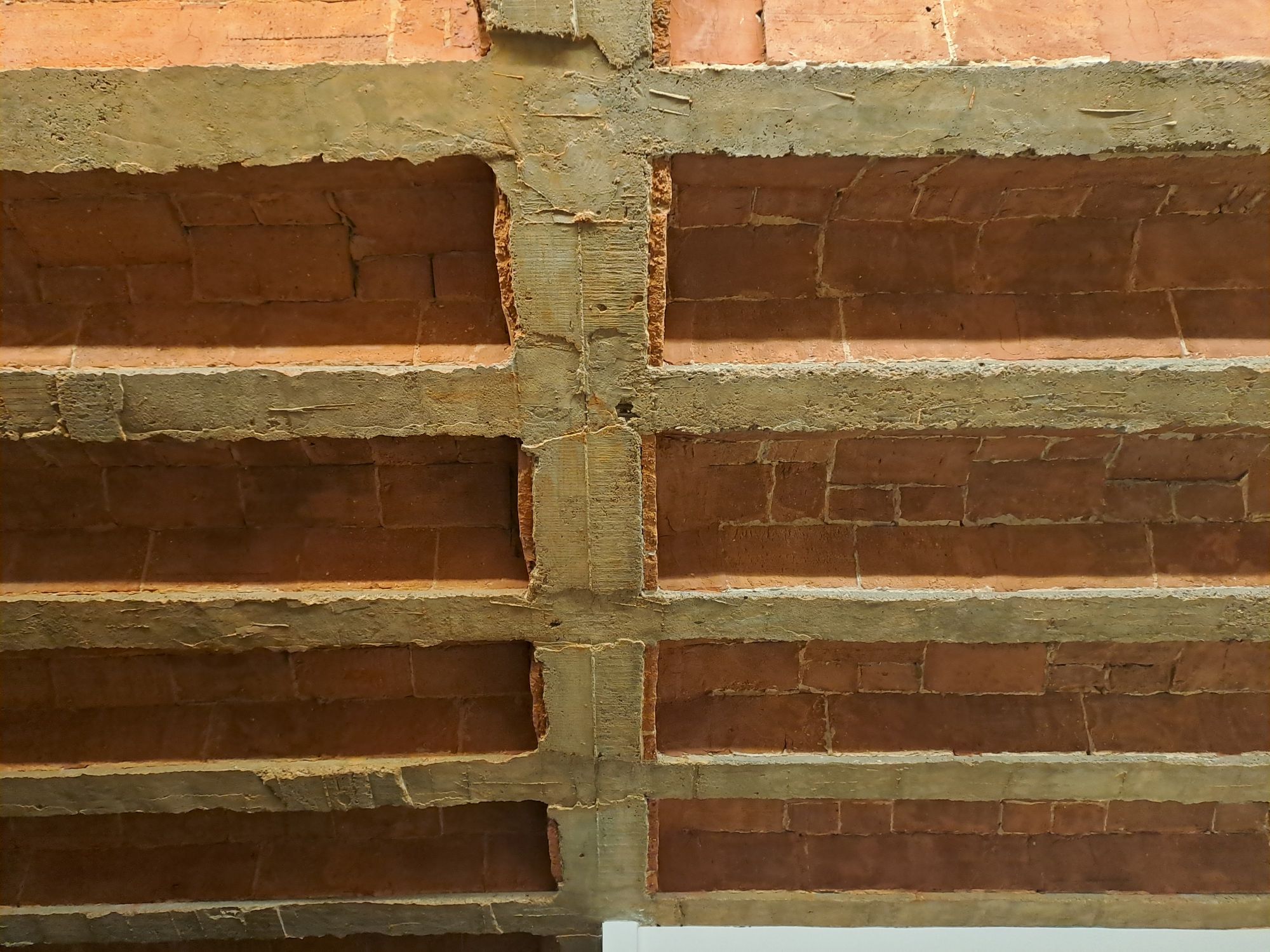
You can see the mortar which attached the false ceiling removed during the refurbishment.
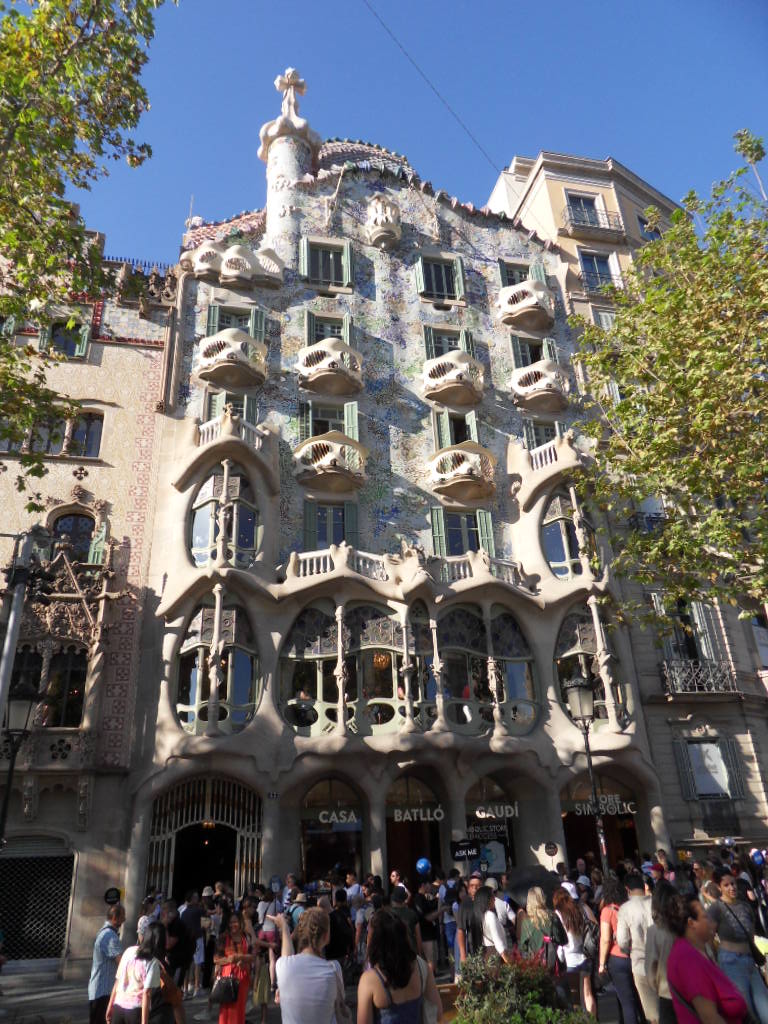
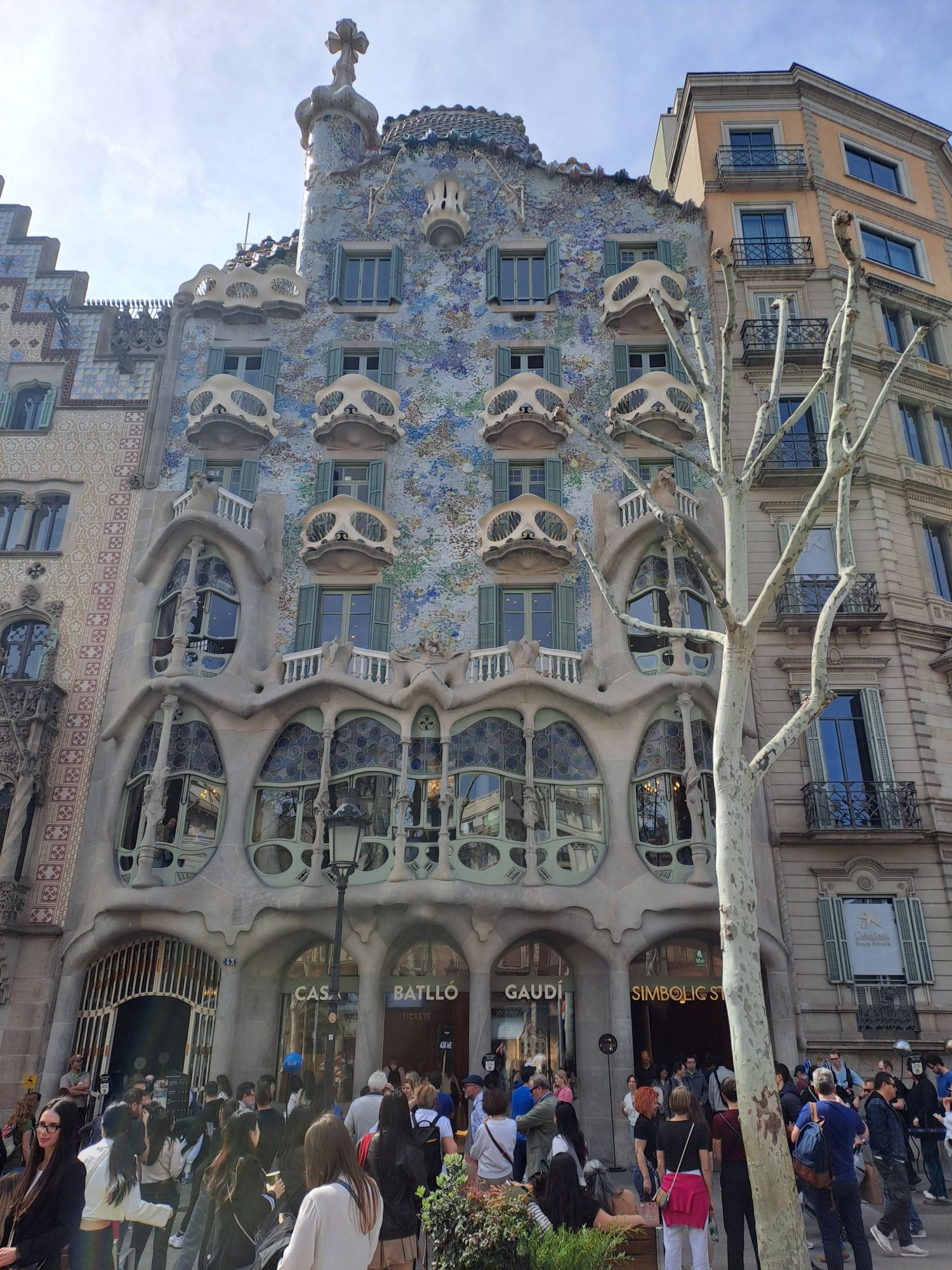
Anyway, if you want to know roughly where I am, it is just one block away from the Casa Batlló. I took the picture on the left last September but the crowds outside queuing to get in are apparently a perennial feature as you can see from the picture on the right I took today.
Anyway, I’m determined to relax today so will now go for a stroll, and do some shopping in preparation for cooking dinner tonight.
Lay your sleeping head, my love,
Human on my faithless arm;
Time and fevers burn away
Individual beauty from
Thoughtful children, and the grave
Proves the child ephemeral:
But in my arms till break of day
Let the living creature lie,
Mortal, guilty, but to me
The entirely beautiful.
Soul and body have no bounds:
To lovers as they lie upon
Her tolerant enchanted slope
In their ordinary swoon,
Grave the vision Venus sends
Of supernatural sympathy,
Universal love and hope;
While an abstract insight wakes
Among the glaciers and the rocks
The hermit’s carnal ecstasy.
Certainty, fidelity
On the stroke of midnight pass
Like vibrations of a bell,
And fashionable madmen raise
Their pedantic boring cry:
Every farthing of the cost,
All the dreaded cards foretell,
Shall be paid, but from this night
Not a whisper, not a thought,
Not a kiss nor look be lost.
Beauty, midnight, vision dies:
Let the winds of dawn that blow
Softly round your dreaming head
Such a day of welcome show
Eye and knocking heart may bless,
Find the mortal world enough;
Noons of dryness find you fed
By the involuntary powers,
Nights of insult let you pass
Watched by every human love.
by Wystan Hugh Auden (1907-1973)

 In the Dark