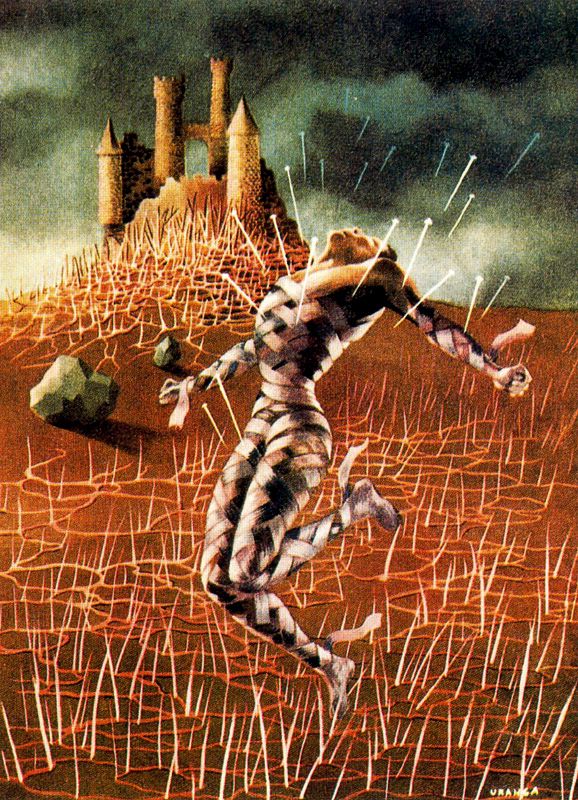
Dolor Reumático II by Remedios Varo, 1948, gouache on cardboard, 25×19 cm.

I found this rather poignant cartoon on Facebook because a friend shared it. Some people have told me they find it depressing. I don’t. I think the finiteness of life is one of the things that makes it bearable.
I don’t know the name of the artist. If anyone does please let me know.
Halley’s Comet last visited us in 1986 when I was 23 and living in Brighton. It will next be visible in 2061, when I shall be 98!
The comet’s orbital period of 75 years or so is brief by astronomical standards, as is the duration of a human life. As Quintus Horatius Flaccus (Horace to you and me) put it in one of his Odes (Book I, Ode 4, line 15):
Vitae summa brevis spem nos vetat incohare longam
This lunchtime I attended a public vigil for Ukraine on Maynooth University campus. It was a moving experience, not least because of the presence of a Ukrainian PhD student, Oleg Chupryna, who addressed the gathering. Although he has lived in Ireland for over 20 years many members of his family are still in Ukraine. They were in Kharkiv when the invasion happened, having refused to leave because they didn’t think the Russians would actually invade, but then found themselves under relentless shelling by Russian artillery. His family managed to flee Kharkiv for the countryside a couple of days ago, but are still trapped in Ukraine, apart from one family member who has arrived safely in Dublin and who read the following poem (in Ukrainian) by Taras Shevchenko, followed by the English translation. you see below.
Shevchenko (who was a painter and illustrator as well as a poet) was born a serf, so the use of the word slavery is not metaphorical. Sales of artwork enabled him to be bought out of his serfdom in 1838, but he spent a great deal of time imprisoned by the Russian authorities. He died in St Petersburg in 1861 at the age of 47.

The poem Calamity Again was written in 1854, in the middle of the Crimean War, at which time Ukraine was part of the Russian Empire. The poem was written at Novopetrovsk Fortress, depicted in the above painting by Shevchenko himself.
Dear God, calamity again! …
It was so peaceful, so serene;
We but began to break the chains
That bind our folk in slavery …
When halt! … Again the people’s blood
Is streaming! Like rapacious dogs
About a bone, the royal thugs
Are at each other’s throat again.
I couldn’t resist sharing this amazing radio image of the Galactic Centre made using the South African MeerKAT radio telescope:
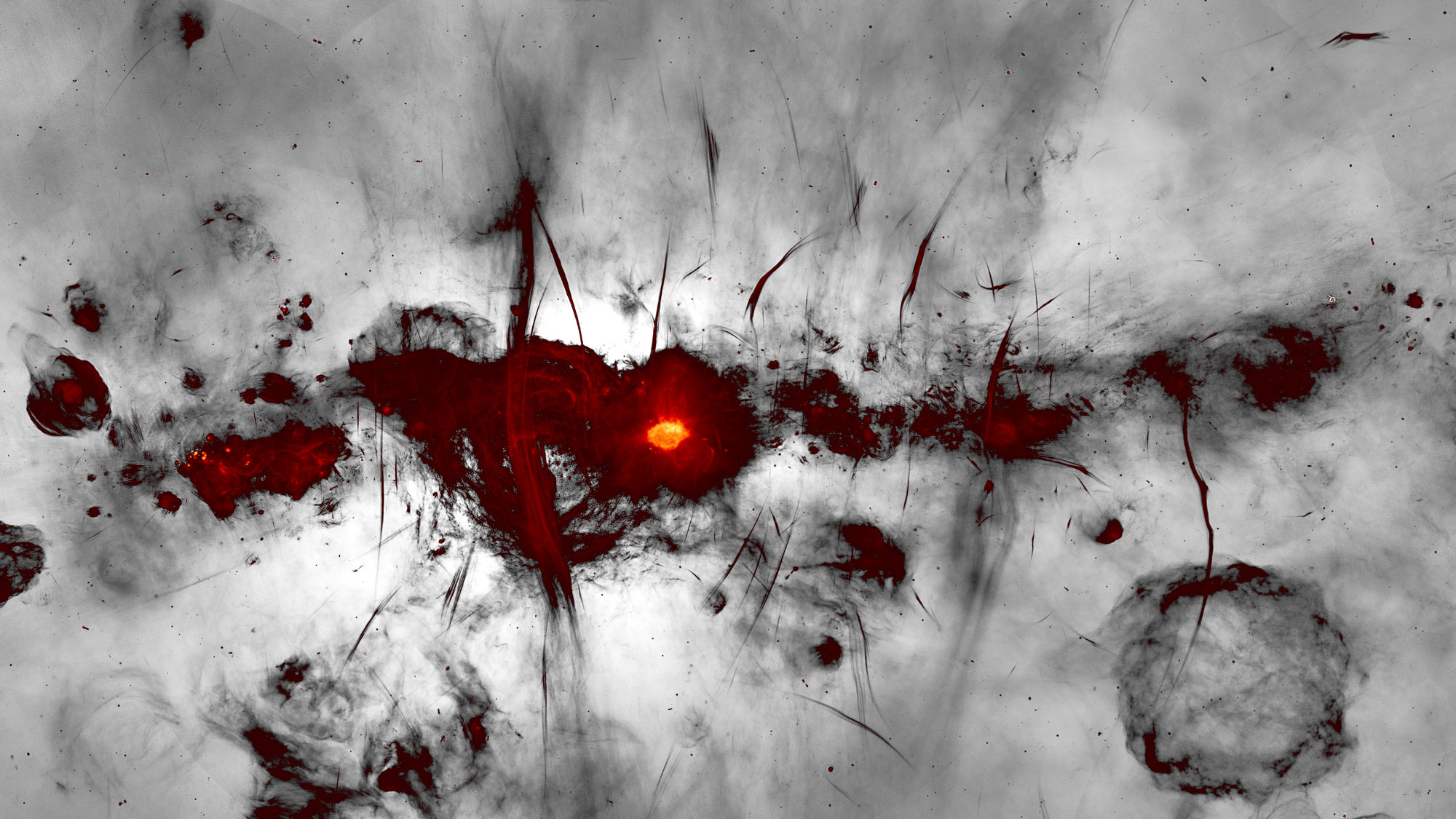
Radio frequency electromagnetic radiation is able to penetrate the dust that permeates this region so can reveal what optical light can not. In particular you can see the very active region around the black hole at the centre of the Milky Way, bubbles caused by exploding stars and – most interesting of all – a number of magnetized filamentary structures.
It’s an extraordinarily beautiful picture made from a mosaic of 20 separate observations. In fact I like it so much I’ve cross-filed it in my “Art” folder. Those of us who work in astronomy or astrophysics are wont to say that there’s much more to it than pretty pictures, but when one like this comes along we’re all sure to geek out over it!
For more information about this image at the science behind it, see here.
Thomas Bewick (1753-1828) was a superb illustrator and natural historian who lived in the North East of England. He is celebrated primarily for his fine engravings and woodcuts of wild animals and birds, and humorous vignettes, some of which are quite cheeky, such as this one called “Man Pissing”…

You can find many other examples of his fine work here.
Bewick also held radical political views in a time of great social unrest across the continent of Europe. His views were heavily influenced by the terrible conditions of the rural poor in his native Northumberland and the corruption of the Government. In 1822 he began to write his Memoir, which is absolutely fascinating, not least because part of it is devoted to his views about the British Government and the media of the time. Two hundred years later, many of his words still ring true.
Here’s an excerpt from a section covering the period from about 1818 to 1823, a period of domestic instability in Britain that led to acts of protest and brutal suppression, including the Peterloo Massacre of 1819:
The pen of literature was prostituted to overshade the actions of good men, and to gloss-over the enormities of the base. The energies of many members of both Houses of Parliament were unavailing against this compact confederacy of undeserving placemen and pensioners, who were bound together by fellow feelings of self-interest, in which all ideas of public trust were lost in private considerations. They had sinned themselves out of all shame. This phalanx have kept their ground, and will do so till, it is to be feared, violence from an enraged people breaks them up, or, perhaps, till the growing opinions against such a crooked order of conducting the affairs of this great nation becomes quite apparent to an immense majority, whose frowns may have the power of bringing the agents of government to pause upon the brink of the precipice on which they stand, and to provide in time, by wise and honest measures, to avert the coming storm.
A Memoir of Thomas Bewick, Written by himself, CHAPTER XVII.
Plus ça change…
P.S. Not far from where I grew up in Newcastle upon Tyne there is a school for children and young adults with autism called the Thomas Bewick School. His name is well known in the Newcastle area for that reason and his artistic legacy, but I’m not sure his memory is as widely celebrated as it should be. He was a fascinating character.
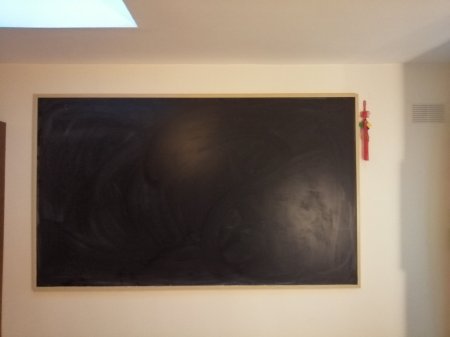
Untitled, by Peter Coles (2021), 2m by 1.2m, chalk dust and oil on panel, Castlebridge Art Museum.
Looking for displacement activities to enable me to avoid working I noticed that people are having fun on social media by using AI apps to generate art from thesis titles. I thought I’d give it a go, and this is what I got for my thesis title Stochastic Fluctuations in the Early Universe:
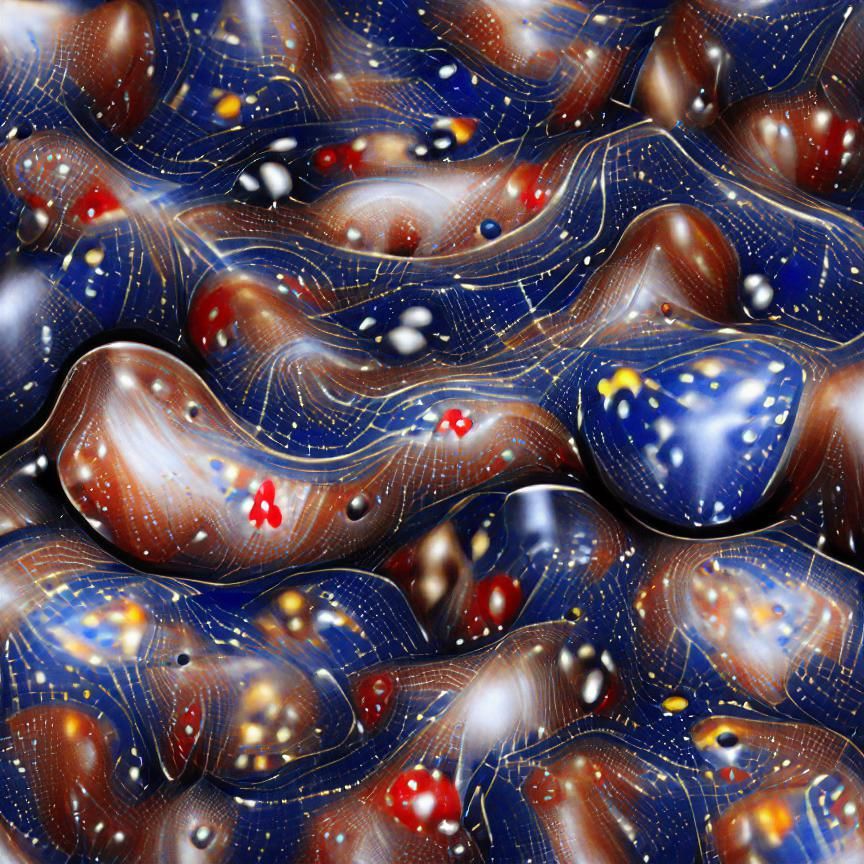
Actually, I rather like it! It’s much better than I’d expected. I’ve been told it looks like Christmas wrapping paper which gives it a seasonal twist too!
There are several apps that will create images inspired by text you type in. The one I used for the example above was this one. Why not try it yourself?
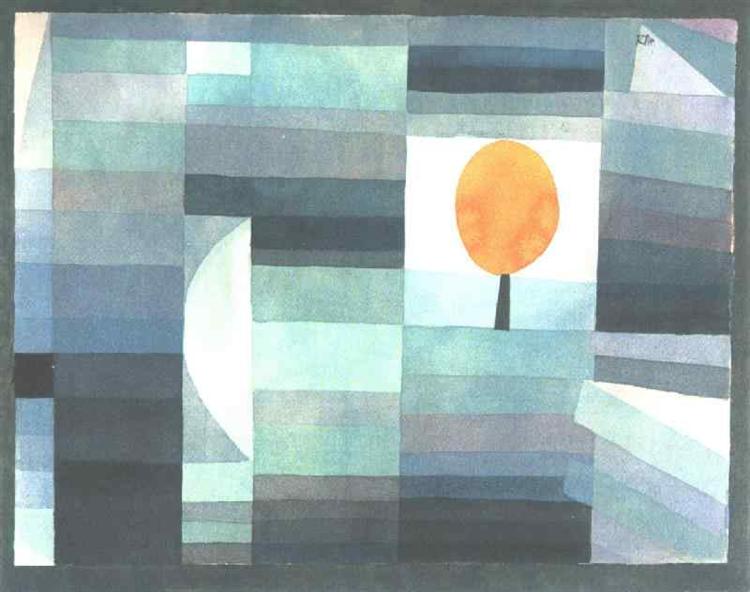
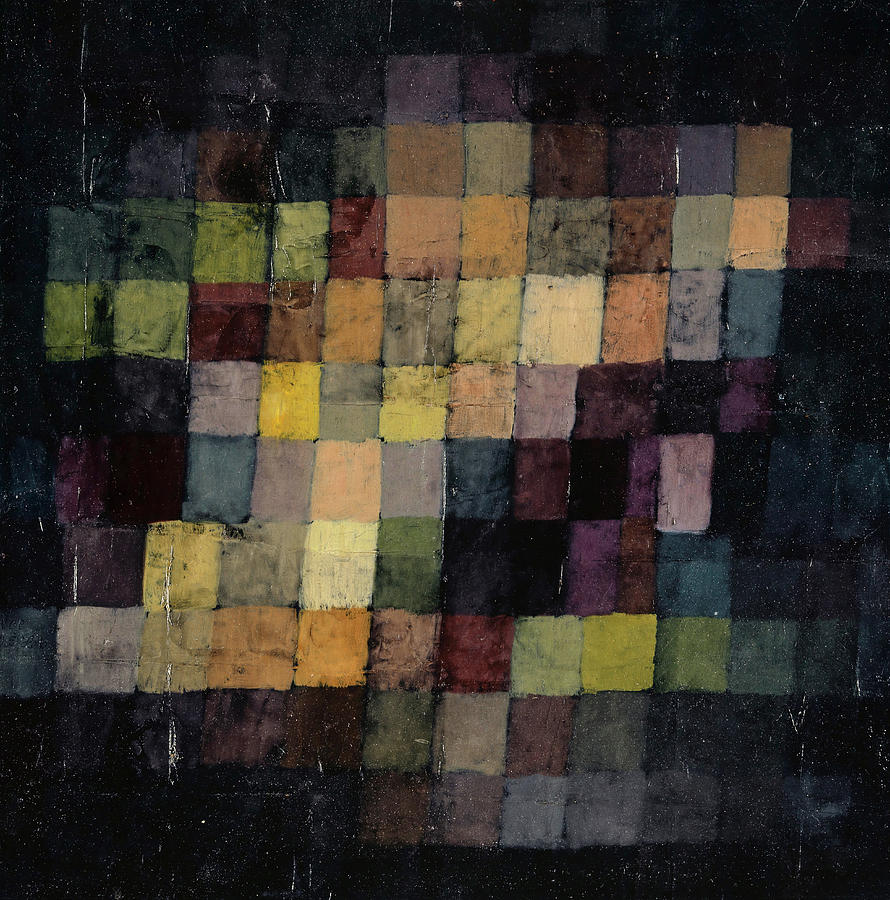
by Paul Klee (1922, 24cm x 31cm, watercolour and pencil on paper, Yale University Art Gallery).
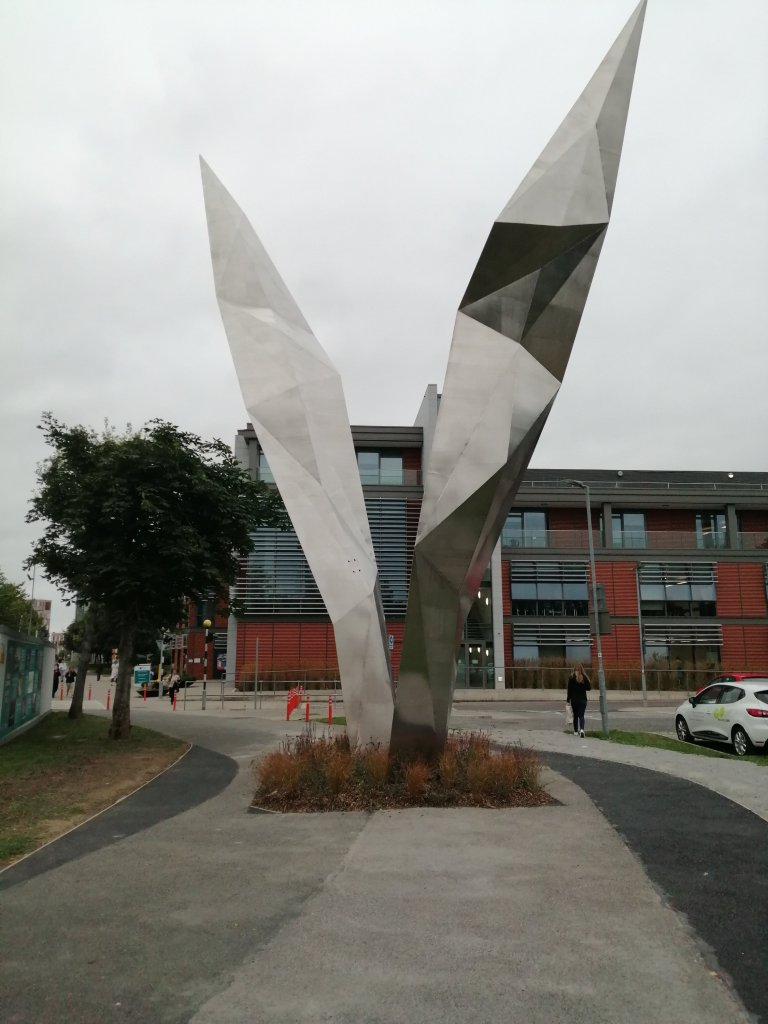
The photograph above shows the sculpture Freedom by Polish-Irish sculptor Alexandra Wejchert, which has recently been installed on the North Campus of Maynooth University. It was formerly located outside the former headquarters of AIB, the bank, in Ballsbridge. AIB has now moved its HQ – the old one is now occupied by Facebook – and the sculpture became surplus to requirements but managed to offload it on graciously offered it on loan to Maynooth University. I won’t comment on the artistic merits of this piece but it seems to me a very strange decision to plonk it right in the middle of the main pedestrian entrance to the North Campus so everyone has to walk around it. I’m also wondering how long it will be before a traffic cone is found on the tip of one of the prongs…