I saw this interesting piece “Constructed Universe” (1983) by Daniel Faust from the Metropolitan Museum of Art via Twitter and it intrigued me enough to share it here, although some of you might think it’s just a load of balls.
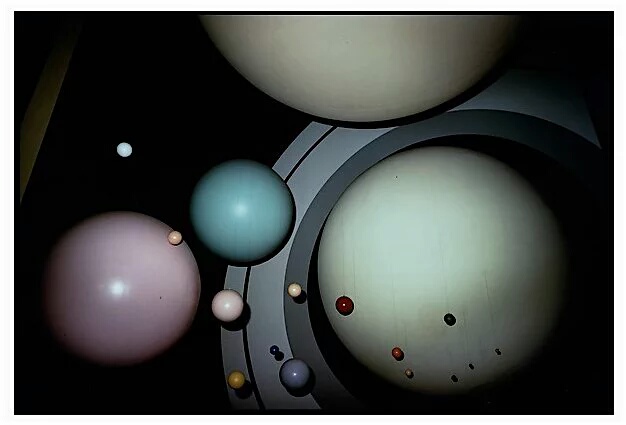
I saw this interesting piece “Constructed Universe” (1983) by Daniel Faust from the Metropolitan Museum of Art via Twitter and it intrigued me enough to share it here, although some of you might think it’s just a load of balls.
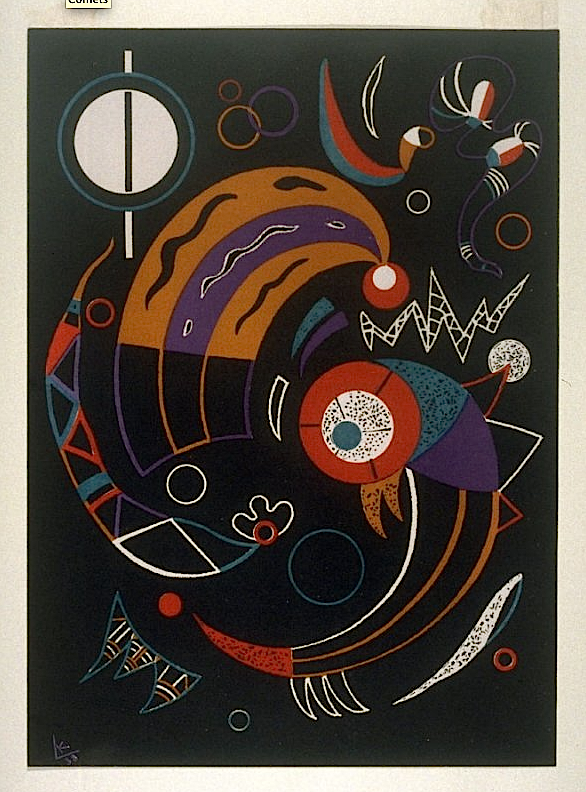
The last time I posted a work of astronomically-themed art by Wassily Kandinsky it proved unexpectedly popular so here’s another one, called Comets. This is also a lithograph and also dates from around 1938.
Follow @telescoperThe Times Higher has given me yet another reason to be disgruntled this week, in the form of an article that talks about the possible effect of the proposed Teaching Excellence Framework (TEF) on “creative” subjects. What bothers me about this piece is not that it criticises the TEF – I think that’s an unworkable idea that will cause untold damage to the University system if, as seems likely, it is railroaded through for political reasons – but that the author (Nigel Carrington, Vice-Chancellor of the University of Arts London), like so many others, lazily implies that STEM disciplines are not creative. I think some of the most intensively creative people in the world are to be found in science and engineering and creativity is something we try very hard to nurture in students at Sussex University regardless of discipline.
Anyway, while feeling grumpy about this article, I remembered this video of an interview with the great jazz pianist, Bill Evans. Jazz is undoubtedly an intensely creative form, not only because it requires spontaneous real-time conversion of ideas into sounds. Evans talks with great passion and insight about creativity in music-making, but the striking thing about what he says at the very beginning about the need to analyse your subject at a very elementary level before proceeding in order to create something that’s “real” applies equally well to, e.g. theoretical physics as it does to jazz.
In the following section he reiterates this point, but also stresses the discipline imposed by a particular form and why this does not limit creativity but makes it stronger.
It’s better to do something simple that is real. It’s something you can build on. because you know what you’re doing. Whereas, if you try to approximate something very advanced and don’t know what you’re doing, you can’t build on it.
No matter how far I might diverge or find freedom in this format, it only is free insofar that it has reference to the strictness of the original form. That’s what gives it its strength.
In much the same way, theoretical physics is not made less creative because it has to obey the strict rules of mathematics but more so. This is true also in the fine arts: the more limited the canvas the more creative the artist must be, but it also applies to, e.g. engineering design. Self-teaching is important in STEM subjects too: the only really effective way of learning, e.g. physics, is by devoting time to working through ideas in your own mind, not by sitting passively in lectures.
All subjects require technical skill, but there is more to being a great jazz musician than mastery of the instrument just as there’s more to being a research scientist than doing textbook problems. So here’s to creativity wherever it is found, and let’s have a bit more appreciation for the creative aspects of science and engineering!
Follow @telescoper
No time for a proper post so I thought I’d fill a bit of space with Stars, or at least with a picture of the lithograph of that title by Wassily Kandinsky made, I think, in 1938. It is certainly a different kind of image from that produced by astronomers, but it does put me in mind of star-forming regions such as the Orion Nebula..

This morning I woke up as usual to BBC Radio 3. Unusually however this morning’s breakfast programme was broadcast live from the picturesque town of Tromsø in Norway, which is well inside the Actic Circle so is dark all day at this time of year. The broadcast from Norway part of a three-week extravaganza called Northern Lights, which focusses on the music and culture North of 60° latitude.
Anyway, this prompted me to do a brief post about a couple of related matters connected by the theme of Northern Lights.
The first is to draw your attention to the fact that, to coincide with this Nobel Prize Week in Stockholm, the artist Olafur Eliasson has set up a temporary public artwork in Stockholm called Your Star, which involves putting an artificial star into the sky over Stockholm. I gather it has been quite difficult to get the star to behave in the windy conditions, but in any case you can use the website to view six short videos and even create your own star..
The second is this wonderful video of the Aurora Borealis? If you haven’t seen this before then take a look. It’s not a fake. This is what it’s really like.
I stood under a show like this once, in Tromsø in fact, and I can tell you ever the word “awesome” applied to anything, this is it. The curious thing is that I had the definite feeling that there was a booming and whooshing sound to go with the light show. I wasn’t the only one there who thought they could hear it as well as see it. And I wasn’t drunk either. Well, not very.
I’m reliably informed however that there is no physical mechanism that could produce sound waves of sufficient power to reach ground level from the altitude at which the light is generated. It must have been psychological, as if the brain wants to add a backing track when it sees something as spectacular as this. Any views on this phenomenon would be welcome via the comments box..
UPDATE: here’s an interesting take on the Auroral Sounds issue.
Follow @telescoperYou might remember a piece I did a while ago about Little Sun by the artist Olafur Eliasson. This is a solar-powered lamp that charges up during the day and provides night-time illumination for those, e.g. in sub-Saharan Africa, without access to an electricity grid. I supported this project myself, including writing a piece here as part of the Little Charter for Light and Energy.
Well, it seems that in his travels around the world promoting Little Sun, Olafur received a lot of comments about how great it would be if the same principle could be used to provide a solar-powered mobile phone charger. So now – lo and behold! – there is a new product called Little Sun Charge. Here’s a little video about it:
I’m mentioning this here because Olafur is attempting to crowdfund this project via a kickstarter campaign. The campaign has already exceeded its initial target, but there are five days still remaining and every penny raised will used to reduce the price of the charger so that it can be sold to off-grid customers for even less than originally planned.
So please visit the link and pledge some dosh! There are treats in store for those who do!
Follow @telescoperNo time for a proper post today so I’m going to rehash an old piece from about six years ago. In particular I direct your attention to the final paragraph in which I predict that peer review for academic publications will soon be made redundant. There has been quite a lot of discussion about that recently; see here for an example.
Critics say the stangest things.
How about this, from James William Davidson, music critic of The Times from 1846:
He has certainly written a few good songs, but what then? Has not every composer that ever composed written a few good songs? And out of the thousand and one with which he deluged the musical world, it would, indeed, be hard if some half-dozen were not tolerable. And when that is said, all is said that can justly be said of Schubert.
Or this, by Louis Spohr, written in 1860 about Beethoven’s Ninth (“Choral”) Symphony
The fourth movement is, in my opinion, so monstrous and tasteless and, in it’s grasp of Schiller’s Ode, so trivial that I cannot understand how a genius like Beethoven could have written it.
No less an authority than Grove’s Dictionary of Music and Musicians (Fifth Edition) had this to say about Rachmaninov
Technically he was highly gifted, but also severely limited. His music is well constructed and effective, but monotonous in texture, which consists in essence mainly of artificial and gushing tunes…The enormous popular success some few of Rachmaninov’s works had in his lifetime is not likely to last and musicians regarded it with much favour.
And finally, Lawrence Gillman wrote this in the New York Tribune of February 13 1924 concerning George Gershwin’s Rhapsody in Blue:
How trite and feeble and conventional the tunes are; how sentimental and vapid the harmonic treatment, under its disguise of fussy and futile counterpoint! Weep over the lifelessness of the melody and harmony, so derivative, so stale, so inexpressive.
I think I’ve made my point. We all make errors of judgement and music critics are certainly no exception. The same no doubt goes for literary and art critics too. In fact, I’m sure it would be quite easy to dig up laughably inappropriate comments made by reviewers across the entire spectrum of artistic endeavour. Who’s to say these comments are wrong anyway? They’re just opinions. I can’t understand anyone who thinks so little of Schubert, but then an awful lot of people like to listen what sounds to me to be complete dross.
What puzzles me most about the critics is not that they make “mistakes” like these – they’re only human after all – but why they exist in the first place. It seems extraordinary to me that there is a class of people who don’t do anything creative themselves but devote their working lives to criticising what is done by others. Who should care what they think? Everyone is entitled to an opinion, of course, but what is it about a critic that implies we should listen to their opinion more than anyone else?
(Actually, to be precise, Louis Spohr was also a composer but I defy you to recall any of his works…)
Part of the idea is that by reading the notices produced by a critic the paying public can decide whether to go to the performance, read the book or listen to the record. However, the correlation between what is critically acclaimed and what is actually good (or even popular) is tenuous at best. It seems to me that, especially nowadays with so much opinion available on the internet, word of mouth (or web) is a much better guide than what some geezer writes in The Times. Indeed, the Opera reviews published in the papers are so frustratingly contrary to my own opinion that I don’t bother to read them until after the performance, perhaps even after I’ve written my own little review on here. Not that I would mind being a newspaper critic myself. The chance not only to get into the Opera for free but also to get paid for spouting on about afterwards sounds like a cushy number to me. Not that I’m likely to be asked.
In science, we don’t have legions of professional critics, but reviews of various kinds are nevertheless essential to the way science moves forward. Applications for funding are usually reviewed by others working in the field and only those graded at the very highest level are awarded money. The powers-that-be are increasingly trying to impose political criteria on this process, but it remains a fact that peer review is the crucial part of the process. It’s not just the input that is assessed either. Papers submitted to learned journals are reviewed by (usually anonymous) referees, who often require substantial changes to be made the work before the work can be accepted for publication.
We have no choice but to react to these critics if we want to function as scientists. Indeed, we probably pay much more attention to them than artists do of critics in their particular fields. That’s not to say that these referees don’t make mistakes either. I’ve certainly made bad decisions myself in that role, although they were all made in good faith. I’ve also received comments that I thought were unfair or unjustifiable, but at least I knew they were coming from someone who was a working scientist.
I suspect that the use of peer review in assessing grant applications will remain in place for a some considerable time. I can’t think of an alternative, anyway. I’d much rather have a rich patron so I didn’t have to bother writing proposals all the time, but that’s not the way it works in either art or science these days.
However, it does seem to me that the role of referees in the publication process is bound to become redundant in the very near future. Technology now makes it easy to place electronic publications on an archive where they can be accessed freely. Good papers will attract attention anyway, just as they would if they were in refereed journals. Errors will be found. Results will be debated. Papers will be revised. The quality mark of a journal’s endorsement is no longer needed if the scientific community can form its own judgement, and neither are the monstrously expensive fees charged to institutes for journal subscriptions.
Follow @telescoperThis morning I came across this picture (via @hist_astro on Twitter):
 It is by Giovanni dal Ponte and was painted in or around 1435; the original is in the Museo Nacional del Prado in Madrid. It depicts the Seven Liberal Arts which, in antiquity were considered the essential elements of the education system. The Arts concerned are: Grammar, Rhetoric, Dialectic, Astronomy, Arithmetic, Geometry and Music. Appropriately enough, Astronomy is in the middle.
I suspect some of you may have noticed that there are more than seven figures in the painting. That’s because each of the Liberal Arts is itself represented by a (female) figure, presumably a Goddess, and also a famous character associated with the particular discipline. Second from the right, for example, you can see Arithmetic accompanied by Pythagoras, who seems to be trying to copy from her notebook. Astronomy. In the centre, kneeling at the feet of Urania (the muse of Astronomy) is Ptolemy..
It’s quite interesting to look at the structure of a Liberal Arts education as it would be in classical antiquity. The first three subjects (Grammar, Rhetoric and Dialectics) formed the Trivium (from which we get the English word “trivial”). “Grammar” means the science of the correct usage of language, knowledge and understanding of which helps a person to speak and write correctly; “Dialectic” basically means “logic”, the science of rational thinking as a means of arriving at the truth; and “Rhetoric” the science of expression, especially persuasion, which includes ways of organizing and presenting an argument so that people will understand and hopefully believe it. These may have been considered trivial in ancient times, but I can’t help thinking that we could do with a lot more emphasis on such fundamental skills in the modern curriculum.
After the Trivium came the Quadrivium: Arithmetic, Geometry, Astronomy and Music all of which were considered to be disciplines connected with Mathematics. Presumably these are the non-trivial subjects. We might nowadays consider Astronomy to be a mathematical subject – indeed in the United Kingdom astronomy was until relatively recently generally taught in mathematics departments, even after the rise of astrophysics in the 19th Century. On the other hand, fewer would nowadays would recognize music as being essentially mathematical in nature. Historically, however the connections between music, mathematics and natural philosophy were many and profound.
Of course there are now many other disciplines and it would be impossible for any education to encompass all fields of study, but I do think that it’s a shame that modern education systems are so lacking in breadth, as they tend to emphasize the differences between subjects rather than what they all have in common.
Follow @telescoperTaking a short break from the combination of marking examinations and listening to cricket which has been my Bank Holiday Monday so far, so I thought I’d post a brief report on the show I went to last night, which happened to be the last night of this year’s Brighton Festival.
All the Animals was a show put together especially for this year’s Brighton Festival by renowned performance artist Laurie Anderson. She is most famous (at least in the UK) for the amazing record O Superman which was a smash hit in 1981; I posted about that on this blog here. A large number of last night’s audience members were clearly devout Laurie Anderson fans but I’ve never seen one of her live shows so wasn’t sure what to expect.
It turned out to be very much a one-woman show, with Laurie Anderson alone on stage. The show consisted of her telling stories about various animals, including her own pet terrier, Lula Belle, who is now sadly deceased. In between the stories there were musical interludes, with herself performing on an electric violin with various digital effects thrown in, and sometimes she accompanied herself as she performed the stories. The show was shot through with a wry humour and Laurie Anderson herself came across as a very engaging personality.
I had been told that her performances were often dazzling multimedia events, but this turned out not to be like that at all. The big screen at the back of the stage was only used a couple of times, once to show excerpts from a list of extinct animal species and once to show a couple of Youtube clips of Lula Belle. There were no dramatic lighting or other effects either. It was all very low key really. Far from the multimedia extravaganza I had anticipated.
There was enthusiastic applause at the end of the show, but to be honest I felt a little disappointed. Don’t get me wrong: I enjoyed the show, and still think Laurie Anderson is a really interesting artist but I suppose I just built up in myself an expectation of something with a more exciting visual element.
So that’s the end of this year’s Brighton Festival. Still, yesterday I posted the following tweet:
Predictions for today: (1) England will lose at Lord’s; (2) Newcastle will get relegated; (3) Laurie Anderson @brightfest will be fabulous
— Peter Coles (@telescoper) May 24, 2015
I guess all three predictions proved false. England didn’t lose on Sunday and indeed are very much favourites to win the Test match as I write this. Newcastle United won their game against West Ham and avoided relegation to the Championship. And Laurie Anderson, though definitely interesting, didn’t quite qualify as “fabulous”…
Follow @telescoperAs I mentioned in my previous post, yesterday evening I attended the opening of a new show at the Fondation Louis Vuitton in Paris. The first thing to say is that the Fondation Louis Vuitton building, designed by Frank Gehry, is an absolutely amazing structure. It was dark and rainy when I arrived there yesterday and I failed to get any decent pictures of the outside but if you google around you will see what I mean. The interior of the building is an extraordinary as the outside; indeed, it’s such a complex topology that the distinction between inside and outside gets completely lost. It’s definitely a work of art in its own right and enormous fun to wander around, although some of the terraces and balconies are not suitable for those of us who are afraid of heights especially since the only barriers are transparent.
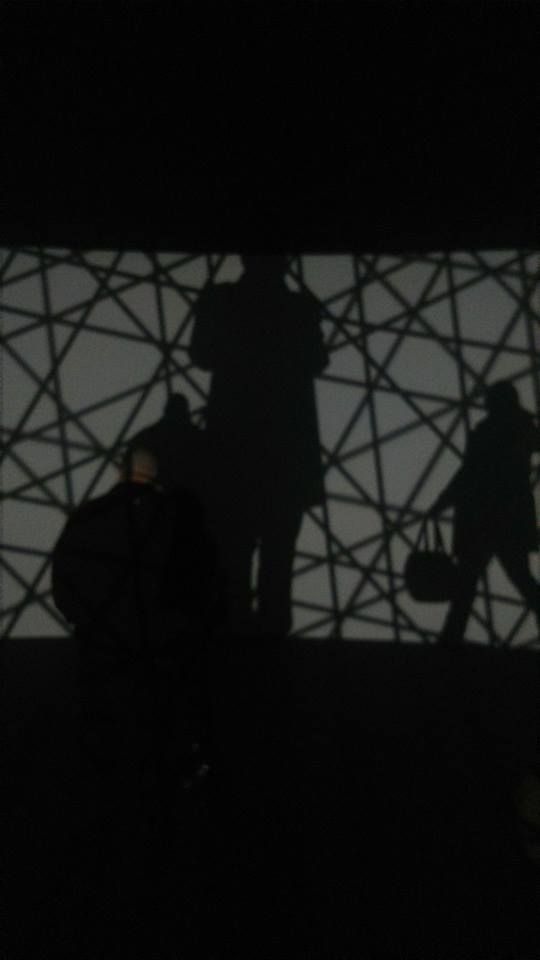
Anyway, the installation I mainly went to see, by Olafur Eliasson, called Contact, is built around two large spaces on the lower ground floor of the Fondation Louis Vuitton building. The first room is semi-circular in shape and darkened. Along what would be the diameter were it a full circle there is a mirror, just in front of the centre of which there is a bright light surrounded by metallic structure in the form of a mesh. The light illuminates a strip of the circular wall, with darkness above and below, and not only casts a shadow of the mesh against the curved wall but also does the same for the people in the room. The radius of the semicircle is about 25 metres so the room can accommodate many people.
First impressions entering this space are quite strange. First, the room seems to be exactly circular. Then you realise there is a mirror and the mixture of geometrical and human shadows on the circular section of wall. Once you have taken in the true geometry, however, there is stull the fun of watching how people behave within it. Like many of Olafur’s works, this one is as much created by the people who enter the room as it is by the artist.
My phone wasn’t really up to taking pictures of this – and in any case it’s something to be experience rather than seen in a photograph, but here are some attempts. In this one, very large shadow in the middle is mine:


The second room is a quadrant rather than a semicircle, with mirrors along the two straight edges creating the impression of a complete circle. This time, instead of a single point of light in the centre there is a horizontal illuminated stripe of an intense orange-red which, in the mirrors, creates in the viewer the impression of being in the middle of a ring of light.
My first impression when I entered this part of the installation was to recall some of the lighting effects near the end of the film Close Encounters of the Third Kind:
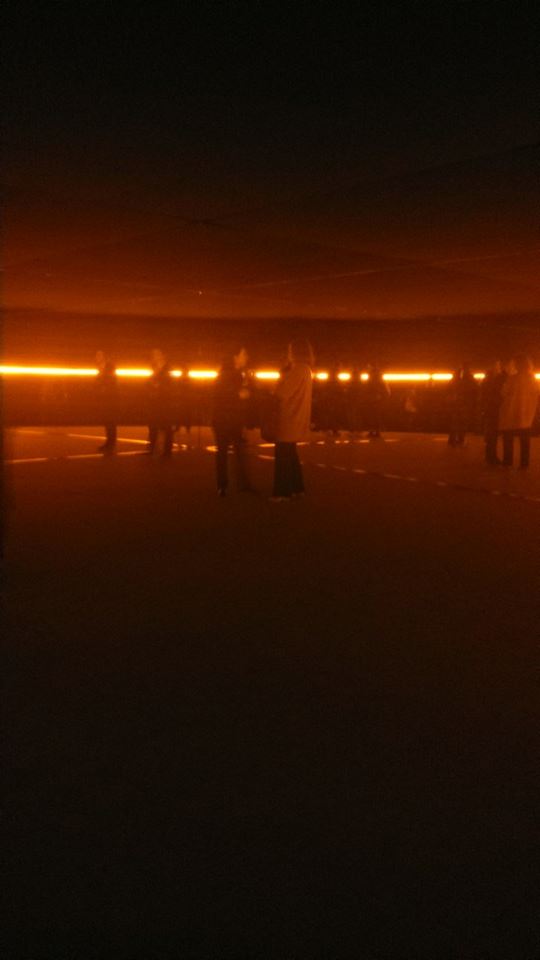

This is evocative of attempts that have been made from time to time to construct cosmological models with a compact topology, such as a finite flat space with its edges identified to form a torus.
In between these two large spaces there are a number of smaller pieces involving curved mirrors devices that invert and otherwise distort the images of people moving around inside the exhibition, one in particular producing an amazing holographic effect. Knowing how these things work does not diminish their power to amaze and to make you want to reach out and try to touch what is not really there..

Anyway, that’s all just a taster. You really have to see it to appreciate it. It’s a show that asks very interesting questions about we use light in order to perceive space and indeed how we construct space itself through our own imagination.
Follow @telescoper
 In the Dark