Archive for the Artificial Intelligence Category

Black Holes, Hawking Radiation (and AI…)

Posted in Artificial Intelligence, The Universe and Stuff with tags , , , , , on December 7, 2025 by telescoper

It seems to be a common misapprehension that the energy released by the supermassive black holes in, for example, active galactic nuclei is in the form of Hawking radiation. It isn’t. Hawking radiation is only significant for black holes of very low mass. The radiation produced around supermassive black holes is due to the extremely high density and temperate of matter falling into the black hole through an accretion disk not due to the evaporation of the black hole itself. Hawking radiation has never been experimentally detected.

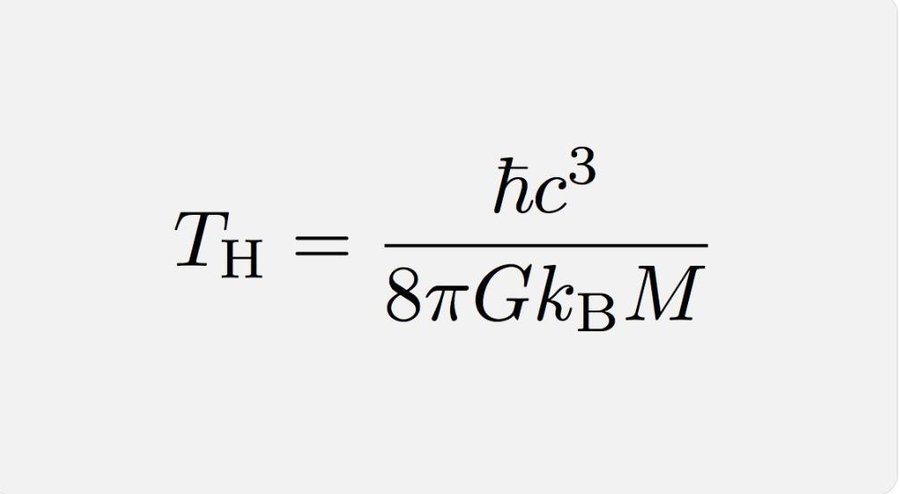
Hawking showed that the a black hole will produce black-body radiation with a temperature, the Hawking Temperature, given by TH in a beautiful formula below that brings together constants relating to gravity, statistical mechanics, quantum theory and relativity:

You can see that the Hawking Temperature is inversely proportional to the mass of the black hole M so is largest for very small black holes. In fact for a black hole with mass of order that of the Moon, the Hawking Temperature is just 3 Kelvin. Since the Universe is bathed in cosmic radiation with this temperature, such a black hole would not evaporate at all because it would absorb as much radiation as it emits by the Hawking mechanism as would any black hole of mass greater than this. The Hawking temperature for a supermassive black hole is many orders of magnitude lower than this, so Hawking radiation is completely irrelevant.

Notice that if a black hole does start to evaporate then its mass begins to decrease. Its Hawking temperature therefore increases so its mass decreases even more quickly. In the end the mass gets so low and the temperature so high that the black hole effectively explodes. Nobody really knows how to describe the final stage as it relies on physics we don’t understand.

Anyway, this all reminds that years ago I set an examination question that involved applying the Hawking formula above to calculate the lifetime of a black hole of mass M. It’s not too hard to show that it scales as M-3. Another part of the question asked: what is the mass of a black hole whose Hawking Temperature is room temperature (say 300 K), what would be the Schwarzschild radius of such a black hole, and what would be its lifetime?

I’ll leave it to my readers to plug the numbers into the Hawking formula above to derive the mass, etc. Please submit your answers through the comments box below. The first correct entry does not win a prize, not even a joke Peace Prize.

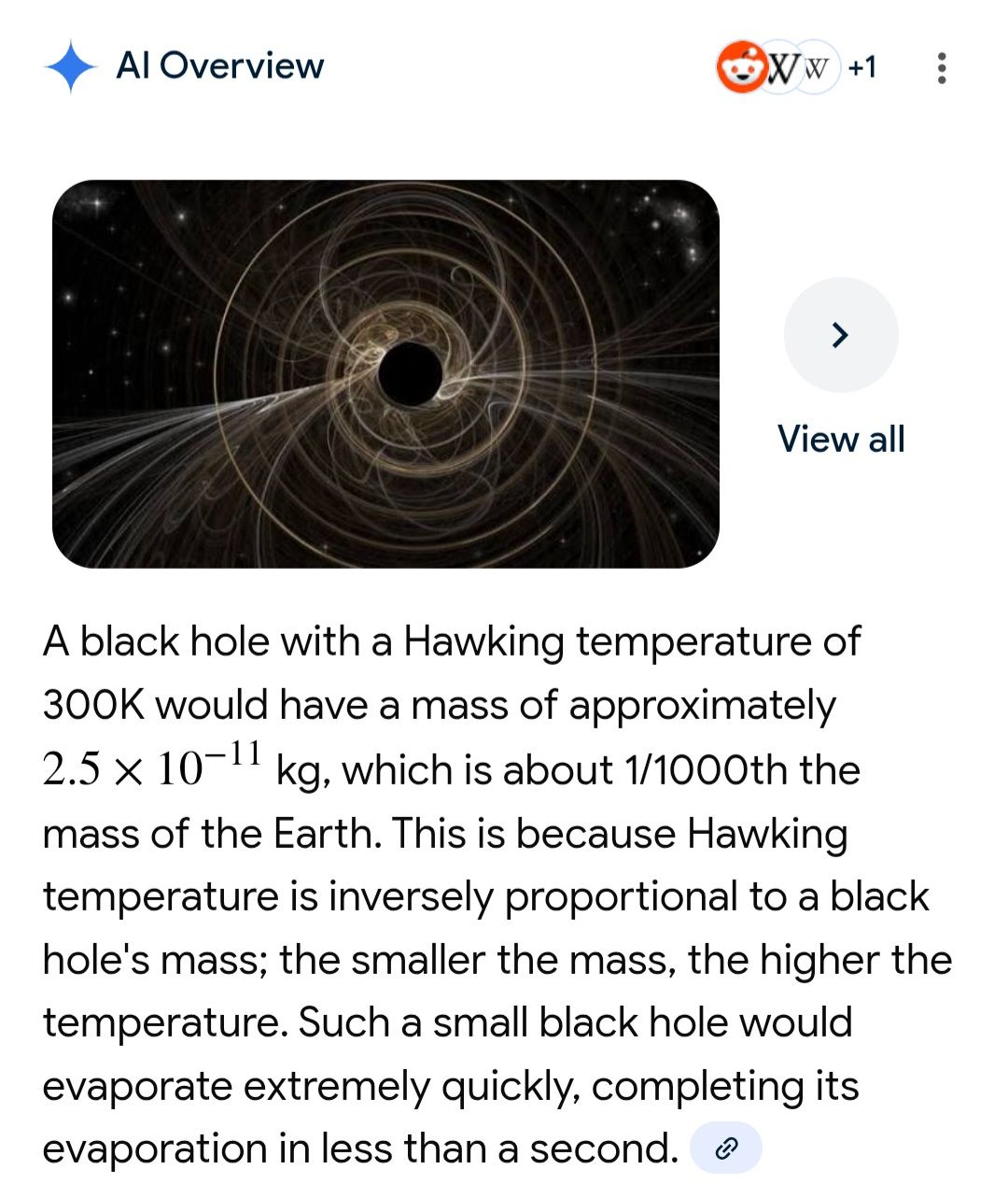
For a laugh I asked Google for the answer. Here is the AI summary:

Bonus marks for pointing out everything that’s wrong in this summary.

Eight Years in Maynooth…

Posted in Artificial Intelligence, Biographical, Education, Maynooth with tags , , on December 1, 2025 by telescoper
Maynooth University Library, home of the famous cat

Today is 1st December 2025, which means that it’s eight years to the day since I started work at Maynooth University. Despite the frustrations, I’m still very happy I made the move all that time ago.

We’ve now had more than a year since the merger of the former Departments of Theoretical and Experimental Physics. This has gone pretty well, actually, with significant improvements in terms of some steps forward in rationalising teaching. It does, however, feel less like a merger and more like an acquisition, with the theoretical activity effectively subsumed into the old Experimental Physics department. I suppose that was inevitable given the relative sizes of the two former Departments, but it has led to a loss of identity and the loss of the group spirit we use to have in Theoretical Physics. To add to this a number of familiar faces have left – two of my own PhD students, Aonghus Hunter-McCabe and Aoibhinn Gallagher have graduated and left, as have others with different supervisors. I am delighted for their success, of course, but will miss having them around.

I continue to enjoy teaching, and was pleasantly surprised to continue doing the same modules this academic year as last. The big change in that regard has been the adoption of different assessment methods to deal with the possibility of students using AI to do their coursework. That seems to be going reasonably well, though I’ll have to wait until the January examinations to see the outcomes.

The thing I’m probably most proud of over the past eight years is, with the huge help of staff at Maynooth University Library, getting the Open Journal of Astrophysics off the ground and attracting some excellent papers. This year has seen yet more significant growth, publications this year set to reach 200, after 120 in 2024 and just 50 the year before that (2024). We’re still smaller than many of the mainstream astrophysics journals, but we’re still growing…

Anyway, eight years of service mean that only two remain until I can claim the full state pension. I’ll be retiring as soon as I can afford to. There were Open Days at Maynooth on Friday and Saturday (28th and 29th November, respectively). These were for prospective students to enter in September 2026. Since I don’t teach any first or second year Physics modules now, and that is likely to continue, it looks like I’ll never see any of that intake in class.

More AI garbage

Posted in Artificial Intelligence with tags , , , on November 30, 2025 by telescoper

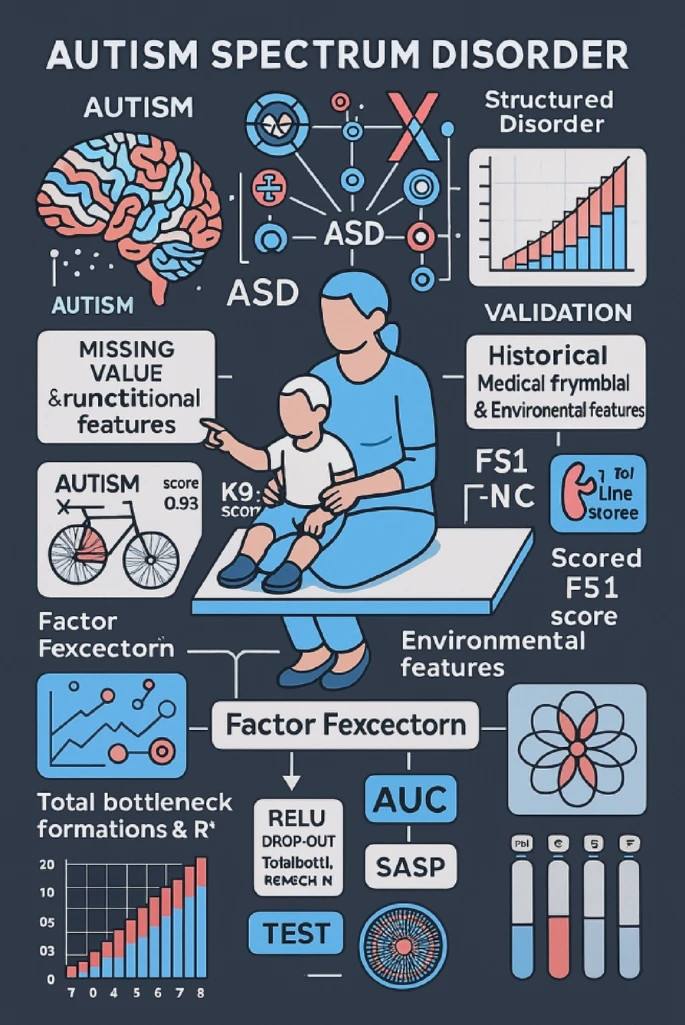
I’m indebted to a post on Mastodon for drawing my attention to a blog post about a paper with the title Bridging the gap: explainable ai for autism diagnosis and parental support with TabPFNMix and SHAP that appeared in the journal Nature Scientific Reports (which claims to be peer-reviewed).

Here is Figure 1 of that paper:

I’m no expert on Autism Diagnosis, but I’m pretty sure that neither “Fexcectorn” nor “frymblal” (medical or otherwise) nor “runctitional” are words in the English language. Why do the person’s legs go through the table? And why is Autism represented by a bicycle? This nonsensical figure was clearly generated by AI, as is much of the text of the paper. How on Earth did this crap pass peer review?

Still, Nature Scientific Reports is indexed in Scopus, which we all know is a watertight guarantee of quality…

P.S. The article was published on 19th November 2025. It is now prefaced by an Editor’s Note: “Readers are alerted that the contents of this paper are subject to criticisms that are being considered by editors. A further editorial response will follow the resolution of these issues.”

A month to go

Posted in Artificial Intelligence, Biographical, Education, mathematics, Maynooth with tags , , , , , on November 25, 2025 by telescoper

I’ve been a bit preoccupied these recent weeks so it was with a shock that I realised that we’re into Week 9, which means just four weeks (including this one) until the end of term and just a month before Christmas. Teaching finishes here in Maynooth on Friday 19th December, but I don’t have any lectures on Fridays so in my case it will finish the day before (with a tutorial). I don’t know how many students will be there, but the module concerned is my 4th year Mathematical Physics module and the students are very hard-working, so I think most will attend. After such a busy term I’m sure that they will need a break as much as I will.

I had to rejig the schedule for both modules I am teaching this semester to accommodate the introduction of in-class tests to replace take-home assignments (for reasons I outlined here). I’ve also been handing out voluntary exercises for practice, not counting towards the module mark but for formative reasons. Both modules are mathematical in nature, and I think the best way to learn mathematics is by doing it…

Despite the changes with respect to last year, I am still roughly on track. In my Engineering Mathematics module I’ve just finished Laplace transforms, and will start Fourier methods tomorrow. With the mathematical physicists, I am in the middle of complex analysis, having done complex differentiation and conformal mappings and starting complex integration next week.

I still have a couple more class tests to get through. On the positive side, the students are turning up for them and have expressed approval for the fact that they don’t have compulsory homework to do off-campus. This form of assessment is undoubtedly harder work for the students, it’s also better preparation for the examination that take-home assignments.

We’ve just received the draft examination timetable for January, and I’m pleased that both of the examinations for which I am responsible will take place quite early in the examination period (on 12th and 15th January, respectively) so I should be able to get them corrected in time to have a break for some research before teaching resumes at the start of February.

Testing Times

Posted in Artificial Intelligence, Education, mathematics, Maynooth with tags , , , , on October 17, 2025 by telescoper

As it was foretold, I conducted my first set of my new-style in-class tests this week. These tests, as I mentioned a while ago,  were introduced because of concerns about the integrity of the coursework element of my modules in the light of improvements in Generative AI.

The main events – one for each of my modules – were both yesterday, but one student couldn’t make it at the scheduled time (for good reasons) so I set a special test this morning, which is now over. Because access to the internet is not allowed these tests are invigilated.

It’s been quite a while since I was last required to invigilate a full examination. I think it was back in Nottingham days, actually. I never enjoyed this task even though I took work to do it wasn’t really possible to do much as one had to keep one’s eyes on the students. Crosswords could be done; these are good in this situation because you can solve a few clues at a time. It was disappointing if I happened to take one that was easy enough to do quickly, as there was little to stave off the boredom after completing it. Other things I used to do included counting the number of right-handed and left-handed students, though I never did any detailed statistical analysis of the results.

Anyway, my recent class tests were a bit different. Designed to fit in a lecture slot of 50 minutes duration, they were much shorter than traditional end-of-year exams. They were also “open-book” style, so students could bring anything on paper that they wanted. Phones and laptops were, however, forbidden. During these tests I just sat quietly with my laptop getting some work done, with an occasional glance at the students. It was actually nice to be locked away like this with no disturbance. Time passed very quickly, actually, though perhaps not as quickly as it did for the students taking the tests.

When I first told the students that the tests would be “open-book”, I think they all assumed that would make them easy. I don’t think that was the case, however, as the questions are designed so that the answers can’t be obtained immediately by looking them up in a textbook. Also, having things on paper rather than in your head does slow you down. I’ve never seen much point in examinations as speed tests. I designed this week’s tests so that the questions could be done in about 30 minutes, but the formal duration was 50 minutes. I encouraged students who finished early to use the remaining time to check their work, but some did leave early.

This new regime also meant I had number of teaching sessions without the exertion of having to do any actual teaching, which was nice. The downside is, of course, that I now have stacks of class tests to correct. That will be payback time.

I won’t know how well the students have coped until I have got their grades, but informal feedback was that they seemed reasonably content with the new method of assessment. I’ll be doing the next ones in about three weeks.

When will the AI Bubble burst?

Posted in Artificial Intelligence, Finance, mathematics with tags , , , , on October 12, 2025 by telescoper

I’m not a financial expert, but I have noticed a significant number of articles in the media suggesting that the Generative AI industry is a bubble waiting to burst. There are recent pieces here on the BBC website, here in the Financial Times (from which I stole the cartoon), and here in the Irish Times, to name but a few.

These stories are based on reports by the Bank of England and the International Monetary Fund, warning of a stock market crash far worse than the dotcom boom-and-bust of 2000 and even the banking crisis of 2008. Over 30% of the valuation of the US stock market, for example, lies in five big technology companies that are investing heavily in the enormous infrastructure required for AI. Their extravagant capital expenditure is underpinned by a complex series of financial arrangements which could unravel very quickly if the investors get cold feet and consider it unlikely they will see a return on their money. It does look very much like a bubble to me.

My own view is that the claims made about the capabilities of AI by tech gurus are grossly overstated. Only the irredeemably gullible could think otherwise. I think a correction is inevitable. It’s not a question of “if” but “when” and “how much”. I am not competent to answer those questions.

P.S. Now there’s an RTÉ Brainstorm piece along the same lines…

Back to Teaching and Coping with GenAI

Posted in Artificial Intelligence, Education, mathematics, Maynooth with tags , , , , on September 21, 2025 by telescoper

Summer is well and truly over: it’s a chilly day in Maynooth; the Autumnal Equinox takes place tomorrow; and tomorrow I return to teaching at Maynooth University. So begins my antepenultimate academic year as a university teacher.

I’ve often remarked how the academic year at Maynooth is largely defined by the astronomical phenomena of the equinoxes and solstices. This year demonstrates this perfectly: Semester 1 lectures for undergraduates begin tomorrow (22nd September), the day of the Autumnal equinox; they end on Friday 19th December with the Winter Solstice on 21st. The half-term study break coincides with Samhain, a cross-quarter day. It’s all refreshingly pagan.

This time last year, having been away on sabbatical the year before, I was preparing to teach two new modules. I have those two again this year so this year should be a bit easiest than last year. I still have to get everything sorted out, though, including setting up my Moodle pages and preparing the materials, which is what I’ve been doing today.

The timetable for my Engineering Mathematics (EE206 Differential Equations and Transform Methods) module has not changed, so my first lectures on that (a double session) are not until Tuesday. I’m also doing MP469 Differential Equations and Complex Analysis for 4th Year Mathematical Physics students again, but the lecture times for that have changed. That is because, as a consequence of the merger of the Departments of Theoretical Physics and Experimental Physics to form a single Department of Physics, times have been coordinated as far as possible to ensure that Physics students can have flexibility in their choice of theoretical or experimental-based modules. The Engineering Mathematics module has not changed because the times for those lectures are such as to fit with the needs of the Department of Engineering, rather than Physics.

The upshot of all this is that my first lecture of the new term is for MP469, tomorrow afternoon at 2pm and my second is also MP469, at 11am on Tuesday. This means that I have three hours of lectures on Tuesdays this term, but at least that makes it possible to have a day without teaching (Wednesday).

You will notice that both the modules I am teaching this term are mathematical in nature. I have been concerned about the integrity of the coursework element of these modules in the light of improvements in Generative AI. Only a couple of years ago GenAI could not solve the sort of problems I set for homework, but now it generally can – especially for EE206. I don’t altogether object to people applying artificial intelligence to solve mathematical problems, but the issue is that it does make mistakes. Moreover, instead of saying “sorry I can’t solve that problem” it will generally present a superficially plausible but incorrect solution. Although students will probably use GenAI for problem-solving, I think it is important that they learn to do such problems themselves, otherwise they won’t know whether the solution coughed up by the algorithm is correct or not. That way lies disaster.

The only way to learn mathematics is by doing it. If students get GenAI to do the mathematics for them, then they won’t learn it. In the past we have given marks for coursework (usually 20% of the module mark) mainly to encourage students to do them. Students who don’t bother to do these exercises generally do badly in the final exam (80%).

For these reasons I am moving the assessment from weekly homework sheets – which could be tackled with AI – to supervised in-class tests for which students can use notes on paper, but not laptops or phones, just like they would in the final examination. I will of course give examples for the students to have a go at themselves, and I will give feedback on their attempts, but they will not contribute to the module score. Another advantage of this approach is that students won’t have to do so much work against deadlines outside of class.

Anyway, that’s the approach I am going to try. I’d be interested to hear what others are doing to deal with GenAI. The Comments Box is at your disposal.

P.S. There is a rumour circulating that The Rapture will occur on Tuesday 23rd September, but it is as yet unclear whether this will happen before, during, or after the lectures I am due to give on that day.

Generative AI in Physics?

Posted in Artificial Intelligence, Education, mathematics, Maynooth with tags , , , , , , , , , on August 11, 2025 by telescoper

As a new academic year approaches we are thinking about updating our rules for the use of Generative AI by physics students. The use of GenAI for writing essays, etc, has been a preoccupation for many academic teachers. Of course in Physics we ask our students to write reports and dissertations, but my interest in what we should do about the more mathematical and/or computational types of work. A few years ago I looked at how well ChatGPT could do our coursework assignments, especially Computational Physics, and it was hopeless. Now it’s much better, though still by no means flawless, and now there are also many other variants on the table.

The basic issue here relates to something that I have mentioned many times on this blog, which is the fact that modern universities place too much emphasis on assessment and not enough on genuine learning. Students may use GenAI to pass assessments, but if they do so they don’t learn as much as they would had they done the working out for themselves. In the jargon, the assessments are meant to be formative rather than purely summative.

There is a school of thought that has the opinion that formative assessments should not gain credit at all in the era of GenAI since “cheating” is likely to be widespread. The only secure method of assessment is through invigilated written examinations. Students will be up in arms if we cancel all the continuous assessment (CA), but a system based on 100% written examinations is one with which those of us of a certain age are very familiar.

Currently, most of our modules in theoretical physics in Maynooth involve 20% coursework and 80% unseen written examination. That is enough credit to ensure most students actually do the assignments, but the real purpose is that the students learn how to solve the sort of problems that might come up in the examination. A student who gets ChatGPT to do their coursework for them might get 20%, but they won’t know enough to pass the examination. More importantly they won’t have learnt anything. The learning is in the doing. It is the same for mathematical work as it is in a writing task; the student is supposed to think about the subject not just produce an essay.

Another set of issues arises with computational and numerical work. I’m currently teaching Computational Physics, so am particularly interested in what rules we might adopt for that subject. A default position favoured by some is that students should not use GenAI at all. I think that would be silly. Graduates will definitely be using CoPilot or equivalent if they write code in the world outside university so we should teach them how to use it properly and effectively.

In particular, such methods usually produce a plausible answer, but how can a student be sure it is correct? It seems to me that we should place an emphasis on what steps a student has taken to check an answer, which of course they should do whether they used GenAI or did it themselves. If it’s a piece of code to do a numerical integration of a differential equation, for example, the student should test it using known analytic solutions to check it gets them right. If it’s the answer to a mathematical problem, one can check whether it does indeed solve the original equation (with the appropriate boundary conditions).

Anyway, my reason for writing this piece is to see if anyone out there reading this blog has any advice to share, or even a link to their own Department’s policy on the use of GenAI in physics for me to copy adapt for use in Maynooth! My backup plan is to ask ChatGPT to generate an appropriate policy…

A Dream of AI

Posted in Artificial Intelligence, Biographical with tags , , on May 30, 2025 by telescoper

I noticed this, apparently genuine, screengrab circulating on social media:

Can it be? Can 2025 be just a dream and we’re really still in 2024? Did Trump not really get elected? More importantly, am I still on sabbatical? If so, why do I have a desk full of projects to grade? And why am I not in Barcelona?

I checked it myself and found this:

Someone at Google obviously tried to fix something by hand and didn’t entirely succeed.

Do you still think that AI isn’t a bubble waiting to burst?

An AI Guide to Europe

Posted in Artificial Intelligence, Barcelona with tags , , , on May 6, 2025 by telescoper

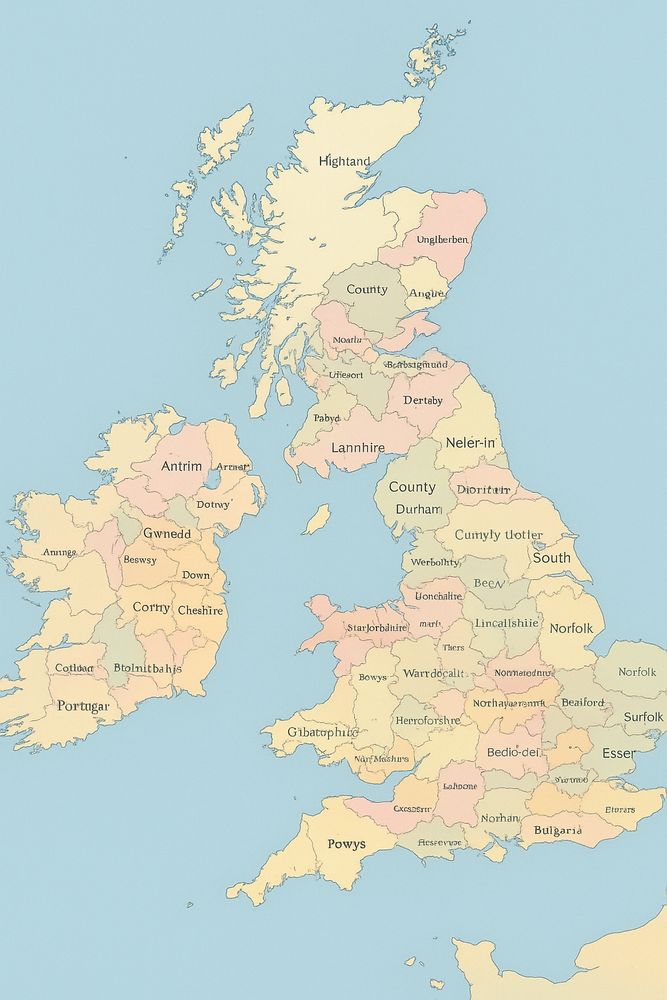
To assist those readers who might be planning conference trips or vacations in Europe I thought I’d share this helpful map (which I found here) that was generated by one of those famously accurate AI apps. There may be a few small errors, but I’m sure they are insignificant:

Apart from everything else, this explains why I found Barcelona much warmer than I had expected when I was there last year…