Archive for the Barcelona Category

The Geometry of Barcelona

Posted in Architecture, Barcelona, Biographical with tags , , , on November 11, 2023 by telescoper

Having a lazy Saturday morning before going out to do some shopping I thought I’d do a silly post about a few random things that struck me about Barcelona. As I have mentioned before, I am resident in area of the city known as Eixample. Most of this zone was built in the 19th and early 20th centuries and its layout was very carefully planned, as you can see from this aerial picture:

I initially thought that the name Eixample related to the exemplary nature of the area, but in fact it means something like “extension”; the “ample” has a similar sense to the English “ample”.

To orient yourself, the Sagrada Familia is towards the bottom left. In the middle of the top you can see Plaza de Cataluña. Near that there is a junction of two wide tree-lined roads; the one running from SW to NE (relative to the picture) is the Gran Via de les Corts Catalanes (which is actually 8 miles long altogether); the one perpendicular to the Gran Via is Passeig de Gràcia. My apartment is a few blocks SW of this junction. You can see to the top left how the pattern of streets changes, as you approach the older part of town, the harbour and the sea.

Anyway, the street plan of Eixample is generally rectangular but if you look carefully you will note that the footprint of the blocks is not quite rectangular; the corners are shaved off to make them octagonal. This is a very nice feature because it means that visibility around the corners is very good and there is a lot of pavement space near the entrances. Many of these buildings now have a bar or restaurant on the ground floor and there is plenty of room for seated areas. Above all, combined with the wide boulevard-type roads, this gives this densely-populated area a much less claustrophobic feel than other cities with rectilinear street layouts, such as New York. Note also that each block encloses a communal space which contains private gardens, play areas, etc, though some appear to have been built over especially.

The road passing diagonally through the picture is called, um, Avenida Diagonal. It plays a rather similar role to Broadway in Manhattan.

As well as A. Diagonal, Barcelona has A. Parallel. In Spanish this is called Avenida del Paralelo; in Catalan it is Avinguda del Paral·lel. The signs on the Metro are all in Catalan so the one on the Metro station on this road says Paral·lel. I was puzzled for some time by the dot between the two letters “l” but it’s quite straightforward. In Catalan (and Spanish) the diagraph “ll” (which used to be listed a separate letter of the alphabet) is pronounced like the English letter “y”, e.g. in paella and amontillado. The dot in Paral·lel is there to indicate that it’s not the letter “ll” in the middle but two letters “l” next to each other and is pronounced para-lel rather than para-yel. The Spanish word “Paralelo” avoids this problem by simply dropping an “l”.

Now it’s nearly time to get ready to go out. The temperature here has fallen noticeably over the last few weeks. It was around 15° last week with a stiff westerly breeze. That was enough to persuade some of the locals to put on their winter coats, scarves and woolly hats although to me it still felt warm when in the sun. Today is about 19° C. The cooler weather makes it far less sweaty and much more pleasant to walk about. It’s also noticeable that there are fewer tourists around, which has two advantages: (a) one’s mean free path between people is longer and (b) it’s much easier to get into places of interest. I hope to ramp up my visits to museums and art galleries between now and Christmas.

University Management Salaries

Posted in Barcelona, Maynooth on November 10, 2023 by telescoper

I have long believed that the hierarchical management structure of modern universities, especially in the UK and Ireland, is wrong and damaging. One aspect of this is the unjustifiably high salaries paid to the people at the very top. I can see no good reason for any university President, Vice-Chancellor, Rector, or whatever else their name is, to receive a salary above the standard scale for professors.
The problem with the high salaries these people get nowadays is not only the expense (which is considerable) but the fact that it sends out the message that they are much more important than they actually are and that the people who actually carry out the core work of a third-level institution – the academics and related staff – are mere subordinates. Moving into management should really be regarded as a sideways move, not an advance.

Incidentally, I would also argue that nobody should be employed in a senior management role in a university who neither teaches nor does research. How can someone who is not active in these areas know the reality of the situation facing staff who are?

Anyway, these thoughts came back into my mind after an informal chat with some people here in the ICC. It turns out that the salary of the Rector of the University of Barcelona, Joan Guàrdia Olmos, is in the public domain. It is made up from various components but the grand total is €124,619.58 (2022 figure). That would be well below the bottom level of the Professor A scale in Maynooth. Contrast that with the President of Maynooth University, Eeva Leinonen, who is paid a salary of €208,509, which is considerably higher than the top of the Professor A scale at Maynooth. Professor Leinonen also receives €13,500 benefit in kind for rent-free accommodation.

You can contrast these salaries with the respective institutions, both of which are public universities. The University of Barcelona has around 63,000 students and about 5000 staff; it is widely regarded as the top University in Spain (pop. 47 million). Maynooth University has about 15,000 students and about 900 staff; it is not regarded by anybody as the top University in Ireland (pop. 5 million).
I think you get the point.

Back to Barcelona!

Posted in Art, Barcelona, Biographical with tags , , on November 5, 2023 by telescoper

After a brief sojourn in not-Barcelona, I’m about to start the trip back. I have a busy week ahead so I hope the journey is relatively stress-free. I’ll be making another trip in a few weeks to a different part of not-Barcelona and I really need to finish a couple of things before then.

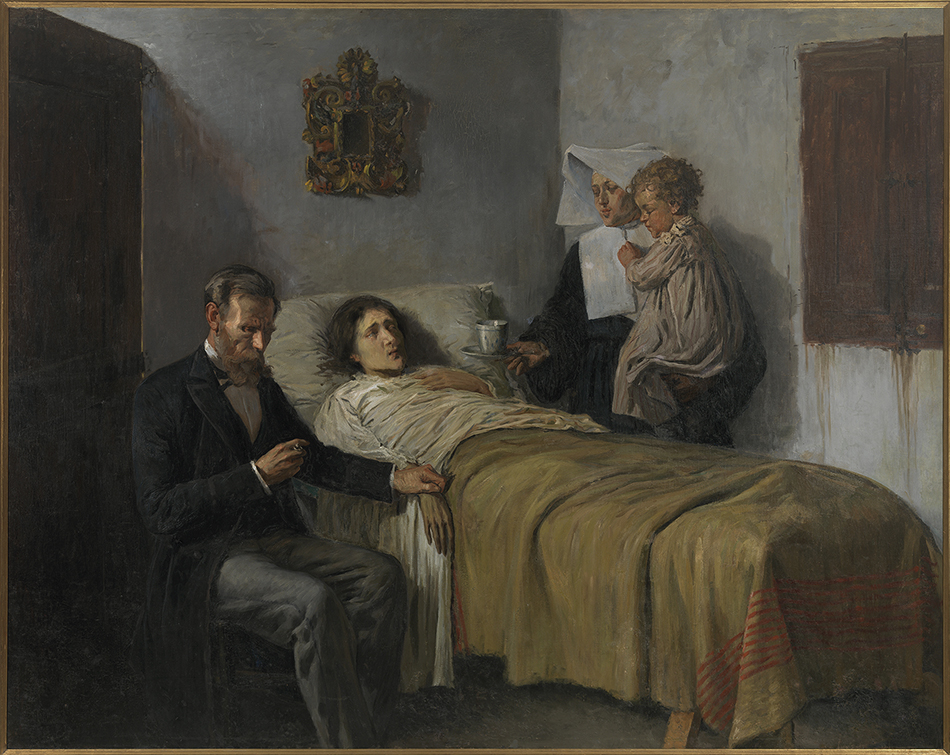
Anyway, lacking the time for a longer post, I thought I’d post a little art quiz. Without googling, or any other form of cheating, can you identify the artist who painted this:

Name the Artist

I’ll post the answer when I get back to Barcelona.

UPDATE 1: the journey wasn’t bad at all. My plane was a bit late but the arrivals process at Barcelona was super-efficient and I walked straight out of the Terminal building and onto the excellent Aerobus which took me to Plaça de Catalunya, which is a five-minute walk from my apartment. As I expected, it’s quite a lot warmer in Barcelona than in not-Barcelona.

UPDATE 2: The painting is called Science and Charity and it is attributed to Pablo Ruiz Picasso (although his father José Ruiz -also a painter – may have helped him. In any case, Picasso was only about 15 years old when he painted it. I don’t think it’s a really great painting – the composition looks a bit stiff and contrived to me – but it is interesting to see the young Picasso experimenting in a style that could be describe as social realism and which is very far from his later work. Incidentally, Picasso signed his early work Pablo Ruiz, but his signature subsequently evolved to Pablo Ruiz Picasso to Pablo R Picasso to Pablo Picasso and finally to Picasso. People have wondered why he did that, but it’s probably just because he wanted to be distinctive: Ruiz is a fairly common name in Spain whereas Picasso is not.

It’s That Time Again…

Posted in Barcelona, History with tags , , on October 29, 2023 by telescoper

It’s 29th October 2023, which marks the end of “Summer Time” in Europe. Accordingly, the temperature in Barcelona has plummetted to 22°C. I have to make a flying visit to the UK next week and I suspect that I’m in for a bit of a shock, having adjusted to these balmy climes.  I have numerous telecons next week too and, since  some parts of the world will be still on Daylight Saving Time (or whatever) there’s potential for confusion in the timing.

Some time ago, before the Covid-19 Pandemic, the European Parliament approved a directive that would abolish `Daylight Saving Time’.  Unfortunately that plan has been ‘paused’ and there’s no sign of it happening for the foreseeable future.  I’ve long felt that the annual ritual of putting the clocks forward in the Spring and back again in the Autumn was a waste of time effort, so I’ll be glad when this silly practice is terminated. It would be far better in my view to stick with a single Mean Time throughout the year. I’m only disappointed that this hasn’t happened already.

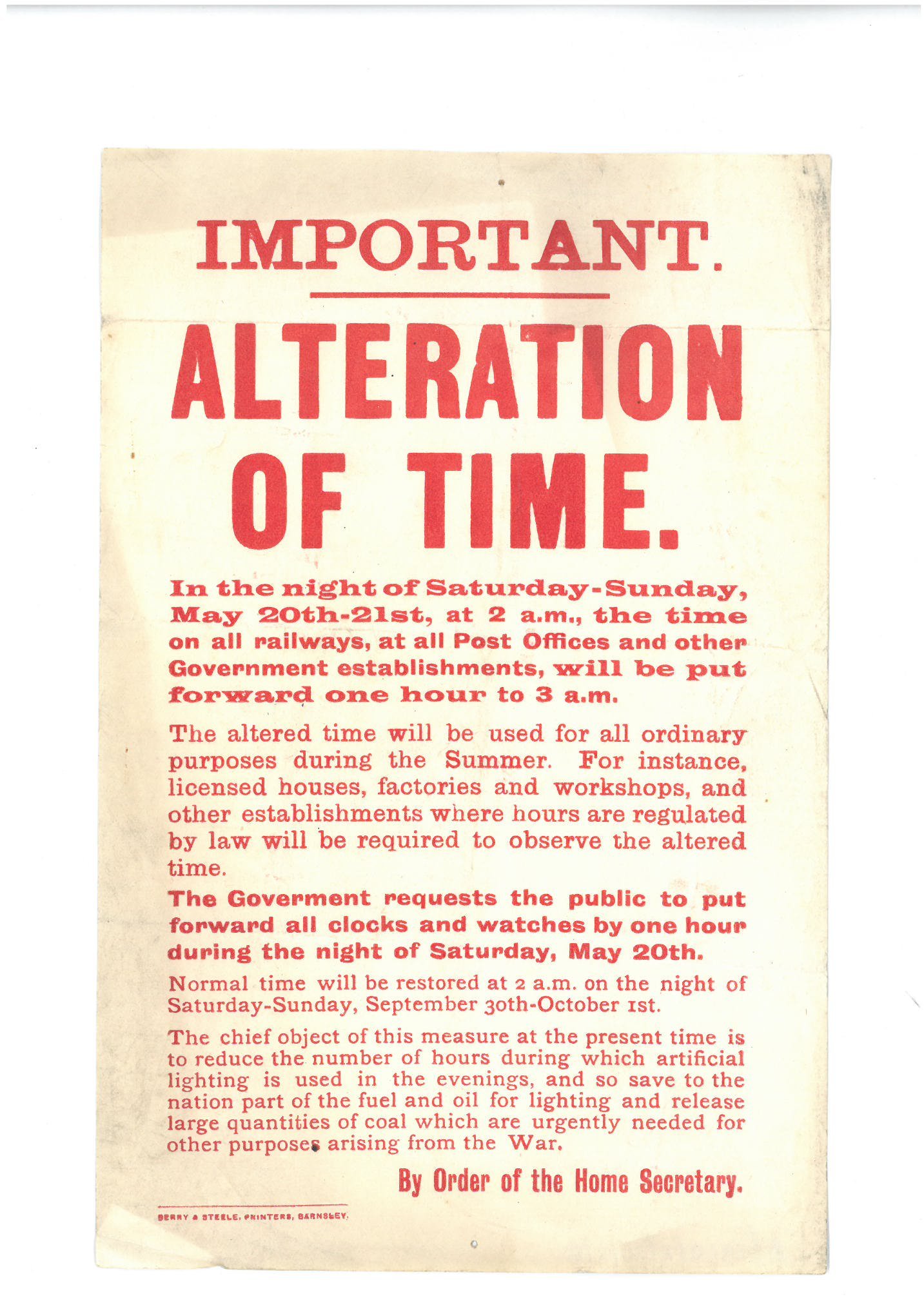
The marvellous poster above is from 1916, when British Summer Time was introduced. I was surprised to learn recently that the practice of changing clocks backwards and forwards in the UK is only about a hundred years old and was introduced as an emergency measure in wartime. To be honest I’m also surprised that the practice persists to this day, as I can’t see any real advantage in it. Any institution or organisation that really wants to change its working hours in summer can easily do so, but the world of work is far more flexible nowadays than it was a hundred years ago and I think very few would feel the need.

Anyway, while I am on about Mean Time, here is a another poster from 1916.

Until October 1916, clocks in Ireland were set to Dublin Mean Time, as defined at Dunsink Observatory, rather than at Greenwich. The adoption of GMT in Ireland was driven largely by the fact that the British authorities found that the time difference between Dublin and London had confused telegraphic communications during the Easter Rising earlier in 1916. Its imposition was therefore, at least in part, intended to bring Ireland under closer control. This did not go down well with Irish nationalists.

Ireland had not moved to Summer Time with Britain in May 1916 because of the Easter Rising. Dublin Mean Time was 25 minutes 21 seconds behind GMT but the change to GMT was introduced in Ireland at the same time as BST ended in the UK, hence the alteration by one hour minus 25 minutes 21 seconds, i.e. 34 minutes and 39 seconds as in the poster.

Britain will probably never scrap British Summer Time on the grounds that whatever the EU does must necessarily be bad. What will happen to Northern Ireland when Ireland scraps Daylight Saving Time is yet to be seen.

Teaching in Base 60

Posted in Barcelona, Cardiff, History, mathematics, Maynooth with tags , , , , on October 27, 2023 by telescoper

Some time ago – was it really over a decade? – I wrote a piece about the optimum size of modules in physics teaching. I was still in the United Kingdom then so my ramblings were based on a framework in which undergraduate students would take 120 credits per year, usually divided into two semesters of 60 credits each. In Cardiff, for instance, most modules were (and still are) 10 credits but some core material was delivered in 20 credit modules. In the case of Sussex, to give a contrasting example, the standard “quantum” of teaching was the 15 credit module. I actually preferred the latter because that would allow the lecturer to go into greater depth, students would be only be studying four modules in a semester (instead of six if the curriculum consisted of 10 credit modules), and there would be fewer examinations. In short, the curriculum would be less “bitty”.

In Maynooth the size of modules is reckoned using the European Credit Transfer System (ECTS) which takes a full year of undergraduate teaching to be 60 credits rather than 120 in the UK, but the conversion between the two is a simple factor of two. In Maynooth the “standard” unit of teaching is 5 credits, with some 10 credit modules thrown in (usually extending over two semesters, e.g. projects). This is similar to the Cardiff system. The exception concerns first-year modules, which are 7.5 credits each because students take four modules in their first year so they have to be 30/4=7.5 credits each. The first year is therefore like the Sussex system. It changes to a five-credit quantum from Year 2 onwards because students do three subjects at that stage.

I find it interesting to compare this with the arrangements here in Barcelona (and elsewhere in Spain). Here the ECTS credit size is used, but the standard module is six credits, not five, and year-long projects here are 12 credits rather than 10. The effect of this is that students generally study five modules at a time (or four plus a project). To add to the fun there are also some 9 credit modules, so a semester could be made up of combinations of 6-credit and 9-credit chunks as long as the total adds up to 30.

Anyway, the main point of all this is to illustrate the joy of the sexagesimal system which derives from the fact that 60, being a superior composite number, has so many integer divisors: 2, 3, 4, 5, 6, 12, 15, 20, and 30. The Babylonians knew a thing or two!

Another Country

Posted in Barcelona, Biographical, Maynooth with tags , , on October 25, 2023 by telescoper

It was only when I looked at my calendar this morning, and saw the reminder that my rent is due shortly, that I realized that I have now been in Barcelona for a whole month (plus one day). Lacking the usual cycle of lectures and other teaching sessions, I’ve still had regular telecons and other virtual discussions through which to reckon the passage of time, but these are different. When I’m teaching I always number my lectures consecutively so it’s easy for me to look at my notes and see that we’re, say, approaching half-term. That gives me a sense of progress which I must admit I don’t feel with scheduled telecons, which seem more cyclic – i.e. going around in circles most of the time.

Other than that, I’ve settled in here better than I expected. I’ve even managed to memorize the codes needed to get into my flat – no mean feat given my fading powers of recollection. Progress on the research has been a bit slower than expected, but I hope to finish the paper I’m working on by the weekend.

Next week is Study Week in Maynooth, including a public holiday on Monday 30th October to mark Samhain. Wednesday November 1st is a (national) public holiday in Spain too, Tots Sants (“All Saints” in Catalan). That would be the third public holiday since I arrived in Barcelona, but I won’t be here for it, as I have to make a flying visit to another country to give a talk, and do a few other things.

This reminds me that I should send an update on the affair of Maynooth University’s Governing Authority. As you may recall, the Powers That Be initially decided to scrap elections to the Governing Authority of the University in favour of selection. There was a protest at this authoritarian plan and a petition was raised. After initially proposing a mixture of election and selection, The Management finally backtracked and agreed to elections for all five internal representatives. Although the elections happened after I moved to Barcelona, they were held online so I was able to vote. The process is now complete, and I send congratulations to the five duly elected representatives!

One thing I hope the new members of Governing Authority will do concerns the outcomes of Maynooth University’s “Staff Climate and Culture Survey” which was carried out in 2022 with the promise made to participants that results would be published in early 2023. No such results have ever communicated to staff (or anyone else that I am aware of) and all mention of this survey has been wiped off the University’s web pages. Perhaps the new members of GA can push for the long overdue publication of this information?

Cursa Bombers!

Posted in Barcelona, Sport with tags , , on October 22, 2023 by telescoper

It’s all go outside my flat! This morning it’s the annual Cursa Bombers (Fireman’s Race), as I found out when I looked it up!

The event begins with teams of four firefighters in full gear running a relay race (4×2.5K) and is then followed by a standard 10K road race. I missed the first bit as I was still in bed.

Spanish Practices

Posted in Barcelona, Education, History, Maynooth with tags , , , , , on October 20, 2023 by telescoper

When I was a lad, during the 1970s, the term Spanish Practices was used pejoratively in a union-bashing sense to describe restrictive practices in the workplace. Until recently I thought it was a modern invention that relied on a stereotypical view of Spanish people as being lazy. In fact it seems the term dates back to Tudor times and is religious in origin, referring to Roman Catholic rites, in contrast to the simpler Protestant forms of worship. Anyway, none of that is what this post is about. I just used the title as clickbait.

I’ve been here in Barcelona, and working in the University of Barcelona, for four weeks now and I thought I’d share a few observations about differences in practice here and in the Ireland (and the UK).

The other night I went out for dinner with colleagues from the Department. The restaurant was much closer to the University than to my flat so instead of going home first I stayed in my office and walked straight there. My route out of the building takes me past a number of teaching rooms. During this warm weather, most of the rooms have the doors open so it’s easy to have a quick look at what’s going on inside. On my way out at about 7.30pm I was surprised to see a number of classes still going on, and they weren’t sparsely attended either.

In Maynooth the latest regular lectures finish at 6pm. Even during the 5pm to 6pm lectures, many students have to leave before the end to catch the one and only bus back to their place of residence. Here the public transport system is so good that isn’t really an issue even for those who don’t live near the campus. As far as I know lectures start at 9am, so students potentially have a very long day. They work hard.

I have to say that I wouldn’t like to have teach late in the evening. I used to do that on Fridays at Queen Mary for the MSc course and didn’t enjoy it. I don’t mind doing 9am lectures, though, but I don’t think students agree – partly because of the difficulty of getting to campus at that time.

In the Faculty of Physics, all the lecture halls, classrooms and laboratories are in one building rather than spread around the campus like they are in Maynooth (and many places in the UK). Fortunately, the building has been designed with students in mind and there is plenty of space for students to use socially or for private study between teaching sessions.

In this picture you can see the inner courtyard of the building occupied by the Faculties of Chemistry and Physics. It’s a big open space, with teaching rooms, etc, on either side. In the far right-hand corner there is a café/bar where one can buy lunch, a coffee, or even a beer, to be consumed either inside or in the seating area in the courtyard. Many students seem to prefer bring their own lunch and eat it in this space., although the food available is pretty good and cheap compared to back home.

As well as being able to eat and drink here, there is plenty of room for students simply to hang out or to study, either alone or in groups. If they don’t feel like that they can use the tram, bus or Metro to go home, and come back later if they have a long gap between classes. None of this is possible at Maynooth.

This particular kind of open space would not work so well in Ireland or the UK because of the weather, though you can probably see in the picture that there had been a bit of rain before I took the photograph, but I hope I’ve made the point that having social spaces makes a huge amount of difference to the student experience, not least because it feels that the University has thought about them. In the neoliberal system that dominates in the UK and Ireland, students are simply a commodity, a source of revenue, to be crammed into every available space and processed as cheaply as possible. In Maynooth students have been, and are being, forced to pay an extra levy for a notional student centre that will probably never be built.

The contrast is very disheartening.

Getting back to educational matters, another thing I’ve noticed walking past classrooms is that it’s not unusual to see a student standing at the blackboard in front of the class going through a problem. I’ve seen that a number of times with quite large classes. Sometimes we ask students to do that sort of thing in tutorials, but I’ve never done so in a full lecture. I think our students would be shocked if we asked, but it’s clearly not unexpected here. That’s a Spanish Practice I’d be quite happy to try.

The Rain in Spain

Posted in Barcelona, Biographical with tags , on October 16, 2023 by telescoper

It started raining yesterday and has carried on today. Yes, water is falling from the sky. It’s not raining heavily, but it has noticeably reduced the number of pedestrians visible. It’s a lot cooler today, too. Not exactly cold, at 21°C, but there’s definitely been a change. Whenever it’s been overcast previously in my stay here it has been very humid but not cooler, especially overnight when the cloud cover keeps the temperature high. Now it’s actually rather refreshing. We’re in for a bit more rain over the next few days too. Nice.

It seems more than a little overdue:

Today hasn’t been a great day so far. I was thinking of doing this morning’s scheduled Zoom call from home using the Wifi connection there. Unfortunately, there was quite a bit of construction noise from elsewhere in the building so I decided to come into the Department and do it here instead. When I got here Eduroam decided not to work for me, so I had no internet connection and consequently had to postpone the Zoom call altogether. I may have to miss a telecon this afternoon for the same reason.

Now there are intolerable levels of construction noise outside my office window too. Sigh.

On top of all that, my phone is refusing to send SMS messages. “Error 0” it says. I’m not sure how to fix that, so I’ll probably just wait for it to fix itself. My mobile data connection is working fine, so I have no idea what the problem is. I shall adopt my usual strategy in such situations of waiting for the issue to correct itself.

Annoying, though. It never rains but it pours…

RWC: The Southern Hemisphere Strikes Back!

Posted in Barcelona, Rugby with tags , , on October 15, 2023 by telescoper

Sadly, Ireland’s Rugby World Cup dream came to an end last night with a narrow defeat (24-28) to the All Blacks. After being 13-0 down at one stage, Ireland clawed their way back into the match and at one stage trailed by only a point with New Zealand with a player in the sin bin. But the All Blacks defence held firm as wave after wave of Irish attacks broke on them. It just wasn’t to be. It was another titanic struggle between two excellent teams, which would have made a worthy final. Both teams looked exhausted at the end. For the record I have to say that, on the balance of play, I think the All Blacks deserved their win, just.

Unfortunately, the peculiarities of the draw meant that only two of the top four teams in the world rankings could make the semi-finals. Ireland won’t be one of them.

Earlier yesterday, in the other Quarter Final, there was an upset when Argentina beat Wales. That’s a great result for the Pumas, but Wales can justifiably argue that Argentina should have had a player sent off for a dangerous tackle. Inconsistencies in refereeing are a major issue in this tournament.

It’s interesting that the four teams who came top in their pools (Ireland, France, Wales and England) are all from the Northern Hemisphere. Now two of them are out. Today, France play South Africa and England play Fiji. It’s possible, though I would say not likely, not that all four semi-finalists will be from the Southern Hemisphere. I think if Fiji play their natural game they can give England a scare, and the game between France and South Africa is hard to call. I think the Springboks’ lack of a goal kicker may cost them dear.

At the start of the competition I thought that, with home advantage, France were clear favourites. I still think that’s the case, though I may have to revise that opinion after tonight’s match!

P.S. It’s raining today in Barcelona

UPDATE: England 30 Fiji 24. Fiji certainly made England work for that result! I can’t see England beating either France or South Africa in the semi-final though.

UPDATE: France 28 South Africa 29. Another pulsating match, with 6 tries in the first half, but South Africa just sneak it. Tight margins again, and especially one very dodgy penalty decision. Heartbreak for the hosts. I’m not often right but I was wrong again.

So the semi-finals will be New Zealand v Argentina and England v South Africa. The team that Ireland beat in their pool game goes through with New Zealand, the team that France beat in their pool.