Archive for the Biographical Category

Historical References

Posted in Biographical, History, Maynooth with tags , , , , , , , on December 2, 2017 by telescoper

This morning, having a few hours free after breakfast before some househunting activities, I took a stroll to buy a newspaper and decided to take a few snaps.

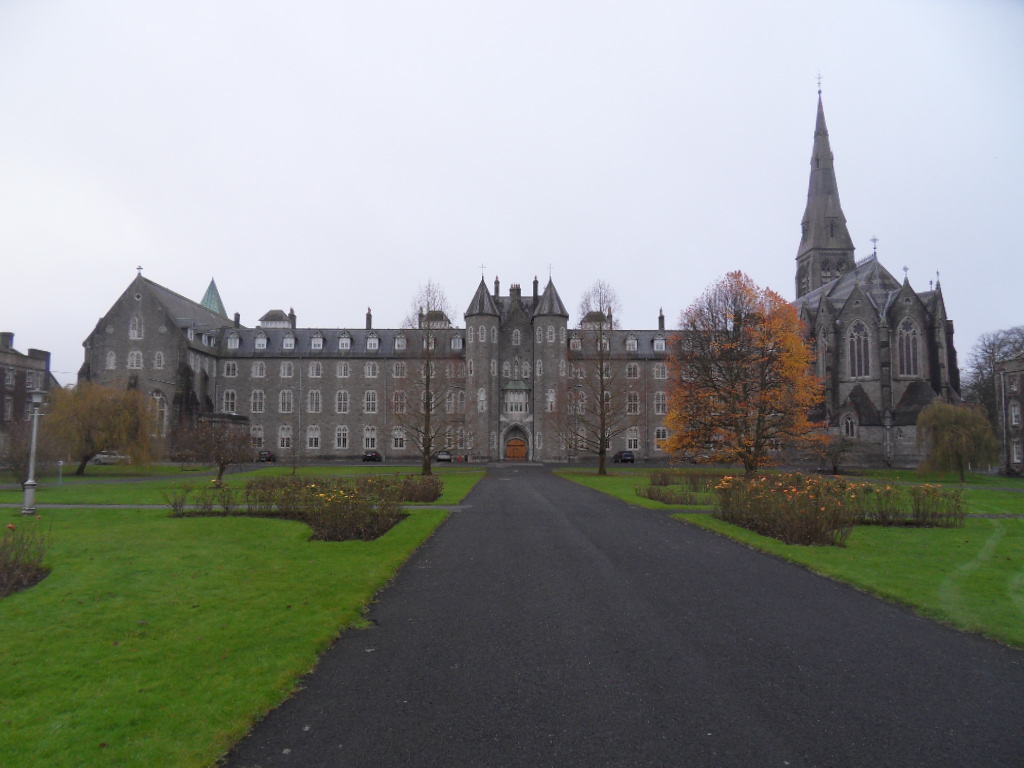
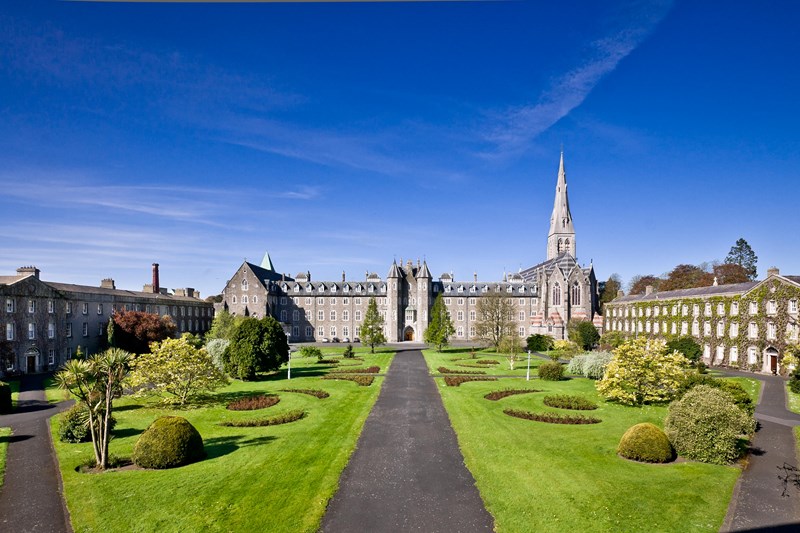
First, here are a couple of pictures of St Patrick’s College, where I am staying. My room is on the top floor, to the left in the wing that juts forward from the main building. The chapel (with the spire) is on the other side.

The building I’m in forms the most impressive side of a quadrangle, one other part of which you can see in the second photograph.

St Patrick’s College was founded in 1795, and its style could best be described as Gothic Revival. It was in fact built as a theological college with funds supplied by King George III. There was a political reason for his largesse. Roman Catholicism was brutally suppressed in Ireland during and after the Eleven Years War in the mid-17th Century, culminating in the vicious subjugation of Ireland by Oliver Cromwell. In effect, the Catholic Church in Ireland was outlawed. Starting from about 1766 some of the restrictions on Catholics began to be removed, but there were no institutions in Ireland capable of training priests so all of those wishing to join the priesthood had to study abroad, primarily in France. George was worried that this would lead to an influx of priests whose heads were filled with revolutionary ideas from the continent, so he decided to fund a place where they could be taught in Ireland, where at least there could be some control over their education.

The old theological college of St Patrick (the `Pontifical University’) forms the core of what is now the South Campus of Maynooth University. Some of the old buildings here seem to take their names from the components of the old Liberal Arts degree: there is a Music House, Logic House, Rhetoric House and so on.

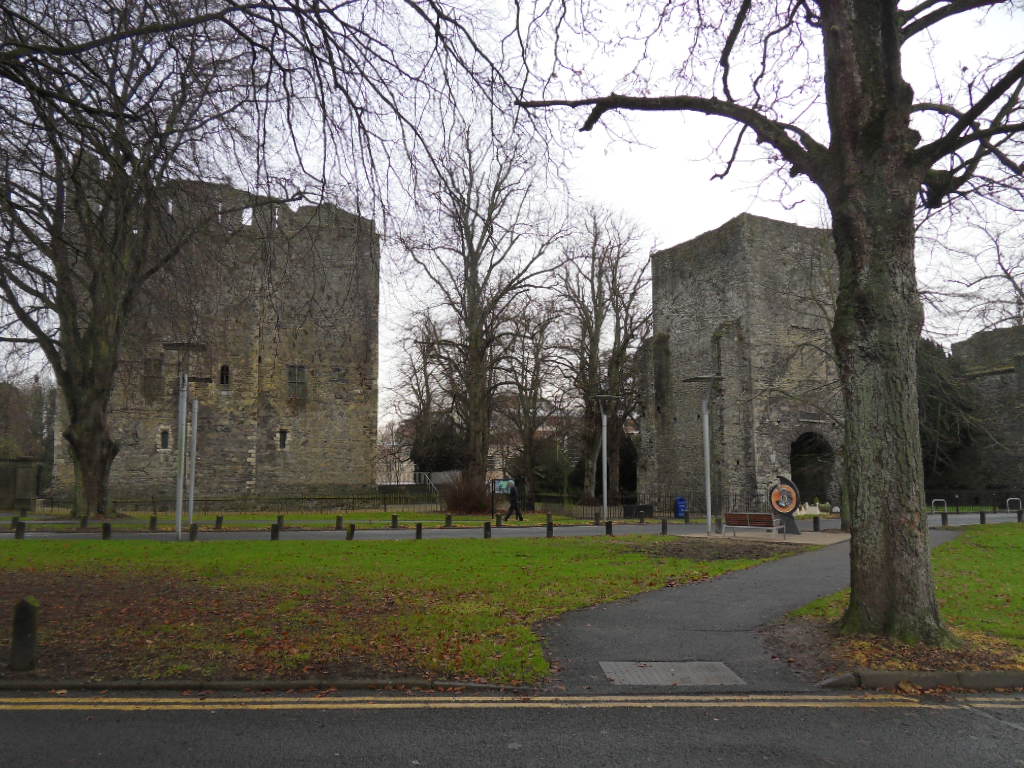
Next the entrance to the South Campus you can see this:

These are the remains of Maynooth Castle (or Geraldine Castle, after the Fitzgerald family), built around 1200. It was a huge and imposing fortress but now only the gatehouse and solar tower remain. It has violent history: heavily damaged in 1535 by siege cannons, its garrison surrendered only to be summarily executed. Rebuilt in the 1630s, it was destroyed completely in the 1640s during – you guessed it – the Eleven Years War. It has been a ruin ever since, but provides an intriguing entrance to the campus!

I’m by no means an architectural expert but I had a hunch that the Church (above) that stands opposite the Castle on the other side of the road leading into campus might also be quite old. Indeed it is. It was built in 1248 as the chapel to Geraldine Castle. It is now an Anglican Church, still used for regular worship.

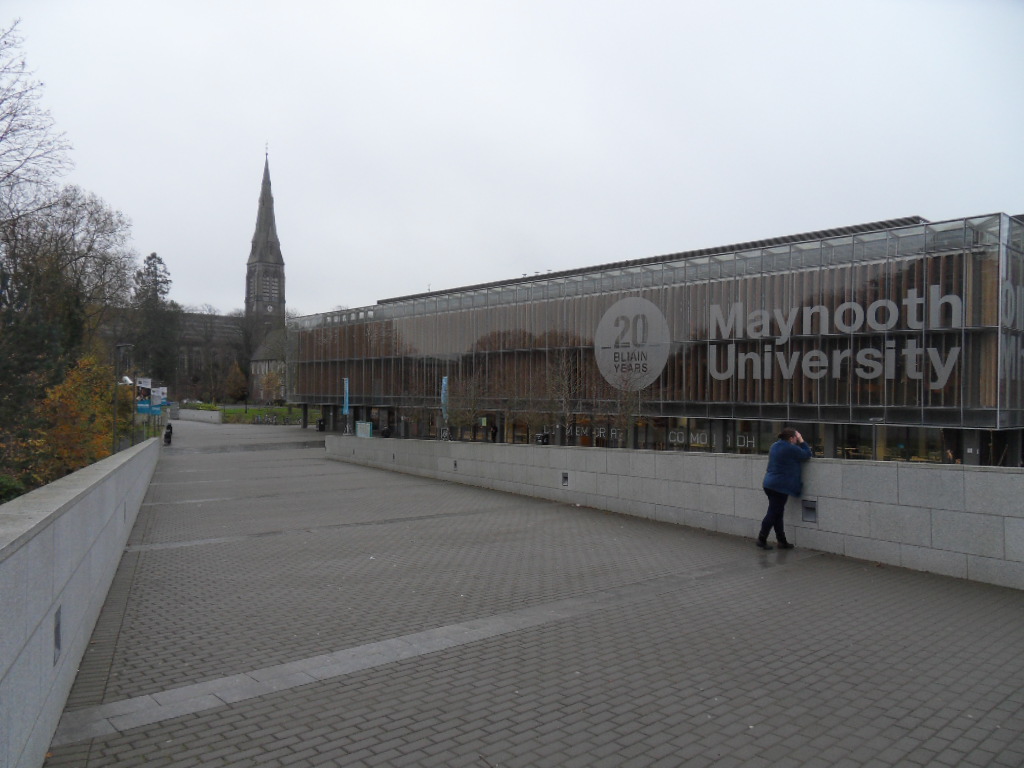
The South Campus is separated from the North Campus (where the Science Building and other modern facilities are) by a main road. The North Campus is very new, most of the buildings are less than 20 years old. Here’s a picture showing the splendid library, with the spire of the chapel of St Patrick’s College in the background.  This is one of the few newer buildings on the South Campus: the pedestrian path you see leads to the main road that splits North and South Campuses.


A Message from Maynooth

Posted in Biographical with tags , , on December 1, 2017 by telescoper

Today I started a new job, as Professor of Theoretical Physics in the Department of Theoretical Physics at Maynooth University, in County Kildare in the Irish Republic.

I haven’t resigned my job at Cardiff University. I’m currently employed there only half the time – or at least that’s what my contract says! – and I’m joining Maynooth on a 50% basis also so I can do one job alongside the other. In particularly I will be teaching in Cardiff next semester as planned.

Although I will be sharing my time equally between Wales and Ireland for the immediate future, I do intend to relocate fully to Ireland, as and when this becomes practicable and can be done in such a way as to not have any impact on ongoing activities in Cardiff.

I’ll post more about Maynooth in due course, but today is filled with organisational things: getting on the IT system, arranging tax and related matters, and finding somewhere to live. In the meantime I’m staying in St Patrick’s House, part of the Catholic seminary on Maynooth University’s South Campus. It’s a lovely building, with rooms that are basic but clean, comfortable and very inexpensive. It was too dark when I arrived last night to take a picture of the place but here’s one from the net:

It’s not quite as summery at the moment, either. It was very cold when I arrived last night and that has continued into today. I will take a snap at some point, but there was a rather ugly-looking crane at the front of the building and would prefer to take a picture when it has gone!

I’ve never been in a seminary before. Although everyone I’ve met here has been wonderfully nice and friendly, I have to say the corridors have more than a hint of The Shining about them:

Anyway, that’s all for now. I hope to have some time at the weekend to have a look around Dublin, which is only 30 minutes or so away by train from Maynooth, and where I may end up living in the not-too-distant future!


Workie Ticket 

Posted in Biographical with tags , , on November 19, 2017 by telescoper

As part of a (very) occasional series of posts relating to words or phrases originating in the North, I thought today I would introduce you to the Geordie expression “workie ticket” (or “worky ticket”), which means a troublemaker or disruptive or otherwise irritating person. 

I believe the expression derives from members of the armed forces who would be deliberately insubordinate or incompetent or misbehave in some other way in order to get themselves discharged and sent home, ie to work their ticket home. 

This phrase was particularly applied to people on National Service, many of whom would rather have been elsewhere and some of whom did their best to get thrown out. It was also used when I was at school in reference to stroppy or disruptive pupils.

I haven’t heard the phrase used in anger (so to speak) for many years, and I don’t know if it is still in common use in Newcastle, but it has popped into my mind on a number of occasions in reference to University staff or students. I couldn’t possibly mention any names…

The threads of an old life

Posted in Biographical, Film with tags on November 18, 2017 by telescoper


Landing on the Nose

Posted in Biographical with tags , , , on November 14, 2017 by telescoper

The other day I noticed a story about a plane carrying 53 passengers that did an emergency landing at Belfast airport. Here is a picture from that link:

The story caught my attention for a couple of reasons. One is that the airline and type of plane (a Bombardier Dash 8 Q400) were exactly the same as the one I took from Cardiff to Dublin a few weeks ago. The other is that something very similar happened to me many years ago, on a trip to America. That event may even have involved the same type of plane, as it was a twin turbo-prop, but in my memory the one I was on was a bit smaller than the one shown above. I don’t remember the name of the airline either (though it might have been the now-defunct US Airways) but it was taking me to State College (Pennsylvania, USA), from either Pittsburgh or Philadelphia, for a meeting at Penn State University. I’m not sure of the year, either, but it must have been around 1990.. I’m not sure of the year, either, but it must have been around 1990. From all that you can infer that my memory isn’t all that good, but I do remember the details of the emergency landing extremely well!

We were approaching State College when I noticed that the plane started circling around the airport, which was visible below. Circling prior to landing owing to air traffic restrictions is not an unfamiliar experience for anyone coming into land at, e.g., London Heathrow, but State College airport is in a fairly remote location in rural Pennsylvania so a problem with the air traffic seemed unlikely. Eventually the pilot came onto the intercom and explained that there was a problem with the undercarriage under the nose of the aircraft and we would have to make an emergency landing. The circling was an attempt to use up fuel to reduce the risk of fire on landing. The dozen or so people on the plane seemed quite scared as the pilot explained the procedure, including the brace position to be assumed when was making its landing.

As it happened, I was seated in a window seat next to the emergency door on the port side near the front of the aircraft so it would be my job to open it and get out quickly to let everyone else get out. As we came into land I studied the instructions over and over again. I am not a particularly courageous individual, and I think having that to concentrate on is the best explanation for why I actually didn’t feel all that scared. I was too busy concentrating on the task at hand to let anything else into my head.

Soon we were coming into land. I could see fire engines from their lights flashing either side of the runway as we came down. The pilot shouted “BRACE! BRACE! BRACE!” as the plane touched down on the wheels under the wings, and was a sharp deceleration as the braking systems were deployed. When we were moving sufficiently slowly the pilot dropped the nose, the plane dipped forward and there was a scraping sound as the plane veered to port. It tilted again which I (correctly) assumed was because it had left the runway and was on the grass verge.

The shout came `OPEN THE DOORS’ and I followed the instructions to the letter, turning the handle, pulling the door towards me so it detached and then flinging it out of the aircraft. It worked like clockwork. I felt like a hero, but that sense of pride soon vanished. Forgetting that the plane had tipped forward, I misjudged the step onto the emergency chute that had deployed and, instead of proceeding in an orderly fashion, I tripped on the way out and fell flat on my face. Fortunately, it was not far down to the ground from the door and it had been raining so I fell onto wet grass rather than concrete. I picked myself up and followed the instructions of the firemen to get the hell away from the plane. I’m sure they were laughing as I ran past them to safety.

The plane was safely evacuated and nobody was hurt. Nobody else got covered in mud like I did either…

Later on I got to know a guy who worked on safety training for cabin crew at British Airways. He told me that one of the most important things about an emergency situation on an aircraft is to give the passengers something to do to keep them occupied. That is the best way to prevent panic. It certainly worked with me!

Dead Lock

Posted in Biographical, Cardiff with tags , , on November 7, 2017 by telescoper

Well, as if I didn’t have enough to do these days, yesterday I managed to lock myself out of my house. Monday not being one of my regular work days (I work part-time at the moment), I had a leisurely morning in, eventually toddling around to the corner shop (Pontcanna Stores) to buy a newspaper and use the Post Office (which is inside the store) to send some correspondence overseas. 

I locked the front door as I left the house, which I always do. The door is fitted with a dead lock so it can be neither locked nor unlocked without using the key. That means I can’t lock myself out by leaving the key inside the house.

However, returning back to my house, I attempted to open the lock with my key only to find, to my dismay, that, although the cylinder within the lock seemed to rotate correctly, the door didn’t unlock. I tried dozens of times to no avail. I was stuck outside with no obvious way to get into the house. I didn’t have access to any tools, and didn’t have my phone either so I was at a loss to know what to do. Eventually I decided to return to the shop to ask if I could use a phone to call a locksmith. 

The shopkeeper (Mr Patel) would have none of it, arguing that a locksmith would cost me a fortune, and instead mobilised his handyman, Mike, who was working upstairs in the flat above the shop. Mike came with me to my house and, after quite a struggle, he managed to get the door open without having to damage the door or frame. I was mightily relieved. I might add that he also refused my offer of payment…

Looking at the lock it after removing it from its door it became obvious what had happened. Something had gone wrong with the mechanism inside the lock which meant that, although the key rotated the action, it didn’t engage the bolt fully which resulted in the bolt not being properly withdrawn from the rebate on the hinge. It’s an old lock so it was probably just internal wear and tear, and, the likelihood being that it would recur every time I used it, I had no choice but to remove the lock so I could try to find a replacement. There is another lock on the door, so it would be fairly secure until I fitted another dead lock, the old dead lock being dead.

Mike suggested I take it to the local hardware shop to find another lock that matched. I did so but he didn’t have an exact fit. Also I had – stupidly – omitted to take the plate from the front of the lock which had the name of the manufacturer written on it. He offered to sell me a new lock (c. £15) and fit it for £20. That seemed a pretty good deal, but he did suggest trying a specialist shop (not far from where I work). Putting a replacement lock into the space vacated by removal of the old one would be much easier than cutting a bigger hole in the door to hold a lock of different size. The man in Cardiff Lock and Safe Co Ltd managed to identify an identical lock but didn’t have one in stock. He ordered one that I can collect tomorrow, and I should be able to mend it then.

I’m posting this not so much because of the little crisis about the dead lock, but to say thanks to all those who helped me out yesterday. It makes a big difference living in a friendly community where people help each other out. Sadly, though, Mr Patel is selling up the business he has owned for over 30 years and it is being taken over by the Coop as yet another mini supermarket.

The Emerson Quartet

Posted in Biographical, Music with tags , , , , , on November 3, 2017 by telescoper

It’s been an enjoyably rich week for me in terms of cultural pursuits, rounded off in fine style last night with a visit to the Royal Welsh College of Music and Drama for a concert by the Emerson String Quartet of music by Purcell, Britten and Beethoven. On Wednesday I made the mistake of going to a concert without having had any food, so this time I sampled the bar menu at the College before the performance. Very nice fish and chips, with very prompt service.

The first half of the concert consisted of three pieces by Henry Purcell, the Chacony in G Minor and two Fantazias (in D Minor and G Major, respectively). The Chacony (from the Spanish `Chacona’ via the French `Chaconne’) is a set of variations over a ground bass, while the Fantazias have a much freer structure with the instruments often mimicking vocal lines. This was followed by the String Quartet No. 2 in C by Benjamin Britten, the last movement of which includes a Chacony as a deliberate homage to Purcell (whose music Britten admired enormously). It was actually written to commemorate Purcell’s death (on 21st November 1695). Overall, though, this is more reminiscent of the approach of Britten’s friend Dmitri Shostakovich. It is full of jagged figures emerging from a background that alternates between dark and frenetic.

After the interval wine break, it was time for one of my favourite pieces in all music, the sublime String Quartet No. 15 (in A minor) by Ludwig van Beethoven (Opus 132). I’ve loved this piece for many years and it became even more special to me five years or so ago when I was recovering from illness. Until last night, though, I had never heard it live.

This is a long work, taking over 40 minutes to perform, dominated by the central third movement, which is headed with the words

Heiliger Dankgesang eines Genesenen an die Gottheit, in der lydischen Tonart

I take the liberty of translating the first two words, using my schoolboy German, as “A Holy Song of Thanksgiving”; Beethoven wrote the piece after recovering from a very serious illness which he had feared might prove fatal. The movement begins in a mood of quiet humility but slowly develops into a sense of hope and deeply felt joy. The most remarkable  thing about this movement to me, though,  is that the music seems to possess the same restorative powers that it was written to celebrate. I certainly found it extremely therapeutic when I was unwell.

Hearing the whole piece live has a much greater impact than hearing one movement on record, and I have to admit I found last night’s performance quite overwhelming. Judging by the rapturous applause from the audience in the Dora Stoutzker Hall, I think a great many people realised that they had just heard something very special.

Music from three very different periods, by three very different periods, all played beautifully with great passion and imagination. What more could you ask for?

Well, we did get something extra – an encore in the form of one of Dvorak’s Cypresses (No. 7 to be precise):

The Hallé at St David’s

Posted in Biographical, Music with tags , , , , , , on November 2, 2017 by telescoper

Last night, as part of an ongoing effort to enjoy as much culture as I can while I still have the chance, I went to St David’s Hall in Cardiff for a concert of music by Ravel, Debussy and Mussorgsky given by the Hallé Orchestra under the direction of Sir Mark Elder. It was a wonderful programme of music, performed with all the colour and verve and professionalism you’d expect from the Hallé.

First up we had the Rapsodie Espagnole, one of Ravel’s first compositions for the full orchestra (although in the original version was for two pianos, he orchestrated it a year after that version was published). For a piece of only about 15 minutes duration its four movements are full of changes of mood, tempo and tonality, which makes it a great piece to warm up both orchestra and audience.

Following that, we had the gorgeous Première Rhapsodie for orchestra and clarinet soloist by Claude Debussy. Written just a couple of years after the Ravel, and inhabiting a similarly impressionistic sound world, this was originally as a test piece for clarinettists at the Paris Conservatoire. The solo part was played with great agility and feeling by young Spanish musician Sergio Castello López. I’d never noticed before how similar the way the clarinet ends this piece is to the opening statement of Gershwin’s Rhapsody in Blue, written about 14 years later…

And then it was time for Ravel’s little inspiration, Boléro, which is easily his most famous composition despite the fact that, as Ravel himself put it, `it has no music in it’. What he meant by that is that it doesn’t have any variation or thematic development or invention, but was written deliberately as an experiment to see how far he could get in writing a work that was entirely based on rhythm and repetition. The result was a smash hit and earned him a very great deal of money, but he grew to resent the fact that it was so much more popular than the other works he himself thought were much better. I know some people who hate this piece, but I think it’s great fun and always enjoy hearing it. Last night was no exception.

The composition of Boléro is so simple that even a non-musician like me can play it. It’s basically written in a slow 3/4 time signature on which is superimposed the following figure:

The second part is basically a repeat of the first, with the last two eighth notes replaced with triplet. The whole pattern consists of 24 notes. I once tried to count how many times it is repeated in a performance of Boléro, but gave up when I got to 100. I think it must be over 200 times.  This figure is introduced first on a single snare drum, which carries on playing it for the duration, i.e. for about 15 minutes in total. As the piece develops the same pattern is picked up by various other instruments, either alone in combination. A second snare drum joins in too. The key to the piece is to keep this all very strictly in tempo, as the piece gradually gets louder.

As I’ve mentioned before on this blog, my Father was a (jazz) drummer. I remember once borrowing his snare drum and attempting to play along with a recording of Boléro. The pattern shown above is not that hard to play in itself, but it’s not as easy as you probably think to keep in tempo as you play it louder and louder. At the start it’s fine: you begin by tapping the sticks on the skin of the drum very close to the rim. To increase the volume you gradually move the point of impact closer to the centre of the drum, which naturally makes it louder. However, to get louder still you have to increase the distance the sticks move, and that makes it tougher to keep to tempo. Playing along at home is one thing, but playing the percussionist playing this in an orchestra must leave the drummer feeling very exposed. One mistake, any speeding up or slowing down, and the whole performance will be ruined.  Percussionists very often have little to do for long passages in an orchestral work, but this takes it to the opposite extreme. It requires constant concentration, but no variation or embellishment is allowed.  I suppose professional musicians just get into the zone and don’t think about the possibility of screwing up. Last night, Principal Percussionist David Hext looked as relaxed as anyone I’ve ever seen starting this piece and seemed even to be enjoying it too, thoroughly deserving the warm applause he got at the end of the performance.

The bolero rhythm is just one element of the composition, of course. There is a melody, in two parts. The first simple and catchy, the second bluesier and a bit syncopated. Each part is played twice, passed around the instruments of the orchestra, first individually and then in combinations. Sometimes the melodic line is doubled, but there are no complicated harmonies and the piece stays in C major throughout, apart from a sudden change of key near the very end. The second part of the melody allows the musicians to release their inner jazz a bit, playing behind or across the beat to generate the feeling that the tune is trying to escape the confines of the incessant rhythm. As is the case in jazz, this sense of tension only works if the basic rhythm is kept strictly in tempo as the crescendo builds

The third element of the composition is the simplest of all, but I feel that it is very important in determining whether a performance of Boléro really rocks. That is a rhythmic pulse based on the three beats of the underlying 3/4. When they’re not playing the melody or shadowing the bolero pattern, the orchestra play this figure and it ends up being boomed out by the timpani in tremendous style but also as the piece progresses the stress shifts between the three beats as different instruments contribute.

I know it’s a familiar piece but I really enjoyed last night’s performance. I’ll also reiterate that as well as making a great sound, a full symphony orchestra playing during a piece like this is a tremendous thing to watch, especially with the percussion section giving it some good old-fashioned welly.

Anyway, after the ensuing wine break interval we resumed with Mussorgsky’s Pictures at an Exhibition (as orchestrated by that man Maurice Ravel).  I remember studying this in music lessons at school,as it was one of the teacher’s approved works. He never told us, however, that the `pictures’ concerned were not large-scale canvases but tiny drawings and design sketches done by one Victor Hartmann, whose sudden death led to the exhibition in question but also affected his friend Mussorgsky very deeply and inspired him to make a musical tribute based on the artwork displayed therein. Mussorgsky thus wrote the piano version which was then subsequently orchestrated by Maurice Ravel.

This is another extremely popular piece, also for good reason. It’s a set of ten movements linked by a `Promenade’ theme that represents the viewer walking around the exhibition (in different moods determined by the pictures). It ends with the most famous section, the magnificent Great Gate of Kiev which provided a suitable finale to a most enjoyable and varied evening of music.

From the House of the Dead in Southampton

Posted in Biographical, Opera with tags , , , , , on October 25, 2017 by telescoper

It has been very hectic around here since I got back from India last week, so I’ve only just found time to do a quick review of Welsh National Opera’s production of From the House of the Dead which I saw last Friday at the Mayflower Theatre in Southampton. I was away for the two performances of this Opera in Cardiff earlier this month and when I mentioned to a couple of friends of mine from London that I was hoping to catch it while it was on tour we decided to compare diaries and see if there was any way we could go together. And so it came to pass that we all ended up in Southampton, me returning to Cardiff through Storm Brian the next day, and Joao and Kim flying off to Cape Verde for two weeks from Gatwick Airport.

Anyway, to the Opera. From the House of the Dead is by Leoš Janáček, and is based on the autobiographical novel of the same (or similar) name by Fyodor Dostoyevsky. It is set in a Siberian prison, in one such establishment Dostoyevsky himself spent four years of his life. It’s a grim story that starts with the arrival of a nobleman, Goryanchikov, to start his sentence. He is stripped of his fine clothes, beaten and tortured, then joins the wretched ensemble of captives until he is unexpectedly released at the end of the Opera. In between the prisoners take turns to describe their life stories, holding on to the past as people do who perceive that they have no future. There is little plot other than this series of narratives apart from a quasi-comic interlude provided by an Easter `show’, in the form of a pantomime. The work is in three relatively short acts which, in this production, run together without an interval. The whole performance lasts about 90 minutes. The picture above, taken during a previous run of this production in Finland, conveys the look and feel of this revival of a production by David Pountney that was first performed in 1982.

From the House of the Dead was written in the last years of Janáček’s life and was not performed until two years after his death. It opens with a prelude that reminded me a lot of his superb String Quartet No. 2 (`Intimate Letters’), written around the same time (1928) but whereas that work is about the nature of love, this Opera is about loneliness, isolation and brutality. The musical score is very rich and varied, but the vocal lines rather constricted, as if to emphasise the sense of captivity. It’s also really an ensemble piece rather than one in which the principal vocalists stand out from the chorus. This works very well for Welsh National Opera, as the chorus of WNO is exceptional. The Orchestra, under the direction of Tomas Hanus (himself a native of Brno, where Janáček lived for much of his life), played superbly, bringing out the subtleties of the orchestration by adding contrasting notes of optimism and hope to the intense, unrelenting darkness.

In short it was well worth the trip to Southampton, even if it did take me five hours to get home via two trains and a rail replacement bus service. This production has deservedly been very positively reviewed in the national media and I strongly recommend you see it during one if its remaining dates, in Oxford, Birmingham, Bristol or Llandudno.

Prize Port

Posted in Biographical, Crosswords with tags , , on October 20, 2017 by telescoper

Way back in July I went to the Third Day’s Play of the Test Match between England and South Africa. On the way to the ground I bought a copy of Money Week, a publication I have never read before, as requested by my old friend and regular commenter on this blog, Anton, who got the tickets for the match. During a lull in the play we did the crossword in the magazine, which was a not-too-difficult thematic puzzle. When I got back to Cardiff I posted off the solution, as a prize of a bottle of vintage port was on offer. Not hearing any more, forgot about it.

When I got back from India this week there was a card waiting for me saying that ParcelForce had attempted to deliver a package while I was away. This morning I went to the main post office to sign for it and pick it up. This is what I got:

I don’t know why it took so long to deliver the prize but it makes a nice change from the usual dictionaries!