Archive for the Biographical Category

The Cuts in UK Higher Education

Posted in Biographical, Cardiff, Education, Maynooth, Politics with tags , , , , on November 28, 2024 by telescoper

Today friend of mine send me a message pointing out that in order to save money the University of Sussex is planning to make about 300 staff redundant; you can see an article about it in the Times Higher here. For the time being it seems the plan to make these savings via a voluntary severance scheme. I don’t know whether academic and administrative staff will be treated equally, either.

This is grim news. I worked at Sussex from 2013 until 2016 when I resigned my post as Head of School of Mathematical and Physical Sciences. I took that decision largely for personal reasons but there were professional reasons too. From 2013 the University had embarked on an ambitious growth plan based on buoyant student numbers and the fee income generated thereby. Staff numbers grew too, to cope with the increased demand for teaching. Unfortunately the management was unable to match this with real improvements in infrastructure, largely due to the disastrous outsourcing of campus estates and services. Many promises made to me as Head of School by Senior Management were broken. I wasn’t the only Head of School to compain of this, either. Although things were still going relatively well when I left in 2016, and I was optimistic for the future of the School then, there were severe risks to its financial stability if student recruitment dived. Sadly, that’s exactly what happened. Falling student numbers – especially from overseas – left the institution very vulnerable, especially since the fee per student did not change. That problem was exacerbated by a burst of inflation. AlthoughIt has clearly been a very difficult time for the University of Sussex, largely due to national and international forces beyond its control, but exacerbated by ineffective, and at times incompetent, institutional management. It should be said also that many University leaders enthusiastically embraced the fees-based system that has led their institutions where they are now, though most of them have now departed and left others to carry the can.

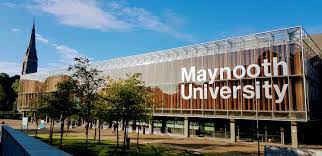
It worries me that Maynooth University is also trying to grow very quickly, without adequate investment in infrastructure especially teaching. It isn’t increasing the number of academic staff much either, preferring to hire more and more managers; yet another such position was advertised this week. I don’t know whether Maynooth’s financial trajectory will follow that of Sussex. The funding environment is very different in Ireland compared to the UK, so it may not. It is clear that the enviroment for education and research here is being steadily degraded by the current leadership.

Anyway, when I saw the announcement about Sussex, I checked other Universities I’ve worked in over the years. There’s a list here. It seems that while there are particular factors at play at Sussex, there are similar difficulties across the Board. Cardiff University has a deficit of £35 million and the VC has refused to rule out compulsory redundancies there. I’m not sure how this is all affecting the School of Physics & Astronomy. Nottingham University, where I worked from 1999 to 2007, has deficit of £30 million, in response to which it has opened a voluntary severance scheme, introduced hiring freezes, cut non-pay budgets, and refused to renew 500 fixed-term contracts.

There certainly are cold winds blowing across the University landscape in the United Kingdom, and there is no sign of any respite. This is just the start.

Machine-based Censorship

Posted in Biographical with tags , , , , , , , on November 25, 2024 by telescoper

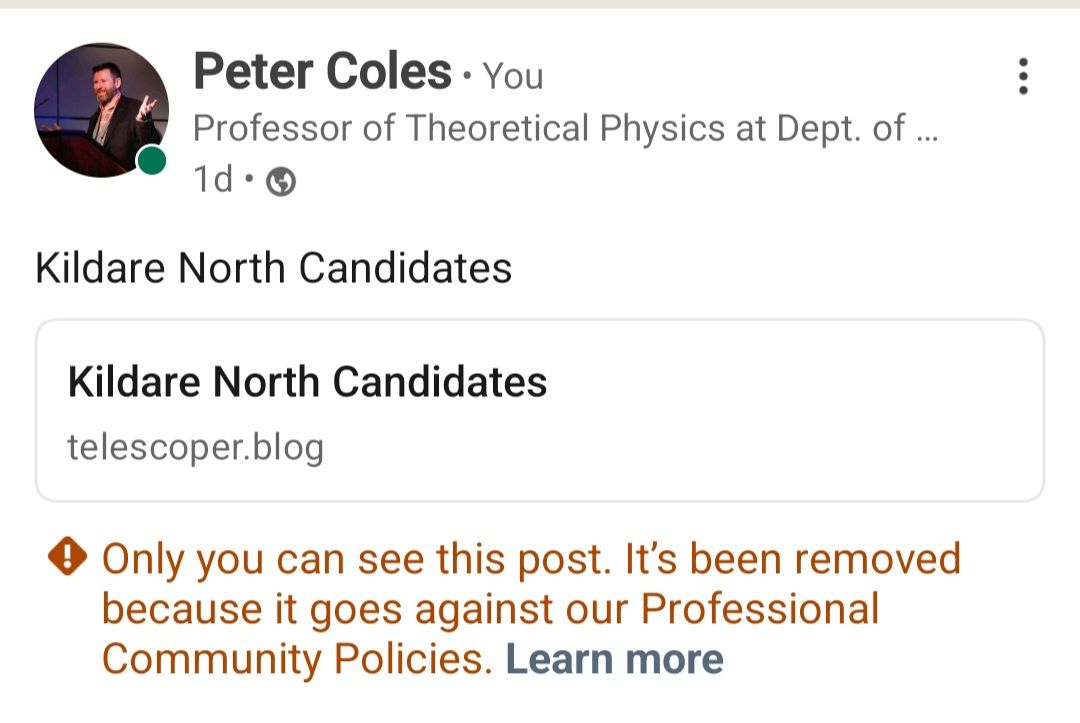
A very noticeable manifestation of the rise of so-called Artificial Intelligence has been the use of AI bots in censoring posts. The most recent example of this I’ve seen was on Saturday when I wrote a post about the general election candidates for my constituency, Kildare North. As usual when I write an article here it gets posted automatically on a variety of other platforms, including LinkedIn. However, Saturday’s post was blocked:

The powers that be did not tell me which of the “Professional Community Policies” that post might have violated so I looked through them all and couldn’t find any plausible reason for blocking that post. I can only assume some defect in the algorithm deployed by LinkedIn had been triggered wrongly. Unfortunately, all this is run by machine so there is no possibility of appeal.

I’ve noticed quite a few bizarre things like this over the past few weeks. The worst offender when it comes to random censorship is Meta (which runs Facebook, Instagram and Threads). I have been posting content automatically on Meta platforms, Facebook and Threads. Recently, however, Meta’s AI algorithm has gone berserk. A couple of weeks ago it blocked this post (about the Edgeworth family) on the grounds that it violated rules concerning “nudity or sexual activity”. Heaven knows how it decided that; you can read the post yourself. I defy you to find any nudity or sexual activity, or reference thereto, or link to any post that mentions such things, anywhere in it!

When I appealed the decision I got this.

Truly bizarre.

More recently, it blocked this post (one of my regular weekly updates for OJAp) on the grounds that it was identified as spam. I can see the need for an automatic screening given the huge volume of posts, but the problem is that my facebook feed is full of actual spam that gets through these filters while innocent posts get blocked. In other words the algorithm is crap. If you ask for a review of the decision, all Meta does is run the algorithm again – with the same results, which is a waste of time.

The algorithm that screens comments on this blog for spam has also been playing up, with some comments from regular contributors being tagged as spam.

None of these is in itself of any consequence to me personally, not least because I’m not trying to run a business using these platforms. However, such AI engines are being deployed nowadays in a huge range of contexts primarily in order to save money. No doubt such processes do save money, but if they are based on poorly constructed algorithms – which they seem to be – the consequences could be dire. Imagine the horror of a health service based on poorly trained AI…

Weird Statistics

Posted in Biographical on November 19, 2024 by telescoper

I got one of these earlier today.

It hasn’t really been a ‘spike’ because it’s carried on all day. As of now (about 10pm local Irish  time), I’ve had over 7,000 hits today. That’s a lot more than average!

The weird thing is that the traffic isn’t all arriving at the same post, so I’ve no idea what triggered this surge. All I know is that most of the readers are based in the USA.

It’s a mystery!

Another interesting thing is that all those hits are coming from just a few hundred unique visitors. It could, therefore, be that all the extra traffic is from one site, in which case it might be someone scraping the content for AI purposes…

Update: the blitz lasted three days. Notice how the number of visitors did not go up, only the number of reads.

The Future of Diamond Open Access in Astrophysics

Posted in Biographical, Open Access with tags , , , , , , on November 17, 2024 by telescoper

The Open Journal of Astrophysics is now reasonably well established as a Diamond Open Access journal for the astrophysics community. We have published over a hundred articles so far this year at such a low cost that we can make our publications free to read and to publish. Thanks for all this is due to the volunteers on our Editorial Board, the excellent team at Maynooth University library, who have supported this project for 6 years, to the arXiv, as well of course to the authors who have chosen to publish with us.

Although we have established a good base, we’re still much smaller than the mainstream journals publishing just a few percent of their output. There is no sign of a slowdown at OJAp. Indeed there are signs that pace will pick up. I heard last week, for example, that Oxford University Press (the publisher of Monthly Notices of the Royal Astronomical Society) has decided to cancel the ‘Read-and-Publish’ agreement that allowed authors from Australian institutions to avoid APCs. I imagine we’ll get quite a few more submissions from Down Under thanks to that decision.

Nevertheless, we’ve a long way to go to catch up with the likes of A&A, MNRAS and ApJ in terms of numbers. If activity continues to grow then we will incur greater costs – our provider, Scholastica, charges us per paper. Those costs will still be smaller than regular journals, but I think it’s unfair that the expense of running a journal that serves the global astrophysics community should fall entirely on one small University in Ireland.

Expense is only one issue. I never envisaged that OJAp would be unique. It was more intended to be a proof of concept. I would like to see a range of Diamond Open Access journals offering a choice for authors and serving different sub-disciplines. Most universities nowadays have publishing operations so there could be network of federated journals, some based on arXiv and some based on other repositories. Perhaps institutions are worried about the expense but, as we have shown the actual cost, is far less than they are wasting on Article Processing Charges. I rather think it’s not the money that is the issue, just the unimaginatively risk-averse thinking in what passes these days for university management.

There are two simple – but not mutually exclusive – possibilities.

One is that astrophysics institutions club together and donate funds not only to keep OJAp going, but also to allow us to invest in improvements. A donation equivalent to the cost of just one APC for a typical journal would help us enormously. We do actually get some donations already, but more would always be welcome. In the long run, an investment in Diamond Open Access would pay back many times in savings; OJAp has already saved the worldwide community over £500,000.

The other is that other members of the community follow the lead of OJAp and set up their own journals. I wouldn’t see others as much as competitors, more as allies with community-led federated system. In the light of the OUP decision mentioned above, why don’t Australian research institutions set up their own version of OJAp? I’d be happy to discuss how to start up such a journal with anyone interested.

If you would like to discuss either of these possibilities please use the comment box below or email me here.

P.S. There is another issue concerning the future of OJAp, which is that I will be retiring in a few years, but now isn’t the time to discuss that one!

Social Media Better than Meta

Posted in Biographical with tags , , , , , , on November 16, 2024 by telescoper

You may or may not know that these blog posts appear automatically on various social media platforms.

I have been posting content automatically on Meta platforms, Facebook and Threads. Recently, however, Meta’s AI algorithm has been randomly blocking posts. A couple of weeks ago it blocked this post (about the Edgeworth family) on the grounds that it violated rules concerning “sexually explicit content”. Today it blocked this post (the weekly update for OJAp) on the grounds that it was identified as spam. I can see the need for an automatic screening given the huge volume of posts, but the problem is that my facebook feed is full of actual spam that gets through these filters while innocent posts get blocked. In other words the algorithm is crap. If you ask for a review of the decision, all Meta does is run the algorithm again – with the same results, which is a waste of time.

I haven’t got time to waste on such stupidity so I will shortly be deactivating automatic posts to Facebook and Threads; these generate very little traffic for me anyway.

There are, however, plenty of alternative ways of following this blog. You can subscribe by email or by RSS feed for a start. On other social media platforms I recommend the federated version on Mastodon here:

https://telescoper.blog/@telescoper.blog

They also appear on my personal Mastodon account here:

https://mastodon.social/@telescoper

Posts also appear on LinkedIn here:

https://www.linkedin.com/in/peter-coles-911912216/

and on my BlueSky account:

https://bsky.app/profile/telescoper.bsky.social

WordPress has just set up an automatic integration with BlueSky, on which I now have over 3000 followers, which is nice, but any one of these is better than Meta!

Midpoint at Maynooth

Posted in Biographical, Education, mathematics, Maynooth with tags , , , , on November 11, 2024 by telescoper

Amid all the excitement last week I forgot that it was the sixth teaching week of the Semester. That means that we’re now past the halfway point. Among other things that meant that examination papers were due in on Friday (8th November). That means two papers for each module I’m teaching, one to be sat in January and another for the repeat opportunity in August, so that’s four altogether.

I always find setting examination questions very difficult. In theoretical physics we want to stretch the stronger candidates at the same time as allowing the weaker ones to show what they can do. It’s a perennial problem how to make the questions neither too easy nor too difficult, but it is compounded this time by the fact that I’m teaching two modules for the very first time so judging the right level is tricky.

Another issue is that I’m once again in a situation in which I have to set examination papers without having taught all the material. At least I’ve covered the first half of the content so I have some idea of what the students found difficult, but that’s not the case for the second half. It should be a bit easier next year once I’ve experience of covering the whole syllabus. Assuming, of course, that I’m teaching the same modules again next year, which is by no means guaranteed…

I’m teaching a module on Differential Equations and Complex Analysis for 4th year students and just about ready to switch to the part that comes after the and. I taught a bit of Complex Analysis when I was at Sussex and I’m quite looking forward to it, although it does pose a particular challenge. Some of the class are doing a Double Major in Theoretical Physics and Mathematics, and have done quite a lot of Complex Analysis before, while others are doing a Single Major in Theoretical Physics and haven’t really done any. I have to somehow find a way to satisfy these two different groups. The only way I can think of to do that is to teach the subject as a physicist rather than a pure mathematician, with an emphasis on examples and real-world applications rather than in the abstract. We’ll see how this works out over the next few weeks.

P.S. On the subject of Complex Analysis, I just remembered this post from a few years ago.

Developmental Review

Posted in Biographical, Maynooth with tags , , on November 8, 2024 by telescoper

Today I attended a (mandatory) training workshop relating to the Developmental Review, a process which is aims to “help to align the objectives of the Reviewee with the goals of the Unit* and with those of the University” and “to develop the capability of all staff, by focussing on the employee’s current role and their future career plans”. In other words, it’s a Staff Appraisal scheme.

Basically the reviewee discusses goals for the next couple of years with the reviewer and identify any training or other needs that would help achieve those goals. The two meet again at the end of the review period to see whether the goals have been reached and agree aims for the next couple of years. And so on.

I have, in a previous existence, been involved with conducting appraisals as a reviewer as well as participating as a reviewee, and found the experience reasonably positive because it is reviewee-led and focussed on career development rather than being tied to pay. This time round, however, the only career development goal on the horizon for me is retirement so I’m not sure I’ll get much out of it unless someone can suggest a way of bringing the date forward…

*Don’t ask me what “the goals of the Unit” are. I have no idea.

Trinity Talk

Posted in Biographical, LGBTQ+ on November 1, 2024 by telescoper

Today I gave the inaugural EDI Seminar at the Department of Physics of Trinity College, Dublin, in the Lecture Theatre formerly known as Schrödinger. I wasn’t sure what to expect ahead of the event, but it was nice to see a large and attentive audience. At the end I was given the above book and whisked off to a pleasant lunch followed by a chat with some of the PhD students.

I’m going to a concert at the National Concert Hall later this evening. It being a mild evening, and there being no point making a trip to Maynooth and back,  I decided to walk around Dublin for a bit.

Management Memes

Posted in Biographical, Maynooth on November 1, 2024 by telescoper

I’m out all day giving a talk at the College of the Holy and Undivided Trinity of Queen Elizabeth, near Dublin, so in lieu of a proper post here’s another Management Meme.

Saving Time Again

Posted in Biographical, Maynooth with tags , , , on October 27, 2024 by telescoper

It’s Sunday 27th October 2024 and in the early hours of this morning the clocks went back, bidding goodbye to Summer Time. You can tell I’m an oldie because I have quite a lot of time-keeping devices around the house that need to be set by hand. My computer updates itself, of course, but I’m not sure if WordPress does. I’ll find out when I publish this post!

I’ve written before about the silly business of moving the clocks backwards and forwards (e.g. here) so I won’t repeat it all again. I will mention, however, that some time ago, before the Covid-19 Pandemic, the European Parliament approved a directive that would abolish `Daylight Saving Time’.  Unfortunately that plan has been ‘paused’ and there’s no sign of it happening for the foreseeable future.  I’ve long felt that the annual ritual of putting the clocks forward in the Spring and back again in the Autumn was a waste of time effort, so I’ll be glad when this silly practice is terminated. It would be far better in my view to stick with a single Mean Time throughout the year. I’m disappointed that this hasn’t already happened.

Anyway, talking of time, we have now completed five weeks of teaching in Semester 1 at Maynooth University. Tomorrow (Monday 28th October) is the October Bank Holiday and next week is Study Week so there are no lectures or tutorials. When I took the train into Dublin on Friday evening I noticed it was much less busy than during term-time. I think most students had already left for the week.

Bank Holiday Weekend Weather..

Normally Study Break comes halfway through the 12-week teaching term but this year it splits 5-7. Since I’m teaching two new modules this term I am not unhappy to have an earlier break to allow me a bit more time for preparation and to catch up on some correcting, but I am conscious that this is going to make for a longer run-in to the Christmas holiday. We are supposed to teach up until Friday 20th December, on which day I do have a lecture scheduled, though I suspect attendance will be low!

I’m not sure how much studying the students do during Study Week, but it’s not a holiday for academic staff even though there is no undergraduate teaching. Among other things we have examinations to write for the January examination period, which must be checked and printed well in advance. The break from teaching will also allow me a bit of time to work on my retirement plans and figure out how much Time I can afford buy with my Savings…