Archive for the Biographical Category

Potato Head Blues

Posted in Biographical, Jazz with tags , , on June 12, 2009 by telescoper

I’ve just spent several hours ploughing through yet more examination scripts – first year ones, not needed before the finals Examination Board. By way of a bit of refreshment I thought I’d listen to this, and enjoyed it so much I thought I’d share it on here.

At one point in the film Manhattan, the character played by Woody Allen makes a list of the things that make life worth living. This record is one of them. Potato Head Blues was recorded on May 10th 1927 in the Okeh Studios in Chicago by Louis Armstrong and the Hot Seven. It’s not actually a blues, but we won’t quibble about that because whatever it is not it is definitely a timeless Jazz masterpiece.

The other members of the band are Johnny Dodds (clarinet, heard to good effect in the solo before Louis Armstrong), Johnny’s brother Warren “Baby” Dodds (drums), Louis Armstrong’s first wife Lil Armstrong (née Hardin, piano), Johnny St Cyr (banjo), Pete Briggs (brass bass or tuba) and John Thomas on trombone. But the star of the performance is, of course, Satchmo himself, who was at the absolute peak of his powers when this record was made. If you have any doubts about what a musical genius he was, go straight to the point (at about 1:50) where he launches into his famous stop-time solo chorus which is just breathtaking in its power and inventiveness. Built from a succession of dazzling impromptu phrases, it explodes into a joyous climax which is beautifully sustained into the final ensemble chorus that follows.  Enjoy!

Examination Matters

Posted in Biographical, Education with tags , , on June 10, 2009 by telescoper

I made it safely back to Blighty last night and have spent the day catching up on a few things. I wasn’t really planning to post anything today, but after looking through the comments on my previous item I thought it was probably a good idea to move on!

My trip to Copenhagen was carefully timed to miss the mammoth examiners’ meeting that took place yesterday in the Cardiff School of Physics & Astronomy, at which decisions were made about the degree classes of the graduating students. Final results have to be confirmed by the University but, following a longstanding tradition, provisional pass lists went up on the boards immediately after the meeting.

When I came in this morning I was delighted to hear that the meeting went off fairly smoothly and also delighted to see the pass lists had very good news for many of the students I know quite well personally. Particular congratulations to all the students who got First Class Honours, some of whom will be taking another step on the academic treadmill and going on to do PhDs here and there. I’m not really sorry I missed the examiners’ meeting, but I am sorry I wasn’t here to congratulate the soon-to-be-graduates in person.

I remember that when I finished my degree and got the result I didn’t actually feel much euphoria, only exhaustion. When I was younger, exams were always times of enormous stress for me. I guess that’s because, when I first went to School, I was very far behind everyone else and, as one of the “slow” kids, I was almost thrown in the educational wastebin. I gradually caught up but for a long time felt that I was still regarded as a bit of a dunderhead so, to prove I wasn’t a fake,  to myself as much as anyone else, I worked very hard at all the examinations I had to take. It was only when I got to University that I realised all the stress wasn’t worth it. It’s nice to pass but you shouldn’t become obsessed with grades and certificates. Examinations seem to have an almost overwhelming significance when they’re the only thing on your horizon, but years later you will look back on them as being of very little real importance (regardless of whether you did well or not).

My feelings about examinations agree pretty much with William Wordsworth, who studied at the same University as me, as expressed in this quotation from The Prelude:

Of College labours, of the Lecturer’s room
All studded round, as thick as chairs could stand,
With loyal students, faithful to their books,
Half-and-half idlers, hardy recusants,
And honest dunces–of important days,
Examinations, when the man was weighed
As in a balance! of excessive hopes,
Tremblings withal and commendable fears,
Small jealousies, and triumphs good or bad–
Let others that know more speak as they know.
Such glory was but little sought by me,
And little won.

It seems to me a great a pity that our system of education – both at School and University – places such a great emphasis on examination and assessment, to the detriment of real learning. The biggest bane of physics education is the way modular degrees have been implemented. Don’t get me wrong. I’m not opposed to modularisation in principle. I just think the way we teach modules in British university fails to develop any understanding of the interconnection between different aspects of the subject. That’s an educational disaster because what is most exciting and compelling about physics is its essential unity. Splitting it into little boxes, taught on their own with no relationship to the other boxes, provides us with no scope to nurture the kind of lateral thinking that is key to the way physicists attempt to solve problems. The small size of each module makes the syllabus very “bitty” and fragmented. No sooner have you started to explore something at a proper level than the module is over. More advanced modules, following perhaps the following year, have to recap a large fraction of the earlier modules so there isn’t time to go as deep as one would like even over the whole curriculum.

Our students take 120 “credits” in a year, split into two semesters. These are usually split into 10-credit modules with an examination at the end of each semester. Laboratories and other continuously-assessed work does not involve a written examination, but the system means that a typical  student will have 5 written examination papers in January and another 5 in May. Each paper is two hours.

These factors mean that the ratio of assessment to education has risen sharply over the last decades with the undeniable result that academic standards have fallen in physics. The system encourages students to think of modules as little bit-sized bits of education to be consumed and then forgotten. Instead of learning to rely on their brains to solve problems, students tend to approach learning by memorising chunks of their notes and regurgitating them in the exam. I find it very sad when students ask me what derivations they should memorize to prepare for examinations. A brain is much more than a memory device. What we should be doing is giving students the confidence to think for themselves.

You can contrast this diet of examinations with the regime when I was an undergraduate. My entire degree result was based on six three-hour written examinations taken at the end of my final year, rather than something like 30 examinations taken over 3 years. Moreover, my finals were all in a three-day period. Morning and afternoon exams for three consecutive days is an ordeal I wouldn’t wish on anyone so I’m not saying the old days were better, but I do think we’ve gone far too far to the opposite extreme. The one good thing about the system I went through was that there was no possibility of passing examinations on memory alone. Since they were so close together there was no way of mugging up anything in between them. I only got through  by figuring things out in the exam room.

I don’t want to denigrate the success of our high achievers. They have taken the course we have given them and done extremely well. They deserve admiration and praise. What I’m saying is that I don’t think the education we provide does justice to their talents. That’s our fault, not theirs…

Notes from the North

Posted in Biographical, The Universe and Stuff with tags , , on June 8, 2009 by telescoper

Just time for a quick post today. I’m in Copenhagen for a short meeting entitled “Cosmology and Astroparticle Physics from the LHC to Planck“. The meeting only lasts today and tomorrow morning, but it’s been a lot of fun so far and has offered me the chance to chat with a lot of people I don’t often get the chance to talk to.

I suppose the only thing from the meeting I really want to mention in this short post is the  current status of Planck, which is currently about a million km from Earth. Both instruments (the High Frequency Instrument HFI and Low Frequency Instrument LFI) are still performing fine and the satellite,  having now been injected into its rather large orbit around L2, is  cooling down to its operating temperature. So far so good. There will be more tests at the beginning of July, after which it will start its real business of scanning the sky to make maps of the primordial temperature  fluctuations.

Today I gave my (usual) talk about cosmic anomalies (which I’ve blogged about before), but there were also interesting talks about possible interpretation of the positron excess observed in the direction of the Galactic Centre,  on a model of anisotropic dark energy  and a wacky contribution by Igor Novikov about semi-traversible wormholes.

Meanwhile, over lunch and dinner the various European participants of the meeting mulled over the results from the elections to the European parliament which completed yesterday.

The results generally showed a move to the right across Europe. In the United Kingdom this also happened, as the Labour Party’s share of the vote collapsed to just under 16%. I’m not going to shed any tears for them, but I am shamed to admit that my country will now be represented in the European Parliament by two members of the British National Party – a bunch of neo-Nazi thugs who are doing the best they can for their own ends to exploit peoples’ discontent with the mainstream parties. Fortunately their share of the vote (about 6%, on a very low turnout) remained relatively small and was, in fact, less than that of the Green Party. Nevertheless with the 65th anniversary of D-Day only a few days ago, it is depressing that so many people have forgotten the sacrifices that previous generations made to save this country from exactly that  kind of fascist. I hope this disaster is not repeated at the next general election. This kind of monstrosity makes the arcane world of cosmology suddenly seem so irrelevant.

Returning to Lognormality

Posted in Biographical, Science Politics, The Universe and Stuff with tags , , , on June 7, 2009 by telescoper

I’m off later today for a short trip to Copenhagen, a place I always enjoy visiting. I particularly remember a very nice time I had there back in 1990 when I was invited by Bernard Jones, who used to work at the Niels Bohr Institute.  I stayed there several weeks over the May/June period which is the best time of year  for Denmark; it’s sufficiently far North that the summer days are very long, and when it’s light until almost midnight it’s very tempting to spend a lot of time out late at night.

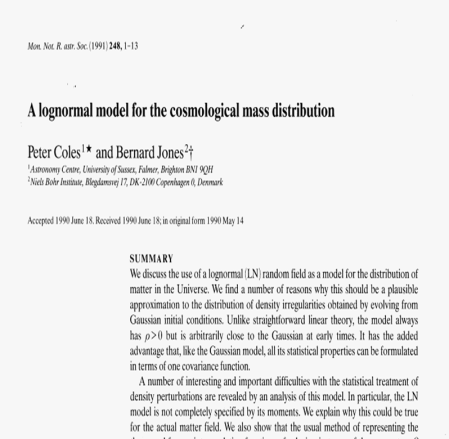
As well as being great fun, that little visit also produced my most-cited paper. I’ve never been very good at grabbing citations – I’m more likely to fall off bandwagons rather than jump onto them – but this little paper seems to keep getting citations. It hasn’t got that many by the standards of some papers, but it’s carried on being referred to for almost twenty years, which I’m quite proud of; you can see the citations per year statistics are fairly flat. The model we proposed turned out to be extremely useful in a range of situations, hence the long half-life.

nph-ref_history

I don’t think this is my best paper, but it’s definitely the one I had most fun working on. I remember we had the idea of doing something with lognormal distributions over coffee one day,  and just a few weeks later the paper was  finished. In some ways it’s the most simple-minded paper I’ve ever written – and that’s up against some pretty stiff competition – but there you go.

Picture1

The lognormal seemed an interesting idea to explore because it applies to non-linear processes in much the same way as the normal distribution does to linear ones. What I mean is that if you have a quantity Y which is the sum of n independent effects, Y=X1+X2+…+Xn, then the distribution of Y tends to be normal by virtue of the Central Limit Theorem regardless of what the distribution of the Xi is  If, however, the process is multiplicative so  Y=X1×X2×…×Xn then since log Y = log X1 + log X2 + …+log Xn then the Central Limit Theorem tends to make log Y normal, which is what the lognormal distribution means.

The lognormal is a good distribution for things produced by multiplicative processes, such as hierarchical fragmentation or coagulation processes: the distribution of sizes of the pebbles on Brighton beach  is quite a good example. It also crops up quite often in the theory of turbulence.

I;ll mention one other thing  about this distribution, just because it’s fun. The lognormal distribution is an example of a distribution that’s not completely determined by knowledge of its moments. Most people assume that if you know all the moments of a distribution then that has to specify the distribution uniquely, but it ain’t necessarily so.

If you’re wondering why I mentioned citations, it’s because it looks like they’re going to play a big part in the Research Excellence Framework, yet another new bureaucratical exercise to attempt to measure the quality of research done in UK universities. Unfortunately, using citations isn’t straightforward. Different disciplines have hugely different citation rates, for one thing. Should one count self-citations?. Also how do you aportion citations to multi-author papers? Suppose a paper with a thousand citations has 25 authors. Does each of them get the thousand citations, or should each get 1000/25? Or, put it another way, how does a single-author paper with 100 citations compare to a 50 author paper with 101?

Or perhaps the REF should use the logarithm of the number of citations instead?

Lulu

Posted in Biographical, Opera with tags , , , on June 6, 2009 by telescoper

On Thursday (4th June) I went to the first night of the Royal Opera’s new production of Lulu, an Opera by Alban Berg. I was planning to blog about this yesterday but after the Opera my birthday celebrations descended into drunken chaos and I ended up getting back very late to Cardiff yesterday; I had to catch up a number of things so I didn’t have time. After the performance and dinner in a nearby restaurant we sat out on Joao’s roofgarden in Notting Hill drinking until the sun started to come up. That part is a bit of blur, but judging by the scale of my hangover yesterday it must have been good. Anyway, I’ve now recovered enough write something about the Opera.

Before Thursday I hadn’t seen Lulu in a live performance, although I do have it on DVD so I knew a bit about it. Berg was a student of Arnold Schoenberg, but he developed his own take on the twelve-tone techniques developed by his mentor. Not everyone finds  serialist music easy to enjoy, but I think if you’re going to have a go at it this Opera is one of the best places to start. I think the score for Lulu is completely wonderful: it’s constantly changing texture, sometimes lushly romantic (with a big  nod in the direction of Mahler in Act I), sometimes bleak and jagged. Sometimes there is no music at all and the singers use a stylised method of vocalisation in between speaking and singing (called Sprechstimme). This  is used only sparingly in Lulu, but it is wonderfully effective dramatically when it is.

The Orchestra of the Royal Opera House, conducted by Antonio Pappano, were absolutely fantastic throughout the performance. I’m no musician but I reckon this music must be extremely difficult to play, especially in the brass section, but they played with great passion as well as flawless precision. They really brought Berg’s music to life, and invested it with a vitality that positively glowed throughout the performance. With playing like this, it was easy to understand why Berg is such an influential composer: you can hear in this Opera the ideas behind many Hollywood movie scores, for example.

So what about the Opera itself? The play revolves around the character of Lulu, an enigmatic figure who is at times innocent and vulnerable and at others cynical and manipulative. Her personality is only revealed to us through her interactions with men, all of which end in disaster. Lulu’s first husband has a heart attack and dies; her second commits suicide. She then shoots another man and is imprisoned but eventually escapes. By the end of the opera, many years later on, she has wound up in London and is living in poverty working as a prostitute. She dies at the hands of Jack the Ripper.

The structure of the Opera is like a mirror, with Lulu’s reversal of fortunes happening after an intermezzo in the middle of Act 2, at the centre of which there is a remarkable musical palindrome (shown above). Before this her role in the drama is to drive the men around her into obsession, madness and death, although she never appears to understand why she has this effect on them. After the dramatic fulcrum of the piece she becomes more and more of a victim. The reason for this is not some great change in her own psychological make-up but just that she is getting older and  losing her looks. No longer sexually desirable, she has lost the only way of controlling the men in her life. From this point on, her decline is inexorable and death inevitable.

The new production is quite unlike the recording I have on DVD in that the staging is resolutely minimal. There is no set, just an occasional translucent screen, the costumes are modern and colours are monochrome. Lulu is dressed at one point  in a black cocktail dress very like that worn by Audrey Hepburn in Breakfast at Tiffany’s. This might have been a deliberate reference to the parallels between Lulu and Holly Golightly (at least in Truman Capote’s novella, which is a much darker concoction than the film based on it); soprano Agneta Eichenholz bears more than a passing resemblance to Audrey Hepburn too. Her slender build -unusual for an opera singer with such a powerful voice – allowed her to play Lulu’s vulnerable aspects very well.

Against a sparse backdrop  the characters emerge as series of grotesques, which – at least in principle – is not a bad way of  presenting this Opera. Set in such a way it appears as a piece of absurdist theatre which is definitely part of what it represents. There are two problems, however.

One is that the sets give very little clue as to the location of the drama: I wouldn’t have known that the last scene was meant to be Victorian London unless I’d seen it before, so Jack the Ripper’s appearance must have been very  confusing to those who hadn’t picked up on that. Lulu is also meant to be a lot older in the last Act, but no attempt is made to age her in this production.  The libretto makes repeated reference to a painting of her, and it serves at the end to remind her of her age, but no portrait ever appears; I found that a bizarre omission.

The other problem is that there are strong links between the story of Lulu and the Grand Guignol  genre of horror plays, with their  opulently macabre  stagings and exaggeratedly gory endings. Throwing all those connections  away robs the Opera of all of its schlock value and, with that, a great deal of the irony needed to make this blackest of black comedies work the way it should. The killing of Lulu in fact happens off stage in this production which makes the ending very tame. I wouldn’t want to go over-the-top in depicting the horror of Lulu’s death – I wanted to see an Opera, not a snuff movie – but the audience should be shocked by the brutality of her final moments; these are the key to what the Opera is about. Perhaps the director was concerned not to let the drama descend into mere titillation. There’s always a danger of crossing the line into vulgar pornography in depicting explicit sexuality and violence, but I think this production is too afraid of taking risks. This opera should feel more dangerous than this setting allows it to be. Ypu’re not meant to feel comfortable about this Opera.

Although limited by the stylized nature of the production, the principals were good. Agneta Eichenholz’s is a  desensitized creature, damaged by abuse and inhabiting a moral vacuum. Her detachment in the face of the death and destruction around her is perfectly judged. She sang beautifully for the most part but – possibly because of first night nerves – her voice came apart on a couple of high notes early on. Other characters worth mentioning are Michael Volle who was outstanding as Dr Schön and Philip Langridge in the dual role of the Prince and the Marquis.

This morning I read Andrew Clements’ review in the Guardian which I thought was a bit harsh: only two stars doesn’t really do justice to a fascinating evening. I would have  given three stars for the quality of the music alone. Personally, I could have listened to the whole thing in a concert performance and still enjoyed it. But having decided to go for a full staging,  it seems to me a bit perverse to have stripped  it down so drastically. Clements claimed he was “bored” by what happened on stage. I certainly wasn’t, but I did find myself more perplexed by the production than by the moral ambivalence of the story itself, so I’d have to say it didn’t really do justice to an Opera which I still think of as masterpiece.

Day of Days

Posted in Biographical with tags , on June 4, 2009 by telescoper

Well, here we are then.

Another birthday.

Actually, this one has been great (so far) and I’m looking forward to the rest of the day. Although it coulded over yesterday evening leading me to think our sunny spell was over, today I awoke to bright sunshine again and it’s stayed the same all morning. The garden looks unkempt but is at least full of flowers and smells, and I had my breakfast outside again before toddling off down to the polling station in St Catharine’s Church Hall to cast my vote in the Elections for the European parliament.

We won’t get the results of that election until Sunday because different European countries are voting on different days and the results are only announced when all polls are closed. I’ll be in Copenhagen on Sunday so will have to catch up on the news from there. Other parts of the United Kingdom are also voting for their local Councils too, and those results will be out tomorrow.

I’m not an expert political analyst but it seems to me these elections could go one of two ways: either the major political parties get a complete drubbing or the population is so disgusted with the political establishment that they don’t turn out at all. When I went to my polling station it was completely deserted apart from the two ladies keeping track of the ballot papers. On the basis of that observation, it could be that apathy will carry the day.

Incidentally, I’m very old-fashioned about voting. I don’t agree at all with the trend of encouraging on-line or postal voting. I think it’s part of one’s civic duty to cast a vote and that means getting off your arse and putting a cross on a bit of paper. It gives a sense of participation to vote in person and most excuses for not doing so just amount to  laziness. There are polling stations all over the place, they open from the early morning until late at night, and it only takes a minute or so to vote.  So get out there and do your bit.

Now I have time to do mark a few more examinations before having a shower and getting ready to get on the train to London. As a birthday treat, organized by Joao Magueijo, a bunch of us are off to the posh seats at Covent Garden to see the opening night of the Royal Opera‘s new production of Alban Berg‘s Lulu, which I’ll review when I get back tomorrow.

ps. A package arrived in the post on Tuesday from my Mum with my usual birthday gift. It turned out to be a raincoat – usually a useful thing for someone living in Wales – but on a sweltering day it seemed a bit comical. No doubt I’ll get a chance to wear it before too long…

Flaming June

Posted in Biographical, Bute Park with tags , , , , on June 1, 2009 by telescoper

Since we’re in the middle of a heatwave I thought “Flaming June” would be a good title. I only just discovered, however, that it’s not as I thought some sort of folk expression or quotation from a poem, but the title of this Pre-Raphaelite painting by Frederic Leighton of a lady wearing what looks like a dress made out of old curtains. Apparently the oleander branch seen in the upper right symbolizes the fragile link between sleep and death. Or, in this weather, the fragile link between sleep and sunstroke.

Anyway, the year rolls on. The examination period is almost over, marking season is upon us and it will soon be time for  examiners’ meetings, class lists and all the arcane business of academic life.

Yesterday I sat in the garden marking a third-year paper or, actually, only half a paper as I give the course jointly with another member of staff. After I’d finished I decided to go for a ride on my bicycle up the Taff Trail and around Bute Park. It was nice, but should have been nicer. Unfortunately, Cardiff City Council’s insane policy of organizing “events” all over the park, involving heavy vehicle movements and temporary buildings, has led to the wholesale destruction of the grass in many places. If the hot summer continues then this will get worse. The site of last year’s National Eisteddfod on Pontcanna Fields still hasn’t recovered; fifteen local sports fields have been completely ruined as you can see from this little video taken a couple of months ago.

Despite ongoing protests, the Council seems determined to press ahead with its plans to make Bute Park unfit as a place of quiet recreation by building a road so that more lorries can enter it.

Anyway, hordes of people were still about in the park yesterday, sunbathing, playing cricket, having barbecues, swimming in the Taff (illegally) and a few brave souls were jogging  around, leaving trails of sweat on the footpaths.

This took me back to the occasion – the best part of twenty years ago – when I entered the Great North Run for the first time. Nowadays this race – the biggest mass participation half-marathon race in the world, with 50,000 competitors – is run in September, but in those days it was held in June. As it happened, there was also a heatwave the first time I did it. I remember lining up at 9.30 on a Sunday morning on the start grid (I was number eleven thousand and something) while the stewards went round pleading with all the participants to take plenty of water as they went around as it was going to be very hot indeed and they didn’t want people suffering from dehydration.

In those days I was quite a keen long-distance runner and was fairly fit. I wasn’t that concerned about the heat but took the advice to heart and determined to stop at all the water stations on the way from Newcastle to South Shields. When we started I also took care not to go off too fast over the first mile or so, which is basically all downhill from the Town Moor to the Tyne Bridge. Not that you could go fast anyway, as the track was so crowded with runners.

I remember the wonderful feeling as we emerged onto the Tyne Bridge and took in the splendid view of the bridges along the river. When we got to Gateshead the crowds were out in large numbers cheering everyone on and I felt completely elated. The first water station was near Gateshead athletics stadium, and I took a drink there as I did at the next, and the next. After Gateshead the route heads towards the Felling bypass at about 4-5 miles and then the runners can see a long climb in front of them. A large thermometer showed the temperature on the road to be about 45 Celsius. Fortunately the people living in houses either side of the road were out in their front gardens offering encouragement and sometimes had their hoses out to shower people as they went past. At one point there was a fire engine that had made an impromptu fountain by the side of the road too.

Unfortunately, as I near the ten mile mark I started to feel a bit strange. I had never actually taken on water while I was running before this race; I never felt the need for it when on training runs. My stomach wasn’t used to the water sloshing around while I was running. I felt quite sick by the time we got to the top of the climb but when I saw the sea and felt its breath on my face I cheered up and descended the steep downward slope towards the seafront near Marsden Rock.

There’s a good mile and a half along the seafront to the finish, however, and I was definitely struggling really badly by then. I could see the finish line but it felt like it wasn’t getting any closer. I slowed to a crawl but kept going, finally reaching the grandstand where a large crowd shouted encouragement. I must have looked dreadful because I heard several people shouting out my number along with “keep going, son”  and “you’re nearly there”.

Eventually I got to the finish line but the feeder lanes were quite busy then – I was finishing at about the peak  time of about 1hr 50 – so I was forced to slow right down because of the people in front of me.

As I crossed the line, I stopped running and was immediately overcome with nausea. I bent over, hands on my knees and emptied the contents of my stomach – mainly water – all over the grass. I felt absolutely dreadful but, after a quick check from the St John Ambulance crew who were on hand, I recovered and found my folks who were nearby. After we got home and I had a shower I felt fine.

About a week later, when I had returned to my flat in London a letter arrived for me. I opened it up and found a small passport-sized photograph, with the caption “YOUR MOMENT OF TRIUMPH”. It turns out there was an automatic camera near the finishing line that snapped everyone crossing it along with a shot of the digital clock showing their finishing time. The idea is that you could order a blow-up of the picture for £25 to put on your wall.

In my case, though, the picture showed not a moment of splendid athletic achievement, but a bedraggled creature puking uncontrollably while those around him looked on in disgust. I didn’t order the blow-up of my throw-up.

Over the years I did the Great North Run a number of times – six or seven, I don’t remember exactly – and a few marathons too, but the strain of running on the roads around London gradually told on my knees and I had to stop because of recurrent pain and swelling. Eventually, a few years ago I surrendered to the inevitable and had arthroscopic surgery to sort out the damage to my knee joints. That seems to have fixed the problem, but my running days are over.

On Green Dolphin Street

Posted in Biographical, Jazz with tags , , , , , on May 31, 2009 by telescoper

Years ago in 1980, when the great pianist Bill Evans passed away suddenly, Humphrey Lyttelton paid tribute to him on his radio programme “The Best of Jazz” by playing a number of tracks featuring him. I didn’t really know much about Bill Evans at the time – I was only 17 then – but one track that Humph chose has been imprinted on my mind ever since, and it’s one of those pieces of music that I listen to over and over again.

The track is On Green Dolphin Street, as recorded in 1958 by the great Miles Davis sextet of the time that featured himself on trumpet, John Coltrane on tenor sax, Julian “Cannonball” Adderley on alto sax, Jimmy Cobb on drums, Paul Chambers on bass and Bill Evans on piano. This is the same band that played on the classic album Kind of Blue, one of the most popular and also most innovative jazz records of all time, which was recorded a bit after the recording of On Green Dolphin Street.  I love Kind of Blue, of course, but I think this track is even better than the many great tracks on that album (All Blues, Flamenco Sketches, Blue in Green, etc). In fact, I’d venture the opinion – despite certainty of contradiction – that this is the greatest Jazz recording ever made.

On Green Dolphin Street was suggested to Miles Davis the band’s leader by the saxophonist Cannonball Adderley. It was the theme tune from a film from the late 1940s. It’s also the title of a more recent very fine novel by Sebastian Faulks.

I think the Miles Davis version demonstrates his genius not only as a musician himself but also as a bandleader. On Green Dolphin Street definitely bears the Miles Davis hallmark, but it also manages to accommodate the very different styles of the other musicians and allows them also to impose their personality on it. This is done by having each solo introduced with a passage with the rhythm section playing a different, less propulsive, 3/4 time behind it. This allows each musician to set out their stall before the superb rhythm section kicks into a more swinging straight-ahead beat  (although it still keeps the 3/4 feel alongside the 4-4, courtesy of brilliant drumming by Jimmy Cobb) and they head off into their own territory. As the soloists hand over from one to the other there are moments of beautiful contrast and dramatic tension, especially – and this is the reason why Humph picked this one in 1980 – when Bill Evans takes over for his solo from Cannonball Adderley. He starts with hesitant single-note phrases before moving into a richly voiced two handed solo fully of lush harmonies. It’s amazing to me to hear how the mood changes completely and immediately when he starts playing.

Not that the other soloists play badly either. After Bill Evans short but exquisite prelude, Miles Davis takes over on muted trumpet, more lyrical and less introspective than in Kind of Blue but still with a moody,  melancholic edge. He’s followed by John Coltrane’s passionately virtuosic solo which floods out of him in an agonized stream which contrasts with Miles’ poised simplicity. By contrast, Cannonball Adderley is jaunty and upbeat, sauntering through his solo up to that wonderful moment where he hands over to the piano. Then Miles Davis takes over again to take them to the conclusion of the piece.

I’m not into League tables for music, but this is definitely fit to put up alongside the greatest of them all…

Catching Up

Posted in Biographical with tags , , , on May 25, 2009 by telescoper

I’ve been away for a few days leading up to the Whitsuntide bank holiday so I thought I’d just throw together a quick post catching up on two or three things.

First, we’re all  indebted to Ed and Haley for putting together this video of the Herschel-Planck launch party a couple of weeks ago. I think it’s very nicely done, despite the fact that I’m in it. In fact, some trick of the lens makes me appear slightly drunk. I don’t know how that can have happened.

I’d also like to take this opportunity to thank the fine folks at the University of Sussex Astronomy Centre for inviting me to give a seminar there on Friday and also laying on such fine hospitality, in the form of an excellent curry afterwards. They also put me up in the splendid Cavalaire hotel (run by Derek and Garry) which is comfortable, friendly and, well, just very Brighton…

I did my graduate studies at Sussex, getting my DPhil there about 20 years ago and stayed thereafter for another couple of years as a postdoc before moving up to London. Having the excuse to go back was rather wonderful because wandering around the city brought back lots of very happy memories of the place.

Some things have changed, of course. I was shocked to discover that the Zap Club under the arches on the seafront has closed down (or at least changed its name).  Superficially, things have come and gone but the overall feel of the town hasn’t changed much, though, as far as I can tell. I was quite surprised that the same bus route (number 25) runs from the town to the Campus in Falmer, although the one I got was stuck in traffic for ages on the way. On a glorious sunny weekend, though, there’s no better place to be than Brighton. I wish I could have stayed a bit longer.

And finally, as I predicted, the last day of the Premiership season did indeed see the relegation of Newcastle United. I wasn’t surprised at the outcome, but it’s typical of this season that they went out with such a whimper. Basically they needed to get something out of their game away Aston Villa and hope that either Sunderland or Hull City would lose. In fact the other two teams played their part by both losing. Unfortunately, however, Newcastle also lost 1-0 (to an own goal) so they go down. I’ve been reconciled to this for quite a long time, however, and it didn’t depress me too much. It probably helped that the substantial bet I made on this eventuality has already paid out and I’ve got a nice bit of dosh to compensate me. It probably also means I’m a cynical bastard. Quite a few folks at Sussex expressed disapproval of my gambling philosophy – always bet on the outcome that you don’t want to happen, as a kind of insurance policy – but I stand by it. I’m looking forward to seeing the team play in Cardiff City next season and, who knows, maybe they’ll be playing Brighton the following year!

Incidentally, the Whit week holiday (which celebrates the feast of Pentecost) was always called “Race Week” when I was a kid on Tyneside, because it is when the Northumberland Plate has been run at Newcastle racecourse (since 1833). The associated festivities regularly got out of hand and degenerated into drunken chaos until, in 1882, the local Temperance Society set up a Temperance Fair on the Town Moor. Over the years this grew into the largest travelling fun fair in Europe and became called “The Hoppings“. It was the highlight of the half-term holiday at School to be taken to The Hoppings – usually in the pouring rain – to come home with a goldfish in a plastic bag and a toffee apple.

Race week isn’t to be confused with the famous “Blaydon Races” which take place on 9th June and which are commemorated in Geordie Ridley‘s music hall song, which mentions the date of 1862. The race referred to in this case is an athletics race which was originally run on Stella Haugh, which is now the site of  a power station. The runners now race from Newcastle to Blaydon following the route described in the song. If you’re confused by the lyrics then you probably weren’t aware that Paradise is a place in Newcastle. The Blaydon Races is typically sung by supporters of Newcastle United, though I suspect those renditions will be rather subdued for a while.

Anyway, back to work tomorrow. In a day or two I’ll be locked away marking examinations. Hey ho.

Divided Loyalties

Posted in Biographical, Science Politics with tags , , , , on May 16, 2009 by telescoper

It’s easy to tell that summer is on the way. England are playing the West Indies at Cricket. It’s the penultimate weekend of the Premiership football season. The undergraduates are taking their exams. I’m sitting with a pile of projects to mark. And it’s raining.

I suppose I have to mention the football. My team, Newcastle United, gave themselves a chance of avoiding relegation on Monday night by beating local rivals, Middlesborough 3-1. A win today at home against Fulham would pretty much have guaranteed safety. They lost 1-0. It now looks inevitable that they will be relegated after 16 years in the top flight.

It’s a thankless task being a Newcastle supporter. I’ve followed them all my life and they have managed to avoid winning any competition of any significance since the Fairs cup in 1968 (now called the UEFA cup). They have loyal fans and a wonderful stadium, but somehow seem completely unable to convert that into success on the field. This season they were doomed as soon as the manager Kevin Keegan quit over the owner Mike Ashley’s refusal to allow him to be involved in signing any players. After a period without a manager, during which they lost game after game, the club appointed veteran relegation specialist Joe Kinnear, who did OK for a while then at Christmas had to go into hospital with heart problems. Another run of poor results followed until, in desperation, the club appointed the iconic former player Alan Shearer to his first managerial position. His lack of experience showed, though, and he’s only managed to win one game. In short, the season has been a shambles.

When my father died (about 18 months ago), I thought that my interest in Newcastle United would wane. Football and music were the only two things we had in common after my parents split when I was about 12 and I went to live with my mother. I saw him only rarely in later years,and much of the time we spent together involved talking about football. However, I still find myself getting nervous on match days and looking anxiously for the scores whenever they’ve been playing. It’s like there is an umbilical cord that still connects me to my home town and I can’t get rid of it.

That feeling was reinforced yesterday when, following a conversation at the RAS Club last week, Robert Smith sent me a booklet that he had received when he attended a conference in Newcastle in 1965. The Official Guide to Newcastle upon Tyne (priced 2/6) filled me with a mixture of nostalgia and amusement. Ironically, given the football team’s inadequacies the motto of the city is FORTITER DEFENDIT TRIUMPHANS, which was also the motto of my old school, the Royal Grammar School (also mentioned in the booklet).

The little picture on the left shows the armorial bearings of the City of Newcastle upon Tyne. The official blazon is: Arms:- Gules three Castles triple towered Argent. Crest on a Wreath of the Colours. A Castle as in the arms issuant therefrom from a demi Lion guardant supporting a Flagstaff Or, flying therefrom a forked Pennon of the Arms of Saint George.

Supporters: – on either side a Sea Horse proper crined and finned Or.

Obviously supporters don’t guarantee success, even if they’re proper crined and finned.

Of course, I shall be disappointed if and when Newcastle get relegated next week, but I don’t go along with all the guff in the newspapers about how it will have dire consequences for the city. They’ve been relegated twice before in my lifetime, and the world didn’t end then nor will it now. In any case, I’d reckon the Football Club has taken much more out of the economy of Newcastle in recent years than it has put back into it. Hard-earned cash from supporters has gone straight into the pockets of overpaid players and inept management staff. Maybe relegation will shake the Club up, which will be good in the long run.

Anyway, every cloud has at least one silver lining and this one has two. At the start of the season, I was prescient enough to place a large bet on Newcastle to get relegated at quite long odds. I expect to be handsomely compensated by Mr William Hill when they do go down. The other thing is that they will have to play Cardiff City in the Championship next year, which will give me the chance to see them play in Cardiff’s brand new stadium.

Incidentally, Cardiff City blew their promotion hopes in spectacular fashion. Needing only to avoid losing to Preston North End by 5 goals in order to secure a place in the play-offs, they lost 6-0.

Meanwhile we’ve been coming down slowly from the high that was Thursday’s launch of Herschel and Planck. I was surprised to see Matt Griffin in the department yesterday afternoon because he was actually at the launch in Kourou. He had left after the launch and flown directly back to Cardiff (via Paris). Our other representatives will return over this weekend, and things will start to get back to normal.

Matt told me that he was so impressed with the professionalism of Arianespace, that he wasn’t at all nervous about the launch. Matt’s instrument, SPIRE, will switch on during 22 May and testing will start. I’m sure that Matt and his team will be more than a little nervous about that!

Assuming both Planck and Herschel work satisfactorily, the next problem we will have to face is the deluge of data that will shortly be upon us. The astronomers at Cardiff University have submitted an application for rolling grant support from STFC (not Swindon Town Football Club) to enable us to extract scientific results from new data especially from Herschel. Unfortunately, though, the coffers are pretty bare and it seems very unlikely that we will get the substantial uplift in funding we need to carry out the work on a reasonable timescale.

A rolling grant is intended to support an ongoing research programme. Typically the grants cover 5 years’ funding, enabling the group to offer longer term contracts to staff than is allowed by the 3-year standard grant format. After 3 years of the rolling period, the group has to bid again for another 5 year period but the timing means there is always two years’ grace, meaning that if renewal is not recommended the group still has two years’ funding so the plug isn’t pulled immediately. If an extension is offered but at a reduced level of funding, a group might decide to refuse the new grant and carry on with its existing two years, perhaps to apply in the following round.

The problem with the current financial situation is that STFC barely has the funds needed to continue its existing rolling grants. In other words if all the groups applying for rolling support declined their new contracts and rolled on their existing grants, STFC would only just be able to pay them. In such a situation there would be no new grants or any kind of increase in existing rollers. The implications for successful exploitation of Herschel and Planck appear to be grim and there could well be a lot of difficult decisions within the department to be made if we have to operate within a much reduced budget.

It would be ridiculous if a billion-dollar mission like Herschel ends up stymied because of the relatively small sums needed to exploit the data, but that doesn’t mean it won’t happen. Football teams aren’t the only organizations to suffer from bad management.