Archive for the Biographical Category

Nobel Prize for Physics Speculation

Posted in Biographical, Science Politics, The Universe and Stuff with tags , on October 6, 2024 by telescoper

Just  to mention that that Tuesday (October 8th 2024) will see the announcement of this year’s Nobel Prize for Physics. I must remember to make sure my mobile phone is fully charged so I can be easily reached.

The announcement of the Nobel Prize for Physics is preceded tomorrow (Monday) by the announcement of the Prize for Applications of Physics to Physiology or Medicine, and on Wednesday by the Prize for Applications of Physics to Chemistry. You can find links to all the announcements here.

I do, of course, already have a Nobel Prize Medal of my own already, dating from 2006, when I was lucky enough to attend the prize-giving ceremony and banquet.

I was, however, a guest of the Nobel Foundation rather than a prizewinner, so my medal is made of chocolate rather than gold. I think after 17 years the chocolate is now inedible, but it serves as a souvenir of a very nice weekend in Stockholm!

Regular readers of this blog may recall that I called it correctly in 2022 when Alain Aspect, John F. Clauser and Anton Zeilinger won the Nobel Prize for Physics that year. I had, however, predicted them every year for many years until they won, and they won’t win it again. I really have no idea who will win it this year, but I’ll suggest that there’s still an outside chance for Michael Berry and Yakir Aharonov for their work on the geometric phase, although if they were going to win they probably would have done so by now.

Feel free to make your predictions through the comments box below!

To find out you’ll have to wait for the announcement, around about 10.45 (UK/Irish time) on Tuesday morning. I’ll update this post when the wavefunction has collapsed.

P.S. My own claim for the 2023 Physics Nobel Prize is based on the discovery of the Coles Law.

P.P.S. I’ve just realized this was my 7000th blog post.

UPDATE: The 2024 Nobel Prize for Physics goes to was awarded to John J. Hopfield and Geoffrey E. Hinton “for foundational discoveries and inventions that enable machine learning with artificial neural networks”. Odd. Not really physics, IMHO.
Sturm und Liouville

Posted in Biographical, Education, mathematics with tags , , , , , on October 4, 2024 by telescoper

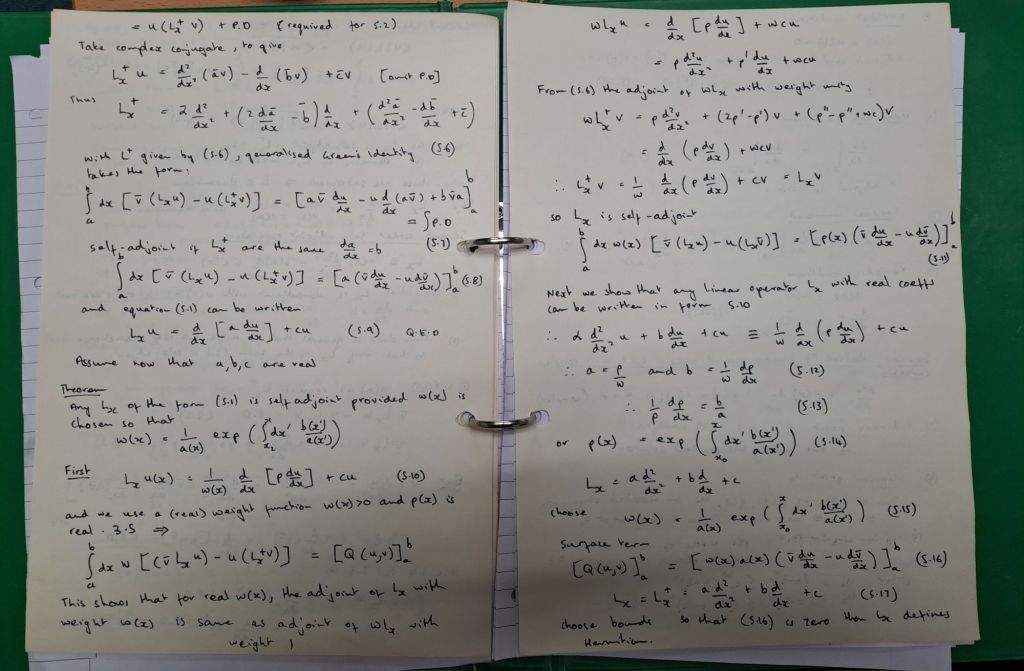
It’s Friday afternoon at the end of Week 2 here at Maynooth so I’ve now completed the 4th lecture of my 4th-year module Differential Equations and Complex Analysis. We’ve now in the section of Sturm-Liouville Theory. I’ve never taught this module before and, as always, teaching a new thing reminds me of all the things I had forgotten since I was a student. In this particular case, I still have the notes I took when I was studying this topic as an undergraduate. It’s scary to think the notes shown above were written by me 40 years ago!

Anyway, as I like to know something about the people behind the names, Sturm-Liouville Theory is named after Jacques Charles François Sturm (1803–1855)* and Joseph Liouville (1809–1882). Contrary to what I’d always assumed, Sturm was not German but was born in Geneva, which is now in Switzerland but which had been annexed by revolutionary France in 1798 so technically speaking he was born in France. Liouville was born in Saint-Omer, near Calais, which to my knowledge has never been part of Switzerland but has been part of the Spanish Netherlands.

*Given the dates, Sturm must have collaborated with Liouville after his earlier work with Drang

Mental Health and Graduate Studies

Posted in Biographical, Mental Health with tags , , , , , , , , on October 3, 2024 by telescoper

There has been a lot of comment on social media about a recent article in Nature about the mental health of graduate students and the numbers looking for treatment. There are many sources of stress that can have a negative effect on mental health, including financial pressures and poor accommodation to name but two. These aren’t really specific to graduate studies. One that is is the pressure to produce results. That actually continues throughout an academic career – burnout is a very real phenomenon – but it’s probably worse during the “apprenticeship” phase when one is inexperienced and still learning the trade.

“Productivity” is indeed important but should not be interpreted as having to work ridiculously long hours. I remember many years ago commenting on an article that claimed 80-100 hours a week was not unusual. There are people who can sit at their desks for 12 hours a day without producing anything very much at all. It’s not the hours that matter, but what you do with them. In no way will indulging your outside interests (sporting, cultural, political, or “other”…),  or simply relaxing, detract from your ability to do research. As a matter of fact, I think such diversions actually improve your work, as well as (of course) your general well-being.

I think it is fair to say that you have to work hard to do a PhD. I worked hard on mine back in the day. But don’t think that means it has to be a grim slog. I can only speak for myself, but I greatly enjoyed my time as a graduate student. I think this was at least in part because when I was doing my PhD I had plenty of outside interests (including music, sport and (ahem) “nightlife”)  and took time out regularly to indulge them. I did experience mental health problems later during my PhD, but these were not caused by being a research student.

I can think of many times during my graduate studies when I was completely stuck on a problem – to the extent that it was seriously bothering me. On such occasions I learned to take a break. I often found that going for a walk, doing a crossword, or just trying to think about something else for a while, allowed me to return to the problem fresher and with new ideas. I think the brain gets into a rut if you try to make it work in one mode all the time.

There were indeed many times during my time as a research student – and have been since – that I worked extremely long hours – all night sometimes. I wouldn’t say exactly that was because I “enjoyed” it, but that I wanted to know an answer and couldn’t get the problem out of my head.  I’ve stayed up into the early hours of the morning trying to finish a crossword too. Not because I had to, but because I couldn’t put it down unfinished. I know that makes me a saddo in many minds, but I think that’s the sort of obsessiveness and tenacity a researcher needs: becoming so absorbed by the task in hand that you don’t notice the passage of time.

I don’t think anyone should try to infer too much from these personal reflections, but I do think there’s one important point that I try to point to every graduate student I advise and that is to look after your mental health. Perhaps the Nature article has a positive side, in that at least graduate students are seeking help. Recognizing that you might have a problem is a very important first step.

Leonard Slatkin at 80

Posted in Biographical, Music with tags , , , , , , on September 28, 2024 by telescoper

Last night found me once again at the National Concert Hall in Dublin for a concert by the National Symphony Orchestra conducted this time by Leonard Slatkin, who has a long association with the NSO and who was 80 years old on 1st September. I must say he looked very sprightly for a man eighty years of age!

To start the programme we had the world premiere of a piece by Leonard Slatkin’s son, Daniel. Voyager 130 was inspired by the Voyager space mission, and especially by the Golden Records carried by the Voyager probes. Among the pieces of music included on those records is the exquisite Cavatina from Beethoven’s String Quartet No. 13 (Opus 130) from which the composer borrows thematic material for this piece. Daniel Slatkin was actually in the audience for this – in fact he was sitting just two rows in front of me – and went up on stage after the very enjoyable performance.

After that, and some rearranging on stage, we had a performance of Beethoven’s Piano Concerto No. 4 with Dublin-born soloist Hugh Tinney. Although for its time it was very unconventional in structure, this is now a very familiar piece in the concert hall. For the most part it was played very well but I did think the orchestra were a bit stiff and lacking in expression in places. The performance was warmly received by the NCH audience, and Hugh Tinney received a standing ovation at the end.

After the wine break we had another familiar work, the Symphony No. 3 by Johannes Brahms, which Leonard Slatkin conducted without a score. I’m persevering with Brahms. I still don’t find that he moves me as much as many other composers and so many people rave about him that I think I must be missing something. The 3rd Symphony is a very fine work, offering lots of variety across its four movements while maintaining a strong sense of coherence and remaining relatively concise – it lasts about 33 minutes in performance. I’m no expert on Brahms but it seems to me that the 3rd Symphony is where he really found his voice as a symphonic composer and stepped out from the shadow of Beethoven.

Apart from the first piece, it was a very conventional programme but I enjoyed it as did the audience. It’s a pity there weren’t more people there, though. I’d guess that the NCH was about 2/3 full at most.

P.S. Last night Leinster rugby were playing a match at Landsdowne Road (beating the Dragons 34-6) and Shelbourne were playing Sligo Rovers at home in the League of Ireland (a 0-0 draw) so the train home was a bit busier than last time but still uneventful. When I got home later I decided to listen to a recording of the Beethoven Strong Quartet No. 13 before bed…

Keeping one’s head above water..

Posted in Biographical, Education, Maynooth on September 26, 2024 by telescoper

I had two teaching sessions today, on two different modules, both of which I’m teaching for the first time, and also had to prepare the first assignments for both sets of students, so I thought it might be a difficult challenge, metaphorically speaking, to keep my head above water. What I hadn’t expected, however, was that the rain would be bucketing down all day, making it almost literally difficult to keep above water. Now that I’ve done what I planned to do at work I have to make my way home through the deluge. At least I remembered to bring a brolly…

Autumnal Equinox 2024

Posted in Biographical, Education, Maynooth, The Universe and Stuff with tags on September 22, 2024 by telescoper

The Autumnal Equinox (in the Northern hemisphere) takes place this afternoon (Sunday 22nd September 2024)  at 13.44 Irish Summer Time (12.44 UT).

Although  the term `equinox’  refers to a situation in which day and night are of equal length, which implies that it’s a day rather than a specific time, the astronomical equinox is more accurately defined by a specific event, i.e. when the plane defined by Earth’s equator passes through the centre of the Sun’s disk (or, if you prefer, when the centre of the Sun passes through the plane defined by Earth’s equator). Day and night are not necessarily exactly equal on the equinox, but they’re the closest they get. From now on days in the Northern hemisphere will be shorter than nights and they’ll get shorter still until the Winter Solstice on 21st December 2024 at 9.21am Irish Time.

Many people take the autumnal equinox to be the end of summer. There is a saying around these parts, however, that `Summer is Summer to Michaelmas Day’ (September 29th), which is not until next week. I must say, though, though it doesn’t feel particularly summery this morning although we did have good weather for most of last week. Looking back over my posts on past occurrences of the Autumnal Equinox, it is notable how many talk about a period of good weather around this time of year. The Welsh phrase Haf Bach Mihangel (Michael’s Little Summer) refers to this kind of spell.

I’ve often remarked how the academic year at Maynooth is largely defined by the astronomical phenomena of the equinoxes and solstices. This year demonstrates this perfectly: Semester 1 lectures for undergraduates begin tomorrow (23rd September), the day after the Autumnal equinox; they end on 20th December, the day before the Winter Solstice. The half-term study break coincides with Samhain, a cross-quarter day. It’s all refreshingly pagan.

This time last year I was getting ready to travel to Barcelona. My sabbatical started on 1st September but I didn’t actually leave for Spain until 24th September. That all seems a very long time ago now, and my sabbatical is well and truly over. I resume teaching next week, though my first lectures (a double session of Engineering Mathematics) are not until Tuesday. I hope I can remember how to teach! I’m also doing Differential Equations and Complex Analysis for 4th Year Mathematical Physics students, but the lectures for that are a bit later (Thursday and Friday). I have taught neither of these modules before, so I am a bit apprehensive.

I now know what I’ll be teaching next Semester too. I’m returning to Computational Physics 1, which I taught for 5 years before my sabbatical, so that’s a familiar one. I’m also doing Particle Physics for 4th year students. I taught a full module in that at Nottingham and a half-module in Cardiff so it’s not exactly new but I haven’t lectured in the subject since about 2010. Has anything important happened in that field since then? I assume that had there been, for example, any new boson discovered I would have heard about it…

Random Gallery

Posted in Biographical, Maynooth with tags on September 21, 2024 by telescoper

In the absence of anything better to post, I thought I’d share a few random pictures I’ve taken around Maynooth University campus since I moved into my new office.

Oh, I’ll just add this little anecdote. I was away from campus on Thursday and after I had done the necessary I was required to take a taxi home. The taxi driver asked me what I did for a living and when I told him he said he was fascinated interested in nuclear physics and proceeded to ask me a series of questions including what heavy water is, whether plutonium occurs naturally, and what is measured in röntgen. It’s always nice when a member of the public shows an interest in physics.

Bluesky in the Dark

Posted in Biographical with tags , on September 19, 2024 by telescoper

I posted last month about how I’ve been faring on social media since I left Twitter. That piece included this:

The first thing I noticed was that my BlueSky account was suddenly getting quite a lot of new followers. I now have about 850, still a long way short of the over 7000 I used to have on Twitter, but the level of engagement is far higher.

Well the exodus from Twitter seems to be accelerating and I now have 1.2K followers on BlueSky including more than a few old contacts I left behind on Twitter. The total number of users of BlueSky has now passed 10 million, which led to this message which I received last week.

I’m quite proud of being among the pioneering 1% of Bluesky users. The Open Journal of of Astrophysics is also there among the first 10%:

I hope this message prompts a few more to take the plunge. I’ll also take this opportunity to reiterate my opinion that it is indefensible for my employer, along with most other universities, to maintain a presence on Twitter.

Beating the Ban

Posted in Biographical, Maynooth with tags , , , , on September 18, 2024 by telescoper

Access to this blog is still blocked on Maynooth University campus. I was told that this was because of phishing activity, but IT Services are not replying to my requests for information about this alleged misconduct. If it were true I would have been subject to disciplinary action, and I haven’t because it is not true. I can only assume that it is a half-witted attempt at censorship.

I did originally think that the entire WordPress.com domain was blocked but I found that I could access the excellent blog by mathematician Terry Tao so it does appear I have been singled out for banning.

You can still read this blog off campus, but if you want to read it on Maynooth University campus, my posts are available in full federated form on Mastodon by following In the Dark on mastodon.social here.

That means you can read whole posts there rather than having to follow a link as on other social media (Threads, BlueSky, LinkedIn and Facebook).

Alternatively, you can receive posts via email here:

In the past I have used this blog, along with my other social media, to promote activities, courses, and job opportunities at Maynooth University. I will not be doing that until the ban is lifted. I have of course also posted items critical of the University management and will continue doing that.

UPDATE: By sheer coincidence (?), just a couple of hours after posting this item (from home), IT services contacted me and told me that this page has now been “reclassified as a blog” and is now accessible from campus (which is where I am writing this update). What it was classified as before is anyone’s guess, but access from campus has now been restored.

More Thoughts of Retirement…

Posted in Biographical, Maynooth with tags , , , , on September 16, 2024 by telescoper

Now that I’m back home from campus after work, and have access to this blog once again, I thought I’d share a little ethical question with you.

Less than a year ago, while I was in Barcelona, I posted an item about looking forward to retirement. Here are two paragraphs from that piece:

The fact of the matter is, though, that I can’t afford to retire yet. I have a mortgage to pay and I’ve only had five full years of pensionable service in the Irish system, so won’t get much of a pension. I have the frozen residue of my UK pension, of course, but that is subject to an actuarial reduction if I take the benefit before I’m 65, which is also the standard retirement age for academic staff in Ireland. I can’t be made to retire here until I’m 70, in fact, but I think I’ll be well beyond my best-before date by then and am not keen to overstay my welcome.

So it looks like I’ll have to stay until I’m 65 at the earliest. In fact I won’t be able to collect the State Pension (SPC) until I’m 66, so I’ll probably have to stay another year. That means that when I get back from sabbatical I will have four or five years left until I can retire. I don’t know what I’ll be teaching when I return but I hope I get a chance to teach a few new modules before the end. In particular some cosmology or astrophysics would be particularly nice. All this is predicated on: (a) me living long enough; and (b) Physics at Maynooth not being closed down; neither of these is certain.

Since I posted this I have made a firm decision that I will retire as soon as I’m able, which should be in June 2028. This is partly because I recently had a health scare which, though it is now seemingly resolved, has persuaded me not to take (a) for granted. There are things I’d like to do before I pop my clogs and I won’t be able to do them while still in full-time employment. I’ve done some calculations and should be able to pay off my mortgage early, perhaps even by the end of this year.

Anyway, this led me to the following ethical question, to which different colleagues have had different responses.

A PhD in Ireland typically takes a minimum of 4 years. That means that if I were to take on a new PhD student next academic year (starting in September 2025) then less than three years would pass before I would retire. If a member of staff is less than 4 years from retirement should they decline all PhD supervision requests?

Opinions through the Comments Box please!

PS. My two current students will both have completed well before 2028.

PPS. Another question is who would take over the Open Journal of Astrophysics…